
Jean Bernardin Suliere 1717-1798
Jean Bernardin Suliere
Birth: 20 May 1717, Québec
Baptism: 21 May 1717, Notre-Dame-de-Québec — godfather Jean Bernardin Lesage, his maternal grandfather
Father: Jean Suliere dit Tranchemontagne · Mother: Marie Louise Lesage
First marriage: 4 February 1743, Pierrefonds (Ste-Geneviève) — Marguerite Payment dit Larivière
Second marriage: 26 February 1748, Verchères (St-François-Xavier) — Marie Rose Vegiard dit Labonté
Land: concession of 9 May 1771, act no. 3336 before Me Jean-Baptiste Daguilhe — three arpents by twenty on the rivière de L'Achigan, fief Bailleul
Children: one by the first marriage; thirteen by the second, of whom eight were buried in infancy
Occupation: cultivateur — from his widow's burial record, 1804
Death: 30 December 1798, L'Assomption · Burial: 1 January 1799, L'Assomption-de-la-Ste-Vierge
A note on evidence
This page follows the standard set in Episode 1: what a record states is kept separate from what a database reports. One notarial minute has been read directly and is quoted below. The parish register acts reproduced here are from the copy photographed at the presbytery; every image has been examined, and where an act is quoted the transcription is a working reading rather than a collated one. No act on this page has been checked against the second copy deposited with the court. Where the PRDH database is used, it is rendered as a table rather than as a card image, so that a database's identification of a person is not displayed as though it were an act.
Introduction
Jean Bernardin Suliere was the firstborn of Jean Suliere dit Tranchemontagne and Marie Louise Lesage. His eighty-one years spanned nearly the whole of the eighteenth century—from the height of New France, through the Conquest, into the early years of Lower Canada.
He was born at Québec in 1717 and named for his maternal grandfather, Jean Bernardin Lesage dit Lepiedmontois, who stood as his godfather at the font. He grew up as his parents moved west by stages into the Montréal region and finally to the parish of Saint-Pierre-du-Portage at L'Assomption.
He was the third generation of his name in this country and the first not to have known the crossing. His grandfather Nicolas Sulière dit Tranchemontagne came from the parish of Quimper, in the bishopric of Brittany, and was buried at Saint-Sulpice on 14 November 1740, aged sixty-six—when Jean Bernardin was twenty-three and had known him. His father, Jean Suliere, was born in Canada about 1696 and never saw France. The Prologue to this series follows Nicolas.
Two grandfathers, two countries
Both of the men behind his name are foreigners in the records, and neither is French-Canadian by birth. The paternal grandfather is de la paroisse de Quimper, evêché en Bretagne, from his burial act of 1740. The maternal grandfather carries the dit name Lepiedmontois—the man from Piedmont—and gave this child his forenames. Breton on one side, Piedmontese on the other, in a boy baptised at Notre-Dame-de-Québec.
Holding the land and living on it
Jean Suliere père took his first concession on the Rivière L'Assomption on 20 January 1718 and replaced it with a second on 30 April 1720. Yet the family were still having children baptised near Montréal in 1720, 1722 and 1724, and the first Suliere baptism at L'Assomption is in September 1725. Jean Bernardin's childhood was spent moving, and the land came several years before the household did.
Baptism, 21 May 1717
21 May 1717 Jean Bernardin was baptised at Notre-Dame-de-Québec the day after his birth. His godfather was Jean Bernardin Lesage—his maternal grandfather and namesake, described in his daughter's marriage contract of the previous September as brigadier des gardes du castor—and his godmother was Anne Audet.
On the surname in this record
The register names the father in a form that reads as “Jean Audet.” That sits oddly beside a godmother named Anne Audet, and the likeliest explanation is eye-skip—either by the priest, copying the godmother's surname into the father's line, or by a later reader. This has not been resolved against the image and is left open here. It matters less than it looks: the child's parentage is fixed independently by the godfather's identity, by the couple's presence at Québec in 1717, and by the PRDH couple record.

Baptism of Jean Bernardin Suliere, 21 May 1717, Notre-Dame-de-Québec. The same act is reproduced in Episode 1, where it marks the eldest of twelve.
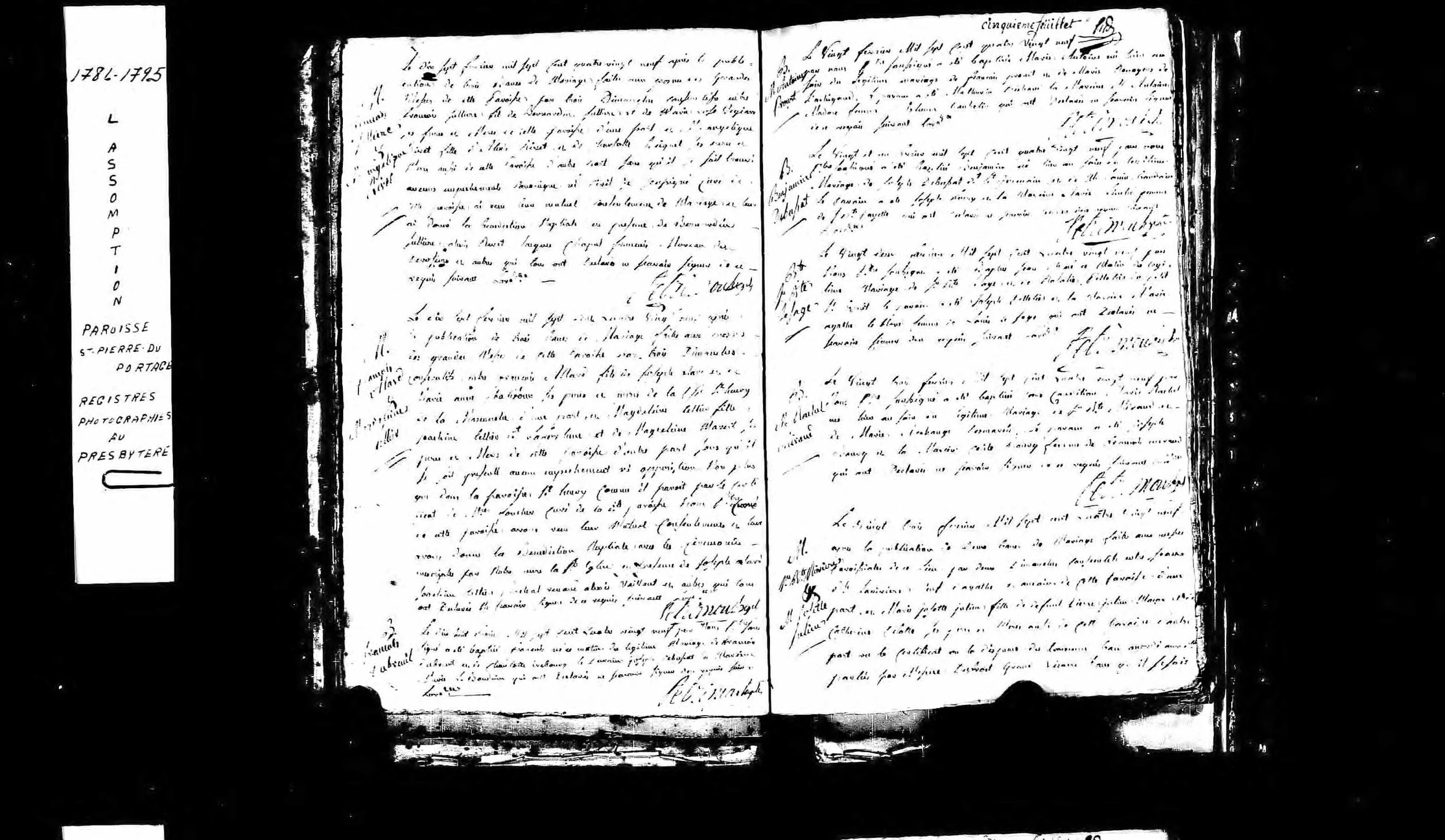
First Marriage: Marguerite Payment dit Larivière, 1743
4 February 1743 At twenty-five, Jean Bernardin married Marguerite Payment dit Larivière at Sainte-Geneviève de Pierrefonds. She was eighteen, daughter of Pierre Payment dit Larivière and Marie Françoise Laviolette Potvin, baptised at Notre-Dame-de-Montréal on 31 October 1724, the day after her birth.
The act records the three banns published on consecutive Sundays, no impediment found, the missionary of Sainte-Geneviève receiving their mutual consent, and the nuptial blessing given with the prescribed ceremonies. The witnesses declared they could not sign—as, four years earlier and twenty-seven years before that, had the groom's father and grandfather.

Parish register page, Sainte-Geneviève de Pierrefonds, 1741–1758.
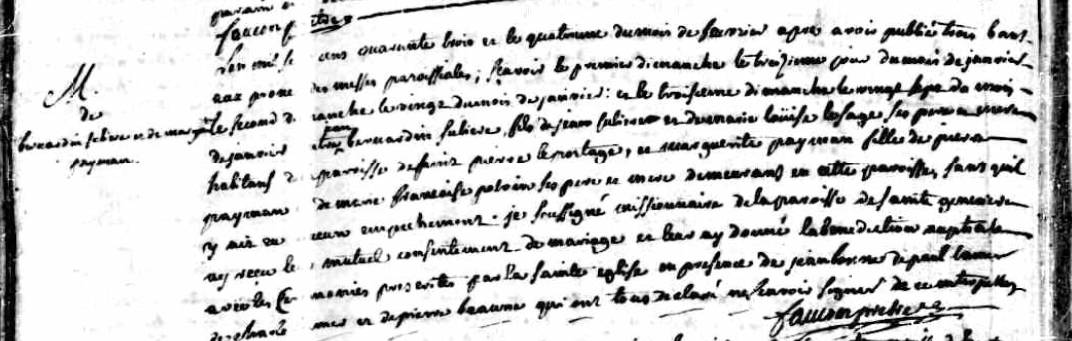
Detail: the marriage of Jean Bernardin Suliere and Marguerite Payment, 4 February 1743.
| Father | Pierre PAYMENT LARIVIERE |
| Mother | Marie Francoise LAVIOLETTE POTVIN |
| Birth | 30 October 1724 |
| Baptism | 31 October 1724 — Montréal (Notre-Dame-de-Montréal) |
| Burial | 2 May 1744 — L'Assomption (L'Assomption-de-la-Ste-Vierge) |
| First marriage | 4 February 1743 — Pierrefonds (Ste-Geneviève), with Jean Bernard SULIERE |
1744: The Baptism and the Burial
A son was baptised on 11 April 1744. His mother was buried on 2 May. Three weeks separate the two acts, and what fills them is the part of this story most often told wrong.
Baptism, 11 April 1744
« L'an mil sept cent quarante quatre le 11ième avril a esté baptisé Jean Bernardin Suliere né d'aujourd'huy fils de Jean Bernardin Suliere et de Marguerite Payament dit la riviere; le parain a esté Jean Suliere, la maraine Thérese Godry dit Bonbonniere epouse de Jean Baptiste Lesage, qui n'ont sçu signer. »
Parish register of Saint-Pierre-du-Portage, L'Assomption, 1744. Signed Degeay ptre. Working reading, September 2026.
The godfather is Jean Suliere—the child's paternal grandfather, the subject of Episode 1, who had been carried to a font himself at Québec forty-eight years earlier and had never learned to sign his name. The act says nothing about the mother's death. A priest recording a birth that had just killed the mother would ordinarily say so, and Degeay does not.
Burial, 2 May 1744
« L'an mil sept cent quarante quatre ce deuxième may a esté inhumée dans le cimetiere de St Pierre du portage le corps avec les ceremonies accoutumées de Marguerite Pyymant dit la riviere agée de 19 ans epouse de Jean Bernardin Suliere, apres avoir esté confessée, et avoir receu le St viatique et le sacrement de l'extreme onction, en presence de Jean Suliere et de Claude Panneton temoins qui ont declaré ne sçavoir ni ecrire ni signer de ce requis suivant l'ordonnance. »
Same register. Signed Degeay ptre. Working reading, September 2026.
She did not die in childbirth
She was confessed. She received the viaticum. She received extreme unction. A woman killed by a delivery does not ordinarily have time for all three. Set that beside a baptism act that does not mention her dying, and a burial three weeks later with an intervening entry in the register between them, and the picture is not a woman who died in labour. It is a woman of nineteen who bore a son in April, declined over some weeks, was given the last rites, and was buried on the second of May.
What killed her is not stated. Puerperal fever, which kills days or weeks after delivery, fits the interval and the decline better than anything else and remains the likeliest explanation—but neither act says so, and this page will not say it either. Neither act gives a date of death.
Who stood at both
Jean Suliere is named in both acts three weeks apart: godfather to the baby in April, witness at his mother's grave in May. He had come from the farm above the portage for the christening and was still there, or had come again, for the burial. The other witness was Claude Panneton. Both declared they could neither write nor sign.
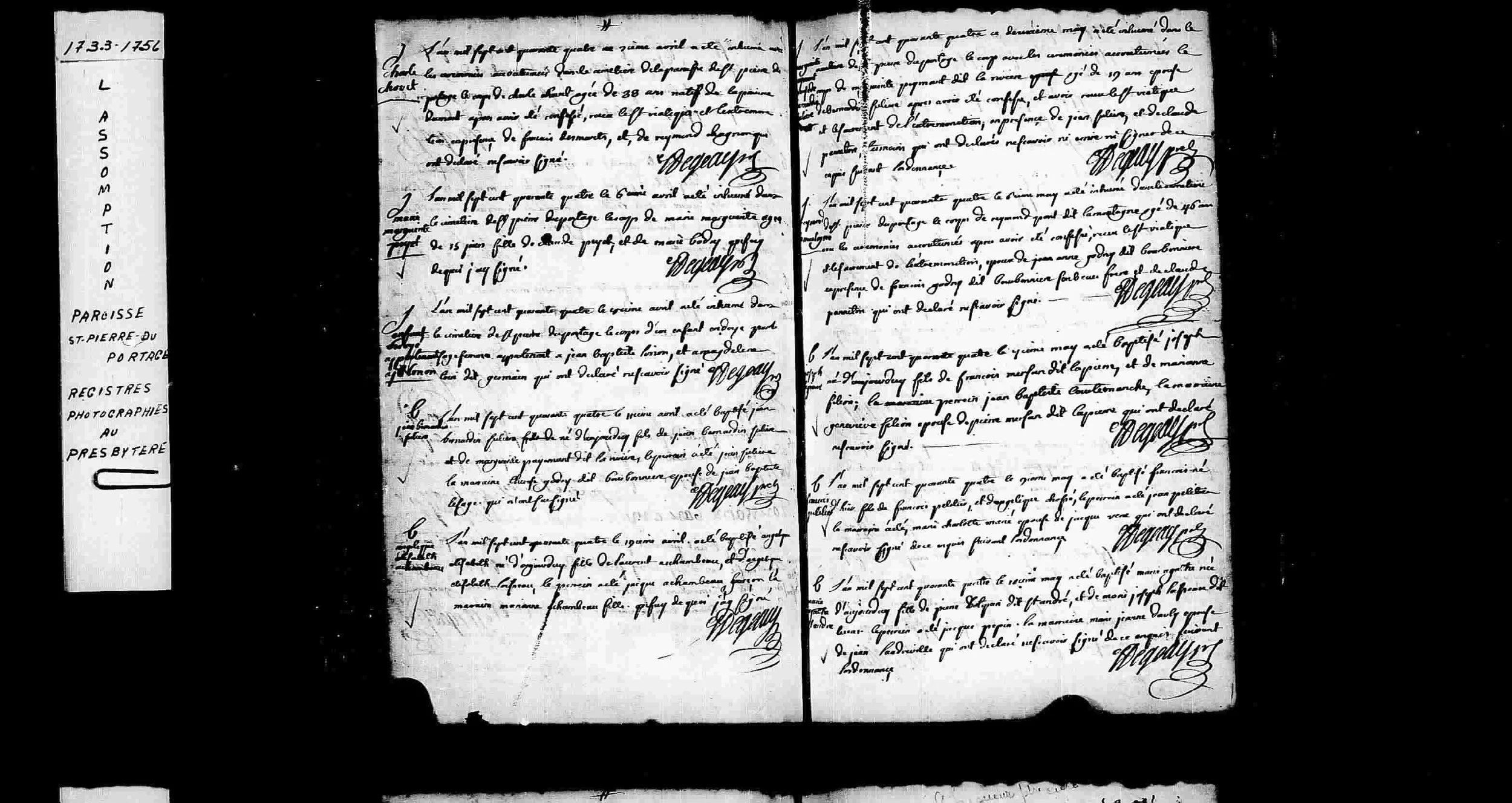
The register page. The baptism of 11 April and the burial of 2 May are separated by a single intervening act—the baptism of Angélique Élisabeth Archambeau on 19 April. Proximity on a page is not proximity in time.

The baptism, 11 April 1744. Godfather Jean Suliere; godmother Thérèse Godry dit Bonbonnière, wife of Jean Baptiste Lesage.

The burial, 2 May 1744. The clause that changes the story: après avoir été confessée, et avoir reçu le St viatique et le sacrement de l'extrême-onction.
| Rank | Name and role as printed | Age |
|---|---|---|
| 01 | Marguerite PEYMANT LARIVIERE | 19 |
| 02 | Bernard SULIERE — spouse of 01 | — |
| 03 | Jean SULIERE — present | — |
| 04 | Claude PANNETON — present | — |
| 05 | Xxxxx DEGEAY — prêtre | — |
Whatever took her, the child lived, and it is through him that this line continues.
| Marriage | 4 February 1743 — Pierrefonds (Ste-Geneviève) |
| His parents | Jean SULIERE TRANCHEMONTAGNE and Marie Louise LESAGE |
| Her parents | Pierre PAYMENT LARIVIERE and Marie Francoise LAVIOLETTE POTVIN |
| Married child | Jean Bernard, m. 27 January 1766, L'Assomption, with Marie Therese MIGNERON RIVIERE |
Second Marriage: Marie Rose Vegiard dit Labonté, 1748
26 February 1748 Four years after the burial, Jean Bernardin married again, at Verchères (St-François-Xavier). His second wife was Marie Rose Vegiard dit Labonté, daughter of Raymond Vegiard dit Labonté and Marie Angélique Anne Pineau dit Deschatelets. The act names him veuf of Marguerite Payment.
Her mother's surname is worth pausing on. Pineau dit Deschatelets is the family two of Jean Bernardin's own sisters married into—Marie-Jeanne-Anne in 1742 and Marie-Gabrielle in 1752. The Suliere and Pineau families were tying themselves together in both directions across the same decade.
The marriage lasted fifty years. Marie Rose outlived him by six, dying 11 June 1804 and buried the next day at L'Assomption.

Marriage of Jean Bernardin Suliere, widower, and Marie Rose Vegiard dit Labonté, 26 February 1748, Verchères (St-François-Xavier).
| Father | Jean SULIERE TRANCHEMONTAGNE |
| Mother | Marie Louise LESAGE |
| Birth | 20 May 1717 |
| Baptism | 21 May 1717 — Québec (Notre-Dame-de-Québec) |
| Death | 30 December 1798 |
| Burial | 1 January 1799 — L'Assomption (L'Assomption-de-la-Ste-Vierge) |
| First marriage | 4 February 1743 — Pierrefonds (Ste-Geneviève), with Marguerite PAYMENT LARIVIERE |
| Second marriage | 26 February 1748 — Verchères (St-François-Xavier), with Marie Rose VEGIARD LABONTE |
Occupation: Cultivateur
His Life's Work
The word comes from a single source: the 1804 burial record of his widow, which calls her veuve de Bernardin Sulliere, cultivateur. It is the only direct statement of his occupation found so far, and it was written six years after his death.
What the word means
An habitant in New France was not a general resident but precisely a landholding farmer—the word given to Jean Bernardin's own father in the acts of 1718, 1720 and 1757, and the word the concession of 1771 uses for Jean Bernardin himself. Cultivateur is largely the same status under a later name, and it becomes the usual term in the parish registers after the Conquest. Both stand against journalier, the day labourer with no land.
So the 1804 record does not show a man who rose to something his father was not. It shows a clerk using the word of his own generation for what the family had been all along.

Full page from the 1804 L'Assomption register containing the burial of Marie Rose Vegiard dit Labonté.

The detail the occupation rests on: veuve de Bernardin Sulliere, cultivateur.
The Land: 9 May 1771
9 May 1771 At fifty-three, Jean Bernardin had a notary write down a holding he had worked for years on someone else's word. The act runs to six pages and puts him on a river his father never farmed, under a seigneur who had gone home to France.
From the concession of 9 May 1771, act no. 3336
« Pardevant le notaire Royal du district de Montreal en la province de Quebec soussigné residant a la paroisse de S[ain]t Pierre du portage sur la riviere de Lassomption et temoins cy apres nommés fut present Sieur Alexis Deslauniers negociant audit lieu de Lassomption […] pour et au nom de Sieur Francois Cotté Ecuyer Sieur de Bailleul, Lieutenant d'une Compagnie des troupes de la marine cy devant […] de present en l'ancienne [France], mondit Sieur Deslauniers fondé de procuration dudit Sieur de Bailleul […] Lequel audit nom a reconnu et confessé avoir concedé et concede a titre de Cens et Rentes Seigneurialles foncieres et non Rachetables […] a Jean Bernardin Sulier habitant sur la riviere de Lachigan […] une terre […] sise et située sur ladite Riviere de Lachigan, de la contenance de trois arpents de front sur vingt de profondeur, tenant sur le devant a vingt arpents de ladite Riviere au derriere de la terre dudit preneur, par derriere en profondeur aux terres non concedees, d'un costé a Joseph Archambault, d'autre costé a […] Lesage »
BAnQ, CN605,S14, greffe de Jean-Baptiste Daguilhe, act no. 3336. Working reading from the digitised minute, September 2026, not collated. BAnQ numérique 4612364.
Four things the index entry does not carry
Who granted it. His father took both his concessions from the Séminaire de Saint-Sulpice. This one comes from Sieur François Cotté, écuyer, sieur de Bailleul, formerly a lieutenant in the troupes de la marine and by 1771 living in France, acting through an attorney.
Who Deslauniers was. Sieur Alexis Deslauniers, a merchant at L'Assomption, appears as Bailleul's attorney under a power of attorney, not as a seigneur in his own right.
Which river. The land lies on the rivière de L'Achigan, in the fief Bailleul—a different watershed and a different seigneurie from his father's farm above the portage. This is the country that becomes the parish of St-Jacques-de-l'Achigan, where two of his own siblings would later be buried.
That it is not a new farm. The parcel is bounded in front at twenty arpents from the river, au derrière de la terre dudit preneur—behind land Jean Bernardin already held—and at the back by unconceded land. The act calls him habitant sur la rivière de L'Achigan already. He was not acquiring a foothold in 1771; he was regularising and extending one he had.
The dimensions are worth a second look: three arpents of front by twenty of depth. That is exactly the parcel his father took from the Seminary in January 1718, half a century and one river away. Whether that is coincidence or the standard unit a Sulpician-trained surveyor laid out, the act does not say.
The neighbours are named: Joseph Archambault on one side, a Lesage on the other. The forename of the Lesage has not been read.
What he owed for it
The rent is a live capon in feather for every twenty arpents of superficie, with sols alongside it, as cens et rentes seigneurialles foncières et non rachetables—payable each year at Saint-Martin, the eleventh of November, the first falling due on 11 November 1771. It is the same feast day his father paid on at the Seminary half a century earlier.
The charges are the familiar ones with one telling difference. The land is subject to the mill of the seigneurie of Bailleul « lorsqu'il y en aura un de construit »—when one shall have been built. There was no mill on the fief in 1771. Bailleul reserves the timber needed to build the church, presbytery, mills, principal manor and other public works; the right of retrait ahead of the grantee's own lignage; and the usual lods et ventes, saisines and fines under the Coutume de Paris. Jean Bernardin must keep feu et lieu within a year and a day, fence in common with his neighbours, suffer the roads, and work and maintain the land.
And one clause his father never had
The act requires him « de conserver tous les bois de chêne qui se trouvent sur ladite terre pour la construction des vaisseaux »—to preserve every oak on the land for shipbuilding. A habitant clearing ground on the Achigan in 1771 was clearing it around the navy's timber.
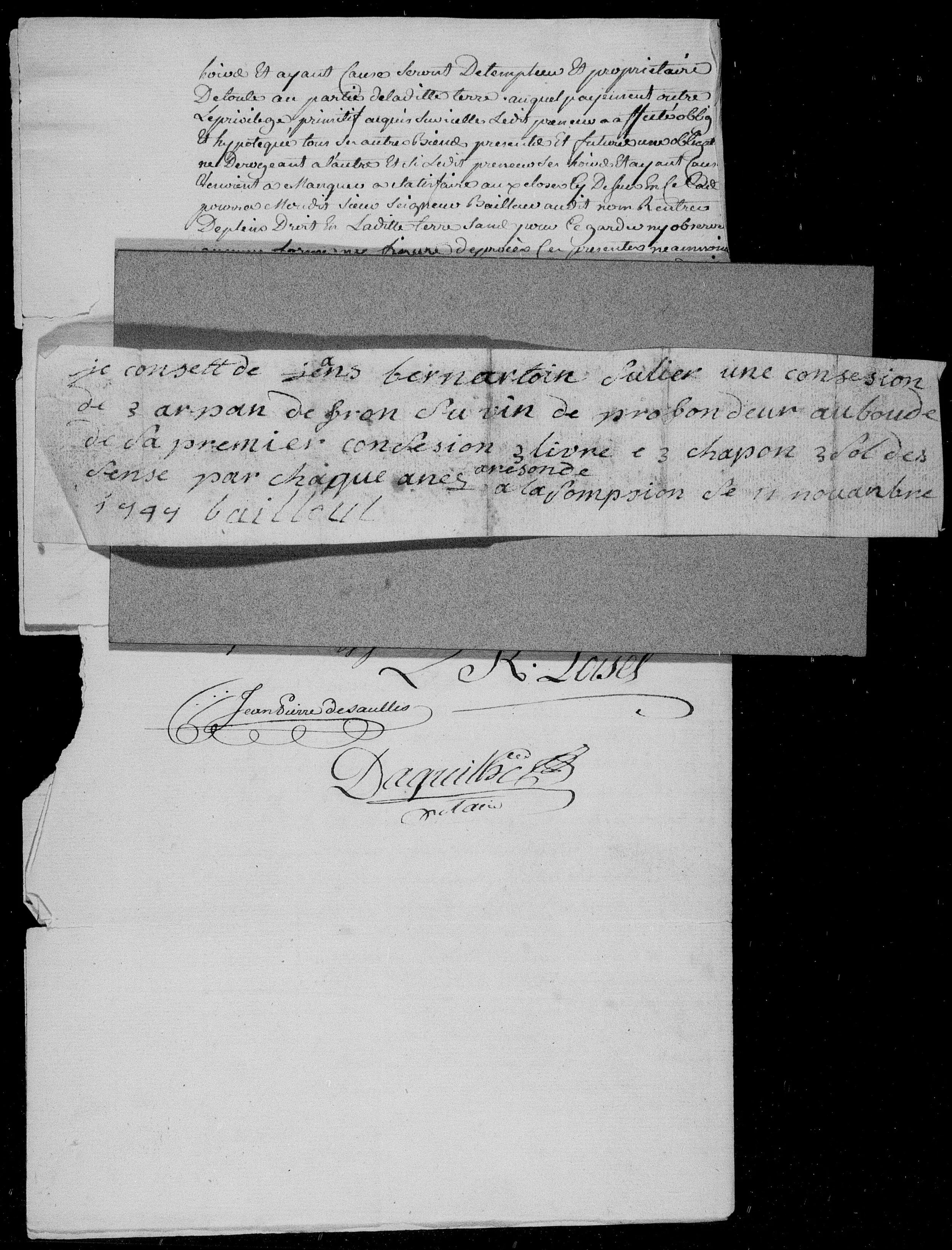
The scrap of paper pinned to the act
Folded into the minute is the private note the concession was made under, seven years before the notary wrote any of the above. It is in a barely literate hand, and it is the earliest direct evidence of this man on the Achigan.
The billet sous signature privée, filed with act no. 3336
« je consett de Jean Bernartain Sulier une consession de 3 arpan de fran su vin de probondeur au boude de sa premier conclesion, 3 livre e 3 chapon 3 sol des sense par chaque anes, a la Sompsion ce 11 novanbre 17[6]4. Bailleul »
Same act. Spelling as written. The final digit of the year reads as a 4 and the decade is not certain; 1764 fits the act and the family's movements, 1744 does not. Working reading, not collated.
What the billet adds
He had a first concession before this one. The note grants three arpents by twenty au bout de sa première concession—at the end of a holding he already had. So the 1771 act formalises his second parcel on the Achigan, and an earlier grant is somewhere behind it, undated and unlocated.
The terms in the note and in the act do not match. The billet says three livres, three capons and three sols a year. The act says a capon per twenty arpents with sols. Whether the notary was restating the same burden in seigneurial form or the terms were renegotiated in 1771 has not been worked out.
Bailleul signed it himself, in Canada, at L'Assomption—before he went back to France and had to act through an attorney.
Still unsettled in this act
The attorney's surname. Page one reads Alexis Deslauniers; the signature block carries Jean Pierre Desaulles; the répertoire says Desaunier. That may be two men—a principal and a witness—or one name written three ways. It has not been resolved.
The witnesses include R. Loisel, the same praticien who witnessed the elder Jean Suliere's inventory in 1757. The date of Bailleul's power of attorney is given on the first page and has not been read with confidence.

Act no. 3336, first page. Deslauniers appears for Cotté de Bailleul; the land is described on the rivière de L'Achigan.
The closing pages, not yet read. The wrapper records that two copies were issued—one to the seigneur, one to the grantee—and that the fee was paid.

The index entry that led to the act: « Concession par Mr Desaunier à Jean Bernardin Sullière ». Compare it with the act above. The clerk's summary names the attorney as though he were the seigneur, omits the river and the seigneurie, and gives no hint that the grantee was already on the land. An index entry is a finding aid; it is not the deed.
The Children
One son came from the first marriage. The second produced thirteen between 1748 and 1768. It was not a large family for long.
Eight of the thirteen were buried in infancy
François at seven days. Joseph Abraham at twelve weeks. Marie at twenty days. Louis François Régis at three weeks. Étienne at six months. Louis at nine months. Rosalie at fifteen months. Antoine at seventeen months. Between 1748 and 1768 this household carried a child to the burial ground on average once every two and a half years.
From the first marriage
| Child | Baptism | Marriage |
|---|---|---|
| Jean Bernardin | 11 April 1744L'Assomption | 27 January 1766, Marie Thérèse Migneron dit RivièreL'Assomption — the subject of Episode 3 |
From the second marriage
| Child | Birth | Marriage | Death |
|---|---|---|---|
| François | 7 Nov 1748 | — | 14 Nov 1748aged seven days |
| Joseph | 16 Jan 1750 | — | not recorded |
| Jean Baptiste | 28 Mar 1751 | 17 Jan 1774, Marie Félicité Morney Léveillé2) 23 Feb 1778, Marie Catherine Marguerite Solquin St-Joseph | 27 Jun 1831Sandwich, Upper Canada |
| Joseph Abraham | 15 May 1753 | — | 5 Aug 1753aged twelve weeks |
| Marie Rose | 26 Sep 1754 | 31 Jul 1775, André Gaudreau | 12 May 1838St-Jacques-de-l'Achigan |
| Antoine | 23 Oct 1756 | — | 8 Apr 1758aged seventeen months |
| Rosalie | 11 Mar 1758 | — | 14 Jun 1759aged fifteen months |
| Étienne | 25 Aug 1759 | — | 10 Mar 1760aged six months |
| Louis | 10 Mar 1761 | — | 17 Dec 1761aged nine months |
| Marie Charlotte | 4 Dec 1762 | — | not recorded |
| Louis François Régis | 25 May 1765 | — | 15 Jun 1765aged three weeks |
| Marie | 10 Aug 1766 | — | 30 Aug 1766aged twenty days |
| François | 7 Apr 1768 | 17 Feb 1789, Marie Angélique Rivet | 24 Jun 1857L'Assomption |
The two François are two people
The François born 7 November 1748 died on the 14th, and a second son was given the same name twenty years later, on 7 April 1768. It is that second François who married in 1789 and lived to 1857. Reusing a dead child's name was ordinary practice; the same family did it with Joseph and Joseph Abraham, and with Louis and Louis François Régis.
Where these dates come from. The PRDH family record for this couple, not from acts read here. Two of the baptisms are reproduced on this page; the other eleven births and all eight burials should be tied to register acts before the table is treated as settled.
| Marriage | 26 February 1748 — Verchères (St-François-Xavier) |
| His death / burial | 30 December 1798 / 1 January 1799 — L'Assomption |
| Her death / burial | 11 June 1804 / 12 June 1804 — L'Assomption |
| Her parents | Raymond VEGIARD LABONTE and Marie Angelique Anne PINEAU DESCHATELETS |
| Children recorded | Thirteen, 1748–1768, all at L'Assomption |
| Married children | Jean Baptiste (1774) · Marie Rose (1775) · François (1789) |
Marie Rose Suliere, 1754–1838
31 July 1775 Marie Rose married André Godro at L'Assomption, at twenty. He came from a long way off—l'Islet de Bonsecours en bas de Québec—and both his parents were already dead.
Marriage, 31 July 1775
« Le trente et un juillet mil sept cent soixante quinze, apres la publication d'un ban par trois dimanches, sans empechement ni opposition, entre André Godon fils de feu André Godon et de deffunte Geneviève Belanger de la ville de l'Islet de Bonsecours en bas de Quebec […] d'une part, et M[arie] Rose Sulliere fille de Bernardin Suliere et de M[arie] Rose Vegiard de cette paroisse d'autre part, je pretre missionaire soussigné ay receu leur consentement mutuel de mariage et leur ai donné la benediction, en presence de Jacques Gregoire et de Charles Brodeur, de Bernardin Suliere pere de l'epouse et de Noël Quenel […] »
Parish register, L'Assomption, 1775. Signed Delavalière ptre. Working reading, September 2026.
A familiar name in the witness list
Bernardin Suliere, father of the bride, was present. So was Noël Quenel—the man who appears in Episode 1 as husband of Marie-Josèphe Suliere and as an heir at the 1757 inventory. He was the bride's uncle by marriage, and the two generations of this family were still standing in the same rooms eighteen years later.

Parish register page, L'Assomption, July 1775.

Detail: the act of 31 July 1775, naming the bride's father and Noël Quenel among those present.
François Suliere, 1768–1857
17 February 1789 François, born in 1768 and the last of the thirteen, married Marie Angélique Rivet, daughter of Alexis Rivet and Charlotte Beignet, at L'Assomption. He was twenty; he lived to 1857.
The act names his parents as Bonaventure Sullière et Marie Rose Vegiard, les père et mère de cette paroisse—both still living, as they were. Bonaventure is one of the forenames this man carried; it appears here and in the PRDH record of the marriage, where he is Jean Bernardin elsewhere. Multiple baptismal forenames used singly and interchangeably were entirely ordinary.

Parish register page, L'Assomption, February 1789. The act is the first entry on the left-hand page.
Jean Baptiste Suliere, and the road west
Jean Baptiste Suliere, b. 1751
17 January 1774 Married Marie Félicité Morney dit Léveillé at L'Assomption, daughter of Louis Morney Léveillé and Marie Angélique Hamelin.
23 February 1778 Married secondly Marie Catherine Marguerite Solquin dit St-Joseph at St-Jacques-de-l'Achigan, daughter of Joseph Solquin St-Joseph and Marie Catherine Lauzon.
27 June 1831 Buried at Assumption Church, Sandwich—now Windsor, Ontario—aged seventy-nine.
What the westward move rests on
Two fixed points: a second marriage at St-Jacques-de-l'Achigan in 1778, and a burial at Sandwich in 1831. Everything between them is unrecorded here. When he left, why, with whom, and whether he went in one move or several are all unknown, and the general reasons French-Canadian families went west in this period are not findings about this man. His PRDH individual record carries no death; the Sandwich burial is the source for it.
The second marriage at St-Jacques-de-l'Achigan is worth noting against the section above: that is the parish of his father's 1771 concession. The family's centre of gravity had already shifted to the Achigan before the son left the province.
| Father | Jean Bernard SULIERE |
| Mother | Marie Rose VEGIARD LABONTE |
| Birth | 28 March 1751 |
| Baptism | 28 March 1751 — L'Assomption |
| First marriage | 17 January 1774 — L'Assomption, with Marie Felicite MORNEY LEVEILLE |
| Second marriage | 23 February 1778 — St-Jacques-de-l'Achigan, with Marie Catherine Marguerite SOLQUIN STJOSEPH |

Burial of Jean Baptiste Souliere, 27 June 1831, Assumption Church, Sandwich, Upper Canada. Aged seventy-nine.
Two baptisms from the second family

Baptism of François, first child of the second marriage, November 1748, L'Assomption.
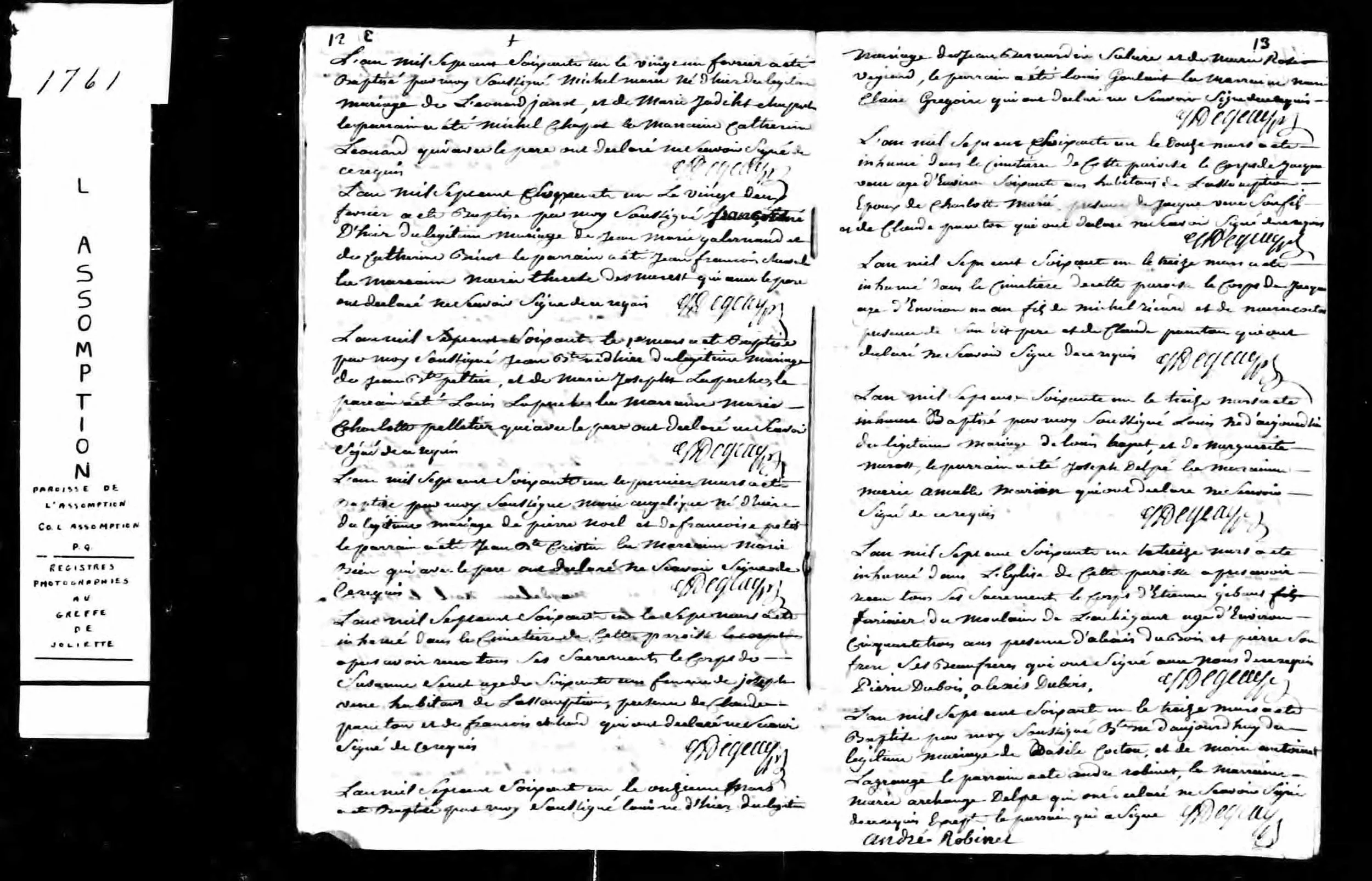
Baptism of Louis, March 1761, L'Assomption.
Death, 1798
30 December 1798 Jean Bernardin Suliere died at L'Assomption at eighty-one and was buried on 1 January 1799 at L'Assomption-de-la-Ste-Vierge. He had outlived his first wife by fifty-four years. Marie Rose survived him until 1804.
Both dates come from the database
The death and burial are carried by the PRDH individual record. Neither act has been read here, and no image of the burial is reproduced on this page. That is a smaller gap than the one in Episode 1—where the father's burial is not in the database at all—but it is the same kind of gap.
Legacy
Jean Bernardin's eighty-one years covered the last decades of New France, the Conquest, and the first generation of British rule. He was born at Québec while his father was still a young habitant with no land of his own; he died on the Achigan, in a parish that had not existed when he was born, holding ground from a seigneur who was living in France.
His marriages tied the Sulieres to the Payment, Vegiard and—through his second wife's mother—Pineau dit Deschatelets families, the last of which his sisters had married into from the other direction. His son Jean Baptiste carried the name to the Detroit River. And through the boy baptised in April 1744, three weeks before his mother's burial, the direct line continues.
That boy is the subject of Episode 3.
Document Gallery
The notarial minute and the parish register images behind this page. Database records are given as tables in the text above rather than in this gallery, so that what a database reports and what a record states are not shown side by side as though they were the same kind of evidence.
Jean Bernardin, Notre-Dame-de-Québec
Full register page
Detail
Baptism and burial, three weeks apart
Detail — godfather Jean Suliere
Detail — the last rites clause

Marguerite Payment — to transcribe
Jean Bernardin & Marie Rose Vegiard
François
Louis
Index entry only
Act no. 3336 — page 1
Act no. 3336 — final page
Marie Rose & André Godro
Detail — the bride's father present
François & Marie Angélique Rivet
François & Marie Angélique Rivet — date to confirm
Marie Rose Vegiard (full page)
“veuve de Bernardin Sulliere, cultivateur”
Jean Baptiste, Sandwich (Ontario)
Sources
Notarial minute, read directly
- Concession par Sieur François Cotté, écuyer sieur de Bailleul, représenté par Sieur Alexis Deslauniers, à Jean Bernardin Sulier, 9 May 1771, act no. 3336, before Me Jean-Baptiste Daguilhe, notaire royal du district de Montréal, resident at Saint-Pierre-du-Portage. BAnQ, CN605,S14; images 06M_CN605S14P_17095–17100. BAnQ numérique 4612364. Read in full apart from the power-of-attorney date and parts of the signature block. Includes the private billet of 11 November 17[6]4 signed by Bailleul. Working reading, not collated.
Finding aid
- Répertoire of the greffe of Jean-Baptiste Daguilhe, entry for 9 May 1771: « Concession par Mr Desaunier à Jean Bernardin Sullière ». Superseded on this page by the minute itself, and reproduced above to show what a clerk's summary does and does not carry.
Parish registers — parish copy, Saint-Pierre-du-Portage and elsewhere
- Burial of Nicolas Suliere, 14 November 1740, Saint-Sulpice — the grantee's grandfather, aged sixty-six, de la paroisse de Quimper, evêché en Bretagne. Treated in full in the Prologue to this series.
- Baptism, 21 May 1717, Notre-Dame-de-Québec.
- Marriage, 4 February 1743, Sainte-Geneviève de Pierrefonds (full page and detail). Examined; not transcribed here.
- Baptism of Jean Bernardin, 11 April 1744, and burial of Marguerite Payment, 2 May 1744, Saint-Pierre-du-Portage, L'Assomption — full page and both details. Both acts transcribed above.
- Marriage, 26 February 1748, Verchères (St-François-Xavier). Examined; not transcribed here.
- Baptisms of François (1748) and Louis (1761), L'Assomption.
- Marriage of Marie Rose Suliere and André Godro, 31 July 1775, L'Assomption — full page and detail. Transcribed above.
- Marriage of François Suliere and Marie Angélique Rivet, 17 February 1789, L'Assomption. Read; the father is named Bonaventure Sullière.
- Burial of Marie Rose Vegiard dit Labonté, 12 June 1804, L'Assomption (full page and detail).
- Burial of Jean Baptiste Souliere, 27 June 1831, Assumption Church, Sandwich, Upper Canada.
Database
- PRDH-IGD, Université de Montréal — individual no. 114733 (Jean Bernard Suliere); individual no. 114734 (Marguerite Payment Larivière); couple no. 23254 (first marriage); couple no. 26254 (second marriage); individual no. 18479 (Jean Baptiste Suliere); burial no. 129050 (Marguerite Payment, 1744); marriage no. 219863 (1775); marriage no. 350076 (1789); and the family record for couple no. 26254, which supplies the thirteen children. Rendered above as tables. Database fields are not transcriptions of acts.
Compiled
- Denis Beauregard, Généalogie des Français d'Amérique du Nord, family sheets [24543] (Jean Bernardin Sulière & Marguerite Paiement dit Larivière) and [80758] (Jean Bernardin & Thérèse Migneron, the next generation). Both carry the male line as presumed by convergence and attach a yDNA signature (R1b-Z200) on that basis, together with a predicted mtDNA haplogroup. A signature presumed by convergence is a hypothesis about descent, not a finding about these individuals, and nothing on this page rests on it. Sheet [24543] gives Marguerite's birth as “about 1725”; the PRDH baptism of 31 October 1724 is preferred here.
Not read, or not resolved
- The death and burial acts of Jean Bernardin, December 1798 and January 1799.
- The first concession on the rivière de L'Achigan, referred to in the billet of 17[6]4 as sa première concession — undated and unlocated.
- Bailleul's power of attorney of 15 September 176[?], and the identity of the attorney: Deslauniers, Desaulles or Desaunier.
- What became of Joseph (b. 1750) and Marie Charlotte (b. 1762), neither married nor buried in the record.
- Baptism acts for eleven of the thirteen children of the second marriage, and burial acts for all eight who died small.
- Any marriage contract for either of Jean Bernardin's marriages; any inventory or partage after 1798 or 1804.
- Anything at all between Jean Baptiste's second marriage at St-Jacques-de-l'Achigan in 1778 and his burial at Sandwich in 1831.
Storyline Genealogy
From Research to Story
Are You Connected to the Souliere Line?
If you descend from the Souliere, Suliere, or Soulier (dit Tranchemontagne) family of L’Assomption and St-André-d’Argenteuil, from the nineteen children of Janvier Souliere Sr., or from the allied Gravel, Poulin, Migneron, Lacasse, or Lesage lines — whether your branch stayed in Quebec or came to Chicago — I’d like to compare notes. Documented trees, DNA matches, family papers, and even half-remembered stories have all moved this research forward.
Get in Touch About This FamilyCousin connections are informal and reciprocal — no fee, no obligation, just shared work on shared ancestry.
Every Family Has a Story Worth Telling
Whether you're just beginning your research or ready to transform years of work into a narrative your family will treasure, I'd love to help.
LET'S TALK ABOUT YOUR FAMILY