
Gabriel Guilbault père 1762 - 1833
Gabriel Guilbault père
A Life Spanning Two Worlds
Gabriel Guilbault was born into the rhythms of New France—a world of parish bells, seigneurial farms, and the promise of adventure in the pays d'en haut. He would live to see that world transform, from French colony to British possession to a Lower Canada four years short of rebellion. Along the way, he would paddle canoes laden with furs, marry an Ojibwe woman who gave him a Métis family, bury a wife and several children, remarry, acquire land, and finally rest in the parish cemetery of St-Benoît.
His story is not one of fame or fortune. It is the story of ordinary survival—of a man navigating the dangerous waters of the fur trade and the equally treacherous currents of colonial change. Yet in the documents he left behind, we find something extraordinary: the preservation of an Indigenous woman's name and identity across three parishes and nearly thirty years of registers — the last of them written fourteen years after she was buried.

Origins: L'Assomption, 1762
On June 13, 1762, in the parish of L'Assomption northeast of Montreal, a boy was baptized Gabriel. The register recorded his parents as Gabriel Gibbort (a phonetic rendering of Guilbault) and Marie Charlotte Morin. It was the final year of the Seven Years' War—within months, the Treaty of Paris would transfer New France to British control.
L'Assomption sat at the junction of the L'Assomption River and the St. Lawrence trade routes, making it a natural launching point for the voyageurs who paddled west each spring. Young Gabriel would have grown up watching the brigades depart, their canoes loaded with trade goods, their songs echoing across the water.
The register records Gabriel as born and baptized the same day, of the legitimate marriage of Gabriel Gibbort and Marie Charlotte Morin. His godfather was Michel Hayet, his godmother Catherine Jourdin; godparents and father alike declared they could not sign. Officiating: Degeay, priest of L'Assomption. The indexed surname — Gibbort — is the most extreme of the many variants this family generated.
— L'Assomption Parish Register, 13 June 1762His father's given name. This act calls the father Gabriel. The marriage of 1757 at Montreal and the family reconstitution both call him Charles — the Charles Gabriel Guilbault who is the subject of Episode 4. Compound given names were used loosely and a priest might record either half. The discrepancy is recorded here rather than resolved.
By the 1780s, Gabriel had joined their ranks. The fur trade offered young French-Canadian men something farm life could not: adventure, independence, and the chance to see the world beyond the parish boundaries. It also offered something else—intimate contact with Indigenous peoples whose labor, knowledge, and kinship networks made the trade possible.
Into the Pays d'en Haut
The pays d'en haut—the "upper country"—stretched from the Ottawa River to Lake Superior and beyond. It was a world of portages and rapids, of winter camps and summer rendezvous, of business conducted in a mixture of French, English, and Algonquian languages.
Gabriel Guilbault entered this world as a voyageur, one of the men who paddled the great canoes that connected Montreal to the interior. The work was grueling: eighteen-hour days of paddling, loads of 180 pounds carried across portages, diets of dried corn and grease. But it was also a life of relative freedom, far from the social constraints of the settled parishes.
À la Façon du Pays
Sometime around 1789-1790, Gabriel formed a relationship with a young Ojibwe woman. Such unions were common in the fur trade—marriages à la façon du pays (marriages according to the custom of the country) created bonds between French-Canadian traders and Indigenous communities that facilitated commerce and survival alike.
Her people, the Saulteaux or Ojibwe, controlled the territory around Lake Superior and the upper Ottawa River. Her knowledge of the land, her family's trading connections, and her labor processing furs would have been invaluable to a young voyageur trying to establish himself in the trade.
For eight years she appears in no surviving record at all. When she finally does, in the autumn of 1798, a priest at St-Paul writes down her nation — and three years later a priest at Oka writes down her name.
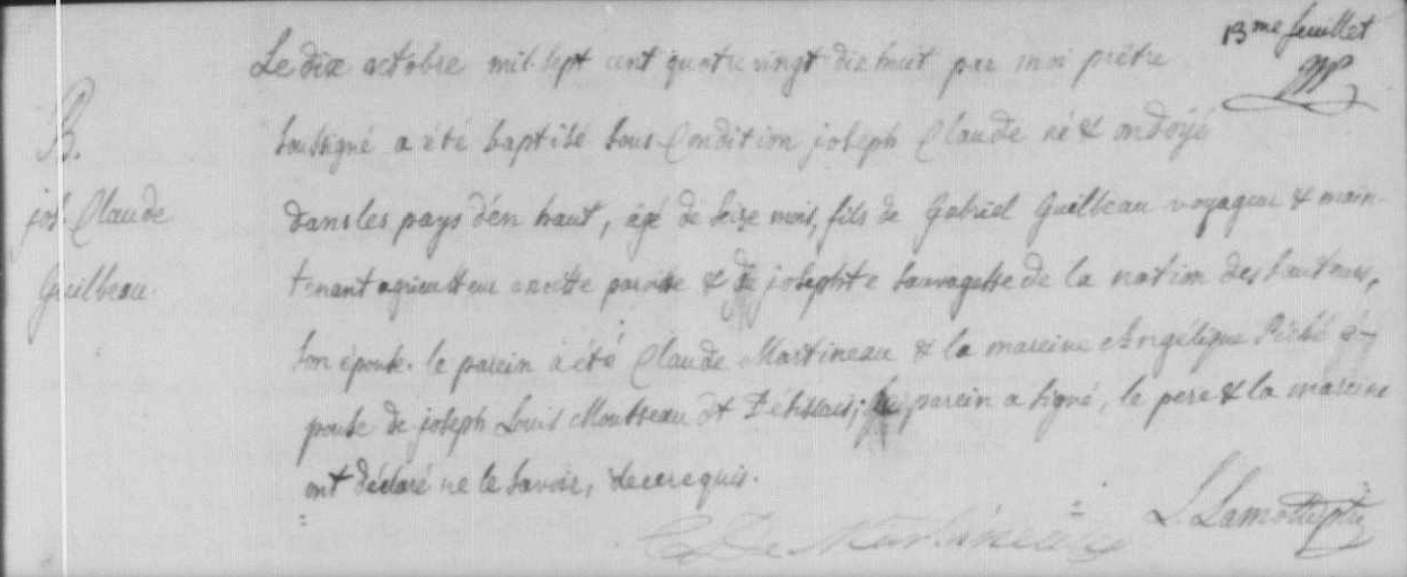
October 10, 1798: The Mass Baptism
By the late 1790s Gabriel and his family had come down to St-Paul-de-Joliette, and the register there names him voyageur & agriculteur — both trades, side by side. On October 10, 1798, he brought three of his children to the parish church for baptism.
The priest recorded them one after another:
All three were baptized sous condition — conditionally. The register explains why in the same breath: each had been ondoyé in the pays d'en haut, far from any parish, by hands the Church could not identify and could not vouch for. The sacrament may have been valid. There was no way to establish it. Conditional baptism was the remedy for exactly that doubt, and it is why three children of one family, aged eight, six and sixteen months, were brought to the font on the same October morning.
And then the detail that made everything else possible. The priest did not simply write "Sauvagesse" and stop, as the convention allowed and as most priests did. He wrote, in all three entries: "Josephte Sauvagesse, de la nation des Sauteurs, son épouse" — Josephte, Indigenous woman of the nation of the Saulteaux, his wife.
A correction, and why it matters. Earlier versions of this page read that word as hauteurs — the high country — and built an argument on it: that Father Lamothe had recorded only a direction, and that her nation was not named until three years later.
The word is Sauteurs. Lamothe named her nation in October 1798, three times in one morning. And eleven months later, baptizing the couple's newborn son François, Father Gosselin wrote the same phrase — de la nation des Sauteurs son épouse — in a hand where the letter is not in doubt. Two priests, two registers, eleven months apart, the same sentence.
He also called her son épouse — his wife — three years before any priest would marry them, and with Gabriel standing in front of him. Whatever the Church had not yet blessed, the register recorded it as a marriage in everything but sacrament.
The sponsors that morning say something the entries do not state outright. Angélique's godfather was Paul Guilbeau — Gabriel's elder brother — with his wife Marie Olivier as godmother. Eleven months later, at François's baptism, the godfather was Joseph Louis Guilbault, Gabriel's younger brother, who had married into that parish the year before. None of them could sign.
Gabriel had come down from the pays d'en haut with an Indigenous wife he was not yet married to and three children the Church did not yet recognise. Two of his three brothers stood for those children inside eleven months. Whatever the family thought of the union, that is what they did about it, and they did it three years before a priest at Oka made it official.
Her name would come at Oka, in the first month of the new century.
January 27, 1801: A Name Preserved
In the first weeks of the new century, Gabriel and Marie Josephte traveled to L'Annonciation at Oka to formalize their union before the Catholic Church. After eleven years and four children, they would finally have a church wedding—and their children would be legitimized.
What happened next was remarkable. The officiating priest did something unusual: he preserved her full Ojibwe name.
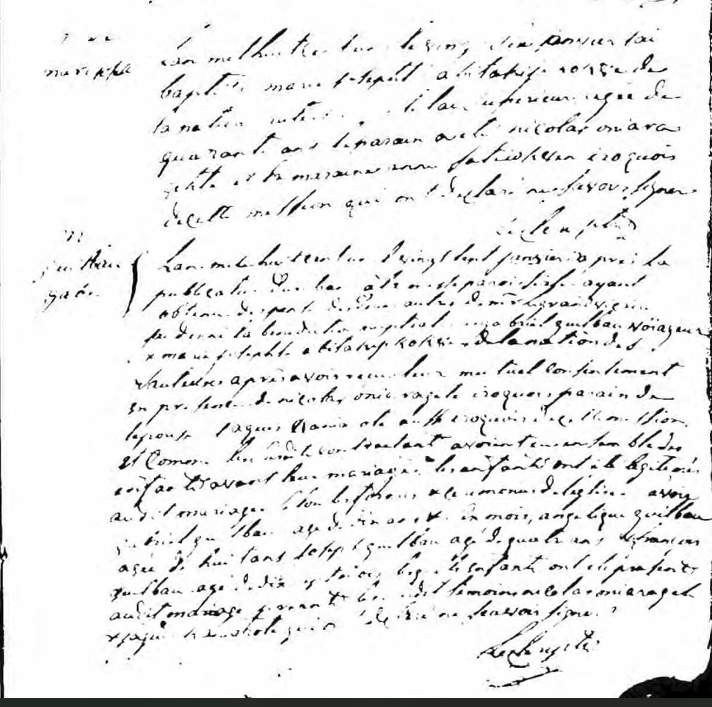

The day before the wedding, January 26, Marie Josephte received Catholic baptism. The register reads: "Marie Josephte Abitakijikok8e de la Nation Sauteuse sur le lac Supérieur"—of the Ojibwe nation on Lake Superior, approximately 40 years old.
Her godparents were both Indigenous: Nicolas Oniaragehte and Anne Satioksen, Iroquois of this mission. The following day the marriage was celebrated — on one published ban, the other two dispensed by the Grand Vicaire — with Indigenous witnesses: Nicolas Oniaragehte, her godfather, and Jaques Kaniarote.
The element "-ikwe" carries the sense of "woman" in Ojibwe. The rest of the name is not translated here. No Ojibwe-language authority has yet reviewed it, and the spellings scattered across the registers and the databases — Abitakijikok8e, Tabitakijokok8e, Abitakisikokve, Abitakipikokoue, and the modern Abitakijikokwe — show priests and indexers writing an unfamiliar language by ear. What the entry does establish is that a priest at Oka wrote down an Ojibwe personal name at all, at length, instead of the single word "Sauvagesse" that the registers of Rigaud would later settle for.
The register also documents the legitimization of their four children: Gabriel (10 years 6 months), Angélique (8 years), Joseph (4 years), and François (17 months). A family that had existed for over a decade "à la façon du pays" was now formally recognized by the Church.
First Family: Life and Loss
Between about 1790 and 1807, Gabriel and Marie Josephte Abitakijikokwe had seven children. Three were born in the pays d'en haut and came down to a parish church only years later; the rest were born in the St. Lawrence parishes and baptized within days. Two did not live to see two years old.
| Child | Born and baptized | Later life | Evidence |
|---|---|---|---|
| Gabriel | c. June 1790, pays d'en haut; ondoyé there, conditional baptism 10 Oct 1798, St-Paul | m. Madeleine Rocbrune, 25 Nov 1823, Rigaud; d. 5 Sep 1880 | Registers, images examined |
| Angélique | c. 1792, pays d'en haut; conditional baptism 10 Oct 1798, St-Paul | m. Joseph Ménard, 30 Jan 1815, Rigaud; d. 15 Apr 1819 | Registers, images examined |
| Joseph Claude | June 1797, pays d'en haut; conditional baptism 10 Oct 1798, St-Paul | d. 29 Jan 1833, buried 31 Jan, Oka | Registers examined; the burial entry names no parents |
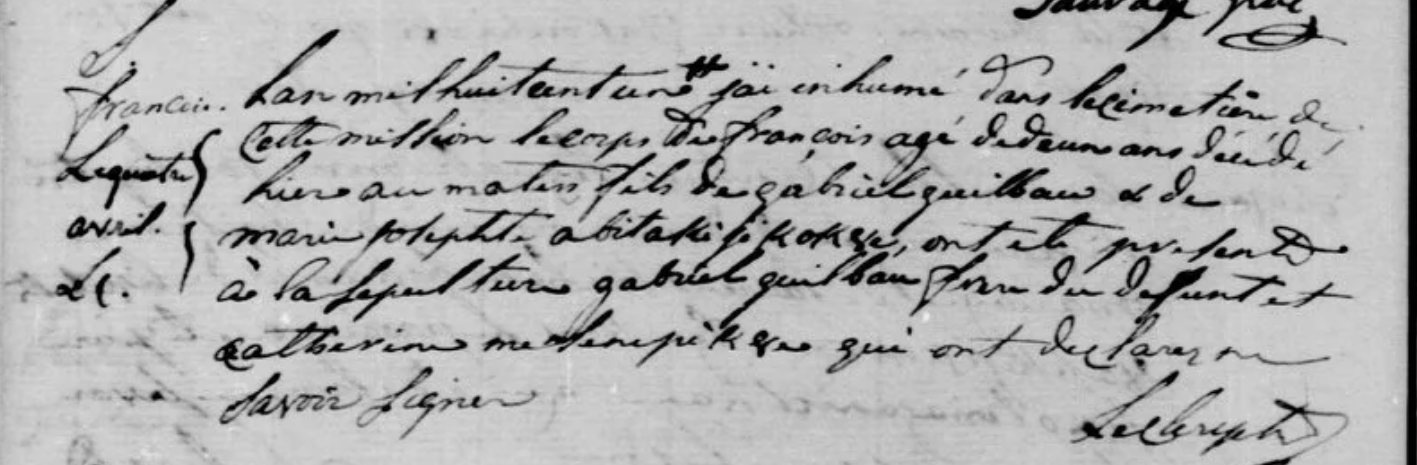
| François | c. 10 Sep 1799; baptized 29 Sep 1799, St-Paul-de-Lavaltrie, aged nineteen days | d. 3 Apr 1801, buried 4 Apr, Oka | Registers, images examined |
| Marie Louise | 25 Jan 1802, Oka | d. 26 May 1803, buried 27 May, aged sixteen months | Registers, images examined |
| Louis | 24 June 1806; baptized 28 June, Rigaud | No record located after baptism | Baptism partially examined — the entry runs off the folio |
| Marie Louise | c. 1807; baptism not located | m. Louis Labre Vincent, 1 Oct 1827, Rigaud; d. 26 Dec 1844, Vaudreuil | Marriage examined; birth and death from the index |
Seven children, five surviving infancy. Compiled from the parish registers named above, with the family reconstitution at PRDH-IGD, Drouin Institute and Université de Montréal, famille no. 91975 (prdh-igd.com). Where the registers and the index differ, the registers are followed here.
A child this table does not include. The PRDH reconstitution adds an eighth to this family — a Charles, with no birth, no baptism and no death recorded, known only from a marriage at L'Orignal in July 1841 to Adélaïde Vadenais.
That marriage belongs to the other family. The groom's burial in 1884 gives his age as sixty-six, which places his birth about 1817–18 — four years after Marie Josephte died. He is the Charles born to Gabriel's second wife at St-Eustache in 1821, and he appears on the second table below. No Charles was born to this marriage.
The burial records of the two children who died young preserve Marie Josephte's name in various spellings—evidence of French priests trying to phonetically capture an Ojibwe name: "Abitakijikokwe," "Abitakijikok8e," "Tabitakijokoke." Each variation is another thread connecting us to a real woman.
Career Evolution: Voyageur, Maçon, Journalier
Gabriel's occupational journey mirrors the changing economy of Lower Canada. The parish records track his transformation:
It is tempting to read this as the classic arc of a successful voyageur — itinerant paddler to settled tradesman to property owner — and to stop at 1827 with the land deed in hand. Three things forbid it. The trade does not run one way: agriculteur in 1798, laboureur in 1799, voyageur again in 1801. The deed names no père or fils. And the last word on Gabriel’s working life is journalier: a day labourer is not what a landholding mason becomes if the story ends well.
The honest version is shorter than the satisfying one. He survived the fur trade, learned a trade, held it for twenty-five years, and finished as a labourer. The middle of that sentence is far better evidenced than either end. His son would repeat it almost exactly — farmer, then voyageur at sixty-one, then journalier at eighty-nine.
June 1813: Farewell to Marie Josephte
After more than two decades together, Marie Josephte Abitakijikokwe died on the evening of 23 June 1813 and was buried two days later, on the 25th. The register gives her age as about fifty. The entry from Ste-Madeleine-de-Rigaud preserves her identity one final time:
"Le vingt cinq Juin, Mil huit cent treize... le corps de Marie Josette Sauvagesse de nation... agée de cinquante ans environs, Epouse Legitime de Gabriel Guilbeaultt Maçon Résident en la Seigneurie d'Argenteuil..."
— Ste-Madeleine-de-Rigaud, Burial Register, June 25, 1813She received the sacraments of the Church—"Munie des Secours de l'Eglise"—and was buried in the parish cemetery. Present at her burial was Gabriel himself, styled in the entry "mari de la défunte" — husband of the deceased. With him were Ignace Poirrault père and François Beaudry. The distinction matters, and this priest's own registers prove he observed it: six years later, at Angélique's burial in this same parish, he wrote "Gabriel Guilbeault, père de la défunte." Where he meant the father, he said so.
Her two stated ages are the only ones the registers give, and they do not agree with each other. About forty at her baptism in January 1801; about fifty at her burial in June 1813. Twelve years elapsed and ten years of age, both figures round decades — which is what a priest wrote when nobody in the room knew. Neither will carry a birth year closer than a few years either way.
Even in death, her Indigenous identity was maintained: "Marie Josette Sauvagesse de nation." And the registers were not finished with her. On 1 October 1827, fourteen years after this burial, the priest at Rigaud married her daughter Marie Louise to Louis Labre Vincent and named the bride's parents in the ordinary form: "fille mineure de Gabriel Guilbeau, consentant, et de Marie Josephte." No nation this time, and no surname — but her name, still being written into a parish register a decade and a half after she was in the ground.
A Second Chapter: Josephe Clausier dit Lapensée
Less than two years after Marie Josephte's death, Gabriel remarried. On February 6, 1815, at Ste-Madeleine-de-Rigaud, he wed Josephe Clausier dit Lapensée, daughter of François Clausier dit Lapensée and Marie Anne Desforges St-Maurice.
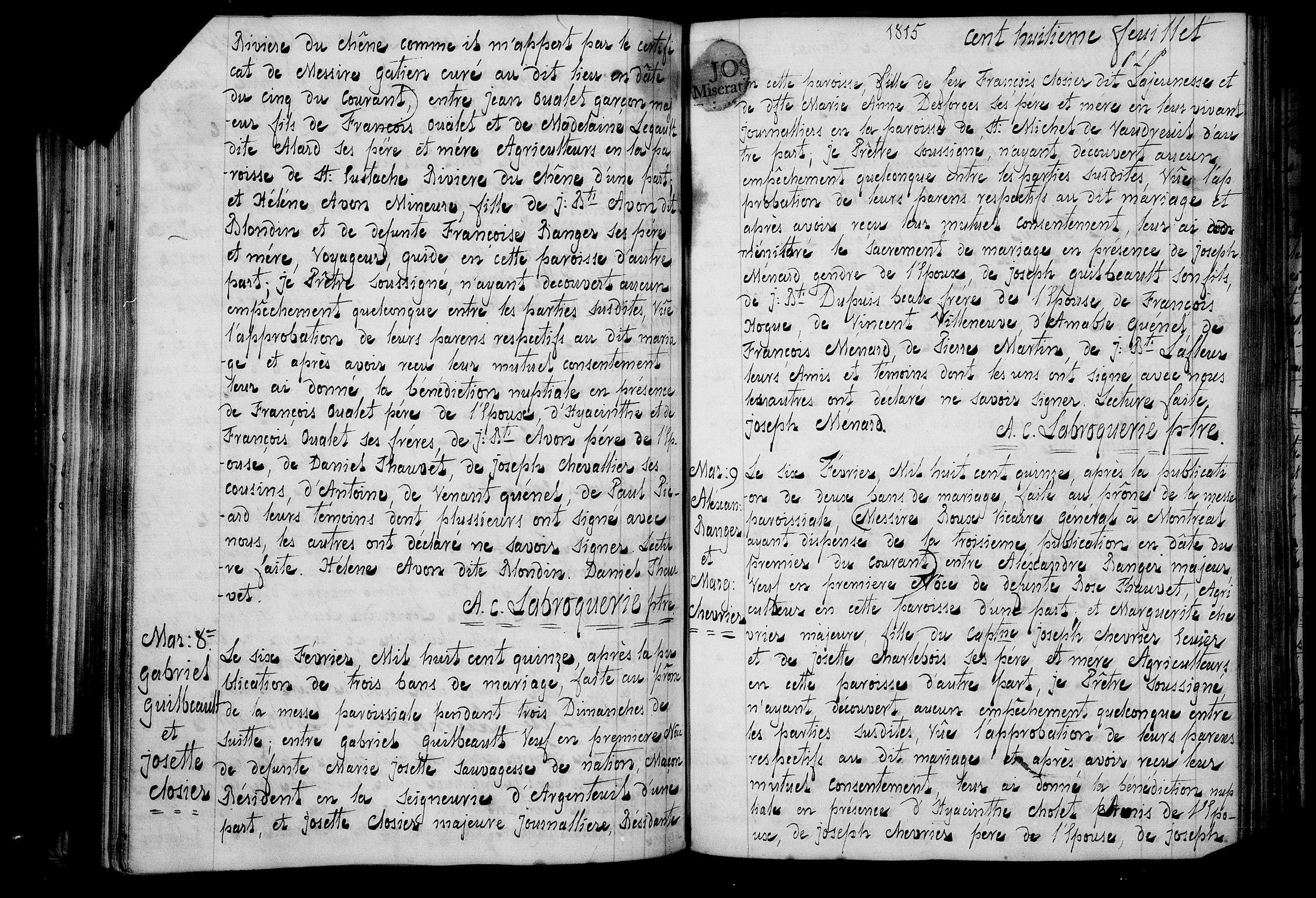
The marriage record is significant for what it tells us about Marie Josephte: Gabriel is identified as "veuf en première noce de defunte Marie Josette Sauvagesse de nation, Maçon Résident en la Seigneurie d'Argenteuil." Even in his second marriage, his first wife's Indigenous identity is preserved.
The entry carries something else. Gabriel and Josephe could not have married without permission: they were related within the degrees canon law prohibited, and a dispensation in the third-to-fourth degree of kinship had to be granted by Messire Roux, vicar general at Montreal, before the ceremony could proceed. Rigaud in 1815 was a small parish in a thinly settled seigneury, and by his fifties Gabriel was marrying inside a pool of families that had been intermarrying for two generations.
It was not the first time the Church had to clear the way for a Guilbault wedding. His own parents married at Montreal in 1757 under a dispense de parenté from the vicar general Étienne Montgolfier, and his grandparents at Québec in 1727 under a double waiver — the three banns and the Lenten prohibition together — granted by the Bishop of Quebec in person. Three generations, three dispensations, three different impediments. His grandson would make a fourth: in May 1879 Évangéliste Guilbault married at St-André on a dispensation from all three banns.
Two Families, One Legacy
First Marriage: Marie Josephte Abitakijikokwe
- Union began ~1789-1790
- Catholic marriage: 1801
- 7 children (5 survived infancy)
- Métis heritage documented
- Union lasted ~23 years; church marriage, 12
Second Marriage: Josephe Clausier dit Lapensée
- Married February 6, 1815
- French-Canadian heritage
- 7 children (4 survived infancy)
- Marriage lasted ~18 years
- Gabriel was 52 at marriage
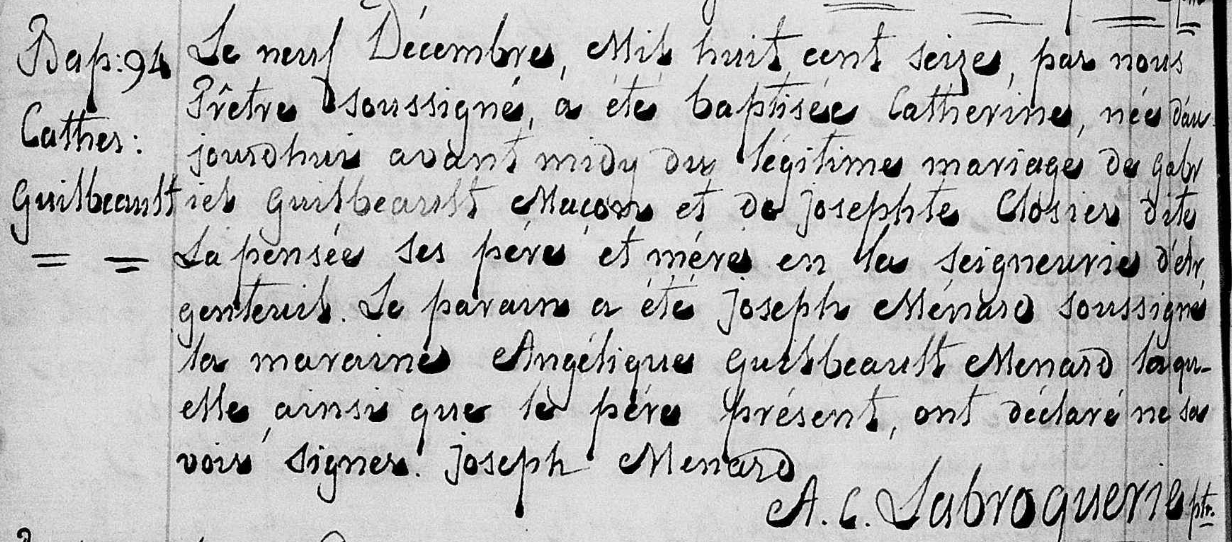
A touching detail connects the two families: when Gabriel and Josephe's daughter Catherine was baptized in December 1816, the godmother was Angélique Guilbeault Menard—Gabriel's daughter from his first marriage. Marie Josephte's daughter stood as godmother to her half-sister, bridging the two families.
Catherine lived six weeks, dying in January 1817 — the burial entry gives her age as a month and a half. She was the first of three losses in this marriage, and not the hardest. In February 1824 Josephe bore twins at Rigaud: Esther, who lived to marry at Montebello in 1842, and a second daughter who was born and buried the same day, never named in the register.
| Child | Born | Parish | Later life |
|---|---|---|---|
| Josephe | 30 March 1815 | Ste-Madeleine-de-Rigaud | m. Jean Baptiste Larocque Rocbrune, 12 Sep 1831, Rigaud |
| Catherine | 9 December 1816 | Ste-Madeleine-de-Rigaud | d. 23 Jan 1817, buried the 24th, aged a month and a half |
| Joseph | 14 June 1819 | Ste-Madeleine-de-Rigaud | m. Élisabeth Perrin Garao, 19 Oct 1846, L'Orignal |
| Charles | 19 February 1821 | St-Eustache | m. Adélaïde Vadenais, 27 Jul 1841, Petite Nation; d. 15 Mar 1884, buried St-André-Avellin |
| Esther | 22 February 1824 | Ste-Madeleine-de-Rigaud | m. Toussaint Carrier dit Carrière, 22 May 1842, Montebello |
| Unnamed | 22 February 1824 | Ste-Madeleine-de-Rigaud | Esther's twin; born and died the same day |
| Jean Baptiste | 29 April 1826 | Ste-Madeleine-de-Rigaud | d. 21 July 1826, aged twelve weeks |
Seven children, four surviving infancy. Family reconstitution at PRDH-IGD, Drouin Institute and Université de Montréal, famille no. 125449 (prdh-igd.com). The baptism and burial of Catherine and the baptism of Charles have been examined in the registers; the remaining entries are taken from the index.
Charles, and a database error worth naming. PRDH assigns the 1841 marriage of Charles Guilbault and Adélaïde Vadenais to Gabriel's first family, and carries a Charles there with no birth, no baptism and no burial.
The groom's own burial settles it. On 17 March 1884 the curé of St-André-Avellin buried Charles Guilbeau, époux de Césarie Vadenais, aged sixty-six — a birth about 1817–18, four years after Marie Josephte was in the ground. He can only be a son of the second marriage, and the Charles baptized at St-Eustache in February 1821 is the only candidate.
One thing still does not sit flush, and it is recorded rather than smoothed: the 1841 act calls him fils majeur, and a man born in February 1821 was five months short of majority that July. The burial is on the register, the age is stated, and the objection stands beside it. Note also that the wife is Adélaïde in 1841 and Césarie in 1884 — two sisters of that family carry those names, and whether Charles married one or both is not established.
Baie de Carillon, 1825
In 1825 an enumerator working the Baie de Carillon sur l'Ottawa, dans le Comté de York et la Seigneurie d'Argenteuil wrote down a Gabriel Guilbaud with nine people in the house.
Which Gabriel it was has been an open question in this research for some time: the census names heads of household only, and by 1825 there were at least two men of that name in the seigneury. The age columns answer it. The household contains a male over sixty. Gabriel père was sixty-three. His son was thirty-five.
The same column settles the 1831 return in the opposite direction. By then the Guilbault household at La Baie has no male over sixty and one aged thirty to sixty — the son, then forty-one, with his young family. The father was still alive in 1831 and has not yet been found in that enumeration.
The neighbours are worth naming, because they recur. Pierre Bertrand; Louis Louisseize père and fils; Hyacinthe Lavigne; John Rogers, immediately beside Gabriel; and below him Josette Rocquebrune veuve and Jean Marie Rocquebrune — the widow and son of Joseph Rocbrune, whose daughter Madeleine would marry Gabriel's son two years before this enumeration.
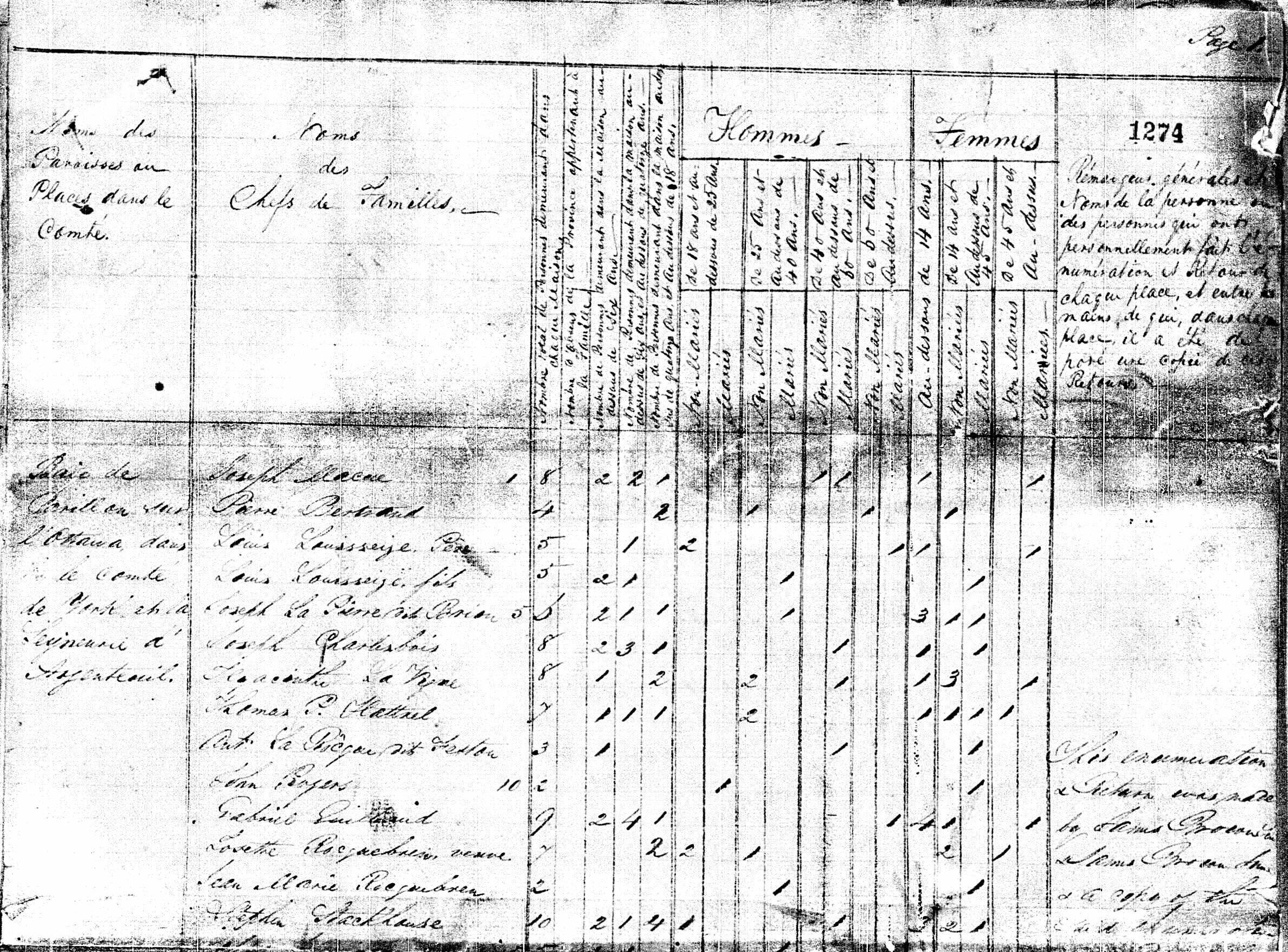
The same families appear around the Guilbaults at La Baie in 1831 and again in 1842, and the Louisseize and Lavigne households would still be neighbours when the family moved across the county line to St-Placide in 1851. This was not a man among strangers.
Three Days That Settled a Different Question
Three entries in this biography carry more weight than their contents suggest, and they belong here rather than only in a case study, because they are the most consequential documents Gabriel Guilbault ever generated.
A ledger account under the name Gabriel Guilbeau runs in the North West Company’s general ledger from 1817 to 1821, closing at the merger. For a time this research read it as his — a documented voyageur, an account under his name, and the conclusion seemed to write itself.
What undid it was not a fur-trade record. It was the parish registers of Rigaud and St-Eustache, read for one thing only: whether the act says he was there.
The account’s closing year is its Athabasca year. Athabasca was a wintering department — it could not be worked seasonally, and the brigades left Lachine in May. A man declaring at St-Eustache on a February morning in 1821 was not at Fort Chipewyan that winter, and the two statements cannot describe one person. The identification was withdrawn.
The distinction that made the test work is narrow. A baptism naming a man as father asserts the child’s legitimacy; it is not an observation that he stood in the church. Presence is credited only where the act carries the clause — ainsi que le père présent — or records him acting as a party. Gabriel has more than thirty entries naming him. Only a handful place him.
Losing the account costs him nothing that was ever really his. His voyageur years are proved by where his children were born, not by an account book, and three interior births across eight years is a stronger record than five lines of wages would have been.
Proprietor at Baie Carillon, 1827
In the summer of 1827 a Gabriel Guilbault bought land. On 23 July, by a deed of sale before the notaries A. T. Kimper and colleague, he acquired from Léon Aubertin and his wife the just moiety — the half — of Lot Number Ten in the Baie Carillon, in the Seigneury of Argenteuil, for £41 8s 4d. The seigneurial transfer duty, the lods et ventes, went unpaid.
Which Gabriel. The declaration styles its man simply “Farmer” and carries no père or fils qualifier, and it names no wife. In these same years the parish register calls the father maçon and journalier while calling his son Gabriel cultivateur — so occupation cannot separate them here, and the instrument on its own places neither man.
What the census adds. Two years before this purchase, the 1825 enumeration puts Gabriel père at Baie de Carillon — the very place — identified by the male over sixty in his household. That is the first independent evidence for the father’s residence there, and it makes him the better candidate. It is not proof: his son was living in the Baie by 1831 and may have been earlier.
What would settle it is the Kimper deed of sale of 23 July 1827, which should name the purchaser’s wife. That document has not been retrieved.
The document below is not that sale. It is what came after it: a declaration of title, taken before a notary sitting as Commissioner for the renovation of the rights and titles of the seigneury under Letters Patent issued at the Castle of Saint Lewis in June 1824. The seignior, Charles Christopher Johnson, was present and accepting through his agent. The declarant appeared and, in the printed formula of the commission, “did voluntarily declare, acknowledge and confess himself to be the actual proprietor and holder” of the land. It is the moment the holding entered the seigneurial record.
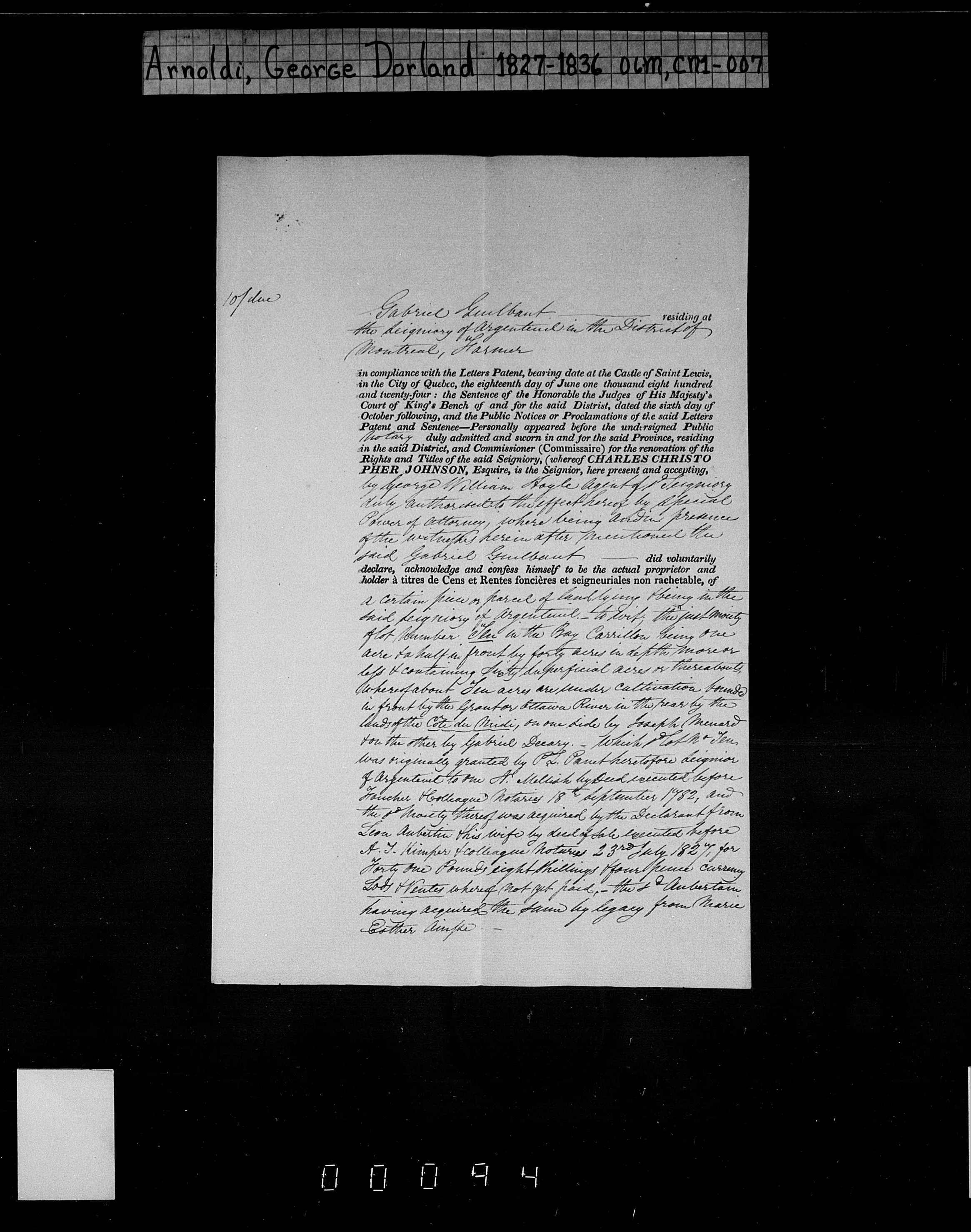
The declaration describes the property in the commission's own terms:
- The parcel: the just moiety of Lot Number Ten, in the Baie Carillon
- Size: one acre and a half in front by forty acres in depth, more or less — about sixty superficial acres
- Cultivated: about ten acres
- Bounded: in front by the Grand or Ottawa River; in the rear by the lands of the Côte du Midi
- Neighbours: Joseph Ménard on one side, Gabriel Décary on the other
- Tenure: à titres de cens et rentes foncières et seigneuriales non rachetable
- Chain of title: granted in September 1782 by P. L. Panet, then seignior of Argenteuil, to A. Mellish; afterwards held by Marie Esther Ainse, who left it by legacy to Léon Aubertin; sold by Aubertin to Gabriel in July 1827

The shape is the standard one. A seigneurial lot took as little river frontage as a family could work with and ran back inland for as long as the concession allowed, so that every holding touched the water — the road, the fishery and the mill route in one. Gabriel's frontage was an acre and a half. His depth was forty. Of the sixty-odd acres that made, ten were cleared, and those ten sat at the river end, where clearing always began.
Gabriel's neighbour on one side was Joseph Ménard — in all likelihood his own son-in-law. The Joseph Ménard who married Angélique Guilbault at Rigaud on 30 January 1815 was already a widower of the late Hélène Charlebois and an agriculteur of the seigneurie d'Argenteuil: an established landholder in this seigneury, not a young man marrying in. He wed Angélique seven days before Gabriel married Josephe in the same parish. Angélique died in 1819; her husband kept the land. By 1827 the two men held adjoining frontage on the Ottawa. The identification is an inference from name, place, seigneury and date rather than a stated relationship in the deed, and it is recorded here as such.
Final Years: St-Benoît, 1833
Gabriel Guilbault died on 6 April 1833 and was buried on 8 April in the parish cemetery of St-Benoît, now part of Mirabel, Quebec. The entry describes him as a widower — Josephe Clausier dit Lapensée had gone before him — and gives his trade as "journalier du lieu," day labourer of this place. Present were Brisque Charbonneau, who alone signed, and André Bernard. The priest was Jn. M. Giroux.
The register also says he was about ninety-three. He was seventy. His baptism at L'Assomption on 13 June 1762 is a hard anchor, examined and unambiguous, and it makes the informant's estimate wrong by twenty-three years. Both figures are recorded here rather than reconciled: the register says what it says, and the discrepancy is itself evidence about how much weight a stated age in this family will bear. Gabriel Jr.'s own burial in 1880 would overshoot by two years, the 1851 census would understate him by eleven, and the 1861 census age column for the household is misaligned outright.
He had outlived his first wife by twenty years, his daughter Angélique by fourteen years, and several of his children. He left behind a family that spanned two cultures and would continue to carry forward the legacy of Marie Josephte Abitakijikokwe.
Gabriel Guilbault's seventy years encompassed the fall of New France, the American Revolution, the War of 1812, and the unrest in Lower Canada that would break into rebellion four years after his death. He had been a voyageur when the canoe routes were the only routes; the first railway in the Canadas opened three years after he was buried. Through it all, the documents he left behind preserved something precious: the identity of an Ojibwe woman whose descendants would one day search for her name.
Document Gallery






Continue the Journey
Gabriel Guilbault's story is part of a larger narrative—the transformation of Indigenous women from nameless "Sauvagesses" in colonial records to documented matriarchs whose descendants can now trace their heritage with confidence.
His wife Marie Josephte Abitakijikokwe is named in the registers of three parishes across nearly thirty years. Her nation is stated as Sauteurs at St-Paul in October 1798 and again in September 1799, and as Sauteuse at Oka in January 1801, where her homeland on Lake Superior is given as well. The methodology that recovered her — FamilySearch Full Text Search, systematic parish-by-parish investigation, and close reading of the original hands rather than the indexes — is set out in full on the methodology page.
Research Note: This episode documents Gabriel Guilbault père, the original voyageur. His son Gabriel Jr. is the subject of Episode 2, and his own father Charles Gabriel of Episode 4. Each generation carried forward Marie Josephte's descent — documented in parish records, remembered in family stories, and now recovered through modern genealogical research.
Are You Connected to the Guilbault Line?
If you descend from the Guilbault (Guilbeau, Guilbeault) family of Charlesbourg and the Quebec parishes, from the children of Marie Josephte Abitakijikokwe, or from the founding families of the line — Senécal, Séguin dit Ladéroute, Morin, Couillaud dit Roquebrune, Gaulin — I’d like to compare notes. Documented trees, DNA matches, family papers, and even half-remembered stories have all moved this research forward.
Get in Touch About This FamilyCousin connections are informal and reciprocal — no fee, no obligation, just shared work on shared ancestry.
Every Family Has a Story Worth Telling
Whether you're just beginning your research or ready to transform years of work into a narrative your family will treasure, I'd love to hear your story.
BEGIN YOUR RESEARCH INQUIRY