
Joseph Olivier Guilbault 1672 - 1738
Joseph Olivier Guilbault
Sixty-Six Years in One Parish
His father crossed an ocean. His grandson would cut stone on the Rivière des Prairies, and his great-grandson would paddle west into the pays d'en haut. Joseph Olivier Guilbault did none of those things. He was born at la Petite Auvergne de Charlesbourg in March 1672 and buried in the same parish sixty-six years later, and in between he seems never to have lived anywhere else.
He married twice and fathered eighteen children. He buried his first wife and at least nine of those children, four of them inside sixteen days in the spring of 1733; his second wife outlived him by almost forty years. He went to court against his own father, stood guardian to his dead wife's niece, and ten weeks before he died signed away half of everything he owned to one son. His estate was still undivided twenty-six years later.
The records give him one designation, from the week of his first widowhood to a quarter-century after his death: habitant.
Habitant de Saint-Charles-de-Charlesbourg
As styled before the notary, 2 October 1738 — ten weeks before his death
Joseph Olivier is the voyageur's great-grandfather.
Origins: Petite Auvergne
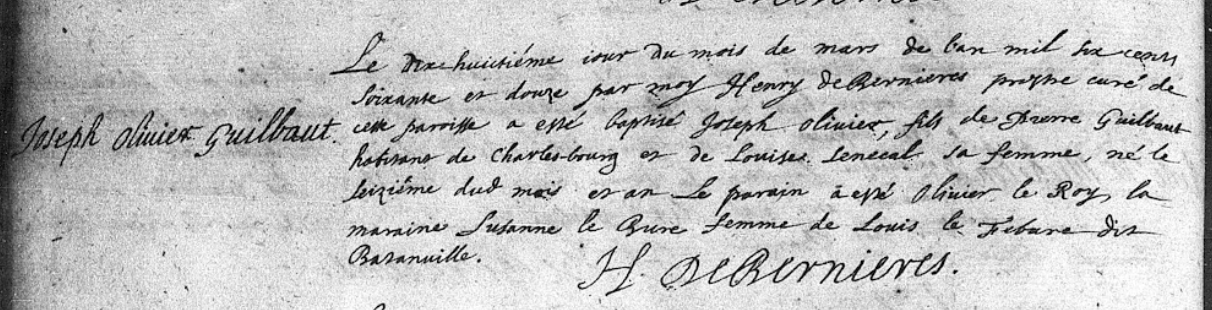
He was born on 16 March 1672 and carried into town two days later to be baptised at Notre-Dame-de-Québec — Charlesbourg had no register of its own yet. His godfather was Olivier Le Roy, who gave him his second name and who would still be standing beside him twenty-two years later at his marriage contract. His godmother was Susanne Le Bure, wife of Louis Le Febure dit Bazanville.
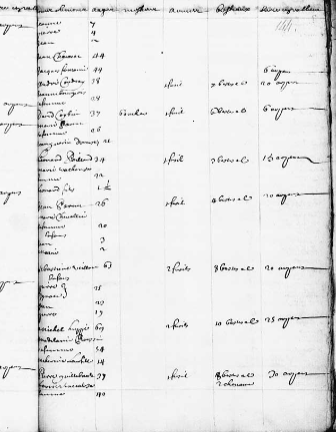
By the census of 1681 the household at Petite Auvergne held thirty arpents under cultivation, eight head of cattle, two horses and one gun. Joseph was nine.
A note on the census. The enumerator lists four children: Marie 13, Joseph 9, Étienne 6, and Pierre 2. But the parish records give no son Pierre — the fourth child was a daughter, Elisabeth, baptised in December 1679. One of the two sources is wrong about that child, and this page does not pretend to know which.
First Marriage: Marie Anne Pageot, 1694
On 15 April 1694, before the royal notary Louis Chambalon at Québec, Pierre Guilbault appeared to contract a marriage for Joseph Guillebault son fils, âgé de vingt-deux ans, et de défunte Louise Senécal sa femme. Thomas Pajot and Marie Catherine Roy appeared for their daughter Marie Anne, who was sixteen. She was their eldest, born at Québec in January 1678, the first of eleven children; three of her brothers and sisters had already been buried.
The kin were named on both sides. Joseph's were few: his brother Étienne; his godfather Olivier Le Roy; Étienne Lefebvre, fiscal procurator of the jurisdiction of Notre-Dame-des-Anges; and one more.

François Dubois had married Joseph's sister Marie in 1688, and the contract records his trade: masson. It is the earliest building-trades word in this family, and it is worth holding onto. Eight years later Joseph's son Charles François would be born into a household with a mason for an uncle — and would end his life sixty years on as an entrepreneur de maçonnerie at Sault-au-Récollet.
Whether the trade passed from uncle to nephew is not documented, and this page does not claim it did. Apprenticeship to an aunt's husband was the ordinary way a craft moved sideways in a colonial family — but ordinary is not evidence, and no act has yet been found linking the two households after 1702.
The settlement was conventional: 250 livres from the Guilbault side, 150 from the Pajots, a dower of 300 livres and a préciput of 150. The farm itself had been bought three days earlier, on 12 April 1694 and before the same notary, by the bride's parents, Thomas Pajot and Marie Catherine Roy, from Jacques Renaud and his wife Marie Charié — two arpents of front by four arpents four perches, for 500 livres and ten more for the pin-money. Its papers went back to a Jesuit concession of the 1660s, and in 1706 every one of them would be read into an inventory.
They married on 3 May 1694 at St-Charles-Borromée, after three banns.
The Hands That Signed
The curé's clause excepts two men from signing: Pierre Guillebo, the groom's father, and Pierre Bizier, the bride's uncle. Joseph's name is not among the exceptions — but it is not among the signatures either.
The notary settles it. Twenty-two months later, on 19 February 1696, Joseph and his father-in-law appeared again before Chambalon to acknowledge that Pierre Guilbault had paid the 250 livres for his son's half of the farm. Thomas Pajot signed. The witnesses signed. The notary signed. And at the foot of the act, in the clerk's own words: ledit Joseph Guillebaud ayant déclaré ne sçavoir signer.

The First Family
Five children in ten years, and three of them living when their mother died.
Marie Anne Pageot died on 12 July 1705. She was twenty-seven, and her youngest was three months old. PRDH records her death and burial at the Hôtel-Dieu in Québec; the notary who inventoried her house sixteen months later used the usual formula for the place "where the deceased died" and set it on the farm. Until the hospital's own register is read, this page does not say which.
1697: Joseph Goes to Court
Joseph was twenty-four, two years married and with a newborn daughter, when he became the first-named plaintiff in a lawsuit against his own father.
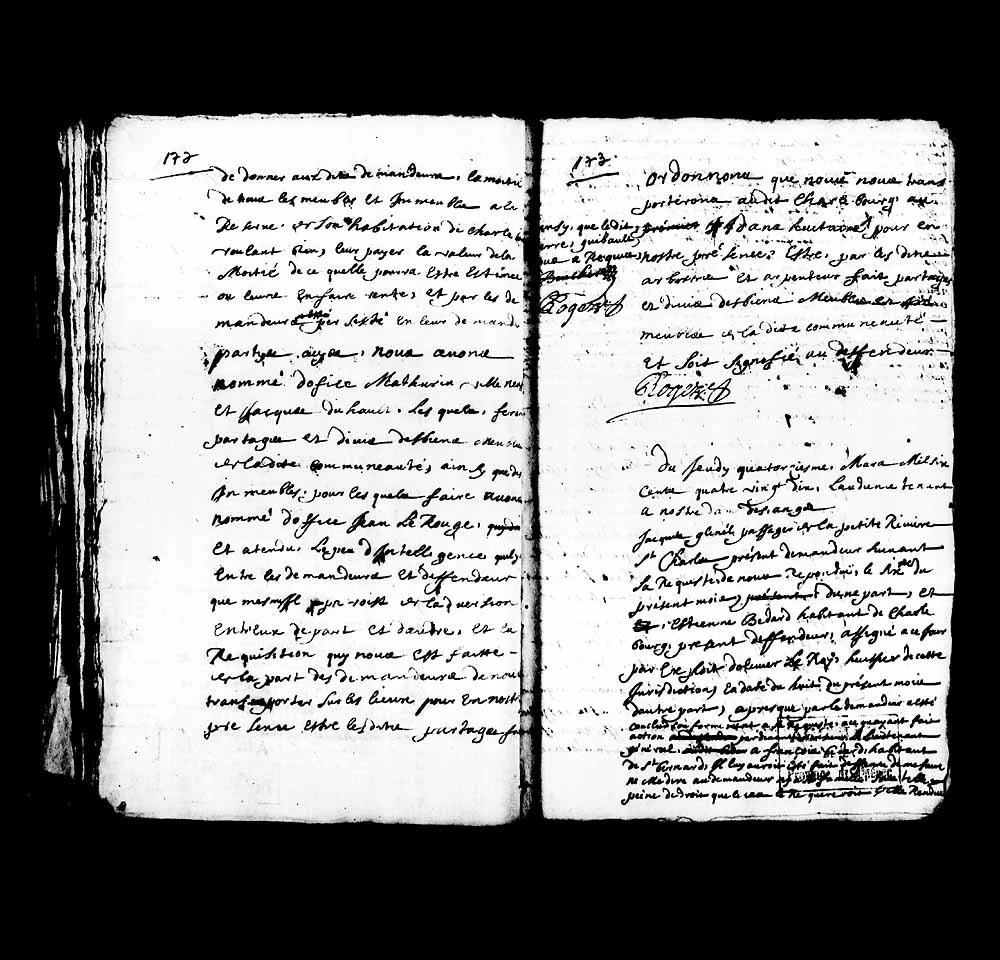
His mother Louise Sénécal had died before April 1693. Nearly four years later her estate was still undivided. In January 1697 Joseph, together with his sister Marie through her husband François Dubois and his newly emancipated brother Étienne, petitioned the court of the seigneurie de Notre-Dame-des-Anges to compel Pierre Guilbault to close the inventory of the community he had held with their mother and proceed to the division.
The court agreed on 24 January. The inventory was closed on 1 February, in Pierre's presence, with Pierre Mortrel of Charlesbourg standing as subrogate guardian to Étienne. And on 28 February the provost judge Guillaume Roger wrote a phrase that has carried this family's quarrel down three centuries: considérant l'aversion entre les demandeurs et défendeur — considering the aversion between the plaintiffs and the defendant. He would go to Charlesbourg himself, with arbitrators of the court's own choosing.

Pierre died on 5 October 1697, at the Hôtel-Dieu. The settlement was made five weeks later, on 10 November, between the four heirs and Françoise Leblanc — the woman Pierre had married on 7 January, in the middle of it all.
November 1706: Four Days
Sixteen months after burying his wife, Joseph set about remarrying — and under the Coutume de Paris that meant settling the first family's rights before a second community could be formed. The paperwork took four days.
Tutelle
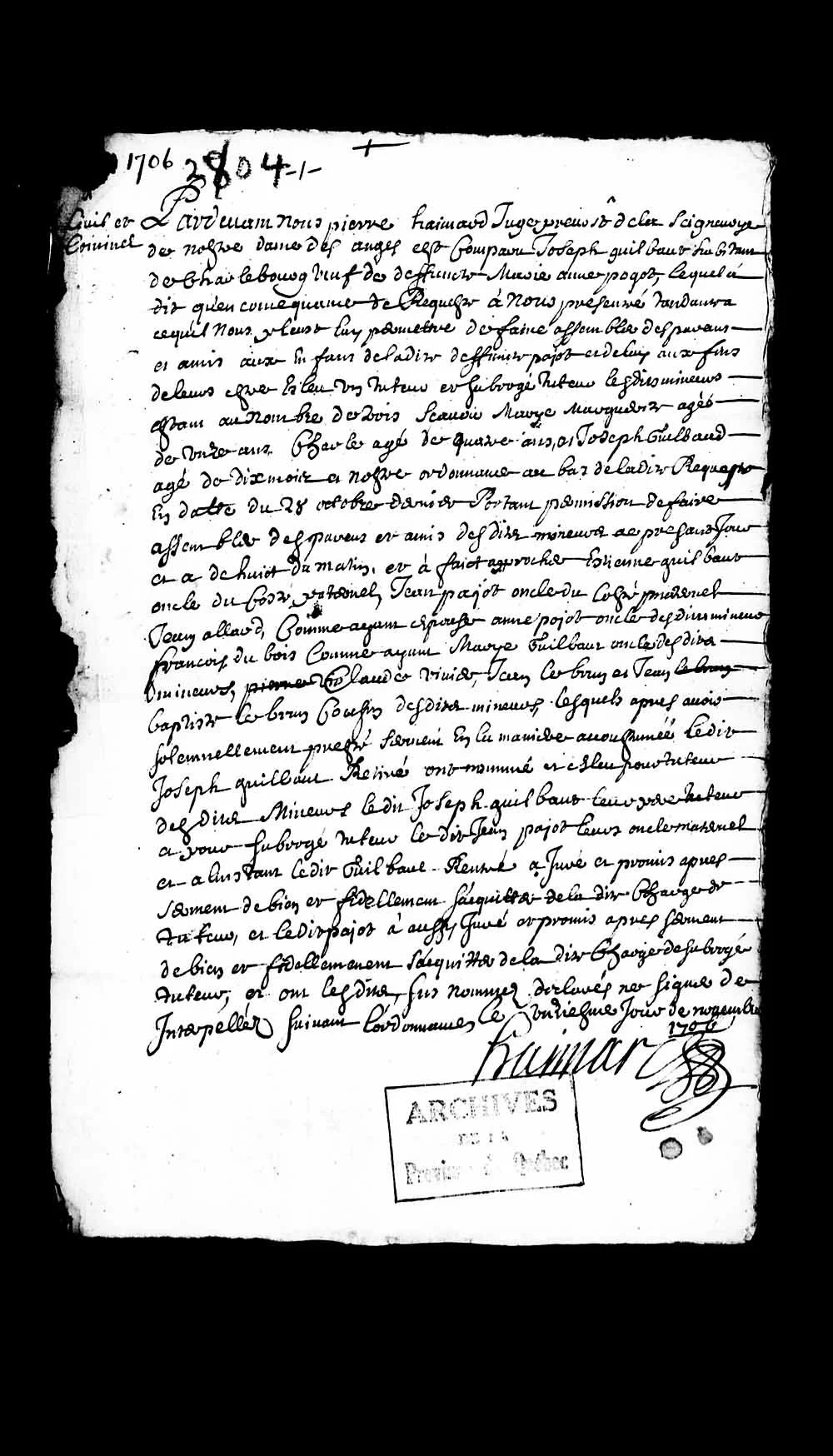
Kin assembled at eight in the morning before the provost judge. Joseph named guardian of his three minor children; Jean Pageot, their maternal uncle, subrogate guardian.
Inventaire
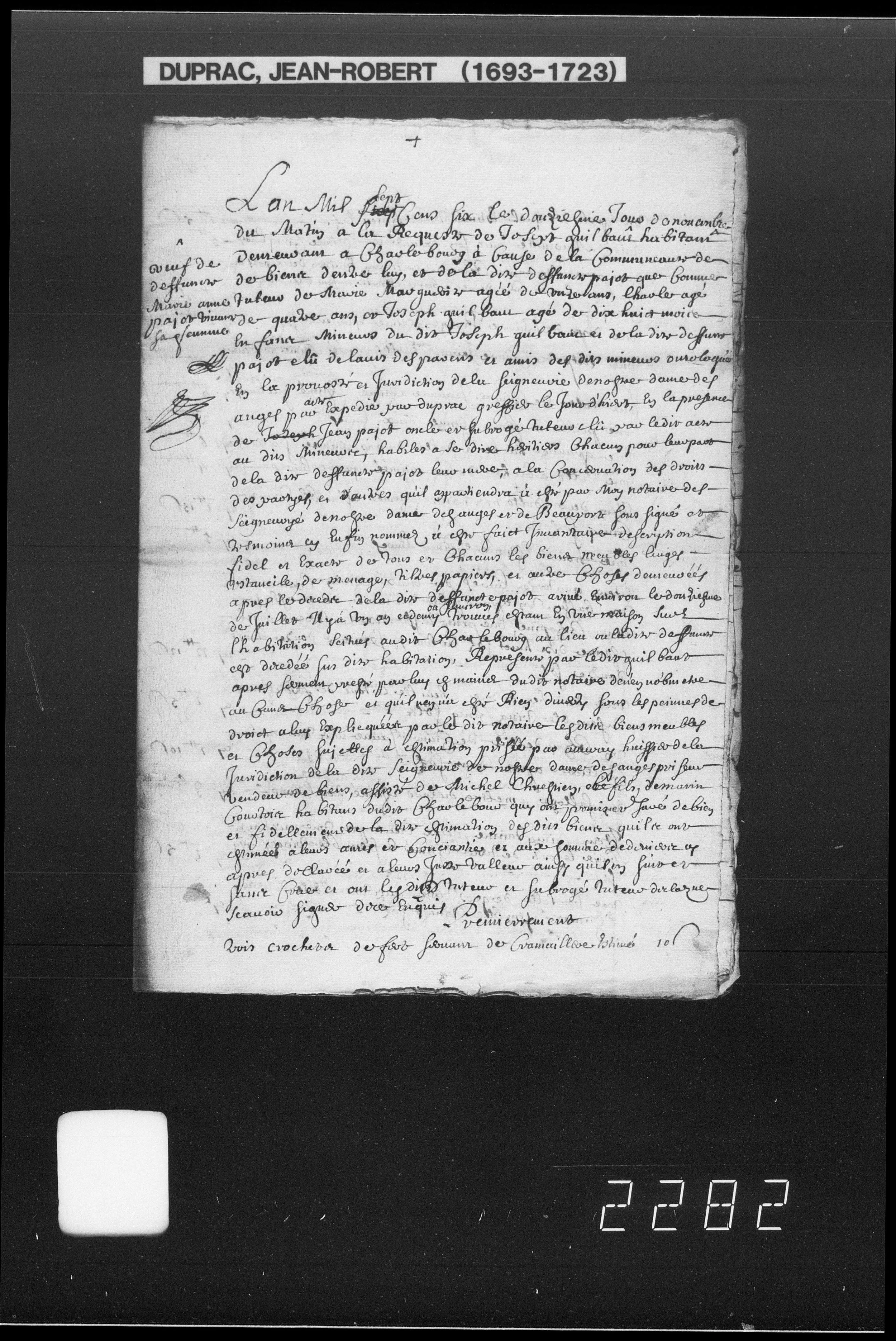
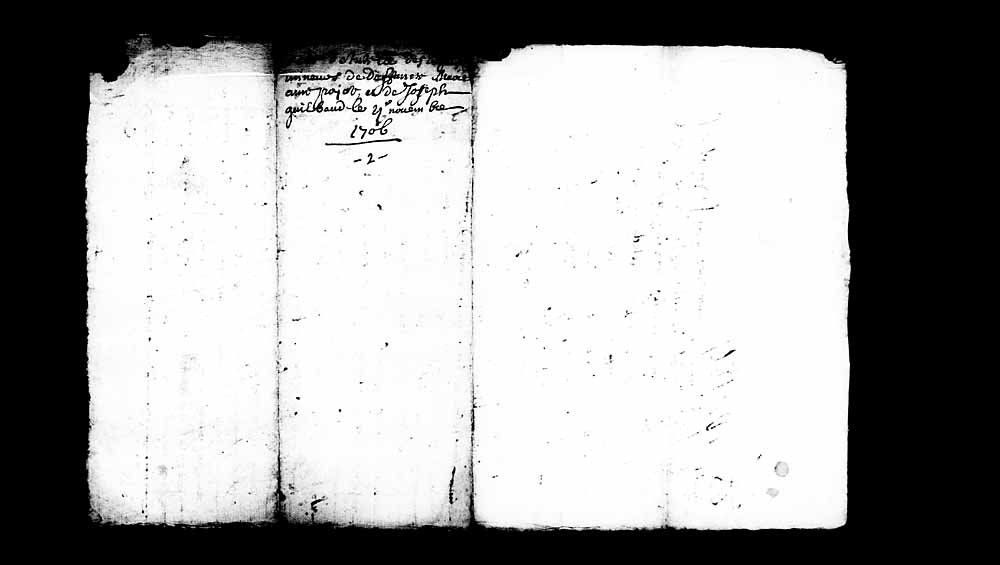
Jean-Robert Duprac came to the house on the farm and inventoried it room by room, barn and all, morning and afternoon: nine pages and eleven title deeds.
Second marriage
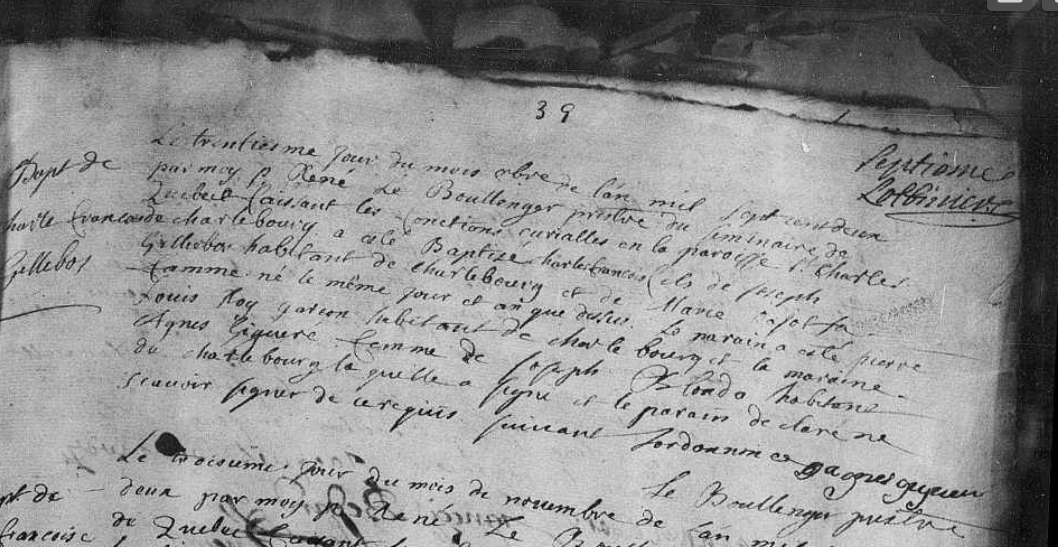
Married Marie Charlotte Dubeau at St-Charles-Borromée, before René Le Boullenger, priest of the Seminary of Québec. Jean Pajot, the children's subrogate guardian, stood among the witnesses.
Clôture
Guardian and subrogate guardian appeared before the court to close the inventory, having nothing further to declare. Both stated they could not sign.
This is not cunning; it is the law. A widower could not remarry until his first wife's community had been inventoried and his children given guardians, or their share would have been swallowed by the new marriage. It is worth knowing, because Joseph's father had done exactly the same thing nine years earlier — guardianship on 3 January 1697, remarriage on the 7th — and it has sometimes been read as strategy. The order was simply required.
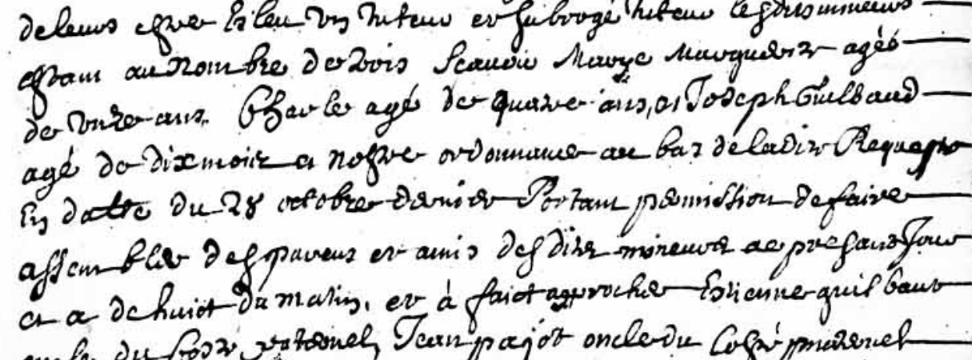
Charles at four is exact, to twelve days. Marie Marguerite at eleven is right. The baby is the problem. The court's clerk wrote ten months, which cannot be: baptised in April 1705, Joseph was nineteen months old, and a child of ten months that November would have been born half a year after his mother died. The next morning, in the family's own house, the notary wrote dix huit mois. One day, two officials, and the second came within a month.

12 November 1706: The House on the Farm
On the morning after the guardianship, at the request of Joseph Guilbaut habitant demeurant à Charlesbourg, widower of Marie Anne Pajot and guardian of their three children, the notary Jean-Robert Duprac came out to the farm. Jean Pajot was there for the children. The goods were valued by Auvray, bailiff of the seigneurial court, with two Charlesbourg habitants, Michel Chrestien fils and Marin Courtois. Joseph swore he had hidden nothing. They stopped at noon and went on at one.
The buildings
A house twenty feet by sixteen, walled with upright posts, a clay chimney near the middle, a garret floored above and below, the thatch half worn. A barn thirty feet by twenty, newly thatched. At the end of it a stable of squared logs, thatched, and in Duprac's words menaçant ruine. None of the buildings was valued.
The chest beside the kitchen
In the room next to the kitchen stood an iron-bound walnut chest with a lock. The first thing listed inside it was a cloak of étamine with a skirt of the same cloth, servant à la deffuncte — hers — valued at twenty-five livres, more than either of the cows. With it lay new linen, a piece of taffeta, a new camlet belt, a woman's bodice and a white chemisette, and an old otter muff. One lot the appraisers did not value at all: a small child's linen, a little skirt and a little apron, set aside for the children by consent of both guardians.
The farm
In the barn, by Joseph's own reckoning, were 450 sheaves of wheat — eighty minots of grain, 142 livres — with peas, oats, hay and straw. There were two black working oxen of about eight years, valued together at eighty livres; a red cow of twelve and a black cow of three; four pigs, eight hens, two turkeys, and a colt four months old. There was a plough with its iron and coulter at forty-two livres, a two-wheeled cart, and a scythe. There was a gun with a four-foot barrel, and in the garret a pair of snowshoes. The household of 1681 had owned one gun too.
What was owed
His brother Étienne owed the community eighty livres. The community owed seventeen livres to a Québec merchant and six to the Jesuit fathers for the seigneurial rent on the land. It owed two to the curé of Charlesbourg — Le Boullenger, who would marry Joseph three days later — and small sums to neighbours, among them Jean Allard and Maurice Réaume.
Eleven papers
Last came the titles, numbered as they were read. First the guardianship of the day before, then the marriage contract of 1694 with its 1696 receipt. After them came the land's own history: the Jesuits' concession to Philippe Matou dit Labrie; Matou's sale to Jacques Renaud; Renaud's sale to Thomas Pajot and Marie Catherine Roy three days before the contract. Then two surveys by Jean Le Rouge fixing the line between Joseph Guilbault and his neighbour, the receipt for the 500 livres, and two receipts from the Jesuit fathers for the rents, dated 1701 and 1703. The man who could not sign his name held a farm whose every change of hands was on paper, and he kept the papers.
That afternoon it was done. Everything was left in the house à la garde dudit Guilbault, for him to answer for to whomever it should belong. He and Jean Pajot declared they could not sign. Three days later he married again.
| Date and place | 12 November 1706, morning and afternoon, in the house on the habitation, Charlesbourg |
|---|---|
| At the request of | Joseph Guilbaut, habitant, widower and guardian |
| Minor children | Marie Marguerite, 11; Charle, 4; Joseph, 18 months |
| Subrogate guardian | Jean Pajot, maternal uncle |
| Notary | Jean-Robert Duprac, notaire des seigneuries de Notre-Dame-des-Anges et de Beauport |
| Appraisers | Auvray, huissier, with Michel Chrestien fils and Marin Courtois |
| Buildings | House 20 × 16 feet; barn 30 × 20 feet; stable "menaçant ruine" — none valued |
| Livestock | Two oxen, two cows, four pigs, eight hens, two turkeys, one colt |
| Titles | Eleven, from the Jesuit concession to the guardianship of 11 November 1706 |
| Signatures | Joseph Fernando (witness), Auvray, Duprac. Guardian, subrogate guardian and appraisers declared they could not sign. |
1713: Standing for Another Man's Child
Seven years later, in January 1713, Georges Allard of Charlesbourg assembled kin to elect guardians for his daughter Marie Marguerite, aged about two. Her mother, Marie Marguerite Pajot — Marie Anne's younger sister, married at Charlesbourg in January 1710 — had died at the Hôtel-Dieu in Québec in March 1711.
Among those called was Joseph Guillebaut à cause de défuncte Marianne Pajot, aussi oncle de la dite mineure. The council elected Georges Allard guardian and Joseph Guilbault subrogate guardian: the man whose job it would be to protect the child's interests against her own father, if it ever came to that.
Marie Anne Pageot had been dead seven and a half years. Her family still counted him as one of theirs.

It is a small act, and it is nearly all we have of him between 1706 and 1738. Thirty-two years of his adult life are otherwise documented only by his children's baptisms.
The Second Family: Thirteen Children
Marie Charlotte Dubeau, daughter of Toussaint Dubeau and Marie Anne Jeanne Jousselot, bore thirteen children between 1708 and 1731, all baptised at Charlesbourg.
| Child | Baptised | Married | Died |
|---|---|---|---|
| Jean Baptiste | 20 Jul 1708 | 11 Jun 1731, Dorothée Racine | 8 May 1787, St-Joachim |
| Pierre | 29 Mar 1710 | 26 Nov 1741, Marie Charlotte Villeneuve | 21 May 1796, Charlesbourg |
| Charles Martin | 10 Jun 1712 | — | 29 Sep 1712, aged 3 months |
| Marie Josephe | 18 Mar 1714 | — | 20 Apr 1715, aged 1 |
| Marie Josephe | 13 Feb 1716 | 29 Feb 1740, Louis Étienne Picard Decouagne | 1 Nov 1805, Trois-Rivières |
| Louis | 1 Jan 1718 | — | 7 Jan 1739, aged 21 |
| François Xavier | 4 Jan 1720 | — | 7 Aug 1769, St-Joachim |
| Marie Anne | 4 Apr 1722 | 22 Jan 1748, Jean François Louis Noiseux | 20 May 1809, Trois-Rivières |
| Charles | 11 Mar 1724 | — | 13 May 1733, aged 9 |
| Marie Françoise | 9 Jan 1726 | — | 6 May 1733, aged 7 |
| Geneviève | 22 Nov 1727 | — | 3 May 1733, aged 5 |
| Thomas | 20 Dec 1729 | — | 18 May 1733, aged 3 |
| Joseph | 17 Dec 1731 | — | 1 Apr 1732, aged 3 months |
May 1733
Geneviève was buried on the third. Marie Françoise on the sixth. Charles on the thirteenth. Thomas on the eighteenth. Five, seven, nine and three years old, in sixteen days.
The registers give no cause. They do not say whether the parish was suffering with them or whether the sickness stopped at their door. Until the burials of that spring are read as a series, nothing more can honestly be said than the four dates.
October 1738: Half of Everything
On 2 October 1738, Joseph Guilbault and Marie Charlotte Dubeau appeared before Me Duprac, notary of the seigneuries of Notre-Dame-des-Anges, Saint-Gabriel and Beauport, and made a donation to their son Pierre: la moitié de tous et chacun de leurs biens meubles, dettes, actions et possessions immeubles pouvant appartenir aux donateurs au jour de leur décès. Half of everything they would own at death, to one of their children. It was registered with the court four days later.
The act names him as the inventory and the marriage register had named him thirty-two years before: Joseph Guilbault, habitant de Saint-Charles-de-Charlesbourg.
He died eleven weeks later.

20 December 1738: Burial at Charlesbourg
Joseph Olivier Guilbault died on 18 December 1738 and was buried two days later in the cemetery of St-Charles-Borromée — the parish where he had married twice and buried nine of his children. The register gives his age as sixty-eight. He was sixty-six years and nine months.
Present were Nicolas Jacques and Charles Bédard, and the priest René Le Boullenger, who had married him to his second wife thirty-two years before.

1764: Seven Shares, and a Brother Taken In
Twenty-six years after his death, his estate had still not been divided.
On 30 June 1764, at half past three in the afternoon, Jean Baptiste Guilbault — habitant of the Côte St-Joachim, and fils et héritier pour un septième de feu Joseph Guilbeault, vivant habitant de la paroisse de Charlesbourg — appeared before the royal notary André Genest. He had petitioned the office of the Governor General, and the endorsement bore the signature of Hector Cramahé. The forms were those of the Coutume de Paris; the authority was British; the language was French. It was the year the military regime gave way to civil government.
His purpose was his brother. François Guilbault, forty-four years old and unmarried, had been living in Jean Baptiste's house for seven years, and was found incapable of managing what he stood to inherit from their father. The kin were assembled and sworn — Pierre Guilbault their brother; the brothers-in-law François Noiseux and Louis Étienne Dequay, for Marie Anne and Marie Joseph; Ignace Pajot and Charles Senard, cousins; Joseph Duperé and Joseph Alard, friends. With Jean Baptiste withdrawn, they deliberated, and returned unanimously that he should be curator of his brother's person and property.
He accepted, and swore to discharge it faithfully.

Seven shares. Six of Joseph's children were living in 1764; the seventh would fall to the line of Charles François, dead four years by then at Sault-au-Récollet. If that is right, his grandchildren were parties to a Charlesbourg estate two years after settling their own father's — but the act that names all seven has not been found, and the arithmetic is not evidence.
François Xavier Guilbault died five years later, on 7 August 1769, at St-Joachim. He was forty-nine.

Marie Charlotte Dubeau, 1688–1778
Joseph's second wife outlived him by almost forty years. She had been baptised at Notre-Dame-de-Québec on 17 August 1688, married him at eighteen, and borne all thirteen of their children at Charlesbourg. Ten weeks before his death she stood beside him at the notary's to give half of what they had to their son Pierre.
On 29 May 1747, at St-Charles-Borromée, she married again: Louis Thibault, son of Nicolas Thibault and Marie Sainte Cloutier.
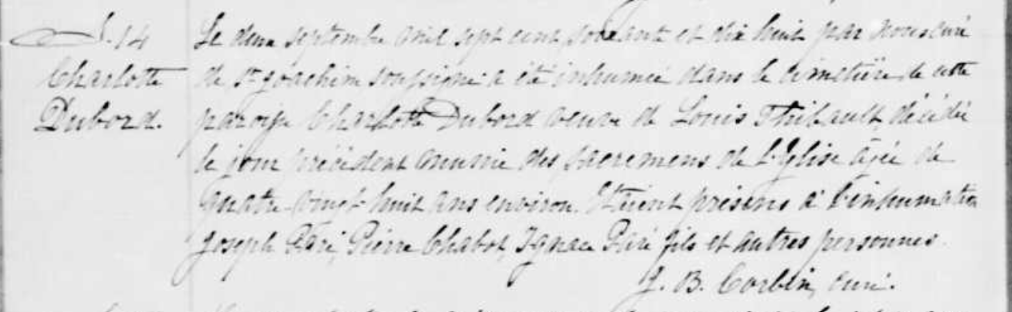
She died on 1 September 1778 and was buried the next day at St-Joachim, on the Côte de Beaupré — the parish where her son Jean Baptiste was a habitant, and where his brother François had lived in his house. The curé, J. B. Corbin, entered her as Charlotte Dubord veuve de Louis Thibault, "âgée de quatre-vingt-huit ans environ." Present were Joseph Paré, Pierre Chabot and Ignace Paré fils. By her baptism she was ninety.
The Hands That Could Not Write
At the foot of the 1764 curatelle, the notary records who signed and who did not. Two men signed with him: François Noiseux and Louis Étienne Dequay — the brothers-in-law, both styled Sieur, married into the family. The curator himself and every other relative and friend present declared they could not write or sign.
It runs four generations. Pierre Guilbault could not sign at his son's wedding in 1694. Joseph Olivier could not sign his own quittance in 1696, nor his first wife's inventory in 1706, nor his second marriage three days later — "conjointement avec l'époux et l'épouse," the curé wrote, none of them could. His sons Jean Baptiste and Pierre could not sign in 1764. And in 1727, at Notre-Dame-de-Québec, Joseph's son Charles François and his bride could not sign either.
The pattern is not that nobody in this family wrote. It is that the Guilbaults did not, and the people who married them sometimes did.
One man in the Charlesbourg circle of 1706 could write. Joseph Fernando witnessed the inventory, was the only person excepted from the curé's clause at the wedding three days later, and signed again at the Allard guardianship in 1713. Who he was, the records gathered so far do not say.

| Parents | Pierre GUILBAULT & Louise SÉNÉCAL |
|---|---|
| Birth | 16 March 1672 |
| Baptism | 18 March 1672, Québec (Notre-Dame-de-Québec) |
| First marriage | 3 May 1694, Charlesbourg (St-Charles-Borromée), Marie Anne PAGEOT |
| Second marriage | 15 November 1706, Charlesbourg (St-Charles-Borromée), Marie Charlotte DUBEAU |
| Death | 18 December 1738 |
| Burial | 20 December 1738, Charlesbourg (St-Charles-Borromée) |
| Parents | Thomas PAGEOT & Marie Catherine ROY |
|---|---|
| Birth & Baptism | 8 January 1678, Québec (Notre-Dame-de-Québec) |
| Marriage | 3 May 1694, Charlesbourg, Joseph GUILBAULT |
| Death & Burial | 12 July 1705, Québec (Hôtel-Dieu) |
| His parents | Thomas PAGEOT & Catherine ROUAULT |
|---|---|
| Her parents | Mathurin ROY & Marguerite LEBIRE |
| Marriage | 13 November 1675, Québec (Notre-Dame-de-Québec) |
| Children | Eleven, 1678–1703 — Marie Anne, the eldest, born at Québec; the rest at Charlesbourg |
| Married | Marie Anne (1694, Joseph GUILBAULT); Jean Baptiste (1703, Marie PARADIS); Anne Élisabeth (1705, Jean Baptiste ALLARD); Marie Marguerite (1710, George ALLARD); Joseph (1716, Marie Madeleine BOISME); Marie Françoise (1717, Pierre MARANDA) |
| Died young | Jeanne (1680); Thomas (1684); Thomas (1689); Thomas (1703); Paul died unmarried in 1711, aged twenty-one |
| Marriage | 15 November 1706, Charlesbourg (St-Charles-Borromée) |
|---|---|
| Her parents | Toussaint DUBEAU & Marie Anne Jeanne JOUSSELOT |
| Children | Thirteen, 1708–1731, all baptised at Charlesbourg — full dates in the table above |
| Reached adulthood | Jean Baptiste, Pierre, Marie Josephe, François Xavier, Marie Anne |
| Parents | Toussaint DUBEAU & Marie Anne Jeanne JOUSSELOT |
|---|---|
| Birth & Baptism | 17 August 1688, Québec (Notre-Dame-de-Québec) |
| First marriage | 15 November 1706, Charlesbourg (St-Charles-Borromée), Joseph GUILBAULT |
| Second marriage | 29 May 1747, Charlesbourg (St-Charles-Borromée), Louis THIBAULT (Nicolas THIBAULT & Marie Sainte CLOUTIER) |
| Death | 1 September 1778 |
| Burial | 2 September 1778, St-Joachim (Montmorency) |
The Line of Descent
Pierre Guilbault & Louise Sénécal — m. 1667, Québec (Episode 7)
Joseph Olivier Guilbault (1672–1738) & Marie Anne Pageot — habitant
Charles François Guilbault (1702–1760) — entrepreneur de maçonnerie (Episode 5)
Charles Gabriel Guilbault (1731–1784) — maçon (Episode 4)
Gabriel Guilbault "le voyageur" (1762–1833) (Episode 3)
married Marie Josephte Abitakijikokwe (Ojibwe)
Document Gallery





Sources
- Parish registers Notre-Dame-de-Québec, 18 March 1672 (baptism); 12 July 1705 (burial of Marie Anne Pageot, Hôtel-Dieu). St-Charles-Borromée de Charlesbourg, 3 May 1694 and 15 November 1706 (marriages); 1695–1731 (baptisms); 1698–1733 (burials); 20 December 1738 (burial of Joseph Guilbault). St-Joachim (Montmorency), 2 September 1778 (burial of Marie Charlotte Dubeau, entered as Charlotte Dubord, veuve de Louis Thibault).
- Notarial acts — greffe de Louis Chambalon, notaire royal en la prévôté de Québec
BAnQ, 03Q,CN301,S58.
• Contrat de mariage de Joseph Guillebault et Marie Anne Pajot, 15 avril 1694 (indexed vol. XVIII p. 69).
• Quittance réciproque entre Joseph Guillebault, le sieur Pageot et Pierre Guillebault, 19 février 1696 (vol. XVIII p. 146). - Notarial act — greffe de Jean-Robert Duprac, notaire des seigneuries de Notre-Dame-des-Anges et de Beauport • Inventaire des biens de la communauté d'entre Joseph Guilbault et défunte Marie Anne Pajot, 12 novembre 1706; Archives nationales à Québec; digital images, FamilySearch, catalogue 754273, images 2239–2247 (first page).
- Court records — Bailliage seigneurial de Notre-Dame-des-Anges
Archives nationales à Québec, Collection Pièces judiciaires et notariales.
• Ordonnance du juge prévôt Guillaume Roger, 28 février 1697, (03Q,TL5,D2769-119).
• Acte de tutelle concernant Marie-Marguerite, Charles et Joseph Guilbault, 11 novembre 1706, (03Q,TL5,D2804).
• Clôture de l'inventaire des biens de la communauté entre Joseph Guilbault et la défunte Marie-Anne Pageau, 30 janvier 1707, (03Q,TL5,D2805-4).
• Acte de tutelle concernant Marie-Marguerite Allard, 19 janvier 1713, (03Q,TL5,D2823-1). - Later court and notarial records
• Donation par Joseph Guilbault et Marie-Charlotte Dubaut à Pierre Guilbault, leur fils, 2 octobre 1738, passée devant Me Duprac, notaire des seigneuries de Notre-Dame-des-Anges, Saint-Gabriel et Beauport, as insinuated 6 octobre 1738; Archives nationales à Québec, Fonds Cour supérieure, District judiciaire de Québec, Insinuations, (03Q,CR301,P1955).
• Curatelle pour François, fils de feu Joseph Guilbault, 30 juin 1764; Archives nationales à Québec, Fonds Cour supérieure, District judiciaire de Québec, Tutelles et curatelles, (03Q,CC301,S1,D3954). - Census Recensement de 1681, Nouvelle-France, Petite Auvergne (Charlesbourg).
- PRDH-IGD Programme de recherche en démographie historique, Université de Montréal. Families nos. 2198, 4459, 7236, 84342; Individuals nos. 16635, 30633, 30634.
A note on what is still missing. No guardianship, inventory or division has yet been found for Joseph's own death in December 1738, though the curatelle of 1764 shows that a division into seven shares was still to come.
Related Reading
Are You Connected to the Guilbault Line?
If you descend from the Guilbault (Guilbeau, Guilbeault) family of Charlesbourg and the Quebec parishes, from the children of Marie Josephte Abitakijikokwe, or from the founding families of the line — Senécal, Séguin dit Ladéroute, Morin, Couillaud dit Roquebrune, Gaulin — I’d like to compare notes. Documented trees, DNA matches, family papers, and even half-remembered stories have all moved this research forward.
Get in Touch About This FamilyCousin connections are informal and reciprocal — no fee, no obligation, just shared work on shared ancestry.
Every Family Has a Story Worth Telling
Whether you're just beginning your research or ready to transform years of work into a narrative your family will treasure, I'd love to help.
LET'S TALK ABOUT YOUR FAMILY