
Pierre Guilbault 1640s - 1697
Pierre Guilbault
Where It All Began
He came from Aunis, the country around La Rochelle, and nobody has found his baptism. The notaries who drew up his marriage contracts could not agree on his parish. The ages set down for him over thirty years put his birth somewhere between 1641 and 1647. He could not write his name, and never did.
What the records do hold is a man who made four marriage contracts and married twice; who was already a habitant of Charlesbourg before the woman he married stepped into a notary's study; who hired out his labour, bought a building lot, and fenced it with cedar; and who, in the last winter of his life, remarried on the same Monday that his youngest son asked the Sovereign Council for the right to enjoy what his dead mother had left him. Seven weeks later the provost judge of Notre-Dame-des-Anges wrote down the word that has followed the family ever since: aversion.
Habitant de Charlesbourg
As the notary Gilles Rageot styled him on 10 July 1667 — three months before his marriage
Pierre is the voyageur's great-great-grandfather.
Origins: Aunis
Every document that names Pierre's parents names the same two people: François Guilbault and Marie Pignon. By November 1665 François was dead — fils de feu François Guilbault. By September 1667 the notary Pierre Duquet wrote fils de deffuncts, in the plural, as though his mother had died too.
Where Pierre came from is less settled. Two acts say one parish and two say another.
Pierre's parish of origin, as the documents give it
Saint-Xandre is a country parish a few miles north-east of La Rochelle; Saint-Barthélemy is inside the town. PRDH follows the register. This page does not choose.
A note on his age. He was 26 in the census of 1667, 37 in the census of 1681, and 50 when he was admitted to the Hôtel-Dieu in 1697. Those three figures put his birth in 1641, 1644 and 1647. PRDH estimates about 1645. The honest answer is the range.
Four Contracts, One Wedding
Pierre Guilbault signed — or rather, declared he could not sign — four marriage contracts in twenty-eight years. Only one of them was followed by the wedding it promised.
The contracts
Why the first two came to nothing, the contracts do not say, and this page does not guess.
One name runs through Pierre's first years in the documents. Adrien Michelon was present at the Le Moyne contract in 1665, at the Lorteau contract in July 1667, and signed Louise Sénécal's in September. Two years later he hired Pierre to bring in his harvest.


30 September 1667: Louise Sénécal
Louise Sénécal was baptised at Saint-Éloi in Rouen on 15 February 1637, the daughter of Pierre Sénécal and Françoise Campion. In the autumn of 1667 she was thirty years old and in Québec, one of the young women sent out under royal sponsorship who have come to be called the Filles du Roi — she is counted among them by Yves Landry and by Silvio Dumas. The Fichier Origine records that her parents had married at Saint-Éloi in June 1632 and that her mother, Françoise Campion, was buried there on 28 December 1645. Louise was eight.
On the last day of September she and Pierre went to the study of the notary Pierre Duquet. The clerk began to write her mother's name as something else, struck it, and wrote Françoise above. He then wrote lesquelles parties et ez la présence de — "the said parties, and in the presence of" — and left the rest of the page blank. No kin were ever named. Besides the two witnesses, two men signed at the foot anyway: R. Parent and Adrien Michelon.
The terms were ordinary for the Coutume de Paris: community of goods; each party's earlier debts their own; a mutual gift of everything to the survivor if there were no children. Pierre settled on her a douaire préfix of two hundred livres tournois — a widow's portion, to be paid once from his property. And the contract recorded that Louise brought one hundred livres of her own into the community.
At the end the notary wrote that the future spouses ont déclaré ne sçavoir escrire ny signer. A single cross stands beneath.


6 October 1667: The Wedding
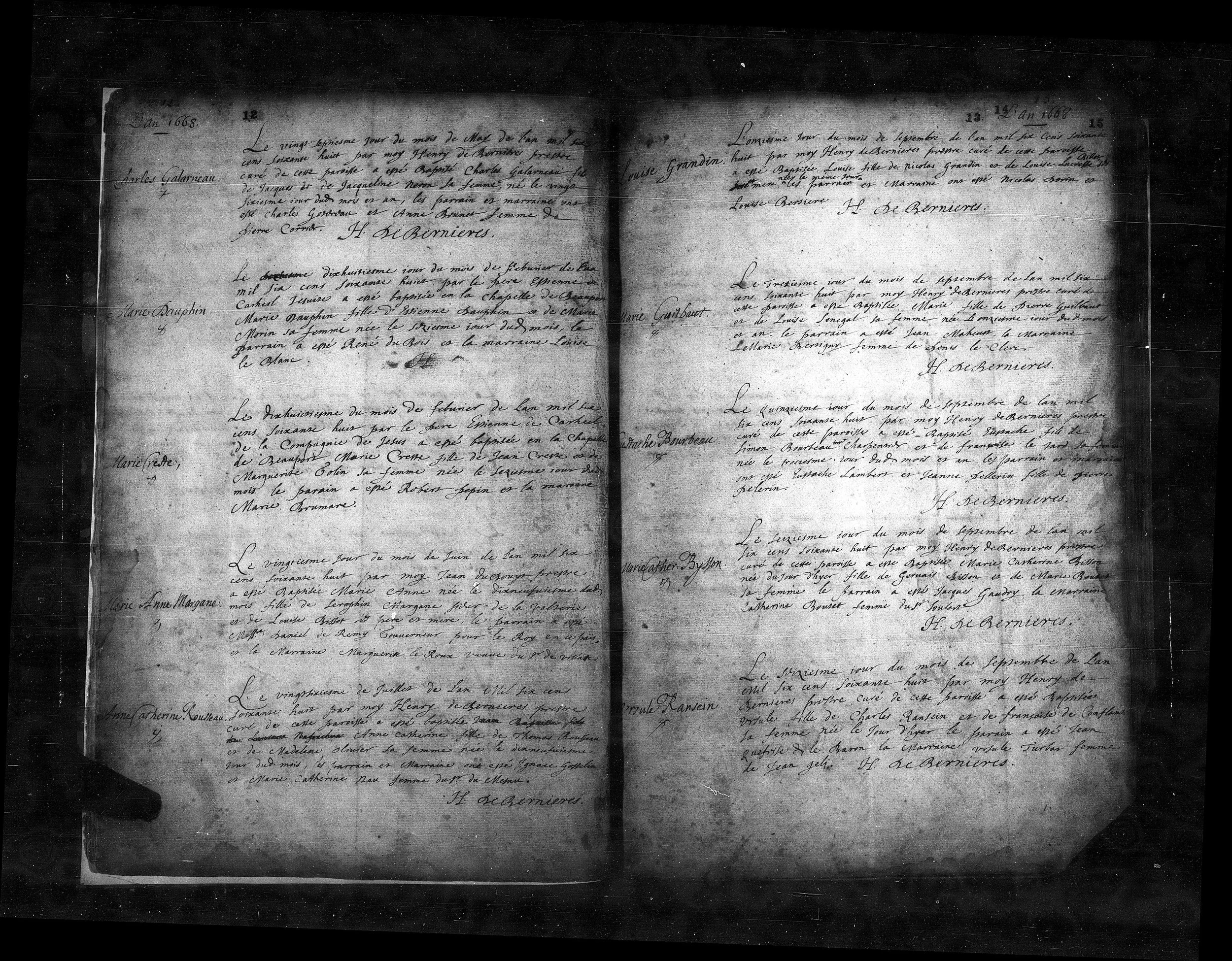
Six days later Henri de Bernières, curé of Notre-Dame-de-Québec, married them after two banns, the bishop having dispensed the third. The entry names Pierre as the son of François and Marie Pignon of Saint-Barthélemy in La Rochelle, and Louise as the daughter of Pierre and Françoise Campion of Saint-Éloi in Rouen. The witnesses were Pierre Chamarre and Pierre Corier, both of the parish. Pierre Chamare had been in the room for Pierre's first contract, two years before.
The register gives no ages and records no signatures.

The census of that year lists them at the Côte de Notre-Dame-des-Anges: Pierre Guillebaud, 26; Louise Senécal, 24; two arpents under cultivation.
Louise was thirty. The census of 1681 would give her as forty when she was forty-four. Both enumerations run her young by four to six years — but who gave the census taker the ages is not recorded, and neither figure can be laid at her door.

Charlesbourg: 1667–1692
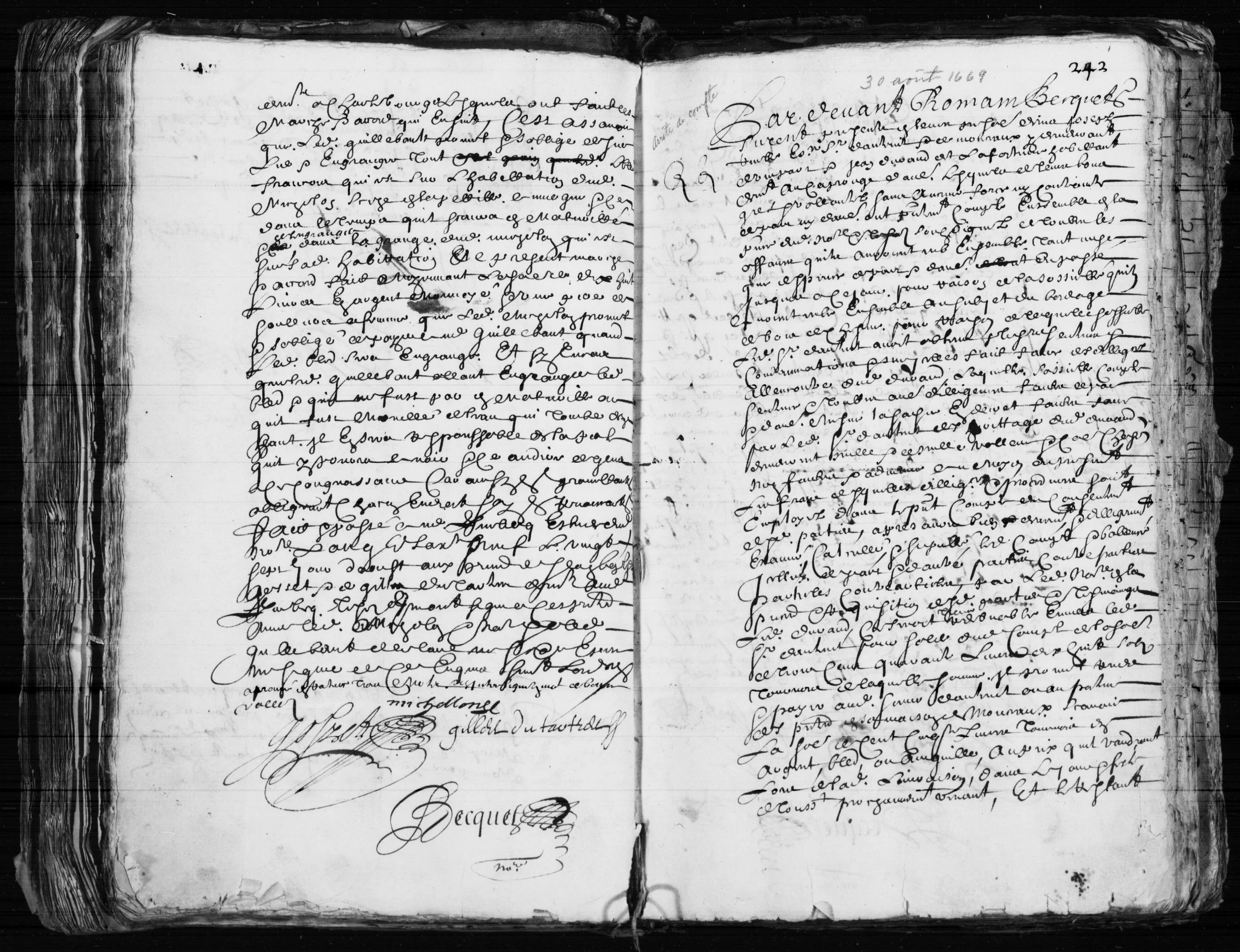
On 27 August 1669 Pierre Guillebault, habitant demeurant à Charlesbourg, stood before the notary Romain Becquet with Adrien Michelon and agreed to bring in the grain standing on Michelon's habitation and house it in Michelon's barn, to be paid when it was under cover. Michelon signed. Pierre declared he could not.
The 1681 Census
Fourteen years later the household at la Petite Auvergne held thirty arpents under cultivation, eight head of cattle, two horses and one gun. Pierre was entered as 37 and Louise as 40.
A note on the census. The enumerator lists four children: Marie 13, Joseph 9, Étienne 6, and Pierre 2. The parish records give no son Pierre — the fourth child was a daughter, Elisabeth, born in December 1679. One of the two sources is wrong about that child.


September 1692: A Lot on the Rue Saint-Nicolas
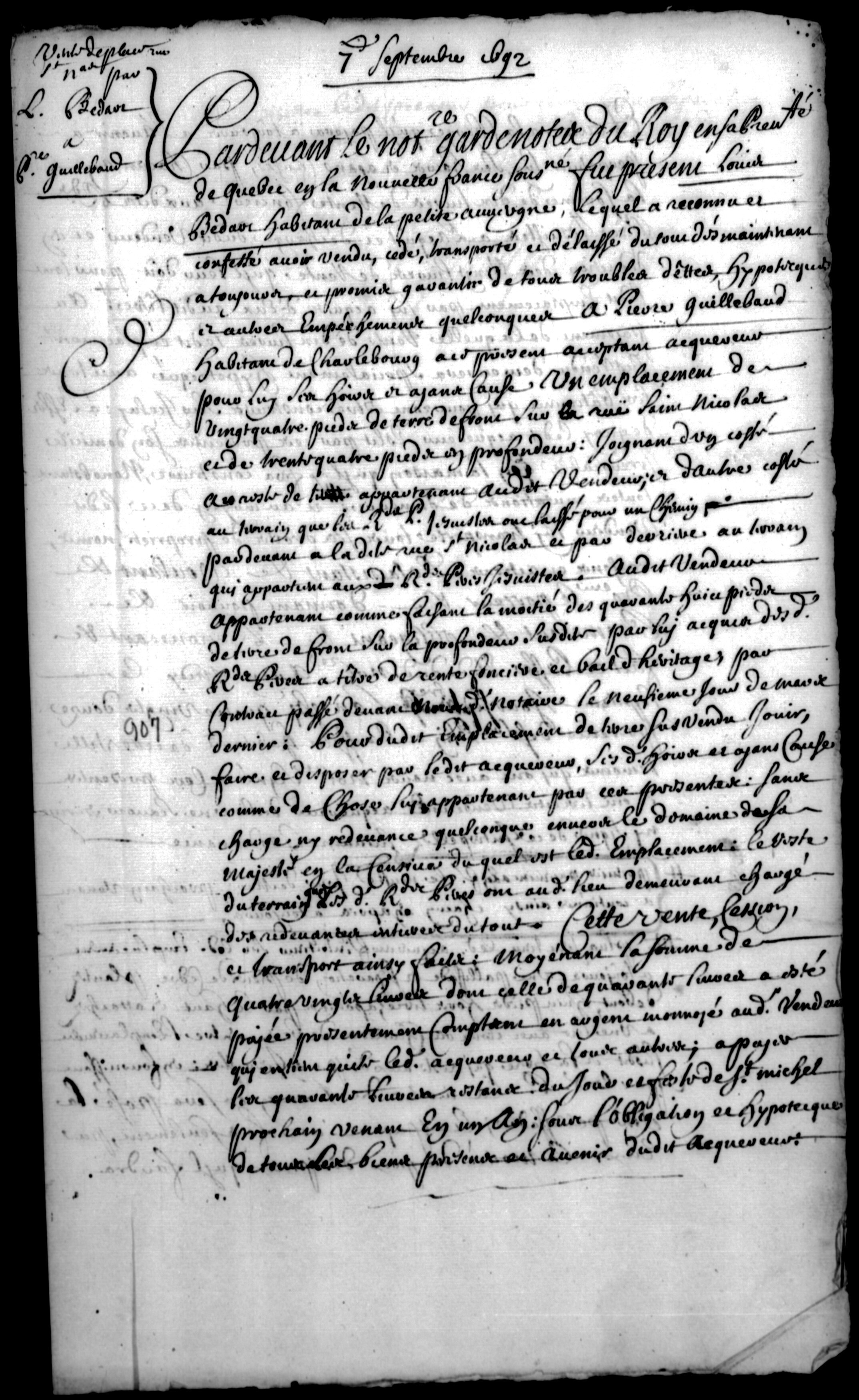
On 7 September 1692 Louis Bédard, habitant of la Petite Auvergne, sold to Pierre Guillebaud, habitant of Charlesbourg, a building lot twenty-four feet wide and thirty-four deep on the rue Saint-Nicolas, backing onto land of the Jesuit fathers and lying in the King's censive. The price was eighty livres — forty paid down in coin, forty due at the Michaelmas after next — and ten livres a year in perpetual rent to the Jesuits.
Pierre bound himself to the house qu'il y fera construire, the house he would build there, and to keep up forever between his lot and the Jesuits' land une palissade de séparation de pieux de cèdre plantés debout, huict pieds hors terre, appointés par le haut — a fence of cedar pickets, eight feet out of the ground and pointed at the top. Seller and buyer both declared they could not write or sign.

The Children of Pierre and Louise
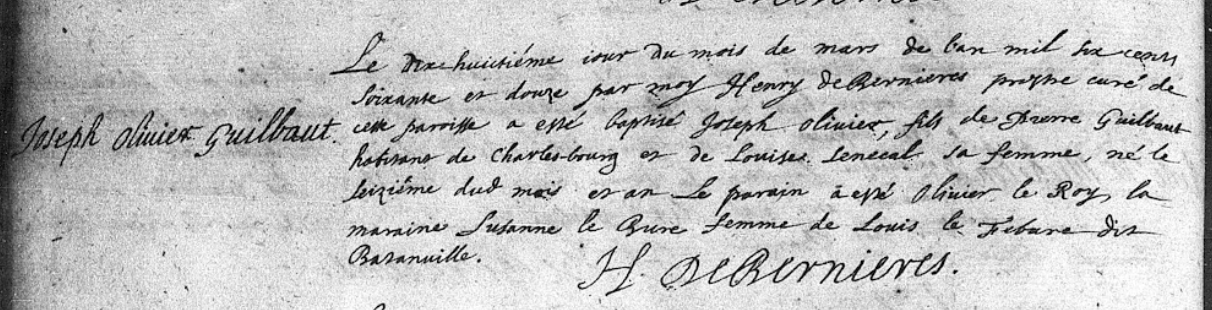
Four children were born to them, all baptised at Notre-Dame-de-Québec. Three can be followed into adulthood.
| Child | Born | Married | Died |
|---|---|---|---|
| Marie | 11 Sep 1668 | 16 Aug 1688, François Dubois | 2 Jan 1747, Québec |
| Joseph (Olivier) | 16 Mar 1672 | 3 May 1694, Marie Anne Pageot | 18 Dec 1738, Charlesbourg |
| Étienne | 15 Feb 1675 | 2 Mar 1699, Marie Françoise Roy | 3 Jul 1720, Hôtel-Dieu de Québec, aged 45 |
| Elisabeth | 16 Dec 1679 | — | No later record found |
Joseph Olivier, the elder son, is the subject of Episode 6 and the line of descent to the voyageur. His godfather was Olivier Le Roy.


17 December 1679: Elisabeth
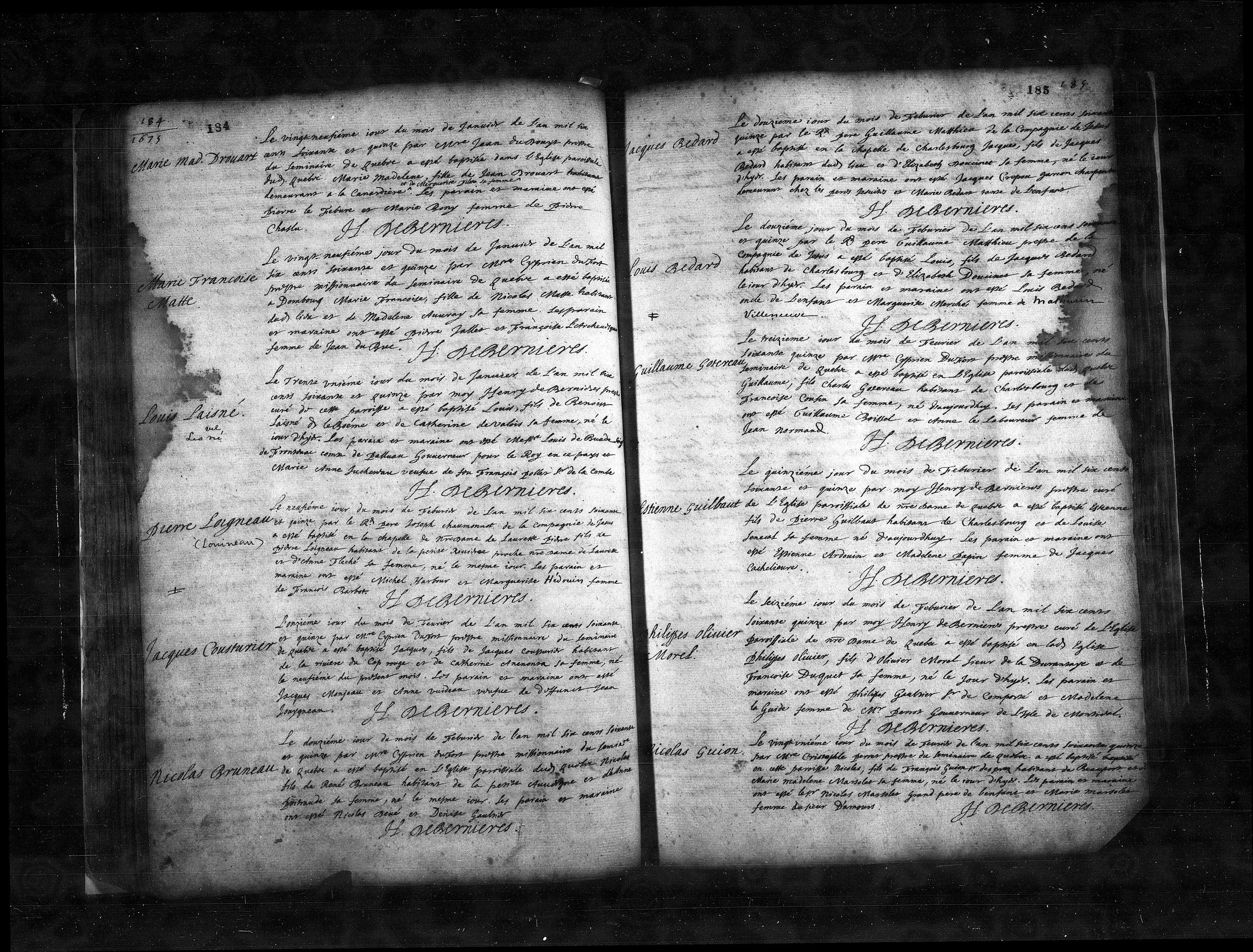
Elisabeth was born on 16 December 1679 and baptised the next day in the parish church of Québec by Charles Glandelet, a priest of the Seminary. The entry names her as the daughter of Louyse Senecal demeurante en la parroisse de Charlebourg, wife of Pierre Guilbaut, habitant of Charlesbourg —
"…et à ce qu'elle dit dudit Pierre Guilbaut son mary, duquel elle est séparée."
…and, by her own account, of the said Pierre Guilbaut her husband, from whom she is separated.
Pierre is not recorded as present. The priest set down the father's name on Louise's word, and set down that the couple were separated. The godfather, a Michel called La Ferté who was in the service of the Intendant, signed Laferté; the godmother, Jacqueline Héron, wife of Jacques Galarneau of Charlesbourg, could not sign.
What "separated" meant in December 1679 — a separation pronounced by a court, or a household living apart — the entry does not say, and no proceeding has yet been found. At the census of 1681 the enumerator listed Pierre and Louise in one household at la Petite Auvergne.

April 1693: A Widower
When or where Louise Sénécal died has not been found. PRDH carries no death and no burial for her. The last record gathered here that names her living is the census of 1681. Denis Beauregard's Genealogy of the French in North America reaches the same limits: dead between the census of 1681 and 13 April 1693.
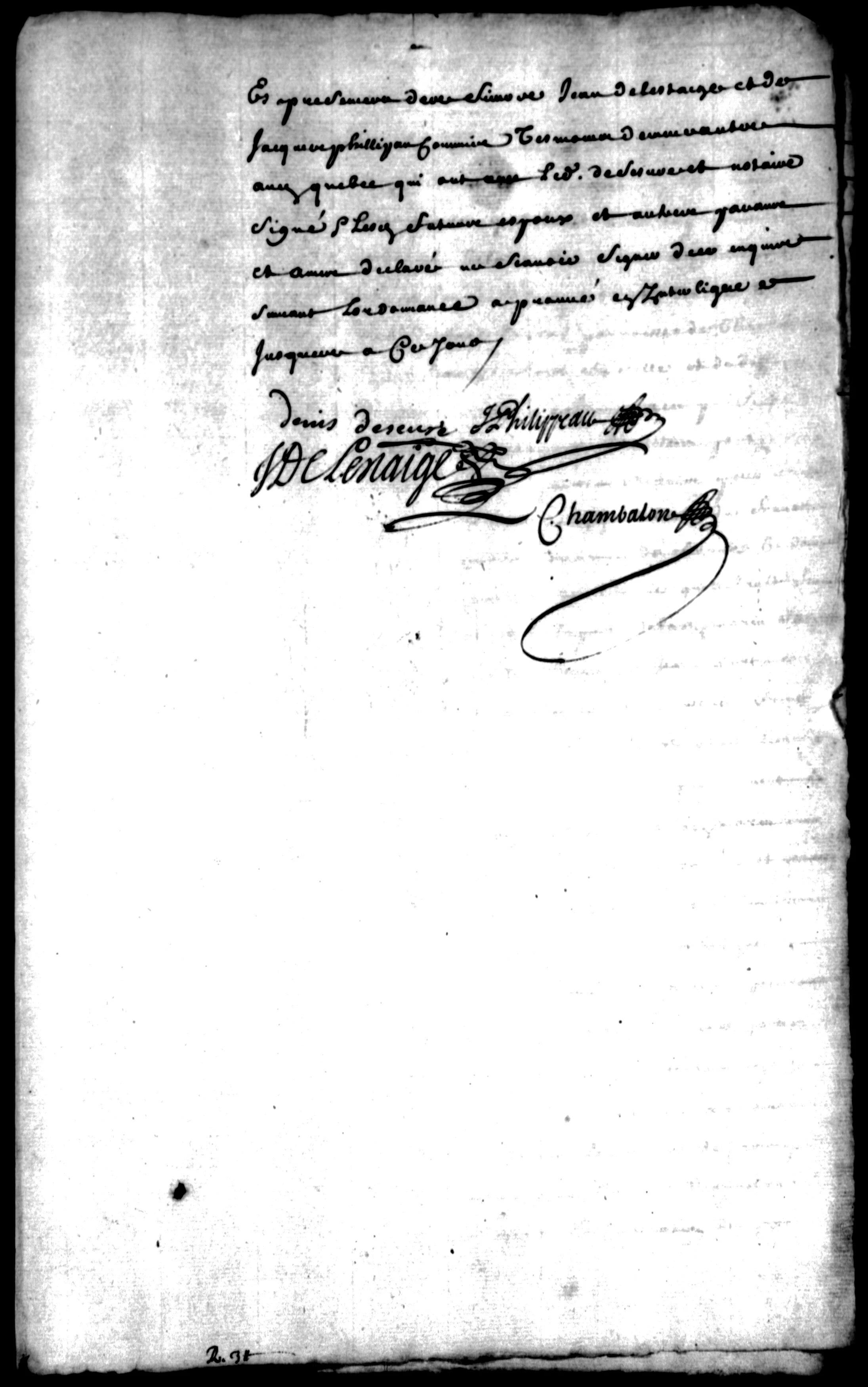
The first record that names her dead is a marriage contract. On 13 April 1693, before the royal notary Louis Chambalon, Pierre Guillebault veuf en premières noces de Louise Senecal contracted to marry Jeanne Morin, daughter of André Morin and the late Marguerite Moreau. On Pierre's side, the notary recorded François Dubois, masson, son gendre, and in his presence Marie Guillebault, Dubois's wife, sa fille.
Four years later that son-in-law and that daughter would be among the heirs who took Pierre to court. In April 1693 they stood beside him.
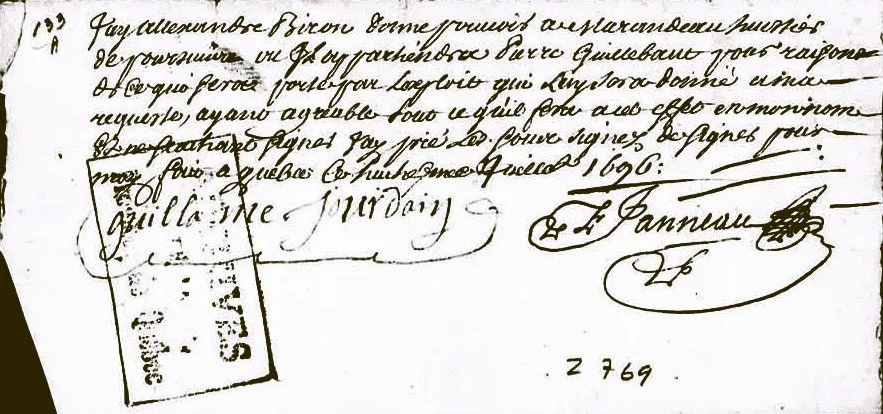
No marriage followed. By July 1696 Pierre was being sued by an Alexandre Biron, couvreur de maisons, who gave the bailiff Marandeau power to pursue him; the summons was served by Olivier Le Roy, bailiff of the seigneury. What Biron claimed is still to be read.

The Winter of 1697
Under the Coutume de Paris a widower who meant to remarry had first to have his minor children given guardians and the community he had held with their mother inventoried, or their share would disappear into the new marriage. Pierre's youngest son, Étienne, was twenty-one and a minor. Read in order, the acts show Pierre starting that process himself, and his children then pressing it to a division.

Two Men at the Wedding
The priest Alexandre Doucet recorded the friends of the groom at Pierre's second marriage. Two of them signed: Pierre Le Febvre, and Thomas Pajot — the father-in-law of Joseph Guilbault, whose name would stand first among the plaintiffs seventeen days later. The bride's father and her brothers Julien and Jacques were there. The clerk who wrote the marginal heading began M de Pierre Guillebo et Louise, crossed out Louise, and wrote Françoise.

What Étienne's Letters Allowed
The letters issued in the King's name that day did not set Étienne free to do as he liked. They allowed him, once his kin on both sides had been heard, to enjoy his movable goods and the income from his land — à la charge néantmoins qu'il ne pourra vendre, aliéner ny hypothéquer ses immeubles qu'il n'ait atteint l'aage de vingt-cinq ans. Baptised on 15 February 1675, he was in fact five weeks short of twenty-two.


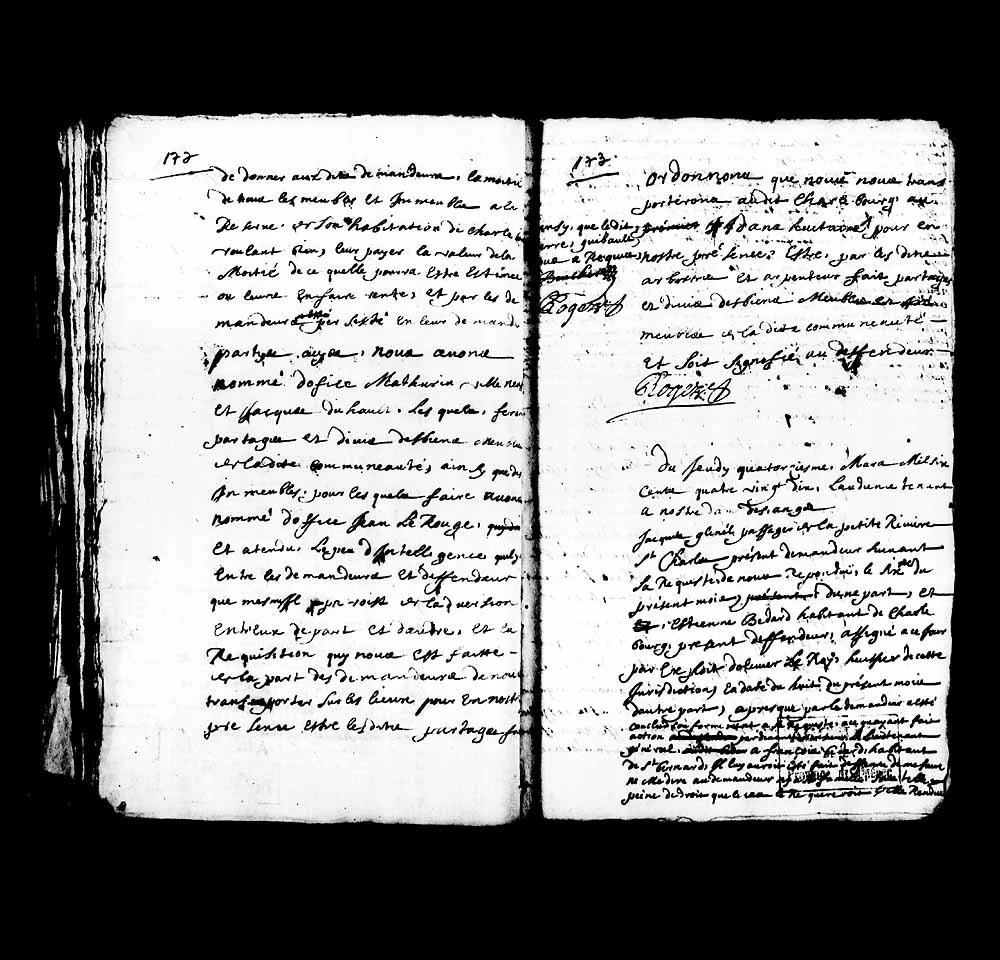
28 February 1697: "Considérant l'aversion…"
A month after the children's petition, on the same plaintiffs' request, the provost judge Guillaume Roger wrote:
"Considérant l'aversion entre les demandeurs et défendeur…"
Considering the aversion between the plaintiffs and the defendant…
The judge would go himself to the defendant's house at Charlesbourg. The movable goods would be divided by Mathurin Villeneuve and Jacques Duhault, arbitrators named by the court of its own motion; the land by Jean Le Rouge. Jacques Duhault had sat on Pierre's family council eight weeks before as one of his friends.
The order records the hostility and what the court did about it. It does not say what caused it, and neither does anything else in the file.

5 October 1697: The Hôtel-Dieu
The register of patients at the Hôtel-Dieu de Québec has a single line for him: le 3 pierre guillebaut agé de 50 ans de charle Bourg, mort le 5. He was buried at the hospital on 5 October 1697, residence Charlesbourg, age fifty. It was seven months after the aversion order and nine months after his second marriage.

On 10 November, before Chambalon, Françoise Le Blanc, widow of Pierre Guillebault, made an accord with the heirs: Joseph and Étienne Guillebault, François Dubois and Marie Guillebault. In February 1698 Étienne ceded his rights in his father's and mother's estates to Joseph, François Dubois and Marie.
What the family council, the inventory and the arbitrators finally divided is not yet known. The inventory of January 1697 — the list of everything Pierre and Louise had in the house at la Petite Auvergne — has not been found.
The Hands That Could Not Write
Across thirty years the notaries recorded the same thing about Pierre Guilbault. In November 1665 with Marie Le Moyne; in September 1667 with Louise Sénécal, who could not sign either; in August 1669 with Adrien Michelon, who could; in September 1692 buying his lot; at the family council of January 1697. Every time: a déclaré ne sçavoir escrire ny signer.
It is where the pattern of Episode 6 begins. His son Joseph could not sign in 1696; his grandson Charles François could not sign at his wedding in 1727; his grandsons Jean Baptiste and Pierre could not sign in 1764.
| Status | Immigrant |
|---|---|
| Birth | About 1645, Saint-Barthélemy, La Rochelle, Aunis (PRDH estimate) |
| First marriage | 1667, Québec (Notre-Dame-de-Québec), Louise SENECAL |
| Second marriage | 1697, Charlesbourg (St-Charles-Borromée), Françoise LEBLANC |
| Status | Immigrant |
|---|---|
| Parents | Pierre SENECAL & Françoise CAMPION |
| Baptism | 15 February 1637, Saint-Éloi, Rouen, Normandy |
| Marriage | 6 October 1667, Québec (Notre-Dame-de-Québec), Pierre GUILBAULT |
| Death & Burial | Not on the PRDH record |
| His parents | François GUILBAULT & Marie PIGNAN |
|---|---|
| Her parents | Pierre SENECAL & Françoise CAMPION |
| Marriage | 6 October 1667, Québec (Notre-Dame-de-Québec) |
| Children | Marie (1668), Joseph (1672), Étienne (1675), Elisabeth (1679) — full dates in the table above |
| His parents | François GUILBAULT & Marie PIGNAN |
|---|---|
| Her parents | Jacques LEBLANC & Suzanne ROUSSELIN |
| Marriage | 7 January 1697, Charlesbourg (St-Charles-Borromée) |
| Death | 5 October 1697 |
|---|---|
| Burial | 5 October 1697, Québec (Hôtel-Dieu) |
| Age | 50 |
| Residence | Charlesbourg |
The Line of Descent
Joseph Olivier Guilbault (1672–1738) & Marie Anne Pageot — habitant (Episode 6)
Charles François Guilbault (1702–1760) — entrepreneur de maçonnerie (Episode 5)
Charles Gabriel Guilbault (1731–1784) — maçon (Episode 4)
Gabriel Guilbault "le voyageur" (1762–1833) (Episode 3)
married Marie Josephte Abitakijikokwe (Ojibwe)
Document Gallery







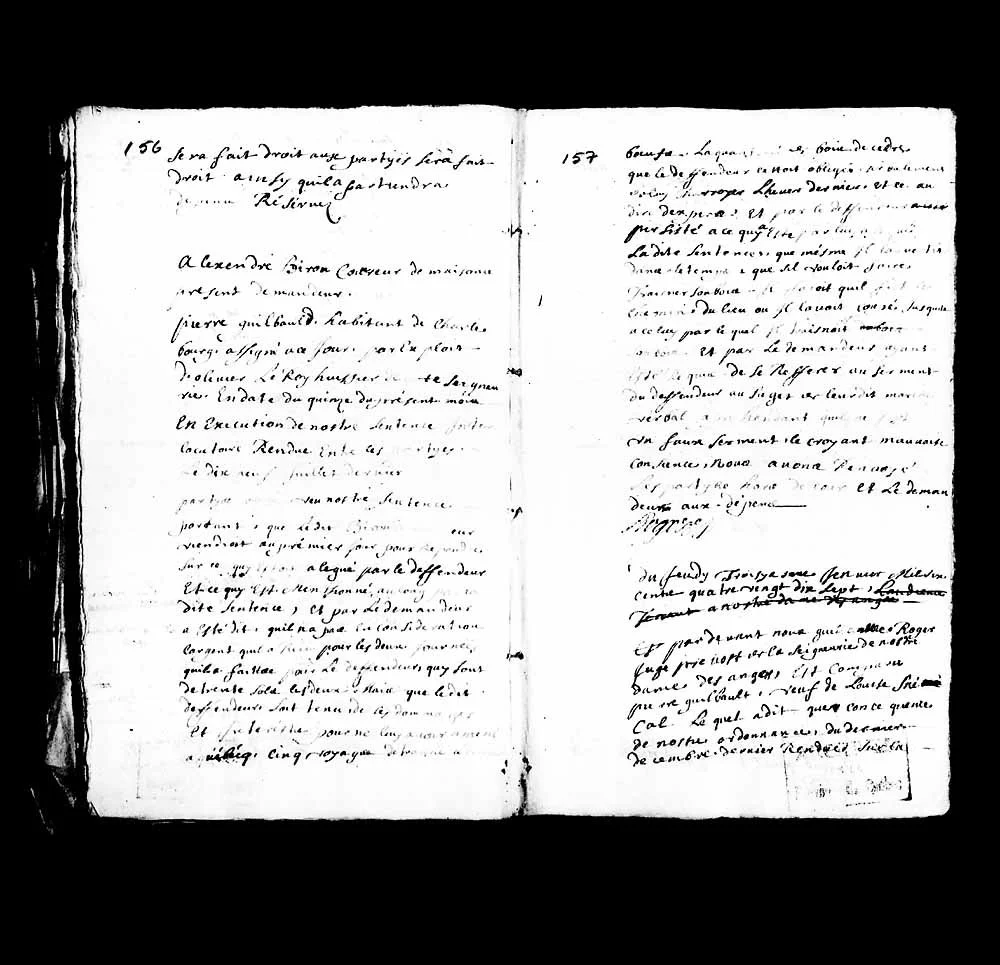


Sources
- Parish and hospital registers Notre-Dame-de-Québec, 6 October 1667 (marriage); baptisms 1668, 1672, 1675, and 17 December 1679 (Elisabeth). St-Charles-Borromée de Charlesbourg, 7 January 1697 (marriage of Pierre Guillebo and Françoise Le Blanc). Hôtel-Dieu de Québec, register of patients, 1697, p. 325; burial, 5 October 1697.
- Notarial acts
• Contrat de mariage de Pierre Guilbault et Marie Le Moyne, 8 novembre 1665, greffe de Michel Fillion; Archives nationales à Québec, CN301.
• Contrat de mariage de Pierre Guillebaut et Marie Lorteau, 10 juillet 1667, greffe de Gilles Rageot; Archives nationales à Québec, CN301.
• Contrat de mariage de Pierre Guillebault et Louise Sénécal, 30 septembre 1667, greffe de Pierre Duquet de la Chesnaye; Archives nationales à Québec, (03Q,CN301,S95).
• Marché entre Adrien Michelon et Pierre Guillebaut, 27 août 1669, greffe de Romain Becquet; Archives nationales à Québec, CN301.
• Vente d'emplacement par Louis Bédard à Pierre Guillebaud, 7 septembre 1692, greffe de François Genaple; Archives nationales à Québec, (03Q,CN301,S114).
• Contrat de mariage de Pierre Guillebault et Jeanne Morin, 13 avril 1693, greffe de Louis Chambalon; Archives nationales à Québec, (03Q,CN301,S58).
• Accord entre Françoise Leblanc, veuve de Pierre Guillebault, et ses héritiers, 10 novembre 1697, and Cession par Étienne Guillebault, 14 février 1698, greffe de Louis Chambalon (indexed vol. XVIII pp. 199, 203). - Court records — Bailliage seigneurial de Notre-Dame-des-Anges
Archives nationales à Québec, Collection Pièces judiciaires et notariales.
• Procuration donnée par Alexandre Biron à Étienne Maranda (Marandeau), huissier, 8 juillet 1696, (03Q,TL5,D2769-96).
• Acte de tutelle concernant Étienne Guilbault, 3 janvier 1697, (03Q,TL5,D2769-110).
• Ordonnance du juge prévôt Guillaume Roger, 24 janvier 1697, (03Q,TL5,D2769-112).
• Clôture de l'inventaire des biens de la communauté entre Pierre Guilbault et la défunte Louise Senécal, 1er février 1697, (03Q,TL5,D2769-113).
• Ordonnance du juge prévôt Guillaume Roger, 28 février 1697, (03Q,TL5,D2769-119). - Conseil souverain
Archives nationales à Québec, Fonds Conseil souverain.
• Arrêt ordonnant d'accorder des lettres d'émancipation d'âge en faveur d'Étienne Guilbeault, 7 janvier 1697, (TP1,S28,P4979).
• Lettres d'émancipation d'âge en faveur d'Étienne Guilbeault, 7 janvier 1697, (TP1,S28,P4980). - Census and map
Recensement de 1667 and Recensement de 1681, Nouvelle-France; Library and Archives Canada.
Plan de la seigneurie de Notre-Dame-des-Anges, copied 22 February 1788 by J. McCarthy from the original of Ignace Plamondon, 19 May 1754; Archives nationales à Québec, Fonds Ministère des Terres et Forêts, (E21,S64,SS5,SSS17,P58). - PRDH-IGD Programme de recherche en démographie historique, Université de Montréal. Pioneer file, Pierre Guilbault; Individual no. 30657; Families nos. 2198, 7766; Marriage no. 66733; Burial no. 72950.
- Compiled genealogies Denis Beauregard, Genealogy of the French in North America, families 965 (Pierre Guilbault & Louise Sénécal) and 4356 (Pierre Sénécal & Françoise Campion), citing the Fichier Origine (no. 17), PRDH and Parchemin; and for Louise's place among the Filles du Roi, Yves Landry (no. 371) and Silvio Dumas (no. 334).
A note on what is still missing. Louise Sénécal's death and burial; any court record of the separation named in 1679; Pierre's baptism in either of the parishes named for him; the inventory of 4–5 January 1697; and the text of the accord that settled the estate in November 1697.
Related Reading
Are You Connected to the Guilbault Line?
If you descend from the Guilbault (Guilbeau, Guilbeault) family of Charlesbourg and the Quebec parishes, from the children of Marie Josephte Abitakijikokwe, or from the founding families of the line — Senécal, Séguin dit Ladéroute, Morin, Couillaud dit Roquebrune, Gaulin — I’d like to compare notes. Documented trees, DNA matches, family papers, and even half-remembered stories have all moved this research forward.
Get in Touch About This FamilyCousin connections are informal and reciprocal — no fee, no obligation, just shared work on shared ancestry.
Every Family Has a Story Worth Telling
Whether you're just beginning your research or ready to transform years of work into a narrative your family will treasure, I'd love to help.
LET'S TALK ABOUT YOUR FAMILY