
Jean Bernardin Suliere fils 1744-1820
Jean Bernardin Suliere fils
Birth: 11 April 1744, L'Assomption — baptised the same day
Father: Jean Bernardin Suliere (Episode 2) · Mother: Marguerite Payment dit Larivière, buried 2 May 1744
Godfather: Jean Suliere, his paternal grandfather (Episode 1)
Marriage: 27 January 1766, L'Assomption — Marie Thérèse Migneron dit Rivière
Children: sixteen recorded, 1766–1786. Six married; five buried in infancy or childhood.
Occupation: journalier — day labourer, from his burial act
Residence at death: l'Isle-Jésus
Death: 6 August 1820 · Burial: 8 August 1820, Terrebonne (St-Louis)
A note on evidence
This page follows the standard of the rest of the series. What a record states is kept separate from what a database reports, and database records are given as tables rather than as card images. The parish register acts reproduced here are from the copy photographed at the presbytery or the greffe; every image has been examined, and where an act is quoted the transcription is a working reading rather than a collated one.
A warning specific to this man. He is not his half-brother. Jean Bernardin, born 1744 to the first marriage, and Jean Baptiste, born 1751 to the second, are two people, and documents belonging to each have been catalogued under the other in more than one database. Jean Baptiste died at Sandwich in Upper Canada in 1831; Jean Bernardin was buried at Terrebonne in 1820. Anything found under either name should be checked against the parents before it is used.
Introduction
On 11 April 1744 a boy was baptised at Saint-Pierre-du-Portage the day he was born, and given his father's name. His paternal grandfather stood as godfather. Three weeks later his mother was buried.
He lived seventy-six years. He married once, fathered sixteen children, moved his household at least four times, buried five of those children small, and worked as a journalier—a day labourer, hired by the day, holding no land. He is the fourth generation of this family and the third in a row who could not sign his name.
1744
11 April 1744 The baptism is transcribed in full in Episode 2, where it belongs to his parents' story. Two things in it matter here.
The first is the godfather: Jean Suliere, the child's paternal grandfather, the subject of Episode 1, who had come from the farm above the portage. The second is what the act does not say.
He was not born motherless
The baptismal act of 11 April 1744 says nothing about the mother dying, and a priest recording a birth that had just killed a woman would ordinarily say so. Marguerite Payment was buried on 2 May—three weeks later, with a baptism entered in the register between the two acts—and her burial records that she was confessed, received the viaticum, and was anointed. A woman killed by a delivery does not ordinarily have time for all three.
So this child was not handed to a wet nurse on the day of his birth. His mother lived some weeks after bearing him, long enough to be prepared for death in the ordinary way. What killed her is not stated in either act, and no date of death is recorded. Puerperal fever fits the interval better than anything else and remains unproved.
The same grandfather who held him at the font on 11 April stood as a witness at his mother's grave on 2 May.
| Rank | Name and role as printed | Pr. |
|---|---|---|
| 01 | Jean Bernard SULIERE | p |
| 02 | Jean Bernard SULIERE — father of 01 | p |
| 03 | Marguerite PAYEMANT LARIVIERE — mother of 01 | p |
| 04 | Jean SULIERE — godfather | p |
| 05 | Therese GODRY BOURBONNIERE — godmother | p |
| 06 | Jean Baptiste LESAGE — spouse of 05 | — |
| 07 | Xxxxx DEGEAY — prêtre | p |
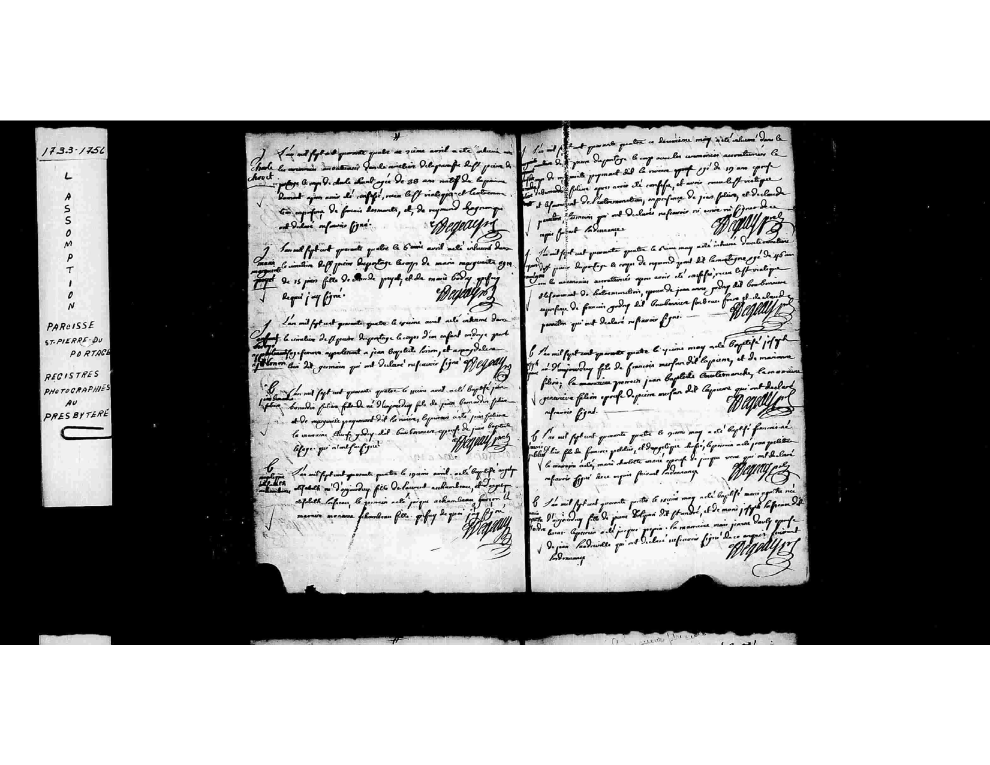
The baptism of 11 April 1744, Saint-Pierre-du-Portage. Godfather Jean Suliere; godmother Thérèse Godry dit Bonbonnière, wife of Jean Baptiste Lesage. Neither could sign.
Marriage, 27 January 1766
27 January 1766 At twenty-one he married Marie Thérèse Migneron dit Rivière at L'Assomption, daughter of Joseph Migneron and Marie Anne Dalpé Pariseau. Both were resident in the parish. His father was living; his mother had been dead twenty-two years, and the record marks her so.
The wedding fell three years after the Treaty of Paris. He was among the first generation of this family to marry under British rule, in a parish where the registers went on being kept in French and the curé went on saying Mass in Latin.
| Rank | Name and role as printed | M.S. | Pr. |
|---|---|---|---|
| 01 | Jean Bernard SULIERRES — spouse of 02 · residence L'Assomption | c | p |
| 02 | Therese MIGNERON — spouse of 01 · residence L'Assomption | c | p |
| 03 | Jean Bernard SULIERRES — father of 01 | — | — |
| 04 | Marguerite PAYMAN — mother of 01 | — | d |
| 05 | Joseph MIGNERON — father of 02 | — | — |
| 06 | Marie Anne PARIZEAU — mother of 02 | — | — |
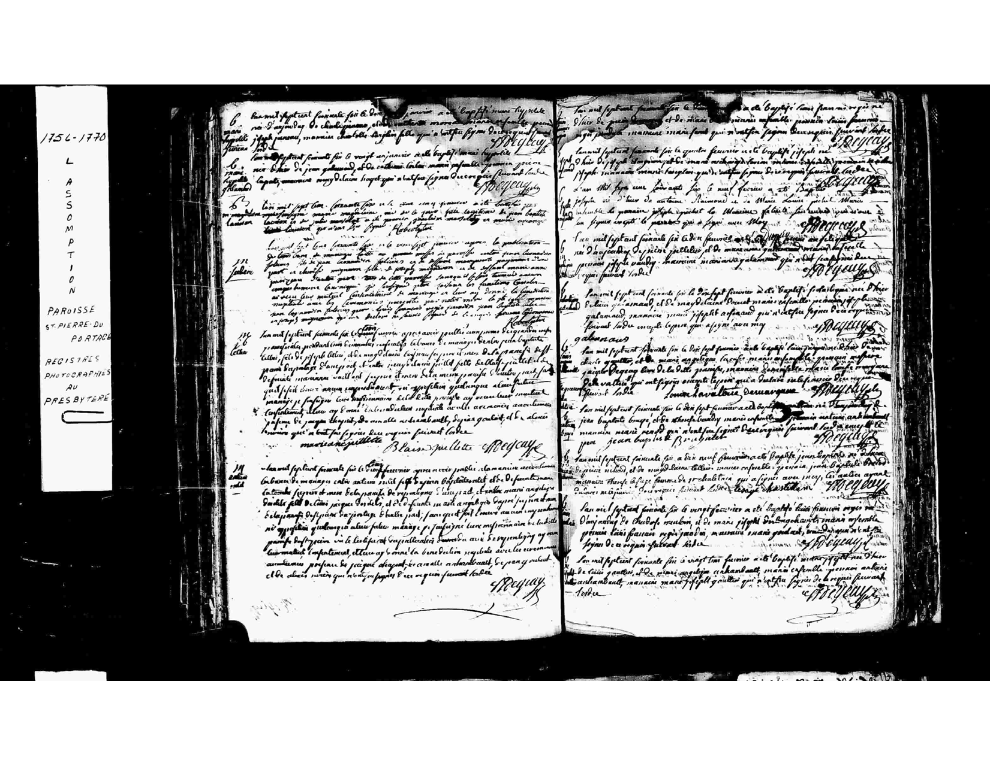
Marriage of Jean Bernard Suliere and Marie Thérèse Migneron dit Rivière, 27 January 1766, L'Assomption.
Sixteen Children
Between December 1766 and April 1786 the couple had sixteen recorded children. Six married. Five were buried small. The rest disappear from the record without a marriage or a burial attached.
| Child | Birth | Marriage | Death |
|---|---|---|---|
| Jean Bernard | 22 Dec 1766L'Assomption | 10 Feb 1794, Marie Josèphe TherrienLachenaie (St-Charles) | 5 Jan 1827Terrebonne |
| Jacques | 24 Jun 1768L'Assomption | 7 Jan 1799, Marie Elisabeth PoulinOka (L'Annonciation) — Episode 4 | — |
| Jean Baptiste | 16 Apr 1770L'Assomption | — | 19 Aug 1770aged four months |
| Pierre | 2 Jun 1771L'Assomption | 21 Feb 1803, Catherine TrottierPointe-Claire | 31 May 1850Pointe-Claire |
| Marie Thérèse | 1 Feb 1773L'Assomption | — | 5 Mar 1777aged four |
| Marie Angélique Alice | 21 Dec 1774L'Assomption | 29 Oct 1810, Joseph Riquet LaverdureTerrebonne | 12 May 1856Rivière-des-Prairies |
| Louis | 27 Aug 1776L'Assomption | — | 7 Mar 1777aged seven months |
| Jean Baptiste | 14 Dec 1777L'Assomption | — | not recorded |
| Marie Archange | 27 Sep 1779Mascouche (St-Henri) | 7 Jan 1799, Joseph SimardRivière-des-Prairies | 6 Jul 1832Longueuil |
| Marie Louise | 18 Jun 1781Mascouche | — | not recorded |
| Marie Luce | vers 1782Rivière-des-Prairies | 1 Mar 1802, Michel MonarqueMontréal (Notre-Dame) | 31 Mar 1832 |
| Anonyme | 4 Jan 1783Mascouche | — | 4 Jan 1783the day of birth |
| Anonyme | 4 Jan 1783Mascouche | — | 4 Jan 1783the day of birth |
| Joseph Marie | 12 Apr 1784Mascouche | — | not recorded |
| Marie Catherine | 4 Apr 1786Mascouche | — | not recorded |
| Marie | not recorded | 11 Jan 1808, Basile CorbeilMascouche | — |
Two entries with no names
On 4 January 1783 the register at Mascouche records two children of this couple born and buried the same day, entered as anonyme. Twins, ondoyés at birth and dead before they could be carried to the church and named. They are the eleventh and twelfth of sixteen.
And a week in March 1777. Marie Thérèse, aged four, was buried on the 5th. Louis, aged seven months, was buried on the 7th. Two days apart.
Where these come from, and one discrepancy
The sixteen births and their dates come from the PRDH family record for this couple, not from acts read for this page; four of the baptisms are reproduced below. Beauregard's family sheet lists a seventh married child—an Archange who married Jean-Baptiste Gendreau at Rivière-des-Prairies on 27 April 1824—whom the PRDH family record does not carry. Whether she is one of the daughters listed above under another name, or a child neither source has placed correctly, has not been worked out.
A Household on the Move
The birthplaces are the clearest evidence this page has for how the family lived, because they change.
Four parishes in twenty years
L'Assomption, 1766–1777 — the first eight children.
Mascouche (Saint-Henri), from 1779 — Marie Archange onward.
Rivière-des-Prairies, about 1782 — Marie Luce.
Mascouche again, 1783–1786 — the twins, Joseph Marie, Marie Catherine.
l'Isle-Jésus, by 1820 — where his burial act places him.
This is not the pattern of a man with land. A habitant stays where his concession is; a journalier goes where the work is. Four moves in twenty years, and a burial in a fifth parish thirty-four years later, is the shape of a life spent hiring out.
One register entry catches the family mid-move. In December 1777 the curé at L'Assomption baptised a Jean Baptiste, son of Bernardin Sullière et Marie Thérèse Migneron, and located the parents de Lachigan—on the Achigan, the river where the boy's own grandfather had taken a concession six years earlier. The godfather was Jean Baptiste Sullière: his half-uncle, born of the second marriage in 1751, the man later buried at Sandwich. Both readings need collating, and both are given here as provisional.
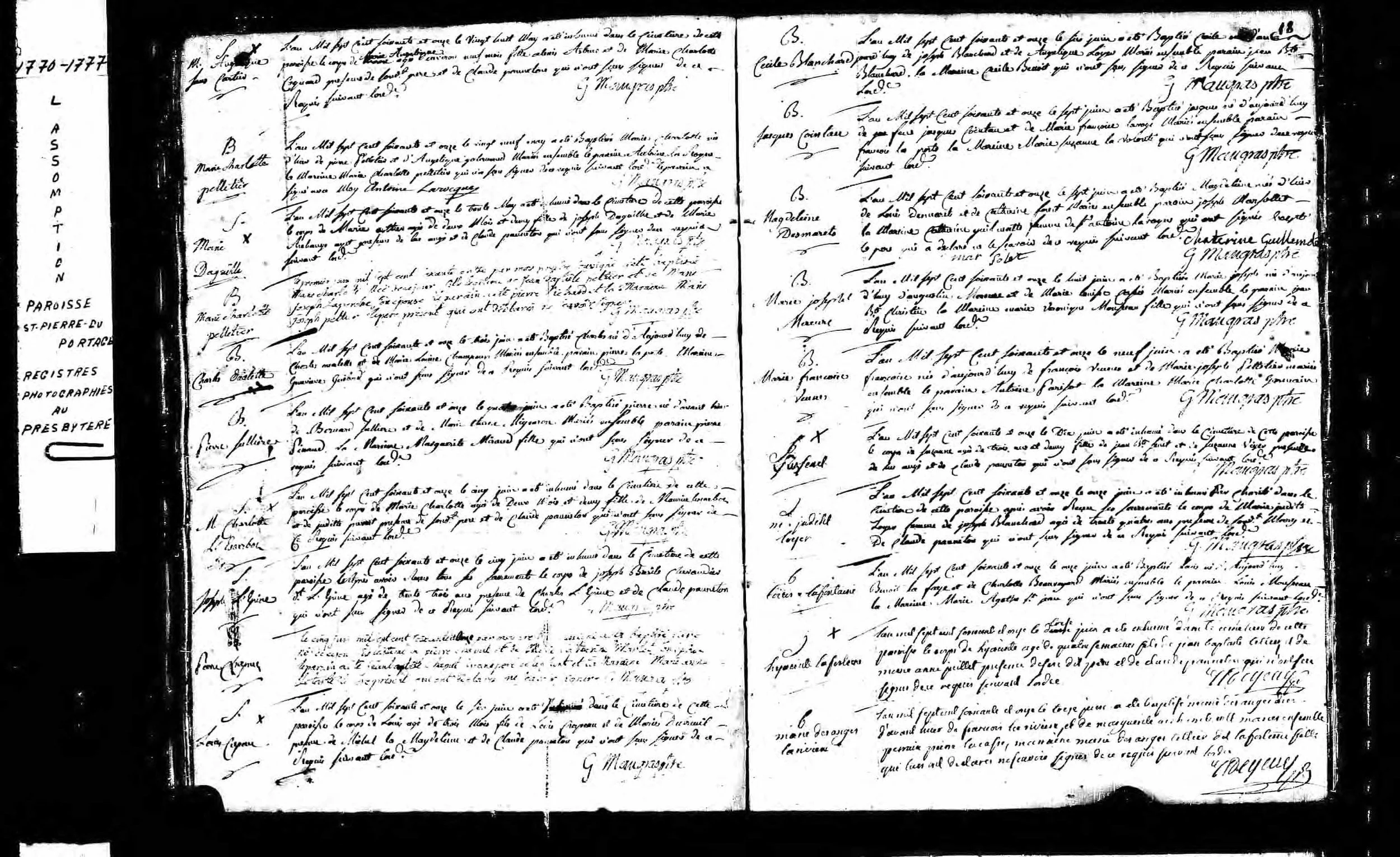
Baptism of Pierre, 4 June 1771, L'Assomption: né d'avant hier de Bernard Sullière et de Marie Thérèse Migneron. Godfather Pierre Simond, godmother Marguerite Miraud.
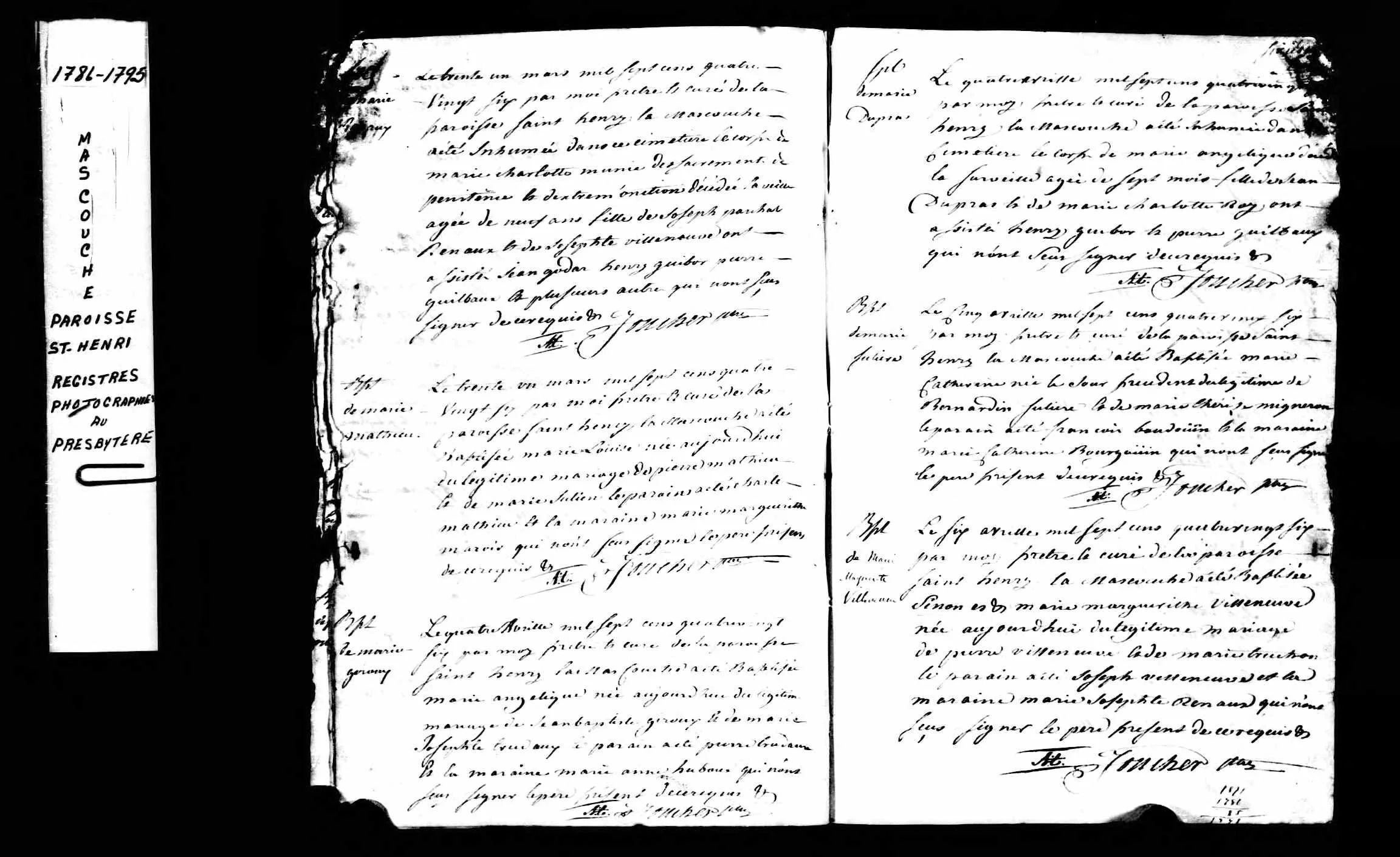
Baptism of Marie Catherine, 5 April 1786, Saint-Henri de Mascouche — the last of the sixteen, and twenty years on from the first.

Baptism of Louis, August 1776, L'Assomption. He was buried the following March, two days after his sister.
The Seventh of January, 1799
7 January 1799 On the same winter day, two of his children married in two parishes about forty kilometres apart. Jacques married Marie Elisabeth Poulin at the mission of the Lake of Two Mountains, at Oka. Marie Archange married Joseph Simard at Rivière-des-Prairies.
What the Oka act shows, and what it does not
The PRDH record of the Oka marriage names Jean Bernard Soulier and Thérèse Migneron as the groom's parents, and marks neither of them present. The bride's uncle and grandfather were there; her parents were not. There is no evidence that Jean Bernardin attended either wedding, and a man cannot be in two parishes at once. Whether the date was chosen deliberately, or two families simply settled on the same slack week after Epiphany, the records do not say.
Jacques Soulière, married at Oka that day, is the subject of Episode 4.
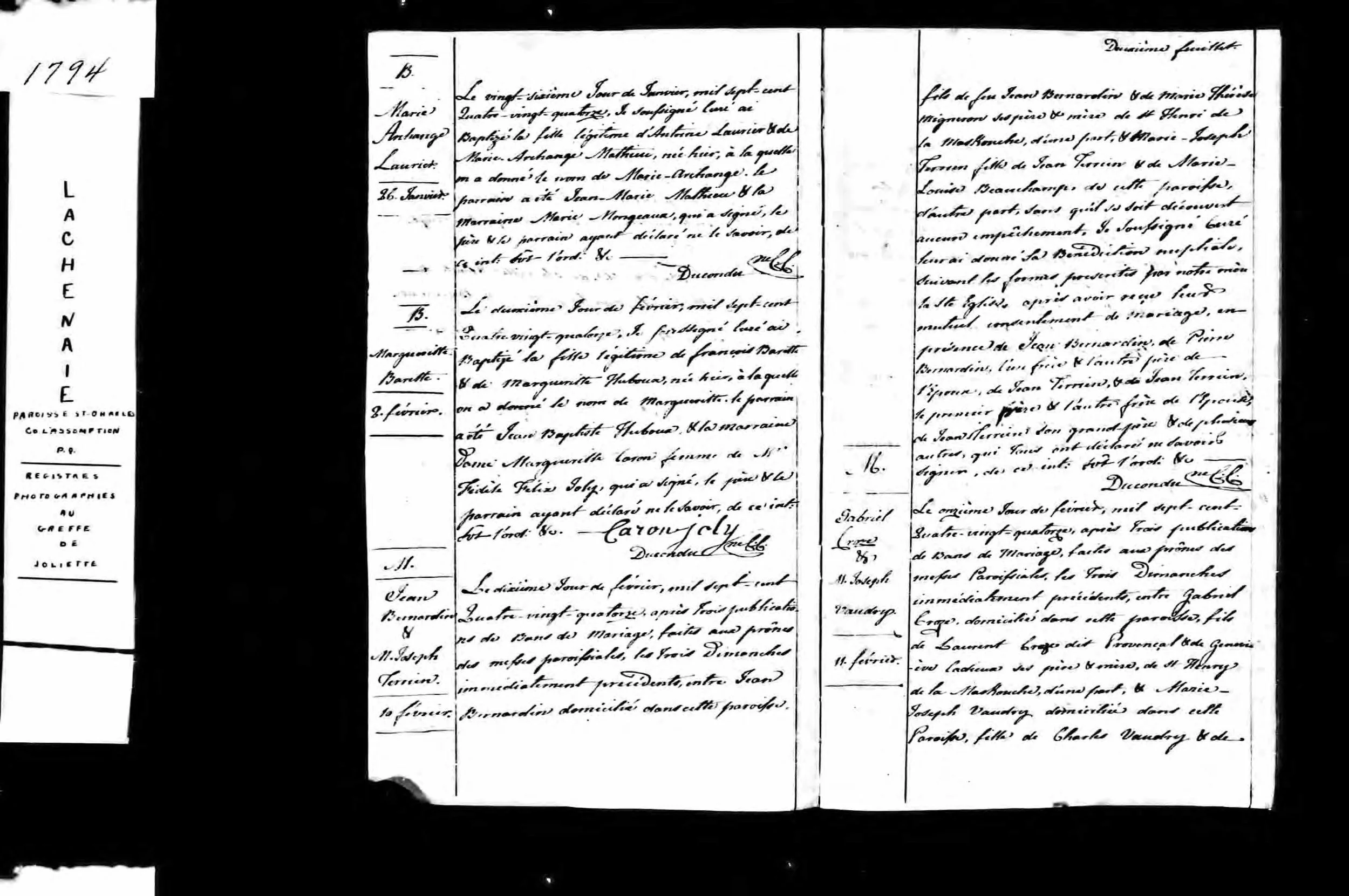
The eldest son's marriage at Lachenaie, 10 February 1794. The act places the groom's parents at St Henri de la Mascouche and names Jean Bernardin and Pierre among those present — the father and a brother.
Death, 1820
6 August 1820 He died, and was buried at Terrebonne two days later.
Burial, 8 August 1820, Saint-Louis de Terrebonne
« Le huit Aoust, mil huit cent vingt, je prêtre soussigné ai inhumé Jean Bernardin dit Soulière, journalier de l'Isle-Jésus, décédé avant-hier, âgé de soixante quatorze ans; témoins, François Dubé et Baptiste Legris, qui n'ont su signer. »
Parish register of Saint-Louis, Terrebonne, 1820. Signed St Germain ptre. Working reading, September 2026.
Three things in one sentence
He was a journalier of l'Isle-Jésus. Not of Terrebonne. He died on the island in the Rivière des Prairies—present-day Laval—and was buried across the water in the nearest parish that would take him. It is the only statement of his residence in the last thirty years of his life.
The age is wrong by two years. Baptised 11 April 1744, he was seventy-six, not seventy-four. Stated ages at burial were routinely approximate, and this one was supplied by whoever came to the presbytery.
The margin does not name him Soulière. The marginal heading reads only Jn Bernardin; the surname appears in the body of the act. An index built from margins will not find him under Soulière, which is part of why his records and his half-brother's have been confused.
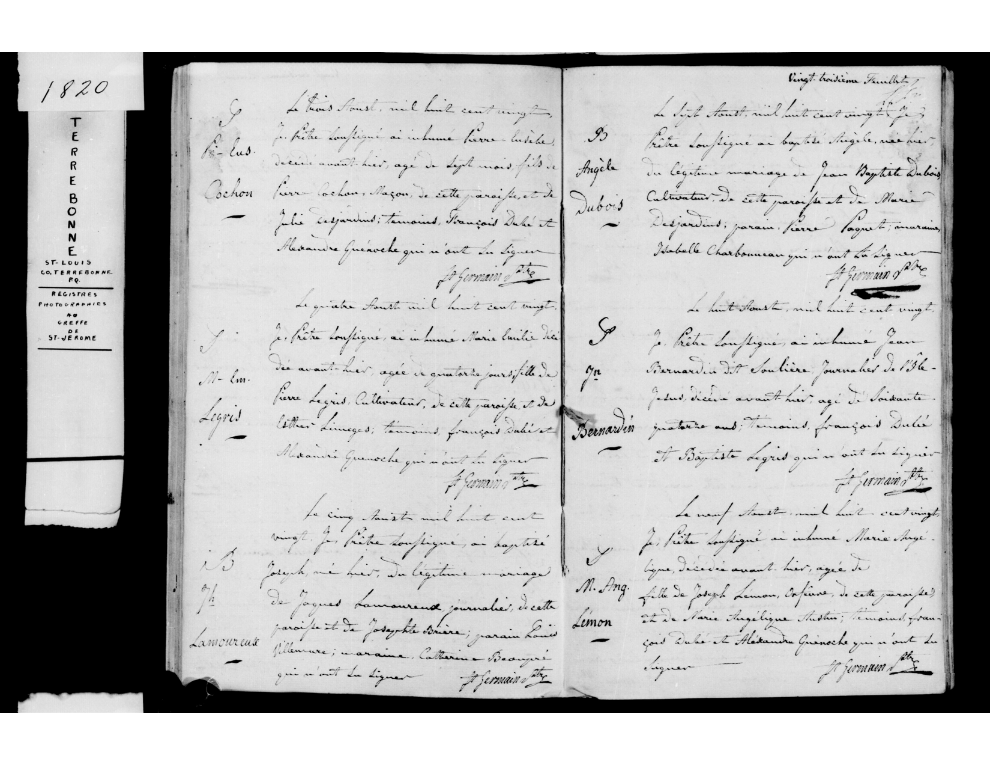
The act itself. In the register it stands second in the right-hand column, between a baptism of 7 August and one of the 9th; the same two witnesses, Dubé and Legris, run through the whole opening — parish regulars rather than family.
| Death | 6 August 1820 |
| Age as stated | 74 |
| Occupation | journalier |
Marie Thérèse, 1821
30 March 1821 Seven months later the same priest buried Thérèse Migneron, veuve de Jean Bernardin Soulière, died two days before, aged seventy-four. The witnesses were François Dubé again and Alexandre Guénoche. They had been married fifty-four years.
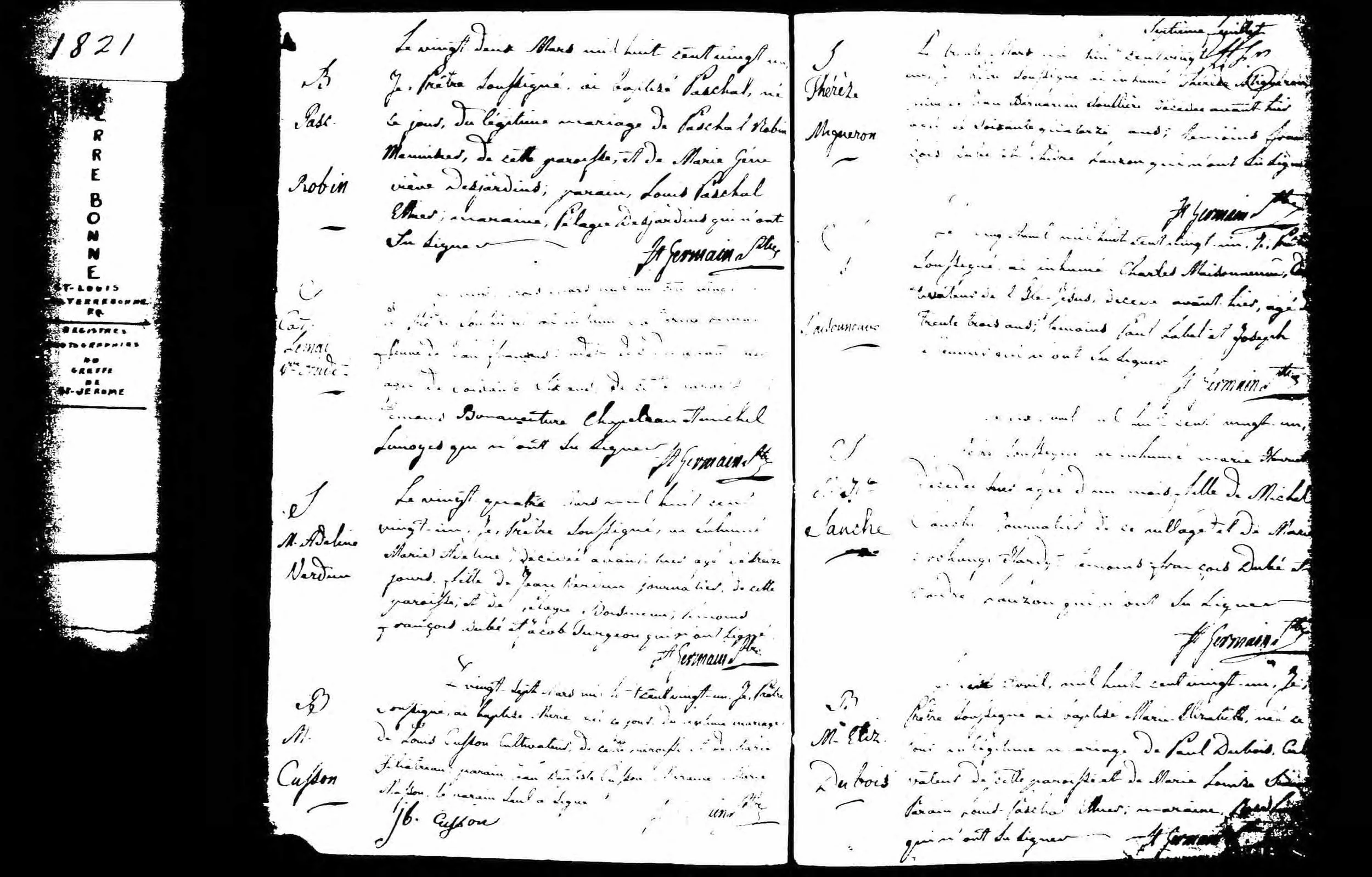
Burial of Thérèse Migneron, 30 March 1821, Saint-Louis de Terrebonne. Her act names her husband; his named no wife.
Legacy
He left no notarial act that has been found. No concession, no sale, no marriage contract, no inventory. For a man who never held land that is an accurate silence rather than a gap: a journalier owns nothing that needs a notary. Four generations into this family, the land his great-grandfather bought on the Île d'Orléans in 1697 and his grandfather took on the Rivière L'Assomption in 1718 had not come down to him.
What he left was children. Six of the sixteen married, into the Therrien, Poulin, Trottier, Riquet, Simard, Monarque and Corbeil families, across parishes from Oka to Pointe-Claire to Longueuil. Through Jacques, married at Oka on the seventh of January 1799, the line continues to Janvier Soulière, to Marie Louise Soulière, and to Emma Guilbault Hamall.
Document Gallery
The parish register acts behind this page. Database records are given as tables in the text above rather than here, so that what a database reports and what a record states are not shown side by side as though they were the same kind of evidence.
L'Assomption
Jean Bernardin & Thérèse Migneron
Pierre — L'Assomption
Louis — buried Mar 1777
Marie Catherine — Mascouche
Son Jean Bernard — Lachenaie
journalier de l'Isle-Jésus
Thérèse Migneron
Sources
Parish registers — parish copy, examined
- Burial of Jean Bernardin dit Soulière, 8 August 1820, Saint-Louis de Terrebonne. Transcribed above. Names him journalier de l'Isle-Jésus, aged seventy-four; witnesses François Dubé and Baptiste Legris. Signed St Germain ptre.
- Burial of Thérèse Migneron, widow of Jean Bernardin Soulière, 30 March 1821, Saint-Louis de Terrebonne. Died 28 March, aged seventy-four.
- Baptism, 11 April 1744, Saint-Pierre-du-Portage, L'Assomption. Transcribed in full in Episode 2.
- Marriage, 27 January 1766, L'Assomption. Examined; not transcribed here.
- Baptisms of Pierre (1771) and Louis (1776), L'Assomption; of Marie Catherine (1786), Saint-Henri de Mascouche. Examined; the Pierre act read.
- Marriage of the eldest son Jean Bernard and Marie Josèphe Therrien, 10 February 1794, Lachenaie (St-Charles). Places the groom's parents at Saint-Henri de Mascouche.
- Register pages, L'Assomption 1770–1777 and 1774–1779, containing further baptisms of this family. Examined; not transcribed.
Database
- PRDH-IGD, Université de Montréal — individual no. 119031; baptism no. 128514 (1744); marriage no. 219588 (1766); family record for couple no. 43199, which supplies the sixteen children; burial no. 2744626 (1820); marriage no. 773796 (Jacques at Oka, 1799). Rendered above as tables. Database fields are not transcriptions of acts.
Compiled
- Denis Beauregard, Généalogie des Français d'Amérique du Nord, family sheets [80758] (this couple) and [50434] (the eldest son and Marie Josèphe Therrien). Both carry the male line as presumed by convergence and attach a yDNA signature on that basis; a signature presumed by convergence is a hypothesis about descent, and nothing on this page rests on it. Sheet [80758] lists a married daughter the PRDH family record does not.
Not located, or not resolved
- Any notarial act naming him. No marriage contract, concession, sale or inventory has been found. For a landless journalier this may be an accurate silence rather than a gap in the search.
- What became of the six children who neither married nor were buried in the record: Jean Baptiste (b. 1777), Marie Louise (b. 1781), Joseph Marie (b. 1784), Marie Catherine (b. 1786), and the unnamed daughter Marie who married Basile Corbeil in 1808.
- The identity of Archange, married to Jean-Baptiste Gendreau at Rivière-des-Prairies in 1824 on Beauregard's sheet and absent from the PRDH family record.
- When and why the household left L'Assomption for Mascouche, and when it reached l'Isle-Jésus.
- Baptism and burial acts for twelve of the sixteen children.
- Collation of the December 1777 baptism, which appears to place the parents de Lachigan and to name Jean Baptiste Sullière as godfather.
Storyline Genealogy
From Research to Story
Are You Connected to the Souliere Line?
If you descend from the Souliere, Suliere, or Soulier (dit Tranchemontagne) family of L’Assomption and St-André-d’Argenteuil, from the nineteen children of Janvier Souliere Sr., or from the allied Gravel, Poulin, Migneron, Lacasse, or Lesage lines — whether your branch stayed in Quebec or came to Chicago — I’d like to compare notes. Documented trees, DNA matches, family papers, and even half-remembered stories have all moved this research forward.
Get in Touch About This FamilyCousin connections are informal and reciprocal — no fee, no obligation, just shared work on shared ancestry.
Every Family Has a Story Worth Telling
Whether you're just beginning your research or ready to transform years of work into a narrative your family will treasure, I'd love to help.
LET'S TALK ABOUT YOUR FAMILY