
Pierre Morin & Catherine Lemesle
Pierre Morin
& Catherine Lemesle
Quick Facts: Pierre Morin
Quick Facts: Catherine Lemesle
On the Military Identification
Almost every published account of Pierre Morin, including the earlier version of this one, describes him as a soldier of the Carignan-Salières Regiment. That description rests on a single line in the 1668 muster roll — a line carrying a name and nothing else. Two specialist compilations now assign it to two different men, and four soldiers named Morin served in the regiment.
This biography no longer asserts the service. It is recorded as unproven — not disproven — and the full analysis is in the companion case study.
1. The Hôtel-Dieu, November 1706
On the eighteenth of November, 1706, a man of fifty-six was carried through the doors of the Hôtel-Dieu de Québec. The Augustinian sisters who received him noted his name, his age, and his origin in their daily register: "Pierre morin agé de 56 ans de Poitou de la Paroise de Sᵗ Estienne de l'euesché de luson." It was the fourth time in his life that an official document recorded his parish of origin—and it would be the last.

Registre journalier des malades, 18 November 1706, entry 18. The word mort is written in the left margin, and the line closes: "mort le 12ᵐᵉ Decembre."
Thirteen days later, on the first of December, the sisters drew up the standing roll of everyone then in the house. Entry number one is "chaterine le mesle féme de Pierre morin agé de 50 ans." His wife. She had come to the hospital too—whether from the same illness, or from the exhaustion of nursing a dying husband at home, or because there was nowhere else to go. She was identified, as she would be for years afterwards, not by her own name alone but as the wife of Pierre Morin.
Pierre died eleven days after that roll was written, on the twelfth of December. Beside Catherine's entry the clerk later added sorty le 20. She was discharged eight days after her husband's death, and lived another fifteen years at least.
The burial register recorded him once more, with the fullest statement of his origin that survives anywhere: province, parish and diocese in a single line. Four documents across thirty-four years, four times the same story. He had been in New France since his early twenties at the latest. He never lost his parish.
He had also, it turns out, been coming and going from that hospital's affairs for most of his adult life. He held land from the Augustinian sisters before 1671 and was lodging in their house when he sold it. Half the price of the farm he bought the day before his marriage was owed to them. In the spring of 1690 he contracted to frame a house on ground beside their hospital. Sixteen years later they carried him in through the door.
This is the story of two lives the documents tell in fragments—a marriage contract here, a census entry there, a baptism, a burial, a land sale, a hospital admission. No diary survives. No letter. No portrait. Neither of them could write. What we know of Pierre Morin and Catherine Lemesle comes entirely from the paper trail of a colony that recorded its people with remarkable care, and from the work of genealogists across three centuries who have reassembled those fragments into families.
It also comes with a caution. Some of what this page said a year ago was wrong, and the corrections are set out at the end rather than quietly removed.
2. Poitou — A Parish Without a Baptism
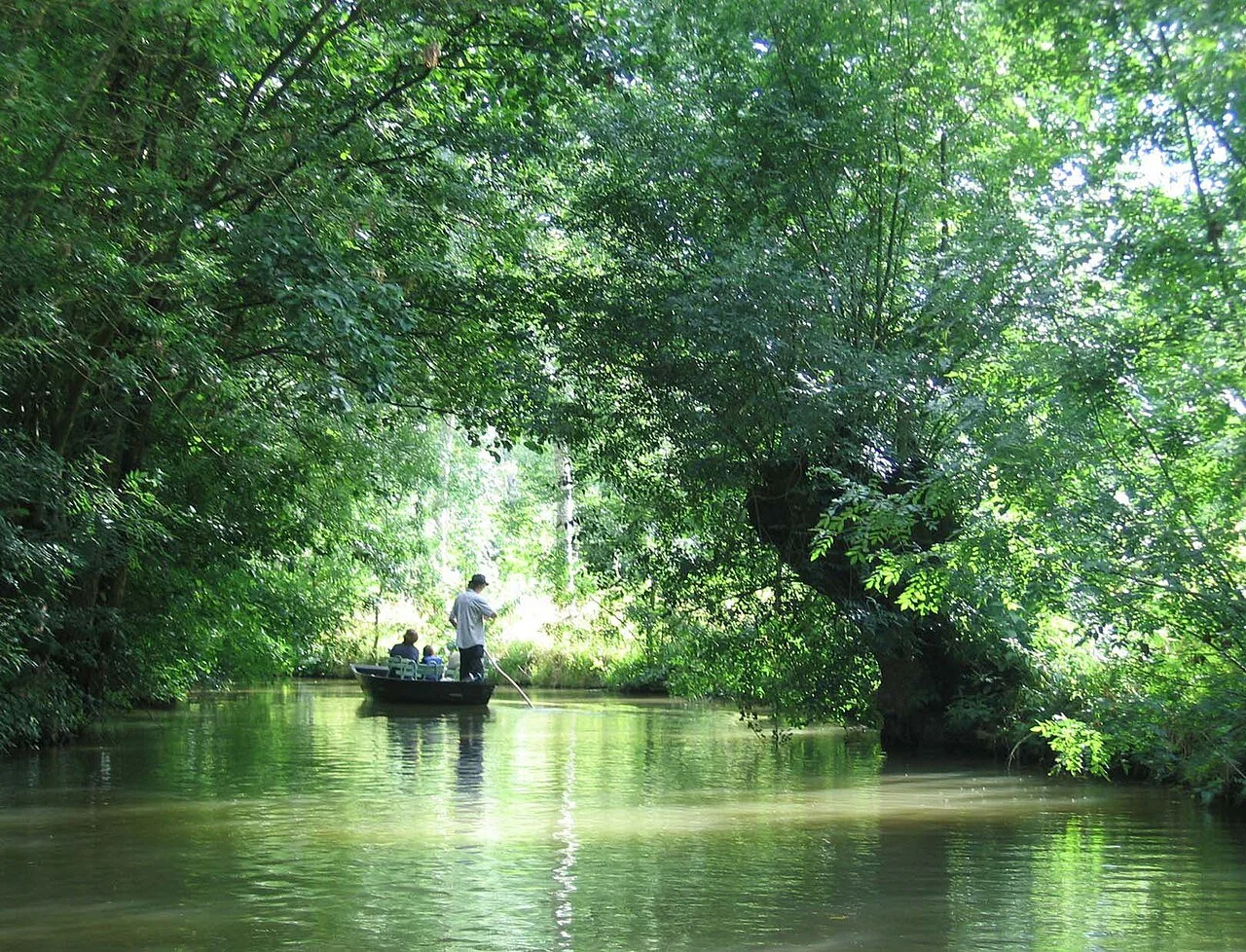
The Marais Poitevin—"Green Venice" of western France. The canals and wetlands near Saint-Étienne-de-Brillouet, where Pierre Morin was born. Photo: Gilbert Bochenek, CC BY 1.0.
Saint-Étienne-de-Brillouet sits in the Marais Poitevin—the "Green Venice" of western France, a landscape of canals and wetlands between La Rochelle and the Vendée coast. In the seventeenth century it was a small parish in the diocese of Luçon, a place of farmers and marshland workers on the edge of the Atlantic salt trade. It was here that Jacques Morin and Hilaire Guéry made their home, and here that their son Pierre was born around 1648.
The year is an estimate, and the estimates disagree. Three database compilations give vers 1648; Michel Langlois gives around 1647. His burial gives an age of fifty-six in December 1706, which points to 1650. The 1681 census gives thirty-four, pointing to 1647. This biography follows the compilations at 1648 and lets the spread stand.
What is not in doubt is the parish. Four documents across thirty-four years name it: the marriage contract of 1672, calling him son of "deffunt Jacques Morin et deffunte Hilaire Guéry de la paroisse de St Estienne de Brilloet Evesché de Luçon"; both copies of the marriage banns, spelling it phonetically as "Sᵗ Etienne de Briloy"; the Hôtel-Dieu register of 1706; and the burial register of the same month. Across different scribes, different decades, different circumstances—from a notary's quill to a nursing sister's pen—the same parish surfaces again and again.
A qualification this page previously omitted. Those four documents are four independent records. They are not four independent informants. Each traces back to Pierre or his household telling a scribe where he came from, and no French register has ever been located to verify it. The Fichier Origine, which admits an immigrant only once a French document has been found, carries no record for him.
Consistency across thirty-four years is remarkable and remains the strongest feature of his record. It is simply not external verification, and this page no longer describes it as though it were.
Nor do the eight notarial acts he signed—or rather did not sign—between 1671 and 1690 add a fifth statement. Not one of them names a parish or a parentage.
The baptism itself has never been found. The registers of Saint-Étienne-de-Brillouet have gaps in the late 1640s, and Pierre's baptism has eluded generations of researchers. Searches under variant spellings—Maurin, Mourin—have produced nothing. No siblings have been located either, which means the presence of Jacques Morin and Hilaire Guéry in the parish cannot be independently confirmed from French records at all. It is known only because their son, decades later and an ocean away, told a notary in Québec who his parents were.
Both were dead by the time he married. The banns record them as "deffunt Jacques Morin" and "deffunte Hilaire Guéry." Whether they died before or after he left France is unknown. He was an orphan with nothing to hold him in a parish that has left no trace of his beginning.
Research Note: The Missing Baptism
The Archives départementales de la Vendée have digitised the parish registers for Saint-Étienne-de-Brillouet, but gaps exist in the late 1640s. FamilySearch Film 2288454 (mixed BMS records, 1647–1668) and the neighbouring parishes of Sainte-Hermine and Thiré remain to be searched. Note that the search window should cover 1645 to 1650: the working figure of c. 1648 is a midpoint between conflicting statements, not a documented year.
3. A Name on a Muster Roll
In 1665 Louis XIV sent the Carignan-Salières Regiment to New France—roughly 1,200 soldiers in twenty-four companies, the first professional military force the colony had seen. Their task was to end the Haudenosaunee raids that had brought the settlement to the edge of collapse. Company by company they built a chain of forts along the Richelieu, the invasion corridor running north from present-day New York: Sorel, Chambly, Sainte-Thérèse, Saint-Jean. In 1666 they marched into Mohawk territory under Alexandre de Prouville de Tracy, burned villages, destroyed crops, and forced a peace that held for nearly two decades. It is one of the reasons New France survived long enough to become a colony rather than a trading post.
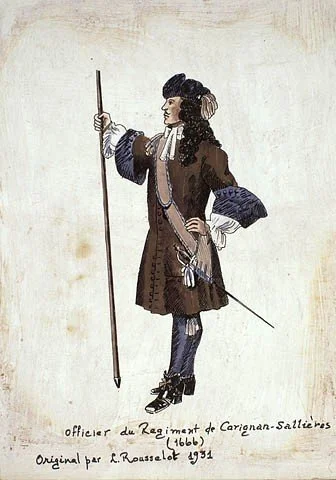
Officier du Régiment de Carignan-Salières, 1666. Original by L. Rousselot, 1931. The brown justaucorps and blue cuffs were the regiment's colours.
When the regiment was disbanded in 1667–68, roughly four hundred of those men chose to stay. Colonial administrators drew up a list of them: the Rolle des Soldats du Regiment de Carignan Salière qui se sont faits habitans de Canada en 1668, nine handwritten pages arranged by company. It survives at Library and Archives Canada.
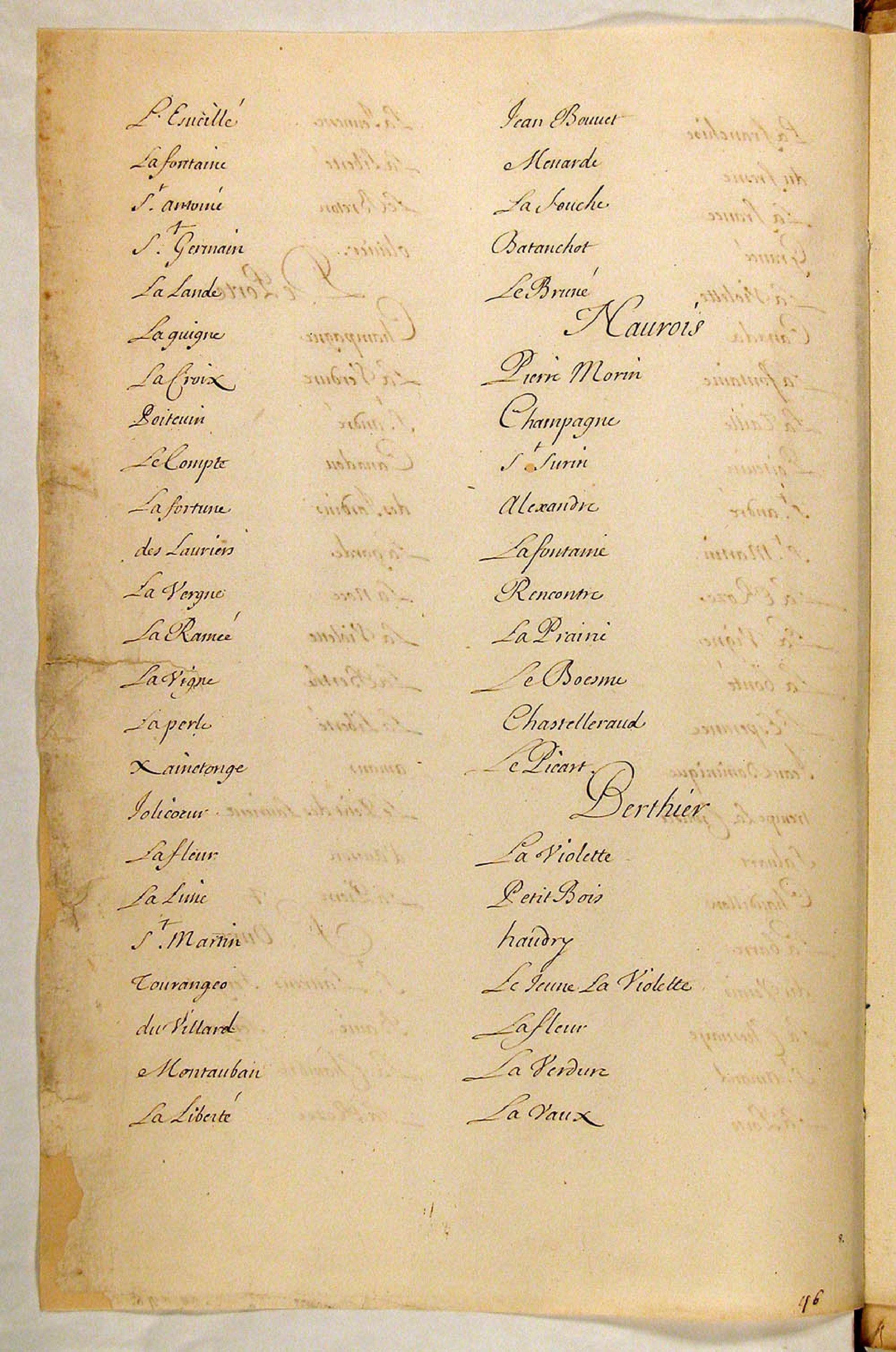
On page eight, under the heading Naurois, the first name written is Pierre Morin.
For most of a year, this page treated that line as the answer. It is not. The roll gives a name and nothing else—no age, no origin, no parentage, no means of telling one Pierre Morin from another. And there were several. Peter J. Gagné's study of the regiment, published in 2025, devotes four consecutive entries to men of that surname: an officer killed in a Mohawk ambush near Fort Sainte-Anne in 1666; Charles Morin, a miller of the Chambly company; Nicolas Morin dit Larose, also Chambly; and a Pierre Morin born about 1643 in the diocese of Saintes, whom Gagné assigns to Naurois and describes, in as many words, as not the Pierre Morin who married Catherine Lemesle.
Michel Langlois assigns the same line to our Pierre.
Neither has a document that says so. Both reason from association—from the company Pierre Morin kept, and from where he lived. That reasoning is not worthless; it is simply not proof, and this biography no longer treats it as such.
What this page said before. Section 3 formerly stated that Pierre served in the Compagnie de Naurois under Captain Pierre de Naurois, who received the seigneury of Lanoraie in 1672. Every part of that is now withdrawn. There was no Captain Pierre de Naurois: the company's captain was Louis de Niort de La Noraye, born 1639, married at Québec in February 1672, granted a seigneurial concession in 1688 and dead in 1708. La Noraye was his own name; Naurois is the roll clerk's phonetic spelling of it. And the assignment of the roll's Pierre Morin to this man is disputed.
The full account is in the case study.
One thing has changed since that section was rewritten, and it cuts against the soldier reading without settling anything. Between 1671 and 1690 the notary Gilles Rageot drew eight acts for this man—land sales, a purchase, a boundary agreement, a building contract. In none of them is he called a soldier or a former soldier. This is the same Rageot who, in August 1668, wrote Soldat de la Compagnie du Sr de Norrouest into François Trotain's marriage contract. He recorded a company when a man had one.
That is not evidence that Pierre never served. A man demobilised in 1668 is an habitant by 1671, and a notary describes people by what they are on the day. But the word is not there, across nineteen years and eight documents, and this page will not supply it.
One detail from the roll is worth keeping, whoever the man was. Of the ten soldiers under the Naurois heading, he is the only one the clerk wrote out in full. The others appear as Sᵗ Surin, Rencontre, La Prairie, Chastelleraud, Le Picart—war names, not surnames—or by a surname alone, or, in one case, by a given name and nothing more. Three hundred and fifty-eight years later, that accident of clerical habit is the reason anyone is arguing about him at all.
4. The Missing Years — and the First Document, 1665–1671
Between the regiment's arrival and Pierre Morin's marriage lie seven years. Until recently this page could put nothing in them at all.
The 1667 census offers a candidate, and it is a candidate this page no longer accepts. At Petite-Rivière on the Côte-de-Beaupré, in the household of Simon Guyon and his wife Louise Racine, the enumerator recorded a servant: "Pierre Martin, age 22, domestique." Martin and Morin are among the most commonly confused surnames in colonial French records. The status—unmarried male servant—is typical of a young man not yet established on his own land. For a year this page identified him as Pierre Morin, and read the 1672 marriage banns, which describe Pierre as habitant de la Petite Rivière, as independent confirmation of the same place.
That identification has been withdrawn. The two Petite Rivières are not the same place. The notarial acts name the family's as la petite Rivière St Charles, and the 1681 census puts them and their entire circle of godparents at Petite Auvergne on that river, beside Québec—some sixty miles from the Beaupré parish.
With that corroboration gone, "Pierre Martin" is one servant with a similar name in a different place. Worse for the identification: an age of 22 in 1667 implies a birth about 1645—closer to the other candidate on the muster roll than to ours. This page no longer offers the entry as evidence.
29 September 1671 — the first certain document
What has replaced it is better, if less romantic. On 29 September 1671, before the notary Gilles Rageot, a Pierre Morin demeurant à l'Hospital de cette ville—living at the hospital of this town—sold a concession of land to François Baribault of Charlesbourg for seventy-two livres tournois, payable by instalments and secured against the land itself. Two witnesses, Jacques de la Touche and Guillaume Renaud, signed with the notary. Pierre declared he did not know how to write or sign.
It is a small act about a small piece of ground, and it is the earliest record in which this man certainly appears. It tells us three things. He was in Québec in September 1671, two months after that year's ships came in. He was lodging with the Augustinian sisters of the Hôtel-Dieu, in a house belonging to their community. And he already held land—which the act says he had from the Religieuses Hospitalières themselves, by an earlier contract passed before the notary Paul Vachon.
That earlier contract has never been read. It is now the most promising unexamined document in this family's file, because a concession names its grantee more fully than a resale does, and a religious community keeping title records is careful about whom it grants to. If any surviving paper states where the man who married Catherine Lemesle came from, in a hand other than his own report, it is likely to be that one.
So the seven years are no longer entirely empty. A young man arrives, hires himself out or takes work he has left no record of, acquires a small concession from the nuns, lodges in their house, and in the autumn of 1671 sells the land on. Nine months later he was married.
5. A Marriage Arranged by the Crown — June 1672
Catherine Lemesle was baptised on 16 April 1646 in the parish of Saint-Pierre-du-Châtel, a medieval church in the heart of Rouen. Her father, Jean Lemesle, was a marchand bourgeois—a merchant of standing. Her mother was Marguerite Renard. The baptismal record survives in the archives of the Seine-Maritime, one of very few documents tracing her life before she boarded a ship for Québec.
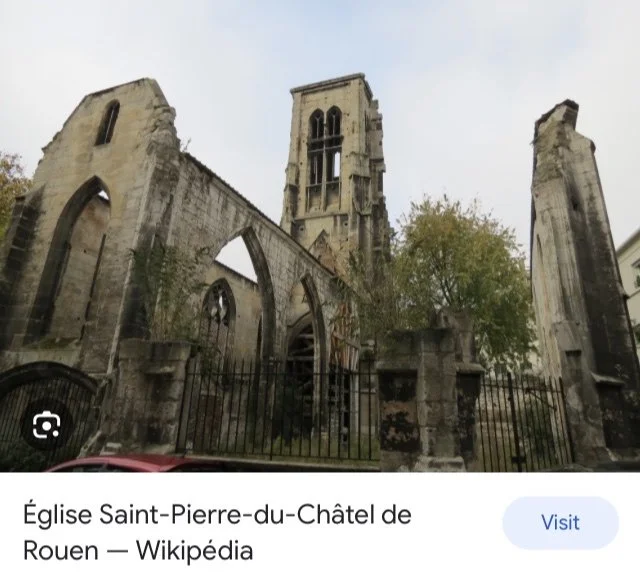
Saint-Pierre-du-Châtel, Rouen—where Catherine Lemesle was baptised in 1646.
Both her parents were dead before she reached New France. She came as a Fille du Roi—one of roughly eight hundred young women sent to the colony between 1663 and 1673 under royal sponsorship, each carrying a dowry to attract a husband. Catherine's was 200 livres, of which 50 came directly from the King. The Fichier Origine estimates her arrival at 1671.
She could not sign her name. The Fichier Origine records it plainly. A merchant's daughter who could not write—perhaps orphaned too young for schooling, perhaps because the daughters of provincial merchants were simply not taught letters in the Rouen of the 1650s. What she brought instead was the King's backing and a willingness to cross an ocean.
3 June 1672 — a farm, the day before
On the third of June, before the same notary who would draw their marriage contract the next morning, Pierre Morin bought a farm.
The sellers were Jean Mérien dit LaSolaye and Barbe Le Baron his wife, habitants demeurant à la petite Rivière. What they sold was a habitation on that river, with its outbuilding and cabins, together with half of that year's standing crop. The price was four hundred livres tournois in principal and a further fifteen francs pour les épingles—the customary gratuity to a vendor's wife—making four hundred and fifteen in all. Half of it went not to the Mériens but to the Augustinian sisters of the Hôtel-Dieu, on the arrival of that year's ships: the sale was clearing a debt the family owed the monastery. Three nuns are named in the act and all three signed, and theirs are the clearest hands on the page.
Two men stood witness. One was Jacques Gauthier. The other was Pierre Baudin—Bodin—who would witness the banns the following week, whose household would be enumerated immediately above the Morins' in 1681, and who would stand godfather to their daughter Marie Jeanne in 1685. He appears in this family's records five times over thirteen years, and the first of them is here.
Pierre bought alone. No wife is named, no community of property is contemplated, no dower is charged against the land; he takes it pour luy, ses hoirs ou ayant cause. It is a single man's purchase, made the day before he signed a marriage contract, and it may explain the haste that follows. A man who has just taken on a farm in June, with half the standing crop included, has reasons to be married before the harvest.
He declared, once again, that he could not write or sign. Five years later Mérien acknowledged the whole four hundred and fifteen livres received, and gave him quittance.
4 June 1672 — the marriage contract
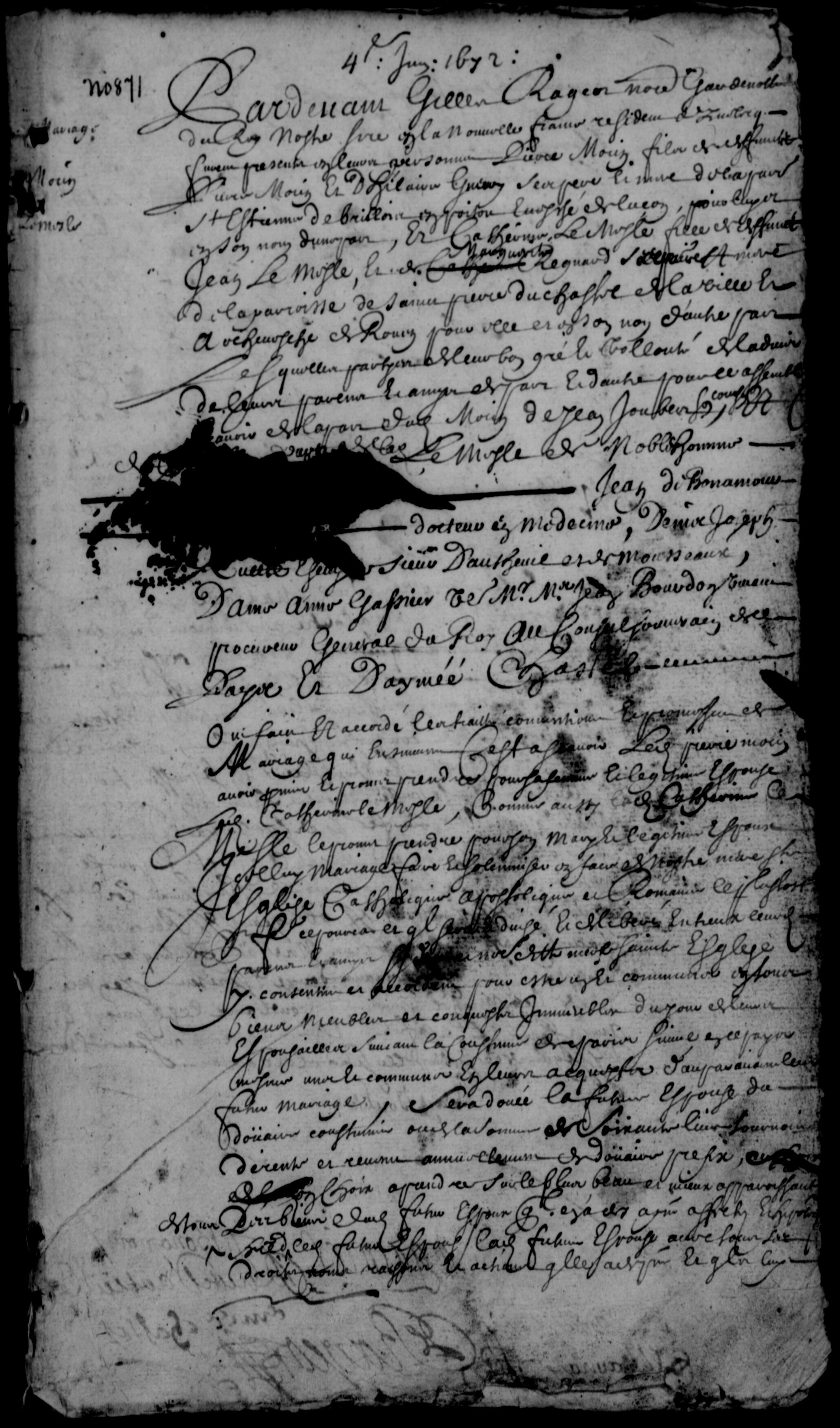
The next day Pierre Morin and Catherine Lemesle signed a marriage contract before Gilles Rageot. It specified a communauté de biens under the Custom of Paris, a douaire préfix of 300 livres, a préciput of 150, and a don mutuel ensuring the survivor inherited if there were no living children.
The contract does not use the word soldat. Pierre is given no military title at all. That silence is worth weighing carefully, because the same notary knew perfectly well how to record one: four years earlier, on 13 August 1668, Gilles Rageot had written François Trotain into a marriage contract as Soldat de la Compagnie du Sr de Norrouest. When Rageot had a company to record, he recorded it.

The signatures: A. Gasnier, J. Bonamour, Ruette d'Auteuil, Chastel, J. Michel, J. Maurray, and Rageot the notary. All witnesses. Neither the bride nor the groom is among them.
Among those who signed was Denis-Joseph Ruette d'Auteuil, a Seigneur and member of the Sovereign Council of New France—the colony's highest governing body. So did Dame Anne Gasnier, widow of Jean Bourdon, procureur général du Roi: the woman appointed by Intendant Talon to bring the Filles du Roi across the Atlantic and see them settled. She had chaperoned Catherine's crossing the previous summer, and eleven months later she put her name to Catherine's marriage contract. It is a small continuity of care that outlasted the voyage, and it survives only because somebody kept the paper.
What that company of witnesses does not do, on its own, is explain itself. Rageot's own index shows d'Auteuil executing an act of his own with the same notary on the same day. A witness list tells us who was in the room; it is weaker evidence than it looks of why.
Corrected. This page formerly stated that Pierre and Catherine both signed the contract, and that Pierre's signature confirmed his literacy. The signatures are witnesses only. The Fichier Origine records that Catherine could not sign, and the 1668 Trotain contract records a Pierre Morin among the friends who declared ne sçavoir signer. Neither of them could write their name. That is a fact about their lives, not a gap in the record, and the page now says so. The notarial acts of 1671, 1682 and 1690 record his declaration three more times.
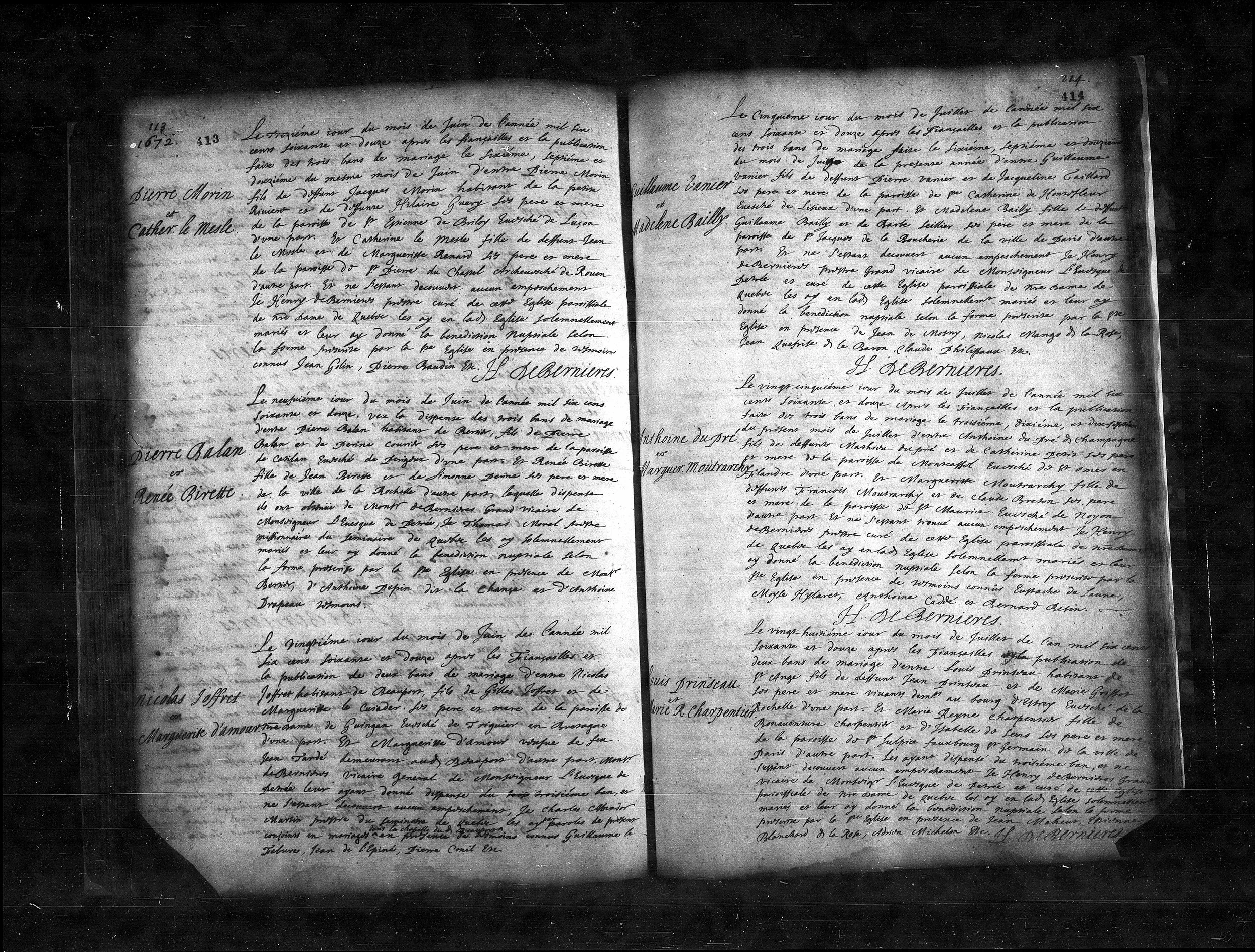
The banns were published on 6, 7 and 12 June 1672, with the marriage on the 13th—three publications inside a single week, where banns on consecutive days would normally require a dispensation. This page once explained the haste by Catherine's recent arrival. With her landing now estimated a year earlier, that explanation no longer works. The farm bought on the third of June is a better one, though it is a suggestion rather than a finding.
They were married at Notre-Dame-de-Québec on 13 June 1672 by Henry de Bernières, curé. He was about twenty-four. She was twenty-six. The witnesses were Jean Jolin and Pierre Baudin—Baudin for the second time in ten days.
One further detail about the notary. Gilles Rageot was married to Marie-Madeleine Morin, youngest daughter of Noël Morin, the master cartwright and Seigneur de Saint-Luc who is the other Morin ancestor in the Guilbault line. Pierre Morin's marriage contract was drawn up by the son-in-law of the most prominent Morin in Québec. Two unrelated families of the same name, one from Poitou and one from Brie-Comte-Robert, both flowing into the same family tree—and linked, at their earliest documented moment, by a notary who married into one and recorded the other's most important document.
6. The Petite Rivière Saint-Charles — Land, Neighbours, Eight Children
For a year this page described a family moving back and forth between the Côte-de-Beaupré and the capital—out to Petite-Rivière-Saint-François, in to the Basse-Ville of Québec, back out to Beaupré again. The records show something simpler and better. They did not move at all.
In June 1676 Rageot describes Pierre Morin as habitant demeurant à la petite Rivière St Charles. In March 1690, fourteen years later, he is still habitant de la petite Rivière. Between those two dates the 1681 census enumerates the family at Petite Auvergne, a côte in the seigneurie of Notre-Dame-des-Anges on the same river, immediately outside Québec. Pierre is 34, Catherine 35. They have one gun, five head of cattle and twelve arpents under cultivation, and four children at home: Marie-Anne 8, Jean 6, Pierre 4, Anne 2.
And the households around them are not strangers.
| Household on the côte | Ages | Who they are to this family |
|---|---|---|
| Pierre Bodin & Etiennette Desmarais | 40, 45 | Witness to the land purchase of 3 June 1672 and to the marriage banns days later; the adjoining property in the sale of 1676; godfather to Marie Jeanne in 1685. Listed immediately above the Morins. |
| Pierre Morin & Catherine Lemesle | 34, 35 | Marie-Anne 8, Jean 6, Pierre 4, Anne 2 |
| Jacques Hédoin & Jeanne Brassard | 50, 37 | Jeanne Brassard was godmother to Marie Jeanne in 1685; the household also supplied Marie Madeleine Hédouin, godmother in 1687. |
| Pierre Guillebeault & Louise Sénécal | 37, 40 | A separate ancestral line of this family's descendants, four households away. |
Every godparent this page once described as belonging to "a small rural community" at Beaupré lived within a few minutes' walk on the Saint-Charles. Bodin was next door. The Hédouins were down the côte. When Marie Jeanne was baptised in 1685 with Pierre Bodin as godfather and Jeanne Brassard as godmother, the family was not returning anywhere. They were standing among their neighbours, as they had for a decade and would for two more.
The land, 1671–1682
The greffe of Gilles Rageot holds eight acts under this man's name across nineteen years. Read in order they describe a working life on one stretch of one river.
| Date | Act | What it records |
|---|---|---|
| 29 Sept 1671 | 675 | Sells a concession to François Baribault of Charlesbourg, 72 livres. Held of the Hospitalières by an earlier contract before the notary Paul Vachon. |
| 3 June 1672 | 870 | Buys a habitation at the petite Rivière from Jean Mérien dit LaSolaye and Barbe Le Baron, 415 livres, half payable to the Hôtel-Dieu. Witnesses Pierre Bodin and Jacques Gauthier. |
| 4 June 1672 | 871 | Marriage contract with Catherine Le Mesle. |
| 14 June 1676 | 1457 | Sells that habitation — two arpents' frontage by twenty-four deep, with house, hangard and stable. Bodin on one side, Gauthier on the other. The act recites the purchase of 3 June 1672 as his title. |
| 8 Aug 1676 | 1483 | Buys adjoining land from Jacques Gauthier — twenty-four arpents deep, with the barn on it. Held of the Hospitalières by contract before Vachon. |
| 1677 | 870 addendum | Mérien acknowledges the whole 415 livres received, and gives quittance. |
| 17 Dec 1679 | 2010 | Buys from Samuel Vigné of the rivière Saint-Charles, 180 livres by instalments. |
| 18 April 1682 | 2367 | Settles the boundary line with his neighbour Nicolas Odet. Declares he cannot write or sign. |
| 12 March 1690 | 3986 | Contracts with Joseph Charpentier to build a house for André Coubron, mason. See below. |
The 1676 sale is the document that ties the whole sequence together, because Rageot wrote into it where the seller had got the land: by contract of the third of June 1672, from Jean Mérien dit LaSolaye and Barbe Le Baron his wife, before the same notary. The man who bought a farm the day before his wedding and the man who sold it four years later are the same person, and the register says so rather than leaving it to be worked out.
Two months after selling, he bought again—adjoining ground from Jacques Gauthier, the other witness to the 1672 purchase, with a barn standing on it. He did not leave the river. He traded sideways within it, and by 1682 he was arguing about where his line ran with the neighbour on the far side.
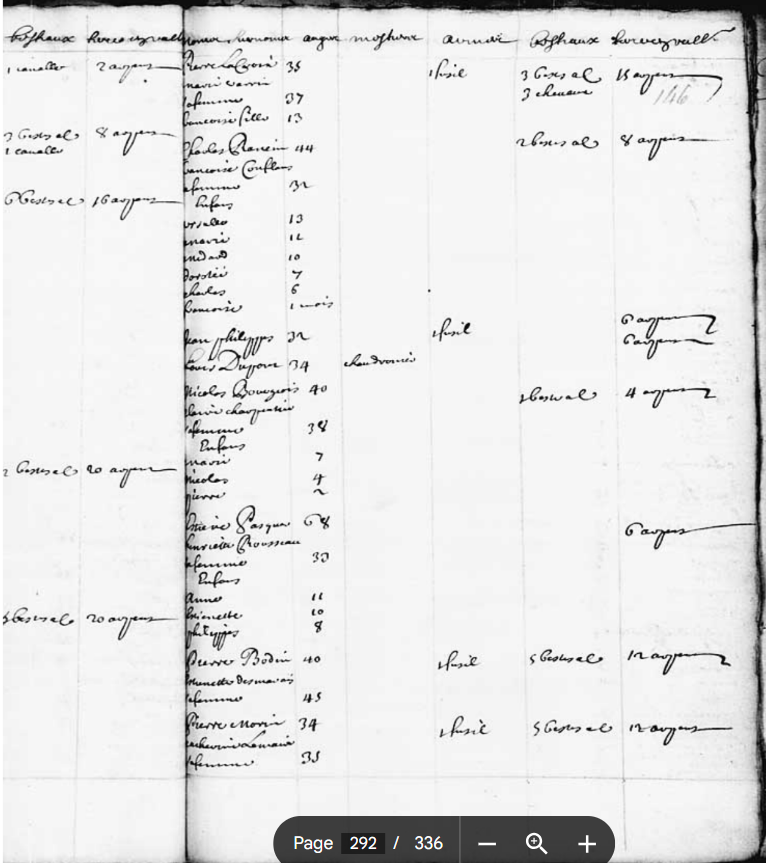
1681 census, Petite Auvergne: Pierre Morin, 34, and Catherine, 35, with one gun, five cattle and twelve arpents. Pierre Bodin's household is directly above.
A trade, at forty-two
The last of the eight acts is the only one that says what he did for a living.
On 12 March 1690, Pierre Morin of the petite Rivière and Joseph Charpentier of Québec—the notary calls them both charpentiers—contracted with André Coubron, a mason of the town, to build him a house. The specification runs to a page: a timber-framed building twenty-four feet long by eighteen wide, closed with round pikes on all four sides, the frame carried on beams sized to the proportions of the building, standing three feet above the enclosure, with gables at either end. The work was to be done well and duly, on ground the client would point out to them near the church and the hospital. The price was 135 livres, and the two men were bound jointly and severally for the work.
Coubron and Joseph Charpentier signed. Pierre declared, for the fifth time in the surviving record, that he did not know how to write or sign.
He was about forty-two. Catherine would bear their eighth child that October. And the ground he was framing on stood beside the hospital whose sisters had granted him his first piece of land nineteen years earlier, and who would carry him into their ward sixteen years later.
Why this is new. The PRDH's individual record for Pierre Morin carries no occupation, because the parish registers it reconstitutes him from carry none. The trade was never lost; it was in a different archive. An empty field on a database card is a statement about that database's sources, not about the man—which is worth remembering the next time a card appears to say that nothing is known.
Eight children
Eight children came in all. Five reached adulthood and married:
| # | Name | Born | Died | Notes |
|---|---|---|---|---|
| 1 | Marie Anne | 22 Jul 1673 | 1743 | OUR ANCESTOR • m. Guillaume Deguise dit Flamand, 1691 |
| 2 | Jean | 28 Jan 1676 | 5 Aug 1687 (age 11) | Baptised at Rivière-Saint-Charles • buried at Notre-Dame-de-Québec |
| 3 | Pierre (first) | c. 1677 | Not traced after 1681 | Enumerated in the 1681 census, age 4 • no baptism, marriage or burial found |
| 4 | Louise Anne | 25 Oct 1678 | 1710 | Entered on the 1681 census as "Anne, 2" • m. Jacques Payant, 1699 |
| 5 | Joseph | 5 Jan 1682 | 1735 | ANCESTOR (Bridault line) • m. (1) Marie Anne Brideau 1704; (2) Dorothée Girardin 1724 |
| 6 | Marie Jeanne | 22 Apr 1685 | 25 Nov 1755 | Godparents Pierre Bodin & Jeanne Brassard • m. Jean Baptiste Legris Lépine, 1711 |
| 7 | Marie Madeleine | 17 Jan 1687 | 3 Jan 1689 (age 1) | Godmother Marie Madeleine Hédouin • buried at Notre-Dame-de-Québec |
| 8 | Pierre Jean (second) | 17 Oct 1690 | 25 Jan 1747 | m. Marie Louise Bezeau, 1721 • 10 children • buried at the Hôtel-Dieu, like his father |
Jean, the eldest son, died on 5 August 1687 at eleven and was buried the next day at Notre-Dame-de-Québec, the curé François Dupré officiating. The record lists his mother as "LEMENU"—one of at least five spellings colonial scribes gave her name. Marie Madeleine died seventeen months later, two weeks short of her second birthday.
The first Pierre is a different kind of loss. He was born about 1677 and appears once, in the 1681 census, a boy of four among his siblings. After that, nothing—no baptism was recorded or has survived, no marriage, no burial. He does not vanish from the record; he simply never re-enters it. The family named a second son Pierre in 1690, which is the usual sign that the first was gone.
The five who grew up made families across the St Lawrence lowlands: Marie Anne, Louise Anne and Marie Jeanne at Québec, Joseph and Pierre Jean at L'Ancienne-Lorette. Between them they carried Pierre and Catherine's blood into what genealogists estimate at 560,000 to 980,000 living Québécois.
7. The Hôtel-Dieu Years — Illness and Death, 1696–1706
The last decade of their life together is lit by an unusual source: the Registre journalier des malades of the Hôtel-Dieu de Québec, the daily patient register kept by the Augustinian nursing sisters from 1689 to 1760. Published by Marcel Fournier and Gisèle Monarque, it records admissions by date, name, age, origin and outcome—and it shows that Catherine Lemesle was chronically ill for the last fourteen years of her husband's life, and beyond it.
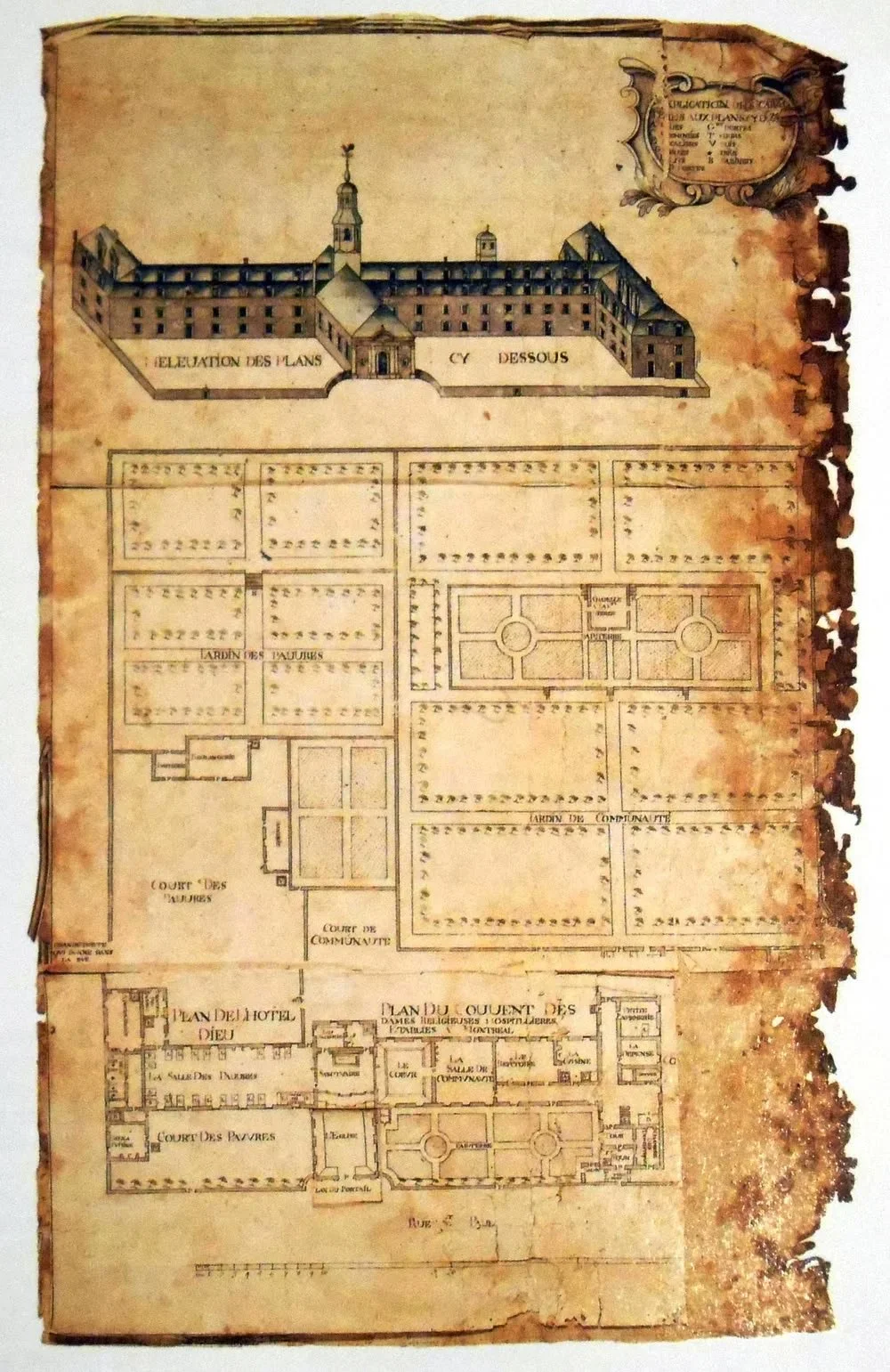
Plan de l'Hôtel-Dieu before the fire of 1695, showing the "Salle des Pauvres" at lower left. Illustration by Gédéon de Catalogne. Archives of the City of Montreal.
Her first recorded admission was 1 November 1696. Four years later, on 12 August 1700, she appeared again, and that entry places the family firmly: "Demelle, Catherine (50 ans), femme de Pierre Morin." Her name is mangled—Demelle for Lemesle, one of the variants that also include Lemesne, Chasterine and Lemenu—but the entry fills a documentary gap between the 1687 baptisms and Pierre's death.
Then, in the autumn of 1706, both of them were in the hospital within two weeks of each other. Pierre was admitted on 18 November. When the sisters drew up the standing roll on 1 December, Catherine was in the house, entry number one. Whether they suffered the same illness, or whether she collapsed from nursing him, the register does not say. What it records is two names on facing pages of the same book.

The standing roll of 1 December 1706, entry 1: "chaterine le mesle féme de Pierre morin agé de 50 ans," with sorty le 20 added later. She was discharged eight days after he died.
Pierre died on 12 December 1706. The burial register recorded him with the fullest statement of origin that survives: "Pierre morin agé de 56 ans de Poitou de la Paroise de Sᵗ Estienne de l'euesché de luson mort le 12ᵐᵉ Decembre." He was buried from the Hôtel-Dieu—as his youngest son would be, forty-one years later.
A transcription corrected. This page formerly gave the death notation as "décédé le 12-126," following the printed edition of the register. The manuscript spells the date out in words. There is no numeric string; the figure was a typographical error, reproduced here in good faith and now removed.
Dying at the Hôtel-Dieu was not a mark of poverty. Run by the Augustinian sisters, it was the principal medical facility of early Québec, admitting settlers with serious illness, the elderly needing nursing, accident victims and respected citizens alike. On the same December page as Catherine is Jaques payent dit Sᵗ onge—Jacques Payant, who had married their daughter Louise Anne seven years earlier.
It was also, for this man, familiar ground. He had held the sisters' land, lodged in their house, owed them half the price of his farm and framed a building beside their walls. Whatever the ward looked like in December 1706, it is unlikely to have been the first time he had been inside it.
8. Catherine Alone — The Widow Years, 1706–1721
Catherine survived Pierre by at least fifteen years, and the hospital register tracks her with institutional precision:
17 April 1707 — "Catherine (55 ans), Poitou, femme de Pierre Morin"
3 March 1708 — "Lemesle, Catherine, femme de Pierre Morin"
8 May 1708 — "Chasterine (58 ans), femme de Pierre Morin"
7 February 1710 — "Lemesne, Catherine (66 ans), Normandie, femme de Pierre Morin"
Three things stand out. She is still femme de Pierre Morin—wife, not widow—years after his death; the scribes did not always update a woman's status. Her age wanders wildly: fifty in 1706, fifty-five in 1707, fifty-eight in 1708, sixty-six in 1710, the last of which is closest to her actual baptism in April 1646. And her origin shifts: in 1707 she is recorded as from Poitou, which is her husband's province, not hers, and only in 1710 as from Normandie, which is correct.
On 14 April 1708 a "fille de Pierre Morin" was also admitted—one of the surviving daughters. Even the children were appearing in the same institutional pages.
Catherine's last documented appearance is 29 June 1721, at the wedding of her youngest son Pierre Jean to Marie Louise Bezeau at L'Ancienne-Lorette. The record identifies him as "fils de deffunt Pierre Morin et de Catherine le Mesle"—his father marked deceased, his mother not. She was about seventy-five, and she saw her last child married.
After that, silence. No burial record for Catherine Lemesle has ever been identified. She may have died at a child's house, or at the Hôtel-Dieu, or in a parish whose registers did not survive. Wherever she lies, she lies without a known grave—a merchant's daughter from Rouen who could not write her name, crossed an ocean at twenty-five, raised eight children, buried three and a husband, endured fourteen years of chronic illness, and lived long enough to watch her family take root in the colony she had been sent to populate.
9. Descendants — Two Ancestral Lines
Pierre and Catherine's blood flows into the Guilbault line through two of their children, making them ancestors twice over by pathways that converge at Évangéliste Guilbault (1845–1883).
The first runs through their eldest daughter, Marie Anne Morin (1673–1743), who married Guillaume Deguise dit Flamand on 12 August 1691 at Notre-Dame-de-Québec. Their daughter Marie Catherine Antoinette married Charles Guilbault, entering the patrilineal Guilbault line directly.
The second runs through their son Joseph Morin (1682–1735), who married Marie Anne Brideau in 1704—twelve children, all born at L'Ancienne-Lorette—and then Dorothée Girardin. Through the Bridault line, Joseph's descendants also converge at Évangéliste Guilbault.
Denis Beauregard's database estimates their living descendants at between 560,000 and 980,000 Québécois: a remarkable legacy for a man from a parish whose registers did not preserve his birth, and a woman who could not sign her name.
10. How This Biography Was Built — and Revised
This biography rests on 71 primary source images and archival references spanning 1646 to 1721, together with eight notarial acts from the greffe of Gilles Rageot located and read in August 2026. The evidence base includes marriage contracts, land sales, a building contract, parish registers, census records, Hôtel-Dieu medical admissions, the 1668 muster roll and military attribution databases, drawn from BAnQ, PRDH-IGD, FamilySearch, Library and Archives Canada, the Archives départementales de la Seine-Maritime, and the Archiv-Histo published registry.
What the documents prove. Pierre's parentage, his parish of origin, his marriage, his residence on the petite Rivière Saint-Charles, his landholding from 1671 to 1682, his trade as a carpenter, his illiteracy, his eight children, and his death. Catherine's baptism, parentage, Fille du Roi status, dowry, illiteracy, and her survival to at least 1721.
What remains unfound. Pierre's baptism at Saint-Étienne-de-Brillouet, searched and not located. The concession contract passed before the notary Paul Vachon, by which he held land of the Hospitalières before 1671 — now the most promising unread document in the file. Catherine's burial. Any post-death inventory. And the two documents that might settle the military question—a land cession at Batiscan and a 1667 deposition in the brandy-trade inquiry, both cited by Langlois without a source.
Where this page has been revised
The military service is no longer asserted. This biography described Pierre Morin as a soldier of the Carignan-Salières Regiment, Compagnie de Naurois. The claim rested on a single line in the 1668 muster roll. Two specialist compilations now assign that line to two different men, and there were four Morins in the regiment. The service is recorded as unproven.
The dit name has been withdrawn. This page was published for months under the title "Pierre Morin dit Champagne." Verney's reconstruction of the company gives a nom de guerre to six of ten soldiers and gives Pierre Morin none; "(Champagne)" on the same roster is a separate man. The muster roll lists Champagne on his own line, and the SFRSC leaves the dit column blank for Morin while filling it for two other soldiers who genuinely carried the name. Eight notarial acts drawn for him carry no dit name either. Langlois's roster does appear to attach it, so the question is not closed—but this site will not use it until a record is produced that attaches it.
The captain's name was wrong. Section 3 named him Captain Pierre de Naurois and dated his seigneury to 1672. The captain was Louis de Niort de La Noraye; La Noraye was his own name, not a later place name; and the concession came in 1688. The 1672 date belongs to his marriage.
The family never lived at Beaupré. Section 6 described them moving between Petite-Rivière-Saint-François and the Basse-Ville of Québec. That correction was first made on the strength of the 1681 census and the godparent network—an inference from association. It no longer has to be. The notarial acts name the place directly: habitant demeurant à la petite Rivière St Charles in 1676, habitant de la petite Rivière in 1690. They stayed on one côte for thirty years.
The 1667 "Pierre Martin" identification has been withdrawn. It rested on the Beaupré reading of the banns. With that gone, the entry is one servant with a similar name in a different place—and an age that fits the other candidate on the muster roll better than ours.
Both spouses were illiterate. The page formerly stated that Pierre signed his own name and that Catherine also signed. The signatures on the contract are witnesses. Neither could write. Pierre's declaration is recorded five times between 1668 and 1690.
Added, rather than corrected. The eight Rageot acts have given this biography four things it did not have: a first certain document in September 1671; a farm bought the day before the wedding, witnessed by the man who would be godfather to their daughter; a land sequence running to 1682; and a trade. Pierre Morin was a carpenter—recorded once, in a building contract of March 1690, and nowhere else in any source.
Smaller corrections. Jean Morin was buried at Notre-Dame-de-Québec, not Boucherville. The first Pierre does appear in the record—in the 1681 census, at age four. Marie Jeanne's family has been removed from Longueuil, which was unsourced. Marie Madeleine died seventeen months after Jean, at one, two weeks short of her second birthday. The census children read Jean 6 and Anne 2, not Jean 5 and Louise 3. The death notation "12-126" was a printer's error and is replaced by the register's own words. Anne Gasnier has been restored to the list of signatories, having been removed in error. And Pierre's birth year has moved from c. 1650 to c. 1648, with the full range of stated ages now given.
Every one of these is documented with its evidence and date in the complete research file, and the attribution problem is set out in full in the case study. They are kept visible rather than deleted, per this practice's convention: a methodology on which nothing has ever failed is not a methodology.
Research and narrative by Mary Hamall Morales, Storyline Genealogy. Primary sources accessed through BAnQ, PRDH-IGD (Université de Montréal), FamilySearch, Library and Archives Canada, Archives départementales de la Seine-Maritime, and Archiv-Histo.com.
Complete Research File
This biography draws on a curated selection of 48 primary source images. The complete inventory holds all 71, together with the eight Rageot acts, 10 Archiv-Histo page references, PRDH records for all eight children, detail transcriptions, examined-but-excluded evidence, and every withdrawn claim with its dated rationale.
Access the Complete Research File → (password protected)
Key Dates
Connection to The Guilbault Line
Primary Source Documents
Maps & Places

Marriage Records — June 1672



Census & Residence


Death & the Hôtel-Dieu

The Military Question
Database Records
| Status(es) | Immigrant |
| Father | Jacques Morin |
| Mother | Hilaire Guery |
| Birth | around 1648, st-etienne de brillouet, ev. lucon, poitou |
| Death / Burial | 1706-12-12, Hôtel-Dieu de Québec |
| First marriage | 1672-06-13, Québec, with Catherine LEMESLE |
| Occupation | Not carried on this card |
No military attribution. The record carries parentage, vital dates and a marriage link. It says nothing about a company or a regiment. Its birth figure is an estimate from stated ages, not a baptismal reading.
And no trade — because the parish registers this reconstitution draws on record none. The notarial archive records one: carpenter, March 1690.
PRDH-IGD, Individual no. 53641; www.prdh-igd.com. Card data restated, not reproduced.| Rank 01 | Pierre MORIN |
| Origin | St-Etienne, Eveche de Lusson au Poitou |
| Age | 056 |
| Place | Québec (Hôtel-Dieu) |
| Father, mother, spouse | Not carried on this card |
The fourth statement of origin, thirty-four years after the first. The card transcribes what the burial register says; it is consistency of testimony, not an independent witness.
PRDH-IGD, Burial no. 73205; www.prdh-igd.com. Card data restated, not reproduced.| Marriage | 13 June 1672, Québec |
| Marie Anne | b. 22 Jul 1673 · m. Guillaume Deguise Flamand 1691 · d. 24 Nov 1743 |
| Jean | b. 28 Jan 1676 · d. 5 Aug 1687 |
| Pierre | b. before 1677, place undetermined · no marriage or death entry |
| Louise | b. 25 Oct 1678 · m. Jacques Payant 1699 · d. 20 Feb 1710 |
| Joseph | b. 5 Jan 1682 · m. Marie Anne Brideau 1704 · d. 11 Dec 1735 |
| Marie Jeanne | b. 22 Apr 1685 · m. Jean Baptiste Legris Lepine 1711 · d. 26 Nov 1755 |
| Marie Madeleine | b. 17 Jan 1687 · d. 3 Jan 1689 |
| Pierre | b. 17 Oct 1690 · m. Marie Louise Bezeau 1721 · d. 25 Jan 1747 |
Eight children, five who married. A PRDH family record is a reconstitution — the linkage of separately indexed baptisms, marriages and burials into one household. It carries no occupation and nothing bearing on military service. It also records only one marriage for Joseph; the second, to Dorothée Girardin in 1724, comes from elsewhere.
PRDH-IGD, family record of Pierre Morin & Catherine Lemesle; www.prdh-igd.com. Card data restated, not reproduced.| Place of origin | Rouen (St-Pierre-du-Chastel), Seine-Maritime, 76540 |
| Arrival | Estimated 1671 |
| Status on arrival | Fille du Roi |
| References | Landry 339; Dumas 281 |
| Dowry | 200 livres, including 50 from the King |
| Could sign | No |
| Death | After 8 June 1721 |
Catherine has a record here; Pierre does not. Fichier Origine admits an immigrant only once a French document has been found. Her Rouen baptism was located; his has never been. The absence is about France, not about his identity.
Fichier Origine, record no. 242471; fichierorigine.com. Record data restated, not reproduced.Sources & Citations
Primary Sources
- Muster Roll (1668): Rolle des Soldats du Regiment de Carignan Salière qui se sont faits habitans de Canada en 1668. Library and Archives Canada, Colonies D²ᶜ 47 (ANOM COL D2C 47), p. 8.
- Catherine's Baptism (1646): Saint-Pierre-du-Châtel, Rouen. Archives départementales de la Seine-Maritime, 3E 1, Registre 557.
- Greffe of Gilles Rageot, BAnQ, CN301, S238 — répertoire 1672, folio 37; name index, "Morin Pierre"; and acts 675 (29 September 1671), 870 (3 June 1672, with quittance of 1677), 871 (4 June 1672, marriage contract, ID 78360), 1457 (14 June 1676), 1483 (8 August 1676), 2010 (17 December 1679), 2367 (18 April 1682) and 3986 (12 March 1690).
- Marriage Banns (1672): Notre-Dame-de-Québec, two register copies (Nᵒ 729; 117/1672/413).
- Marriage Register (1672): Notre-Dame-de-Québec, 13 June 1672.
- Marriage Contract of François Trotain (1668): Notary Gilles Rageot, no. 307, 13 August 1668 — naming Trotain as a soldier of the company, and Pierre Morin among the friends who could not sign.
- Census (1667): Library and Archives Canada, image 135 of 179 — the "Pierre Martin" entry, identification withdrawn.
- Census (1681): Recensement de la Nouvelle-France, Petite Auvergne. LAC, microfilm M-2330, pp. 292–293.
- Children's Baptisms (1673–1690): Notre-Dame-de-Québec, Rivière-Saint-Charles and Petite Rivière.
- Children's Burials (1687–1689): Notre-Dame-de-Québec — Jean, 6 August 1687 (PRDH #69555); Marie Madeleine, 3 January 1689 (PRDH #69662), both officiated by curé François Dupré.
- Hôtel-Dieu Admissions (1696–1710): Fournier, Marcel, and Gisèle Monarque. Registre journalier des malades de l'Hôtel-Dieu de Québec, 1689–1760. Archiv-Histo.com, pp. 330, 474, 613, 620, 629, 648, 651, 652, 692.
- Burial Register (1706): Hôtel-Dieu de Québec, 12 December 1706.
Secondary Sources
- Gagné, Peter J. From Soldiers to Settlers: The Carignan-Salières Regiment in Canada, 1665–1668. Vol. 2 (2025), pp. 502–504.
- Verney, Jack. The Good Regiment: The Carignan-Salières Regiment in Canada, 1665–1668. Montreal & Kingston: McGill-Queen's University Press, 1991. Appendix B, Table 4, p. 168.
- Langlois, Michel. Compagnie Naurois.
- SFRSC. Alphabetical Listing of the Carignan-Salières Regiment Officers and Soldiers Who Settled in Canada, January 2025.
- PRDH-IGD, Université de Montréal. Individuals 53641 and 81890; family record; burial 73205; List of Migrants 402529; confirmation 403507.
- Fichier Origine, record 242471 (Catherine Lemesle).
- Beauregard, Denis. Genealogy of the French in North America.
- Laforest, Thomas J. Our French-Canadian Ancestors, Vol. 16 (Noël Morin chapter). LISI Press.
Companion Pages
Are You Connected to the Guilbault Line?
If you descend from the Guilbault (Guilbeau, Guilbeault) family of Charlesbourg and the Quebec parishes, from the children of Marie Josephte Abitakijikokwe, or from the founding families of the line — Senécal, Séguin dit Ladéroute, Morin, Couillaud dit Roquebrune, Gaulin — I’d like to compare notes. Documented trees, DNA matches, family papers, and even half-remembered stories have all moved this research forward.
Get in Touch About This FamilyCousin connections are informal and reciprocal — no fee, no obligation, just shared work on shared ancestry.
Every Family Has a Story Worth Telling
Whether you're just beginning your research or ready to transform years of work into a narrative your family will treasure, I'd love to hear your story.
BEGIN YOUR RESEARCH INQUIRY