
Two Contracts, Twenty-Three Years, One Missing Folio
Two Contracts, Twenty Years,
One Missing Folio
The original case study documented Paul Guilbault père in the Athabasca at fifty-nine. Two signed engagements — one from July 1798, one signed after the North West Company had already dissolved — show he had been doing this since he was thirty-seven. Meanwhile the ledger account long attributed to his brother Gabriel has no contract behind it at all, in any surviving volume. What the new documents establish, and what the missing folio might explain.
When I published the Invisible Voyageur case study, the evidentiary foundation was a single account in a company blotter: F.4/37, the Athabasca General Blotter for 1820–21. Paul Gibeault. Contracted at five hundred livres, settled at 617.14. A mason and farmer the Quebec records had called nothing but a mason and farmer, documented in one page of a company ledger as a voyageur at fifty-nine.
That was the case. It felt like enough. It isn’t the complete case anymore.
Two documents in HBCA Series F.5 — the NWC Servants' Contracts volumes — have now extended the documented career back twenty-three years and placed Paul Guilbault père in the North West Company engagement system in July 1798, at thirty-seven, under one of the most senior partners the NWC ever had. And in doing so, they sharpened a question about the account book entry long read as his brother Gabriel's. That account — five annual wages in the North West Company general ledger, running 1817 to 1821 — has no engagement contract behind it in any surviving volume.

HBCA F.5.1: North West Company Servants’ Contracts, 1798. The volume contains Paul Guilbault’s earliest documented NWC contract at folio 115 — approximately twenty-three years before the account books that formed the original Invisible Voyageur case study. Hudson’s Bay Company Archives, Archives of Manitoba, Winnipeg.
The Contract That Moved Everything Back Twenty-Three Years
F.5/1, folio 115 — Paul Gibeau, milieu, 19 July 1798The HBCA Series F.5 volumes contain the pre-printed engagement forms that each NWC worker signed before entering the interior. Each form names the engagé, the accepting agent, the role, the route, the wages, and the return point. The engagé signs by mark if he cannot write. The agent and witnesses countersign.
F.5.1 is the earliest surviving contract volume: the 1798 series, with individual contracts running to approximately 1801. It contains two entries for Paul Guilbault père — and the first one is not a contract at all.
Page 76 of F.5.1 contains a blank pre-printed engagement form with only one field completed: the engagé’s name. Paul Gibeau. Every other field is empty. No agent. No term. No role. No wages. No date. No signature.
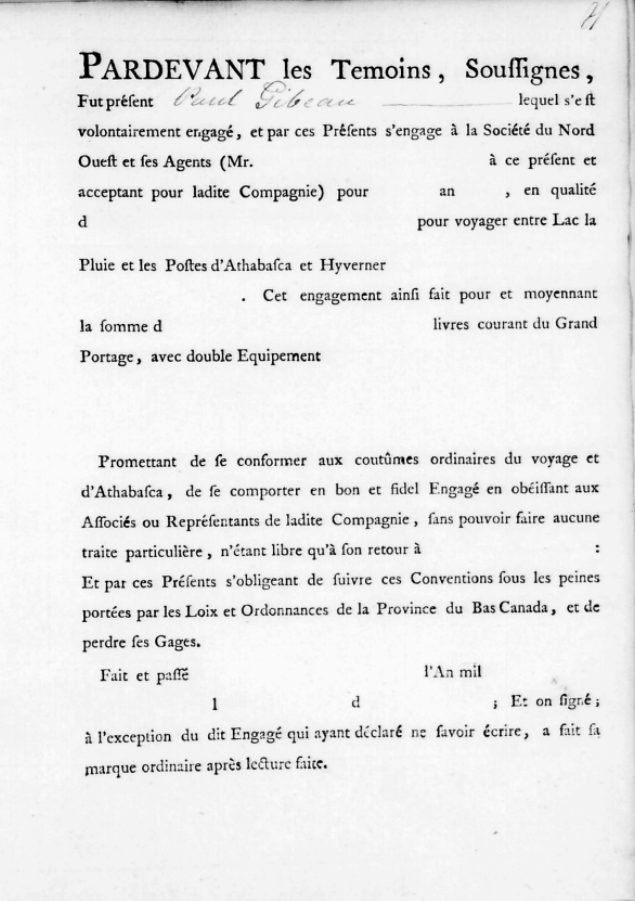
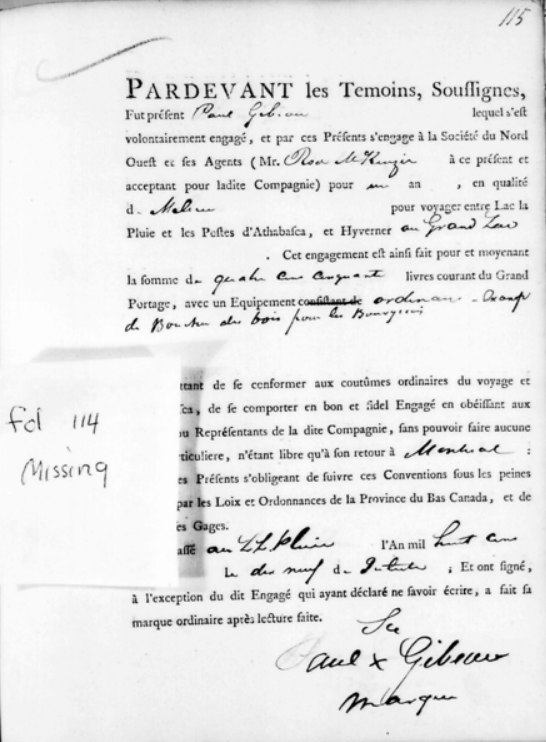
The blank form is worth pausing on, though it says less than it first appears. Folio 81 carries Paul's name on an otherwise empty pre-printed form; the completed contract is at folio 115, thirty-four leaves later, with a run of eighteen blank forms in between at folios 86 to 103. The volume had spare stock in it, and a name on unused stock need not belong to the engagement that eventually followed. What is telling is what the archivist did with it. Folios 86 to 103 were omitted from the film as blank. Folio 81 was kept. Somebody distinguished a blank form from a blank form bearing a name and retained the one that did — so the name was written by a hand that expected to use it. When, and for which engagement, the volume does not say. One further difference is worth noting. The printed text on folio 81 stipulates avec double Equipement; the contract he actually signed at folio 115 gives one. Different stock, different terms.
A few folios later, the completed contract appears. Agent: Roderick McKenzie — a first cousin of Alexander Mackenzie and one of the most senior partners in the NWC’s Athabasca operations. A few folios later, the completed contract appears, dated 19 July 1798. Agent: Rod. McKenzie. Role: milieu. Route: Lac la Pluie to the Postes d'Athabasca, wintering au Grand Lac. Wages: 450 livres with one equipment. Free at Montreal. Paul signs by mark.
He was thirty-seven.
Two folios in the immediate neighbourhood of Paul’s contract do not survive. Folio 114 is the leaf immediately before it. Folio 112 is three before that. Their contents — one or more contracts for one or more engagés — are unknown and unknowable from this volume.
No Gabriel Guilbault appears anywhere in F.5.1 or F.5.3. But the general ledger carries an account under that name running five annual wages, and a man in the interior for five outfits should have signed for something. Whether a Guilbault was on folio 112 or 114 is one of the questions this discovery leaves behind — and it now bears on a second, because the holder of that ledger account has not been identified.
The Final Contract — After the Company Dissolved
F.5.3, pages 32–33 — 22 May 1821 — Samuel Black — William McGillivray Jr.The North West Company merged with the Hudson’s Bay Company in March 1821. Two months later, on 22 May 1821, Paul Guilbault signed another NWC servants’ contract.
The agent was Samuel Black — one of the most formidable operational partners the NWC ever had, assigned to the Athabasca department, described by George Simpson as among the most capable and feared men in the Company. The witnesses were William McGillivray Jr. — a son of the McGillivray family that had effectively run the NWC in its final years — and James Hill. Role: milieu de picheur. Wages: 500 livres. Winter post: Lac d’Athabasca. Return: Montréal.

F.5.3, page 32 — Paul Gebeault’s final NWC contract, dated 22 May 1821. The NWC had dissolved two months earlier. Samuel Black signed as agent; William McGillivray Jr. as witness. Paul was sixty years old. The bottom of the contract adds a clause that appears in neither of his earlier engagements: he is exempt from portage carrying when he leaves. He was accommodated, not retired. HBCA, Archives of Manitoba.
The summary notation on the following page is brief: Paul Gibeault — 1 Year — Mid Man & Pickeurs — 500# — 1 pass paper — for 1822. The engagement was intended to carry forward into the reorganized HBC’s first full year of operation. Paul was being contracted into the post-merger company on NWC paper, with NWC partners signing, two months after the merger was finalized.
And at the bottom of the contract: a clause not present in either of his previous engagements. “Le dit Engagé est exempté de porter quand il sortira et avon un beau passé.” The said Engagé is exempt from portage carrying when he leaves, and will have a good pass. At sixty, Paul was formally excused from the physical demands of carrying loads across the portages. He was still engaged as a paddler. He was still going. He was simply not expected to carry.
The Engagements and the Account
From Rod. McKenzie to Samuel Black — 1798 to 1821| Source | Agent | Role | Wages | Winter Post | Paul’s Age |
|---|---|---|---|---|---|
| F.5/1, fo. 115 19 July 1798 |
Rod. McKenzie | Milieu | 450 livres | Great Slave Lake | 37 |
| F.4/37 1820–1821 |
(Athabasca dept.) | Voyageur | 500 contracted 617.14 settled |
Athabasca | ~59 |
| F.5.3, pp.32–33 22 May 1821 |
Samuel Black | Milieu de picheur | 500 livres | Lac d’Athabasca | ~60 |
1798 and 1821
calling him voyageur
the two contracts
The Account That Left No Contract
Two engagements for Paul. For the ledger account under Gabriel’s name, none — in any surviving volume.Filtered on the Guilbault surname cluster, the HBCA name index returns Gabriel Guilbault in three places: the Lac La Pluie blotter for 1820, the Athabasca general blotter, and folio 414 of the general ledger. The Athabasca account is marked settled. The ledger folio carries five annual wages — 551, 330, 687.10, 500 and 650 — opening in 1817 and closing at 336 at the merger.
Paul signed twice across twenty-three years and both engagements survive. The man on folio 414 worked five outfits and left no contract at all.
That asymmetry is what this discovery leaves open, and it has become more interesting rather than less. The identification of the folio 414 account has since been withdrawn — the parish registers place Gabriel père in Lower Canada during the account’s Athabasca year — so the missing contract is now a missing contract for a man whose name is known and whose identity is not.
Possible Explanations — The Evidence So Far Does Not Resolve This
That “if” is doing all the work. Nobody has established what orders this volume. Until someone reads folios 113, 115 and 116 for their dates and agents, proximity here proves nothing — and if those folios carry scattered dates and different agents, the speculation collapses entirely. It is a cheap test and it has not been run.
None of these is provable or disprovable from the evidence in hand. What is clear is that a name in a company ledger and a name on a signed engagement are two different kinds of record, and this family has one of each attached to different men. Paul has the contracts and no parish record that mentions them. Folio 414 has the wages and no contract, and no settled identity behind the name.
What the New Documents Change
The Invisible Voyageur, updatedThe original case study described Paul Guilbault père as a man who went to the pays d’en haut once, in his late fifties, and whose Quebec records never recorded it. That was already remarkable. The new picture is different in a specific and important way.
He was not a man who went once and came home. He was a man with a two-decade career running parallel to every mason and farmer designation the Quebec parish system produced for him. In c.1800–1801, while the registers of St-Paul-de-Lavaltrie were calling him maçon and laboureur, he was under contract to Roderick McKenzie, paddling to Great Slave Lake. Thirty years later, a burial register at the same parish called him cultivateur. Not a word about any of it.
The Revised Picture
Paul Guilbault père was an intermittent voyageur across approximately twenty years — fitting NWC engagements around his Quebec life as mason, farmer, and father of a large family. The “invisible” pattern was not a late-life anomaly. It was the consistent pattern of his working life from the age of forty. The invisibility was structural and total from the beginning. Every Quebec record that ever bore his name confirmed it.
The F.5 series is now part of the primary source base for this case. The updated case study summary, a new full methodology page, and this post reflect the complete evidentiary picture as of this research update. The question of Gabriel’s missing contract — and the content of folio 114 — remains open.
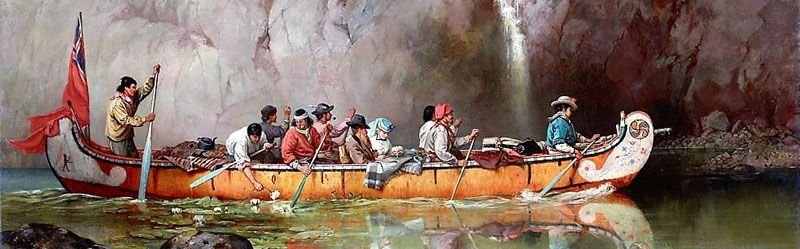
Frances Anne Hopkins, Voyageurs, 1869. Hopkins paddled these routes herself. Paul Guilbault paddled them at forty and again at sixty — and the Quebec record system never called him anything but a mason and a farmer. Library and Archives Canada.
What’s New — Research Update Summary
The Invisible Voyageur case study summary has been updated to reflect all three contracts and five primary source documents. A new full methodology page documents each document in sequence from earliest evidence to final settlement, including the F.5 archive structure, the phonetic variant problem, BCG standards application, and the open research questions. Both pages are now live.
Are You Connected to the Guilbault Line?
If you descend from the Guilbault (Guilbeau, Guilbeault) family of Charlesbourg and the Quebec parishes, from the children of Marie Josephte Abitakijikokwe, or from the founding families of the line — Senécal, Séguin dit Ladéroute, Morin, Couillaud dit Roquebrune, Gaulin — I’d like to compare notes. Documented trees, DNA matches, family papers, and even half-remembered stories have all moved this research forward.
Get in Touch About This FamilyCousin connections are informal and reciprocal — no fee, no obligation, just shared work on shared ancestry.
Every Family Has a Story Worth Telling
Whether you're just beginning your research or ready to transform years of work into a narrative your family will treasure, I'd love to help.
LET'S TALK ABOUT YOUR FAMILY