
What the Finding Aids Don’t Show You
What the Finding Aids
Don’t Show You
Two indexes cover the same collection and return different answers. A microfilm reel catalogued as holding a run of volumes quietly redirects one of them somewhere else. And an index entry, however precise it looks, cannot tell you which of several men who shared a name you have actually found. None of the three is a flaw in the archive. All three will cost you a conclusion if you don’t know about them.
The Hudson’s Bay Company Archives at the Archives of Manitoba hold the North West Company’s surviving records — account books, servants’ contracts, post journals, correspondence — acquired by the HBC at the 1821 merger. For anyone tracing a French-Canadian voyageur ancestor, they are the richest documentary source that exists. They are also, in three specific ways, easy to search incompletely while believing you have been thorough.
What follows is not a criticism of the finding aids. Every one of them was built carefully, for a purpose, and each does its job. The problem is that researchers — this one included — tend to treat a finding aid as though it were the collection. It isn’t. It is a description of part of the collection, made by someone with particular questions in mind, and the gap between the description and the thing described is where conclusions go wrong.
Blind Spot One: Two Indexes, Different Answers
The same collection, described twice, by people solving different problemsTwo search tools index the HBCA employment records. They were built at different times for different purposes, and they do not return the same set of results for the same person.
HBCA NWC Account Books Name Index
Built to navigate one series in depth: the blotters and general ledgers where individual employee accounts are tracked. Precise where it reaches, and the most reliable route to a core service record.
- 3,791 entries, 1795–1827
- Indexes the account books series specifically
- Returns a class mark and a folio — enough to order the plate
- Its dates describe volumes and index entries, not service
Commercial indexes of the HBC records
Built to widen digital access across a large corporate archive rather than to describe one series exactly. Broader reach, looser precision, and different transcription decisions — which is exactly why it catches what the specialised index does not.
- Searchable by given name across the whole collection
- Surfaces renderings no surname search would reach
- Standardises surnames editorially — a decision, not a record fact
- Less granular on per-employee account detail
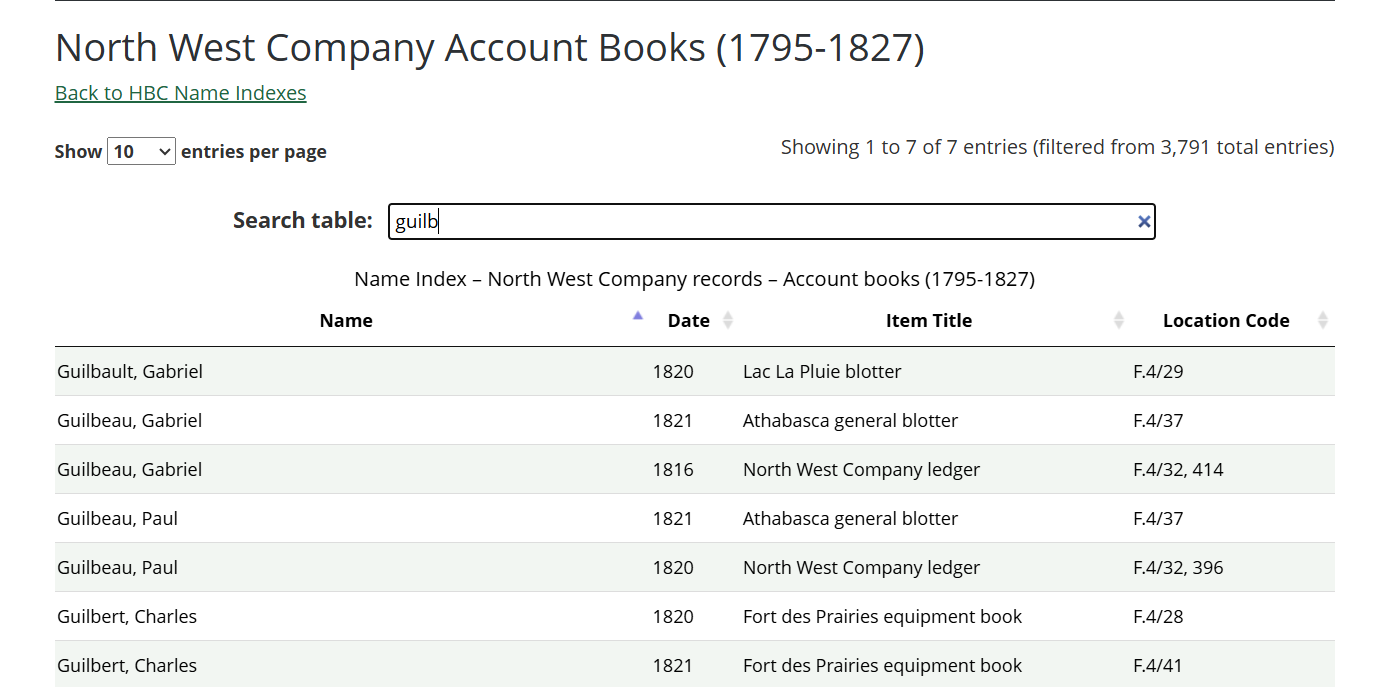
Filtered on guilb, the HBCA index returns seven entries. Filtered on gib, the same index returns six more — including three ledger pages nobody working from the surname alone would ever have looked at.
Same index. Same collection. Same family. The difference is three letters.
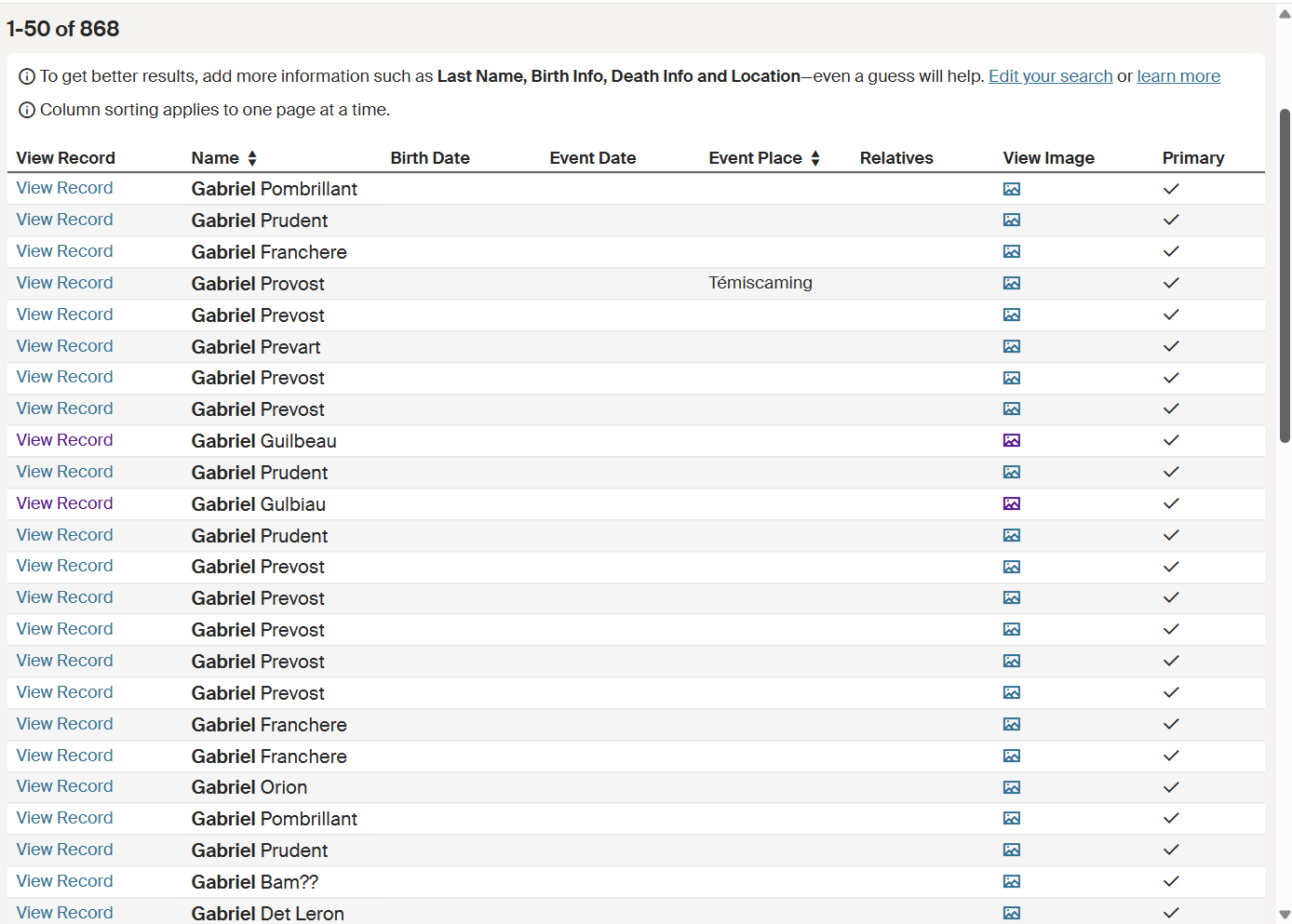
And on the commercial side, a given-name search for Gabriel returns 868 results and surfaces a rendering of the surname degraded almost past recognition. No surname search finds it. You have to be willing to read an 868-result set by eye.
Blind Spot Two: The Gap Neither Index Shows
A substitution card at image 420 of reel 5M6This is the one that no comparison of search tools would ever surface, because it isn’t in a search tool. It is on the film.
HBCA microfilm reel 5M6 is catalogued as Subsidiary Companies, North West Company Account Books 1817–1821. A researcher requesting it, or working through it on a reader, would reasonably understand that description to mean the account books of those years are on that reel.
At image 420, the film carries a substitution card:
F.4/32 is the general ledger. It holds the multi-year employee accounts — the folios that show what a man was paid year on year, whether a balance was carried in from an earlier volume, and how his account closed at the merger. In my own research it holds every open ledger question in the file.
It is filmed on two reels outside the set that carries the rest of the series. Nothing in the reel’s catalogue description says so. A researcher working 5M6 in order, finding no ledger, would conclude the ledger had been searched.
Establishing that required mapping the reel image by image. The by-product is a page-level map that, as far as I can find, nobody has published — and that anyone working NWC servants in this period needs.
HBCA reel 5M6 — where each volume and inventory begins, across 774 images
Compiled while establishing a negative result. The map was not the object of the research; it was what the research needed in order to state honestly what had and had not been searched.
The servants’ contracts carry their own version of this. In F.5/1 alone, folios 112 and 114 do not survive — an archivist has noted each as missing in the margin — and folios 86 to 103 were omitted from filming as blank forms. Twenty leaves unavailable in a single volume.
Which matters enormously if you are trying to say that someone’s contract is not there. A negative search is only as wide as what was actually browsed, and in this series what was browsed is bounded by decisions a filmer made decades ago.
Blind Spot Three: What an Index Can Never Do
It found a name. It did not find a person.The first two blind spots are about coverage — things a search misses. The third is different, and it is the expensive one, because it operates on results you did find.
An index entry returns a name, a class mark, a folio and a date. Order the plate and you gain a wage, a set of purchases, a closing balance. What you never gain, anywhere in that chain, is an age, a parish, or a father’s name.
An index entry in my own research gave a date of 1816 against a ledger folio. I built a five-year career on it, and published it.
The folio itself opens in 1817, with a wage credit on the first line and no balance carried forward from any earlier volume. The 1816 described the index record, not the man. Everything downstream of that date — the length of the service, the man’s age when it began, the shape of the narrative — had to be re-examined when the plate was finally read.
Compounding it: if your family recycled given names — and most French-Canadian families did — the index cannot tell you which of several same-named men it has found. In my own research three men of one direct line carried the same given name across three generations, with cousins carrying it in the same parishes at the same time. One account survives. It has still not been assigned to a man.
The Two Rules That Follow
In the ledgers, figures are the discriminator and spelling is noise. Two men of one name, in one department, in one season, are separated by their wage column and by nothing else. The clerks spelled both several ways; the figures never moved.
Then go home and test it against the parish registers. Read every act naming your man, credit presence only where the record says so in its own words, and set those dates against the account’s wage years. That test decides an identification, and no finding aid can perform it for you.
A Search Protocol That Accounts for All Three
What thorough HBCA employee research now requiresFive steps, in order
Search the account books name index — on fragments, not names
Archives of Manitoba → HBCA Resources → Name Indexes → North West Company Account Books, 1795–1827. Search the surname, then partial strings. In this family, guilb returned seven entries and gib returned six further ones, including ledger pages the surname search never reached.
Search the servants’ contracts index separately
A different database from the one above, and easily missed. Contracts before 1818 are bound chronologically rather than filed by name; from 1818 they are filed alphabetically. A contract is often the single most identifying document in the series, because it names a parish and carries the man’s own signature or mark.
Search a commercial index by given name alone
Then read the results by eye. A surname search will not reach a badly degraded rendering; only the given name will surface it. Expect several hundred results and budget the time. Search surname variants as well, to catch whatever does come up directly.
Order the plate, and make the page foot
Never quote a figure from an index or a caption. Order the image, read the first line, and add the columns. An account that balances tells you your reading is right; one that does not tells you something has been misread. And check the reel structure before recording any negative — a substitution card can make a volume look searched when it never was.
Test the identification against the parish registers
Build a presence ledger: every parish act naming your man, with presence credited only where the act says so. Set those dates against the account’s wage years. If he is standing in a Lower Canadian parish in a season he would have had to be wintering two thousand miles away, the account is not his.
Why It’s Worth the Extra Passes
None of these blind spots is exotic. Two indexes with different scopes, a film with a redirection card in the middle of it, and a name index that cannot distinguish two men of one name — these are ordinary features of a large archive described by several people over several decades.
What makes them costly is that each one produces a confident wrong answer rather than an obvious blank. You do not come away thinking you failed to find something. You come away thinking you found everything.
Are You Connected to the Guilbault Line?
If you descend from the Guilbault (Guilbeau, Guilbeault) family of Charlesbourg and the Quebec parishes, from the children of Marie Josephte Abitakijikokwe, or from the founding families of the line — Senécal, Séguin dit Ladéroute, Morin, Couillaud dit Roquebrune, Gaulin — I’d like to compare notes. Documented trees, DNA matches, family papers, and even half-remembered stories have all moved this research forward.
Get in Touch About This FamilyCousin connections are informal and reciprocal — no fee, no obligation, just shared work on shared ancestry.
Every Family Has a Story Worth Telling
Whether you're just beginning your research or ready to transform years of work into a narrative your family will treasure, I'd love to help.
BEGIN YOUR RESEARCH INQUIRY