
The Munnick Annotations:Reading Harriet Duncan Munnick
From Oka to Oregon · Research Methodology · Oregon
The Munnick Annotations: Reading Harriet Duncan Munnick
How the Catholic Church Records of the Pacific Northwest work as a genealogical resource — and how to read them well
When I finally held the physical book, I understood something I hadn’t fully grasped from working with it online. It is not a register. It is not a finding aid. It is a conversation — between the original priest who recorded a name in archaic French, and the researcher who spent decades learning who that person actually was.
The Catholic Church Records of the Pacific Northwest — compiled by Harriet Duncan Munnick, in collaboration with Mikell Delores Warner and others — is the essential archive for anyone tracing fur trade families in the Oregon Country. The Vancouver volumes cover Fort Vancouver and the Stellamaris Mission. The St. Paul volumes cover French Prairie, 1839–1898. Together they document the community of HBC servants, country wives, and their children who built the settlement at the western end of the fur trade world.
Munnick didn’t just transcribe the registers. She cross-referenced them with HBC employment records, Oregon land claims, census data, and the oral histories preserved in community memory. The result is something that no single archive could produce on its own: a record of who these people were, where they came from, and what happened to them.
This post is a practical guide to reading her work — what the annotation system means, how to use the three layers of evidence, where Munnick is authoritative and where she can be wrong, and why both things matter for BCG-standard genealogical research.
The Publication
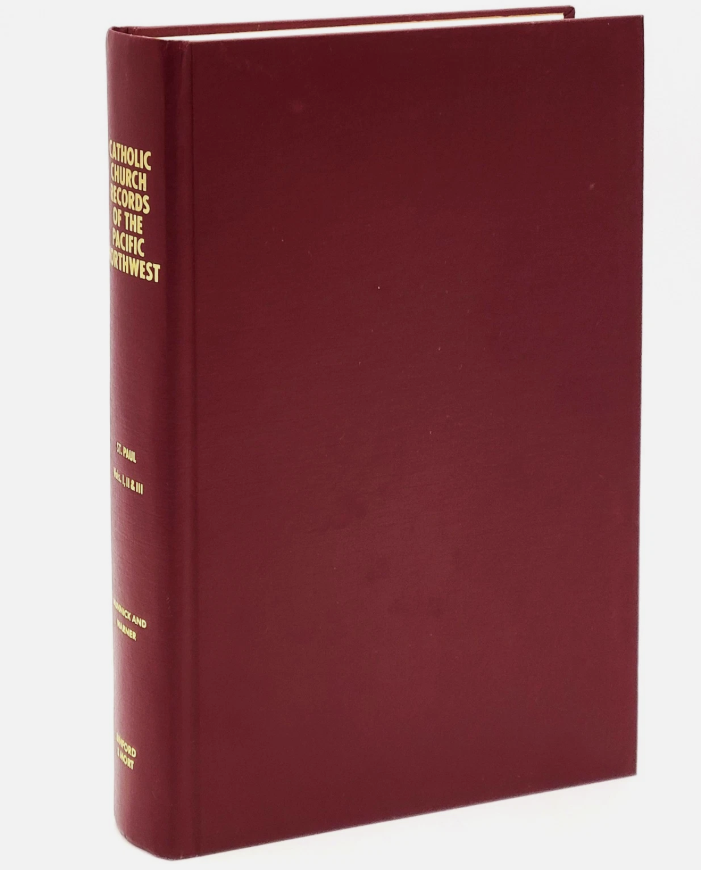
Catholic Church Records of the Pacific Northwest
St. Paul, Oregon 1839–1898 · Volumes I, II and III
Compiled by Harriet Duncan Munnick in collaboration with Mikell Delores Warner. Published by Binford & Mort, Portland. The St. Paul volumes cover the French Prairie mission community from its founding through the end of the nineteenth century. Companion Vancouver volumes (I and II) cover Fort Vancouver and the Stellamaris Mission, with records beginning in 1838.
The original church registers are held at the Archdiocese of Portland. Munnick’s transcriptions provide reference numbers, biographical annotations, and in most cases photographic reproductions of the original pages — making this a three-in-one resource: finding aid, transcription, and independent research tool.
The Annotation System
Munnick organizes every entry with a letter prefix that tells you immediately what kind of sacramental record you are reading. The system is consistent across volumes — once you understand it, you can move between the Vancouver and St. Paul registers fluently.
The Reference System
Four Record Types, One Archive
Every entry in Munnick carries a letter prefix identifying the sacramental record type. The number that follows is sequential within each volume.
The most numerous entries. Covers both infant baptisms and adult baptisms — the latter often performed immediately before a marriage ceremony when a country wife was being received into the Church for the first time.
Marriage records frequently follow the day after an adult baptism when a couple is regularizing a prior country union. Witness names, pre-nuptial children recognized, and the ability to sign are all recorded and genealogically significant.
Burial records often carry the age at death, sometimes the cause, and occasionally the names of surviving family members. They are the only Oregon record for many individuals who arrived without documentation and died before the census era.
The most valuable entries. Munnick’s own research notes — cross-referencing HBC records, land claims, oral history, and census data — appear here. They identify individuals, explain name variants, and document what happened to families after the sacramental record closes.
Two Layers in Every Entry
The most important thing to understand about reading Munnick is that each entry has two distinct components, and you need both.
The transcription is a translated summary of the original sacramental record: the date, the names, the priest, the witnesses. It is what the register contains. The annotation is what Munnick adds from her independent research: who the person was, where they came from, what family they belonged to, what happened to them next.
In the Laurent Quintal case, the transcription of M-61 tells you that Laurent married Marie Anne Nipissing on July 9, 1839, at Fort Vancouver, that they had pre-nuptial children, and that neither could sign their name. The annotation A-59 tells you that “Napassant” — the name that appears in later Oregon records for Marie Anne’s extended family — is a phonetic corruption of “Nipissing,” and that it is not a separate family. Without the annotation, you lose the thread entirely in every document after 1839.
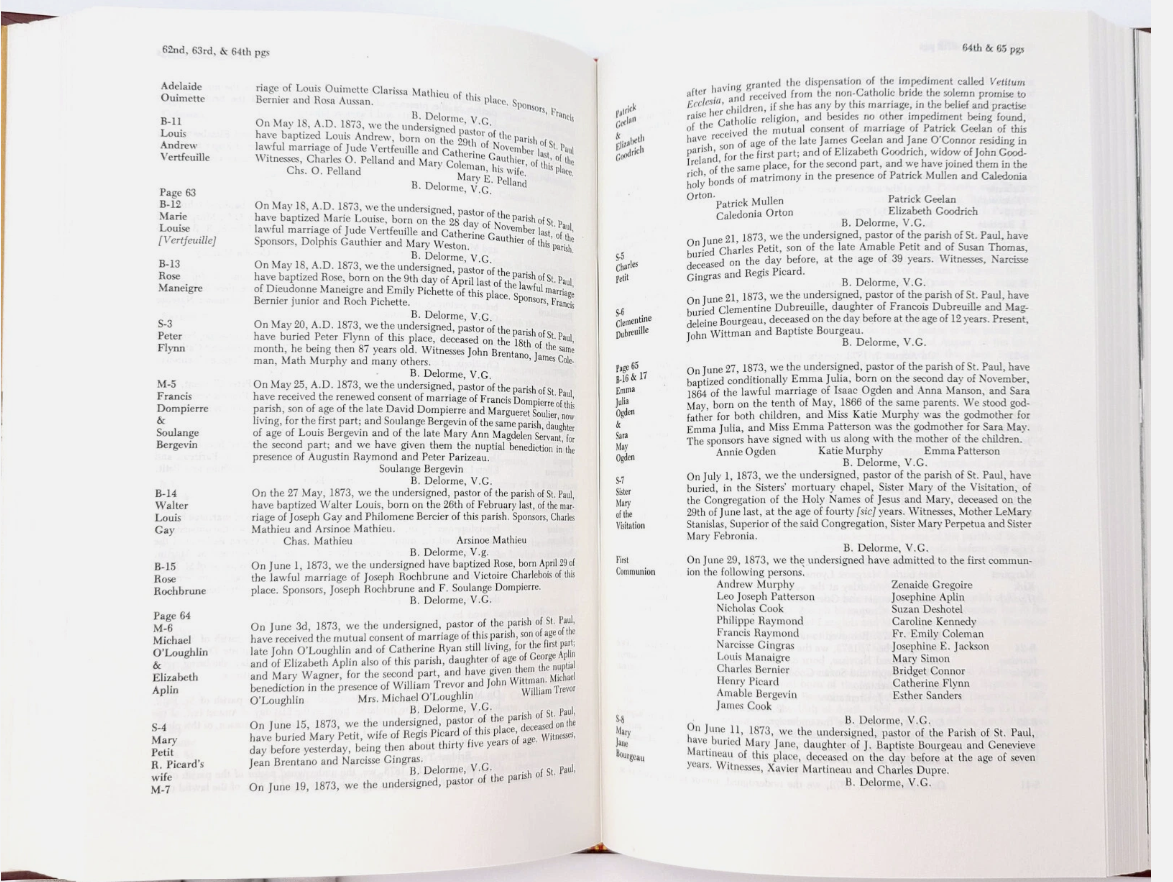
Interior pages — St. Paul registers showing the margin reference system (B-, M-, S-), transcribed entries, and Munnick’s biographical annotations alongside
The Name Variant Problem
The priests who recorded these sacramental registers were French speakers writing down names they heard spoken — often for the first time, often in a language they did not speak. The results are spellings that bear only a phonetic relationship to the names they represent.
“Nipissing” becomes “Napassant.” “Quintal” becomes “Kantal,” “Cantrel,” “Coutrell.” “Guilbault” becomes “Guilbeau,” “Guilbeault,” “Guillbault.” The same person can appear under three or four different spellings across a single volume — and under entirely different surnames in records from different archives.
Munnick’s annotations document these variants systematically. When she identifies a person across multiple records under different spellings, she notes it. When a western surname form diverges significantly from the Quebec original, she traces the phonetic corruption. This cross-referencing work — which took decades — is the reason the volumes are usable at all for anyone researching French-Canadian or Indigenous families in the Oregon Country.
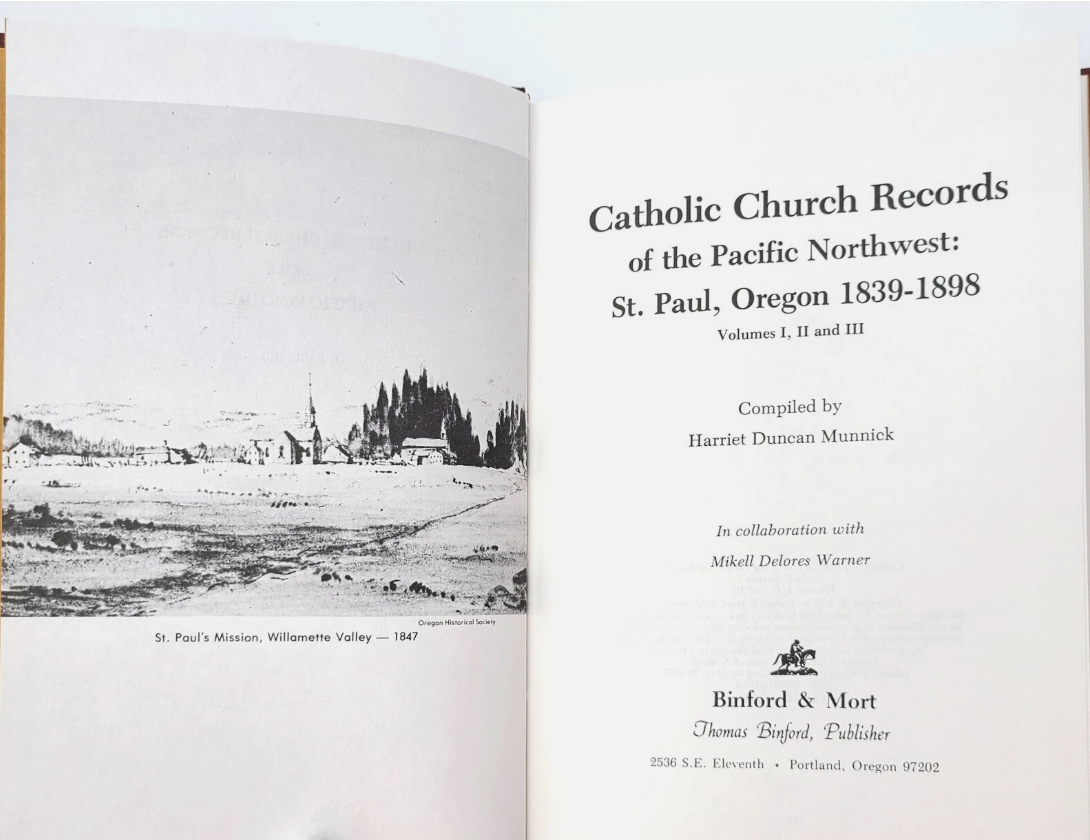
Title page spread — St. Paul’s Mission, Willamette Valley, 1847 (Oregon Historical Society)
The Biographical Annotations: Community in Context
The A- entries are where Munnick’s decades of research are most visible. They are not simply cross-references to other register entries — they are community portraits.
A-36, for instance, covers Joseph Gervais I — one of the earliest French Prairie settlers, born 1787, who came from the Rocky Mountain Fur Company, joined Hudson’s Bay, settled on the Prairie with a Chinook wife, served as a church leader, and died leaving a community whose descendants Munnick traces through three more annotations. The entry is essentially a short biography, drawing on HBC records, Oregon provisional government documents, contemporary accounts, and oral history preserved in family memory.
This is what the Munnick annotations are at their best: a way into the social world of French Prairie that the bare sacramental registers cannot provide. When your ancestor appears as a witness at a baptism in 1843, the A- entries for the people around them tell you who they were — whether they were HBC colleagues, mission neighbors, or kin connected through country marriages.
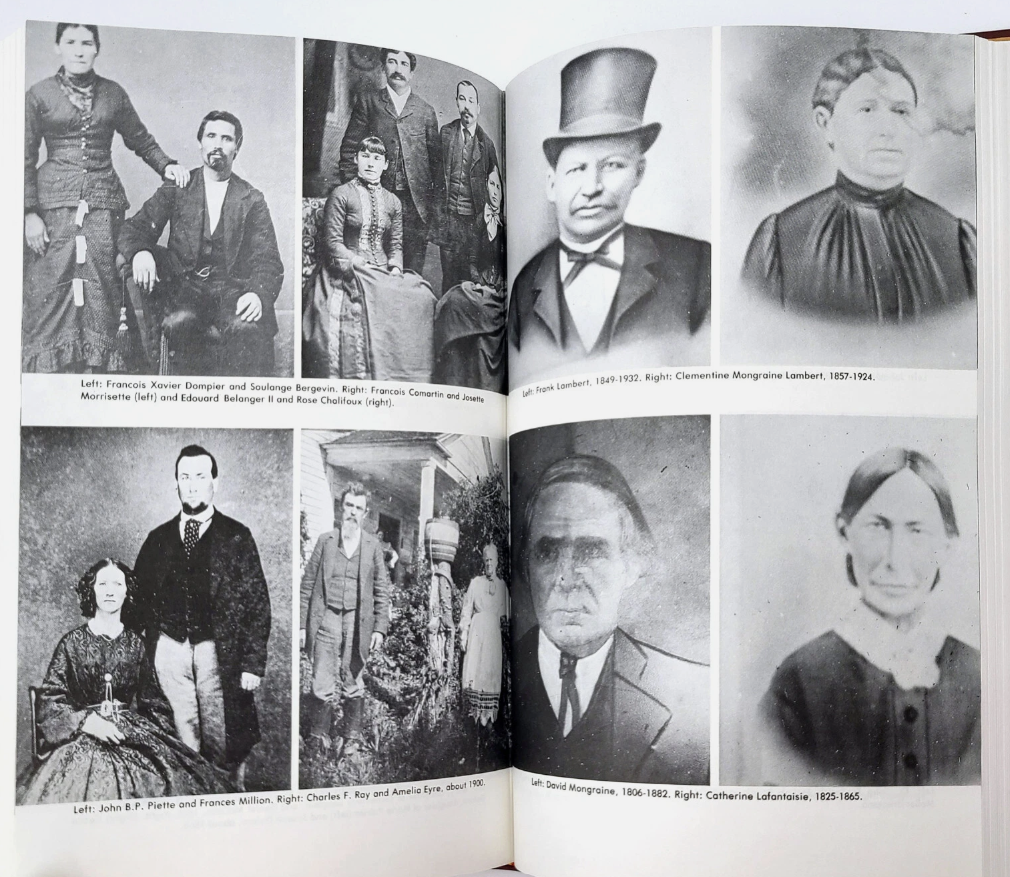
Portraits of French Prairie families from inside the St. Paul volumes — the community Munnick spent decades documenting
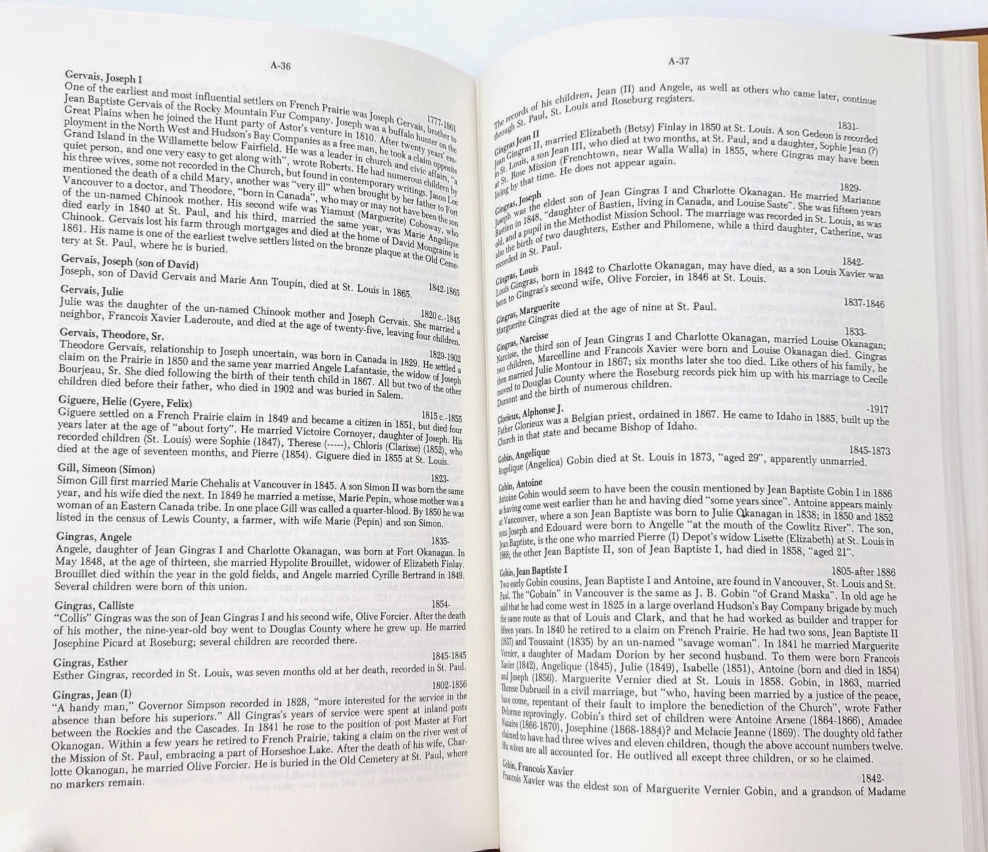
Biographical annotation pages — A-36 (Gervais, Joseph I) and surrounding entries showing the community portrait format
Where Munnick Can Be Wrong
The Munnick annotations are a compiled secondary source. They are authoritative in ways that no other resource matches for this community — but they are not infallible, and BCG-standard research requires treating them accordingly.
The most instructive example from my own research involves the attribution of a famous phrase. The annotation A-83 for Laurent Quintal states that Alexander Ross called him “that sly dog, Laurent” in his 1824 Snake Country journal. The HBCA biographical sheet for Laurent Quintal says the same phrase was used — but attributes it to an entirely different man: Laurent Karatohon, an Iroquois deserter on the same expedition.
Both compiled sources were reading the same primary document. One of them was wrong.
The party roster distinguishes them. The journal narrative does not — unless you read every entry that mentions a Laurent, in order, tracking the references backward. Secondary compilers who did not do this work did not distinguish the two men. The Ross journal itself does, explicitly, on February 25, 1824: “two Iroquois, Laurent and Lazard, had deserted.”
The resolution required going back to the primary source — the published journal in Oregon Historical Quarterly, Vol. 14, No. 4 (1914), transcribed from the original HBCA document by Agnes Laut. Five mentions of Laurent in the journal. The deserting Laurent is identified as Iroquois on February 25. The “sly deep dog Laurent who once already deserted” on March 23 refers back, through the phrase “once already,” to that same Iroquois man. Laurent Quintal, listed on the party roster, never appears in the narrative by name again.
The principle: When a Munnick annotation and a primary source conflict, the primary source wins. When two compiled sources conflict, the resolution path is always the same — find the original document and read it. Munnick knew this herself. Her work was always meant to lead you to the registers, not to replace them.
A Three-Layer Citation Standard
Across the case studies in this series, I use a consistent citation structure for every Munnick-based finding. It documents the primary source, the transcription, and the annotation as three independent evidentiary layers — not as a single source cited once.
The Three-Layer Citation Standard
Finding the Record You Need
Each volume contains an extensive alphabetical index. The first challenge is always phonetic: look for the spelling you expect, but also look for the spelling you might not expect. “Quintal” appears in Oregon records as Kantal, Cantrel, Coutrell, and Chantal. “Nipissing” appears as Napassant, Napesa, Nipissank, Nequim. If your search fails under the expected spelling, think about how the name sounds — not how it is written.
The second challenge is coverage. The Vancouver volumes cover 1838 onward at Fort Vancouver and the Stellamaris Mission. The St. Paul volumes begin in 1839. If your ancestor arrived in the Oregon Country before 1838 — as Laurent Quintal did, in 1831 — there is no Catholic register record of their life until the mission system caught up with them. The gap in the record is not an absence of the person. It is an absence of the institution.
The third challenge is the distinction between what the register contains and what the annotation adds. When Munnick says, in A-83, that Laurent was called “that sly dog, Laurent,” she is adding something that is not in any register — it comes from the Ross journal, via the HBCA biographical sheet. When I went back to the primary source, the attribution was wrong. The register was right. The annotation was not. Both layers are valuable precisely because you can check one against the other.
Munnick spent decades building this resource. Using it well means using it honestly — following her citations back to their sources, treating her annotations as the starting point for investigation rather than its conclusion, and being willing to say when the primary record says something different from what she found.
That is the work she would have wanted.
The Munnick annotations are the primary finding tool for the Laurent Quintal & Marie Anne Nipissing case study and the Paul Guilbault “The Canadian” case study in this series. The sly dog resolution, the Napassant/Nipissing variant, the B-186 and M-61 records naming Louis Nipissing as Marie Anne’s father, and Paul Guilbault’s marriage record M-18 and fifteen register appearances are all documented with full three-layer citations in the methodology pages for each case study.
Part of the Storyline Genealogy series: The Guilbault Line: Voyageurs of the Pays d’en Haut — and the Oregon Country
Want to Know When New Stories Are Published?
Subscribe to receive updates on new family history research—no spam, just meaningful stories when there's something worth sharing.
SUBSCRIBE TO OUR NEWSLETTEREvery Family Has a Story Worth Telling
Whether you're just beginning your research or ready to transform years of work into a narrative your family will treasure, I'd love to help.
BEGIN YOUR RESEARCH INQUIRY