
Born in the Pays d’en Haut
Joseph Claude Guilbault
Born in the Pays d’en Haut
His father was buried as a day labourer. His uncle as a farmer. Every other man in the extended Guilbault voyageur family had a Quebec identity to fall back on at the end. Joseph Claude Guilbault had one word — and it is very nearly the only word the records give us about the thirty-one years between his childhood and his grave.
Revised 6 August 2026. An earlier version of this biography carried Joseph Claude through a documented fur trade career. Re-examination of those records has withdrawn the central one — it belongs to another man — and left two others undecided. The reasoning is set out in full on the methodology page. What follows is the life the records will actually support.
Part One · The World He Was Born Into
June 1797 — somewhere in the pays d’en hautHe was born in the interior in June of 1797, to a French-Canadian voyageur and an Anishinaabe mother. He never knew a Quebec parish as home. He was carried to one at sixteen months of age, baptized with his brother and sister on a single October afternoon, named once more at four when his parents married — and then, as far as the Quebec record system is concerned, he vanishes for thirty-one years.
The world he was born into was his mother’s as much as his father’s. Marie Josephte Abitakijikokwe was an Anishinaabe woman recorded at her own baptism at Oka in January 1801 as de la nation Sauteuse sur le lac supérieur — Saulteaux, from the shores of the great lake the Anishinaabe call Gichigami. Her name, written down by a Sulpician priest who heard it spoken and rendered it as best he could, is one of very few Ojibwe women’s names to survive intact anywhere in the Quebec colonial record. It survives in three Oka entries between 1801 and 1803 and nowhere else. By the time she was buried at Rigaud in 1813, the priest wrote only sauvagesse de nation.
His father, Gabriel Guilbault, was a voyageur from the parishes of the St. Lawrence valley who had gone into the interior trade, met an Anishinaabe woman somewhere in the pays d’en haut, and built a family there before bringing it down to Quebec. The 1798 baptism register catches him mid-transition, in a formulation the priest evidently thought worth the extra words: voyageur et maintenant agriculteur — voyageur, and now farmer. He was trying to come home. By January 1802 he was a maçon, the word interlined above the line and the change validated by the priest’s own hand at the foot of the entry, which makes the shift in his trade datable to the month.
Joseph Claude was a child of that world, and so were two of his siblings. Three of Gabriel and Marie Josephte’s children were born in the upper country and carried down together: Gabriel fils, then eight years and four months; Angélique, about six; and Joseph Claude, sixteen months. Only François, born in September 1799, was born in the St. Lawrence valley. What set Joseph Claude apart was never where he began. It was that he alone did not stay.
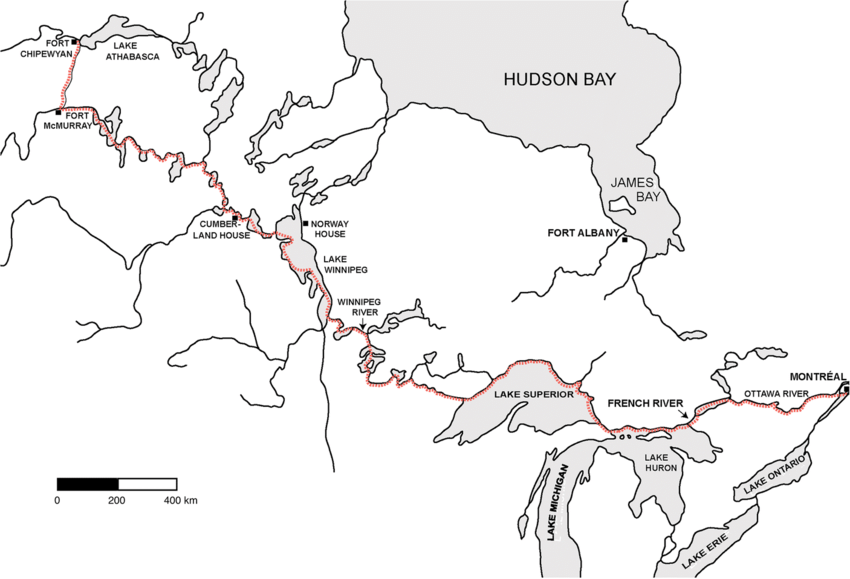
Lac La Pluie — the Athabasca depot
Among the interior stops on that highway, Lac La Pluie (Rainy Lake) held a uniquely strategic place. The economic historian H. A. Innis identified it as the depot for the season’s furs coming south from the Athabasca: every load of beaver from the far northwest passed through it, and every brigade heading north was outfitted there.
For genealogists working with the account books this matters directly. A man whose account appears in the Lac La Pluie blotter is not at a quiet local post; he is at the logistical pivot of the entire northern operation. A Gabriel Guilbault outfitted himself there on 26 July 1820 — a capot, a shirt, calico, rum, and a portage sling, footing at 133 livres. Which Gabriel remains an open question in this research file.
Part Two · The Baptism That Named Him
10 October 1798 — St-Paul-de-LavaltrieThe priest at St-Paul-de-Lavaltrie performed several baptisms on the afternoon of 10 October 1798. Among them were three children of Gabriel Guilbeau and his wife, described in Joseph Claude’s entry as Josephte sauvagesse de la nation des hauteurs — of the upper-country nations. The children had been born in the interior and privately baptized there, ondoyés, and the ceremonies were supplied now that the family had come down.
Joseph Claude was the youngest of the three, sixteen months old. The priest recorded that he had been né et ondoyé dans les pays d’en haut. That phrase is the first documentary trace of his life, and it is precise. He was not a Quebec child who had travelled to the interior. He was an interior child brought to Quebec for a single afternoon.

“… baptisé sous condition Joseph Claude né et ondoyé dans les pays d’en haut, agé de seize mois, fils de Gabriel Guilbeau voyageur et maintenant agriculteur en cette paroisse et de Josephte sauvagesse de la nation des hauteurs, son épouse.”
The priest wrote those words on an October afternoon and closed the register. It is the only document in the entire file that names Joseph Claude and both his parents together.
Registres paroissiaux, St-Paul-de-Lavaltrie, 10 October 1798; PRDH baptism #553676Two years later the family was at Oka. On 26 January 1801 Marie Josephte was baptized at the mission of the Lake of Two Mountains; the following day she and Gabriel were married there, and the marriage legitimized the four children then living — Gabriel at ten years six months, Angélique at eight, Joseph at four, François at seventeen months. That entry is the second and last record to state who Joseph Claude was.
| Marriage | 27 January 1801, L’Annonciation d’Oka |
| Children | Gabriel (b. c. June 1790, pays d’en haut) · Angélique (b. c. 1793, pays d’en haut; m. Rigaud 1815; d. Rigaud 1819) · Joseph Claude (b. 1797-06, pays d’en haut; d. 1833-01-29, Oka) · François (b. 10 Sep 1799; d. Oka 1801) · Marie Louise (b. Oka 1802; d. 1803) · Louis (b. Rigaud 1806) · Marie Louise, second of the name (b. c. 1807; m. Rigaud 1827; d. Vaudreuil 1844) |
| Joseph Claude — marriage | None recorded |
| Joseph Claude — children | None recorded |
What the card is, and is not. The database links Joseph Claude’s 1833 Oka burial to this family. That linkage is PRDH’s editorial decision, not a reading of the burial record — the Oka entry names no parents at all, and its own card carries a single rank with no father, mother or spouse. The card shows you a conclusion. The register shows you a record.
PRDH-IGD, Family no. 91975, Gabriel Guilbault & Marie Josephte Abitakijikokwe; www.prdh-igd.com. Card data restated, not reproduced.For his siblings, the record system did its ordinary work. Gabriel fils grew up in Quebec, married Madeleine Rocbrune in 1823, fathered sixteen children, was still calling himself voyageur in the 1851 census at sixty, and was buried at St-Placide in 1880. Angélique married at Rigaud in January 1815 — seven days before her father’s own remarriage in the same parish — and was buried there four years later, aged twenty-six, with Gabriel Guilbeault, père de la défunte standing at the grave and unable to sign.
For Joseph Claude, the system recorded a beginning, a legitimation at four, and an end.
Part Three · The Years of Silence
1801 — 1832 — thirty-one yearsAfter the January 1801 legitimation at Oka, Joseph Claude Guilbault disappears from the record entirely. He was three and a half years old.
He would have been in the world of his parents. The family is documented at Oka in the early years of the century — the marriage in 1801, the baptism of his sister Marie Louise in January 1802 with the mother described as de cette mission, the burial of that child in May 1803, the burial of his brother François there in April 1801 with an Algonkin woman named Catherine Nesepik8e present. Then the family moves. By 1806 Gabriel is recorded as a mason in the seigneurie d’Argenteuil, and the later children are baptized at Rigaud.
His mother died on 23 June 1813 and was buried at Ste-Madeleine-de-Rigaud two days later, aged about fifty, her husband present and named in the entry as mari de la défunte. Joseph Claude was sixteen. Whether he was there, or in the interior, or somewhere between, is not known. His father remarried in February 1815, to Josephe Clausier dit Lapensée, and had seven more children. Joseph Claude appears in none of it.
Thirty-one years of a man’s life, and the archive holds nothing that is securely his.
Why the Silence Is the Story
It would be easy to read that gap as a failure of research. It is not. It is what the record system does to a man who lived outside it.
Parish registers were built to document settled Catholic lives in fixed parishes: born here, married here, buried here. A man who spent his working life in the pays d’en haut generated no parish events at all — no marriage, no children baptized, no land, no burial until the last one. The obvious remedy is the archives of the companies that employed voyageurs, and those archives are real. They were searched thoroughly. What came back was a set of accounts and contracts bearing a version of his name, and the hard discipline of this case has been learning that a name is not a man.
Part Four · Two Records That May Be His
1820 — 1832 — the open questionsTwo documents from the interior remain candidates, and honesty requires that they be presented as candidates rather than as chapters.
The first is a Hudson’s Bay Company engagement passed at Colville House on the upper Peace River on 17 May 1820. A man who could not write made his mark on it. He contracted as devant de canots — the bowman, the paddler who reads the water ahead and calls the line through the rapids, a skilled position and not a beginner’s — for one year, pour la même somme de l’année dernière et le même Équipement. The witnesses were Chas Thomas and Batiste Brunelle, the second of whom also signed by mark. At the foot of the page, below the signatures, someone added a line excusing him by name from travelling to a particular post: Exempt de voyager au fort Ste Marie. Whoever he was, somebody had made him a promise.
His name was Joseph Guilbeau. The renewal clause proves an earlier engagement in 1819 that has never been found. And the contract states his parish of origin, which is where the difficulty lies: it reads de la paroisse Larivière, and Larivière is not St-Paul, not Lavaltrie, not L’Assomption, not Joliette. Whether Joseph Claude is the man who made that mark is, at present, unresolved.
The Hudson’s Bay Company Archives plates carry a printed prohibition on reproduction, so the contract is described here rather than shown. The full reference is HBCA, A.32/31, folio 323, Archives of Manitoba, Winnipeg, and any reader may order the image directly.
The second is a census entry: Guilbeault, Joseph — age 35 — White Horse Plain — Canada. White Horse Plain, Prairie-du-Cheval-Blanc, was the Métis community on the Assiniboine west of the Red River Settlement, established permanently in 1823 under Cuthbert Grant. Its people came from exactly the networks Joseph Claude was born into: French-Canadian fathers, Indigenous mothers, children raised between two worlds who made a third of their own. A man of thirty-five with his background would have been at home there in a way he had never been at home in Lanaudière.

The legend of the white horse
The community had its own story. A Sioux chief wished to marry the daughter of an Assiniboine chief; she was given instead to a Cree chief she loved, who offered a rare snow-white horse as a gift. The Sioux pursued them, and both were killed. For years afterward the white horse was seen roaming the plain, and the place took its name from the memory.
The parish of St-François-Xavier was founded there in 1834, with Father Charles-Édouard Poiré as its first priest — one year after Joseph Claude died. Had the community kept registers a year earlier, this biography might have a different shape.
Part Five · The Last Journey
January 1833 — OkaHe arrived at the Oka mission in the weeks before 29 January 1833. The priest, Durocher, wrote the phrase that has echoed through this research ever since: depuis peu domicilié en cette mission. Recently settled here. He had not been long.
What brought him is not documented. Men in the interior trade did not travel to the Lake of Two Mountains in January without a reason. He may have been ill when he left the west. He may have been coming to a place he half-remembered from childhood, the way people in every age turn toward the familiar when they feel an end approaching. He may simply have been heading east and died sooner than he meant to.
He died on 29 January and was buried on the 31st, in the register of the same mission church that had recorded his parents’ marriage thirty-two years before. The entry is short. The priest did not know him — in the margin he wrote the surname, struck part of it through, and wrote it again.

“Le trente un Janvier mil huit cent trente trois par moi Prêtre soussigné a été inhumé Joseph Guilbeault Voyageur, décédé avant hier agé d’environ quarante ans, depuis peu domicilié en cette mission. Furent présents à son inhumation Louis Pierre Constant Pinesi et Simon Kakiuttawelch qui n’ont su signer.”
On the thirty-first of January 1833, by me the undersigned priest, was interred Joseph Guilbeault, Voyageur, died the day before yesterday, aged about forty years, recently settled at this mission. Present at his burial were Louis Pierre Constant Pinesi and Simon Kakiuttawelch, who could not sign.
Registres paroissiaux, L’Annonciation d’Oka, 31 January 1833
| Rank 01 | Joseph GUILBEAULT |
| Age | 040 |
| Sex | m |
| Marital status | — |
| Prof. | d |
| Death | 29 January 1833 |
| Burial | 31 January 1833 |
| Place | Oka (L’Annonciation), MRC Deux-Montagnes, Laurentides |
| Father | Not indexed — not named in the record |
| Mother | Not indexed — not named in the record |
| Spouse | Not indexed — not named in the record |
| Witnesses | Not indexed |
One rank, and nothing else. This is the whole of what the database holds for the burial. The d in the Prof. column is not a marital status; compared against other cards in this family it marks the subject of the burial as deceased.
That this man is Gabriel and Marie Josephte’s son is an argument from convergence — the trade, the age, the timing, the place his mother had once belonged to, and the absence of any competing Joseph of the right description. It is a sound argument. It is not a stated fact.
PRDH-IGD, Burial no. 4722464, Oka (L’Annonciation), 31 January 1833; www.prdh-igd.com. Card data restated, not reproduced.Forty against thirty-five — and why it is the least of it
The priest guessed environ quarante for a man of thirty-five, and hedged the guess. Against the rest of this family that is remarkably close. Gabriel père’s burial in April 1833 gives ninety-three against a documented seventy — twenty-three years out. Joseph Morin’s in 1781 gives ninety against seventy-one. Gabriel fils’s in 1880 gives ninety-two against ninety.
Four generations, four overstatements, all in the same direction. The two ages Joseph Morin gave in person, at his marriages, are right within a year; the one given after his death is wrong by nineteen. A stated age is only as good as the person stating it, and at a burial nobody is stating it.
Part Six · The Men Who Stood at the Grave
Grand Chief Pinesi, and a second Algonkin man named SimonThe priest barely knew the man he was burying. The two who stood witness were another matter.
Louis Pierre Constant Pinesi — the forenames transposed, as French priests routinely transposed them — was Pierre Louis Constant Pinesi (1768–1834), the most prominent Algonkin leader in the Ottawa River watershed. He had been recorded as premier chef of the Algonkins of the Lake of Two Mountains since a petition of July 1798, and for the next thirty-six years he petitioned the Crown, again and again, for recognition of Algonkin title to the lands of the Ottawa and its tributaries. He fought in the War of 1812 with four of his sons and was distinguished at Beaver Dams. He was never answered.
In February 1830 the Crown, in the name of Sir James Kempt, designated him Grand Chief. The certificate survives: a printed form letter with a name, a title and a date filled into the blanks, signed by a military secretary. It conferred no authority he did not already hold among his own people, and it resolved none of his petitions. He was chief of the bande de la Tourte, and he signed with the mark of a passenger pigeon.
Three years later he stood at the grave of a voyageur the priest could not spell. Eighteen months after that, on 13 August 1834, he and his wife Marguerite Nipawikwe died of cholera at Oka within hours of one another and were buried the following day.
Simon Kakiuttawelch has not been identified. The name as the priest wrote it does not match any attested rendering for the Grand Chief’s son, and Simon was not a distinguishing name at this mission — Pinesi’s own brother was a chief called Simon Chimaganich, and his son-in-law was the Nipissing chief Simon Kiwekwato. He was an Algonkin man of some standing who came to the burial with the Grand Chief, and that is as far as the record goes.
What that leaves is the part that mattered. The phrase depuis peu domicilié en cette mission has always been read as the priest not knowing him, and it still means that; the struck-out surname in the margin says the same thing twice. But the most prominent Algonkin leader in the Ottawa valley attended the burial, with a second Algonkin man beside him. A voyageur who reached Oka in his last weeks was a stranger to the French priest and not a stranger to the Algonkin community there.
Somebody knew who he was — and two people did, whose names the priest wrote down and could not spell either.
Part Seven · Ten Weeks Later, Ten Miles Away
6 April 1833 — Saint-BenoîtGabriel Guilbault père died at Saint-Benoît on 6 April 1833 and was buried on the 8th. The register calls him journalier du lieu — a day labourer of the place — and gives his age as about ninety-three, against a baptism of 13 June 1762 that makes him seventy. He was a widower of Josephe Lapensée. Two men were present; one could sign.
He had been a maçon in the Rigaud and Argenteuil records from 1802 through 1815. By the end he was a labourer in the parish where he died.
His son had been buried ten weeks earlier and about ten miles away. Both parishes sit in Deux-Montagnes county; Oka and Saint-Benoît are near neighbours. They died in the same season, in adjoining districts, recorded by different priests in different register systems, and nothing in either entry acknowledges the other. The proximity makes the silence harder to explain rather than easier.
Whether either man knew is not recoverable. What can be said is that both were shaped by the same country, and that the archives which recorded the ends of their lives were never designed to record the middles.
Joseph Claude Guilbault — what the records hold
Joseph Claude Guilbault
His uncle Paul lived his whole life at St-Paul-de-Lavaltrie, lent money out as secured grain annuities in his sixties, and was buried in 1831: cultivateur. His father came home to the Ottawa River, and was buried in 1833: journalier du lieu. Both had a Quebec place and a Quebec trade to be recorded by.
Joseph Claude had no Quebec farm, no Quebec marriage, no Quebec trade. He has a baptism, a legitimation, two records that may be his, and a grave. What lies between them is not a gap in the research. It is the shape of a life the record system was never built to hold.
And when the priest at Oka opened his register on 31 January 1833 and wrote down what little he knew of a man he had barely met, he wrote the one word that no one has been able to take away:
Voyageur.
✦ Free Download: Five Signs of Indigenous Ancestry in Quebec Parish Records
Learn the phrases, naming patterns, and record clues that reveal Indigenous ancestors hidden in Quebec parish records—the same methodology that identified Marie Josephte Abitakijikokwe. Includes FamilySearch Full Text Search strategies.
Get Your Free GuideEvery Family Has a Story Worth Telling
Whether you're just beginning your research or ready to transform years of work into a narrative your family will treasure, I'd love to hear your story.
BEGIN YOUR RESEARCH INQUIRY