
The Storyline
Real families. Real discoveries. Real stories.
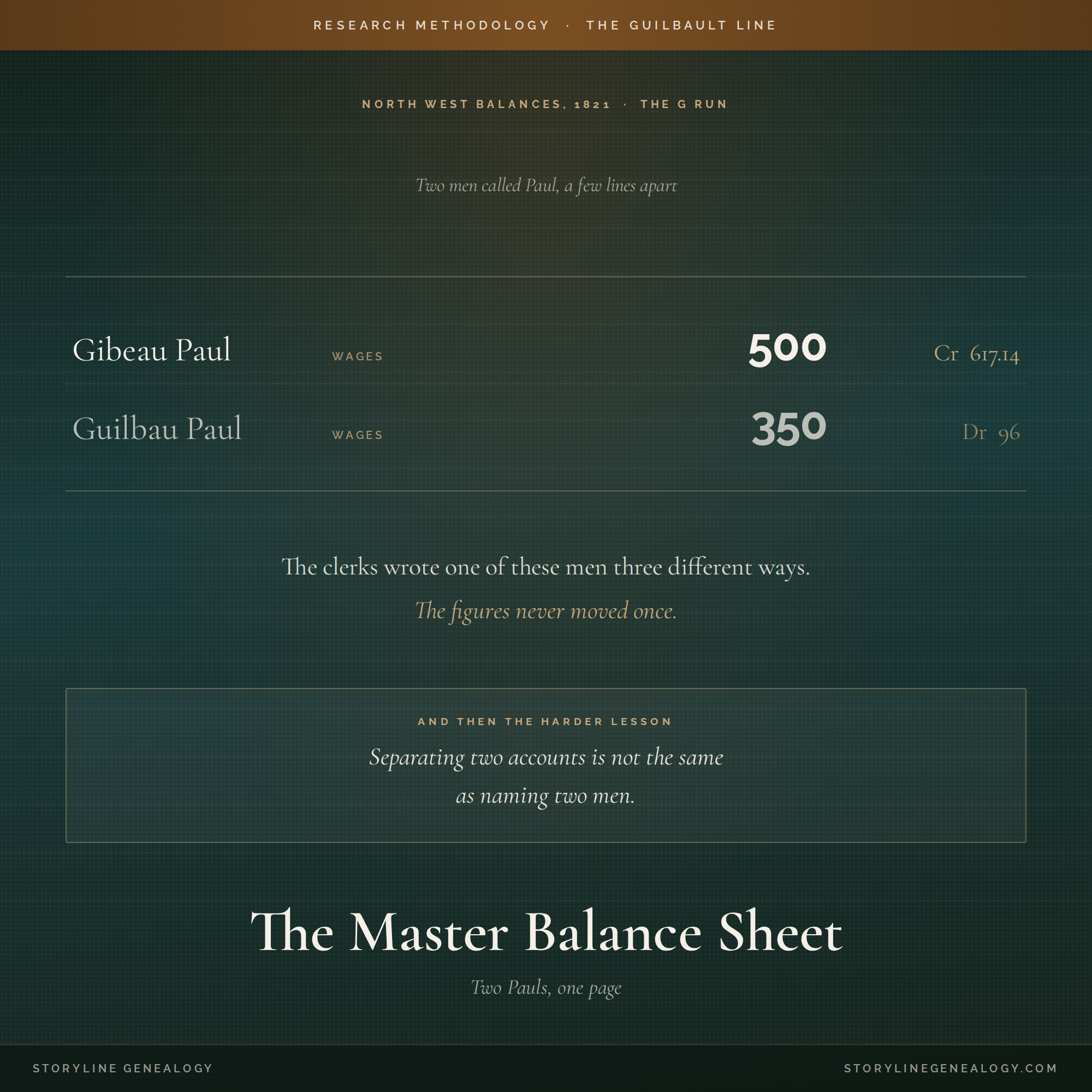
The Master Balance Sheet: Two Pauls, One Page
Two men called Paul appear in the North West Company's 1821 settlement register, in the same department, in the same season. The clerks spelled one of them three different ways, so the spelling could tell them apart from nothing. The figures could, and did — a wage of 500 against a wage of 350, holding still across every volume. What took another year to see is that separating two accounts is only half the work, and the easier half. Neither figure says who either man was.
Part of the Storyline Genealogy series: The Guilbault Line: Voyageurs of the Pays d'en Haut — and the Oregon Country
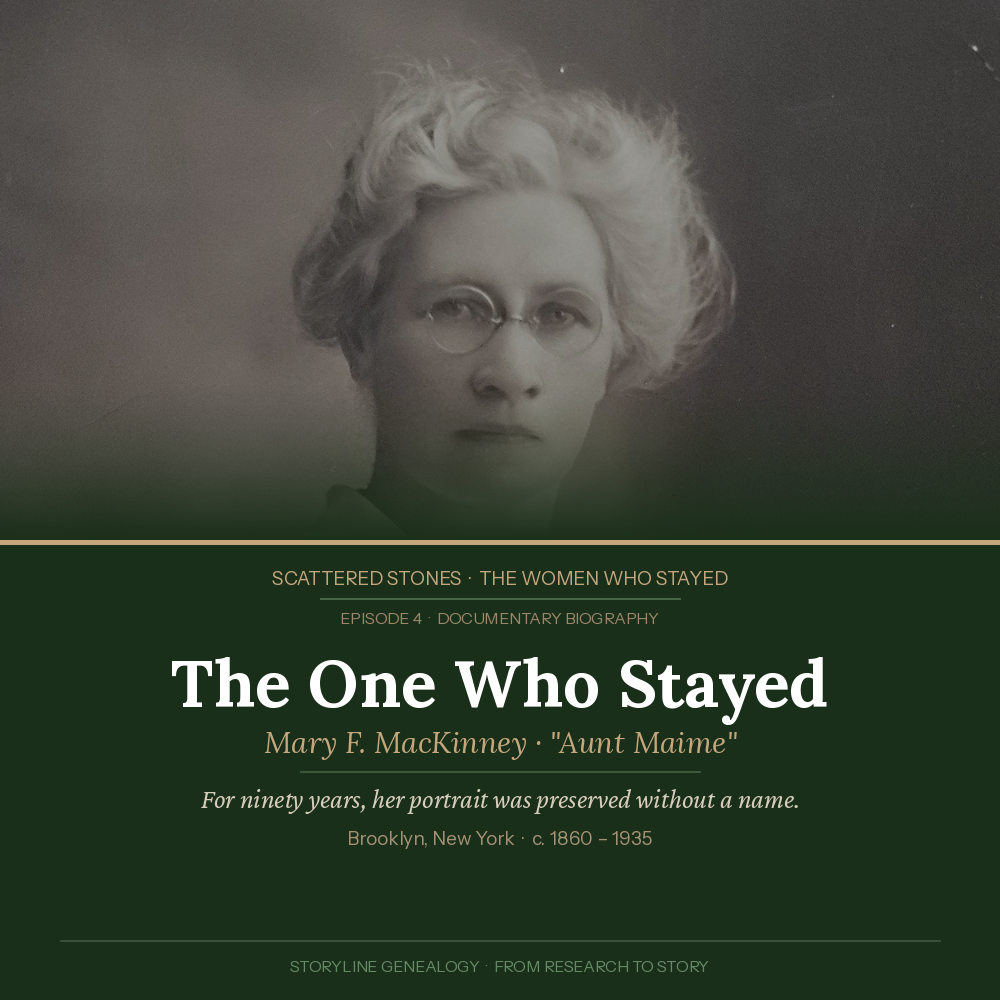
Mary F. MacKinney
For ninety years, her portrait was preserved without a name. When it was finally identified in October 2025, it revealed the story of a woman who went from placing desperate newspaper ads for housework to running her own Brooklyn boarding house — all while raising two orphaned girls who had nowhere else to go in November 1888.
Part of the Storyline Genealogy Series: Documentary Biographies From Research to Story
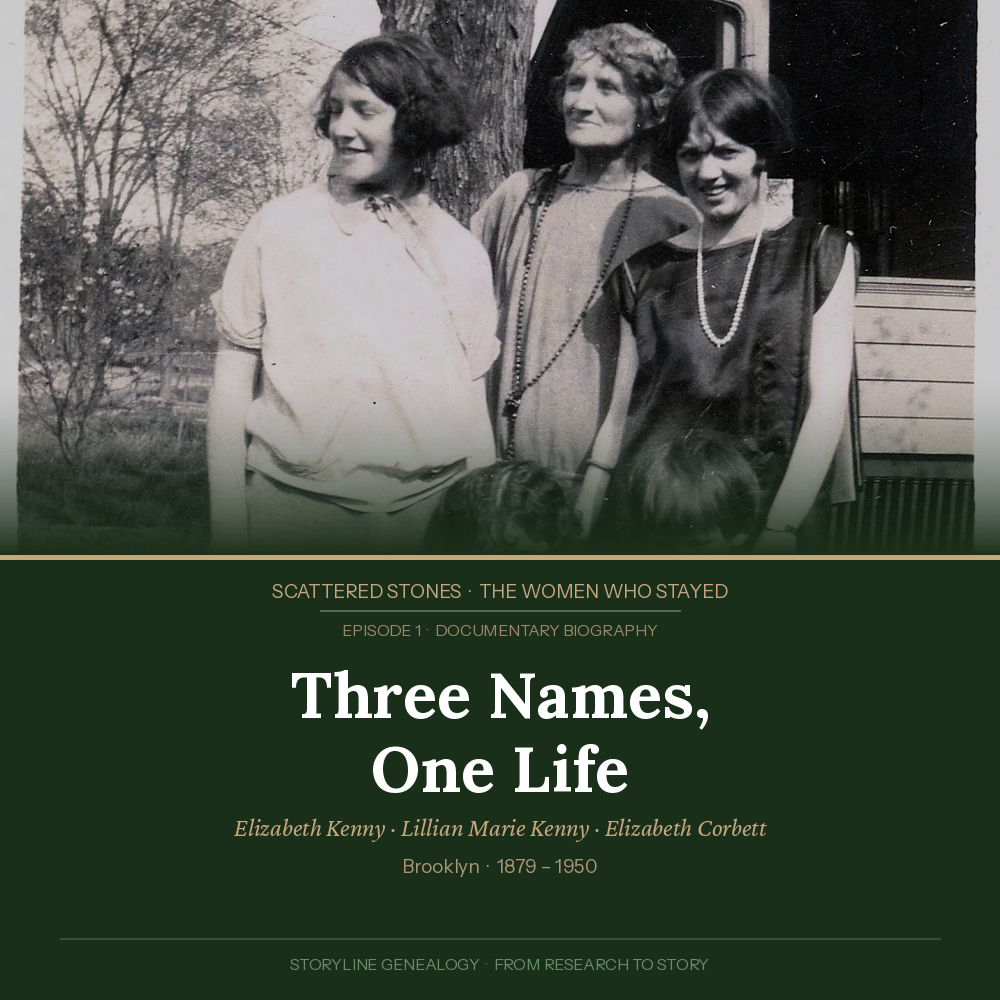
Elizabeth Kenny Corbett
She used three names across her lifetime, served twelve days in the U.S. Navy before the Armistice ended the war she'd enlisted for, and raised her sister's children after the twelve-day catastrophe of January 1924. Proving all three names belonged to the same woman required a decade of research — and one government card that put both names on a single line.
Part of the Storyline Genealogy series: Documentary Biographies From Research to Story
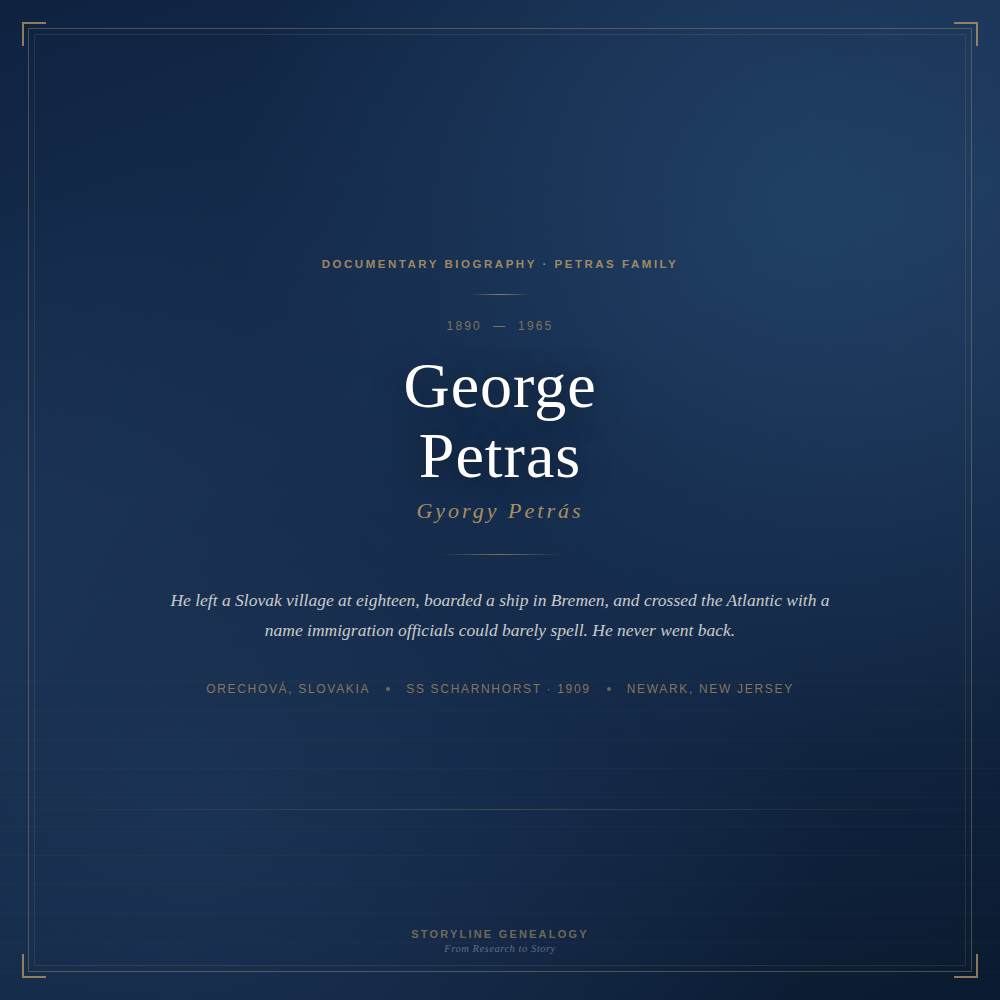
George “Gyorgy” Petras
In 1909, an eighteen-year-old Slovak named George Petras boarded a ship in Bremen and crossed the Atlantic. Immigration officials spelled his name four different ways. He settled on Thomas Street in Newark, married, raised seven children, worked the docks at Port Newark, and waited thirty-five years to make his citizenship official. This documentary biography traces his journey through the primary sources that survived him.
Part of the Storyline Genealogy series: Documentary Biographies From Research to Story
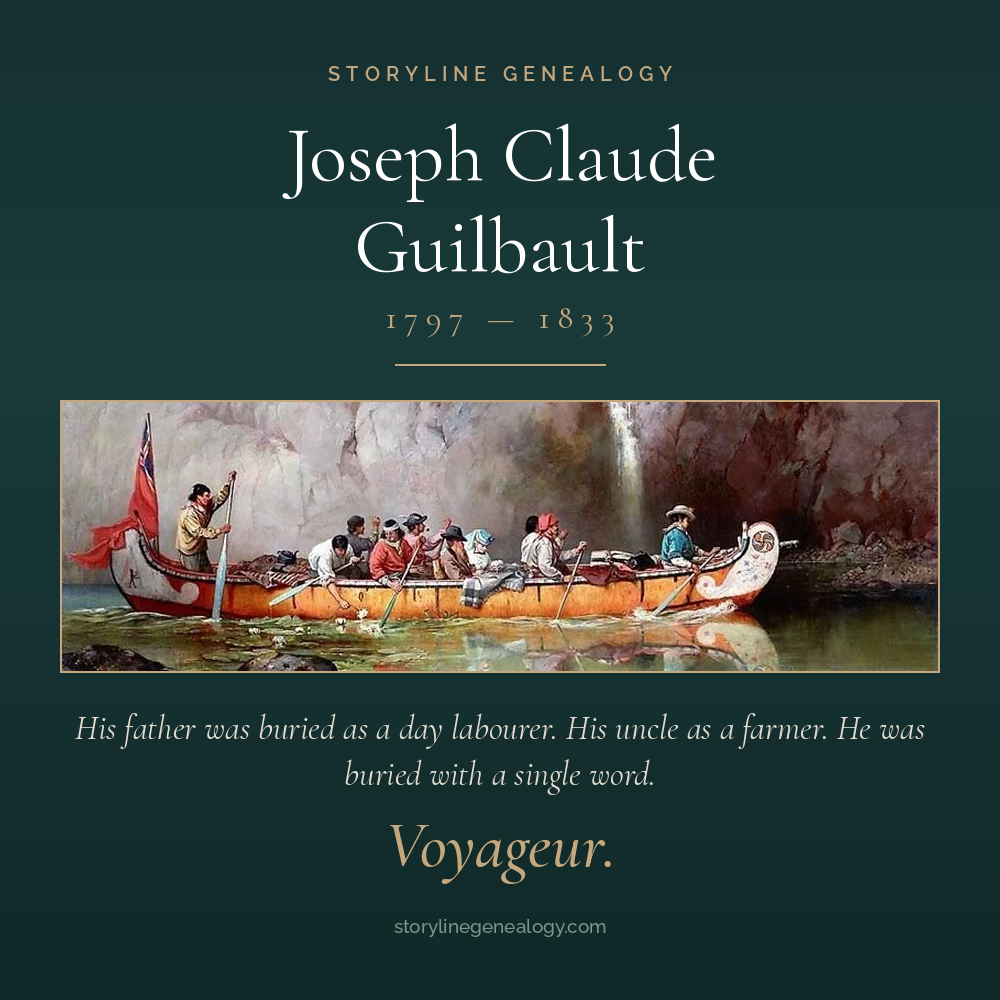
Born in the Pays d’en Haut
Joseph Claude Guilbault was born in June 1797 somewhere in the pays d'en haut, to a French-Canadian voyageur and an Anishinaabe mother from Lake Superior. He was baptized at sixteen months, named once more at four, and then disappears from the Quebec record for thirty-one years. When a man of his name was buried at Oka in 1833, the priest wrote one word for his occupation — and the Grand Chief of the Algonquins stood at the grave.
Part of the Storyline Genealogy series: The Guilbault Line: Voyageurs of the Pays d'en Haut
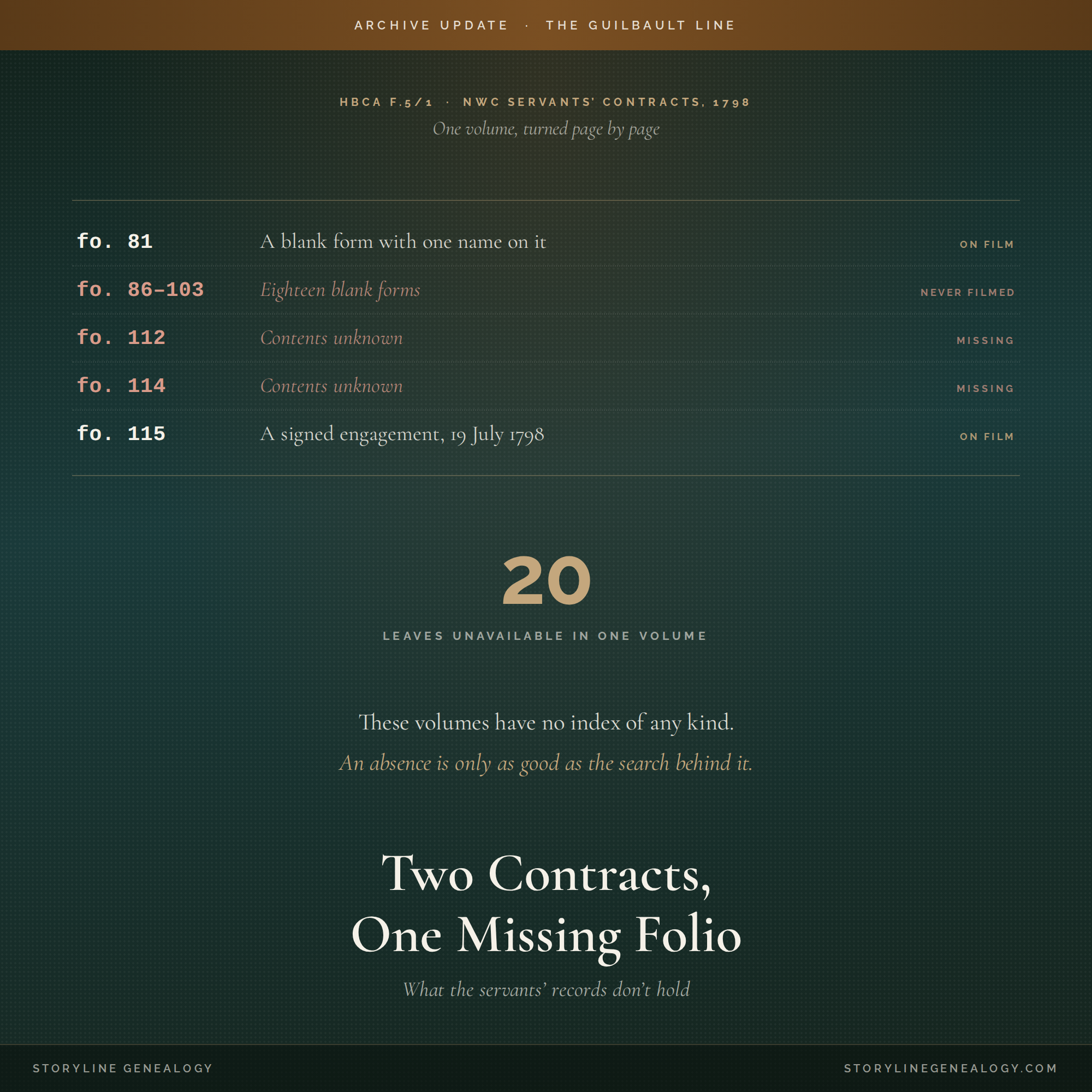
Two Contracts, One Missing Folio
The North West Company's servants' contracts are the most informative documents in the fur-trade archive and almost unusable: the volumes carry no name index of any kind, so finding a man means turning every page. Do that, and you start noticing what isn't there. In one volume alone, two folios are lost and eighteen more were never filmed — twenty leaves unavailable, any of which could hold an engagement. One man in this family has two signed contracts and no identity. Another has five years of wages and nothing signed anywhere.
Part of the Storyline Genealogy series: From Research to Story
From Death Rapids to Saint Paul Mission: Hilaire Guilbault
In September 1838, Hilaire Guilbault of Verchères, Québec, survived the worst disaster on the Columbia River brigades — the bateau capsizing at Les Dalles des Morts that killed twelve people, including the wife of Governor Sir George Simpson. He did not go home. Four years later he gave sworn testimony before James Douglas at Cowlitz Farm. Six months after that he stood godfather at Saint Paul Mission. Three documents tell the arc of a life built from the wreckage of a river crossing.
Part of the Storyline Genealogy series: The Guilbault Line: Voyageurs of the Pays d'en Haut — and the Oregon Country
French Prairie: The Western Terminus
French Prairie was not a coincidence. It was the predictable endpoint of a network that began at Oka, ran through Fort Walla Walla and New Caledonia, and ended at St. Paul, Marion County — where the same families who had lived beside each other at the Lake of Two Mountains reconstituted themselves three thousand miles west. This post documents why the HBC pipeline sent those families west, why they landed where they did, and what the three-country archive gap between Quebec and Oregon means for anyone trying to trace them.
Part of the Storyline Genealogy series: The Guilbault Line: Voyageurs of the Pays d'en Haut — and the Oregon Country
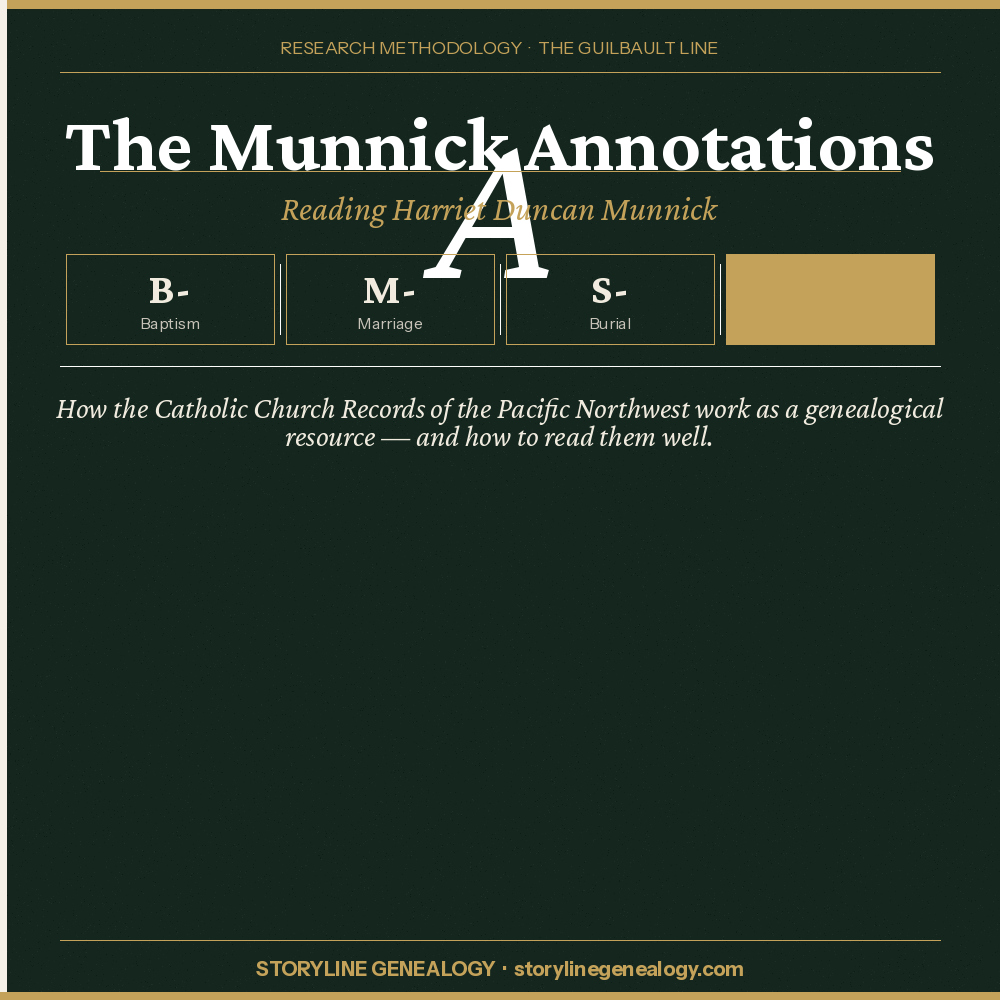
The Munnick Annotations:Reading Harriet Duncan Munnick
Harriet Duncan Munnick spent decades turning sparse sacramental registers into something no single archive could produce on its own — a record of who the people of French Prairie actually were, where they came from, and what happened to them. The Catholic Church Records of the Pacific Northwest are the essential finding tool for fur trade genealogy in the Oregon Country. This post is a practical guide to reading them: how the B-, M-, S-, and A- annotation system works, how to use transcription and annotation as separate evidentiary layers, how to track a name through its phonetic variants, and where Munnick can be wrong — and why knowing that makes the resource more useful, not less.
Part of the Storyline Genealogy series: The Guilbault Line: Voyageurs of the Pays d'en Haut — and the Oregon Country
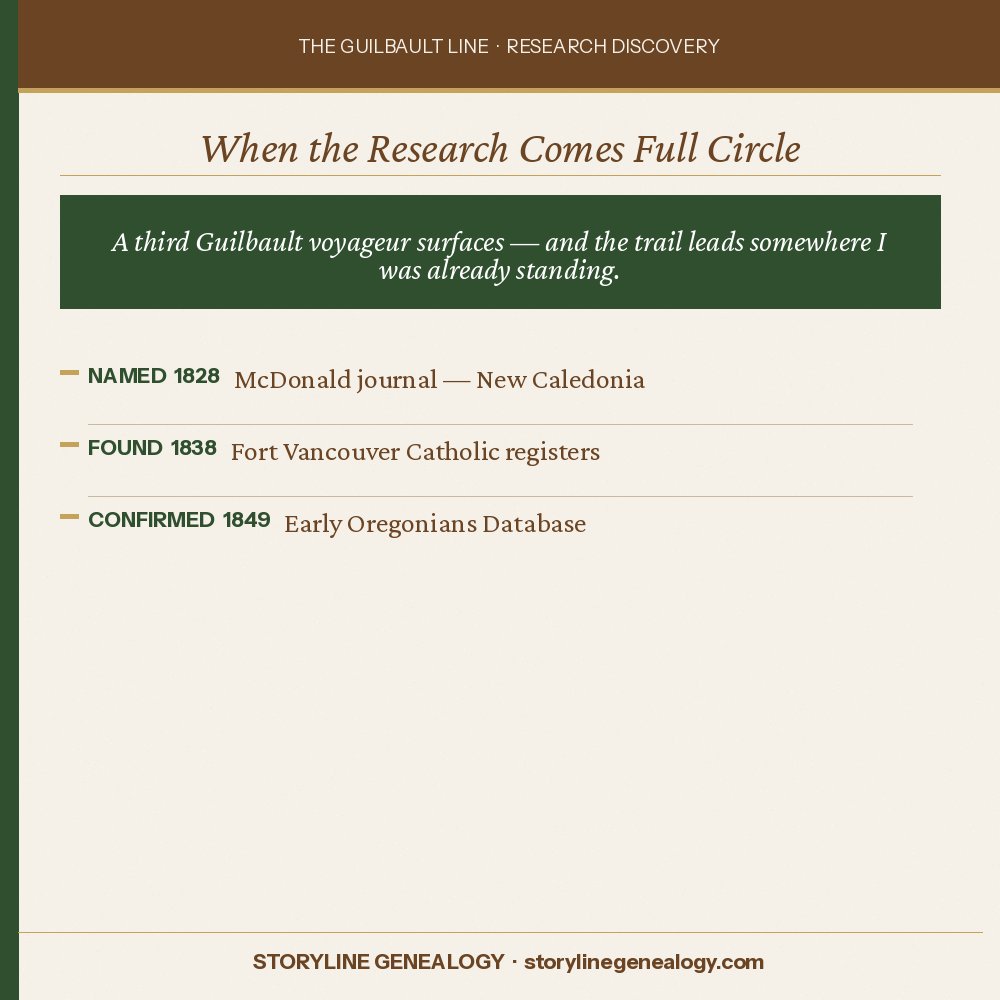
When the Research Comes Full Circle
I thought I was checking a single fact. Four PRDH family records later I had three men called Paul Guilbault instead of two: one who stayed in his parish and left a thick notarial trail, one who went to New Caledonia and Oregon and never came back, and one who exists only as figures in a company ledger, spelled three ways, with no parish to send anyone looking. Then the trail led to Marion County, Oregon — where I had already been working for weeks, on an entirely different project.
Part of the Storyline Genealogy series: The Guilbault Line: Voyageurs of the Pays d'en Haut — and the Oregon Country
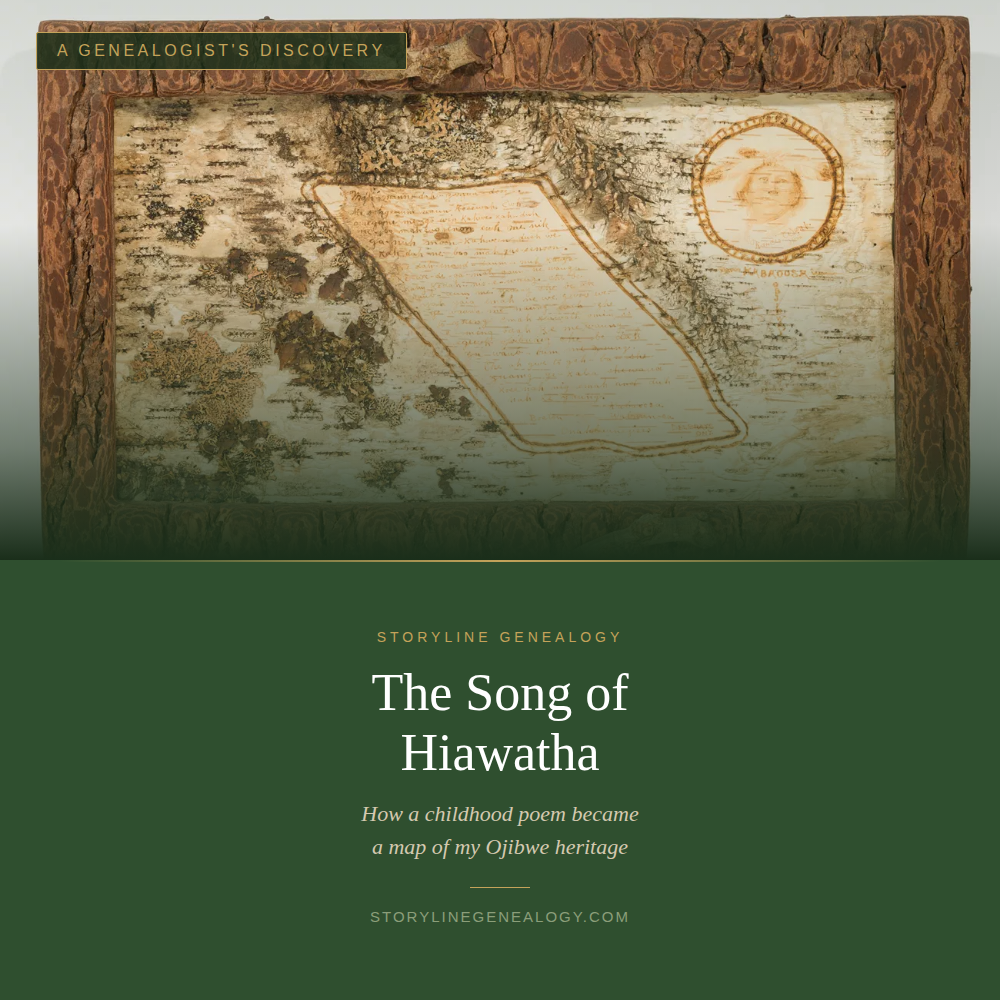
The Song of Hiawatha: A Genealogist’s Discovery
When I rediscovered two old copies of The Song of Hiawatha while sorting my office, they sat beside my Munising maple bowls—hand-painted pieces I had collected for years, drawn to them without knowing why. That same day, I discovered why: Munising, Michigan, sits at the gateway to Pictured Rocks National Lakeshore—the heart of Hiawatha country, the homeland of my Ojibwe 4th great-grandmother, Marie Josephte Abitakijikokwe.
Part of the Storyline Genealogy series: From Research to Story
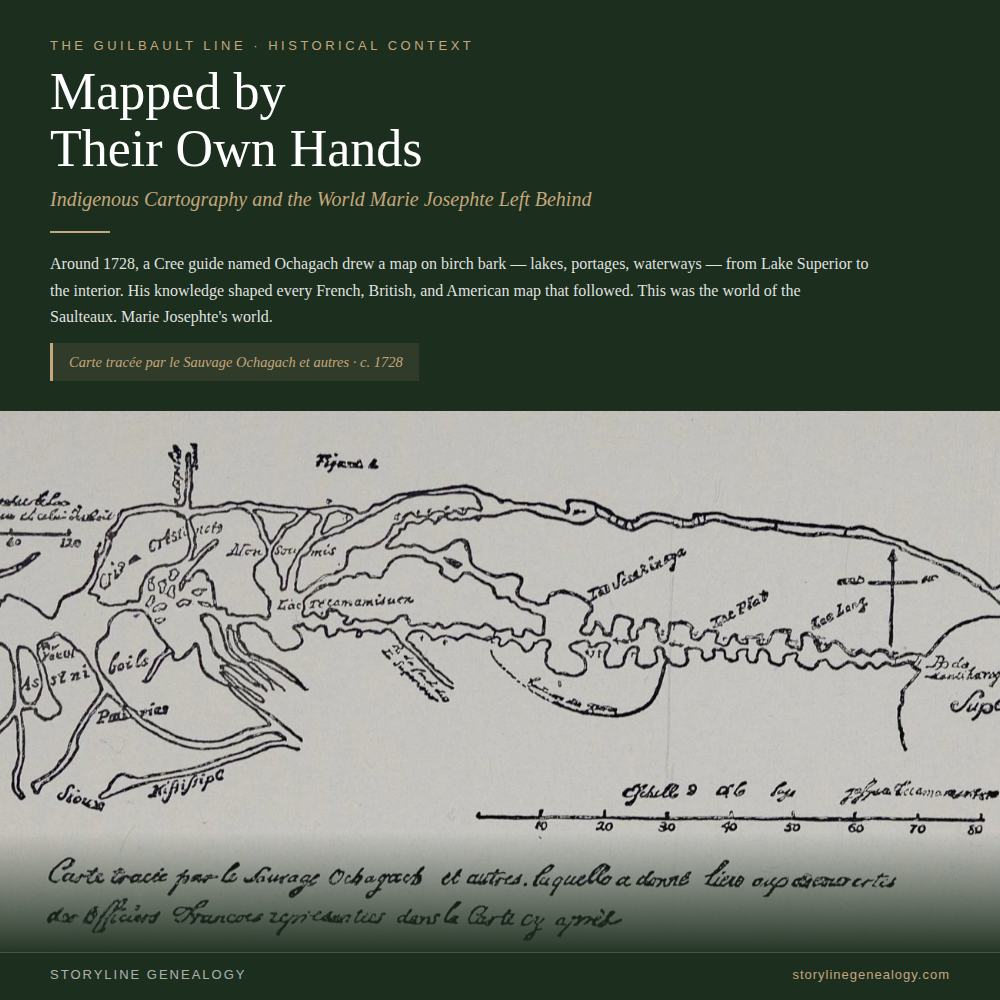
Mapped by Their Own Hands
Around 1728, a Cree guide named Ochagach drew a map on birch bark. It showed the water route from Lake Superior westward through the lakes and portages to Lake Winnipeg — every node, every connection, every carrying-place documented in a cartographic language that European mapmakers would spend the next fifty years trying to translate. The French officer who received it sent it to Paris. A Parisian geographer engraved it onto copper. The same portage chain appears on British and American maps a generation later. The original knowledge was Anishinaabe. So was Marie Josephte Abitakijikokwe's world.
Part of the Storyline Genealogy series: The Guilbault Line: At the Lake of Two Mountains
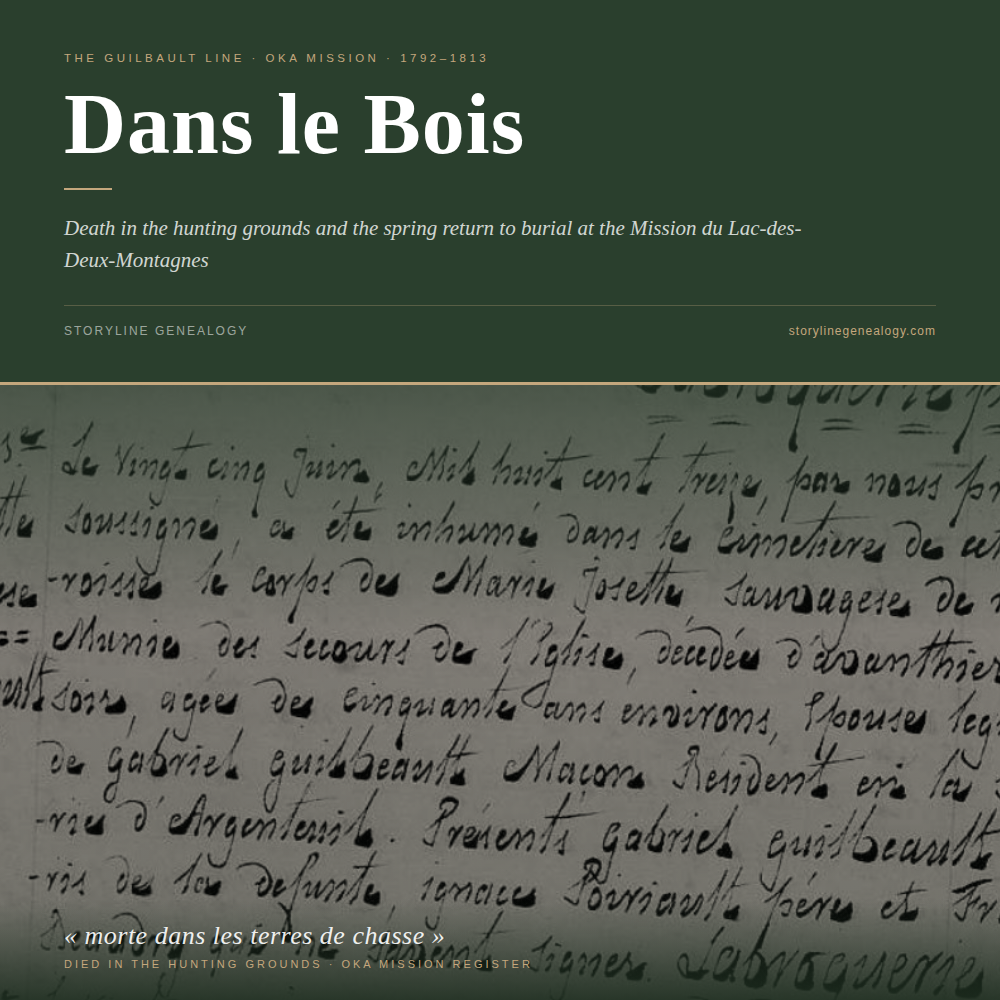
Dans le Bois: Death in the Hunting Grounds
Scattered through the Oka Mission parish registers, in the handwriting of three different priests across three decades, a phrase appears and reappears: mort dans le bois. Died in the woods. Décédée dans les terres de chasse. Died in the hunting grounds. These are not euphemisms. They are geographic facts — and once a researcher understands what they mean, the burial records of the Mission du Lac-des-Deux-Montagnes open up in an entirely different way.
Part of the Storyline Genealogy series: The Guilbault Line: At the Lake of Two Mountains
A Name Written in Cedar and Sky
On 27 May 1786, a priest at the Oka Mission wrote down two names on the same register page, one above the other, and did not remark on what they shared. Both women bore the root kijik — cedar, sky, day, medicine — in their names. Over the next ninety-eight years, fifty-five individuals across five Anishinaabe nations would carry that root through the registers of the Lake of Two Mountains mission. This piece traces where the name came from, who carried it, and how a single act of godparenthood preserved it for generations.
Part of the Storyline Genealogy series: The Guilbault Line: At the Lake of Two Mountains
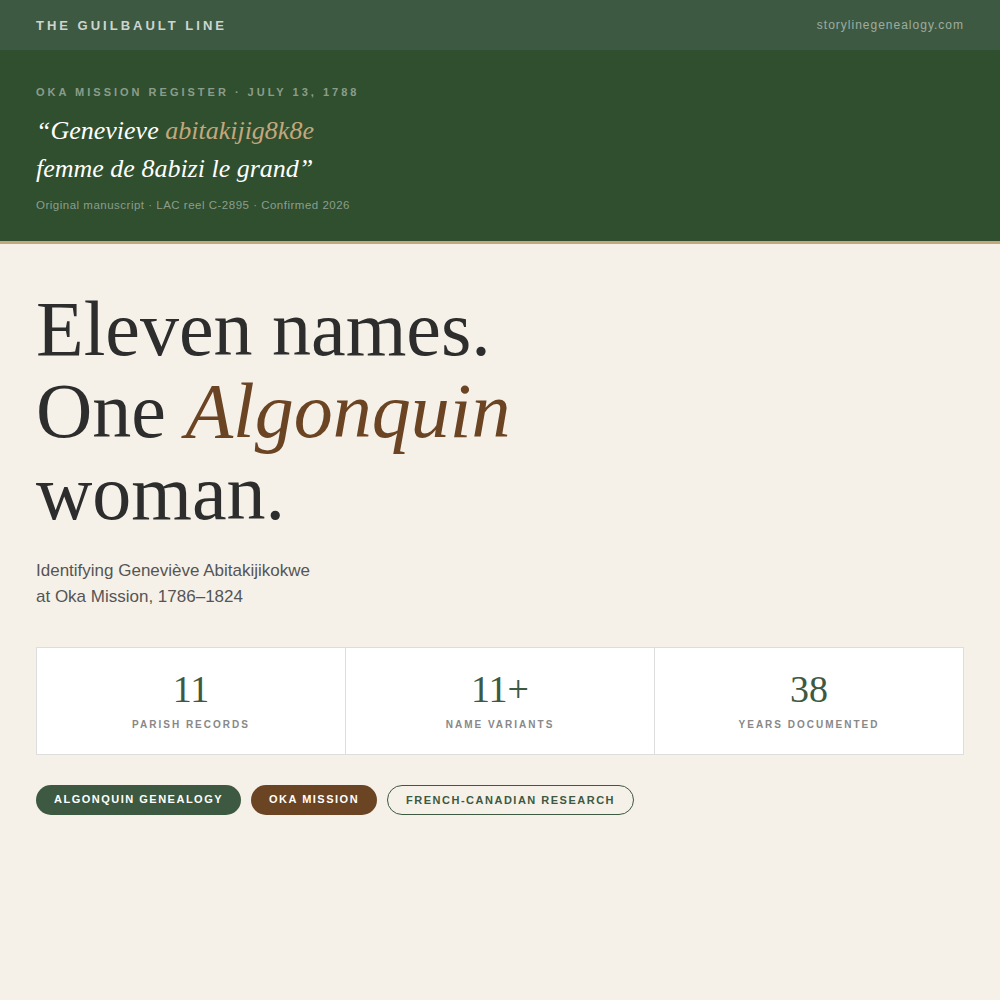
Geneviève Abitakijikokwe: Eleven Name Variants
Her name was written ten different ways across thirty-eight years of Oka Mission registers. The woman behind those names — Geneviève Abitakijikokwe, wife of the Algonquin war chief Kitchiwabisi — appears in eleven primary records between 1786 and 1824. Identifying her required going beyond the published indexes to the original manuscript. What I found there changed the entire shape of the problem.
Part of the Storyline Genealogy series: The Guilbault Line: At the Lake of Two Mountains
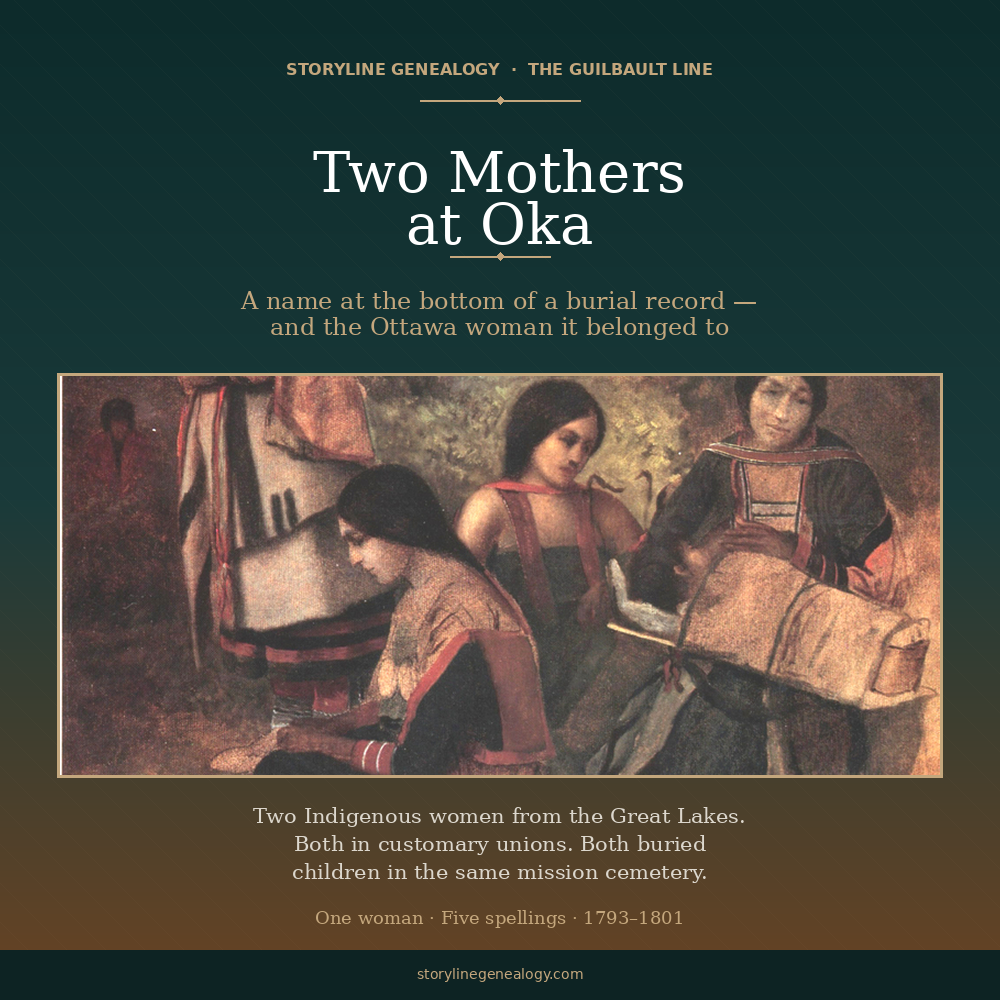
Two Mothers at Oka: Identifying Catherine Messinabikwe
On April 4, 1801, a priest at the Oka mission buried a two-year-old boy named François. Two witnesses were present: the boy's ten-year-old brother, and a woman the priest recorded as Catherine mesepik8e. She was not identified as a relative. She was simply there. Tracing her Algonquian name across five colonial spellings — Mador, Mabre, Missinebi8e, mesepik8e, Messinabikwe — revealed an Ottawa woman from Michilimackinac who had buried her own daughter in the same cemetery two years earlier.
Part of the Storyline Genealogy series: The Guilbault Line: At the Lake of Two Mountains
Paul Guilbault père
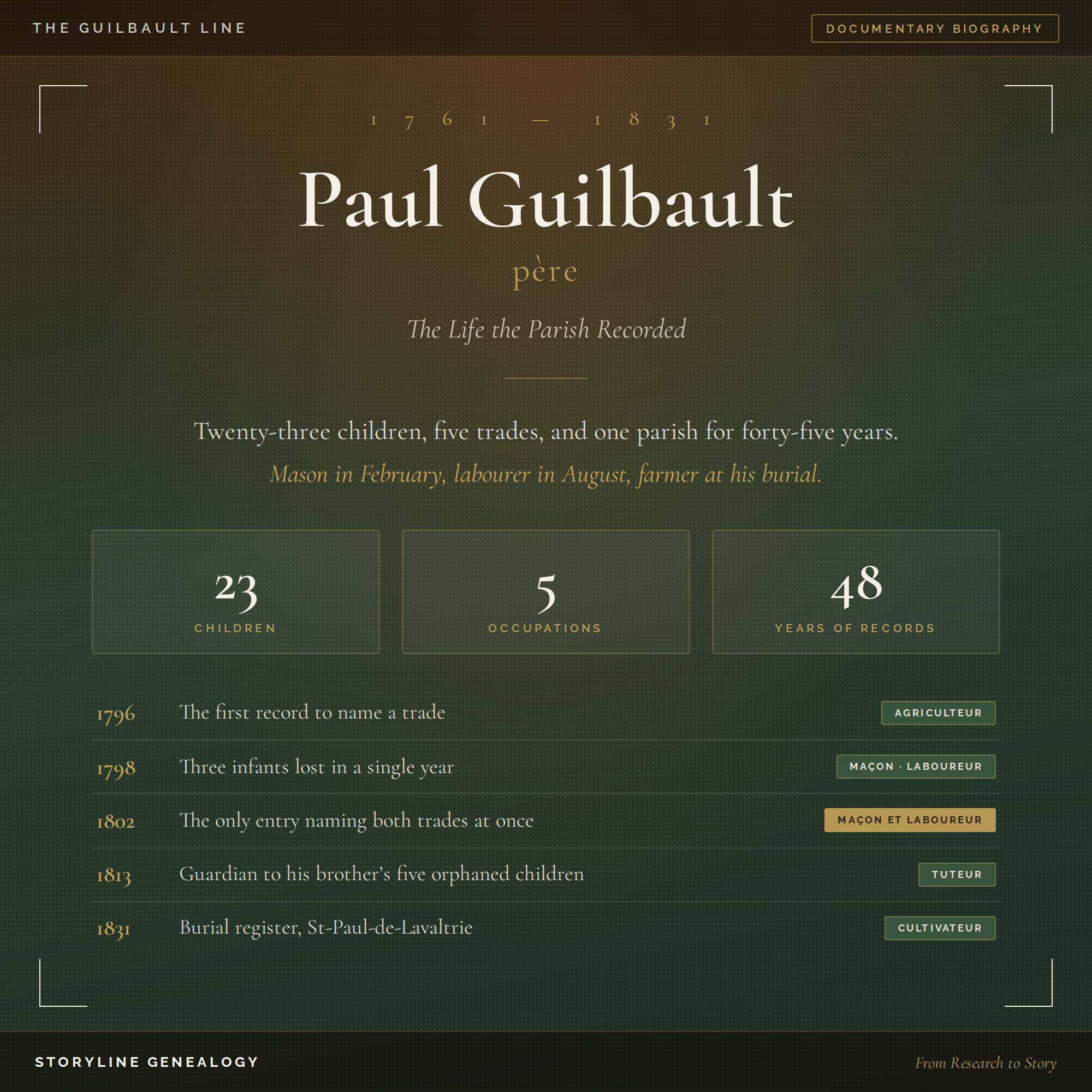
For forty-five years the priests of St-Paul-de-Lavaltrie wrote down what Paul Guilbault was, every time something happened to him or to one of his twenty-three children. In February 1810 he was a mason. By August he was a labourer. At his burial in 1831 he was a farmer, and fourteen months after his death a priest wrote him down as a farmer again. This is the documentary biography of a man whose parish record is so complete it can be used to test claims made about him elsewhere.
Part of the Storyline Genealogy series: The Guilbault Line
The Brothers Guilbault
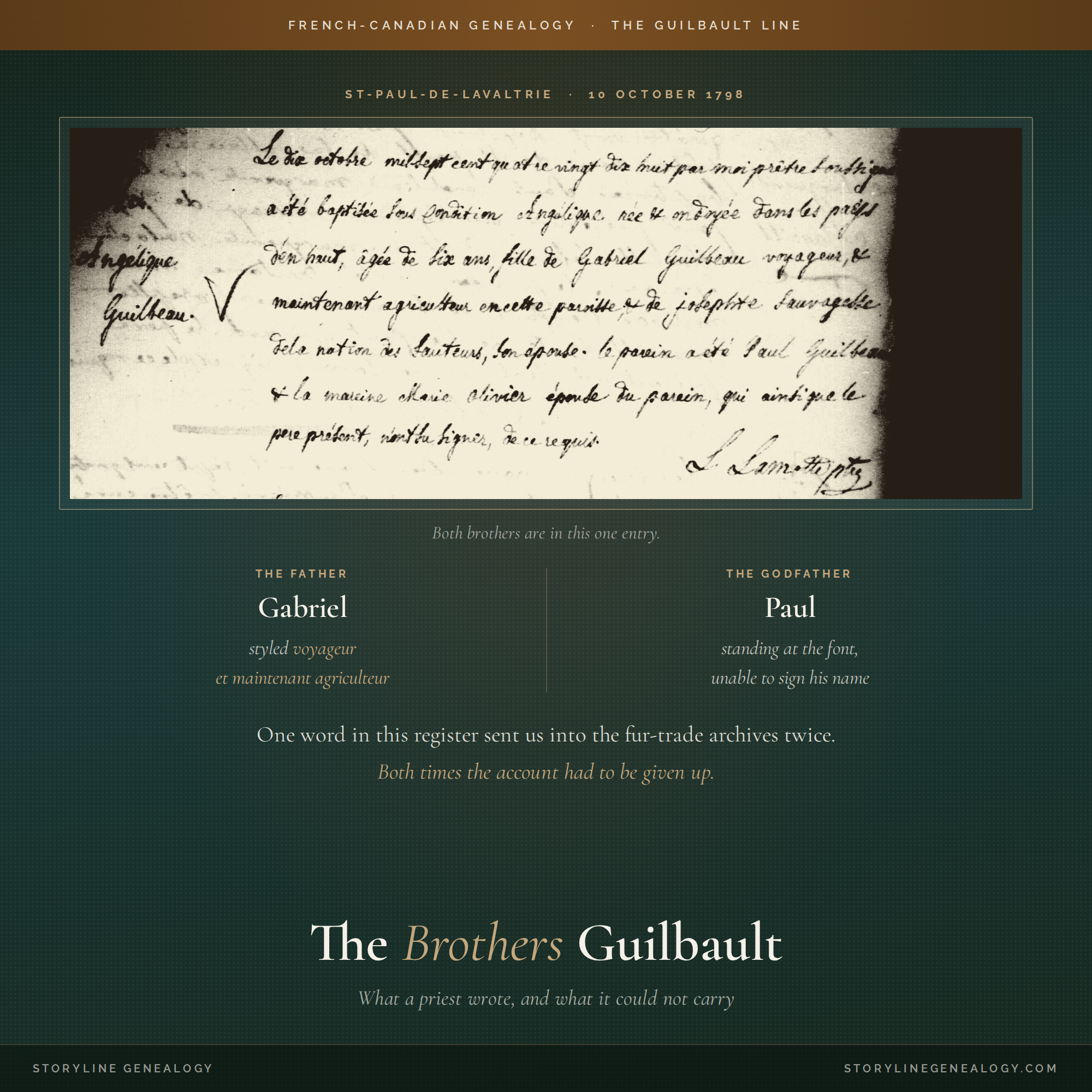
On 10 October 1798, a priest at St-Paul-de-Lavaltrie baptized a six-year-old girl born in the pays d'en haut. In the same entry he named her father Gabriel Guilbault a voyageur, and her godfather Paul Guilbault — Gabriel's brother — as a man who could not sign his name. That one word sent this research into the Hudson's Bay Company Archives twice, once for each brother. Both times an account was found. Both times it had to be given up.
Part of the Storyline Genealogy series: The Guilbault Line
The Lieutenant and the Voyageurs
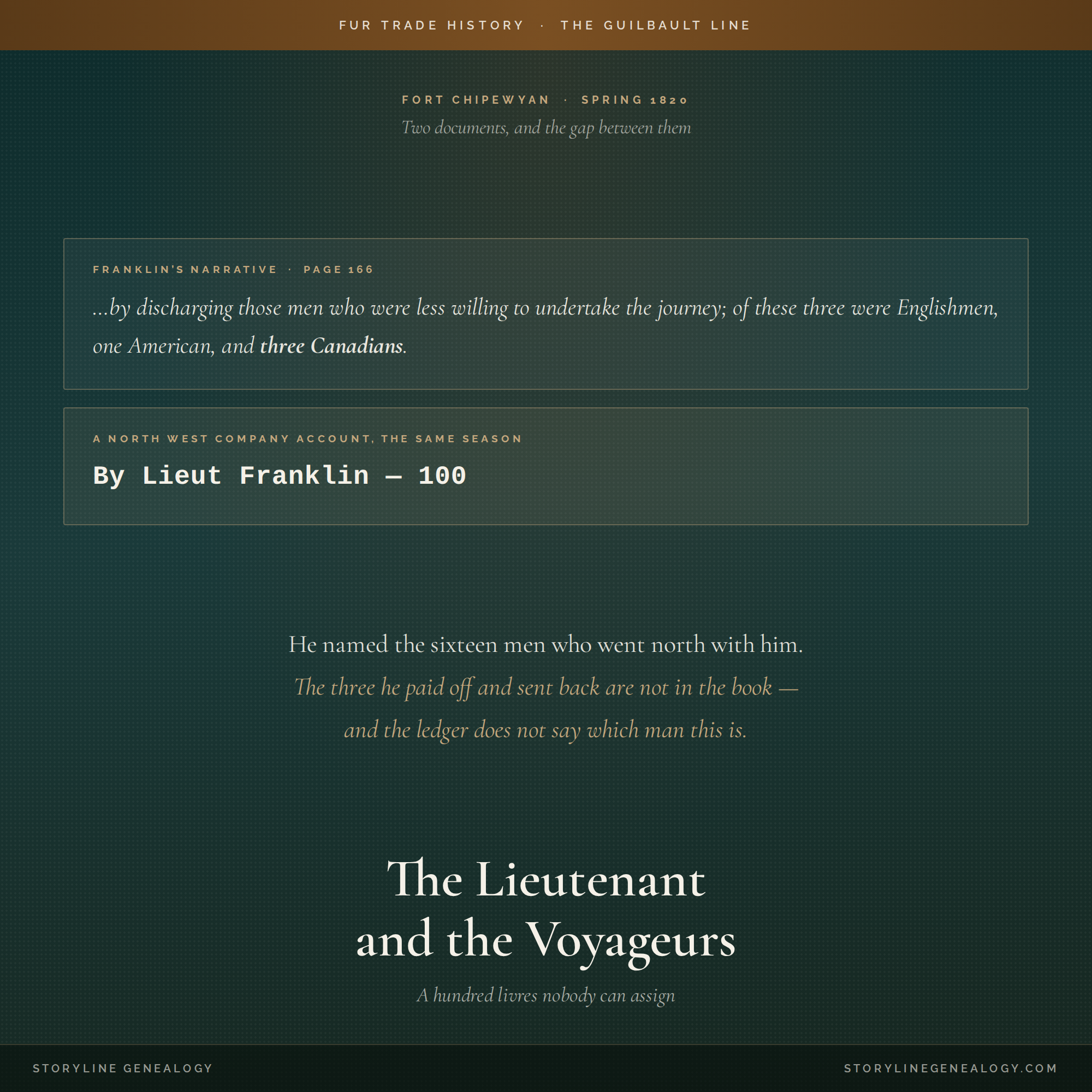
In the spring of 1820, Lieutenant John Franklin spent four months at Fort Chipewyan trying to hire French-Canadian voyageurs willing to paddle him toward an unmapped Arctic coast. Some agreed. Some refused — sensibly, since a North West Company crew had recently been killed in the same country. And in July, before the party went north, Franklin discharged three Canadians and paid them off. He named the sixteen who went. He did not name the three who didn't, and one line in a company ledger may be all that survives of one of them.
Part of the Storyline Genealogy series: From Research to Story
Finding a Gabriel Guilbault in the North West Company Records
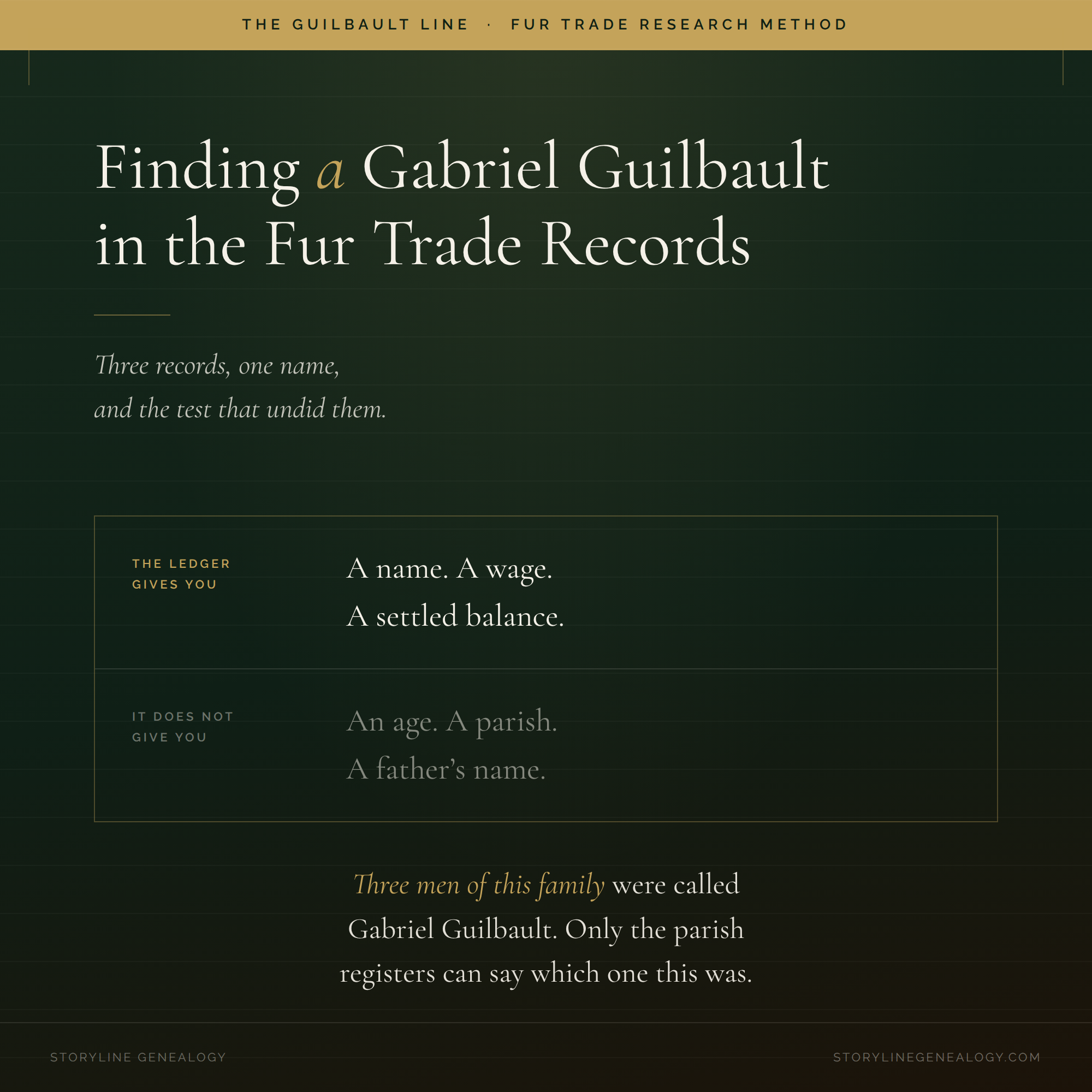
A fur trade account book gives you a name and a number. No age, no parish, no father's name. This is how I found Gabriel Guilbault in the North West Company records — three volumes, a cross-post balance, an account marked settled — and how the parish registers later showed the man I had found was not the man I thought. The search method still works. It's the sixth step that decides it.
Part of the Storyline Genealogy series : A Research Journey From the Index to the Account Book