
Two Contracts, One Missing Folio
Two Contracts,
One Missing Folio
In one volume of the NWC servants’ contracts, twenty leaves are unavailable: two folios lost, eighteen never filmed. One man in this family has two signed engagements and no identity. Another has five years of wages and no contract at all. Neither absence proves anything — and knowing exactly how big the holes are is the only reason we can say so.
The HBCA Series F.5 volumes hold the pre-printed engagement forms that every North West Company servant signed before going into the interior. Each names the engagé, the accepting agent, the term, the capacity, the route and wintering post, the wages, the equipment, and the point at which the man becomes free. He signs by mark if he cannot write; the agent and witnesses countersign.
They are the most informative documents in the whole fur-trade archive, and they are almost unusable. The F.5 volumes carry no name index of any kind. There is no search, no finding aid, no catalogue of who is inside. Locating a man requires turning every page of every surviving volume and reading each form.
That is how the two contracts in this study were found. And it is how the gaps were found with them.
Folio 115 — 19 July 1798
Passed at Lac la Pluie, under one of the company’s senior partnersEngaged voluntarily to the Société du Nord Ouest and its agents, Mr Rod. McKenzie here present and accepting for the Company, for the space of one year, in the capacity of milieu, to travel between Lac la Pluie and the Postes d’Athabasca and to winter au Grand Lac. Wages quatre cent cinquante livres courant du Grand Portage, with one equipment. Not free until his return to Montreal. Passed at Lac la Pluie the nineteenth of July. Having declared that he could not write, he made his ordinary mark: Paul × Gibeau.
Roderick McKenzie, cousin of Alexander Mackenzie, was among the senior partners of the North West Company and closely involved in the Athabasca department through the 1790s. His name on a middleman’s engagement is not an administrative accident.
Two details are worth holding onto. The contract was passed at Lac la Pluie — Rainy Lake, deep in the interior — and not at Montreal. That is why it names no parish. A Montreal engagement passed before a notary opens with the formula de la paroisse de… and gives you a place to go looking. An interior engagement signed in front of a company agent gives you nothing of the kind.
Folio 81 — A Name on an Empty Form
What it seemed to prove, and what it actually showsThirty-four leaves earlier in the same volume sits a pre-printed engagement form with exactly one field completed: the name Paul Gibeau. No agent, no term, no capacity, no wages, no date, no mark, no witnesses.
An earlier version of this research read folio 81 as evidence that the company knew this man before terms were settled — that a clerk had written his name in advance because he was expected. That reading is withdrawn. It is circular: a clerk writes the name he is handed, and nothing about the form says when or why.
The printed text supplies a concrete alternative. Folio 81 stipulates avec double Equipement; the contract actually signed at folio 115 provides one equipment. Different stock, different terms. A clerk who began on the wrong form and started again accounts for everything visible, including its survival thirty-four folios earlier in the volume.
What the folio does show is something about the archive rather than the man. Folios 86 to 103 — eighteen consecutive blank forms — were omitted from the microfilm as blank. Folio 81 was kept. Somebody distinguished an empty form from an empty form bearing a name, and retained the one that did.
That is a small fact about how the filming was done, and it is the kind of fact worth logging. It tells you the omissions were selective rather than mechanical, which means the film is a curated object and not a complete one.
The Volume’s Own Gaps
Twenty leaves unavailable in a single volumeOnce you are paginating a volume by hand, you notice what is not there. In F.5/1 alone:
HBCA F.5/1 — what is available and what is not
Two folios lost and eighteen unfilmed makes twenty leaves unavailable in one volume — each of which could carry one or more engagements. Any statement that begins “there is no contract for…” has to be read against that number.
Pages 32–33 — 22 May 1821
Signed two months after the company had already dissolvedThe North West Company merged into the Hudson’s Bay Company by agreement of 26 March 1821. Two months later, a servants’ contract was drawn on North West Company paper and signed.
Engaged to the merchants trading under the name of the Compagnie du Nord Ouest, S. Black Esqr accepting, for one year, in the capacity of milieu et de piêcheur, to travel between Lac de la Pluye and the Postes d’Athabasca and to winter au Lac d’Athabasca, for cinq cents livres courant du Grand Portage with the ordinary equipment, free at Montreal. Not knowing how to write he made his mark: Paul × Gebeault. Countersigned Sam Black; witnesses William McGillivray Jr and James Hill.
And at the foot, a clause that appears in neither the 1798 engagement nor the form at folio 81: “Le dit Engagé est exempté de porter quand il sortira…” — the said engagé is exempt from carrying when he goes out.
Samuel Black was among the most formidable of the company’s Athabasca partners. William McGillivray Jr. belonged to the family that had effectively run the North West Company in its last years. Their names on a middleman’s engagement, two months after the merger, are consistent with the orderly transfer of labour obligations into the restructured company — which is exactly what the 1821 balances volume records.
The portage exemption is the most human line in the file, and it is worth being careful about. A middleman written out of carrying by name is being accommodated for something — age, injury, condition. This research read it for years as an accommodation for a man approaching sixty. That reading imported an age from an identification since withdrawn. No company document gives this man’s age. The clause is recorded here and not interpreted.
What the Two Engagements Give
And the one column that stays empty| Source | Agent | Capacity | Wages | Wintering | Parish named? |
|---|---|---|---|---|---|
| F.5/1, fo. 115 19 July 1798 |
Rod. McKenzie | Milieu | 450 livres, one equipment |
Great Slave Lake | No — passed at Lac la Pluie |
| F.4/37 1820–21 blotter |
Athabasca dept. | — | 500 contracted, settled 617.14 |
Athabasca | No |
| F.5/3, pp. 32–33 22 May 1821 |
Samuel Black | Milieu et de piêcheur | 500 livres | Lac d’Athabasca | No — passed in the Athabasca |
1798 and 1821
in F.5/1 alone
a home parish
The Account That Left No Contract
Five years of wages under a name, and nothing signed anywhereFiltered on the Guilbault surname cluster, the HBCA name index returns a Gabriel Guilbault in three places: the Lac La Pluie blotter for 1820, the Athabasca general blotter, and folio 414 of the general ledger. That ledger folio carries five annual wages — 551, 330, 687.10, 500 and 650 — opening in 1817 and closing at 336 at the merger.
All three surviving contract volumes have been paginated under every attested spelling. No Gabriel Guilbault appears in any of them.
So the family presents two opposite absences. One man has two signed engagements and no parish, no parentage, no age — a career without an identity. The other has five outfits of wages under a known name and nothing signed anywhere — an identity without a career document. And the identification of folio 414 has itself been withdrawn: the parish registers place Gabriel père at Rigaud in June 1819 and at Saint-Eustache in February 1821, inside the account’s own wage years. The missing contract is now a missing contract for a man whose name is known and whose identity is not.
Why a working servant might leave no contract — five explanations, none yet tested
It is tempting to go further and suppose that folio 114, sitting immediately before a known contract, held a related one. Resist it. Nobody has established what orders this volume — whether by date, by agent, by post, or not at all. Reading folios 113, 115 and 116 for their dates and agents would settle it, and it is a cheap test that has not been run. Until then, proximity in a bound volume proves nothing.
What this post used to say
An earlier version presented these engagements as Paul Guilbault père’s — the mason and farmer of St-Paul-de-Lavaltrie, signing at thirty-seven and again at sixty, with a two-decade fur-trade career running in parallel to every occupation designation the parish system gave him. That identification is withdrawn.
The company documents spell their man Gibeau, Gibeault and Gebeault, and name no parish, parentage or age. Three Quebec documents place Paul Guilbault père at home inside the years the account books pay this man: a godparent clause of October 1798, a guardianship account rendered in person before a notary in July 1820, and a witness clause at his daughter’s wedding in October 1821. Athabasca is a wintering department; the two cannot be one. The career belongs to a man still unidentified.
Two counting corrections went with it. This post described three contracts; pages 32 and 33 of F.5/3 are one contract and its index summary, so the total is two. And every age given here has been removed, because no company document supplies one.
What survives is the part about the archive. The volumes still have no index. Twenty leaves are still unavailable in F.5/1. The documented negative for Gabriel still stands with its stated limits. Nothing in this post’s account of the records depended on knowing who the man was — which is why that half needed no correction at all.
What This Actually Establishes
An absence is only as meaningful as the search behind it is measured. “No contract survives for this man” is worth something when you can say which volumes were paginated, under which spellings, and how many leaves were unavailable. It is worth nothing otherwise.
And the two absences in this family point in opposite directions. A signed contract with no parish tells you what a man was hired to do and never who he was. A ledger account with no contract tells you a man was paid and never on what terms. Neither document type is sufficient alone, and this archive routinely supplies only one.
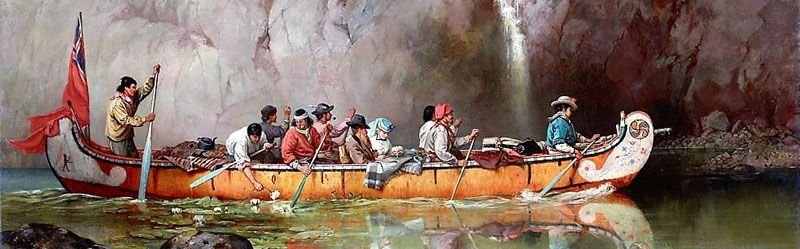
Frances Anne Hopkins, Voyageurs, 1869. Hopkins travelled the canoe routes herself and painted what she witnessed. Every man in a brigade like this one signed a form before he left — and the volumes that held those forms have no index, twenty missing leaves in the first volume alone, and no column for where any of them came from. Library and Archives Canada.
Related Reading
Who Was Paul Gibeau? →
The full case study: ten years of wages, two signed engagements, three volumes that interlock — and a man nobody has identified.
Assigning a Fur-Trade Account to a Man Who Has No Parish →
Document by document, with the ledger arithmetic shown and the negative searches bounded.
The Brothers Guilbault →
One word in a 1798 baptism, and two men it led us to wrongly.
The Voyageur Years — Gabriel Guilbault →
The folio 414 account, the candidates who could have held it, and the parish registers that excluded the obvious one.
Two Contracts, One Missing Folio: What the NWC Servants’ Records Don’t Hold
Part of the Storyline Genealogy series: The Guilbault Line · Voyageurs of the Pays d’en Haut
A Storyline Genealogy research article · From Research to Story
Primary sources, all transcribed rather than reproduced: HBCA F.5/1, NWC Servants’ Contracts 1798, fo. 81 and fo. 115; F.5/3, NWC Servants’ Contracts 1815–1822, pp. 32–33; F.4/37, NWC Athabasca General Blotter 1820–1821; F.4/32, NWC General Ledger, fo. 414; Archives of Manitoba, Winnipeg. Registres paroissiaux, St-Paul-de-Lavaltrie, Rigaud and Saint-Eustache. BAnQ CN605,S24, Joliette. PRDH-IGD, Université de Montréal.
Are You Connected to the Guilbault Line?
If you descend from the Guilbault (Guilbeau, Guilbeault) family of Charlesbourg and the Quebec parishes, from the children of Marie Josephte Abitakijikokwe, or from the founding families of the line — Senécal, Séguin dit Ladéroute, Morin, Couillaud dit Roquebrune, Gaulin — I’d like to compare notes. Documented trees, DNA matches, family papers, and even half-remembered stories have all moved this research forward.
Get in Touch About This FamilyCousin connections are informal and reciprocal — no fee, no obligation, just shared work on shared ancestry.
Every Family Has a Story Worth Telling
Whether you're just beginning your research or ready to transform years of work into a narrative your family will treasure, I'd love to help.
LET'S TALK ABOUT YOUR FAMILY