
George “Gyorgy” Petras
✦ Documentary Biography · The Petras Family ✦
George "Gyorgy" Petras
From Orechová to America's Industrial Heart
September 15, 1890 · Orechová, Slovakia — March 1965 · New Jersey
He left a Slovak village at eighteen years old, boarded a ship in Bremen, and crossed the Atlantic with a name that immigration officials could barely spell. He never went back. He never stopped sending money home.
"Name: George Petras · Age: 52 · Place of Birth: Slovakia · Employer: Newark Tidewater Terminal · Place of Employment: Port Newark, NJ"
— WWII Draft Registration, April 25, 1942 · Oliver Street School, NewarkThe registration card tells a quiet story. George Petras was fifty-two years old when he walked into Oliver Street School in Newark to register for the wartime draft — thirty-three years after he had arrived in America with nothing. The same hands that had carried luggage across a German port now signed a document for the United States government at a Newark schoolhouse. He had built something here. This was his country now, even if he hadn't made it official yet.
That would come two years later, in 1944, when George filed his Petition for Naturalization. Fifty-four years old. Thirty-five years in America. He had waited longer than most — but he had been here through the whole of it.
From Orechová to Bremen to New York
The Village
George Gyorgy Petras was born on September 15, 1890, in the village of Orechová — written in immigration documents as "Orechowa" — in what was then part of the Austro-Hungarian Empire. Today Orechová sits in eastern Slovakia's landscape of river valleys and forested hills. In George's time it was part of the complex multi-ethnic territory of historic Hungary, where Slovak communities lived under Hungarian administration, speaking their own language at home and navigating a world that was shifting around them.
His father's name appears in Slovakian church records as György Petrás — the Hungarian spelling of the same family name. A baptism record from 1880 in Ivančiná, Turčianske Teplice, documents the baptism of a sister, Anna Petrás, whose father is listed as György Petrás and mother as Mária Gyuricza. George grew up in this family, in this landscape, until he was eighteen years old.

George Petras & Mary Margaret Kuklisak
Wedding portrait, 1913 · Colorized · Newark, New Jersey
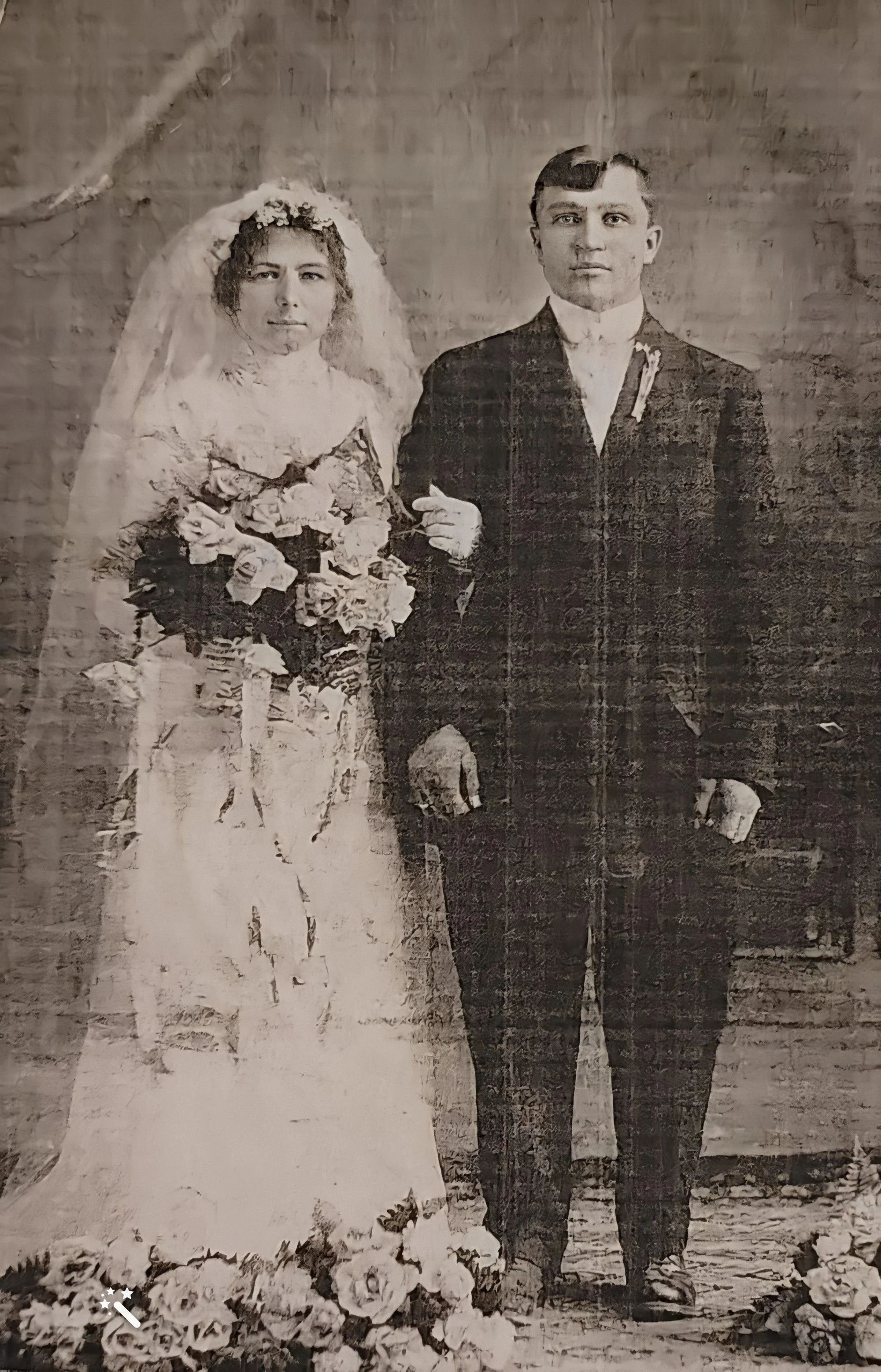
Wedding portrait · Original enhanced · A rare personal glimpse beyond the official documents
The Crossing
On February 12, 1909, George Petras arrived in New York. He was eighteen years old. He had sailed from Bremen, Germany — the standard embarkation point for Eastern European immigrants routing through German ports — aboard the SS Scharnhorst, a Norddeutscher Lloyd passenger liner. Immigration records entered his name as "Georg Petras." His naturalization petition, signed thirty-five years later in his own hand, confirms the details: departed from Orechowa, arrived February 12, 1909, at New York, on the Scharnhorst.
Like thousands of other young Slovaks in the early 1900s, George left a village life for industrial America. The timing placed him in one of the greatest waves of Eastern European immigration in American history — and in Newark, New Jersey, he would find a community already in place to receive him.
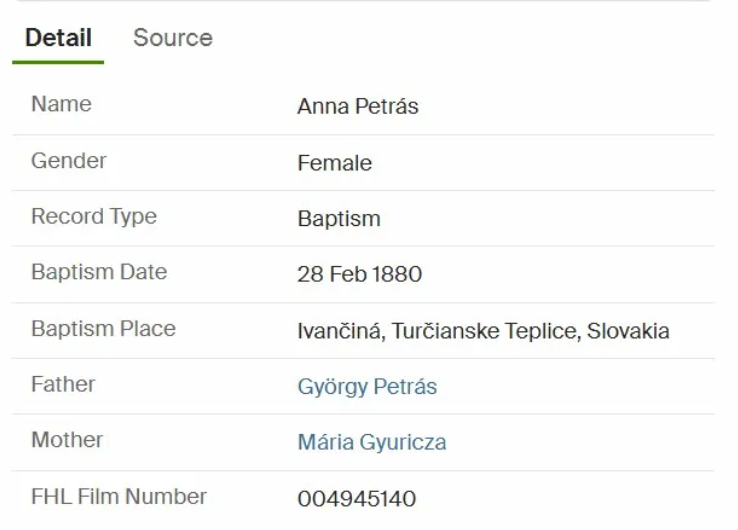
Baptism record · Anna Petrás · February 28, 1880 · Ivančiná, Turčianske Teplice, Slovakia · Father: György Petrás · Mother: Mária Gyuricza · George's sister, documenting the family in Slovakia a decade before his birth
Building a Life in Newark's Ironbound
George settled on Thomas Street in Newark's Ironbound neighborhood — a vibrant, working-class district bounded by the Passaic and Hackensack rivers that welcomed wave after wave of immigrants. By 1930 he was living at 148 South Street; by 1942 the draft registration shows 157 Thomas Street; the naturalization petition of 1944 lists 174 Thomas Street. The addresses trace a man who stayed close to the community he knew, moving only blocks at a time across three decades.
The Ironbound was far from genteel. Its streets were dense with industrial workers from nearby factories — Benjamin Moore paints, Ballantine's Beer — alongside railroad and port workers. Churches served different ethnic communities: Slovak parishes, Lithuanian congregations, Polish parishes. The neighborhood's saloons numbered in the hundreds and served as crucial meeting places where recent immigrants could learn English, find work, and maintain connections to their homelands.
The Ironbound Neighborhood · Newark, New Jersey
Newark's Ironbound district took its name from the railroad lines that bounded it on multiple sides. For Slovak, Polish, Hungarian, and Italian immigrants arriving in the early 1900s, it was a port of entry in a second sense — a place where the language you knew was still spoken, where your church held Mass in your tongue, where the grocers stocked the food you recognized.
George Petras lived within a few blocks of Thomas Street for most of his American life. His children were born here. His son George Jr. grew up here, attended local schools, and built his own business in Livingston, the suburb to the west where the family would eventually settle.
Mary and Marriage
By 1913, George had met and married Mary Margaret Kuklisak, a fellow Slovak immigrant. His naturalization petition records the marriage as January 19, 1913, at Newark, New Jersey. It also notes that Mary was born at Middleton, Pennsylvania, on January 26, 1891 — a detail that opens a question: had her family already made the crossing before her? The Pennsylvania birthplace suggests she may have been born in America to Slovak immigrant parents, or that the family moved between countries in the years before her birth.
Together George and Mary would have seven children, documented in the naturalization petition: George (December 15, 1913, Newark); Mary (September 17, 1915, McAdoo, Pennsylvania); Anna (July 30, 1917); Edward (June 25, 1919); Peter (June 25, 1919, twins); and Michael (June 19, 1921, Cleveland, Ohio). The family's geography traces movement — Newark, then Pennsylvania, then Ohio — before returning to New Jersey, where George would spend the rest of his life.
At Port Newark · America's Industrial Heart

WWII Draft Registration · April 25, 1942 · George Petras, age 52
Employer: Newark Tidewater Terminal · Port Newark, NJ
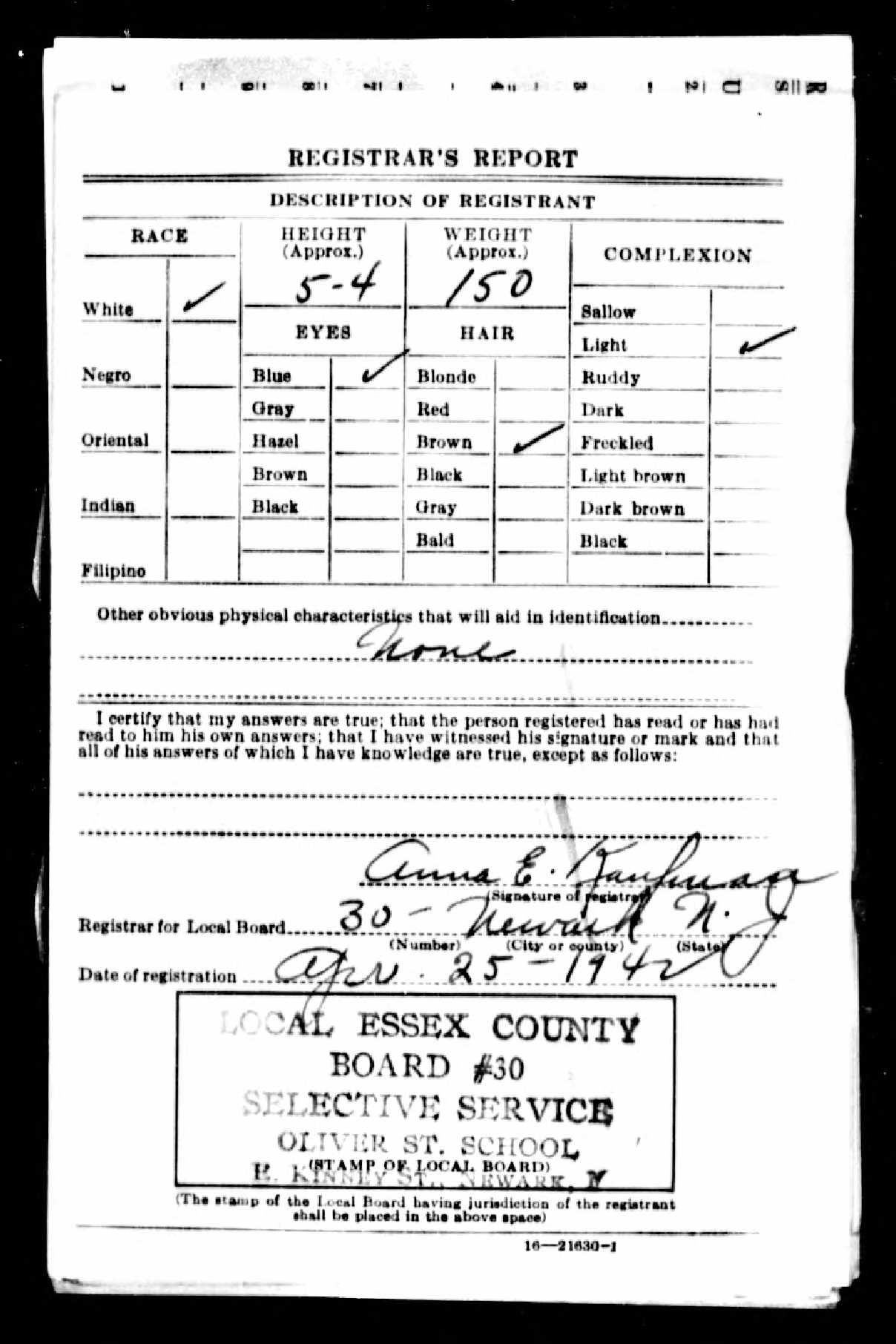
Registrar's Report · Description: White, 5 ft 4 in, 150 lbs, blue eyes, brown hair, light complexion · Local Board 30, Essex County
The WWII Old Man's Registration, held in April 1942 for men born between 1877 and 1897, gives us a precise snapshot of George Petras at fifty-two. He was living at 157 Thomas Street, Newark. His emergency contact was his wife Mary at the same address. His employer was the Newark Tidewater Terminal at Port Newark.
Port Newark had been carved from the Newark Meadows wetlands beginning in the 1910s, transforming tidal flats into one of the most strategically important ports on the East Coast. By the time George registered, the terminal was a hub of wartime industrial activity — a massive logistical operation supporting the movement of goods and military materiel. George Petras, the Slovak immigrant who had arrived with nothing in 1909, was now part of the machinery of America's war effort.

Port Newark · 1926 · "Gateway to America's Richest Markets" · George Petras worked at the Newark Tidewater Terminal at this port, which by the 1940s had become one of America's most vital industrial shipping facilities
Tracking the Family: Three Decades of Census Records
The federal censuses of 1920, 1930, and 1940 track George and Mary's family across three decades of American life in Newark, showing a household that grew, established itself, and gradually sent its children out into the world.

1920 Census
Newark, Essex County, NJ · George age 30
Click to enlarge

1930 Census
148 South Street, Newark · George age 40
Click to enlarge

1940 U.S. Federal Census · Newark, Essex County · George Petras age 50 · Click to enlarge
George John Petras Jr. (December 15, 1913, Newark) · 1913–1992
Mary Frances Petras (September 17, 1915, McAdoo, Pennsylvania) · 1915–2003
Edna Petras (1917–)
Anna Petras Corvelle (July 30, 1917) · 1917–2003
Peter Petras (June 25, 1919) · 1919–
Edward Petras (June 25, 1919, twin) · 1919–1977
Michael Petras (June 19, 1921, Cleveland, Ohio) · 1921–
The Long Road to Citizenship
George Petras filed his Petition for Naturalization in 1944 — thirty-five years after he had arrived in America. His naturalization petition, signed in his own hand as "George Petras," is a remarkable document: a fifty-four-year-old man formally claiming the country he had lived in for more than half his life.
The petition lists his occupation as "caretaker" and his address as 174 Thomas Street. It records his physical description: male, white complexion, dark eyes, blue-brown, height 5 feet 3 inches, weight 160 pounds, no visible distinctive marks. It confirms his departure point — Bremen, Germany — and his vessel — the Scharnhorst — and his arrival date: February 12, 1909. The document records that two of his sons, Peter and Michael, were serving in the U.S. Army at the time of his petition.
The delay in naturalization — thirty-five years between arrival and citizenship — was not unusual for immigrants of his generation. Many initially planned to earn money in America and return to their homelands. The transformation of Eastern Europe through two world wars, and the rise of communist regimes after 1945, made return not just unlikely but impossible. For George, the decision to formalize his American identity may have been prompted in part by his sons' military service: they were Americans fighting for America. Their father would become one too.

Petition for Naturalization · George Petras · 1944 · Newark, New Jersey · Signed in his own hand · "I have been a bona fide resident of the United States for the term of 3 years at least immediately preceding the date of this petition, to wit: since Feb. 12, 1909"
Legacy · What He Built
George Gyorgy Petras died in March 1965 in Raritan, Monmouth County, New Jersey. He was seventy-four years old. He and Mary are buried at Gate of Heaven Cemetery in East Hanover — a resting place that would eventually hold three generations of the family, including their son George Jr., their daughter-in-law Martha Castle Petras, and their grandson John Michael Petras.
The children he raised in Newark's Ironbound neighborhood scattered across New Jersey — to Livingston, to Union, to Burlington, to Little Egg Harbor. His son George Jr. built G.J. Petras Automotive Tools and Equipment in Livingston. His daughter Jackie married a United States Air Force officer and settled in Georgia. His granddaughter, through George Jr., would become Jacqueline Martha Petras O'Brien — connecting the Slovak immigrant family from Orechová to an Irish-American military family from Caldwell, New Jersey.
He left a village. He built a family. He crossed the Atlantic with a name immigration officials spelled four different ways, and he signed his naturalization petition fifty-four years old, a caretaker at 174 Thomas Street, Newark — the same neighborhood where he had started.
Document Gallery
Primary sources used to reconstruct George Petras's life · Click any image to enlarge
Wedding Portrait · Colorized
George & Mary · Newark, 1913
Photo
Wedding Portrait · Enhanced
George & Mary · Original enhanced
Photo
1880 Baptism · Slovakia
Anna Petrás · George's sister · Ivančiná
Baptism
1942 · WWII Draft Registration
Age 52 · Employer: Newark Tidewater Terminal
Draft
1942 · Registrar's Report
Physical description · Local Board 30, Essex Co.
Draft
1920 U.S. Federal Census
Newark, Essex County · Age 30
Census
1930 U.S. Federal Census
148 South Street, Newark · Age 40
Census
1940 U.S. Federal Census
Newark · Age 50
Census
1944 · Petition for Naturalization
35 years after arrival · Signed by George Petras
Naturalization
Social Security Documentation
George John Petras Jr. · Death date: 8 Jan 1992
SS Record
Port Newark · 1926
Where George worked · America's industrial port
HistoricalEvidence Analysis
PRIMARY SOURCE: 1880 Slovak Baptism Record — Anna Petrás
Baptism of Anna Petrás, February 28, 1880, Ivančiná, Turčianske Teplice, Slovakia. Father: György Petrás. Mother: Mária Gyuricza. FHL Film No. 004945140. This record documents George's family in Slovakia a decade before his birth, establishing the Petrás surname spelling in its original Slovak/Hungarian form and placing the family in the Turčianske Teplice district.
PRIMARY SOURCE: WWII Draft Registration Card — April 25, 1942
Old Man's Registration (Fourth Registration), held April 27, 1942, for men born April 28, 1877 to February 16, 1897. George's card records: 157 Thomas St., Newark; age 52, born September 15, 1890, Slovakia; employer Newark Tidewater Terminal, Port Newark. Registrar's report: white, 5 ft 4 in, 150 lbs, blue eyes, brown hair, light complexion. Local Board 30, Essex County, Oliver Street School. Note: The date April 25, 1942 on this document has sometimes been mistranscribed as 1918 — this is definitively the WWII registration, not WWI.
PRIMARY SOURCE: Petition for Naturalization — 1944
Filed at Newark, NJ. George Petras, 174 Thomas St., occupation: caretaker. Born September 15, 1890, Orechowa, Czechoslovakia. Wife: Mary, born Middleton, Penn., January 26, 1891, married January 19, 1913, Newark. Children: George (12/15/13, Newark), Mary (9/17/15, McAdoo, Pa.), Anna (f, 7/30/17), Edward (m, 6/25/19), Peter (m, 6/25/19), Michael (m, 6/19/21, Cleveland, Ohio). Arrived February 12, 1909, New York, on vessel "Scharnhorst" from Bremen, Germany, under name "Georg Petras." Two sons (Peter and Michael) in U.S. Army at time of filing.
RESEARCH NOTE: Ship Name Variants
Immigration records variously spell the vessel as "Schornhorst," "Scharnhorst," and "Scharnhorst." George's own naturalization petition spells it "Scharnhorst." The SS Scharnhorst was a real Norddeutscher Lloyd passenger liner that operated Bremen–New York routes in this period. The variant spellings in different records represent transcription differences, not different ships. The naturalization petition — completed by George himself — is the authoritative source for the correct spelling.
Every Family Has a Story Worth Telling
Whether you're just beginning your research or ready to transform years of work into a narrative your family will treasure, I'd love to help.
LET'S TALK ABOUT YOUR FAMILY