
French Prairie: The Western Terminus
From Oka to Oregon · Historical Context · French Prairie
French Prairie: The Western Terminus
Why HBC veterans and their country wives settled Marion County, Oregon — and why it was never a coincidence
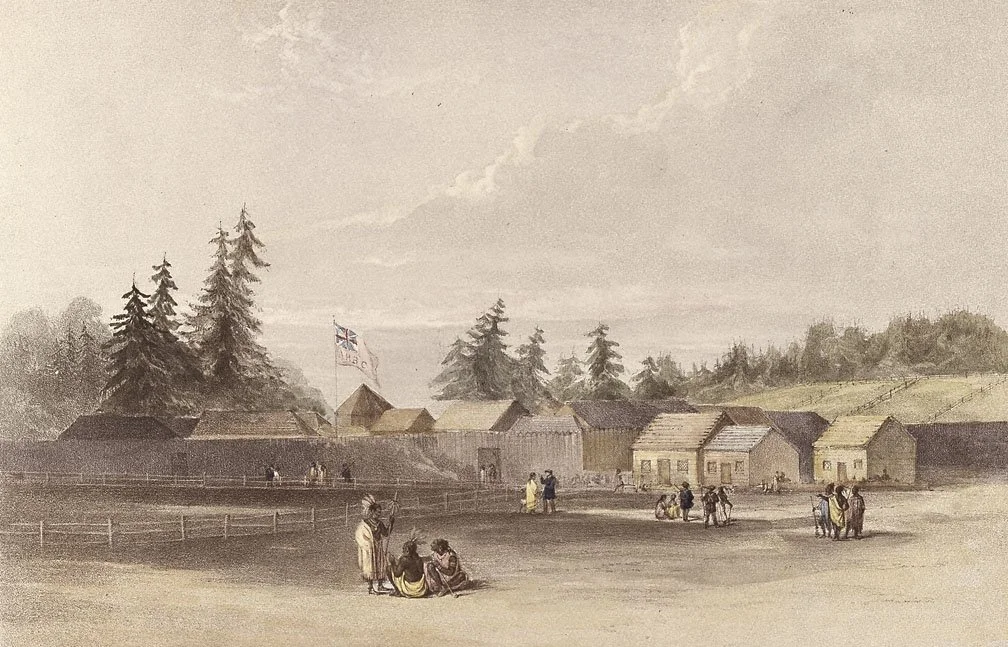
French Prairie was not a coincidence. It was the predictable endpoint of a network that began at Oka, ran through Fort Walla Walla and New Caledonia, and ended at St. Paul, Marion County — where the same families who had lived beside each other at the Lake of Two Mountains reconstituted themselves three thousand miles west.
The question is not why former HBC servants settled in the Willamette Valley. The question is why they settled there, in that specific configuration, with those specific families as neighbors. The answer is not geography, though the geography helped. It is not the Catholic mission, though the mission mattered. It is the structure of the HBC itself — what it required of its servants, what it offered them at the end of their contracts, and what kind of men it sent to the Columbia District in the first place.
Paul Guilbault received his provisional land grant at Champoeg on September 7, 1846 — Vol. 3, Pg. 079. His cousin Hilaire was buried at the Saint Paul Mission Cemetery in June 1849. Laurent Quintal farmed Marion County until 1860, when he died at Calapooia Creek. These three men did not end up in the same township by chance. They arrived there through the same pipeline, through the same employer, from the same community of origin.
The Pipeline: From Contract to Prairie
The Hudson’s Bay Company organized its labor force through strict hierarchy. At the top were the commissioned officers — chief factors, chief traders, clerks — most of them British. Below them were the working-class engagés: voyageurs, trappers, boatmen, farmers, and tradesmen, bound by employment contracts that governed wages, rations, equipment, and movement.
The engagés were ethnically diverse in ways the commissioned officers were not. French-Canadians dominated the voyageur class from the NWC era forward. Iroquois from Kahnawake and Kanesatake served as skilled trappers throughout the interior. Métis employees of Cree, Ojibwe, and mixed heritage worked at every level of the company’s North American operations. Governor Simpson, describing a typical Columbia River brigade in the 1820s, noted his boat carried Iroquois, a Cree half-breed of French origin, a Gaelic-speaking North Briton, French Canadians, and Sandwich Islanders — all within the same canoe.
When a man completed his contract, the HBC offered a choice. He could return to Quebec — if he came from Quebec, if he had family there, if he had something to return to. Or he could take his final wages, his tools, and his country family, and settle south of the Columbia River, on land the HBC had no interest in claiming after 1846. Many chose the latter. Not because Oregon was appealing in the abstract, but because their lives were already there. Their wives were Walla Walla, Chinook, Nipissing. Their children had been baptized at Fort Vancouver. The Catholic mission at St. Paul was building a church. The land was open and fertile. And their former colleagues were arriving on the same terms, in the same years, from the same posts.
Why French Prairie
Three Reasons the Network Landed Here
The Willamette Valley was not the only place HBC servants could have settled. French Prairie is where they actually went — for specific, documentable reasons.
Geography
The Champoeg Landing
A forty-foot bluff above the Willamette River provided a stable dock in all seasons. Champoeg sat at the intersection of Kalapuya trails and the river, accessible by water and land. The prairie land behind it required no clearing — it was open and ready for farming. The first non-Indigenous farms in Oregon were planted here, not further north, because the land was here.
Infrastructure
The HBC Granary & the Catholic Mission
Champoeg had an HBC granary and trade store before the provisional government vote of 1843. The Catholic mission at St. Paul had a church by 1836. The infrastructure preceded the settlement — retired trappers moved toward services that already existed, not toward empty land. Étienne Lucier established his farm adjacent to the HBC post by 1829. The first families clustered around existing institutions.
Community
The Columbia District Network
The men who settled French Prairie had worked together for years — in the same post journals, the same servants’ accounts, the same Snake Country expeditions. Amable Quesnel and Laurent Quintal appear on the same ledger page in B.239/g/1, 1821–22. Paul Guilbault and Hilaire Guilbault are connected by godparenthood in the same Catholic register. These were not strangers who happened to choose the same valley. They were a community that moved together.
The HBC’s Role in Settlement
It is tempting to frame the French Prairie settlement as a story of men escaping HBC control — leaving their contracts behind to farm freely. The reality is more complicated. The HBC actively managed the transition. Chief Factor John McLoughlin at Fort Vancouver helped Etienne Lucier with farming supplies, including livestock, when he established his claim in 1829. The company’s policy of allowing retired servants to farm south of the Columbia River — as long as they stayed south, not complicating British territorial claims north of the river — was a deliberate choice, not a concession.
The HBC needed the French Prairie community to exist. A stable agricultural settlement south of the Columbia produced food for Fort Vancouver, reduced the cost of supplying the Columbia Department from London, and kept retired servants within the orbit of company influence without placing them on land the company intended to hold. When the Oregon Treaty of 1846 ceded all land south of the 49th parallel to the United States, the French Prairie settlers were already there — already farming, already Catholic, already connected to the mission at St. Paul. The HBC had, in effect, pre-populated the territory it was surrendering.
The engagé class reflected an ethnic diversity the commissioned officers did not. French-Canadians, Iroquois, Métis, Sandwich Islanders — bound together by contract, by language, by the fur trade’s own culture. When the contracts ended, that culture did not dissolve. It moved south to the Prairie and kept going.
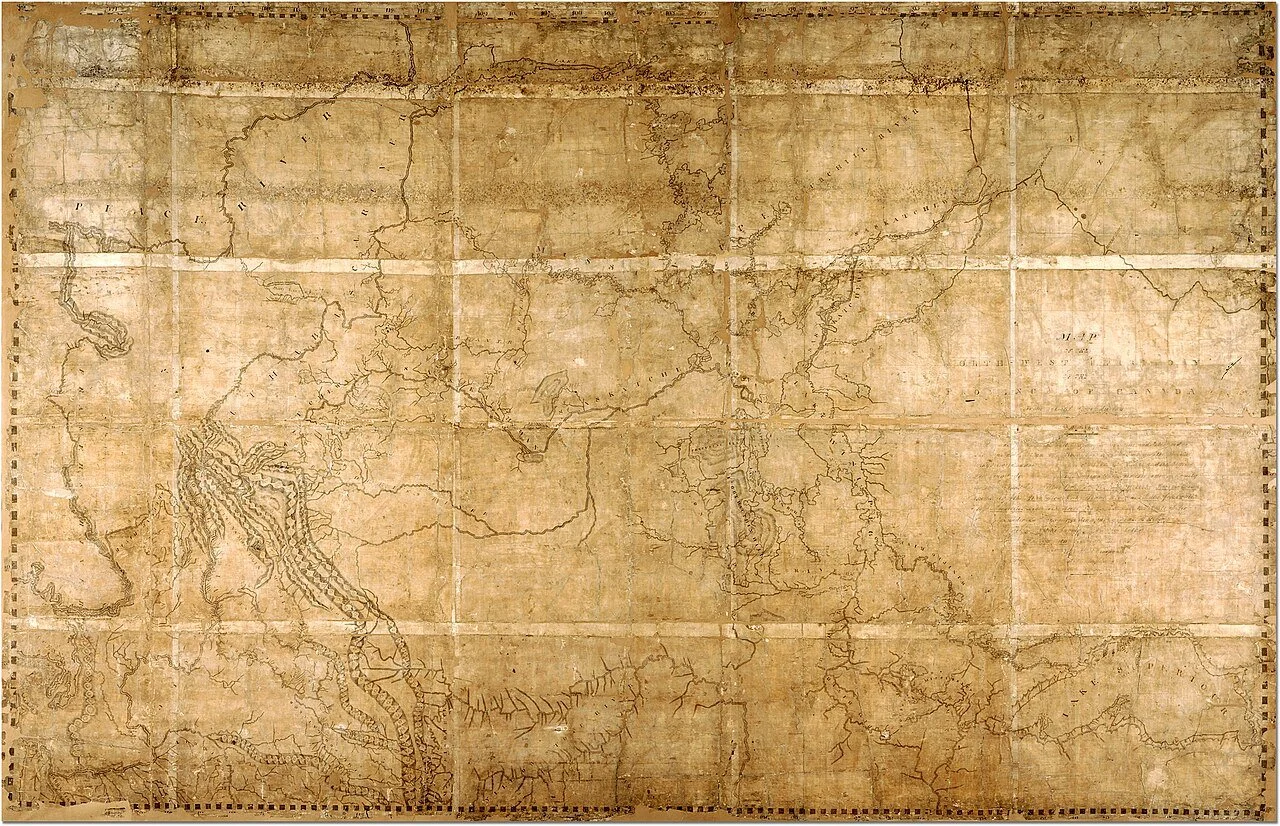
David Thompson, Map of the North-West Territory of the Province of Canada from Actual Survey, 1792–1812 (made for the North West Company, 1813–14). Archives of Ontario, I0012850. The map documents the full NWC network — the same canoe routes that carried Gabriel Guilbault to Athabasca and Paul the Canadian to New Caledonia before both lines converged on French Prairie.
Two Generations, One Direction
The Guilbault research makes the generational logic visible. The first generation of fur trade voyageurs — men like Gabriel Guilbault père and his brother Paul père — went west to the Athabasca country in 1820–21 and came back. They were nearly sixty. They had farms to return to in Quebec. The NWC was dissolving into the HBC and the old system was ending. They came home, collected their wages, and died as cultivateurs in the parishes that had recorded their baptisms.
The next generation — younger men like Paul Guilbault (b.1798) and Hilaire Guilbault (b.1818) — went further west and did not come back. Paul entered HBC service in 1821, the year the merger settled, and by 1831 he was at Fort Walla Walla. Hilaire entered HBC service in 1838. Both men built their families in the interior — Paul with Caty Walla Walla at Fort Vancouver, Hilaire with Louise Walla Walla at the same mission. When their contracts ended, there was nothing in Quebec to return to. Their wives were from the Columbia District. Their children had been born on the Prairie side of the mountains. French Prairie was not a destination they chose from a list. It was the natural end point of the life they had already made.
The same pattern applies across the community. Laurent Quintal entered NWC service in 1817 at nineteen, overwintered from the start, and did not see St-Constant again. By 1839 he was a free man of the prairies — the phrase the priest wrote in his marriage record at Fort Vancouver, recording a status the HBC ledger had noted two years earlier with a single word: Free.

Franklin, John. Route of the Expedition from York Factory to Cumberland House and the Summer & Winter Tracks from thence to Isle a la Crosse in 1819 & 1820. From Narrative of a Journey to the Shores of the Polar Sea (London: John Murray, 1823). The same Athabasca network that brought Gabriel Guilbault père and his brother Paul to the interior in 1820–21 — NWC accounts place both men at Lac La Pluie and Athabasca during the period this map documents.
Champoeg, 1843: The Vote That Named a Territory
On May 2, 1843, settlers met at the HBC granary at Champoeg and voted 52 to 50 to form a provisional government. The margin was two votes. The result was not inevitable.
The French-Canadian settlers were the swing vote — and most of them voted against it. Their hesitation was not simply loyalty to Britain. It was pragmatism. A formal government meant taxes, land surveys, and the potential loss of the informal squatters’ rights under which they had been farming for a decade. The American missionary faction, led by Jason Lee, had used the “Wolf Meetings” of the preceding months — ostensibly about predator control — to lay the groundwork for exactly the kind of civil authority the French-Canadians feared.
Two French-Canadians crossed the line and voted with the Americans: Étienne Lucier and one other. It was enough. The Provisional Government of Oregon was established, providing the legal framework that would last until Oregon became a U.S. territory in 1848. Paul Guilbault received his provisional land grant at Champoeg three years later, in September 1846 — under the legal structure that narrow vote had created.
The irony is complete. The community that built French Prairie, that made the Willamette Valley inhabitable for American settlers who followed, that pre-populated the territory the Oregon Treaty surrendered — that community voted against the government that would govern them, and lost by two.
What the Archive Sees
For genealogical research, the French Prairie settlement has a specific archival consequence. The men who built it existed in two entirely separate record systems — and the gap between those systems is where most of the family tree errors for this community originate.
A man who was born in St-Constant, Quebec in 1797, went west in 1817, spent twenty years in HBC service in the Columbia District, and died at Calapooia Creek, Oregon in 1860 left records in three different countries, in three different languages, under three to five different spelling variants of his name. The Quebec parish register records his baptism and his parents. The HBCA records his wages, his career, and the word “Free” at the end of his last ledger entry. The Catholic Church Records of the Pacific Northwest record his marriage, the baptisms of his children, and the community he built his life in. None of these archives reference each other. Without connecting all three, you cannot tell the story of who he was.
That connection is the work. Not just for Laurent Quintal, but for every man in those French Prairie registers whose baptism is in Quebec and whose burial is in Marion County. Munnick documented who they were in Oregon. The HBCA documented what they did for twenty years before they got there. The Quebec registers documented where they came from. French Prairie is the place where all three archive systems point to, without any of them knowing the others exist.
Paul Guilbault “The Canadian” (b.1798, Lavaltrie) received his provisional land grant at Champoeg, September 7, 1846, Vol. 3 Pg. 079. He died ca. 1849, possibly in the gold fields; his widow Catherine (Caty Walla Walla) married Laurent Sauvé in April 1850. Hilaire Guilbault (b.1818, Verchères) is buried at the Saint Paul Roman Catholic Mission Cemetery, dying June 24/26, 1849 — in the same community, months after his cousin. Laurent Quintal farmed Marion County from 1839 until he moved to Douglas County, dying at Calapooia Creek ca. 1860.
These three men are documented in the same archive system at French Prairie because they arrived through the same pipeline. Their case studies and methodology pages are in the Guilbault Line series.
Part of the Storyline Genealogy series: The Guilbault Line: Voyageurs of the Pays d’en Haut — and the Oregon Country
Are You Connected to the Quintal-Nipissing Line?
If you descend from Laurent Quintal and Marie Anne Nipissing — under any of the Oregon spellings Quintal, Cantelle, Chantell, Cantrel, or Kantal — from the Nipissing (Napassant) family, or from the allied Délard, Bourjeau, or Quesnel/Quenal lines of the Columbia District, French Prairie, and Douglas County communities, I’d like to compare notes. Documented trees, DNA matches, family papers, and even half-remembered stories have all moved this research forward.
Get in Touch About This FamilyCousin connections are informal and reciprocal — no fee, no obligation, just shared work on shared ancestry.
Every Family Has a Story Worth Telling
Whether you're just beginning your research or ready to transform years of work into a narrative your family will treasure, I'd love to help.
BEGIN YOUR RESEARCH INQUIRY