
The Song of Hiawatha: A Genealogist’s Discovery
A STORYLINE GENEALOGY DISCOVERY
The Song of Hiawatha
A Genealogist's Discovery
In Honor of Marie Josephte Abitakijikokwe
I was sorting through my new office space, deciding what to bring upstairs, when I found them: two old copies of The Song of Hiawatha tucked among stacks of genealogy books I had set aside years earlier. I had bought them when I first discovered that this poem—one I had read in school, one I had long filed away as historical fiction—might be connected to my Ojibwe heritage.
And right next to my ojibwe art display sat my Munising maple bowls.
I had been collecting those hand-painted wooden bowls for years—drawn to them without knowing why. I simply loved them. That same day, I discovered why: Munising, Michigan, sits at the gateway to Pictured Rocks National Lakeshore——the very landscape Longfellow set his poem in. The bowls were crafted from the maple and birch forests of that same country. The books and the bowls were two different ways of holding the same piece of the world.
"Part of my process of researching ancestors is that when I discover their location of origin, I search for some type of historical map or artifact or art from that area as a tangible connection to them. But sometimes, the connection finds you first—before you even know you are looking."
The poem. The bowls. And beneath them both: my 4th great-grandmother, Marie Josephte Abitakijikokwe—an Ojibwe woman who lived in the very world Longfellow romanticized, whose people's stories and language breathed life into those famous lines. A full circle I had been tracing without knowing it.
Two Old Books, One Story
The two copies I rediscovered that day represent different eras in the poem's publication history. Both are from the decades when The Song of Hiawatha was still at the height of its popularity—when schoolchildren across America memorized its trochaic tetrameter, when it was assigned in literature classes, when Longfellow was regarded as America's greatest poet.
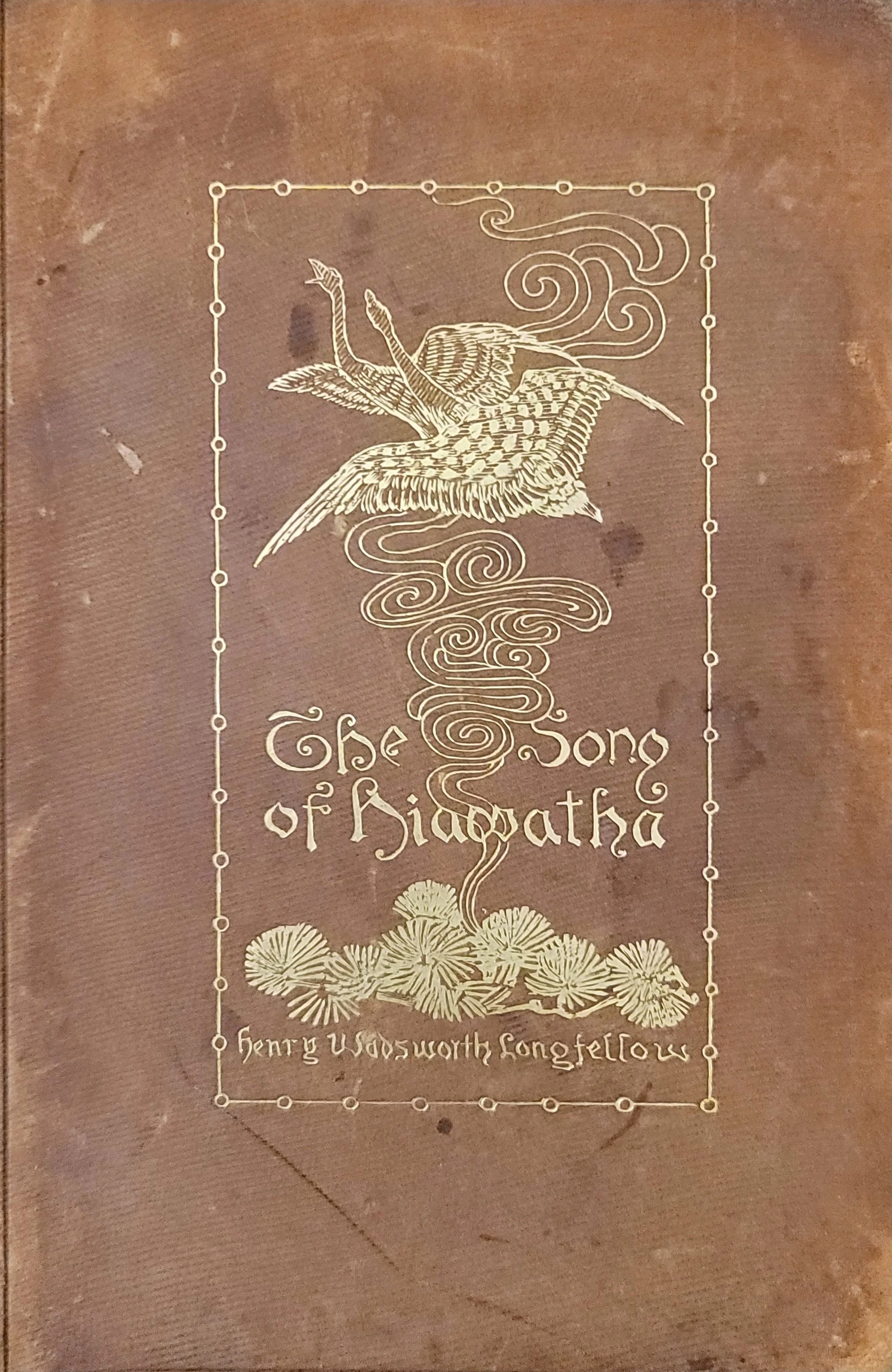
An 1890 edition of The Song of Hiawatha—its rich brown cloth cover embossed with the gold image of geese in flight and pine trees below, the title in flowing script. A beautiful artifact of Victorian-era bookmaking.

The 1901 Riverside Literature Series edition—a school text published by Houghton Mifflin and Company, Numbers 13 and 14, priced at forty cents. This is the edition that schoolchildren across America would have read—and which contains something extraordinary.
The 1901 Riverside edition is the one that stopped me. Its title page reads: The Song of Hiawatha by Henry Wadsworth Longfellow, with Illustrations, Notes, and a Vocabulary, and an Account of a Visit to Hiawatha's People by Alice M. Longfellow.
Alice M. Longfellow. The poet's daughter. And her account—"A Visit to Hiawatha's People"—describes one of the most remarkable cross-cultural encounters of the early twentieth century, one involving birchbark scrolls, Ojibwe ceremonies, and the living descendants of the very people whose stories shaped her father's poem.

The title page of the 1901 Riverside edition—a school text that carried within it Alice Longfellow's remarkable firsthand account of visiting Hiawatha's people at Desbarats, Ontario.
The Poem's Ojibwe Roots
When Henry Wadsworth Longfellow published The Song of Hiawatha in 1855, he drew almost entirely on the ethnological writings of Henry Rowe Schoolcraft—a geologist, explorer, and Indian agent who lived for years at Sault Ste. Marie (Baawitigong) on the St. Marys River. Schoolcraft had documented Ojibwe legends, language, and culture in a multi-volume work that Longfellow used as his primary source.
But there was a crucial intermediary: Schoolcraft's wife, Jane Johnston Schoolcraft, known by her Ojibwe name Bamewawagezhikaquay (Woman of the Sound the Stars Make Rushing Through the Sky). Born in 1800 in Sault Ste. Marie, she was a member of a prominent Ojibwe family—the daughter of Ojibwe chief Waub Ojeeg and his Irish-Canadian wife. She was fluent in both Anishinaabemowin and English, a gifted poet herself, and the real literary engine behind the legends Schoolcraft recorded.
It was Jane Johnston Schoolcraft who translated her people's stories. Who provided the Ojibwe words—Nokomis (grandmother), Gitche Gumee (Lake Superior, "Big-Sea-Water"), manoomin (wild rice), ziinzibaakwad (maple sugar). Who ensured the oral traditions of Baawitigong found their way onto the page. Longfellow never met an Ojibwe person. He borrowed their world through her work.
The poem also contains a well-documented error: Longfellow took the name of the Iroquois (Haudenosaunee) leader Hiawatha—a 15th-century statesman who helped found the Haudenosaunee Confederacy—and applied it to a character based on the Ojibwe spirit-hero Manabozho (also called Nanabozho), believing the two figures to be the same. They are not. But the world of the poem—its language, its geography, its stories—is unmistakably Ojibwe, drawn from the community of Baawitigong.
The Birchbark Invitation: Kabaoosa Writes to Alice Longfellow
Forty-five years after the poem's publication, something remarkable happened. In 1900, a band of Ojibwe men from the Garden River First Nation near Sault Ste. Marie traveled to Boston to perform at the Sportsman's Show. Among them was George Kabaoosa—the grandson of Chief Shingwauk, a leader who had ruled the scattered Ojibwe bands near Lake Superior and Lake Huron with their principal village at Garden River.
Kabaoosa had grown up hearing the legends of his people from his uncle and great-uncle, who had carefully preserved them. He had also heard Longfellow's poem read to him by his Sunday-school teacher in his youth—and recognized his people's stories within it. When the Garden River band came to Boston, one of their chief hopes was to visit the home of the Longfellow family in Cambridge—to honor the poet who had cared enough for their legends to turn them into poetry.
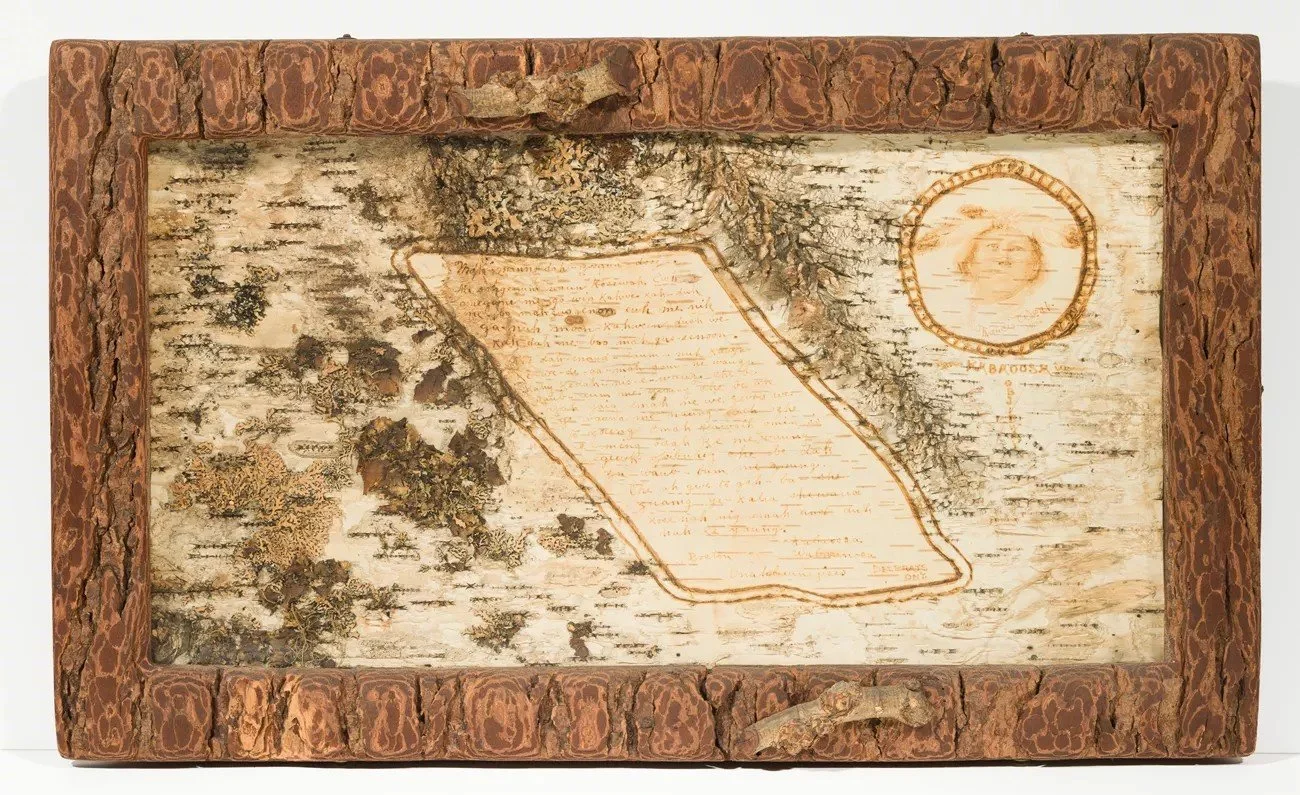
LONG-6132: The birchbark invitation to the Longfellow family, inscribed in Anishinaabemowin with 24 lines. In the upper right corner, artist Francis West painted a portrait of Kabaoosa. The frame is made of bark ornamented with a twig. Museum Collection, Longfellow House / NPS Photo.
That visit to Cambridge set in motion an extraordinary plan. A Canadian gentleman who had been arranging the expedition had long cherished the idea of training the Ojibwe to perform scenes from "Hiawatha" in the forests on the shores of the "big sea water." Kabaoosa embraced the scheme. A formal invitation was extended to the Longfellow family—written not on paper, but on birchbark, in Anishinaabemowin. It is now in the collection of the Longfellow House in Cambridge, Massachusetts.
The large, roughly hewn piece of birchbark is inscribed with twenty-four lines. In the upper right corner is a circular portrait of Kabaoosa himself, painted by Boston artist Francis West and labeled "Kaboosa, Objibway." According to the translation that has been circulated since 1902, the invitation reads:
The invitation was accepted. In August 1900, a party of twelve guests left the train at Desbarats, on the north shore of Lake Huron in Ontario, where they were met by the Ojibwe in full costume. In sailboats and canoes, they set out for a small rocky island that had been prepared for them, with a square stone lodge and tepees of tanned hide and stained canvas, two Indian families living nearby, cooking and serving, sailing the boats, entertaining their guests with songs, dancing, and storytelling.
Odahnewasenoque: Alice Longfellow Joins the Ojibwe
The performance of "Hiawatha" was staged on a rocky, thickly wooded point about two miles from the island. Near the shore, a platform was built around a tall pine-tree; grouped around it were tepees and wigwams forming an Indian village. Behind, the ground sloped gradually upward, forming a natural amphitheatre. Alice Longfellow described the play as a great success—a living ceremony in the landscape that had inspired her father's imagination.
But the performance was not the only ceremony. In a gesture of profound generosity and recognition, Alice Longfellow and other members of the Longfellow family were formally inducted into the Ojibwe tribe. Each person who received this honor was given a wiigwaasabak—a birchbark scroll—inscribed in the Ojibwe language with their individual adoptive name.
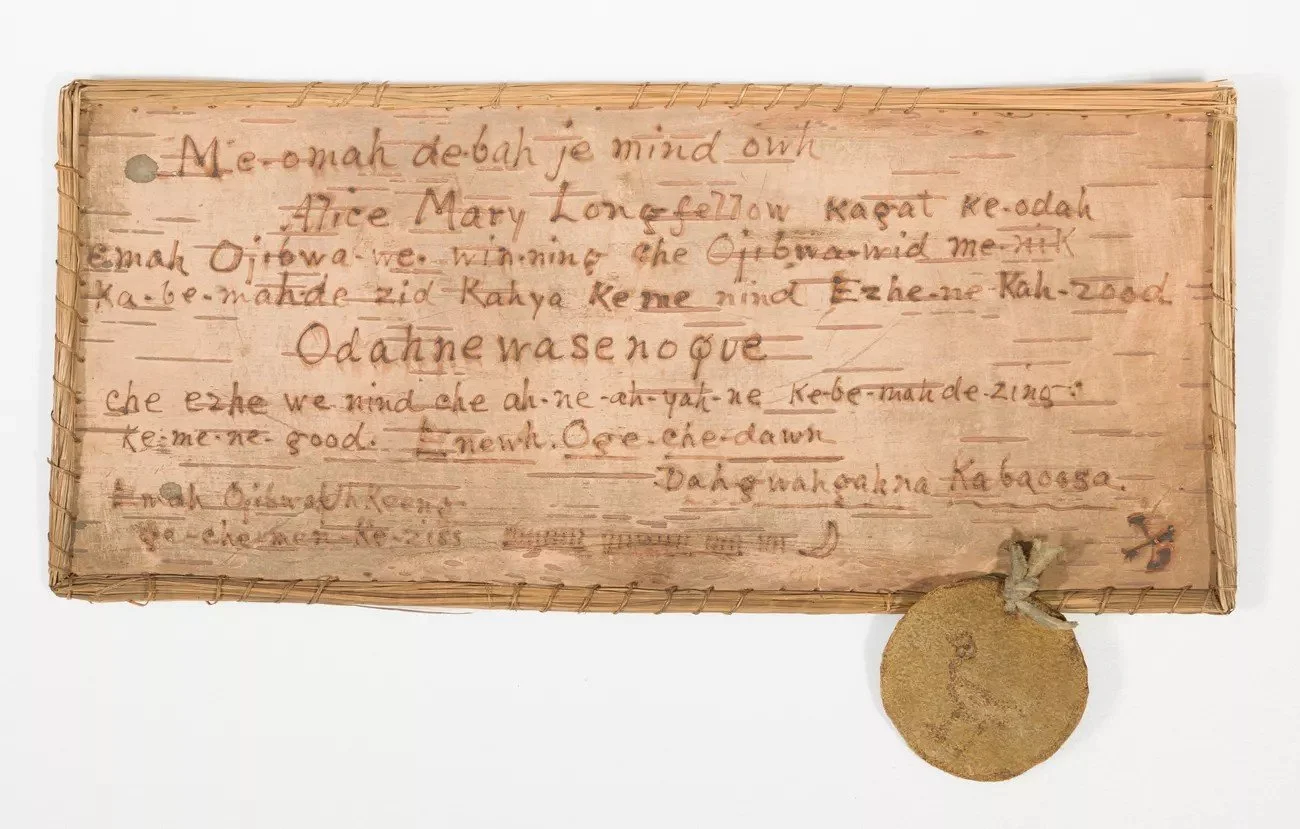
Alice Longfellow's birchbark certificate of adoption, 1900. The scroll is edged with tightly bound reeds stitched around the border. A circular leather medallion attached with a leather thong hangs from the lower right corner. Museum Collection (LONG 7563) / NPS Photo / James Jones.
Odahnewasenoque
(also recorded as "Ohdahnewasenoque")
"First Flash of Lightning"
The Ojibwe adoptive name given to
Alice Mary Longfellow
at Desbarats, Ontario, 1900
Five birchbark documents relating to the 1900 Hiawatha pageant survive in the Longfellow House collection, including the original invitation and Alice's personal certificate.
Alice's certificate reads in part: Me-omah de-bah je mind owh / Alice Mary Longfellow kagat ke-odah / Emah Ojibwa-we-win-ning che Ojibwa-wid me- / Ka-be-mahde-zid Kahya ke-me-nind Ezhe-ne-Kah-zood / Odahnewasenoque...
The scroll itself is an example of a wiigwaasabak (plural: wiigwaasabakoon)—a birchbark document used for ceremonial purposes, to record historical information, and to preserve sacred knowledge. Writing was done on the bark's surface with a stylus of bone, wood, or other material, with charcoal occasionally rubbed into the etched lines to provide greater definition. The pieces presented to the Longfellow family members were edged with tightly bound reeds stitched around the border.
Alice's certificate includes an additional feature whose significance remains unknown: a circular leather medallion, with an image of a long-legged bird stamped into it, attached with a short leather thong to the lower right corner.
The production was deemed a great success. It began a tradition that lasted for over thirty years, with the pageant eventually performed in the United States and Europe. What Kabaoosa and the Garden River Ojibwe had created—during an era when Indigenous ceremonies were often outlawed by the government—was a way to keep their drumming, dancing, language, and legends alive under the guise of theatrical performance.

From the 1901 Riverside edition: Alice Longfellow's account of the visit, alongside a photograph of Kabaoosa costumed as Hiawatha. The text explains how Longfellow blended the Ojibwe trickster-hero Manabozho with the noble Iroquois Hiawatha to form the poem's central character.

The printed translation of Kabaoosa's birchbark invitation as it appeared in Alice Longfellow's 1902 account—"Ladies: We loved your father. The memory of our people will never die as long as your father's song lives, and that will live forever."
Hiawatha's Country: The Pictured Rocks
When Longfellow described Hiawatha by the shores of Gitche Gumee—"By the shining Big-Sea-Water"—he was writing about a real landscape. The massive sandstone cliffs of what is now Pictured Rocks National Lakeshore, stretching along the southern shore of Lake Superior in Michigan's Upper Peninsula near Munising, are the literal backdrop for the poem's adventures. The Anishinaabe had known these cliffs for generations as places of power and spirit.
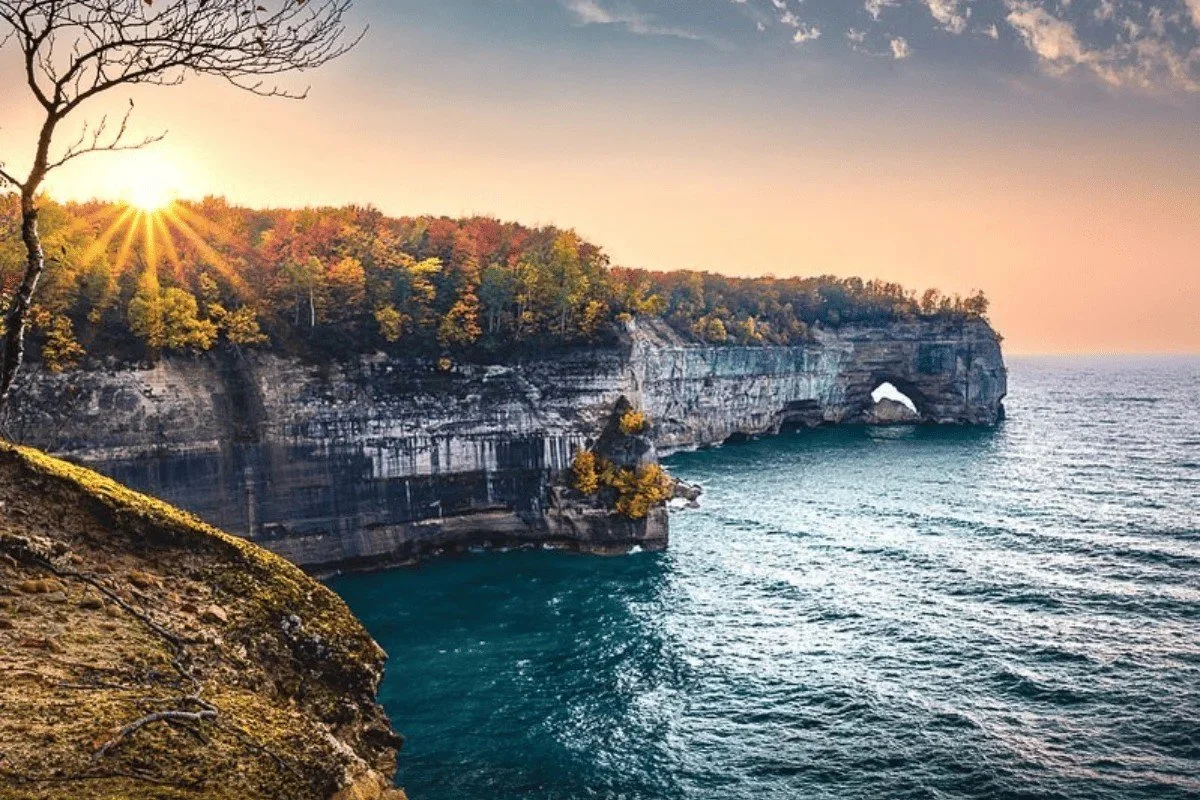
Pictured Rocks National Lakeshore—the sandstone cliffs on the southern shore of Lake Superior (Gitche Gumee) near Munising, Michigan. This is the literal landscape of Longfellow's poem, the homeland of the Anishinaabe people who knew these cliffs as places alive with spirit.
The Anishinaabe believed these massive cliffs were alive with unseen spirits—manitous. Travelers crossing the dangerous waters below would leave tobacco offerings as a sign of respect and for safe passage. The vivid red and orange mineral stains on the rock face were believed to carry deep spiritual meaning. The formations—Miners Castle, the arches, the cathedral-like coves—were seen as physical embodiments of powerful presences in the world.
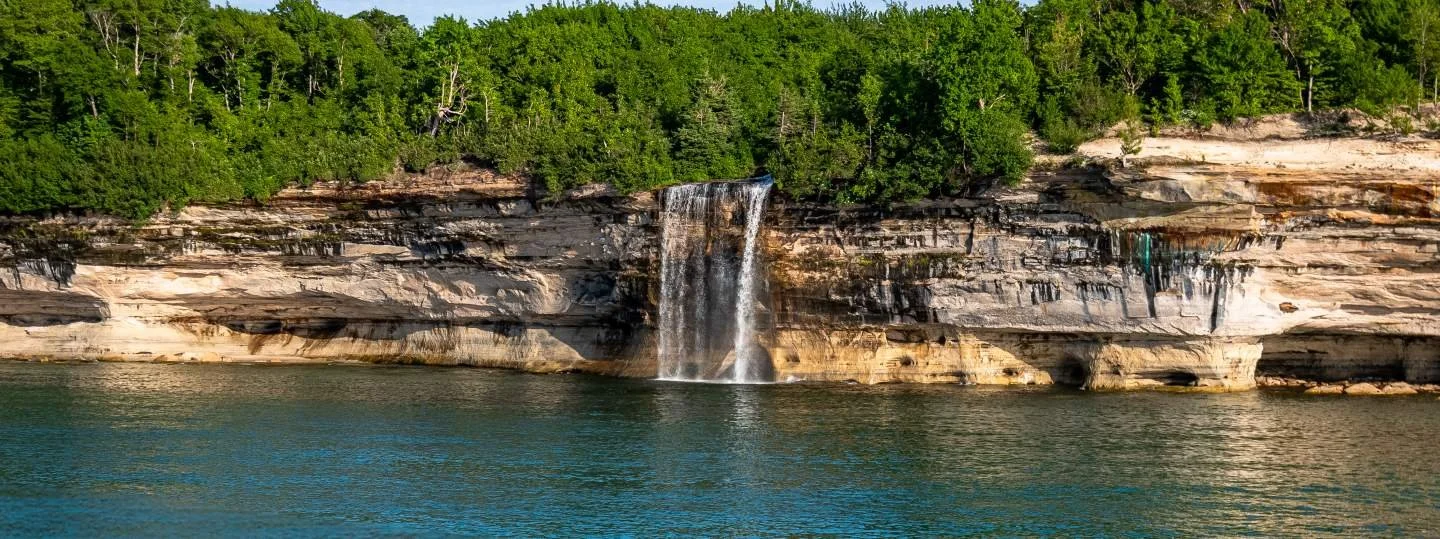
Spray Falls—a waterfall plunging directly into Lake Superior at Pictured Rocks. Munising Falls is within the town itself.

The golden sandstone cliffs of Pictured Rocks against a summer sky. The iron and manganese in the rock create the vivid mineral stains that named the lakeshore.
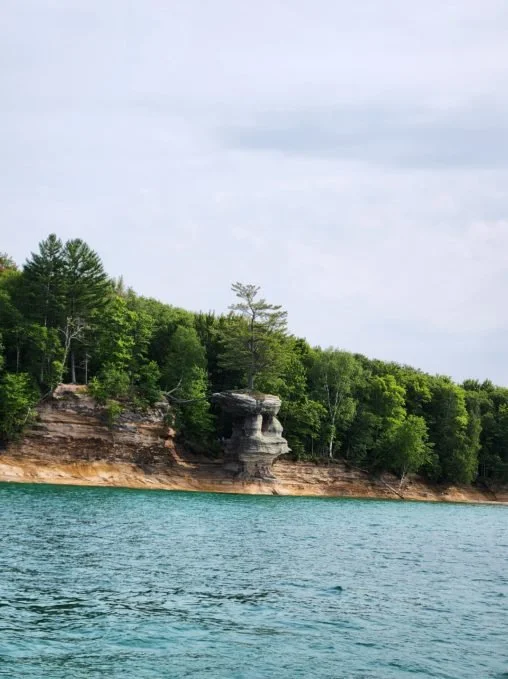
Pictured Rocks seen from Lake Superior—the perspective the Ojibwe knew best, traveling by canoe along this sacred shoreline.
The name Munising itself comes from the Ojibwe word minisiing—"at the island"—referring to Grand Island, which sits in the bay just offshore. The entire landscape is Ojibwe country: named in Ojibwe, shaped by Ojibwe spiritual understanding, documented in Ojibwe oral tradition long before Longfellow ever put pen to paper.
A Connection I Didn't Know I Was Making: Munising Maple
For years, I had been collecting hand-painted wooden bowls from the Munising Wood Products Company—a Michigan manufacturer that operated from 1911 to 1955, producing machine-lathed bowls from the local hardwoods of the Upper Peninsula: maple, beech, birch. Their art department hand-painted each piece with flowers, birds, roosters, and woodland designs before the factory closed.
I was simply drawn to them. I loved them. I had no idea—none—that Munising was the gateway town to Pictured Rocks, the heart of Hiawatha country, the same landscape I had been reading about in connection with my Ojibwe ancestry. The bowls were sitting right next to my Ojibwe art. The connection had been there all along, waiting for me to notice it.
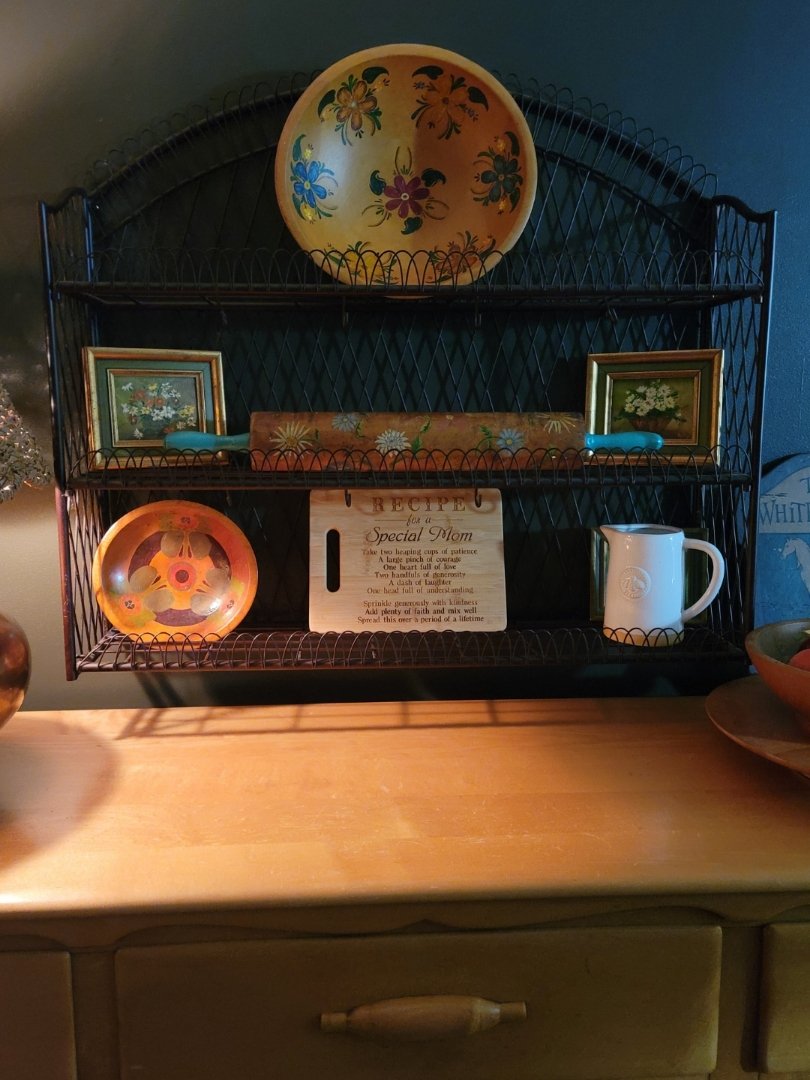
My Munising maple collection—bowls and rolling pin displayed alongside Ojibwe art. The entire collection sitting together was a connection I had made without realizing it.
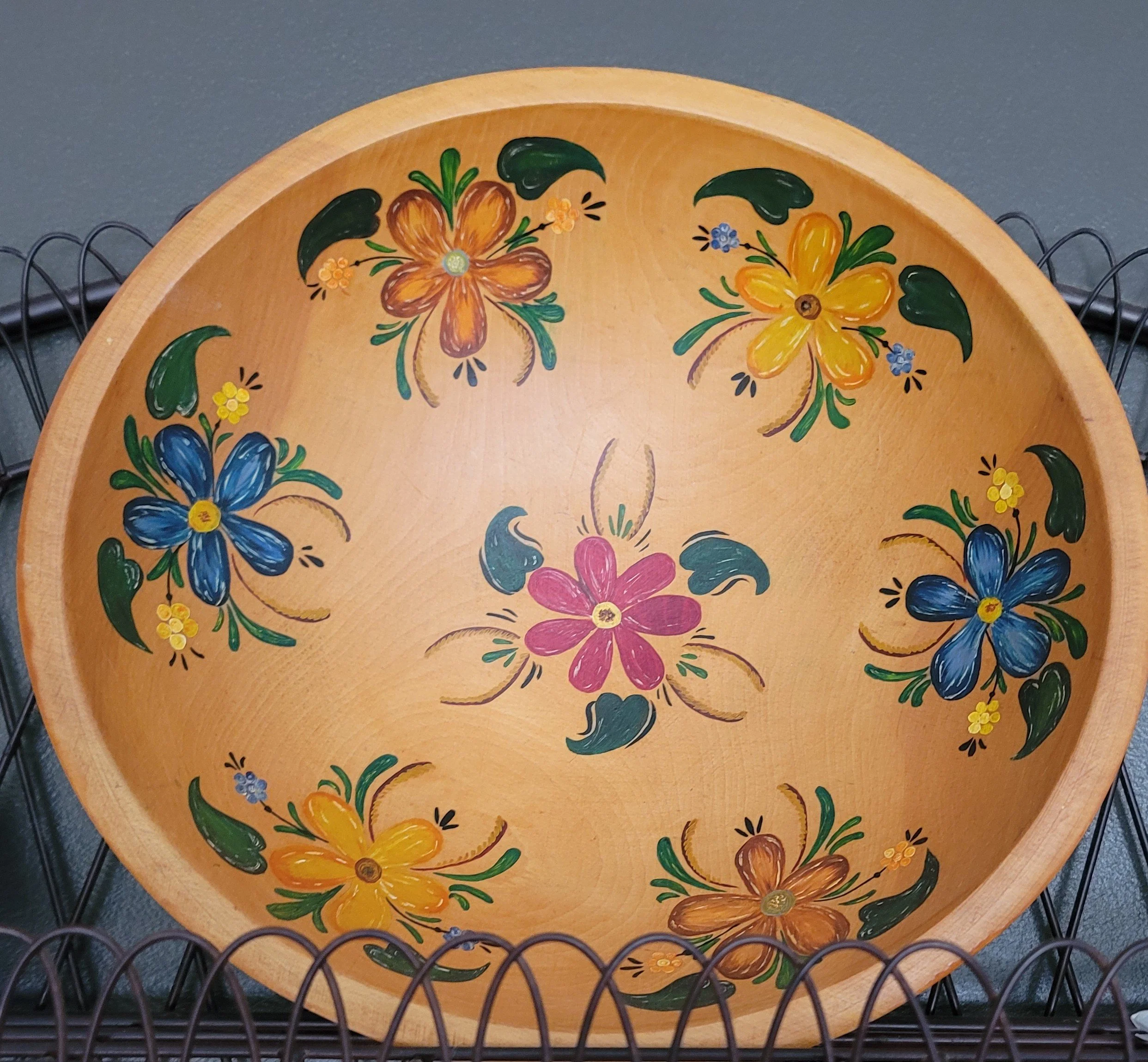
A large Munising maple bowl with hand-painted floral designs—made from the hardwood forests of the Upper Peninsula, the same landscape where the Ojibwe harvested maple sap each spring and where Longfellow set his poem.
These bowls were crafted from the very maple and birch forests of the Upper Peninsula—the same trees Longfellow describes Hiawatha using to build his canoe ("Give me of your bark, O Birch-tree!"), the same forests where the Ojibwe harvested manoomin (wild rice) and gathered maple sap each spring for ziinzibaakwad (maple sugar). The Ojibwe regard the maple tree as a sacred gift—a "tree of life"—and the spring sugarbush season as a time of community renewal. The month of April is Iskigamizige-giizis: the Moon of Boiling.
To hold a Munising bowl is to hold a piece of the land itself. The material is the country. And I had been collecting it for years, drawn by something I couldn't name—until the day I looked up from my books and understood.
Why This Matters: Marie Josephte Abitakijikokwe
All of these threads converge at the same point: Marie Josephte Abitakijikokwe, my Ojibwe 4th great-grandmother, born around 1770, who married French-Canadian voyageur Gabriel Guilbault in the world of the Pays d'en Haut—the Upper Country where Ojibwe people, French traders, and the great lakes met.
For two hundred years, she existed in family records only as "Sauvagesse"—the generic French term for "Indigenous woman." No name. No story. Then, in a marriage record from 1801 preserved at L'Annonciation in Oka, Quebec, a priest had written her full Ojibwe name: Abitakijikokwe—a name with the suffix -ikwe, meaning "woman" in the Ojibwe language. After 200 years of silence, she emerged with her identity intact.
When I read Longfellow's poem now—when I encounter the Ojibwe words, the Great Lakes landscape, the grandmother Nokomis teaching by the shores of Gitche Gumee—I am not reading fiction. I am reading a filtered, romanticized, and imperfect window into the world my ancestor knew. The stories behind the poem came from women like Jane Johnston Schoolcraft, who preserved her people's oral traditions across the cultural divide. The landscape is the landscape where Ojibwe people fished, traded, harvested wild rice, and boiled maple sap for generations.
And the birchbark—the wiigwaasabakoon that Kabaoosa used to write his invitation to the Longfellow family, the scroll that carried Alice's Ojibwe name—is the same material Marie Josephte's people used for canoes, for containers, for writing, for ceremony. A continuous thread from the shores of Gitche Gumee to a marriage record in Quebec to a school edition of a poem in my hands.
For Marie Josephte Abitakijikokwe (c. 1770–1813)
Ojibwe wife of Gabriel Guilbault · Mother of six children
My 4th great-grandmother
Whose world was here—in this country, in this land, in these stories—all along.
Related Reading
Ojibwe Baskets, Beads, and Art: A Genealogist's Discovery →
Exploring Ojibwe artistic traditions as tangible connections to Marie Josephte Abitakijikokwe.
Finding Marie Josephte: How One Ojibwe Woman Emerged from 200 Years of Silence →
The full story of discovering my 4th great-grandmother's identity in Quebec parish records.
The Guilbault Line: A Documentary Biography →
The complete case study tracing the voyageur family from Quebec to the present.
Perthshire Paperweights: A Genealogist's Discovery →
Another entry in "A Genealogist's Discovery"—on tangible connections to Scottish heritage.
Sources
Longfellow, Henry Wadsworth. The Song of Hiawatha. Boston: Ticknor and Fields, 1855.
Longfellow, Alice M. "A Visit to Hiawatha's People." In The Song of Hiawatha, Riverside Literature Series, Numbers 13 and 14. Boston: Houghton Mifflin and Company, 1901.
Higginson, Thomas Wentworth. Henry Wadsworth Longfellow. Boston: Houghton Mifflin and Company, 1902. [Contains Alice Longfellow's account of the 1900 Desbarats pageant and the translation of Kabaoosa's birchbark invitation.]
"LONG-6132: Birchbark Invitation." Longfellow House–Washington's Headquarters National Historic Site Collection. National Park Service. Museum accession LONG 6132.
"Alice Longfellow's Birchbark Certificate." Longfellow House–Washington's Headquarters National Historic Site Collection. National Park Service. Museum accession LONG 7563. NPS Photo / James Jones.
Schoolcraft, Henry Rowe. Algic Researches. New York: Harper & Brothers, 1839. [Primary source used by Longfellow.]
Murphy, Lucy Eldersveld. Great Lakes Creoles: A French-Indian Community on the Northern Borderlands. Cambridge: Cambridge University Press, 2014.
Minnesota Historical Society. Ojibwe cultural resources on maple sugaring traditions.
Additional primary source documents: Archives Nationales du Québec; Register of L'Annonciation, Oka, Quebec, 1801.
✦ Free Download: Five Signs of Indigenous Ancestry in Quebec Parish Records
Learn the phrases, naming patterns, and record clues that reveal Indigenous ancestors hidden in Quebec parish records—the same methodology that identified Marie Josephte Abitakijikokwe. Includes FamilySearch Full Text Search strategies.
Get Your Free GuideEvery Family Has a Story Worth Telling
Whether you're just beginning your research or ready to transform years of work into a narrative your family will treasure, I'd love to hear your story.
BEGIN YOUR RESEARCH INQUIRY