
The Interconnected Families of Numancia
The Interconnected Families of Numancia
How DNA evidence and FamilySearch Full Text Search revealed a century of interconnected heritage. Six major family surnames—Roldan, Gonzales, Quimpo, Tamayo, Isturis, and Martelino—intermarried across generations in a tightly knit Philippine community, creating the network of relationships that eventually led to America.
DNA Match Validated
A distant cousin match led us to common ancestors: Paulino A. Martelino and Isabel Pillo Tolentino. Documentary research confirmed a 4th cousin once removed relationship through the Martelino line, with potential additional connections through the Quimpo family network.
Descent Lines to the Tester
Paternal Line: Morales–Gonzales–Quimpo
Maternal Line: Tamayo–Roldan–Isturis–Martelino
Research Discovery
The June 1927 Pacto de Retro sale provides the first documentary confirmation that Fortunato Roldan was married to Margarita Isturis. This document, discovered through FamilySearch Full Text Search, shows Fortunato purchasing three parcels of land in Barrio Imelaran—establishing him as a property owner in Numancia two years before the earliest previously known records.
Primary Document Evidence
Fourteen Documents Spanning 1927–1962
Fortunato Roldan, "married to Margarita Isturis," purchases three parcels in Barrio Imelaran for ₱50. First documentary proof of their marriage.
Fortunato authorized to sell cattle and carabaos in Numancia—establishing his role as trusted community figure.
Crispina Gonzales mortgages land inherited from Captain Lucas Gonzales. Confirms Lucas deceased by 1928; Bonifacia Quimpo as lender.
Maria Fernandez references Fortunato Roldan and "Geron" (very likely Cenon) Gonzales in family property matter—now chronologically supported by evidence that Cenon was active in Numancia in this period.
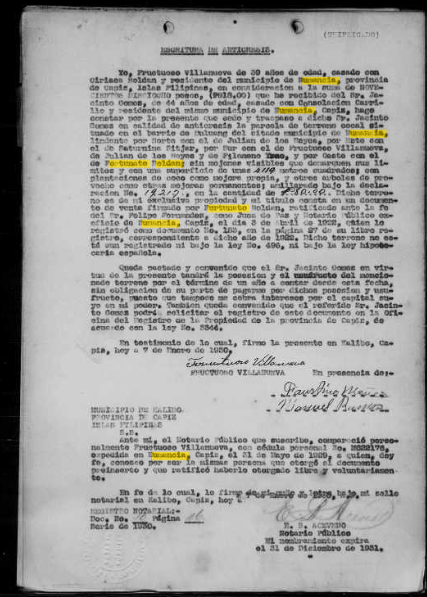
Identifies Cirlaca Roldan (likely Fortunato's sister) and shows Fortunato owned adjacent property in Barrio Nalawan.
Jose Tamayo (21) marries Maria Corazon Roldan. Parents: Felipe Tamayo & Natividad Icomina. FHL Film 1748080.
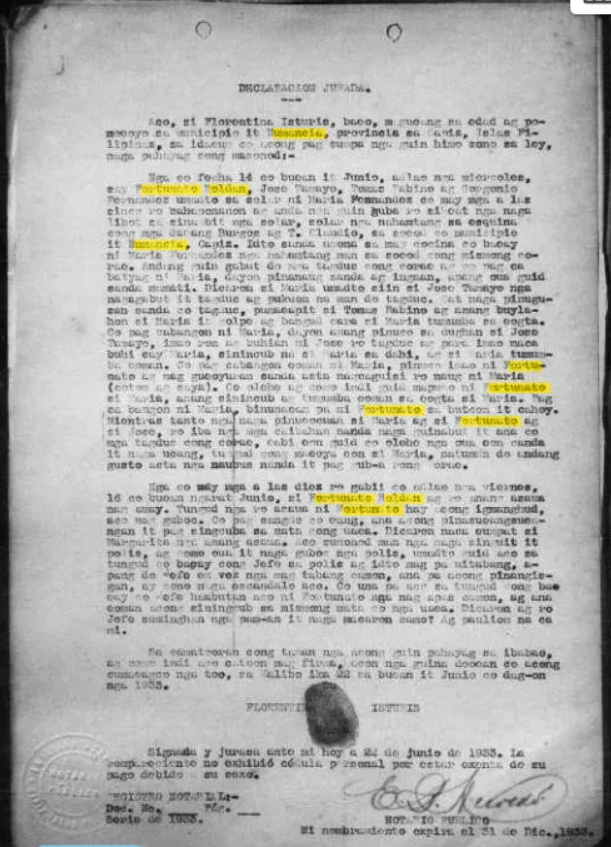
Florentina Isturis (likely Margarita's sister) documents Fortunato and Jose Tamayo together at Maria Fernandez's house—father-in-law and son-in-law.
Antonia K. Roldan (76, widow, née Kimpo) authorizes son Maximo. Properties listed under "Antonia Kimpo"—confirming her maiden name.
Cenón swears at age 59, fixing his birth at c. 1874—superseding an indexed 1888–1928 death record. States he knew Onofre Fernandez since boyhood. Notary: Mamerto L. Morales.
The page preceding Cenón's affidavit, before the same notary—corroborating the boyhood acquaintance and linking the Fernandez and Gonzales families.
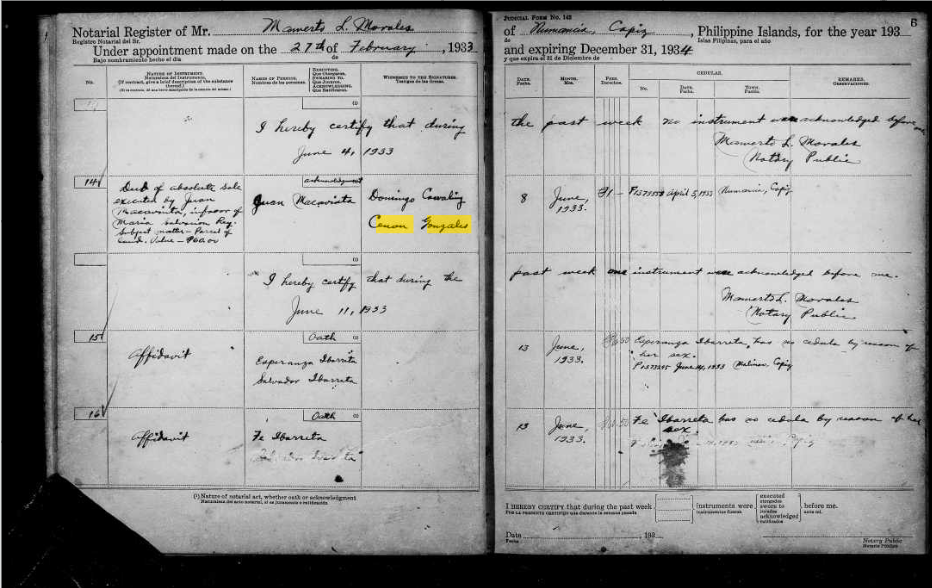
Deed of absolute sale with Cenón Gonzales as witness—independent proof he was alive and active in Numancia after 1928.
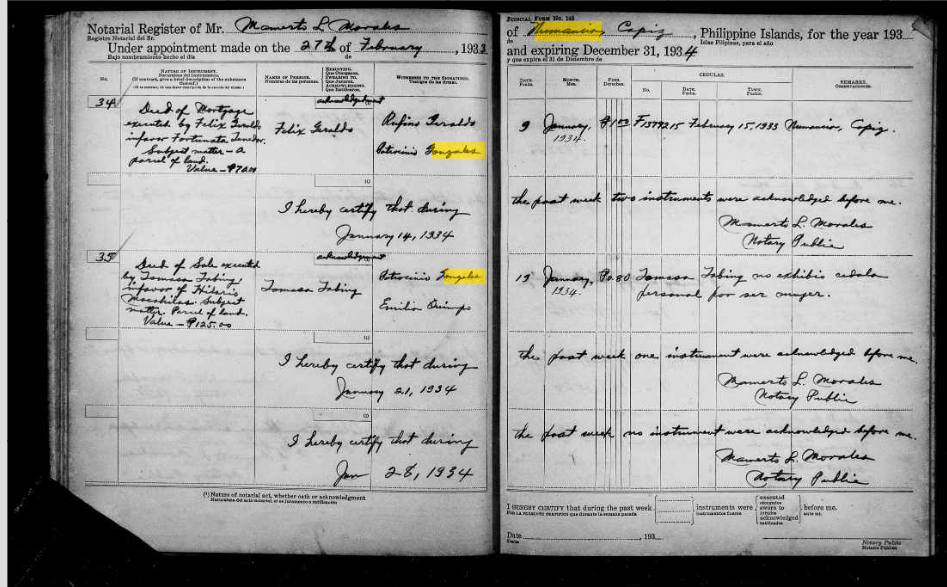
Deed of mortgage with Cenón and Patrocinio Gonzales as witnesses, placing father and daughter together in the same transaction.
Deed of absolute sale with Patrocinio Gonzales and Emilia Quimpo as witnesses—Cenón's wife and daughter active in community affairs.
Names Cenón Gonzales alongside his brother Castor, placing Cenón alive in November 1935 and corroborating the sibling set among Captain Lucas's children.
Key Family Connections
Roldan–Isturis Marriage
Fortunato F. Roldan married Margarita M. Isturis (b. 1890), connecting the Roldan landowners with the Isturis judicial family. Her father, Juez Roman Isturis, held municipal judicial authority.
Evidence: 1927 Pacto de Retro, 1933 Declaration
Gonzales–Quimpo Marriage
Cenon Gonzales (c. 1874–after 1935) married Emilia Quimpo (b. 1880), uniting Captain Lucas's land empire with the extensive Quimpo network that included lenders, landowners, and merchants.
Evidence: 1933 affidavit (self-stated age 59), 1933–1935 notarial records
Tamayo–Roldan Marriage
Jose Tamayo (1910–1970) married Maria Corazon Roldan on June 27, 1931, joining the Tamayo farming family with Fortunato's line. Their daughter Hally became a physician.
Evidence: Marriage record, FHL Film 1748080
Cirlaca Roldan Identified
Cirlaca Roldan, married to Fructuoso Villanueva, owned property adjacent to Fortunato in Barrio Nalawan—suggesting she was his sister. The 1931 document references Fortunato as neighboring landowner.
Evidence: 1931 Arrendamiento document
Roldan–Kimpo Connection
Antonia K. Roldan (née Kimpo, b. ~1886) married into the Roldan family. The Kimpo family included notary Leoncio Kimpo, who appears in multiple documents as both official and adjacent landowner.
Evidence: 1962 Power of Attorney
Quimpo Financial Network
Bonifacia Quimpo (married to Feliciano Gonzales) served as lender in the 1928 mortgage to Crispina Gonzales. The Quimpo family appears repeatedly as both marriage partners and financial actors.
Evidence: 1928 Mortgage Contract
Documentary Timeline
Primary Sources







Complete Document Transcriptions & Translations
Access the full Spanish and Hiligaynon transcriptions with English translations, detailed genealogical analysis notes, and research conclusions for all fourteen primary source documents.
View Document Transcriptions (PDF)Research Methodology
This research demonstrates how modern technology can unlock previously inaccessible Philippine genealogical records. The combination of DNA analysis, FamilySearch Full Text Search, and careful document translation revealed family connections that traditional indexed searches had missed for decades.
DNA Analysis
A 26 cM match provided the initial clue. Segment analysis suggested 4th-5th cousin range, guiding documentary research toward specific ancestral lines.
Full Text Search
FamilySearch's 2024 technology breakthrough searches actual document text rather than indexes—unlocking property records, declarations, and legal documents previously invisible to researchers.
Document Translation
Eight primary documents translated from Spanish and Hiligaynon (Visayan) revealed names, relationships, and property connections spanning 35 years.
Are You Connected to the Morales-Tamayo Line?
If you descend from the Morales or Tamayo families of Numancia and Kalibo, Aklan, or from the intermarried Numancia families — Gonzales, Quimpo, Roldan, Isturis, Martelino, Icamina, Ferrer — whether your branch remained in the Philippines or emigrated to the United States, I’d like to compare notes. Documented trees, DNA matches, family papers, and even half-remembered stories have all moved this research forward.
Get in Touch About This FamilyCousin connections are informal and reciprocal — no fee, no obligation, just shared work on shared ancestry.
Every Family Has a Story Worth Telling
Whether you're just beginning your research or ready to transform years of work into a narrative your family will treasure, I'd love to help.
BEGIN YOUR RESEARCH INQUIRY