
Researching Prince Edward Island
Researching Prince Edward Island
A Guide to Genealogical Methods for Atlantic Canadian Research
The strategies, resources, and repositories that helped trace the Kenny and Connors families from County Wexford through Newfoundland to Prince Edward Island
Tracing Irish families who settled in Prince Edward Island requires navigating a unique set of records, repositories, and research strategies. This companion piece shares the methodologies developed over years of research into the Kenny and Connors families—techniques applicable to any PEI genealogy project.
"The best place to begin to trace your family history is with yourself. From there you can begin to work back generation by generation, from the known to the unknown, to your immigrant ancestors."
— Public Archives and Records Office of PEIPrince Edward Island's genealogical records present both challenges and opportunities. The island's unique lot system, strong preservation efforts by the PEI Genealogical Society, and interconnected communities mean that with the right approach, researchers can often trace families back to their earliest days on the island—and sometimes to their origins across the Atlantic.
☘ PEI Genealogy Quick Reference Guide
Get the printable 4-page guide with repositories, maps, search tips, and checklists to use at your desk while researching.
Get Your Free GuideCore Research Principles
Successful PEI genealogy research rests on fundamental principles that guide every search, every source evaluation, and every conclusion.
Work from Known to Unknown
Begin with yourself and work backward, documenting each piece of information and confirming relationships as you progress. Never jump directly to a distant ancestor without establishing the connecting generations.
Focus on One Line at a Time
Concentrate on one family line to avoid confusion and maintain research clarity. In my Kenny-Connors research, I traced each branch systematically before connecting them through their shared community.
Document Every Source
Record the source, location, and date of each piece of information. This allows you and other researchers to verify findings and build upon your work with confidence.
Establish the NDPs
Before visiting repositories, establish the Names of people and relationships, Dates of births, marriages, and deaths, and Places where events occurred.
My Research Experience
When researching the Kenny and Connors families, I discovered baptism and marriage records in both Newfoundland and New Brunswick prior to their settlement in PEI. This "two-step" migration pattern—arriving first in one Atlantic province before relocating—is common among Irish immigrants. Always expand your search beyond PEI's borders.
Essential Repositories
Prince Edward Island genealogy research centers on several key repositories, each holding distinct record types. Understanding what each offers—and how to access their holdings—is essential for thorough research.
Public Archives and Records Office (PARO)
The Public Archives houses the largest collection of PEI genealogy material in the province. Located in Charlottetown's Atlantic Technology Centre, PARO holds vital statistics, land records dating from the 1760s, court records, and extensive private collections donated by researchers over decades.
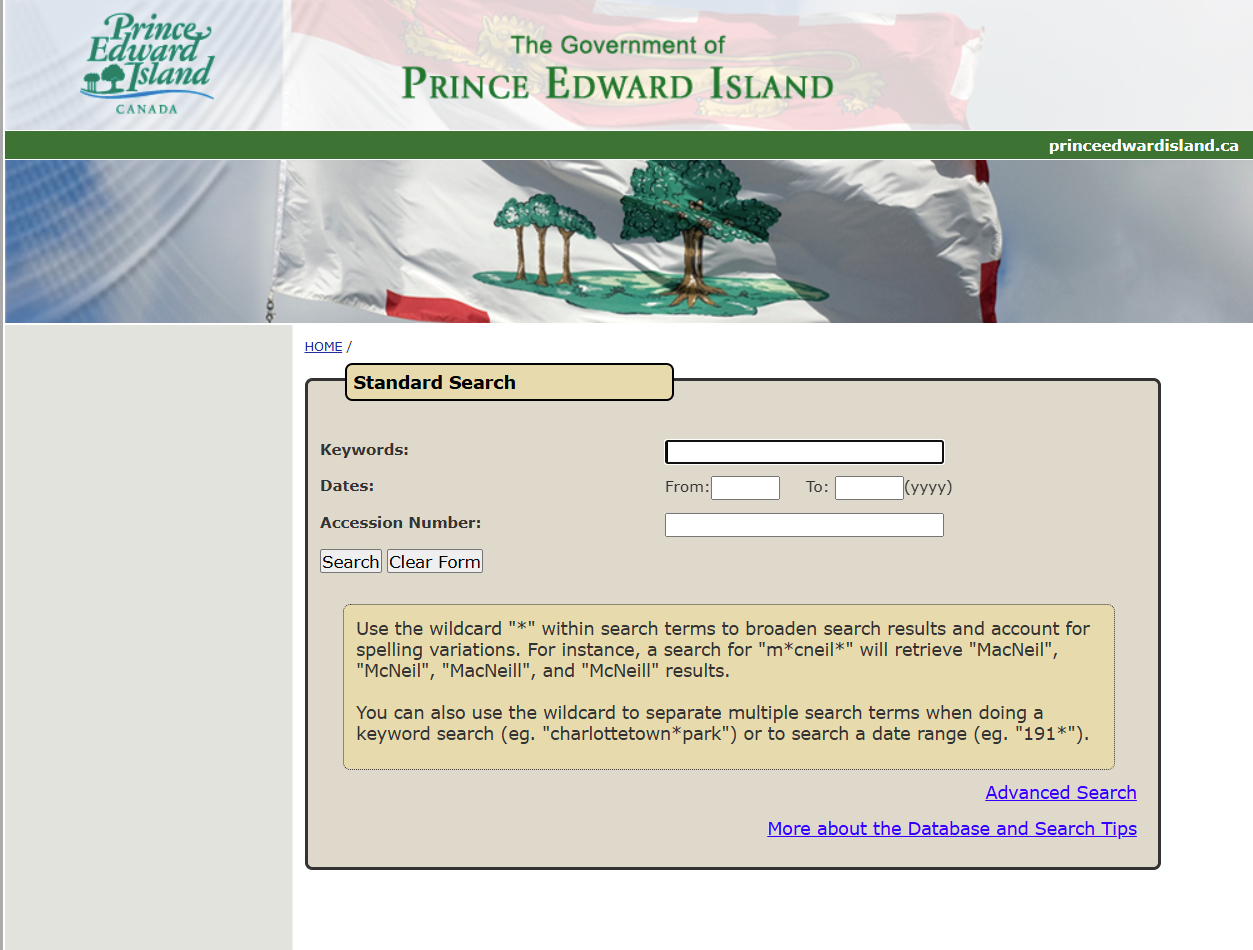
The PARO Collections Database search interface. Use wildcards like "m*cneil*" to capture spelling variations such as MacNeil, McNeil, and McNeill.
Research Tip
A research pass is required for in-person access at the Public Archives, and they do not participate in inter-library loans. Plan your visit carefully and bring organized notes to maximize your time.
PEI Genealogical Society (PEIGS)
Founded in 1976, the Prince Edward Island Genealogical Society has produced invaluable finding aids that open doors for researchers worldwide. Their publications include cemetery transcripts, census indices, and specialized compilations tracking emigrants from Scotland, Ireland, and England.

The PEIGS Shop offers Publications, Cemetery Transcripts, and Census Books—essential resources for PEI researchers.
The Society's volunteer-driven projects have documented every known cemetery on Prince Edward Island between 1972 and 1982, with ongoing updates. These transcripts often reveal information no longer legible on weathered stones.
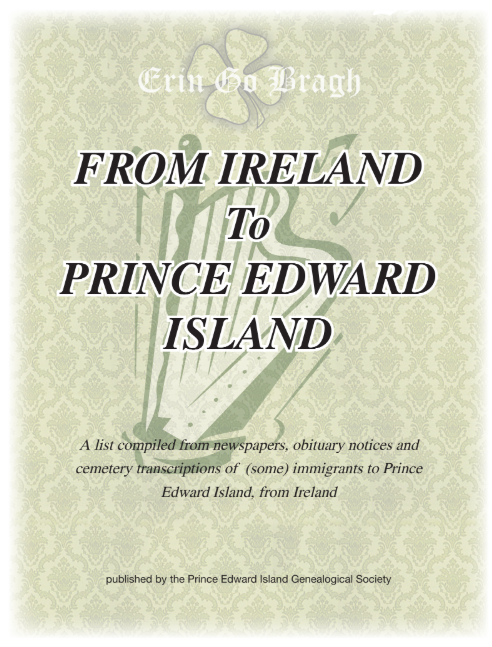
From Ireland to Prince Edward Island
A compiled list from newspapers, obituary notices, and cemetery transcriptions of Irish immigrants to PEI. Published by PEIGS.

Index to Past and Present (1907)
An alphabetical index by David W. Dystant containing 12,376 entries to the 1907 history of PEI. Invaluable for locating biographical sketches.
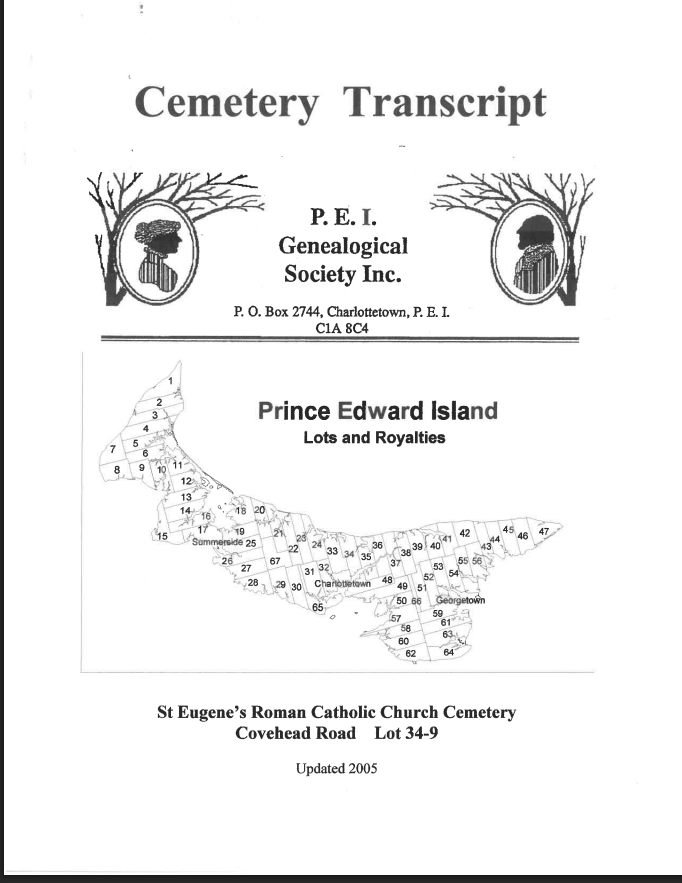
Cemetery Transcripts
Individual transcripts available by lot. This example covers St. Eugene's Roman Catholic Church Cemetery on Covehead Road, Lot 34.
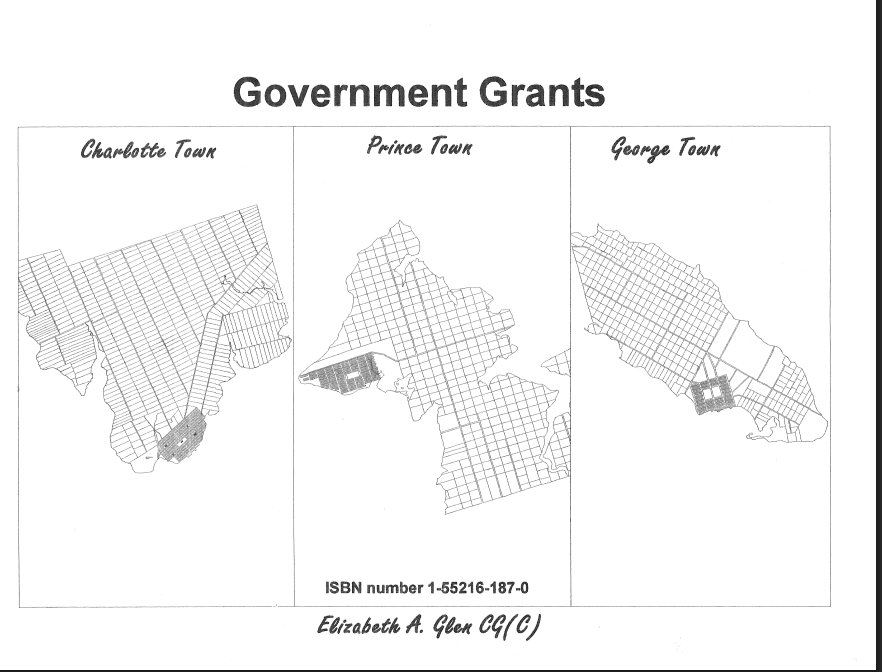
Government Grants
By Elizabeth A. Glen, CG(C). Documents land grants in Charlotte Town, Prince Town, and George Town—essential for tracing early property ownership.
The Past and Present Index
The 1907 Past and Present of Prince Edward Island was published under the advisory editorship of Hon. D.A. MacKinnon and Hon. A.B. Warburton. The original publication included no index—a significant barrier to research until David Dystant created one in 2000. Note that biographical sketches were subscriber-funded and reviewed by subjects, so some contain errors. Female children's names are often listed only as "Mrs. W. G. Distant" rather than by given name.
The Island Register
This volunteer-run genealogical website contains a wealth of information about PEI families and offers an excellent way to connect with others researching your surname. The site includes family trees, pioneer profiles, and community histories, along with the 1863 Lake Map—a critical resource for locating ancestors in their communities.
Maps as Research Tools
Maps are among the most underutilized yet powerful tools in PEI genealogy. They locate ancestral properties, trace migration patterns, and help researchers understand the community context in which their ancestors lived. Prince Edward Island is fortunate to have several historical maps that complement each other—from estate surveys to commercial atlases—each offering unique genealogical insights.
Why Maps Matter
Land records can establish that your ancestors were on PEI in a given year, pinpoint locations so records arranged by lot can be more easily used, and help trace the movement of your family across the island and beyond.
Estate Surveys: The 1850 Hickey Map
Before the commercial maps, landlords commissioned cadastral surveys to manage their tenant populations. Daniel Hickey's 1850 survey of Lot 34—officially titled "A Plan of Township No. 34, The Property of Sir Graham Montgomery & Brothers"—records every tenant by parcel number, name, and acreage. Unlike later maps that show geographic locations, the Hickey Map functions as a landlord's inventory.

Detail from the 1850 Hickey Map showing Lawrence Kenny at No. 19 (50 acres). The red ink annotation "now Thos Carroll" records a later ownership transfer—making this a living document that tracked changes over decades.
Why Estate Surveys Matter
Estate surveys like the Hickey Map provide parcel numbers that connect tenant names to specific legal records, conveyances, and probate files. The red ink annotations show ownership transfers over time, revealing family movements and property sales. For Lot 34, the Hickey Map shows Lawrence Kenny at No. 19 and Hugh Connors at No. 236—neighbors sixteen years before the 1863 Lake Map confirmed their proximity.
The 1863 Lake Map
The Lake Map provides a comprehensive snapshot of property ownership across Prince Edward Island at a specific moment in time. For researchers tracing mid-nineteenth century families, this map often reveals exactly where ancestors lived and who their neighbors were.
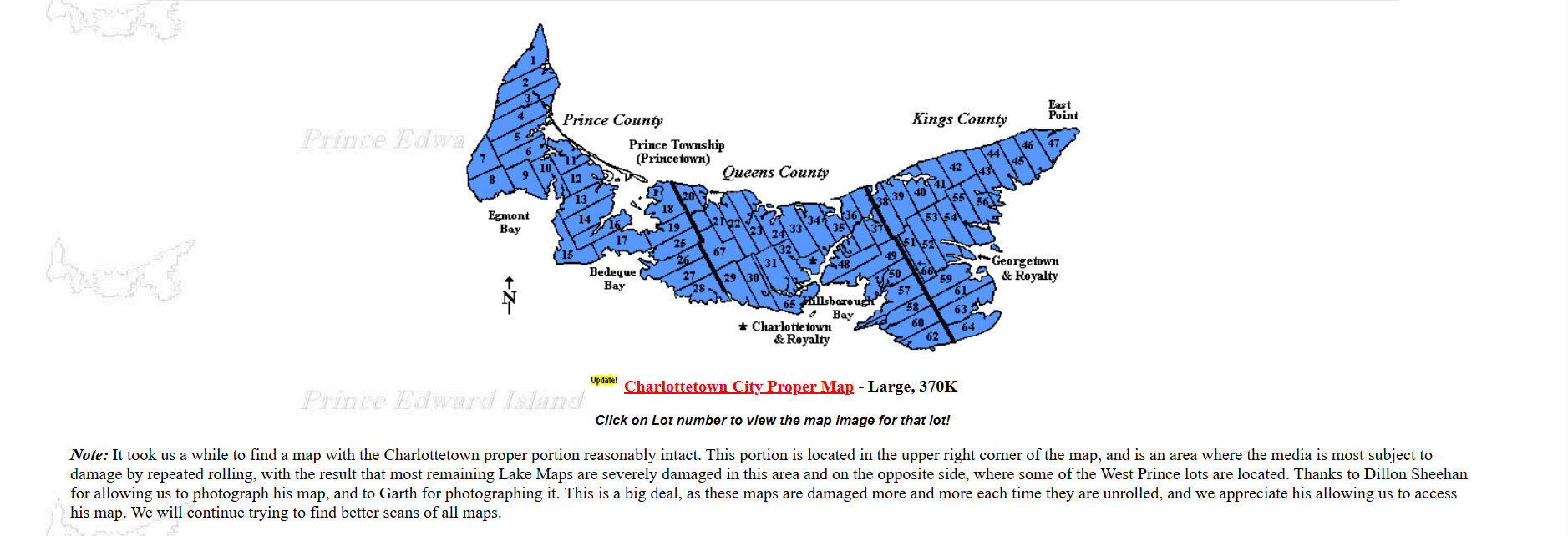
The 1863 Lake Map showing Prince Edward Island's lot system. Click on lot numbers through The Island Register to access detailed views.
In my Kenny-Connors research, the 1863 Lake Map confirmed what the earlier Hickey Map had shown. On Lot 34, I found "L. Kenny" and "H. Connors" on neighboring properties—visual confirmation of the community connections first documented in the 1850 estate survey and later supported by church and cemetery records.

Detail from the 1863 Lake Map showing L. Kenny and J. Conners as neighbors on Lot 34 along Covehead Road. This visual evidence confirms the family connections documented in church and cemetery records.
Meacham's 1880 Atlas
The 1880 Meacham's Illustrated Historical Atlas provides another essential snapshot, capturing property ownership roughly a generation after the Lake Map. Comparing these two sources reveals family movements, property transfers between generations, and the arrival of new families.

Plan of Lots 33 & 34, Queens County, from Meacham's 1880 Illustrated Historical Atlas. The detail shows property holders nearly two decades after the Lake Map, revealing family continuity and change.
| Map/Atlas | Date | Best Used For |
|---|---|---|
| Hickey Map (Lot 34) | 1850 | Estate tenant lists by parcel number, earliest property records, connecting to land conveyances |
| Lake Map | 1863 | Island-wide property locations, Famine-era immigrant settlement patterns, neighbor identification |
| Meacham's Atlas | 1880 | Second-generation holdings, property transfers, community development |
| Cummins Atlas | 1926 | Early 20th century research, third/fourth generation tracking |
| Fire Insurance Maps | Various | Urban property details, building structures in towns |
Cemetery Records
Cemetery inscriptions often provide the most direct evidence of family relationships, death dates, and sometimes even birthplaces. The PEI Genealogical Society's systematic transcription project ensures this information remains accessible even as stones weather and become illegible.
From the St. Eugene's Cemetery Transcript
Entry 53: KENNY: (Father) Lawrence KENNY, d. Feb 20, 1899, Ae 95. (Mother) His wife, Catherine CORCORAN, d. Jan 23, 1855, Ae 53. Their son, James, died Jun 25, 1872, Ae 40.
This single cemetery entry—Lawrence Kenny and Catherine Corcoran in Lot 34's St. Eugene's Roman Catholic Church Cemetery—reveals a family unit spanning nearly a century. Lawrence's death at age 95 in 1899 places his birth around 1804; Catherine's death in 1855 at age 53 indicates birth around 1802. Their son James, who died at 40 in 1872, was born approximately 1832—likely in Ireland before the family's emigration.
Reading Cemetery Transcripts
PEIGS cemetery transcripts use standard abbreviations: b. = born, Ae = age, d. = died, dcd = deceased, dau. = daughter, s. = son, h. or w. = spouse, ch. = children, IGC = In God's Care, EREL = Ever Remembered Ever Loved. Predominant surnames appear in bold CAPITALS on the left; maiden names also appear in bold.
Start with Family: Documents and Prior Research
Before venturing into archives and online databases, the most valuable genealogical resources may already exist within your own family. Elderly relatives, family Bibles, photograph albums, and the research of previous family genealogists can provide irreplaceable information that no public record contains.
People Are Your Best Resource
Talk to relatives, friends, and neighbors who knew your forbears. Elderly people in particular may be a treasure trove of information. If you cannot visit them in person, phone, email, or write a letter. Ask for more than just names, dates, and places—inquire about stories, traditions, photographs, diaries, and old legal papers.
In my own Kenny-Connors research, invaluable information came from my father's first cousin, Mary Ellen Molony Brady. Her meticulously prepared Family Group Sheets from 1991 provided a foundation that would have taken years to reconstruct from public records alone. These documents captured family knowledge from a generation closer to the immigrant ancestors—details that might otherwise have been lost.
What to Ask For
Has anyone already compiled a family history? Are there interesting stories, legends, or traditions passed down over the years? Does anyone have old family photographs, diaries, letters, or scrapbooks? Is there an old family Bible with birth, marriage, and death information? Does anyone have old legal papers such as wills or land deeds? What role did religion play in your forbears' lives?
Prior family research—even if incomplete or containing errors—provides crucial starting points and often preserves oral traditions that contextualize documentary evidence. Verify what you inherit, but honor it as a gift from those who came before.
Recommended Reading
Understanding the broader context of Irish immigration to Atlantic Canada enriches individual family research. These scholarly works provide the historical framework that transforms names and dates into lived experiences.
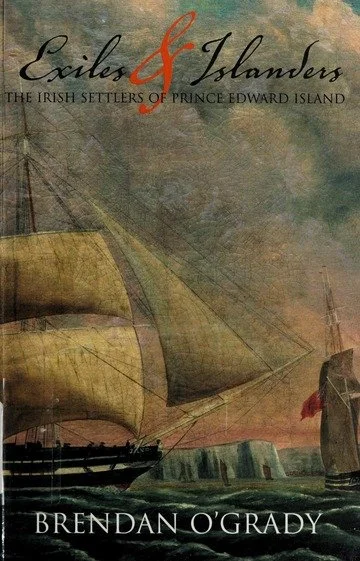
Exiles and Islanders by Brendan O'Grady (2004)
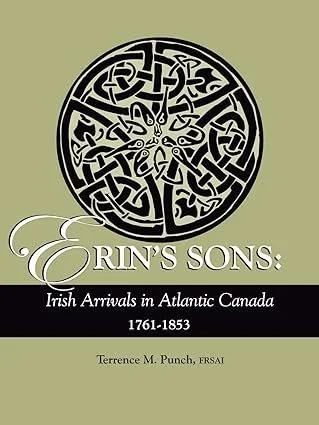
Erin's Sons by Terrence M. Punch, FRSAI
Exiles and Islanders: The Irish Settlers of Prince Edward Island
Brendan O'Grady's Exiles and Islanders (2004) details Irish immigration to PEI from 1763 to 1880, challenging the common myth that most were Famine refugees. O'Grady demonstrates that Irish settlers came from all over Ireland, mostly before the Famine, and settled across the island in various occupations while maintaining their culture for generations.
Drawing on diverse sources including folklore, letters, and shipping records, O'Grady provides a comprehensive cultural history essential for understanding the world your PEI Irish ancestors inhabited. For Kenny and Connors family research, this work illuminates the broader patterns of settlement in Queens County and the persistence of Irish identity on the Island.
Erin's Sons: Irish Arrivals in Atlantic Canada
Terrence M. Punch's four-volume Erin's Sons series documents Irish immigrants to Newfoundland, PEI, New Brunswick, and Nova Scotia between 1751 and 1863. Compiled from newspapers, cemeteries, church records, and land documents, this series traces thousands of individuals to their specific origins in Ireland.
The Four Volumes
Why This Series Matters
Punch created this series to bridge gaps in Irish record-keeping. Many Irish census returns did not survive before 1901, while Atlantic Canadian records often provide more detailed information for the same period. If Irish records have failed you, Atlantic Canadian sources may hold the answers.
Expanding Beyond PEI Borders
Many PEI families followed "two-step" migration patterns, landing first in Newfoundland, New Brunswick, or Nova Scotia before settling on the Island. Additionally, PEI was politically part of Nova Scotia until 1769, meaning early land and legal records may reside in Nova Scotian archives.
Regional Archives for Atlantic Canadian Research
"I personally found baptism and marriage records in both Newfoundland and New Brunswick prior to settlement in PEI."
— From my Kenny-Connors research notesA Practical Research Workflow
Based on my experience tracing the Kenny and Connors families, here's a step-by-step workflow for PEI genealogy research:
Gather Family Documents First
Contact relatives and collect any existing research, family Bibles, photographs, letters, and documents. Prior family researchers—like Mary Ellen Molony Brady's 1991 Family Group Sheets in my case—may have preserved knowledge now lost to living memory.
Establish Your Starting Point
Document what you know: names, dates, places. Create a pedigree chart showing your connection to PEI ancestors. Identify the specific lot or parish where your family lived.
Search PARO and MemoryPEI
Use the online database to search vital statistics, land records, and estate files. Remember to use wildcards for surname variations (e.g., "Ken*y" for Kenny/Kenney).
Locate Your Family on Historical Maps
Search estate surveys (like the 1850 Hickey Map for Lot 34), the 1863 Lake Map, and 1880 Meacham Atlas. Note parcel numbers from estate surveys—they connect to land conveyances. Note neighbors on all maps—they may be extended family or future marriage partners.
Obtain Cemetery Transcripts
Purchase the relevant lot transcript from PEIGS. Cross-reference deaths with church burial records and newspaper obituaries.
Search Church Records
Catholic registers often provide more detail than Protestant ones. Look for baptisms, marriages, and burials. Note godparents and witnesses—they often indicate family relationships.
Expand to Adjacent Provinces
Search New Brunswick, Newfoundland, and Nova Scotia records for earlier generations. Many Irish immigrants arrived via these provinces before settling in PEI.
Connect with Other Researchers
The Island Register and PEIGS can connect you with others researching your surname. Join the Society to access their newsletter and research assistance.
Essential Resources at a Glance
| Resource | What It Offers | Access |
|---|---|---|
| PARO Collections Database | Vital statistics, land records, court records, estate files | Online search; in-person for original documents |
| MemoryPEI | Photographs, documents, archival materials | Online |
| PEIGS Shop | Cemetery transcripts, census books, immigrant compilations | Purchase online or by mail |
| The Island Register | Family trees, pioneer profiles, historical maps | Online (free) |
| Island Imagined (UPEI) | Historical maps including Hickey surveys, Lake Map, colonial documents | Online (free) | FamilySearch | Baptism/marriage indexes (1721-1885), wiki guides | Online (free) |
| Robertson Library, UPEI | Census microfilm, newspapers, Island Imagined project | In-person; some digital access |
Continue the Journey
This companion piece supports the Two Families, One Story: The Kenny-Connors Line documentary biography series, which traces two Irish families from County Wexford through Newfoundland to Prince Edward Island. Explore how these research methods revealed the connections between Lawrence Kenny, Catherine Corcoran, and their neighbors the Connors family on Lot 34.
☘ PEI Genealogy Quick Reference Guide
Get the printable 4-page guide with repositories, maps, search tips, and checklists to use at your desk while researching.
Get Your Free GuideEvery Family Has a Story Worth Telling
Whether you're just beginning your research or ready to transform years of work into a narrative your family will treasure, I'd love to hear your story.
BEGIN YOUR RESEARCH INQUIRY