
The Storyline
Real families. Real discoveries. Real stories.
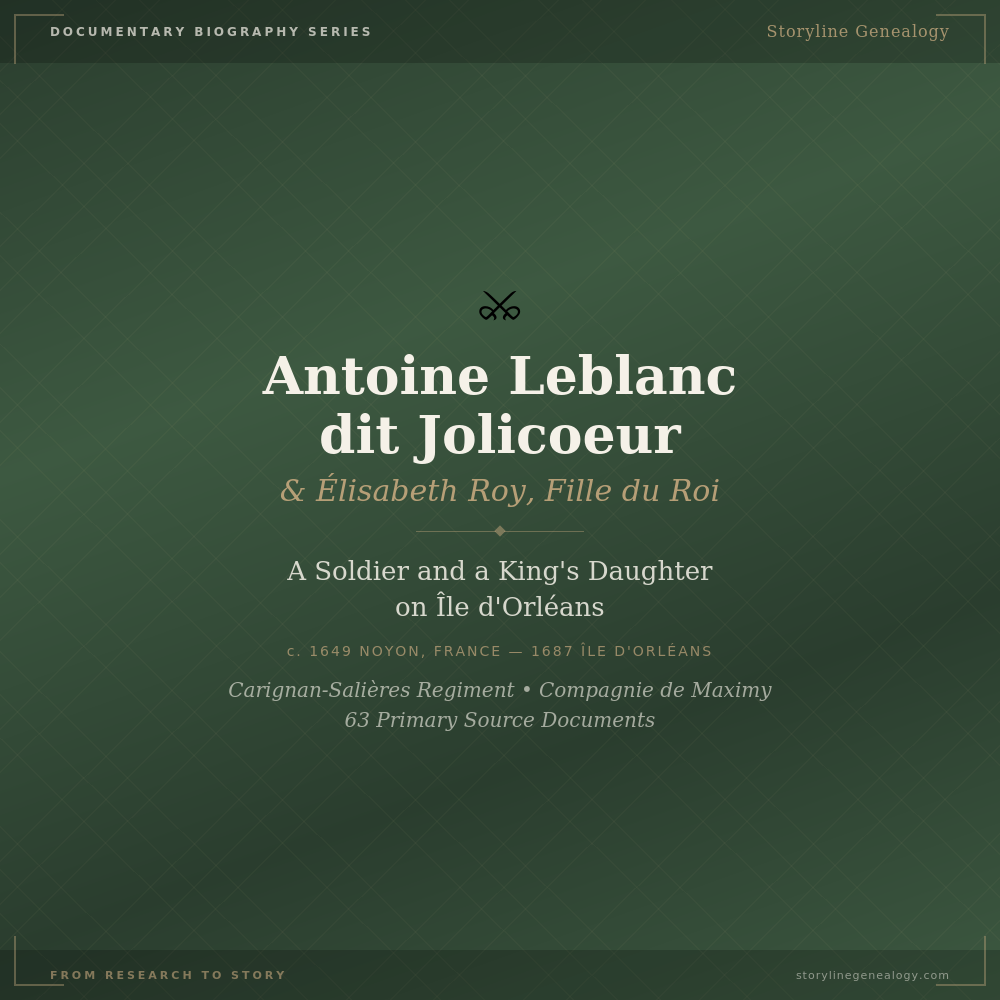
Antoine Leblanc dit Jolicoeur & Elisabeth Roy
In December 1687, a thirty-eight-year-old soldier called "Cheerful Heart" was buried at Saint-Jean, Île d'Orléans. Antoine Leblanc dit Jolicoeur had crossed the Atlantic as a teenager in the Carignan-Salières Regiment, married a Fille du Roi from Senlis, raised five children, and buried two of them in a single grave. Through parish registers, notarial acts, census records, and military rosters, this documentary biography reconstructs eighteen years of life on an island in the St. Lawrence — from 63 primary source documents with Evidence Explained citations.
Part of the Storyline Genealogy series: Carignan-Salières — From Soldiers to Settlers
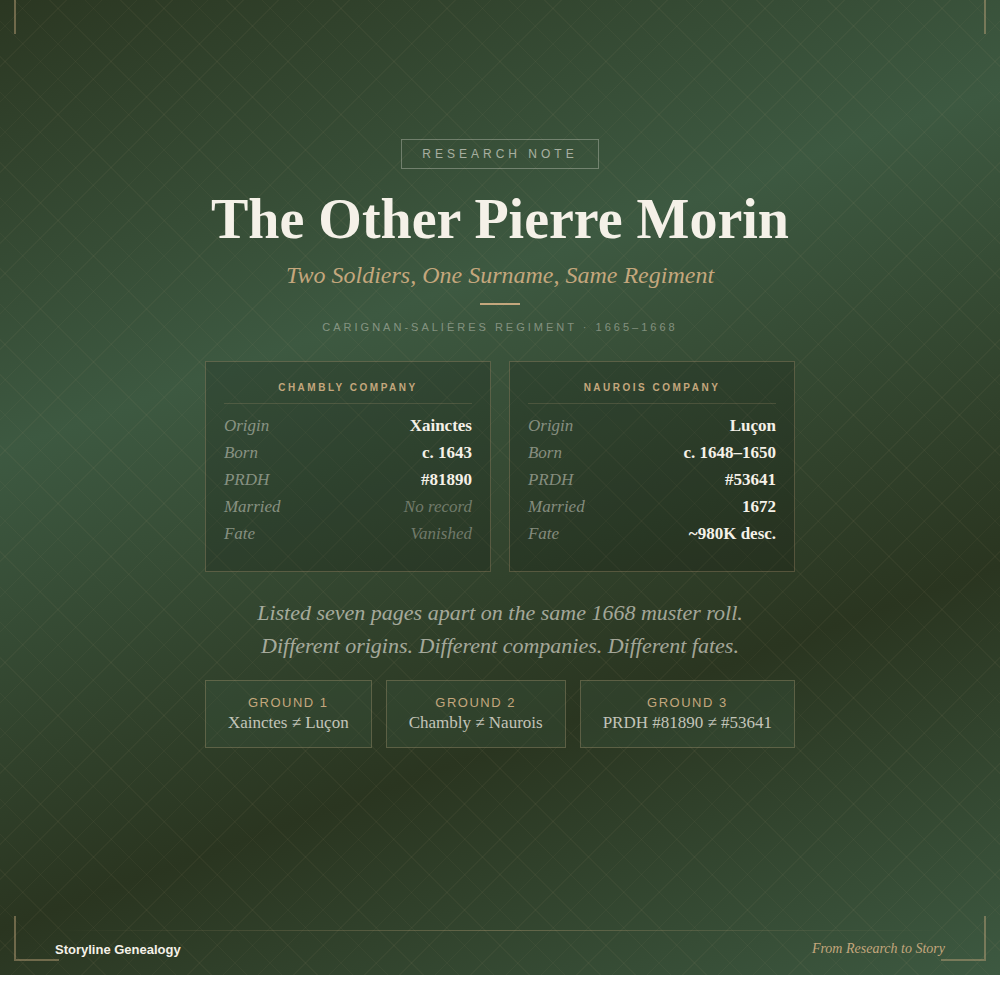
The Other Pierre Morin: Disambiguation
Two men named Pierre Morin served in the Carignan-Salières Regiment. The 1668 muster roll lists them in different companies, seven pages apart. One became a founding ancestor. The other disappeared from history. This research note documents the primary-source evidence that separates them.
Part of the Storyline Genealogy series: From Research to Story
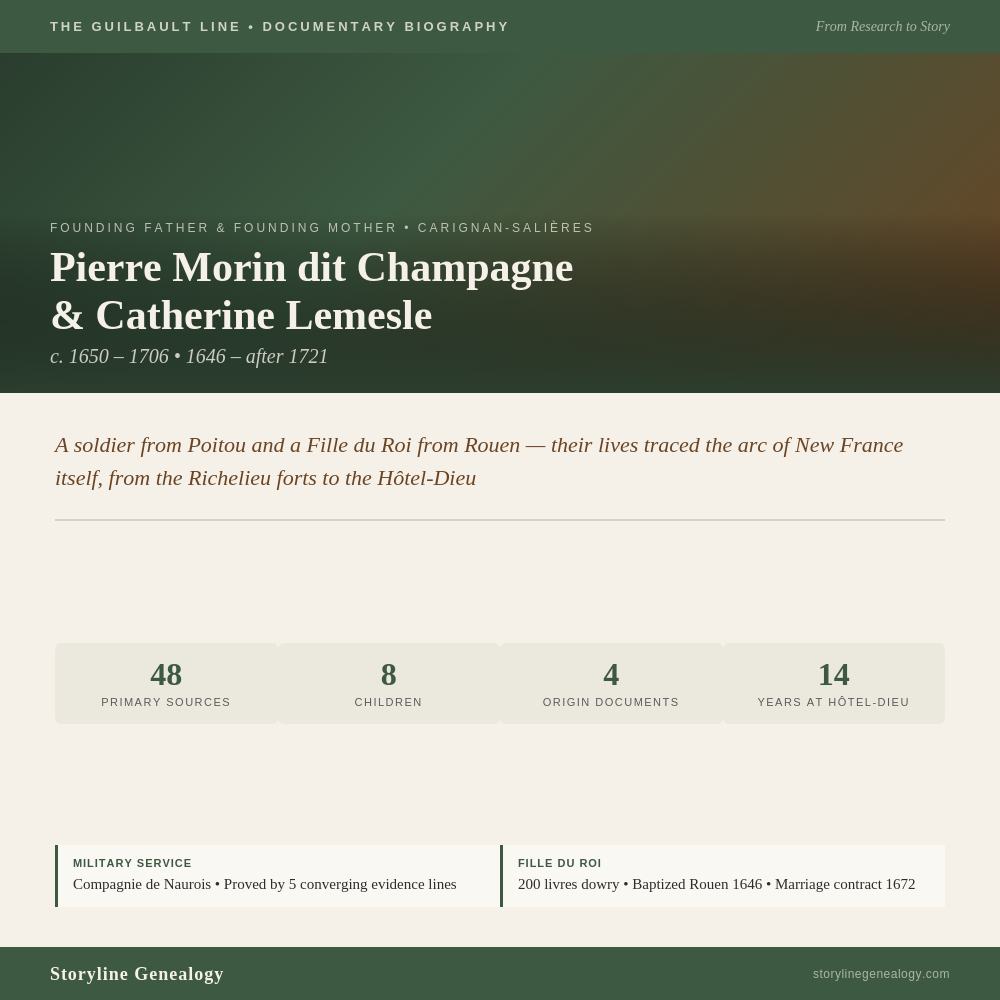
Pierre Morin dit Champagne & Catherine Lemesle
On the eighteenth of November, 1706, a fifty-six-year-old man was carried through the doors of the Hôtel-Dieu de Québec. The Augustinian sisters noted his name, his age, and his origin: "Morin, Pierre (56 ans), paroisse Saint-Étienne, Poitou." Thirteen days later, they admitted his wife: "Lemesle, Catherine (50 ans), femme de Pierre Morin." This documentary biography traces Pierre and Catherine's lives through 48 primary sources — from a village in the marshlands of Poitou to the Carignan-Salières forts on the Richelieu, from a Fille du Roi's arrival in Québec to their final days together at the Hôtel-Dieu. Their story is told in the fragments the colony left behind: a marriage contract, a census entry, a baptism, a burial, a hospital admission.
Part of the Storyline Genealogy series: From Research to Story
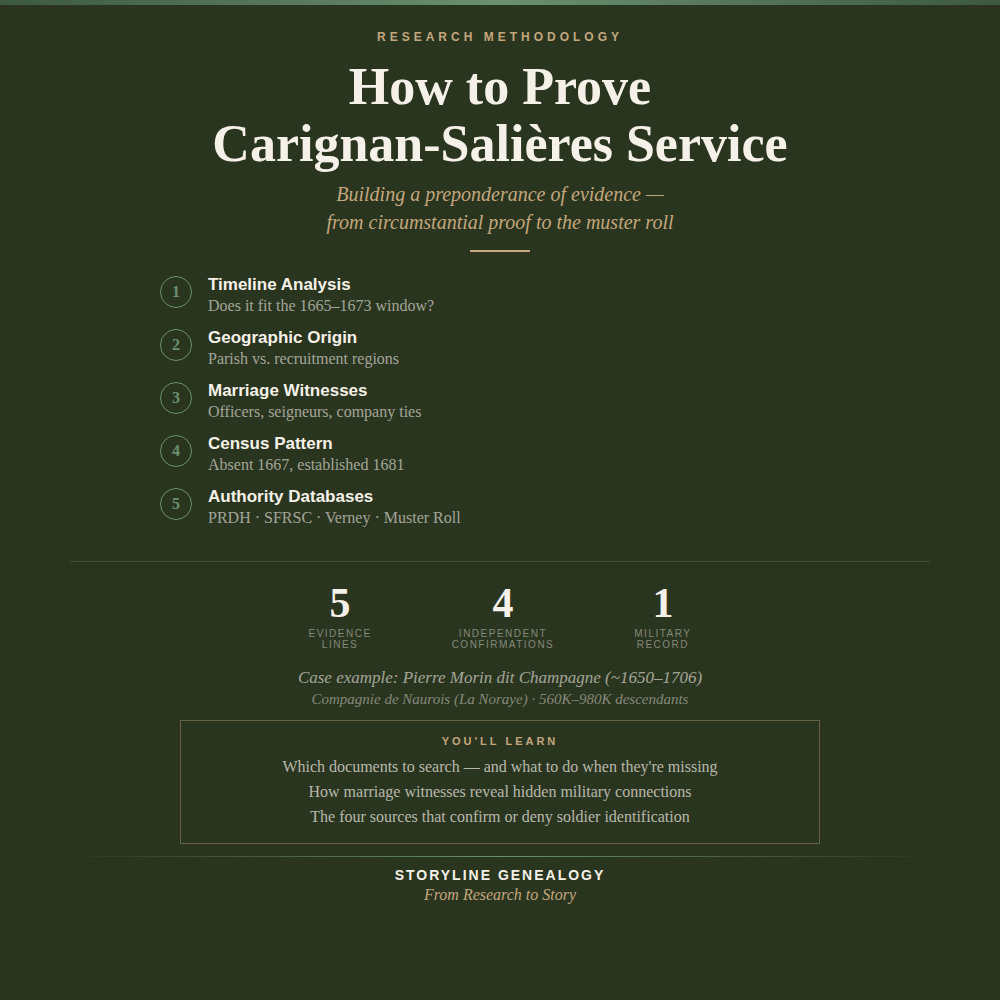
How to Prove Carignan-Salières Service With or Without a Muster Roll
None of Pierre Morin's personal documents call him a soldier. Five converging lines of evidence built the case for Carignan-Salières service — and then the 1668 muster roll confirmed what the evidence already proved. This step-by-step methodology shows how to identify a Carignan-Salières ancestor using timeline analysis, geographic origin, marriage contract witnesses, census patterns, and four independent authority sources.
Part of the Storyline Genealogy series: Carignan-Salières — From Soldiers to Settlers
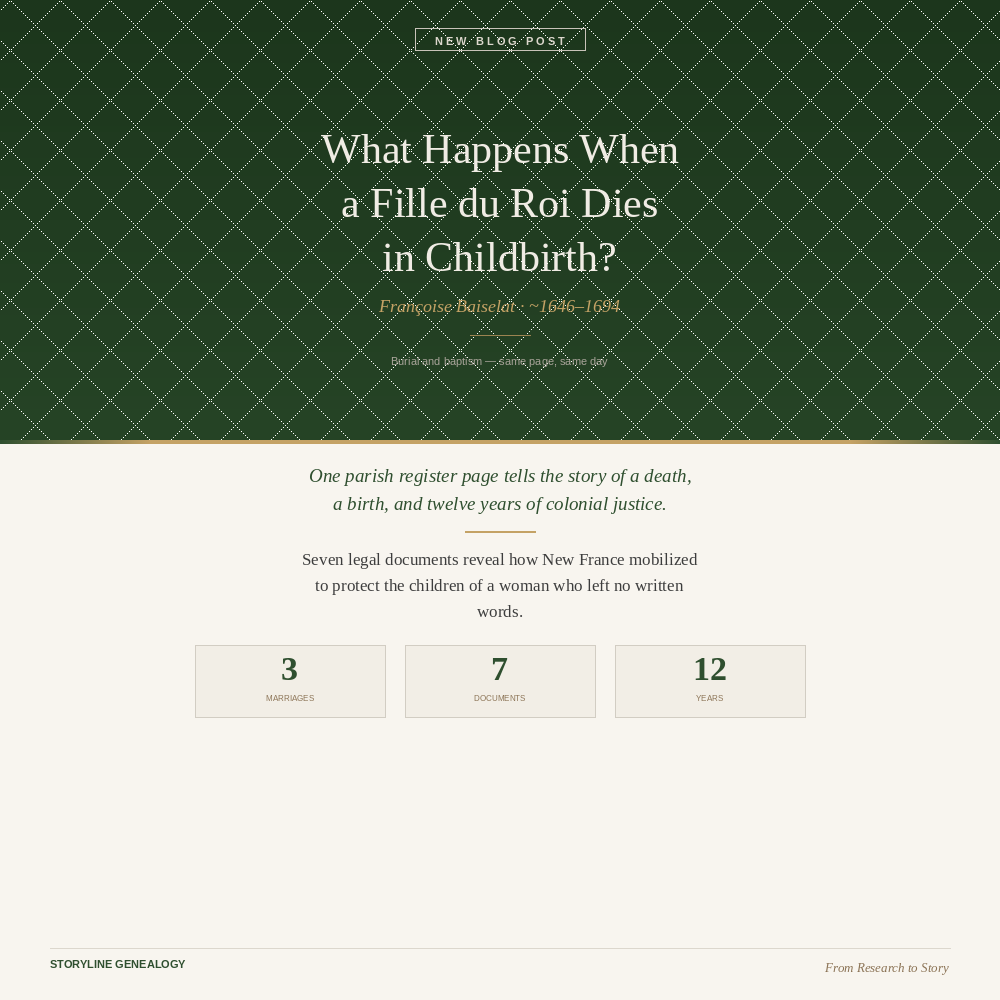
What Happens When A Fille du Roi Dies in Childbirth?
On May 30, 1694, a curé recorded a burial and a baptism on the same page of a parish register. What followed was twelve years of colonial justice — seven legal documents that reveal how New France protected the children of a woman who left no written words.
Part of the Storyline Genealogy series: From Research to Story

André Corbeil dit Tranchemontagne
In 1684, a young soldier from Saintonge stepped off a ship at Québec carrying a name that would outlive him by centuries. "Tranchemontagne" — the Mountain-Slasher — was not a family name. It was a declaration. Here is the story of André Corbeil and the military nickname culture that transformed European recruits into something entirely new.
Part of the Storyline Genealogy series: Uncovering the stories behind the names that built New France.
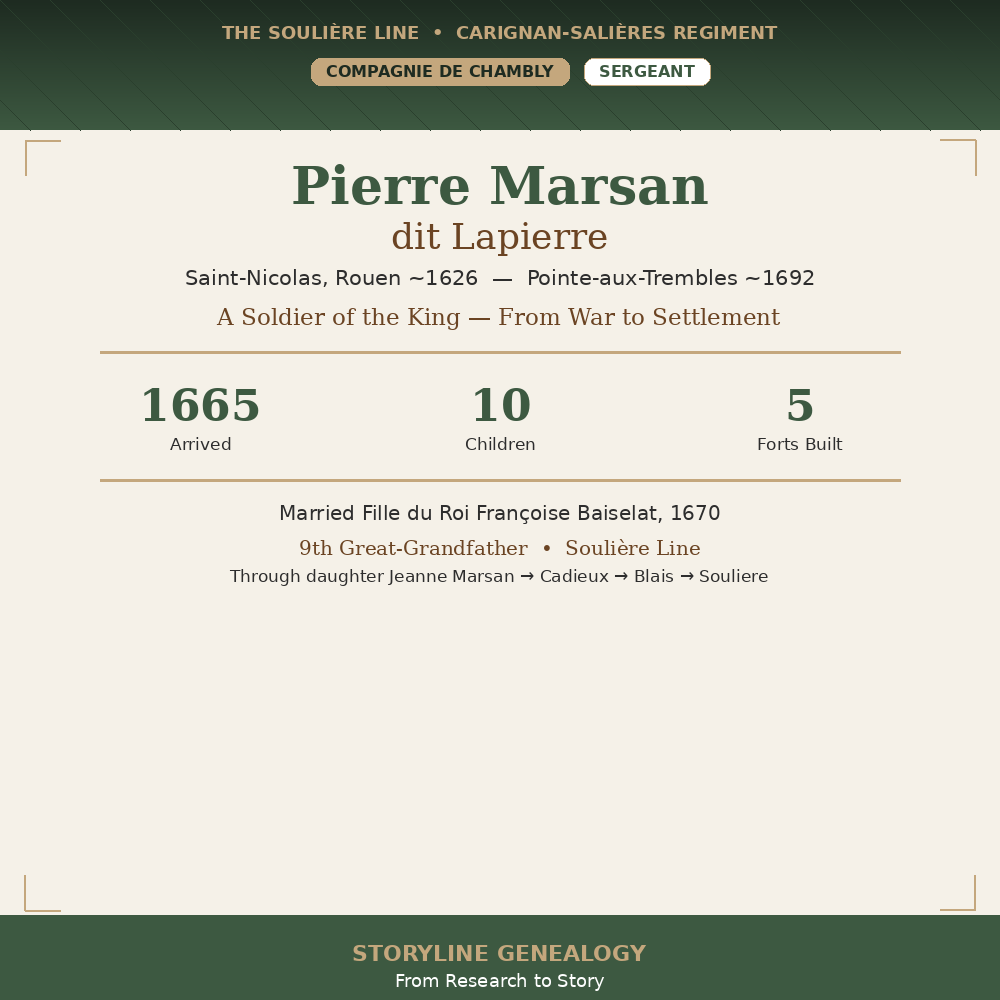
Pierre Marsan dit Lapierre: Carignan-Salières Regiment
Long before he became a husband, father, and ancestor rooted in Canadian soil, Pierre Marsan dit Lapierre was a soldier shaped by discipline and uncertainty. When he embarked from La Rochelle in April 1665 aboard the Vieux Siméon, he joined hundreds of men bound for a distant colony few in France could imagine. As a sergeant in the Company of Captain Jacques de Chambly, Pierre arrived not as a settler seeking fortune, but as part of a royal strategy: the deployment of professional troops to stabilize New France and secure it against the Iroquois nations whose raids had long threatened its survival. His rank set him apart—older, experienced, and entrusted with the daily weight of command. Part of the Storyline Genealogy series: Documentary Biographies From Research to Story
Part of the Storyline Genealogy series: Carignan-Salières — From Soldiers to Settlers
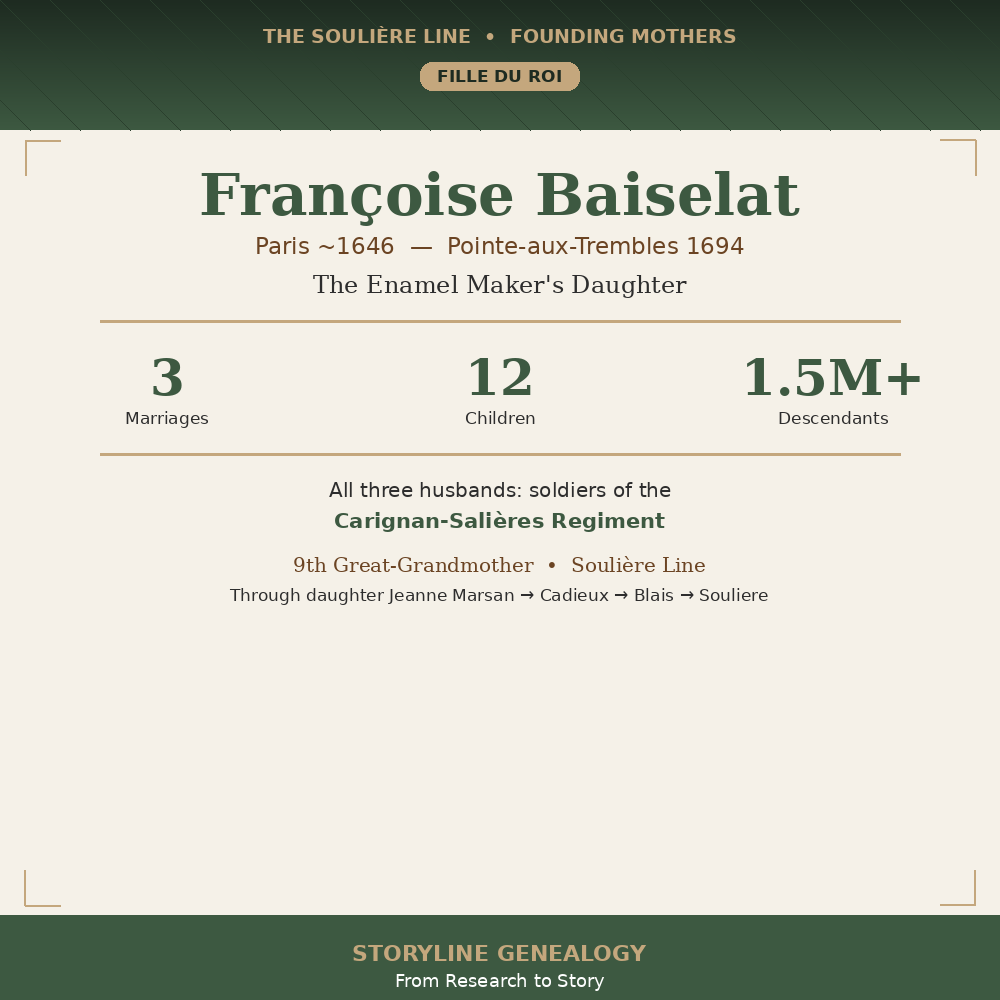
Françoise Baiselat: Wife of a Carignan-Salières
Françoise Baiselat was born about 1646 in the Rue Saint-Sauveur, Paris—the daughter of Benjamin Baiselat, a master enamel maker, and Claude Prou. In 1668, she left everything she knew and crossed the Atlantic as a Fille du Roi, carrying goods worth 300 livres for her dowry. What followed was a life shaped by the rhythms of the colony—three marriages, all to soldiers of the Carignan-Salières Regiment, twelve children across two families, and a quarter century at Pointe-aux-Trembles on Montreal Island. Today, between 1.1 and 1.5 million Quebecers descend through her Marsan line alone.
Part of the Storyline Genealogy series: Filles du Roi & Filles à Marier — The Women Who Built New France
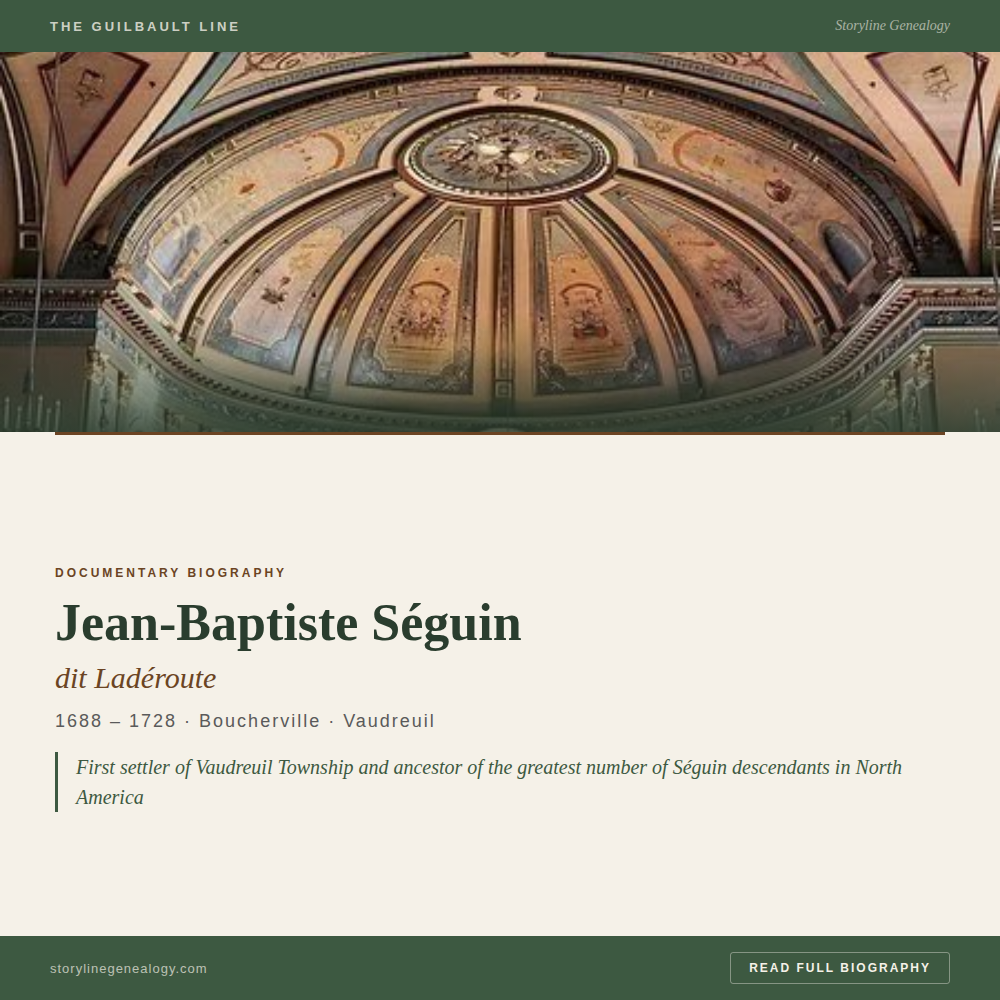
Jean-Baptiste Séguin dit Ladéroute: First Settler of Vaudreuil
Born in the same Boucherville church where his father married a King's Daughter, Jean-Baptiste Séguin dit Ladéroute (1688–1728) became the first settler of Vaudreuil Township and left the greatest number of Séguin descendants in North America. This documentary biography traces his life through 53+ primary source documents — from the salt protest that tore his family apart to the mission church at Oka where his children built new lives.
Part of the Storyline Genealogy series: Documentary Biographies — From Research to Story
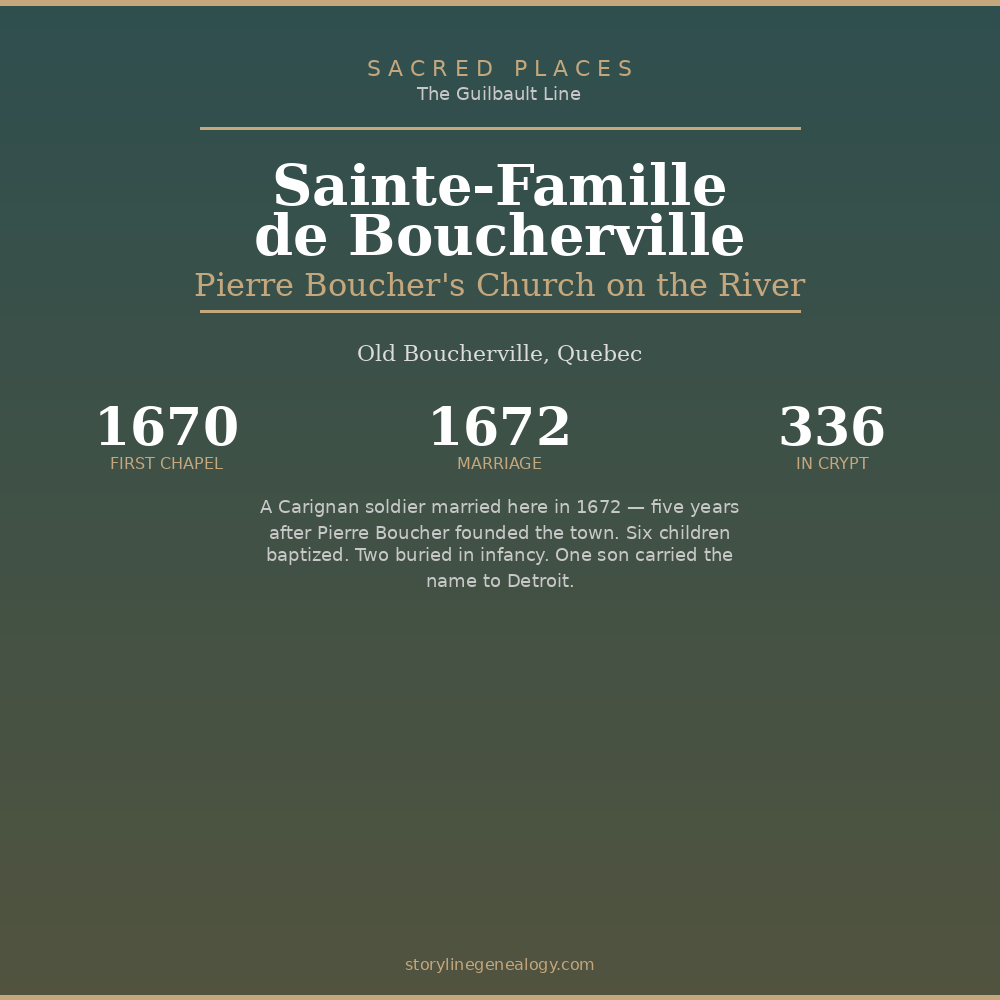
Sainte-Famille de Boucherville: Pierre Boucher's Church on the River
Sainte-Famille de Boucherville stands on land donated by Pierre Boucher himself — one of the most remarkable figures in early New France. On October 31, 1672, Carignan-Salières Regiment veteran François Séguin dit Ladéroute married Jeanne Petit in the original wooden chapel, just five years after the town was founded. Over the next two decades, the Séguin family filled the parish registers with baptisms and burials. Their son Jean-Baptiste, our direct ancestor, would carry the family name westward to the fur trade at Detroit.
Part of the Storyline Genealogy series : Sacred Places

Église Saint-François-de-Sales
The church of Saint-François-de-Sales in Neuville, Quebec, houses the oldest carved religious decor in North America and the parish registers that anchor the Soulière Line to the very beginnings of New France. In 1686, Marie Barbe Sylvestre — daughter of Carignan-Salières Regiment veteran Nicolas Sylvestre dit Champagne — married Jean Bernardin Lesage dit Lepiedmontois, an Italian soldier from Racconigi, Piedmont. Their story begins here, in the breadbasket of New France.
Part of the Storyline Genealogy series : Sacred Places
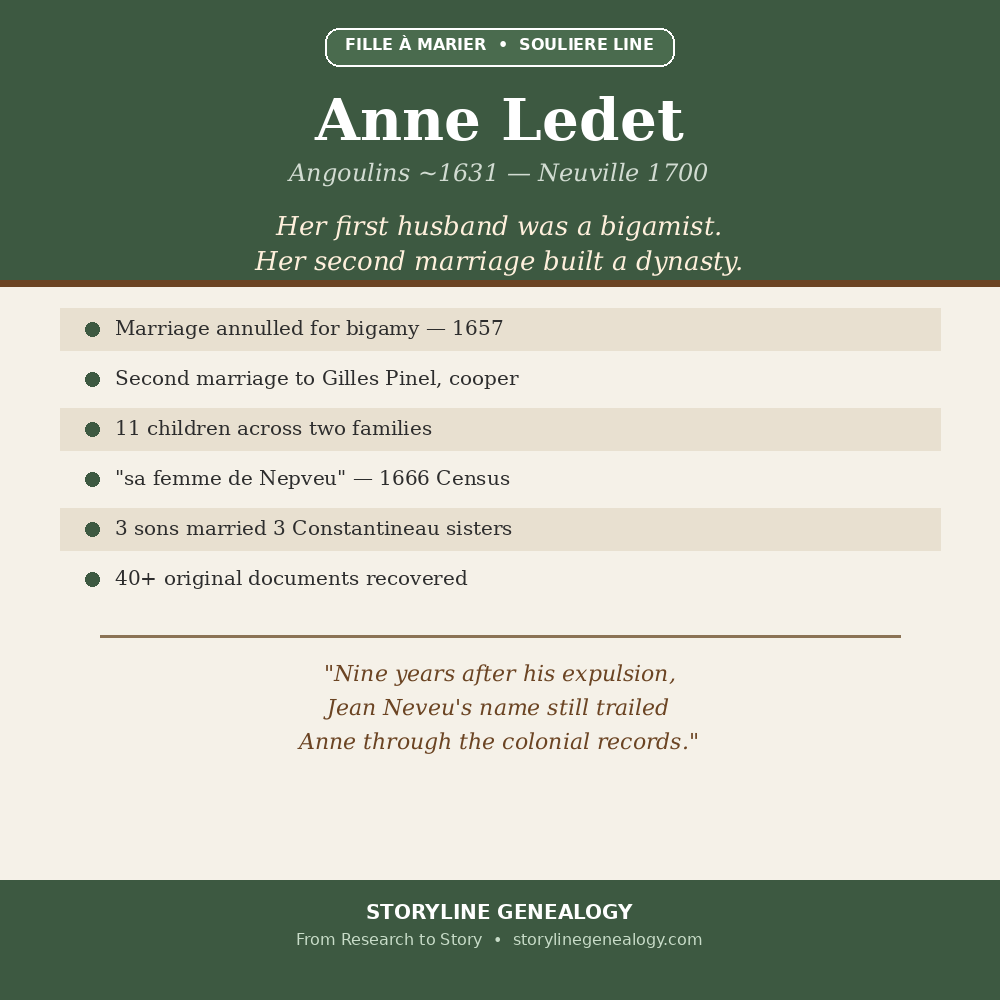
Anne Ledet: A Life Shaped by Scandal and Survival
Anne Ledet's first husband was a bigamist. Her daughters were declared illegitimate. But in 1657 she married Gilles Pinel, raised eleven children, and became a founding matriarch of Neuville, Quebec.
Part of the Storyline Genealogy series: Filles du Roi & Filles à Marier — The Women Who Built New France
Finding an Italian Ancestor in French-Canadian Research
When you're deep in French-Canadian genealogy, the last thing you expect to find is an Italian. But a dit name—Lepiedmontois, "the Piedmontese"—revealed a soldier from Racconigi, Italy, hiding in plain sight among 10,000 French settlers. Out of the founding immigrants of New France, over 95 percent were French. Italian permanent settlers were among the rarest of the rare. This is the story of how one dit name unraveled the assumption of a purely French founding population—and what it means for your research.
Part of the Storyline Genealogy series: French-Canadian Genealogy — From Research to Story
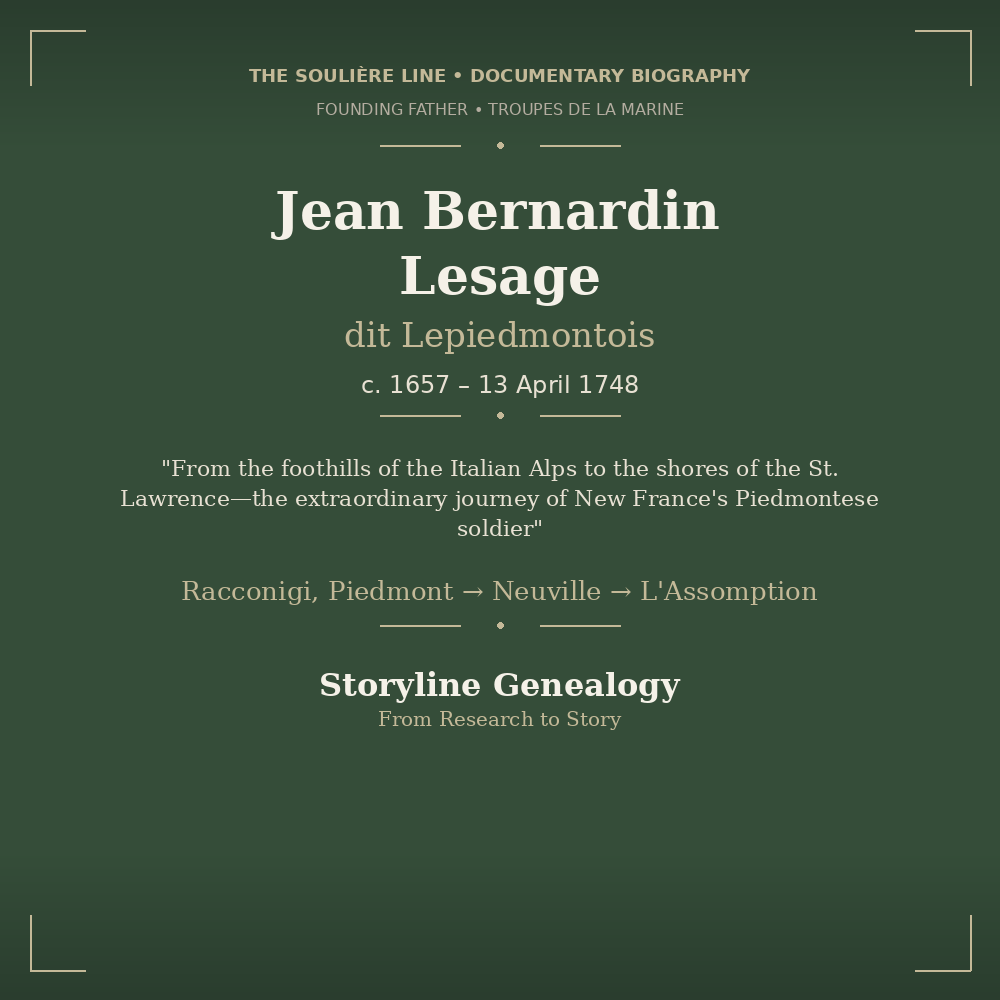
Jean Bernardin Lesage dit Lepiedmontois
Among the approximately 10,000 founding immigrants who settled in New France before 1760, over 95 percent were French. Italian permanent settlers were extraordinarily rare. Jean Bernardin Lesage dit Lepiedmontois was one of a tiny handful of "foreign" pioneers to make a permanent life in the colony—and his dit name, meaning "the Piedmontese," would mark his Italian origins for generations. From Racconigi in the shadow of the Alps to the shores of the St. Lawrence, this is the story of New France's Piedmontese soldier.
Part of the Storyline Genealogy series: From Soldier of the Troupes de la Marine to Settler
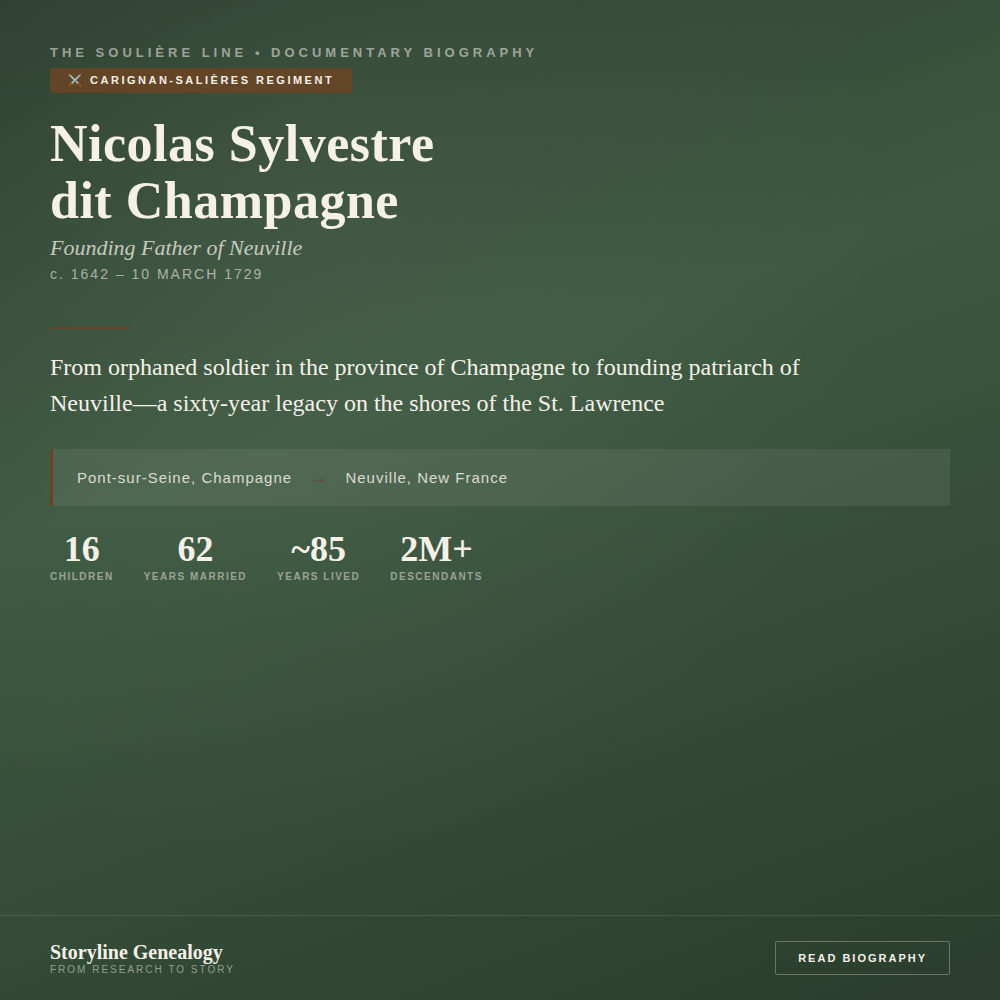
Nicolas Sylvestre dit Champagne: Carignan-Salières Regiment
Nicolas Sylvestre dit Champagne was born around 1642 in Pont-sur-Seine, France, orphaned by age ten, and enlisted in the Carignan-Salières Regiment's Company of Grandfontaine. He arrived at Quebec aboard L'Aigle d'Or in 1665, fought in the Mohawk campaigns, then married Barbe Neveu and settled at Neuville. Over thirty years they raised sixteen children. Married sixty-two years, they were buried just thirty-nine days apart at Neuville in 1729. Today, up to 2.24 million Québécois descend from them.
Part of the Storyline Genealogy series: Carignan-Salières — From Soldiers to Settlers

St. Gabriel’s Church : Parish of New Lots
In the working-class streets of East New York, St. Gabriel's Church served as the spiritual anchor for the O'Brien family of Brooklyn. From James H. O'Brien's 1902 wedding to his brother's 1930 requiem Mass, three generations of sacraments were celebrated within these walls at 749 Linwood Street—a parish that still stands today, celebrating its centennial in 2024-2025.
Part of the Storyline Genealogy series: Sacred Places
St. Aloysius Church: Mother Church of West Essex
For over a century, St. Aloysius Church has stood at the corner of Bloomfield Avenue in Caldwell, New Jersey—the only Catholic church in America located next door to a presidential birthplace. Within these French Gothic walls, four generations of the O'Brien and Robertson families celebrated life's sacred moments: from Mary Agnes Robertson's requiem Mass in 1924 to the weddings of all three O'Brien daughters in the 1950s, to the golden jubilee Mass where Miles and Lillian renewed their vows surrounded by 17 grandchildren and a great-granddaughter.
Part of the Storyline Genealogy series: Sacred Places
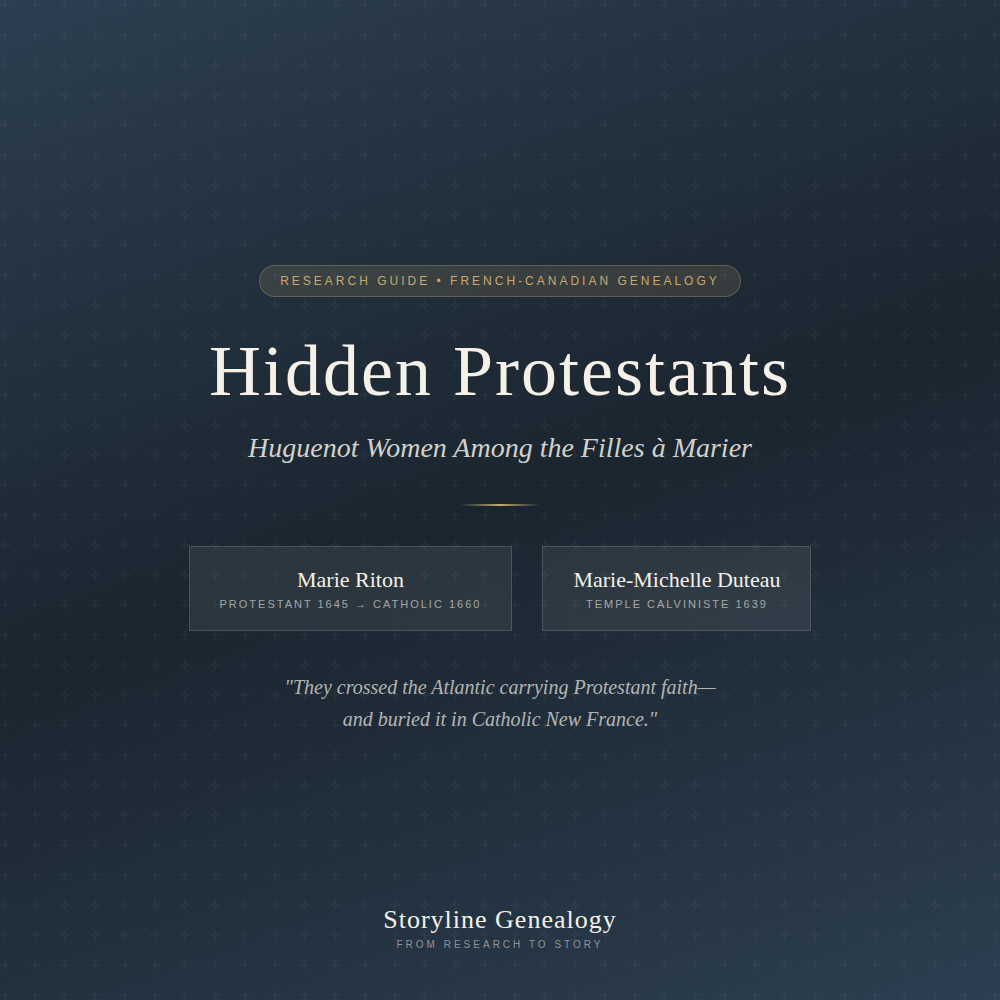
Hidden Protestants: Huguenot Women Among the Filles à Marier
Among the first women who settled Quebec were hidden Protestants—Huguenots forced to convert to Catholicism to survive. Learn how to trace their buried heritage through temple registers and abjuration records.
Part of the Storyline Genealogy series: Filles du Roi & Filles à Marier — The Women Who Built New France
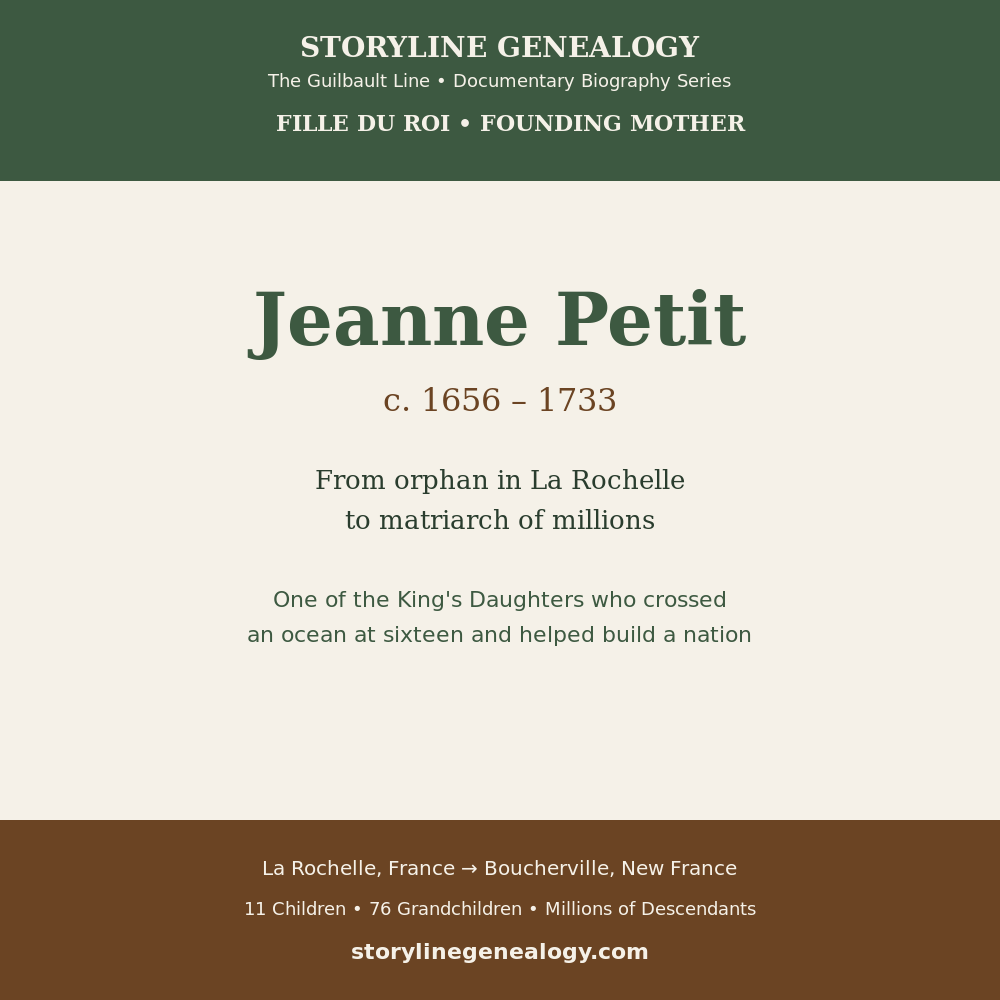
Jeanne Petit: From Orphan in La Rochelle to Matriarch of Millions
Jeanne Petit was a young woman protected by the king, part of the contingent of 125 Filles du Roi who came to New France in 1671. At just 16 years old, already orphaned, she crossed the Atlantic to build a new life. She married François Séguin dit Ladéroute, a soldier turned weaver, and together they raised 8 children to adulthood at Boucherville. Today, her descendants number nearly 2 million people—a legacy built from nothing but hope and determination.
Part of the Storyline Genealogy series: Filles du Roi & Filles à Marier — The Women Who Built New France
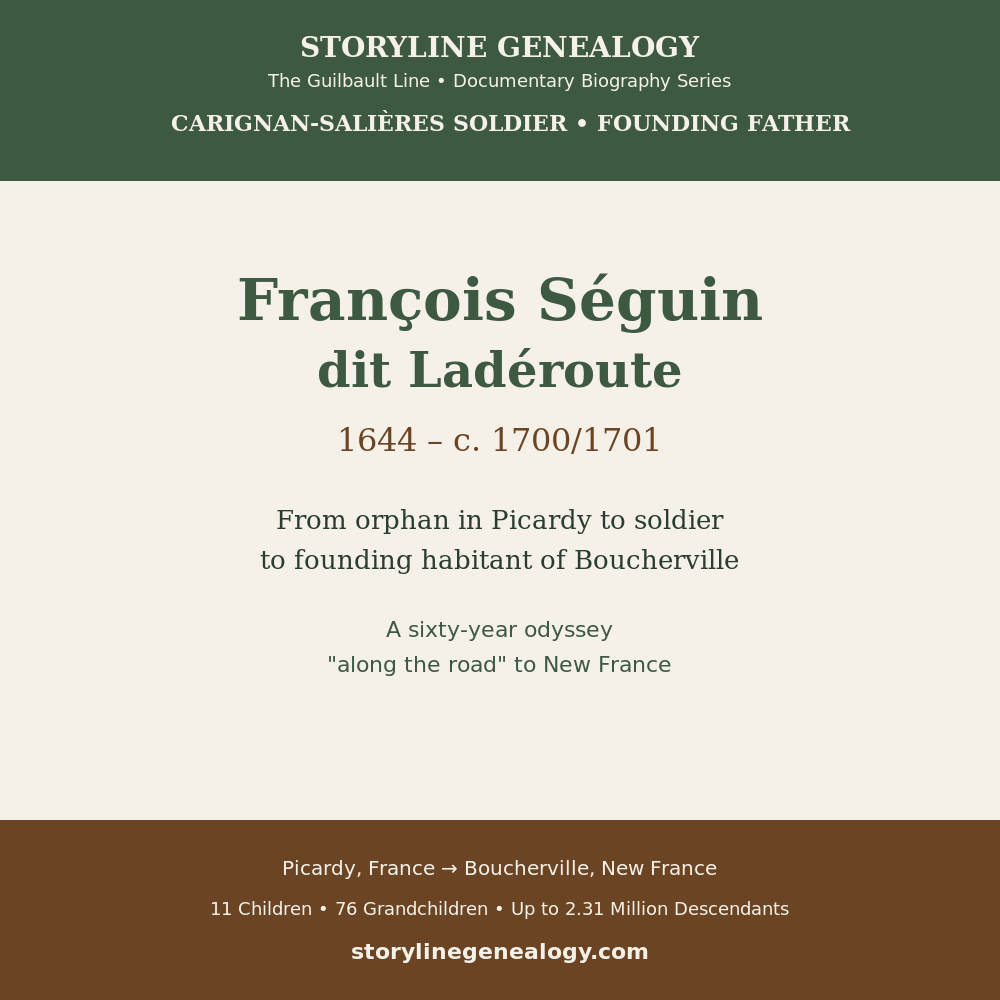
François Séguin dit Ladéroute: Carignan Soldier, Weaver, and Settler of Boucherville
François Séguin dit Ladéroute came from the region of Bray, west of Beauvais, in the former province of Picardy. Orphaned at age six when his mother Marie Massieu died, he enlisted in the Carignan-Salières Regiment and arrived in New France aboard the Saint-Sébastien on September 12, 1665. After marrying Fille du Roi Jeanne Petit in 1672, he settled at Boucherville as a weaver, raising 11 children. Today, his descendants number between 1.89 and 2.31 million people.
Part of the Storyline Genealogy series: Carignan-Salières — From Soldiers to Settlers