
The Storyline
Real families. Real discoveries. Real stories.
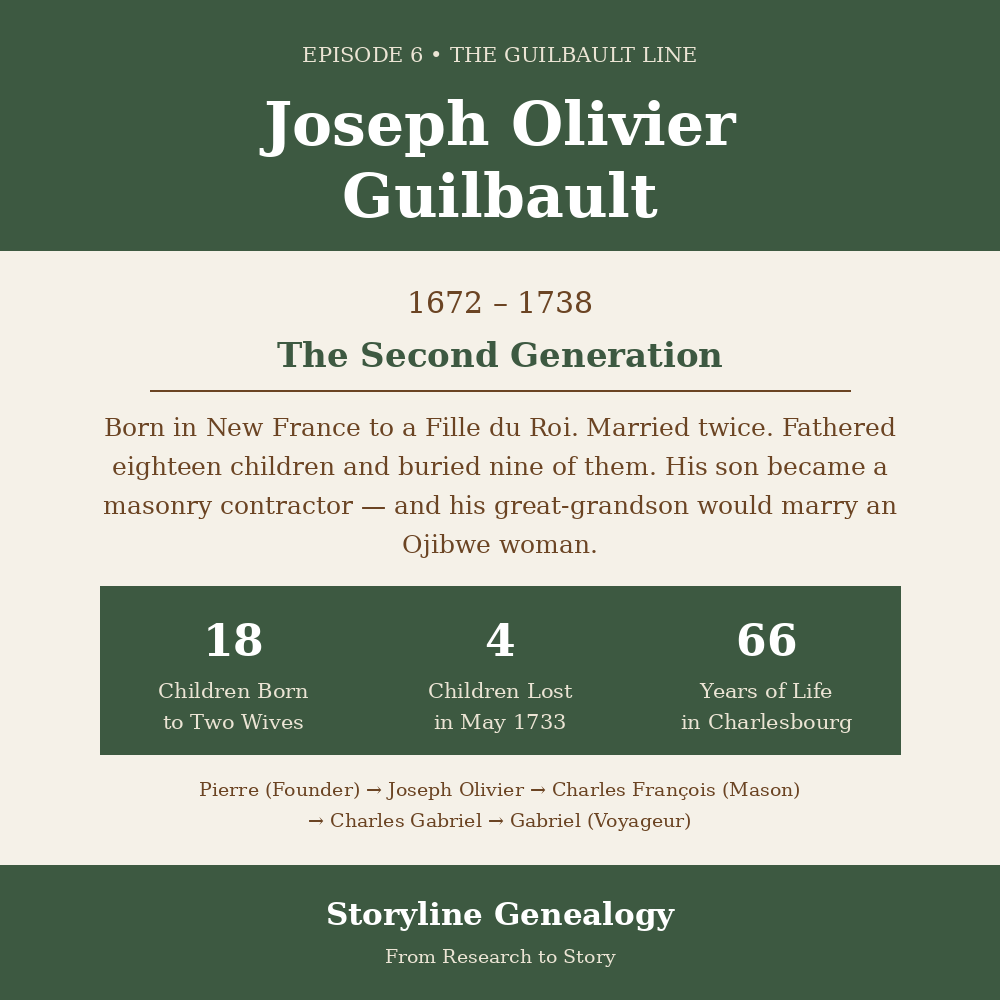
Joseph Olivier Guilbault 1672 - 1738
His father crossed an ocean; Joseph Olivier Guilbault spent sixty-six years in one parish. He took his father to court, married twice, fathered eighteen children and buried nine of them — and in November 1706 had a notary inventory his house room by room, down to his late wife's cloak, still in the walnut chest. Episode 6 of The Guilbault Line.
Part of the Storyline Genealogy series: Documentary Biographies From Research to Story
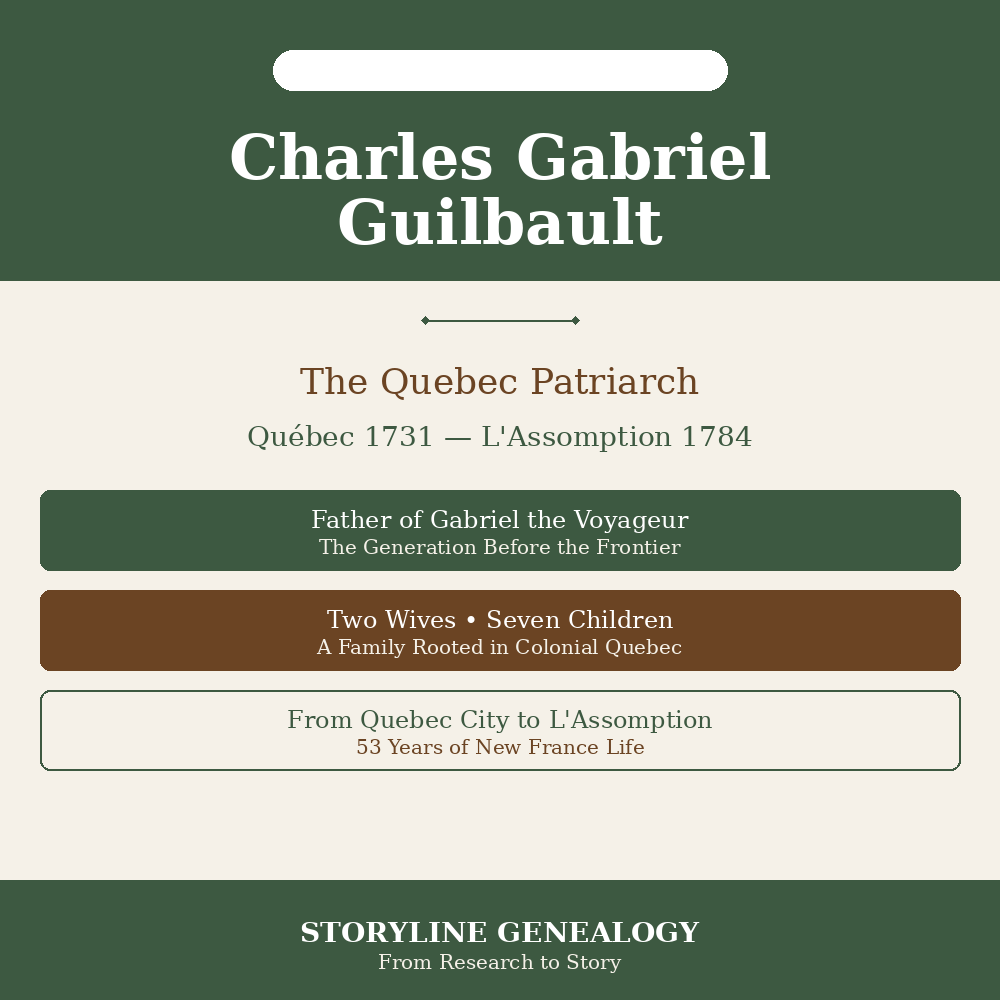
Charles Gabriel Guilbault: 1731 -1784
Before Gabriel Guilbault paddled canoes into the pays d'en haut and married an Ojibwe woman, there was his father—another Gabriel, born Charles Gabriel Guilbault in Quebec City in 1731. This Quebec patriarch married twice, raised four sons to adulthood, and established the family in L'Assomption that would eventually bridge French and Indigenous worlds. His 53-year life span encompassed the British Conquest and the transformation of New France, setting the stage for his son's frontier adventures.
Part of the Storyline Genealogy series: Documentary Biographies From Research to Story
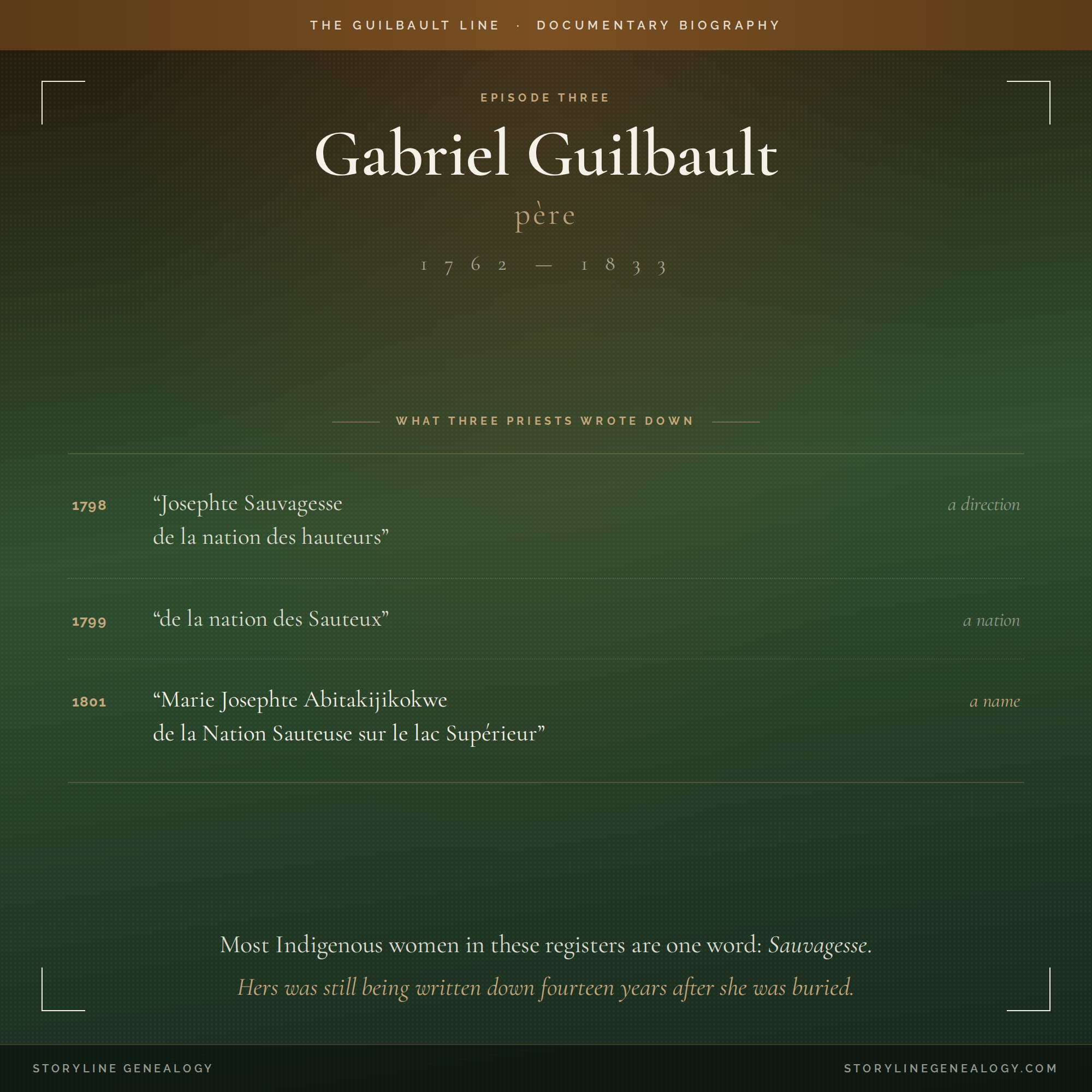
Gabriel Guilbault père 1762 - 1833
Gabriel Guilbault was born at L'Assomption in 1762, in the last year of New France, and lived to see the world that made him disappear. He went to the pays d'en haut as a voyageur; three of his children were born there and did not see a parish church until 1798. The Ojibwe woman he married is named in the registers of three parishes across nearly thirty years — the last of them written fourteen years after she was buried. His own record runs voyageur, farmer, mason for twenty-five years, and day labourer at the end.
Part of the Storyline Genealogy series: Documentary Biographies From Research to Story
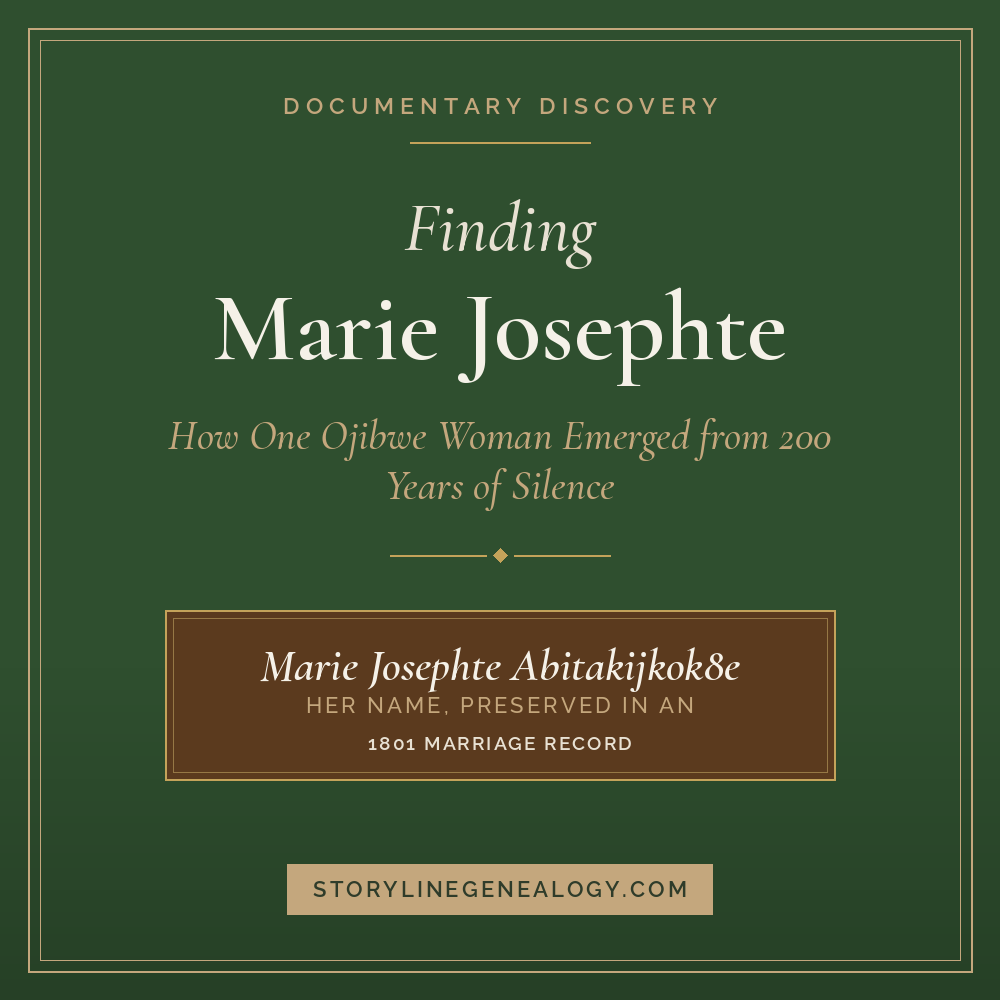
Finding Marie Josephte Abitakijikokwe
For generations she existed in our family tree as one word: Sauvagesse. No name, no nation, no story — just the wife of a French-Canadian voyageur, another Indigenous woman assumed lost to colonial record-keeping.
She wasn't lost. Priests had written her name down four separate times, in registers that survive. What had gone missing was the habit of looking.
This is how Marie Josephte Abitakijikokwe was found — through eleven original parish registers, a full-text search that read handwriting instead of indexes, and one overlooked entry sitting directly above the marriage record everyone had already seen. That entry gave her a nation and a homeland: Saulteaux of Lake Superior, seven hundred miles west of the parish where she was buried.
Part of the Storyline Genealogy series: At the Lake of Two Mountains
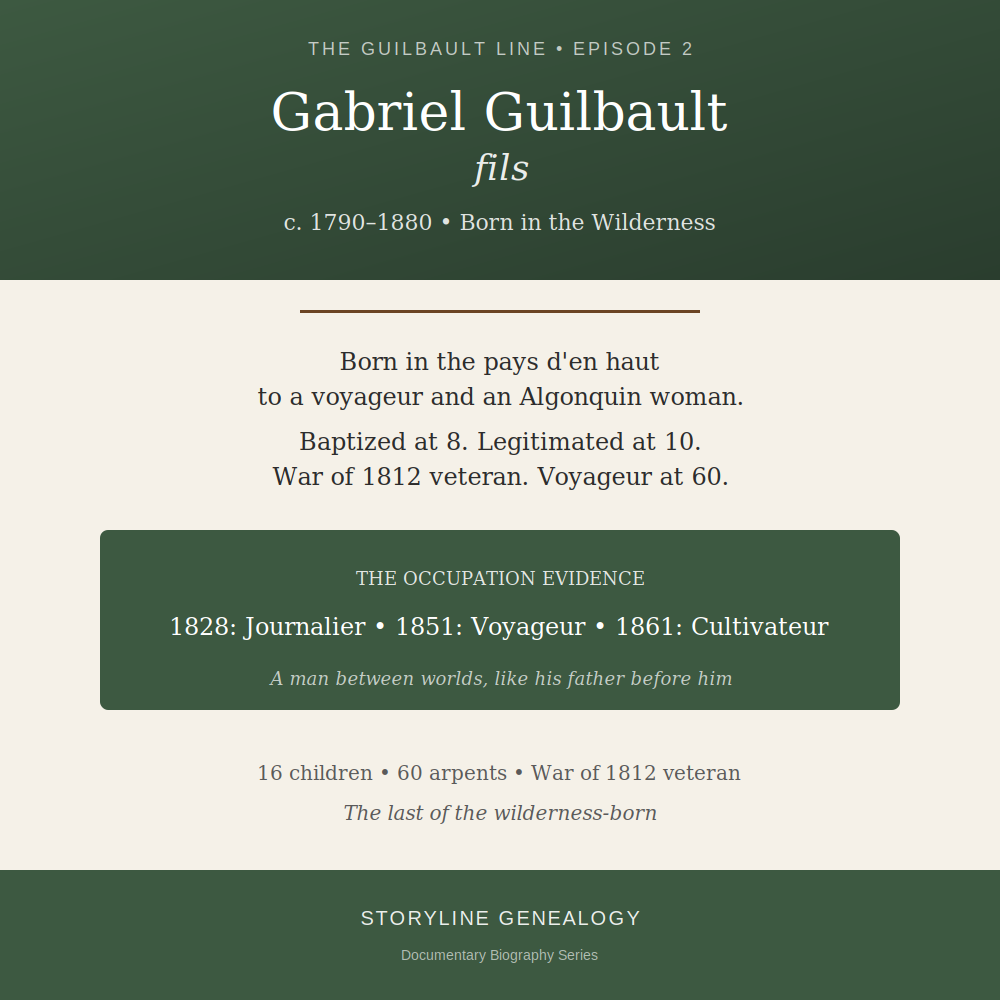
Gabriel Guilbault fils 1790 - 1880
Gabriel Guilbault fils was born around 1790 in the pays d'en haut—the vast interior wilderness of the fur trade—to a French-Canadian voyageur and an Algonquin woman named Marie Josephte Abitakijikokwe. Conditionally baptized at age eight when his family returned to the St. Lawrence Valley, legitimated at ten when his parents formally married, Gabriel lived a life between worlds. The records show his occupation shifting from journalier to voyageur to cultivateur—still claiming the paddle at sixty years old. Father of sixteen children, owner of sixty arpents, he died in 1880 as the last of the wilderness-born.
Part of the Storyline Genealogy Documentary Biography series: Following one family line through the documents that prove it—birth to death, generation to generation.
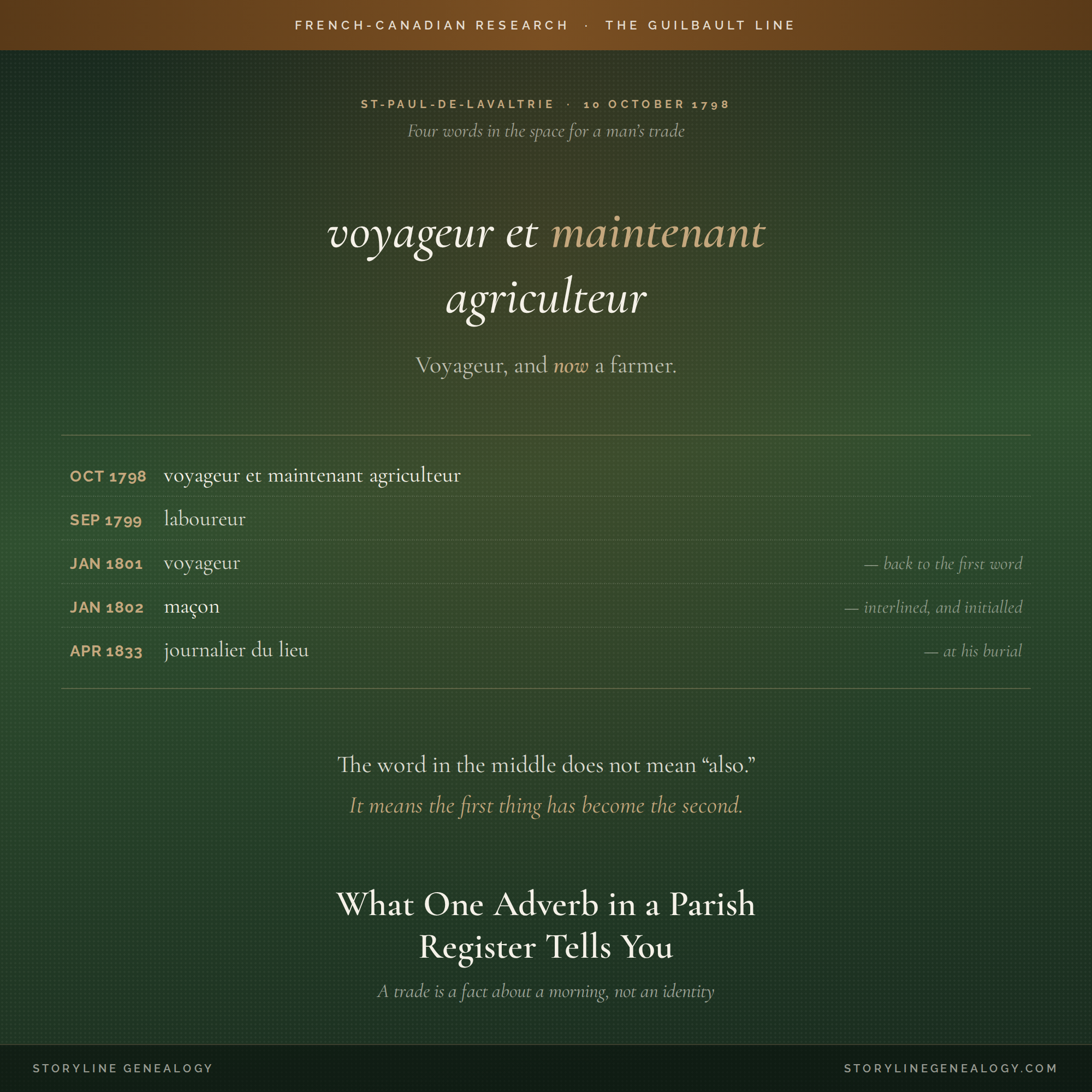
“Voyageur et Maintenant Agriculteur”
On 10 October 1798 a priest at St-Paul-de-Lavaltrie baptized three children of one family on the same day. The eldest was eight, born in the pays d'en haut, and had never been inside a parish church. In the space where a priest recorded a man's trade, this one wrote four words: voyageur et maintenant agriculteur. Voyageur, and now a farmer. The word in the middle does not mean "also" — it means the first thing has become the second. The priest wasn't describing a way of life. He was dating a change of one.
Part of the Storyline Genealogy French-Canadian Research series: Understanding the records, the context, and the lives they document.
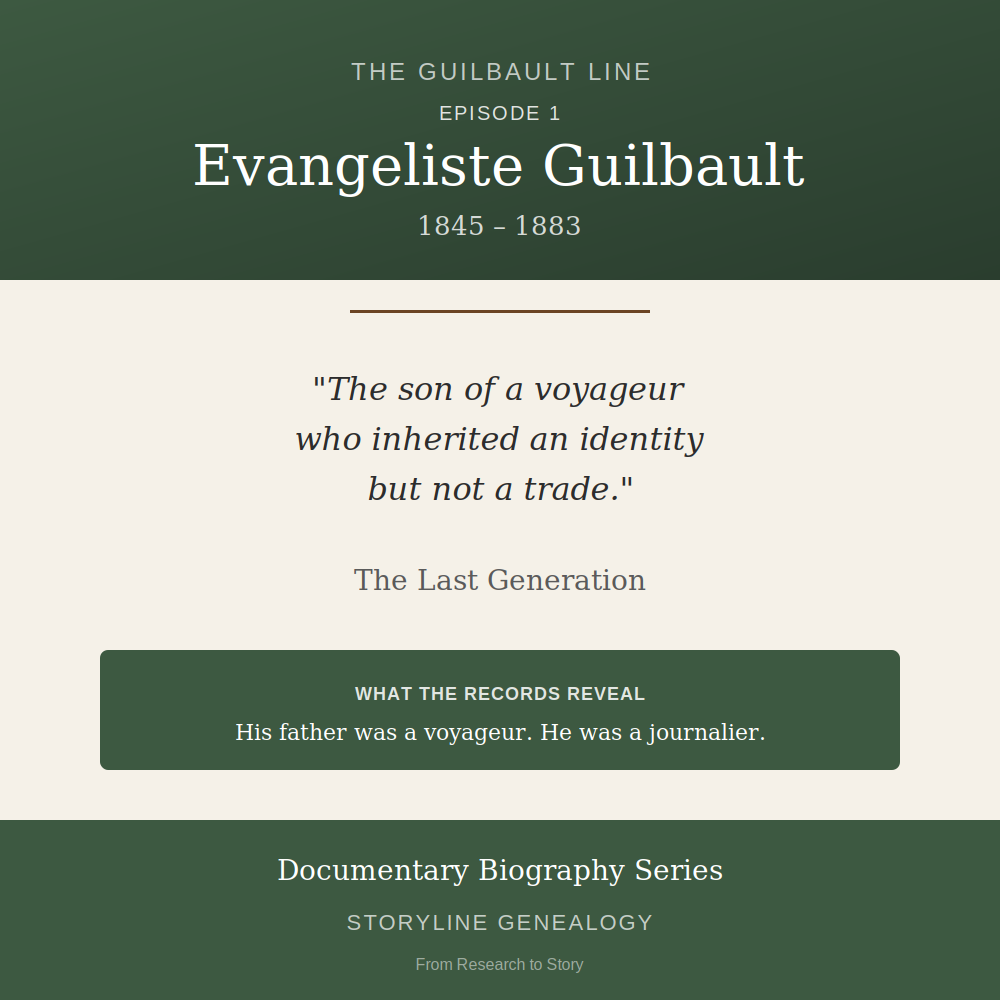
Evangeliste Guilbault 1845 – 1883
His father was a voyageur. He was a journalier. The primary sources tell a story that family narratives overlooked—of a man caught between eras, who died at 38 leaving three children under four and a widow who would live to ninety-one. This is not the story of a voyageur. This is the story of the last generation.
Part of the Storyline Genealogy series: Documentary Biographies From Research to Story
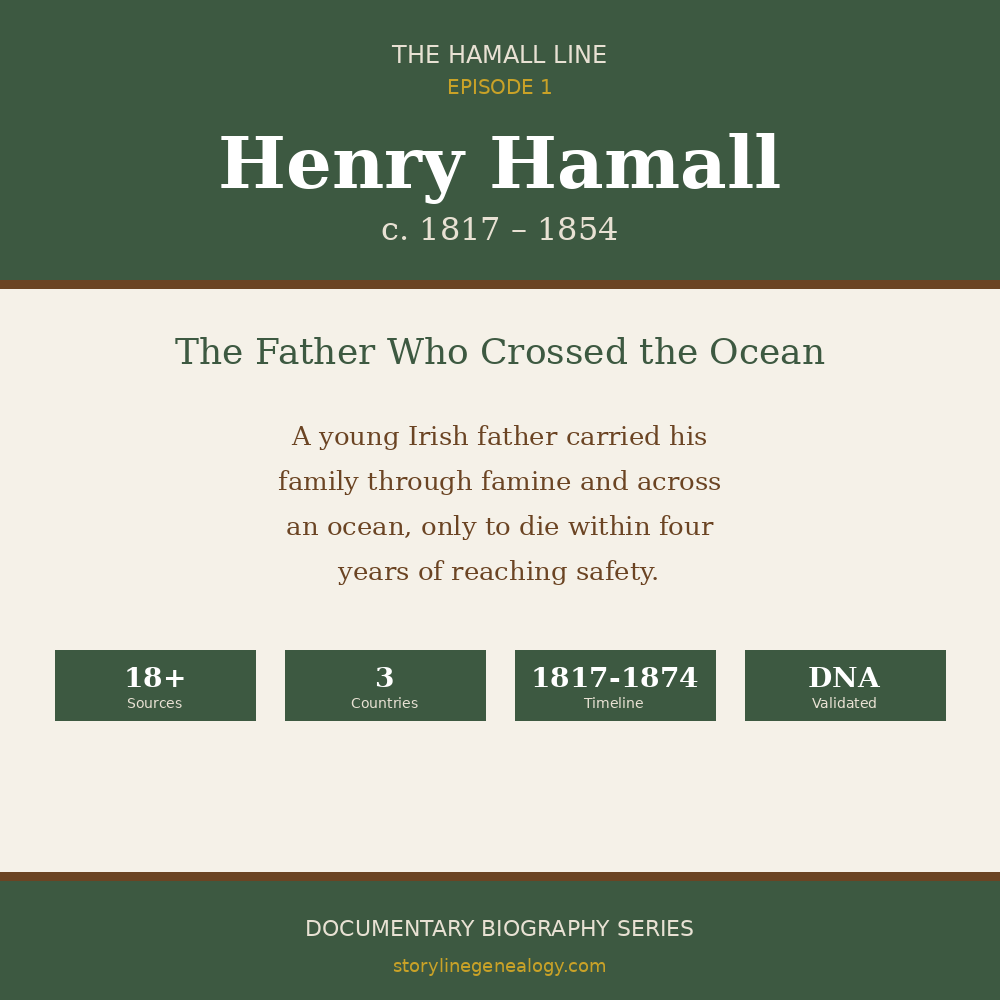
The Hamall Line: Henry Hamall
Born around 1817 in County Monaghan, Ireland, Henry Hamall carried his family through famine and across an ocean, only to die within four years of reaching safety. This documentary biography traces his 1841 marriage to Mary McMahon, their emigration during the Great Famine, and the blended family that would eventually solve a seven-year genealogical mystery.
Part of the Storyline Genealogy series: Documentary Biographies From Research to Story
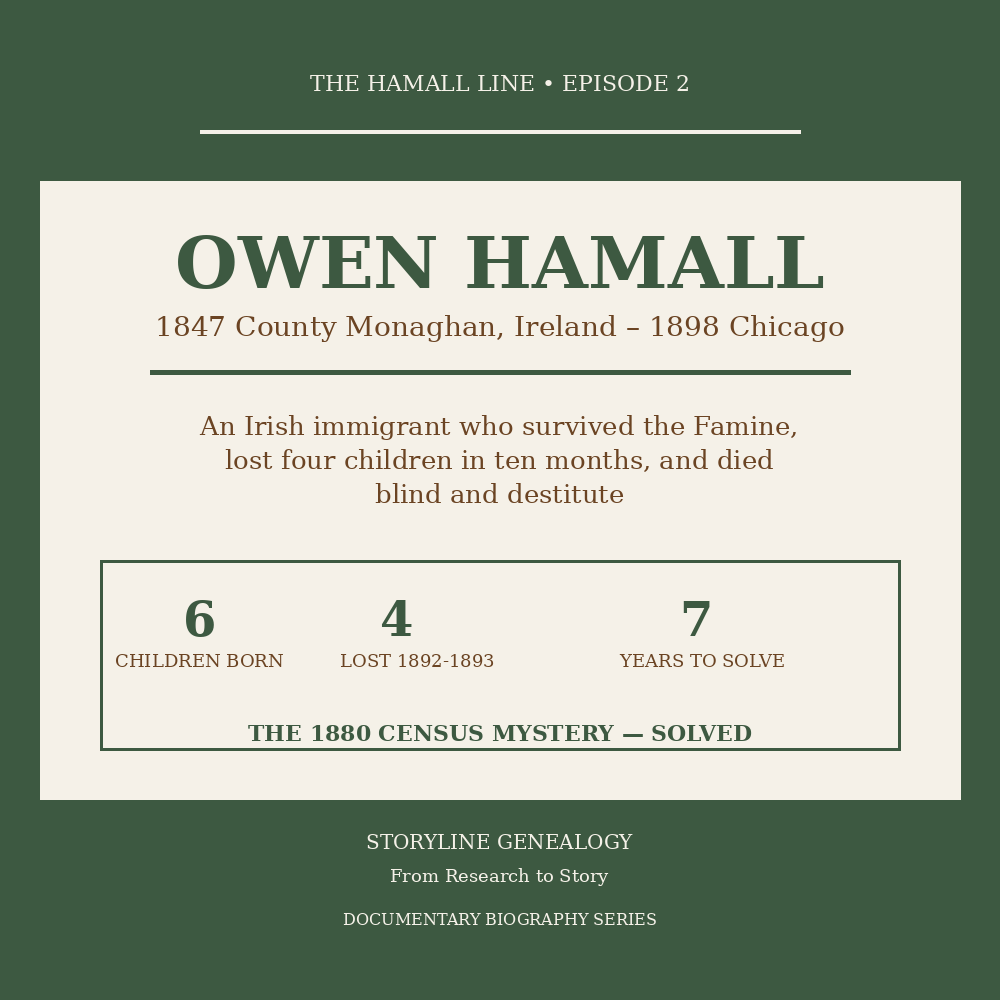
The Hamall Line: Owen Hamall
Owen Hamall was born in 1847 in County Monaghan, Ireland—the year the Great Famine reached its devastating peak. He survived the emigration to Montreal, his father's early death, and his mother's remarriage that created a blended family. In Chicago, he built a life as an iron molder, married Kate Griffith, and had six children. Then tragedy struck: four children died within ten months. Owen went blind, appeared on Chicago's "Destitute List," and died at 51. A mysterious census entry—"Hammil, Thornton"—took seven years to solve, finally revealing the half-brother hidden in plain sight since 1880.
Part of the Storyline Genealogy series: Documentary Biographies From Research to Story
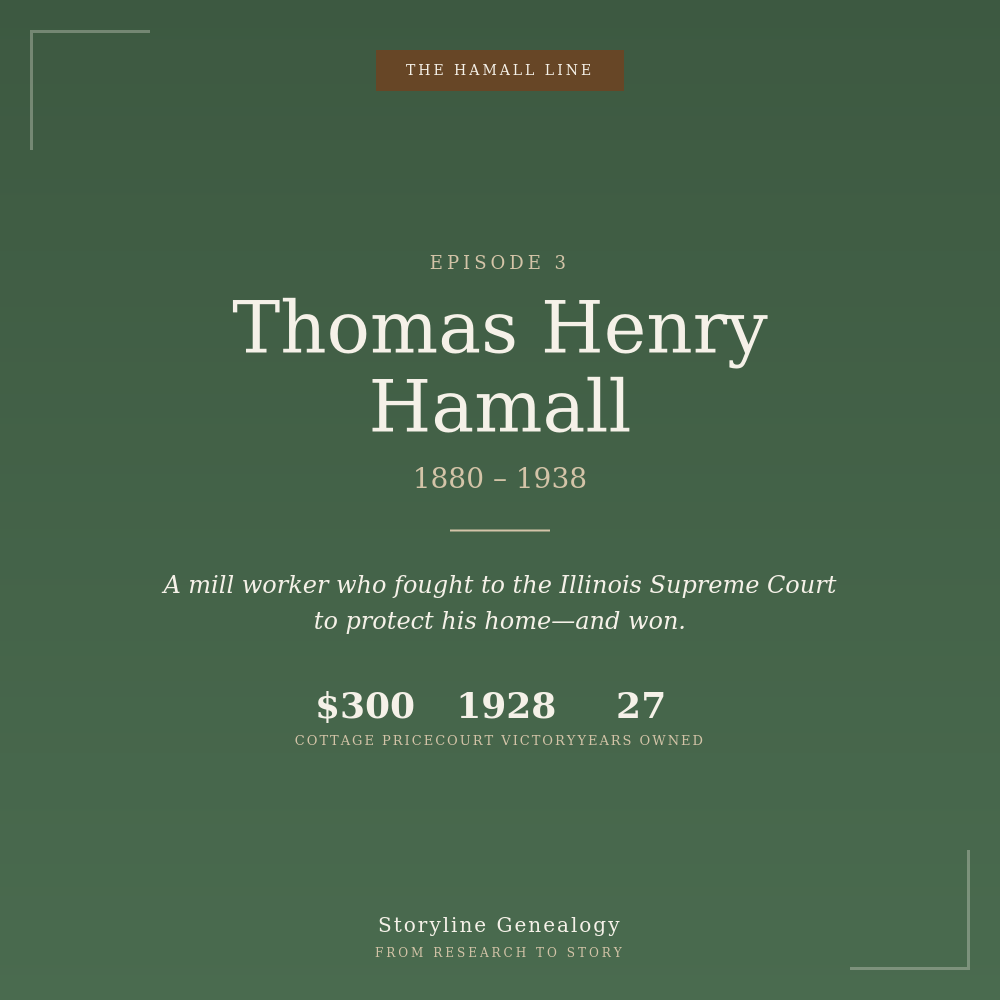
The Hamall Line: Thomas Henry Hamall
A mill worker's son who lost four siblings by age thirteen, Thomas Henry Hamall built a cottage in Riverside, Illinois for $300—then fought all the way to the Illinois Supreme Court to keep it. His 1928 victory in Hamall v. Petru created legal precedent still cited today, and the property he protected passed through three generations of Thomas Hamalls across 87 years.
Part of the Storyline Genealogy series: Documentary Biographies From Research to Story
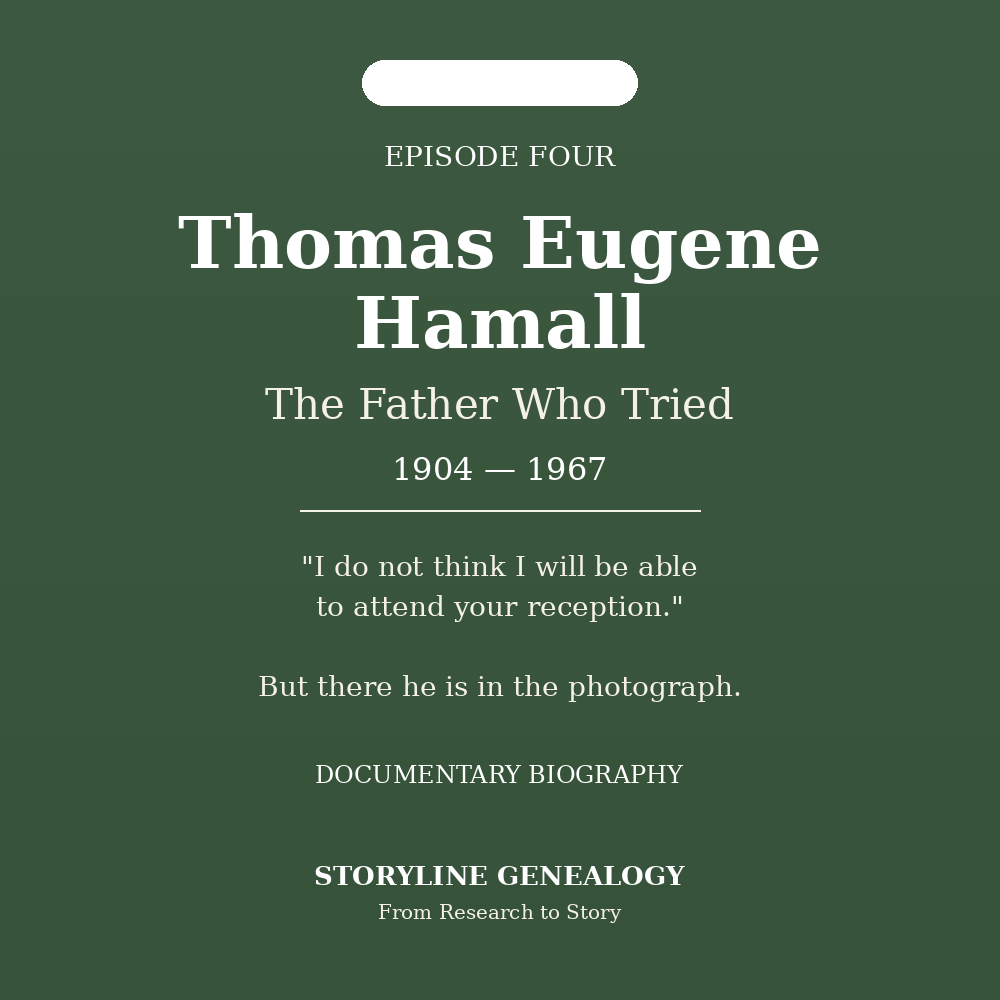
The Hamall Line: Thomas Eugene Hamall
He wrote that he didn't think he could attend. But there he is in the photograph, standing next to his ex-wife at their son's wedding. From bank teller to milkman to nurseryman, from Chicago to Miami, from divorce to reconciliation—this is the story of Thomas Eugene Hamall, the father who tried.
Part of the Storyline Genealogy series: Documentary Biographies — From Research to Story
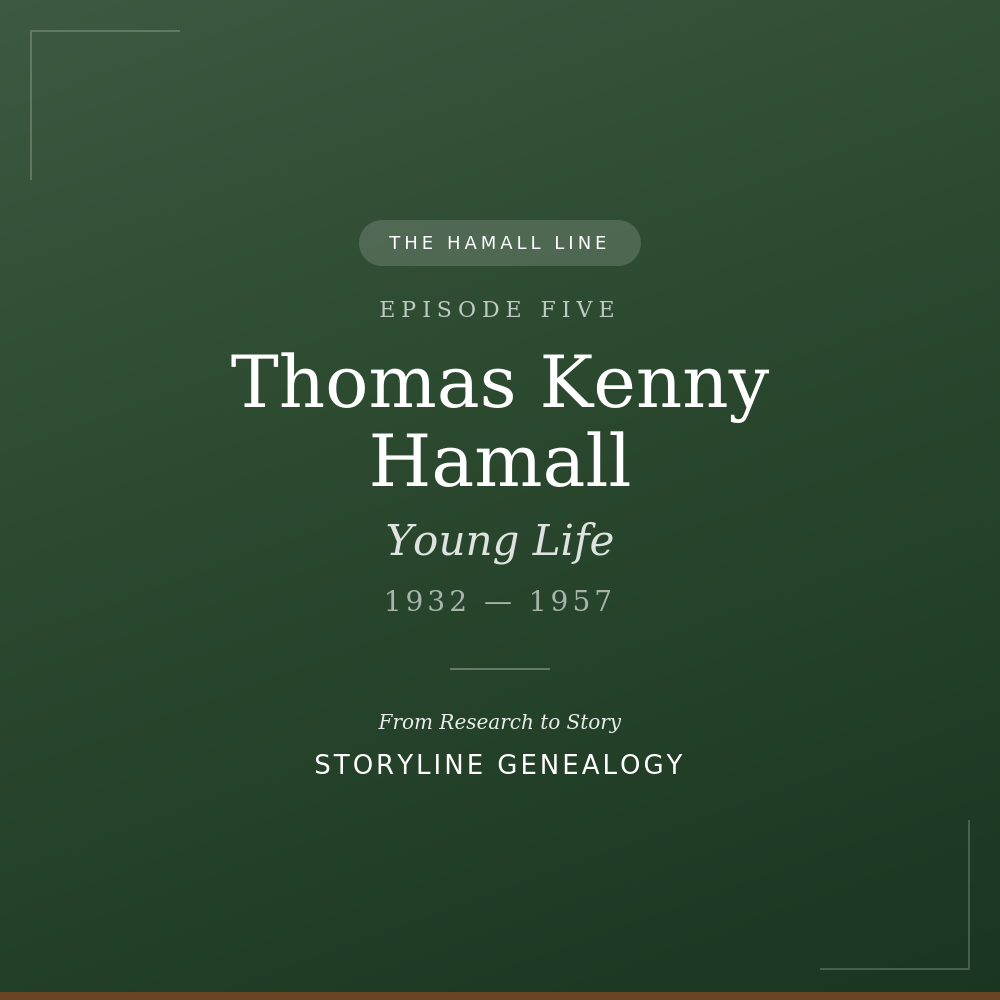
The Hamall Line: Thomas Kenny Hamall
Episode 5 of The Hamall Line Documentary Biography Series traces Thomas Kenny Hamall's young life from his 1932 birth in Evanston through his 1957 engagement at St. Patrick's Cathedral in New York City. Through birth certificates, census records, photographs, and his own handwritten autobiographical notes, we reconstruct the story of a boy uprooted by divorce at age nine who found stability with his Kenny grandparents in Miami, discovered a calling to the priesthood, served in the U.S. Navy, and ultimately built the foundation for the family man he would become.
Part of the Storyline Genealogy series: Documentary Biographies From Research to Story
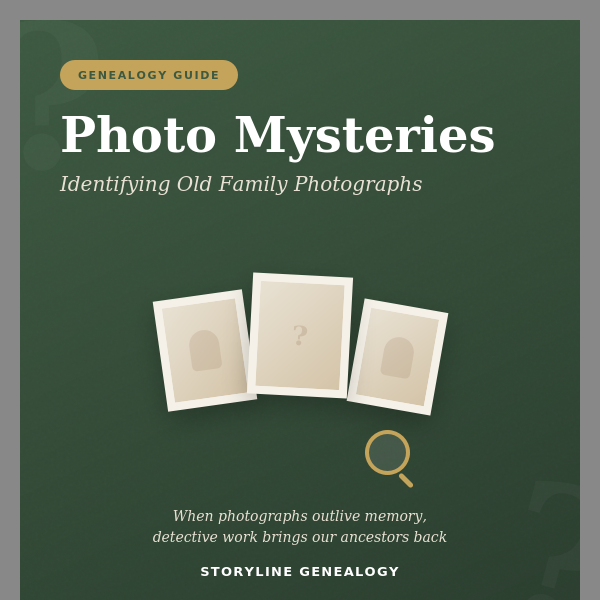
Photo Mysteries: The Art of Identifying Old Family Photographs
Nothing brings genealogy to life quite like staring into the face of an ancestor who's been gone for a hundred years. If you're lucky enough to have old vintage photographs—tintypes, cabinet cards, formal portraits—each unlabeled image is a puzzle waiting to be solved. Here's how photo detective work brings our ancestors back.
From Research to Story—transforming fragmented memories into complete family narratives
Jean Bernardin Suliere fils 1744-1820
On 11 April 1744 a boy was baptised at L'Assomption the day he was born, and his grandfather stood as godfather. Three weeks later his mother was buried — not in childbirth, as the family long believed, but after weeks of illness and the last rites. He lived seventy-six years, fathered sixteen children across four parishes, buried five of them small, and worked as a journalier: a day labourer who never owned the ground he worked.
Part of the Storyline Genealogy series: Documentary Biographies From Research to Story
Jean Bernardin Suliere 1717-1798
His first wife died in childbirth just fourteen months after their wedding. The baby survived. Jean Bernardin Suliere would live another fifty-four years, remarry, raise a second family, and see his descendants spread across L'Assomption. Through parish registers that document both tragedy and resilience, we trace one man's eighty-one year journey through colonial Quebec.
Part of the Storyline Genealogy series: Documentary Biographies From Research to Story
Jean Suliere dit Tranchemontagne 1696-1766
Jean Suliere dit Tranchemontagne lived a life that traced the expansion of French colonial settlement from the Île-d'Orléans to the fertile lands along the Rivière L'Assomption. Through parish registers, notarial records, and the careful handwriting of priests, we reconstruct the story of a pioneer who raised twelve children and established roots that continue through his descendants today.
Part of the Storyline Genealogy series: Documentary Biographies From Research to Story

Uranium Glass: The Heirloom That Glowed
For decades it sat on her table, then on mine. A beautiful clear green bowl and candlesticks—gifts from my father's side of the family. I always liked it. There was something about it, something that drew me to it. After my mother passed in 2022, a coworker suggested I try shining a black light on that green glass. What I discovered changed everything: Cambridge Glass from 1930, possibly a wedding gift for my grandparents, glowing with a secret four generations of women never knew. Part of the Storyline Genealogy series: Documentary Biographies — From Research to Story
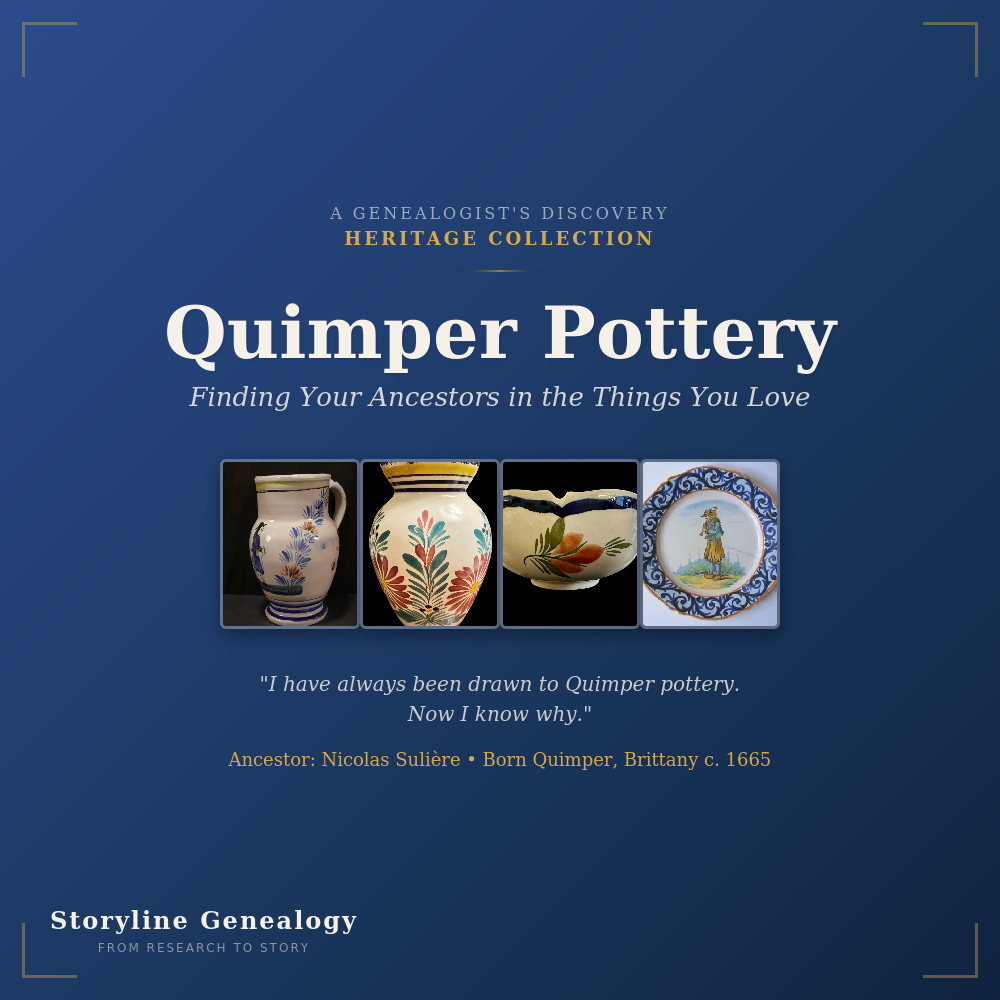
Quimper Pottery: A Genealogist's Discovery
I have always been drawn to Quimper pottery. The hand-painted Breton figures, the vibrant blues and yellows, the graceful curves of pitchers and vases—there was something about them that felt familiar, though I couldn't say why. Now I know. While tracing my French-Canadian ancestry, I discovered that Nicolas Sulière Tranchemontagne—the immigrant who carried that bold name to New France—was born in Quimper, Brittany, around 1665. The same town where faïence pottery has been made for over three hundred years.
Part of the Storyline Genealogy series: Documentary Biographies — From Research to Story
Nicolas Sulière dit Tranchemontagne 1664-1670
In November 1740, a priest at Saint-Sulpice recorded the burial of a man from "la paroisse de Quimper, evêché en Bretagne." That man was Nicolas Sulière — and the name he carried, Tranchemontagne, would echo through seven generations to the present day. He crossed the Atlantic before 1691, married on Île d'Orléans, bought two arpents beside his father-in-law, and ended his working life as a day labourer in the town of Québec. Nine children; three lived to marry. This is where the story begins.
Part of the Storyline Genealogy series: Documentary Biographies — From Research to Story
Jacques Souliere 1768 – before 1841
On 7 January 1799, at the mission church of Oka, a man of thirty from L'Assomption married a girl of seventeen from Pierrefonds. Neither could sign. They had eleven children and buried five of them small — three in a single Montreal spring. The one document in which Jacques Souliere speaks in his own voice is a scrap of a deed giving a village lot to his father-in-law, keeping back only une place pour y bâtir une petite maison si besoin étoit. He was last seen alive on 16 April 1839, giving his sixteen-year-old daughter leave to marry. No one wrote down where he died.
Part of the Storyline Genealogy series: Documentary Biographies — From Research to Story