
Nicolas Sulière dit Tranchemontagne 1664-1670
Nicolas Sulière dit Tranchemontagne
Birth: about 1664–1665, parish of Quimper, diocese of Cornouaille, Brittany — no baptism located
Parents: Vincent Sustier and Marie Navence, named in his marriage act of 1691
Arrival in New France: before April 1691 — date, ship and circumstances unknown
Marriage: 30 April 1691, St-Jean, Île d'Orléans — Marie Marguerite Leblanc dit Jolicoeur
Land: two arpents of frontage in the parish of Saint-Jean, Île d'Orléans — bought 8 October 1697 for 95 livres, sold 29 October 1704 for 350
Occupation: journalier — day labourer in the town of Québec, from the census of 1716
Children: nine, 1692–1711. Three married; four died as children; two died in their twenties.
Burial: 14 November 1740, St-Sulpice (L'Assomption), aged seventy-six
A note on evidence
This page follows the standard of the episodes that come after it. What a record states is kept separate from what a database reports, and the two are not displayed as though they were the same kind of evidence. The parish register acts reproduced here are from the copy photographed at the presbytery; every image has been examined, and where an act is quoted the transcription is a working reading rather than a collated one. No notarial act has been found in which Nicolas is a principal party. He appears in one as a neighbour and a witness, and that single mention carries more about his circumstances than anything else on this page.
Introduction
In November 1740 a missionary priest at Saint-Sulpice buried a man of seventy-six and wrote down where he had come from. That one clause is the reason this family can be followed back across the Atlantic at all.
The man was Nicolas Sulière, also written Sustier and Soulière, and called by a name that outlasted all of them: Tranchemontagne. He was born in Brittany about 1664, crossed the ocean before 1691, married on the Île d'Orléans, buried five of his nine children, worked as a day labourer in the town of Québec, and died three hundred kilometres upriver in a parish his children had settled.
Quimper
The origin comes from two independent acts, forty-nine years apart, and they agree.
From the burial, 14 November 1740
« […] le corps de Nicolas Sulière agé de soixante et seize ans, fils de feu Julien et de Marguerite Lebleau son epouse, de la paroisse de Quimper, evêché en Bretagne […] »
Parish register of St-Sulpice, 1740. Working reading. PRDH renders the origin field as paroisse de Quimper Corantin en Bretagne.
The marriage act of 1691, as abstracted by Tanguay, places him in the same country by a different name: « fils de Vincent et de Marie Navence, evêché de Cornouaille, Basse-Bretagne ». Cornouaille was the diocese whose seat was Quimper. The parish and the diocese are the same place described from two angles.
Quimper—kemper in Breton, “confluence”—sits where the Odet and the Steir meet in western Brittany. Its cathedral is dedicated to Saint Corentin, which is why the older records call the town Quimper-Corentin, and why that second word survives in the burial entry. The faience industry the town is now known for was founded in 1708, long after Nicolas had left; it is part of Quimper's story but not of his.

Brittany in 1683, within Nicolas's lifetime and before he sailed. Quimper sits in the west, marked as the seat of Cornouaille.
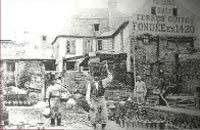
The old streets of Quimper, photographed around 1920. The street plan is medieval; the buildings are not all his.
What is not known about the crossing
When Nicolas came, on what ship, and in what capacity are all unknown. He may have come as an engagé under a three-year indenture, as a soldier, or on his own account. No engagement contract, no passenger list and no arrival record has been found. The first document that places him in New France is his marriage, in April 1691, when he was about twenty-six.
The Name
What a dit name is
A dit name—literally “called”—was a second surname used alongside the family one. It could come from a physical trait, a trade, a birthplace or a soldier's nickname, and once fixed it passed from father to child, sometimes swallowing the original name entirely. In this family it did the opposite: Tranchemontagne travelled beside Soulière for seven generations without ever replacing it.
Tranchemontagne means “cuts the mountain.” In seventeenth-century French it was a stock name for a swaggerer—the sort of boast a soldier's comrades pinned on him, closer to “mountain-slayer” than to any literal feat. Where Nicolas got it is unrecorded. It is already attached to him in 1691.
The surname itself, Soulière or Soulier, comes from the old French word for shoe and usually marked a shoemaker somewhere back in the line.
The name moved as much as the man
Across five records he is Sustier (1691), Sustie dit Tranchemontagne (1702), Suière dit Planche Montagne (1716), Sulière (1740) and Sullières in his son's land acts. The 1716 census form of the dit name—Planche Montagne, plank rather than blade—is a census taker writing down what he heard. Searching any index on one spelling will lose him.
Marriage on the Île d'Orléans, 1691
30 April 1691 At the parish of Saint-Jean on the Île d'Orléans, Nicolas married Marie Marguerite Leblanc dit Jolicoeur, daughter of Antoine Leblanc Jolicoeur and Elisabeth Roy. She was born on the island on 2 July 1671 and baptised at Sainte-Famille six days later. She was nineteen; he was about twenty-six.
Her baptism — Sainte-Famille, Île d'Orléans, 8 July 1671
« Le huitieme jour du mois de juillet de l'année mil six cens septante et un, a esté baptisée Marie Marguerite fille d'Antoine Le Blanc et d'Elisabeth Le Roy ses pere et mere, née le second jour du mesme mois et an; parain Paul Vignaux et maraine Marguerite Abraham, femme de Lavigne. »
Signed Morel, prêtre missionnaire. A later hand adds in the margin that this Lavigne is Joseph Ozanne Nadeau. Working reading, September 2026.
The Île d'Orléans in 1691 was the most densely settled ground in the colony: a long island in the St Lawrence just below Québec, divided into narrow river-front strips and five parishes. The Leblancs were established there. Nicolas, newly arrived, was not.

The Île d'Orléans as surveyed by Villeneuve, engineer to the King, in 1689—two years before the wedding—with the occupants of that year named around the edges. Saint-Jean, where they married, is on the south shore toward the eastern end; no. 33 in its list is Nicolas Houdet and no. 37 is François Dumas, the two men whose families' contract of 1698 places Nicolas's land between them. He is not on the map himself—in 1689 he had not yet taken ground. Reproduced by J.-Camille Pouliot, 1927.

The island a century later, on Des Barres's chart of the St Lawrence, London 1781. The strip farms running back from both channels are the pattern Nicolas's children were born into.
Nine Children
Between 1692 and 1711 Marie Marguerite bore nine children—four on the Île d'Orléans, then, from 1708, at Québec.
| Child | Birth | Marriage | Death |
|---|---|---|---|
| Marie Renée | 24 Jun 1692St-Jean, Î.O. | — | 28 Sep 1714Québec, Hôtel-Dieu — aged 22 |
| Joseph | 6 Jan 1694St-Jean, Î.O. | — | 24 Mar 1715Québec — aged 21 |
| Jean | vers 1696place undetermined | 14 Sep 1716, Marie Louise LesageNotre-Dame-de-Québec — Episode 1 | 1766L'Assomption |
| Nicolas | 11 May 1698St-Laurent, Î.O. | 3 Oct 1729, Marie Marguerite Jean ViensNotre-Dame-de-Québec | 2 Sep 1764St-Ours — aged 66 |
| Bernard | 18 Oct 1700St-Jean, Î.O. | — | 17 Apr 1709Québec — aged 8 |
| Pierre | 26 Aug 1703St-Jean, Î.O. | — | 27 Jun 1705Québec — aged 22 months |
| Marguerite | 28 May 1705St-Laurent, Î.O. | — | 29 Sep 1714Québec — aged 9 |
| Louis Marie | 6 Sep 1708Québec | — | 22 May 1710Québec — aged 20 months |
| Marie Jeanne Anne | 3 Apr 1711Québec | 3 Nov 1729, Joseph Laporte St-GeorgeSt-Sulpice (L'Assomption) | 11 Nov 1747L'Assomption — aged 36 |
Three married, not four
Jean, Nicolas and Marie Jeanne Anne are the three who married. Four children died small—Pierre at twenty-two months, Louis Marie at twenty months, Bernard at eight, Marguerite at nine. Two more died grown but unmarried: Marie Renée at twenty-two and Joseph at twenty-one.
The autumn of 1714. Marie Renée was buried at Québec on 28 September and Marguerite on the 29th—consecutive days—the elder having died at the Hôtel-Dieu. Joseph followed six months later. Three of nine children in half a year, two of them within a day, is the shape of an acute illness moving through a household, but no cause is recorded in any of the three acts and none is claimed here.
These dates come from the PRDH family record for the couple, not from acts read for this page.
Two Arpents at Saint-Jean
23 January 1698 In the house of François Dumas, on the Île d'Orléans, a notary of the bailliage et comté de Saint-Laurent drew up a marriage contract between Pierre Houdet (Audet) and Marie Dumas. The bride's parents gave the couple two arpents of land, and the notary had to say where those two arpents lay.
From the Houdet–Dumas marriage contract, 23 January 1698
« […] lesd. deux arpents tenant d'un costé a la ligne de Nicolas Le Sustier dit tranchemontagne, [d'autre] costé aux Dumats, […] devant sur le fleuve St Laurent et d'autre bout et par derriere sur la ligne qui separera par le milieu de lad. isle »
Before Me Nicolas Catrin, notary in the bailliage et comté de Saint-Laurent; entered in the register of insinuations at folio 42. BAnQ numérique 3338281. Working reading, September 2026.
He held land
A ligne is a surveyed side boundary, and a man does not have one unless he holds a lot. In January 1698 Nicolas Sustier had a strip on the Île d'Orléans—fronting the St Lawrence, running back to the line that divides the island down its spine. He was thirty-three, seven years married, with four children born and a fifth coming. He had bought it three and a half months earlier.
Where the lot was
The insinuation copy gives the shape of the land but not the côte. Villeneuve's map supplies it.
Saint-Jean, on the south shore
Among the occupants Villeneuve recorded at Saint-Jean in 1689 are no. 33, Nicolas Houdet—the groom's father—and no. 37, François Dumas, the bride's. The two arpents conveyed in 1698 adjoined the Dumas on one side and Nicolas Sustier's line on the other. His strip therefore lay on the Saint-Jean côte, fronting the south channel of the St Lawrence and running back to the ridge line that divides the island.
Everything else agrees. He married at Saint-Jean in April 1691. Marie Renée, Joseph, Bernard and Pierre were all baptised at Saint-Jean between 1692 and 1703. This was his parish for a dozen years, and now it is his ground as well.
And the map agrees. Nicolas is not on it. Villeneuve listed the occupants of 1689, and in that year the land was still in other hands—as the sale of 1704 confirms, since Nicolas did not buy it until October 1697.
The datation names him a second time. The contract was passed in the Dumas house before an assembly of the two families, and at the end the notary lists those present who could not put their names to it. Nicolas Le Sustier is among them. Eighteen years before his son Jean declared the same thing at Québec, and twenty-two before that son said it again to a notary at Villemarie, the first of them was already making his mark.
What this document is, and why it may be all there is
What survives here is the entry in a register of insinuations—the court's record of acts containing donations, entered so they would hold against third parties. It is an official copy, not the contract.
Catrin's own greffe has been searched. What survives of it at BAnQ (CN301,S55) is a fragment held in the Collection Pouliot: ten images carrying four acts—a Fortier–Cadeau marriage contract, a donation, a consent of 30 April 1700 by Jacques Bluteau and Claire Paré of Sainte-Famille, and an act of 21 June 1700. The minute of 23 January 1698 is not among them. For a notary whose minutes survive only as a collector's gathering, the insinuation copy may well be the only text of this contract that exists.
One thread worth pulling: among the others present in the Dumas house that day is a name that reads as Poliquin. Fifty-five years later a Marguerite Suyer dite Tranchemontagne married a Jean-Baptiste Poliquin. The reading is uncertain and the families were both numerous, so nothing is claimed from it here.

The insinuation register at folio 42. The Houdet–Dumas contract is the lower of the two entries; the marginal heading reads Mariage P[ier]re Houdet + Marie Dumats.

The clause itself: tenant d'un costé a la ligne de Nicolas Le Sustier dit tranchemontagne.
The Purchase, 8 October 1697
8 October 1697 Before Me Charles Rageot de Saint-Luc at Québec, Maury Gervais and Françoise Monnoisier his wife—she previously the widow of the late Gauvreau—sold their two arpents to Nicolas.
From the purchase, 8 October 1697
« […] ont vendu, quitté, cedé, transporté et delaissé […] a Nicolas Le Suistre, habitant dud. Comté Sainct Laurent paroisse S[ain]t Jean, present et acceptant acquereur pour luy, ses hoirs et ayants cause, une terre et habitation sise et située audit comté Sainct Laurent et en la paroisse dudit St Jean, de deux arpens de terre de front […] jusqu'a la ligne ou route qui separe ladite Isle de pointe en pointe, d'un bout au fleuve, d'autre a la ditte ligne ou route; joignant d'un costé a François Dumast, d'autre costé a Antoine Le Blanc […] »
BAnQ, CN301,S236, greffe de Charles Rageot de Saint-Luc, 8 October 1697; images 03Q_CN301S236P_0311–0312. Working reading, September 2026.
The parish, in the act's own words
Villeneuve's map put his land at Saint-Jean by inference from his neighbours. This act says it outright, twice: the land is en la paroisse dudit St Jean, and Nicolas is already habitant of that parish before he buys it. He had been living at Saint-Jean since his marriage there in 1691—on someone else's ground, most likely his father-in-law's—and in 1697 he bought the strip next door.
The title, back to the beginning
1669 — conceded by Monseigneur de Laval, first bishop of Québec, to André Gauvreau, by contract before Paul Vachon, then notary and procureur fiscal of the comté de Saint-Laurent. Laval owned the Île d'Orléans from 1668 until he sold it in 1675, so the grantor fits the year exactly.
— to his nephew Jean Gauvreau, sole heir.
— to Françoise Monnoisier, the nephew's mother, on his death.
1697 — to Nicolas Le Suistre.
1704 — to Guillaume Lemelin.
The 1704 deed gives the same recital in shorter form; where this act reads André for the first grantee, the 1704 recital was read here as Jean. The 1697 act is the fuller and earlier of the two and its reading is the one carried.
The charge on the land was twenty sols of rente and two sols of cens for each arpent of frontage, with two live capons—or thirty sols apiece in their place—payable every year at Saint-Martin. The price was ninety-five livres tournois: forty-four already received, and fifty-one counted out before the notary in monnaie de carte et sols marqués, the colony's card money.

The purchase, 8 October 1697. The margin reads Vente par Maury Gervais à Nicolas Le Suistre.

The second page: the chain of title back to Laval's concession of 1669, and the ninety-five livres.
Cleared, Never Built, Sold: 1704
29 October 1704 Seven years to the week after buying it, Nicolas sold the land. The deed of sale before Me François Genaple at Québec is the fullest document this man appears in, and it recites the whole history of the two arpents—including how he got them.
Sale to Guillaume Lemelin, 29 October 1704
« Pardevant le notaire gardenotes du Roy en la ville et prevosté de Quebec en la nouvelle france soussigné fut present Nicolas Le Suier habitant de l'Isle et Comté St Laurent […] faisant tant pour luy que pour Marguerite Le Blanc sa femme, a laquelle il promet et s'oblige faire au plustost ratiffier ces presentes a la premiere commodité qu'elle pourra trouver pour venir en cette ville […] a volontairement vendu […] a Guillaume Lemelin present et acceptant acquereur […] une terre ou habitation de deux arpens de terre de front située sur le fleuve en l'Isle et Comté St Laurent du costé du Sud, et de profondeur jusqu'a la ligne ou route qui separe ladite Isle de pointe en pointe par son milieu; joignant d'un costé a François Dumats et d'autre costé a Antoine Le Blanc; en l'estat que ladite terre est et comporte presentement, tant en desert que bois debout, sans batimens sur icelle […] »
BAnQ, CN301,S114, greffe de François Genaple, 29 October 1704; images 03Q_CN301S114P_6679–6680. Working reading, September 2026.
He was never a grantee
This deed repeats the chain of title set out above: Nicolas held by purchase, not by concession, and what he sold in 1704 was a thirty-five-year-old holding that had passed through three hands before his.
His neighbours were his wife's family
The land adjoined François Dumas on one side and Antoine Leblanc on the other. Antoine Leblanc Jolicoeur was Marie Marguerite's father. A Breton newcomer with no kin in the colony bought the farm next door to his father-in-law—which is very likely how he came to hear it was for sale.
What he had made of it in seven years
Nothing that stood up. The act describes the two arpents tant en désert que bois debout, sans bâtimens sur icelle—part cleared, part still in standing timber, and no buildings on it at all. After seven years of ownership there was no house, no barn, nothing raised. Wherever the family were living between 1697 and 1704, it was not on this ground.
The charge on it was twenty sols and one live capon of seigneurial rent for each of the two arpents of frontage, with two sols of cens, payable every year in perpetuity at Saint-Martin, the eleventh of November. Sixty-seven years later his grandson would take land on the Achigan at a capon and a Saint-Martin term. The forms did not change.
The price was three hundred and fifty livres, in four terms: sixty paid down on the spot en monnaie de castor—beaver money—counted out in front of the notary, and the balance in three further payments.
Ninety-five livres in, three hundred and fifty out
That is what the two deeds say, seven years apart, for the same two arpents with no building added. It is tempting to read it as a profit and it may well have been one—the désert had grown, and cleared ground was what a buyer paid for. But both prices were settled in the colony's paper money, card money in 1697 and beaver money in 1704, and those instruments did not hold a steady value against each other or against livres of account. The figures are given here as the acts give them, and the arithmetic between them is left alone.
An absent wife, and a promise
Marguerite Leblanc was not there. Nicolas sold in his own name and hers, and undertook to have her ratify the sale « au plustost […] a la premiere commodité qu'elle pourra trouver pour venir en cette ville »—at the first opportunity she could find to come to town. Under the Coutume de Paris the land was community property and her ratification was needed to make the sale safe. Whether she ever gave it, and before which notary, has not been found. She was pregnant that autumn; Marguerite was born the following May.

The sale, 29 October 1704, before Me François Genaple. The margin reads Vente d'habitation, Isle St Laurens — N[icol]as Le Suier à Guill[aum]e Lemelin.

The second page: the price, the terms, and the beaver money counted out before the notary.
A Day Labourer in the Town of Québec
The family moved off the island. From 1708 the children are baptised at Notre-Dame-de-Québec, and two records catch Nicolas in the town itself.
23 July 1702 The daily register of the sick at the Hôtel-Dieu de Québec records the admission of « Sustie dit Tranchemontagne, Nicolas ». Nothing else—no age, no parish, no complaint, no discharge. He was about thirty-eight. Twelve years later his eldest daughter would die in the same building.

The Hôtel-Dieu's daily register of the sick, 23 July 1702. The entries around his give ages and parishes; his gives only the name and the dit.
How firm is that identification?
It rests on the dit name alone. No age or parish is given, and the surname is written Sustie. Against that: Tranchemontagne is not a common name in the colony, and Nicolas is the only man carrying it at Québec in 1702. Probable rather than proved.
1716 The census of the town of Québec, taken by order of the intendant and printed by the abbé Beaudet in 1887, lists the household at number 180:
Recensement de la ville de Québec, 1716 — entry 180
180 Nicolas Suière dit Planche Montagne, journalier … 51 ans
f. Marguerite Leblanc … 49
enf. Nicolas … 19
Marie Jeanne … 6
L. Beaudet, ed., Recensement de la ville de Québec pour 1716 (Québec: A. Côté, 1887), p. 27, no. 180. Canadiana oocihm.02966.
Four things in four lines
He was a journalier. A day labourer—hired by the day, holding no land. This is the only statement of his occupation anywhere, and it settles a question the surname raises and does not answer: whatever Soulière once meant, this man was not working as a shoemaker in 1716.
His age fits. Fifty-one in 1716 puts his birth about 1665; seventy-six at his burial in 1740 puts it about 1664. Two independent statements agreeing within a year is as good as an undocumented birth year gets.
The household is nearly empty. Of nine children, two are at home: Nicolas at nineteen and Marie Jeanne at six. Four were already dead, three more had died in 1714–15, and Jean—the subject of Episode 1—is not listed. He was about twenty and married that September at Notre-Dame-de-Québec. Whether the count was taken after his marriage or he was already living away as a hired man, the census does not say.
It corroborates the marriage contract. Six days before Jean's wedding, the notary Rivet wrote that Nicolas was demeurant en cette ville—living in the town. The census, taken the same year and by a different hand for a different purpose, puts him there with a trade and an address in the sequence of houses. Two unrelated sources, one fact.

Page 27 of Beaudet's edition of the 1716 census. Entry 180 sits between a mason from Angoumois and a carter; the street is full of tradesmen and labourers.
Upriver
Between 1716 and 1740 the whole family left the Québec region for the country north-east of Montréal, and the records mark the stages.
The move, as the acts record it
The daughter's wedding at Saint-Sulpice in November 1729 is the hinge. She was eighteen and marrying in a parish where her brother had held land for eleven years. A father of sixty-five with no land of his own, whose surviving children were all in that district, had little reason to stay in the town of Québec—and he was buried at Saint-Sulpice eleven years later. Whether he moved for the wedding, before it, or years after it is not recorded.
Death at Saint-Sulpice, 1740
14 November 1740 He was buried in the parish cemetery at Saint-Sulpice by P. Sartelon, missionary priest doing the curial duties. The witnesses were Pierre Lescarbot, the beadle, and Louis Massé, master shoemaker.
| Rank | Name and role as printed | Age |
|---|---|---|
| 01 | Nicolas SULIERE — spouse of 02 Origin: paroisse de Quimper Corantin en Bretagne | 76 |
| 02 | Marguerite LEBLANC — spouse of 01 | — |
| 03 | Pierre LESCARBOT — bedeau, present | — |
| 04 | Louis MASSE — maître cordonnier, present | — |
| 05 | P SARTELON — prêtre, missionnaire, faisant les fonctions curiales | — |
The parents named in this act
The burial calls Nicolas the son of feu Julien et de Marguerite Lebleau. His marriage act of 1691 calls him the son of Vincent et de Marie Navence. Both cannot be right, and the difference is not a mystery so much as a mechanism.
Why the 1691 names are the ones to keep
The mother's name is his wife's. Marguerite Leblanc was not Nicolas's mother; she was the woman he married on the Île d'Orléans in 1691, and she outlived him. The PRDH says so in the note above. A priest at a graveside, taking details from the family, writing the widow's name into the mother's slot is one of the commonest errors in a burial act.
The father's name is hearsay at forty-nine years' distance. Julien comes from whoever stood at the grave in 1740—children who had never met the man and knew of him only from their father's talk. Vincent comes from the marriage act of 1691, drawn up when Nicolas himself was present, and when documentary proof of a foreign groom's freedom to marry was ordinarily required.
What follows. Vincent Sustier and Marie Navence are the parents this page carries. Julien is recorded as a variant reading, not as a rival fact. What both acts agree on is the place, and the place is what makes the crossing traceable.
Still unproved: neither name has been checked against any register in Quimper or the diocese of Cornouaille. Until a French baptism is found, the parentage rests on a single colonial act.

The burial act, 14 November 1740. The origin clause runs to the right of his age.
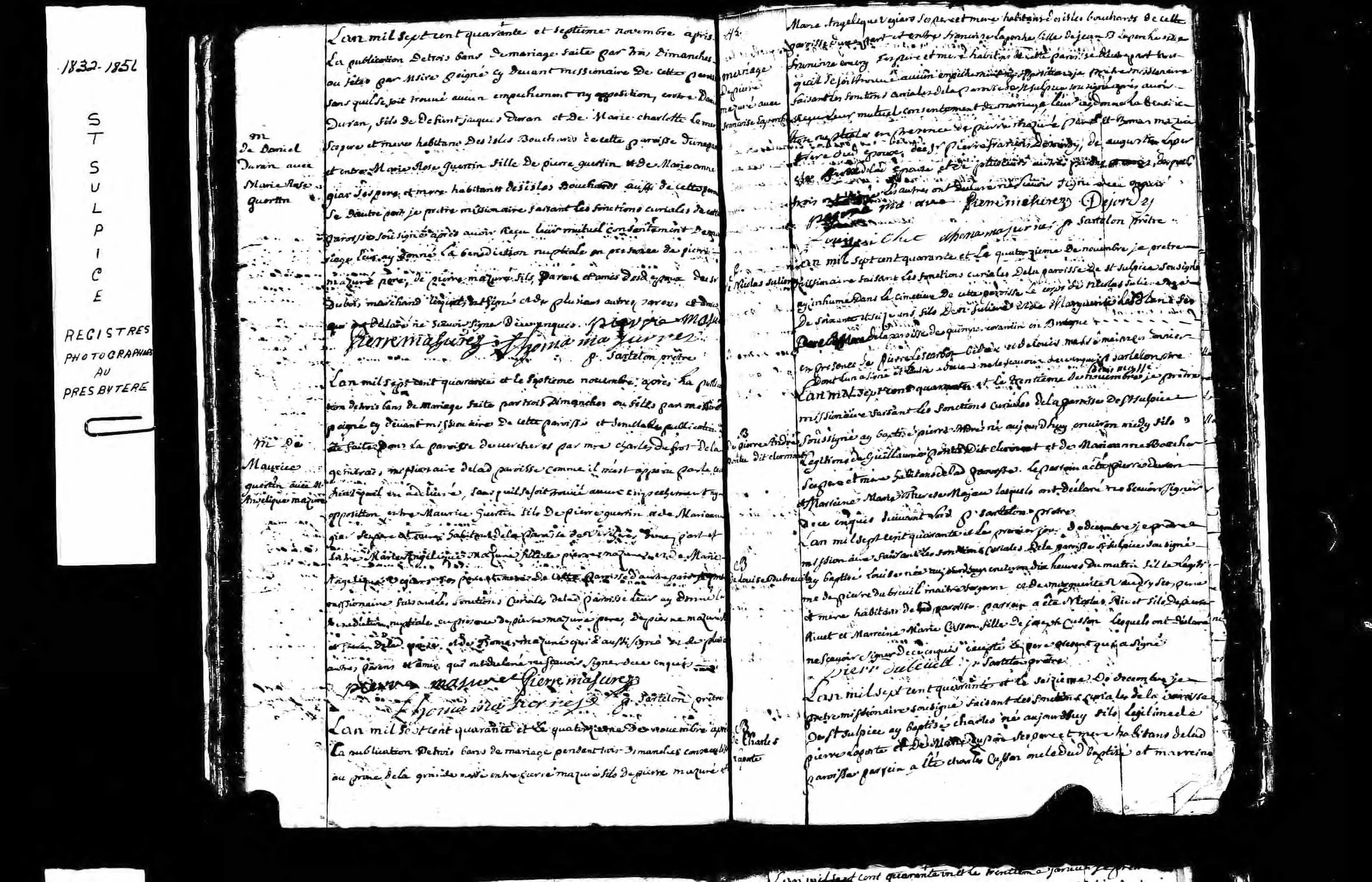
The full register page at Saint-Sulpice.

Tanguay's abstract of the 1691 marriage: SUSTIER, Nicolas, fils de Vincent et de Marie Navence, evêché de Cornouaille, Basse-Bretagne, with the nine children beneath. Tanguay is an abstract of the register, not the register. The act itself has not been read for this page.
Legacy
Nicolas Sulière bought two arpents beside his father-in-law at thirty-two, never built on them, sold them at thirty-nine, and was a hired labourer in the town of Québec at fifty-one. He left no signature—he and his descendants for three generations declared they could not write. What he left was a name and a direction. His son Jean took ground on the Rivière L'Assomption in 1718 and held it for forty-eight years. Jean's son Jean Bernardin moved on to the Achigan. And the dit name went with them, through Jacques, through Janvier, through Marie Louise, to Emma Guilbault Hamall.
A day labourer from Quimper, buried at seventy-six in a parish three hundred kilometres from where he had raised his children, with a beadle and a shoemaker standing by. The priest wrote down where he was from. That is the whole of it, and it was enough.
The Tranchemontagne Series
Document Gallery
The register acts, the census and the maps behind this page. Database records are given as tables in the text above rather than here, so that what a database reports and what a record states are not shown side by side as though they were the same kind of evidence.
Entry 180 — journalier, 51 ans
Register of the sick
Detail — the Quimper clause
Saint-Sulpice register (full page)

Marie Marguerite Leblanc — detail

Ste-Famille register (full page)
Vincent & Marie Navence named

Sustier / Tranchemontagne
Rageot — page 1
Chain of title to Laval, 1669
Houdet–Dumas contract
la ligne de Nicolas Le Sustier
Genaple — page 1
Price and beaver money
Villeneuve's survey, with 1689 occupants
Des Barres, chart of the St Lawrence
Quimper and the diocese of Cornouaille
Photographed c. 1920
Sources
Parish registers — parish copy, examined
- Burial of Nicolas Sulière, 14 November 1740, St-Sulpice (L'Assomption) — detail and full page. Transcribed above. Gives his age as seventy-six, his origin as the parish of Quimper, and his parents as Julien and Marguerite Lebleau.
- Baptism of Marie Marguerite Leblanc, 8 July 1671, Ste-Famille (Île d'Orléans), born 2 July — detail and full page. Transcribed above. Signed Morel, prêtre missionnaire.
- Marriage of Nicolas Sustier and Marie Marguerite Leblanc, 30 April 1691, St-Jean (Île d'Orléans). The register act has not been read; it is known here only through Tanguay's abstract.
Census and institutional records
- L. Beaudet, ed., Recensement de la ville de Québec pour 1716 (Québec: A. Côté, 1887), p. 27, entry 180. Canadiana oocihm.02966; ark:/69429/m01j9765dn2h. A nineteenth-century printed edition of the manuscript enumeration, not the enumeration itself.
- Registre journalier des malades de l'Hôtel-Dieu de Québec, 1689–1760, entry of 23 July 1702: Sustie dit Tranchemontagne, Nicolas. Identification rests on the dit name alone.
Notarial minutes, read directly
- Vente par Maury Gervais et Françoise Monnoisier sa femme à Nicolas Le Suistre, 8 October 1697, before Me Charles Rageot de Saint-Luc, notaire royal en la prévôté de Québec. BAnQ, CN301,S236; images 03Q_CN301S236P_0311–0312. Transcribed above. Names Nicolas as habitant of the parish of Saint-Jean before the purchase, and recites the concession by Mgr de Laval to André Gauvreau before Paul Vachon in 1669. Working reading, not collated.
- Vente par Nicolas Le Suier (Sustier) et Marguerite Leblanc son épouse à Guillaume Lemelin, 29 October 1704, before Me François Genaple, notaire gardenotes du Roi en la prévôté de Québec. BAnQ, CN301,S114; images 03Q_CN301S114P_6679–6680. Transcribed above. Two arpents of frontage at Saint-Jean, south side of the Île d'Orléans, between François Dumas and Antoine Leblanc; 350 livres; recites the chain of title from the first concession of 1669. Indexed in the printed répertoire of the Genaple greffe, p. 165. Working reading, not collated.
Judicial register
- Marriage contract of Pierre Houdet (Audet) and Marie Dumas, 23 January 1698, before Me Nicolas Catrin, notary in the bailliage et comté de Saint-Laurent, entered in the register of insinuations at folio 42. BAnQ numérique 3338281. Names Nicolas Le Sustier dit Tranchemontagne twice: as the side boundary of the land conveyed, and among those present who declared they could not sign. An official copy; Catrin's minute has not been located.
Searched without result
- Greffe de Nicolas Catrin, BAnQ CN301,S55, Collection Pouliot — ten images, four acts, examined September 2026. The minute of 23 January 1698 is not among them.
- Pierre-Georges Roy, Inventaire des contrats de mariage du Régime français — no contract found for the marriage of 1691. Roy indexes only greffes deposited at the Archives judiciaires de Québec as of 1937.
Printed abstract
- Cyprien Tanguay, Dictionnaire généalogique des familles canadiennes, entry for the marriage of 30 April 1691 at St-Jean, Île d'Orléans. Tanguay abstracts the registers; his entry is a finding aid and a report of an act, not the act.
Database
- PRDH-IGD, Université de Montréal — individual no. 50187 (Nicolas Suliere Sustier Tranchemontagne, status immigrant); couple no. 6734 (Vincent Sustier and Marie Navence); family no. 6733 (the nine children); burial no. 127891 (1740); baptism no. 31177 (Marie Marguerite Leblanc, 1671). Rendered above as tables. Database fields are not transcriptions of acts.
Not located
- Marguerite Leblanc's ratification of the sale of 1704, which Nicolas undertook to obtain. Not found.
- The original concession by Mgr de Laval to André Gauvreau, 1669, before Me Paul Vachon — the title behind the title, and the day and month of it not yet read with confidence.
- Where the family actually lived at Saint-Jean between 1691 and 1704, given that the two arpents carried no buildings.
- Me Nicolas Catrin's original minute of 23 January 1698. Not among the four acts surviving in his greffe at BAnQ (CN301,S55, Collection Pouliot), and possibly lost.
- A marriage contract for 1691. Not found in Pierre-Georges Roy's Inventaire des contrats de mariage. Roy indexes only greffes deposited at the Archives judiciaires de Québec as of 1937, so this is a negative of defined extent, not proof that no contract was made.
- Any inventory or clôture after his death in 1740; any donation to a child before it.
- The marriage act of 30 April 1691 in the register of St-Jean, Île d'Orléans — the document behind Tanguay's abstract, and the earliest statement of his parentage.
- His baptism at Quimper, and any record of Vincent Sustier and Marie Navence in the diocese of Cornouaille.
- His crossing: no engagement contract, passenger list or arrival record.
- The death and burial of Marie Marguerite Leblanc, living in 1740.
- Baptism and burial acts for the nine children, all of which are carried here from the PRDH family record.
Storyline Genealogy
From Research to Story
Want to Know When New Stories Are Published?
Subscribe to receive updates on new family history research—no spam, just meaningful stories when there's something worth sharing.
SUBSCRIBE TO OUR NEWSLETTEREvery Family Has a Story Worth Telling
Whether you're just beginning your research or ready to transform years of work into a narrative your family will treasure, I'd love to hear your story.
BEGIN YOUR RESEARCH INQUIRY