
Uranium Glass: The Heirloom That Glowed
Uranium Glass
Some discoveries happen in archives. Some happen in the dining room, in the dark, holding a flashlight you ordered from Amazon because a coworker told you about "a whole thing" she'd seen on antique shows.
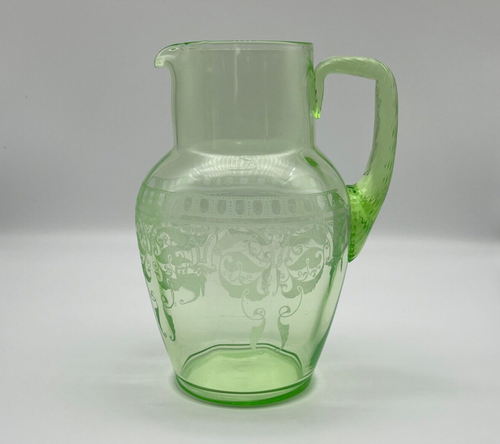
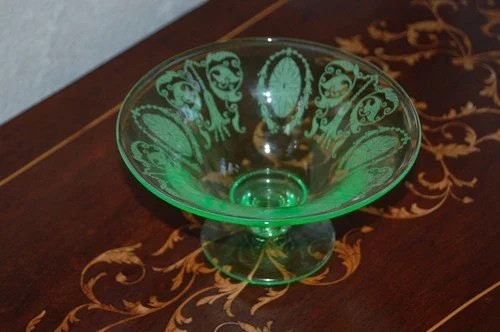
About seven years into our marriage, when we finally had our first real dining room, my mother gave me something that had graced her own table for years: a beautiful clear green bowl and matching candlesticks. Very pretty. Very elegant. She told me it came from my father's side of the family, though she couldn't say more than that.
It sat on my table and buffet for twenty-eight years. I always liked it. There was something about it—something that drew me to it in a way I couldn't explain. Just a very pretty green glass.
The Discovery
In 2022, my mother passed away. As I carefully went through her things, I found a few more pieces of this green glass tucked in her cabinets—items I'd forgotten existed, or perhaps had never noticed. A decanter. Tiny glasses. More pieces that matched that beloved bowl.
I mentioned it to a coworker, along with the whole story about the centerpiece I'd always loved. And she said something that changed everything:
"You should get a black light and see if it glows. That's a whole thing—I've seen it on antique shows."
I went on Amazon that night. Ordered a black light flashlight. Waited for it to arrive.
When it did, I couldn't believe what I saw.
The Moment
My very pretty, clear, transparent green glass was glowing. Not reflecting—glowing. A brilliant, otherworldly green that seemed to pulse with its own light.
I immediately wished my mother had been there to see it. She would have loved it.
These pieces had been in her house all those years. Gifts from her in-laws—my grandparents. Used for decoration in her dining room. Occasionally the decanter and tiny glasses were actually used for serving. Those candlesticks had been her primary dining room candlesticks before they became mine.
And none of us had ever known.
What Makes It Glow
Uranium glass—sometimes called Vaseline glass for its petroleum-jelly color in daylight—contains a small amount of uranium oxide, typically just 0.1 to 2 percent. This additive was used from the 1830s through the 1940s to create that distinctive yellow-green color. The uranium is what makes the glass fluoresce under ultraviolet light, producing that eerie, beautiful glow.
The levels of radioactivity are extremely low—generally considered safe for handling and display. People used this glass for everyday dining for over a century. My grandparents did. My mother did. I did, before I ever knew what made it special.
Understanding Uranium Glass
- Active period: 1830s–1940s (production largely stopped during WWII when uranium was restricted)
- Uranium content: Typically 0.1–2% uranium oxide
- The glow: Fluorescence occurs under UV/black light due to the uranium content
- Safety: The radioactivity levels are very low—safe for display and occasional use
- Names: Also called Vaseline glass, canary glass, or Depression glass (depending on era and style)
Cambridge Glass: The Majestic Pattern
Research revealed that my pieces were Cambridge Glass in the "Majestic" pattern—elegant, etched glassware produced in Cambridge, Ohio. The Cambridge Glass Company operated from 1902 to 1958, and at its height, as many as seventy-five workers might handle a single piece from start to finish.
The Cambridge Glass Company
Cambridge, Ohio • 1902–1958
Founded by Arthur James Bennett, the company chose Cambridge for its access to natural gas, coal mines, and railroads. Their elegant glassware—including the Majestic pattern in uranium green—became prized collectibles.
The Majestic pattern was produced around 1929–1930. Which means this glass was made right around the time my grandparents married on June 4, 1930.
A wedding gift, perhaps? From someone on the Kenny side or the Guilbault side—both families were in Chicago at the time. I don't know for certain. But the timing suggests it: elegant new glassware for a young couple starting their life together, passed down through the generations until it reached my mother, then me, then finally revealed its secret in the hardest year of my life.
Under the Black Light
The collection comes alive


Journey of an Heirloom
My Glowy Glass
At the most difficult time of my life, I would go into my dining room and shine that light to see "my glowy glass." It had a calming effect. It actually brought me moments of joy—this unexpected magic hiding in plain sight for ninety years.
I started looking on eBay for companion pieces. For my birthday, my daughter asked what I would like, and I said: "You know, there are these uranium glass lamps made from tall candlesticks. I would love to have them on my dining room buffet."
Beautiful by day. But at night, with black light bulbs installed, every piece of glowy glass I own immediately lights up with that beautiful fluorescence.
I still can't believe I didn't know about this earlier. That my mother never knew. That my grandmother—and possibly my great-grandmother—never knew at all. They held this glass, used it, admired it, passed it down. And never once saw it glow.
I still love to go into that dining room, turn on those uranium glass lamps, and watch the whole collection come to life. The bowl my mother gave me. The pieces I found in her cabinets after she was gone. The new additions I've gathered since.
Three generations of women owned this glass. Four, if my great-grandmother was the one who first received it. None of them knew its secret.
Now I carry it forward—the glass, the story, the glow.

Want to Know When New Stories Are Published?
Subscribe to receive updates on new family history research—no spam, just meaningful stories when there's something worth sharing.
SUBSCRIBE TO OUR NEWSLETTEREvery Family Has a Story Worth Telling
Whether you're just beginning your research or ready to transform years of work into a narrative your family will treasure, I'd love to help.
LET'S TALK ABOUT YOUR FAMILY