
Jacques Souliere 1768 – before 1841
Jacques Souliere
Birth: 24 June 1768 · Baptism: 25 June 1768, L'Assomption
Father: Jean Bernardin Suliere fils (Episode 3) · Mother: Marie Thérèse Migneron dit Rivière
Marriage: 7 January 1799, Oka (L'Annonciation) — Marie Elisabeth Poulin
Land: lot no. 5, rue du Prince, village of Saint-André — given away 14 June 1805
Children: eleven, 1801–1825. Five married; five died in infancy or childhood.
Death: not found. Living and consenting on 16 April 1839; his widow remarried on 21 January 1841. A window of twenty-one months.
A note on evidence
This page follows the standard of the rest of the series. What a record states is kept separate from what a database reports, and database records are given as tables rather than as card images. One notarial deposit has been read directly and is quoted below. The parish register acts reproduced here are from the copy photographed at the presbytery or the greffe; every image has been examined, and where an act is quoted the transcription is a working reading rather than a collated one.
A warning specific to this name. A second Jacques Sulière — born 1755, married Marie Charlotte Majeau at L'Assomption in 1785, died at St-Jacques-de-l'Achigan in 1840 — was living in the same district at the same time. He was a grandson of Episode 1 through Louis, and so this man's first cousin once removed. Notarial acts at Saint-Jacques in 1807, 1808 and 1818 belong to him, not to the Jacques of this page. Check the wife's name before attaching anything: Poulin here, Majeau there.
Introduction
On 7 January 1799, in the mission church at Oka, a man of thirty from L'Assomption married a girl of seventeen from Pierrefonds. Neither could sign. Their marriage would last at least twenty-six years and produce eleven children, and it is through their son Janvier that this line reaches the present.
Jacques Souliere was born on 24 June 1768 and baptised the following day at L'Assomption, the second of the sixteen children of Jean Bernardin Suliere and Marie Thérèse Migneron. He was the fourth generation of his family in this country and the fourth in a row who could not write his name.
Oka, 7 January 1799
7 January 1799 He married Marie Elisabeth Poulin at the mission of the Lake of Two Mountains — the Sulpician establishment at Oka. She was the daughter of Charles Poulin and Marie Céleste Blais, born at Pierrefonds on 15 May 1781 and baptised the same day. He was thirty; she was seventeen.
| Rank | Name and role as printed | M.S. | Pr. |
|---|---|---|---|
| 01 | Jacques SOULIER — spouse of 02 · maj | m | p |
| 02 | Marie POULIN — spouse of 01 · min | — | p |
| 03 | Jean Bernard SOULIER — father of 01 | — | — |
| 04 | Therese MIGNERON — mother of 01 | — | — |
| 05 | Charles POULIN — father of 02 | — | — |
| 06 | Marie Celeste BLAIS — mother of 02 | — | — |
| 07 | Joseph POULIN — uncle of 02 | — | p |
| 08 | Athanase POULAIN — grandfather of 02 | — | p |

His baptism at L'Assomption, 25 June 1768, the day after his birth.

Her baptism at Sainte-Geneviève de Pierrefonds, 15 May 1781, the day she was born.
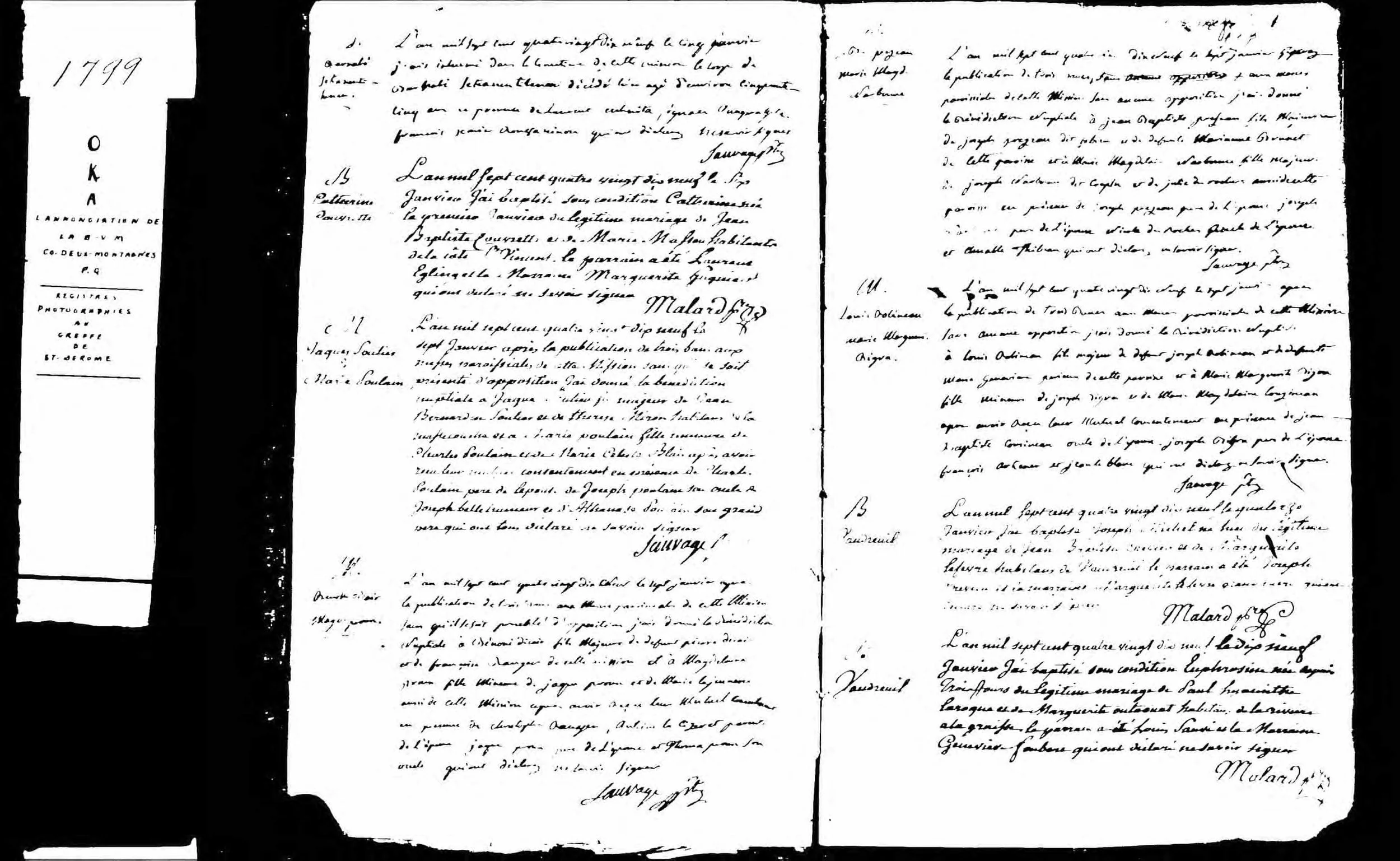
The marriage act at Oka, 7 January 1799.
A Lot on the rue du Prince
14 June 1805 The only document in which Jacques Souliere speaks in the first person is a scrap of a private deed, written for him at the village of Saint-André and deposited eight months later with a notary at Montréal.
Private deed, Saint-André, 14 June 1805
« Moi Jacques Soulière, en presence de temoins soussignés, reconnois et confesse avoir cedé, quitté par donation pure et simple, dès maintenant et a toujours, l'emplacement No 5 rue du Prince a Charles Poulin mon beau-pere, a la reserve seulement d'une place pour y batir une petite maison si besoin etoit. Ne sachant signer j'ai fait ma marque. Lecture faite. Fait au village St André le 14 de juin 1805. »
Deposited 10 February 1806 before Me Peter Lukin père, notary. BAnQ, CN601,S269; images 06M_CN601S269P_15697–15699. Docket no. 3720, 1re expédition. Working reading, September 2026.
What kind of act this is
A dépôt, not a notarial donation. The deed was made privately at Saint-André on 14 June 1805 and brought to Lukin on 10 February 1806 to be registered. That distinction matters: the sentence above is not a notary's formula but a statement taken down from Jacques himself, in his own order of words, ending with the reason he could not sign it.
And it is a town lot, not a farm. A numbered emplacement on a named street in a village — no arpents of frontage, no depth, no river. He gave it outright to his wife's father, keeping back only une place pour y bâtir une petite maison si besoin étoit. A place to build a small house, should he ever need one.
Why Saint-André matters. It is in Argenteuil, on the north bank of the Ottawa. Their children were being baptised at Rigaud from 1804 — a different seigneurie, in Vaudreuil, on the other side of the river. Elisabeth would be buried at Saint-André-Est in 1852, and their son Janvier would settle there. The family's connection to that village begins with this deed.

The deed itself, in the deposit of 10 February 1806. Six lines in the first person, and a mark.
Eleven Children at Rigaud
Jean Baptiste was born at Saint-Benoît in August 1801. Every child after him was baptised at Rigaud (Ste-Madeleine), in the seigneurie of Rigaud, county of Vaudreuil — not, as has sometimes been written, in Argenteuil, which lies across the river.
| Child | Birth | Marriage | Death |
|---|---|---|---|
| Jean Baptiste | 21 Aug 1801St-Benoît | 7 Sep 1824, Thérèse Couturier LajoieRigaud | — |
| François | 7 May 1804Rigaud | 1 Mar 1824, Marguerite Couturier LajoieVaudreuil (St-Michel) | — |
| Janvier | 19 Jan 1806Rigaud — Episode 5 | 17 Nov 1828, Esther Lacasse LacosteSt-Benoît · 2) 29 Apr 1850, Elisabeth Gravel | 1889 |
| Pierre | 11 Oct 1808Rigaud | — | 29 Mar 1814Montréal — aged five |
| Marie Julie | 8 Oct 1810Rigaud | — | 25 Apr 1814Montréal — aged three |
| Jacques | 23 Sep 1812Rigaud | — | 25 Mar 1814Montréal — aged eighteen months |
| Antoine | 30 Aug 1815Rigaud | — | not recorded |
| Louise Eliere | 15 Jul 1818Rigaud | — | 13 Jun 1819Rigaud — aged eleven months |
| Anonyme | 24 Dec 1820Rigaud | — | 27 Dec 1820aged three days |
| Archange | 15 Jun 1822Rigaud | 16 Apr 1839, David Robidoux BelairL'Orignal (Prescott) | — |
| Michel | 31 Dec 1825Rigaud | 14 Aug 1845, Domitille VilleneuveL'Orignal (Prescott) | — |
Five of the eleven died small
Pierre at five, Marie Julie at three, Jacques at eighteen months, Louise Eliere at eleven months, and an unnamed child at three days. The child of July 1818 was a daughter, Louise Eliere, buried at Rigaud on 13 June 1819.
Five of the eleven married. Antoine, born in August 1815, is the one who is neither married nor buried in the record, and he is unaccounted for.
These dates come from the PRDH family record for this couple, not from acts read for this page; several of the baptisms are reproduced below.
The Spring of 1814
Something took the family to Montréal in the spring of 1814, and three of their children were buried there within five weeks.
| Child | Born | Buried | Age |
|---|---|---|---|
| Jacques | 23 September 1812 | 25 March 1814 | eighteen months |
| Pierre | 11 October 1808 | 29 March 1814 | five |
| Marie Julie | 8 October 1810 | 25 April 1814 | three |
Why Montréal?
Every one of their other children was baptised at Rigaud, seventy kilometres upriver. These three were buried at Notre-Dame. Nothing in the record explains what the family was doing in the city — work, an errand, a hospital, a stay with kin, all are possible and none is documented. It is the largest unexplained fact on this page after the missing burial.

The child Jacques, March 1814, Notre-Dame-de-Montréal.

Pierre, aged five.

Marie Julie, aged three, buried 25 April 1814 — a month after her brothers.
The Man Without a Burial
Jacques Souliere has no burial act, no inventory, and no mention in any later document of his children. His PRDH individual record carries no death and no burial. The gap has long been read as running from the birth of his last child on the final day of 1825 to his widow's remarriage on 21 January 1841 — fifteen years in which he could have died anywhere.
Two of his children's marriage acts close it to twenty-one months.
17 November 1828 — Janvier at Saint-Benoît
Marriage of Janvier Soulière and Esther Lacasse
« […] entre Janvier Soulière domicilié en la seigneurie d'Argenteuil, desservie à Ste Magdeleine de Rigaud, fils majeur de Jacques Soulière et de Marie Elizabeth Poulin ses père et mère d'une part, et Esther Lacasse fille mineure de Pierre Lacasse cultivateur et de Marie Labonté […] auquel les parents respectifs ont consenti »
Parish register of Saint-Benoît (Deux-Montagnes), 17 November 1828, entry 28. Banns published also at Ste-Madeleine de Rigaud, per the certificate of Me Hudon, curé of that parish. Signed M. J. Félix ptre. Working reading, September 2026.
The father is named without feu. A priest recording the marriage of a dead man's son writes feu or défunt; this one does not, and the database marks Jacques as present at the ceremony. He was alive in November 1828, three years after his last child was born.
16 April 1839 — Archange at L'Orignal
Marriage of David Bellair and Archange Soulière
« Le seize Avril mil huit cent trente neuf […] entre David Bellair de cette paroisse fils majeur d'Olivier Bellair et de Marguerite Baltazar, de cette mission de St Jean Baptiste de l'Orignal, d'une part, et Archange Bellardin dit Soulière fille mineure de Jacques Bellardin dit Soulière et d'Elisabeth Poulin; ne s'étant découvert aucun empêchement, nous soussigné prêtre de cette mission avons reçu le mutuel consentement de mariage et leur avons donné la bénédiction nuptiale en présence de Louis Baribeau et de Léon Leclerc, et cela avec l'approbation des pères et mères. Tous ont déclaré ne savoir signer. »
Register of the mission of St-Jean-Baptiste de L'Orignal (Prescott), 16 April 1839, entry M.1. Signed P. Lefaivre ptre. Working reading, September 2026.
This is the last sighting
Archange was born in June 1822, so she was sixteen, and the act calls her fille mineure. A minor could not marry without her parents' consent, and the priest records that the marriage was made avec l'approbation des pères et mères. Her father is named, again without feu.
So Jacques Souliere was alive on 16 April 1839, and gave his consent. His widow remarried on 21 January 1841. He died in the twenty-one months between those two dates, at about seventy, somewhere in Prescott County or across the river in Argenteuil.
What this makes worth doing. The window is now short enough to work. The registers of L'Orignal, Saint-André-Est and Rigaud for 1839–1841 are a finite run of pages, and a burial in any of them would answer the question this family has carried longest.
A note on the surname in the 1839 act
The priest writes the family as Bellardin dit Soulière, and the database renders it Bernardin Suliere. That is the same dit name Episode 3's father carried — Bernardin, taken from his own forename — heard and written down at L'Orignal by a priest with no reason to know where it came from. Three generations on and two hundred kilometres away, the name is still travelling with them, and still changing shape.
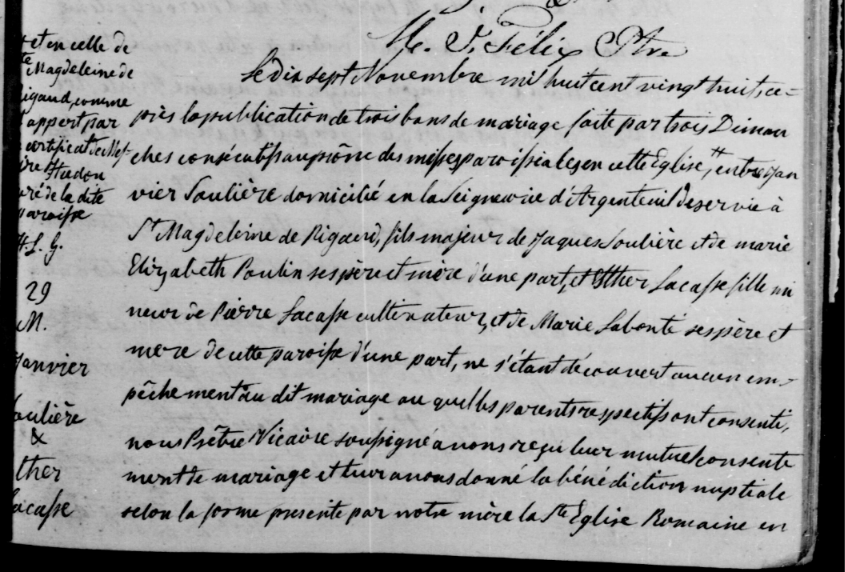
17 November 1828, Saint-Benoît: fils majeur de Jacques Soulière et de Marie Elizabeth Poulin ses père et mère. No feu.

16 April 1839, L'Orignal: fille mineure, married avec l'approbation des pères et mères. The last trace of her father.
After Him
Marie Elisabeth Poulin outlived her first husband by at least eleven years and probably many more.
1851 census Enumerated in January 1852 in the United Townships of Longueuil and Alfred, Prescott County, she appears at the foot of her son Michel's household — entered simply as Mother, aged seventy-one next birthday, and recorded under the surname Soulier, not Benoit.
| Name | Relation | Occupation | Age next birthday |
|---|---|---|---|
| Michel Soulier | head | Jobber | 28 |
| Matilda Soulier | wife | — | 22 |
| Julien Soulier | son | — | 7 |
| Marceline Soulier | daughter | — | 3 |
| Isabell Soulier | daughter | — | 1 |
| Elizabeth Soulier | Mother | — | 71 |
14 August 1852 She died, and was buried two days later at Saint-André-Est.
Burial, 16 August 1852, Saint-André-Est
« Ce jourd'hui seize aout mil huit cent cinquante deux, par nous prêtre soussigné, a été inhumé dans le cimetière de cette [paroisse] le corps de Marie Elizabeth Poulin, veuve de feu Joseph Benoit, décédée avant hier, âgée de soixante quinze ans; et ce en presence de François Soulière, Janvier Soulière et plusieurs autres qui n'ont su signer. »
Parish register of Saint-André-d'Argenteuil, 1852, entry S.33. Signed S. A. Bernier. Working reading, September 2026.
Three things the burial act settles
She was widowed twice. The act calls her veuve de feu Joseph Benoit — her second husband had died before her.
Her sons stood at the grave. François and Janvier Soulière are named as present, and like everyone else there they could not sign.
The stated age is wrong. Seventy-five, says the priest. Baptised 15 May 1781, she was seventy-one — and the census taken seven months earlier gives seventy-one next birthday. Two records against one; the burial age is the outlier.

The census page. Her line is the last of the six, entered as Mother.
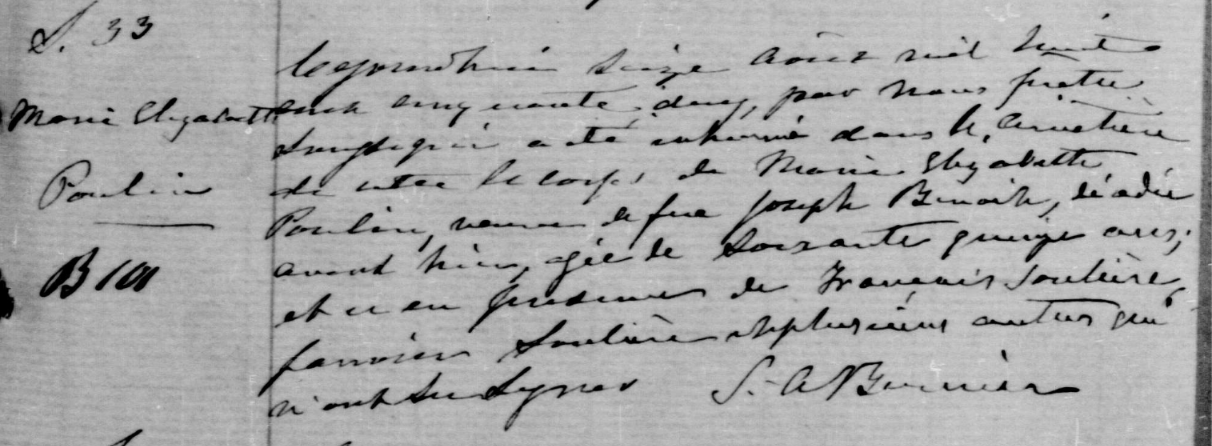
The burial act of 16 August 1852: veuve de feu Joseph Benoit, with François and Janvier Soulière present.

The full register page at Saint-André-Est, August 1852.
Legacy
Jacques Souliere left no signature and, so far, no grave. What he left in his own voice is six lines of a deed: he gave a village lot to his wife's father and kept back a place to build a small house if he should ever need one. Whether he ever built it is not recorded.
Four generations, one occupation
His son Michel is a jobber in the census of 1851. His father Jean Bernardin was journalier de l'Isle-Jésus at his burial in 1820. His great-great-grandfather Nicolas was journalier in the census of the town of Québec in 1716. A century and a half of work hired by the day, and the only thing that changes is the language the word is written in.
Five of his eleven children married, into the Couturier Lajoie, Lacasse, Robidoux and Villeneuve families, and the family's centre moved west with them — from Rigaud in Vaudreuil, to Saint-Benoît and Saint-André in Argenteuil, and across the Ottawa into Prescott County. His son Janvier, born at Rigaud on 19 January 1806, is the subject of Episode 5.
Document Gallery
The notarial deposit, the census and the parish register acts behind this page. Database records are given as tables in the text above rather than here, so that what a database reports and what a record states are not shown side by side as though they were the same kind of evidence.
Jacques — L'Assomption
Marie Elisabeth Poulin — Pierrefonds
Oka (L'Annonciation)
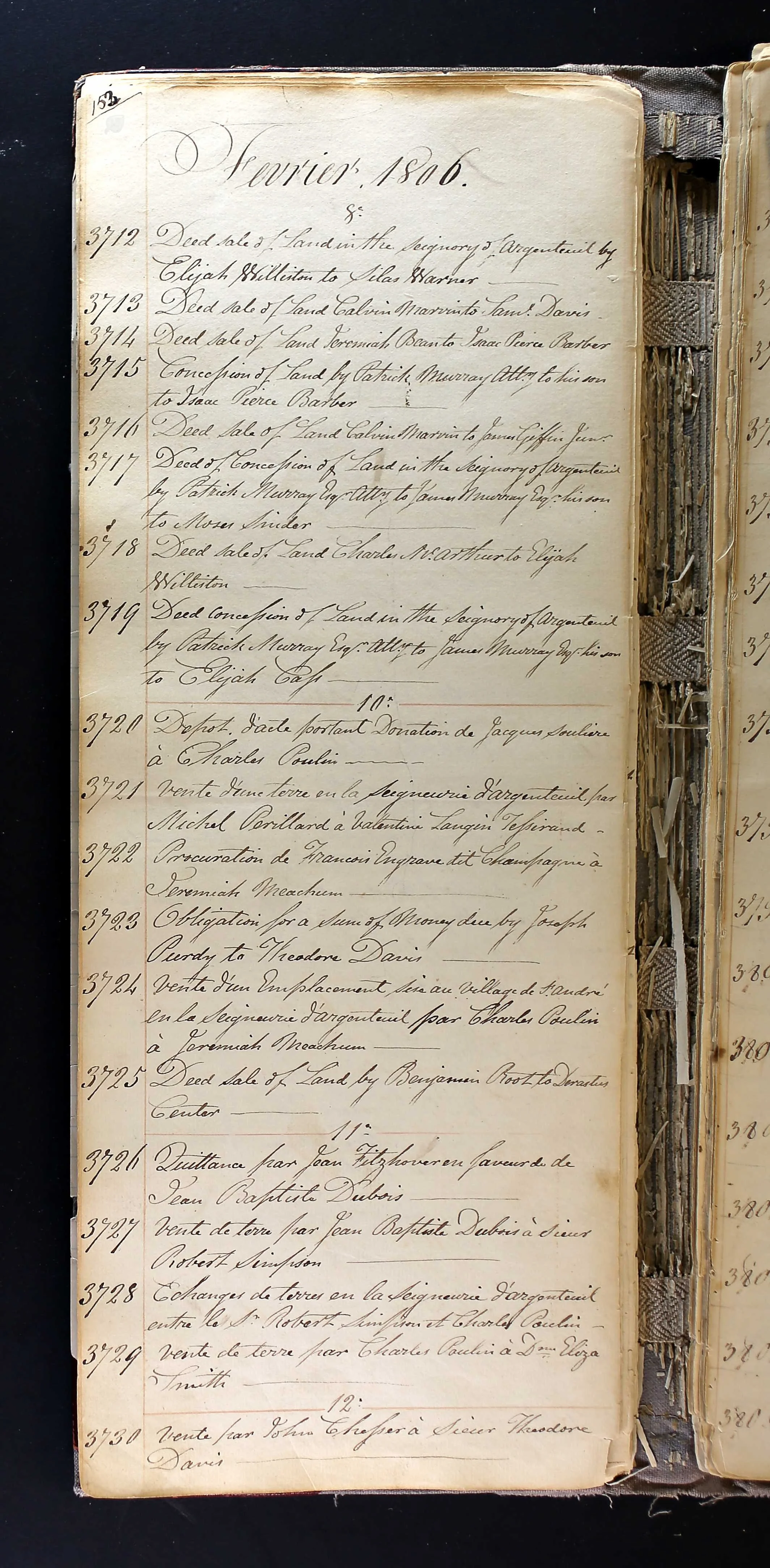
Wrapper — Lukin, no. 3720
« l'emplacement No 5 rue du Prince »

Jean Baptiste — St-Benoît

François — Rigaud

Janvier — Episode 5
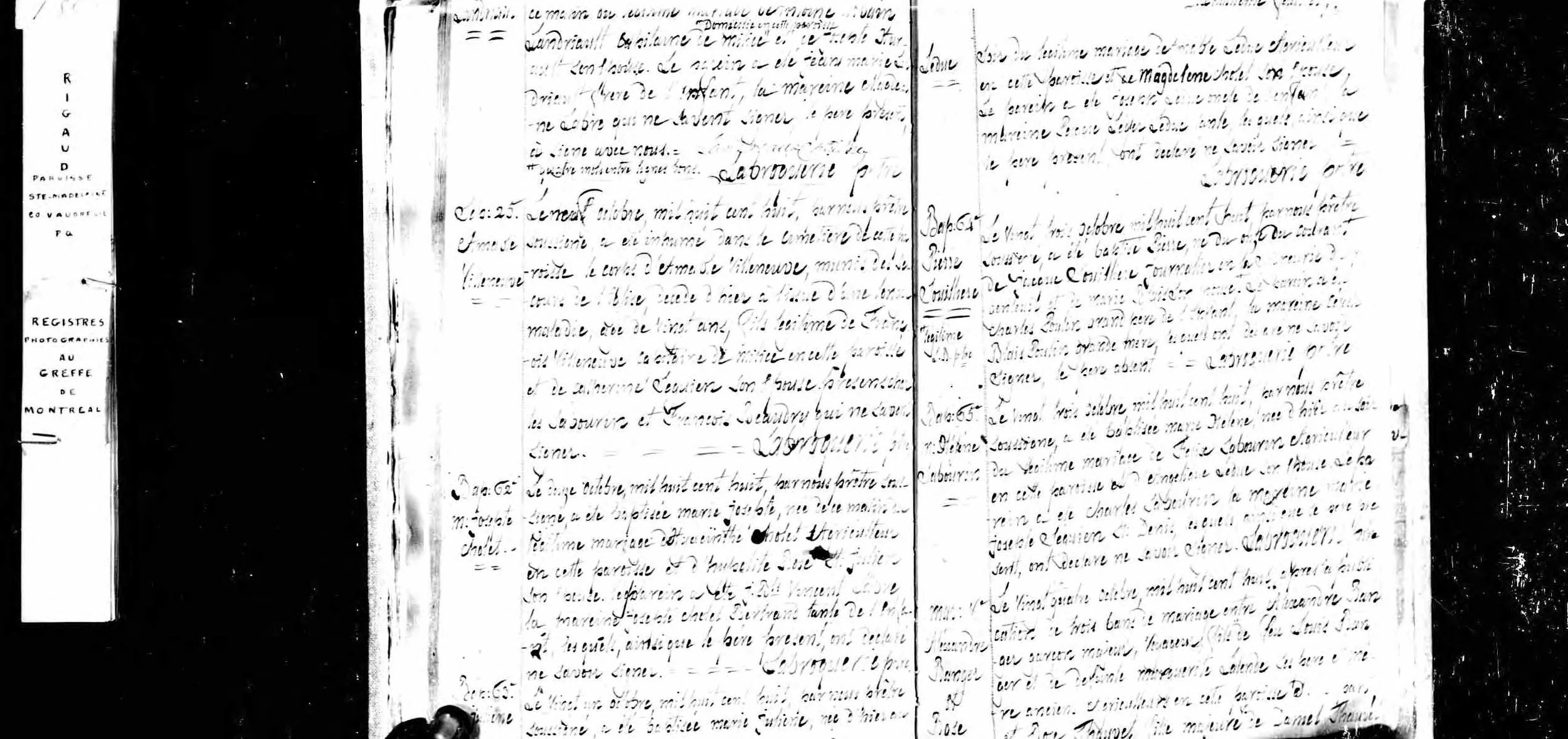
Pierre — died 1814
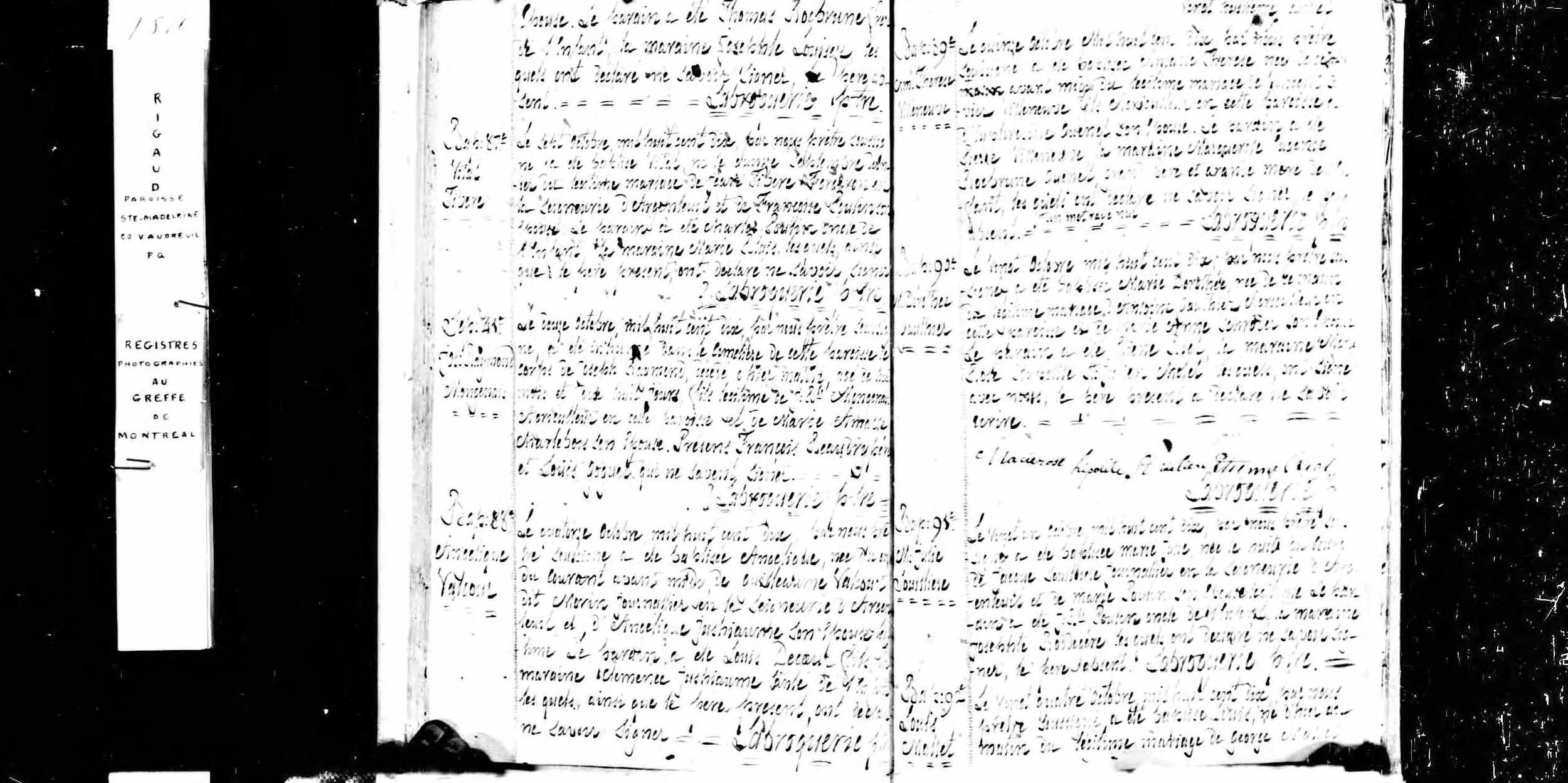
Marie Julie — died 1814

Jacques — died 1814
Jacques — Notre-Dame-de-Montréal
Pierre, aged five
Marie Julie, aged three
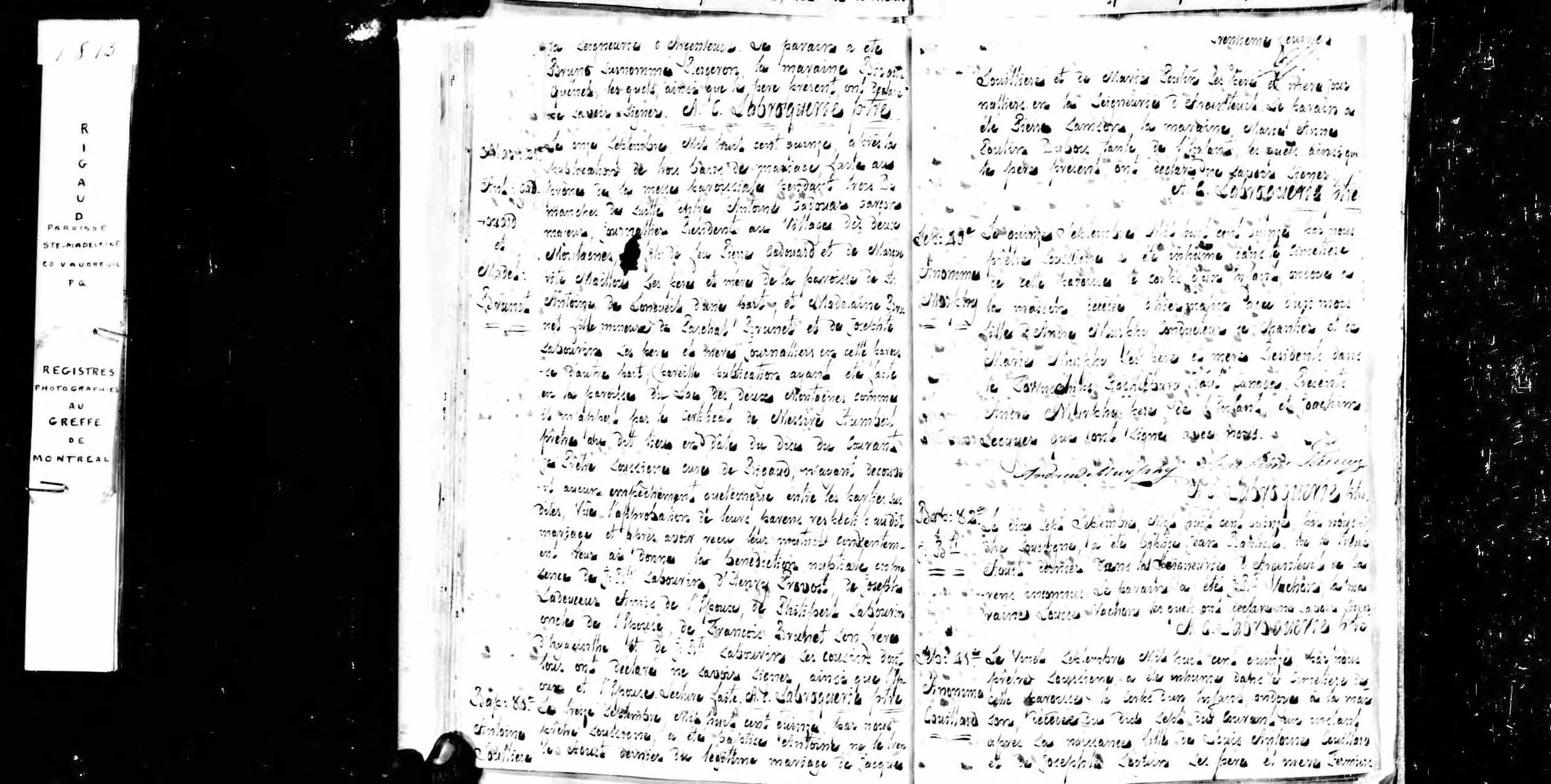
Antoine — unaccounted for
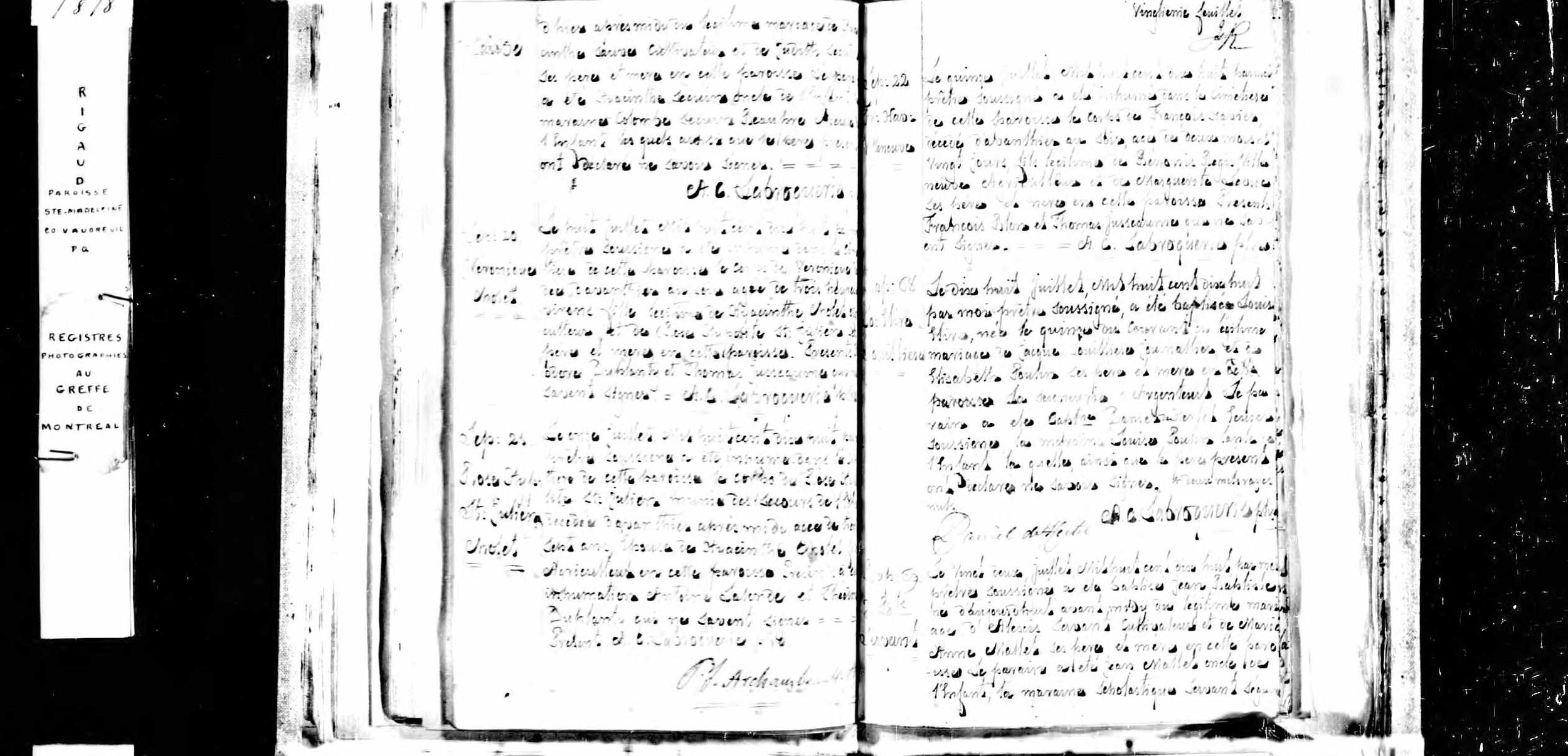
Louise Eliere — died 1819

Archange — Rigaud

Michel — the last child

Janvier & Esther Lacasse — St-Benoît
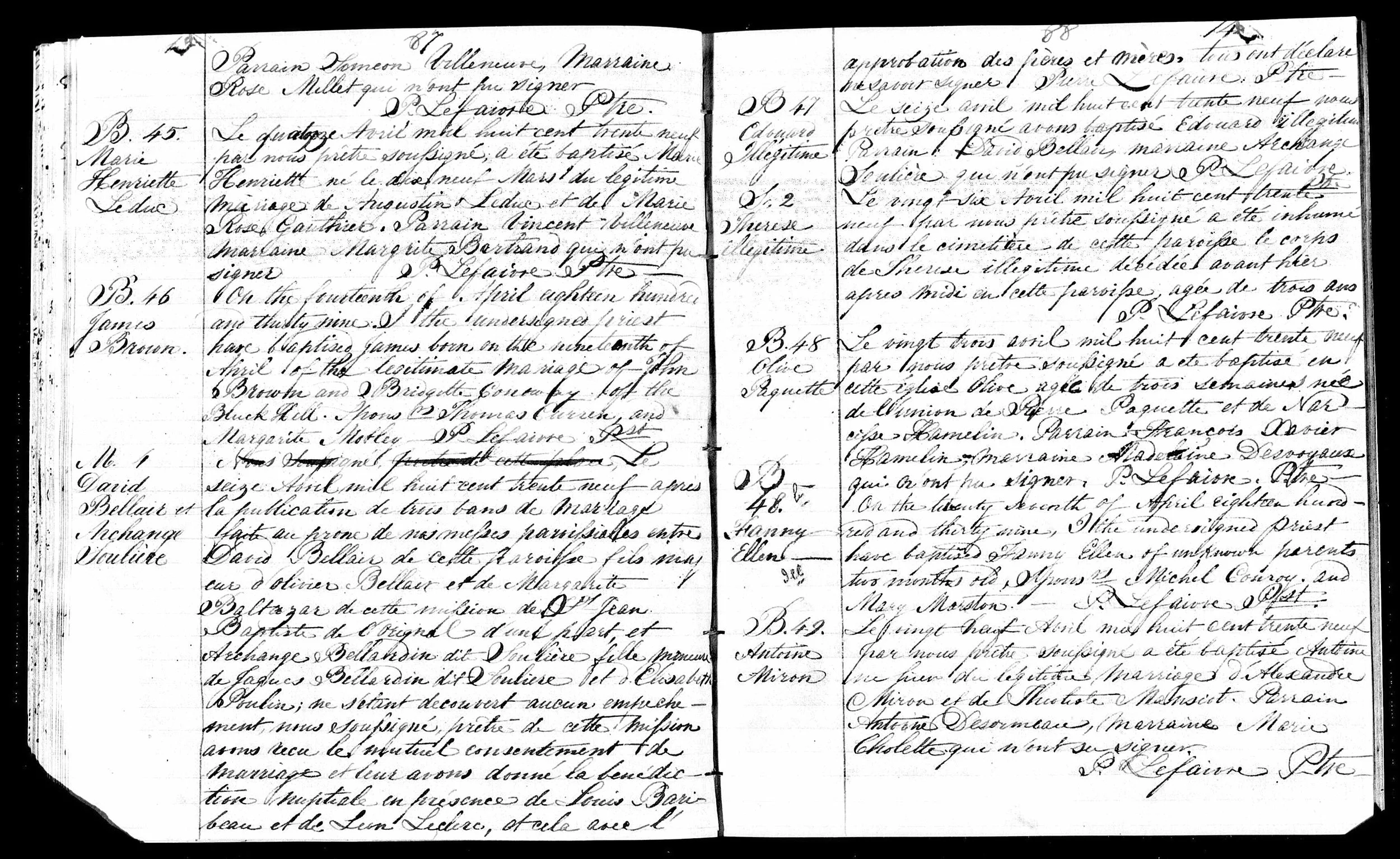
Archange & David Bellair — L'Orignal
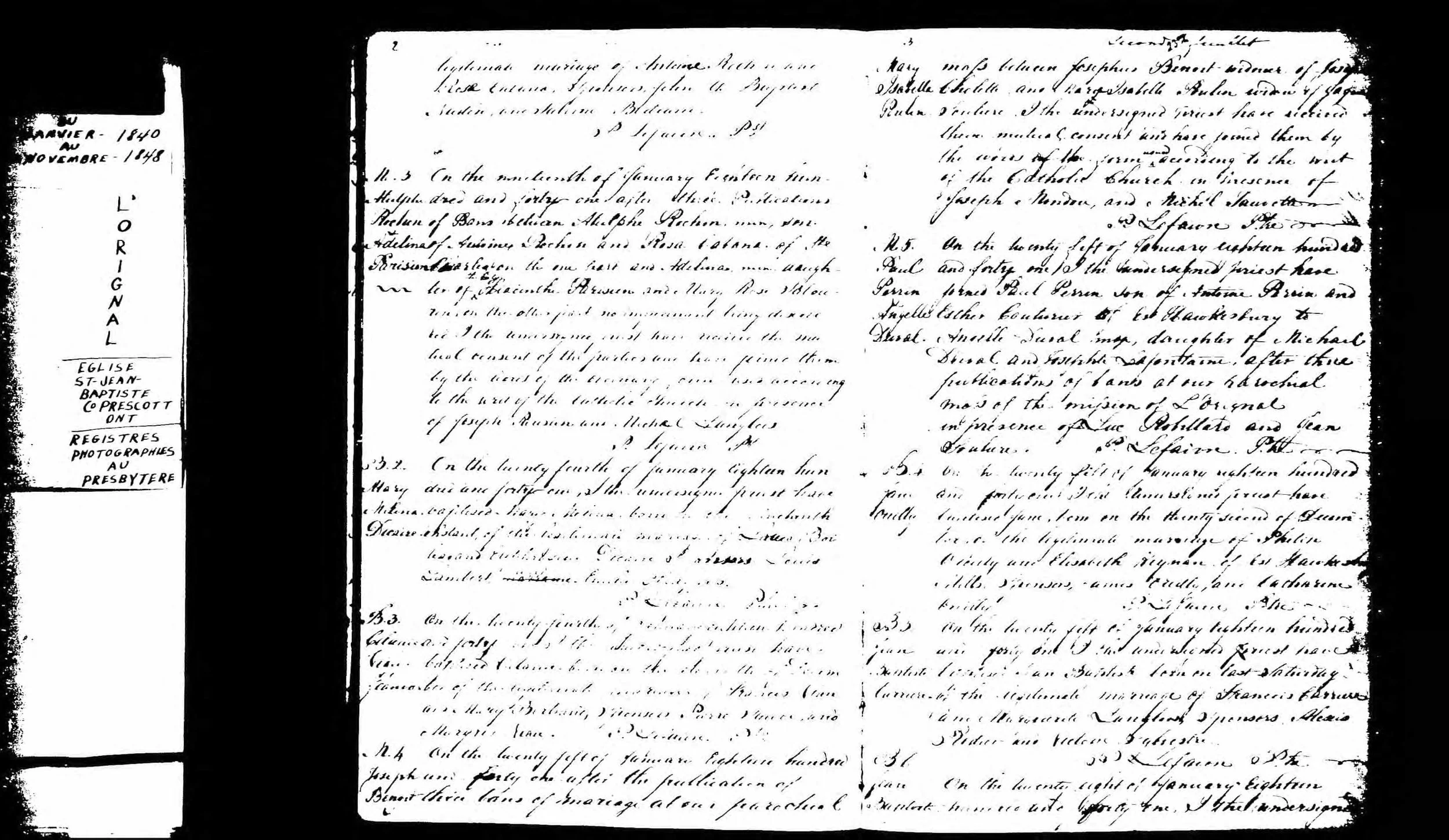
Elisabeth, veuve, to Benoit — L'Orignal
Prescott County — with son Michel
Detail — veuve de feu Joseph Benoit
St-André-Est register (full page)
Sources
Notarial record, read directly
- Acte portant donation de Jacques Soulière à Charles Poulin, private deed made at the village of Saint-André on 14 June 1805, deposited 10 February 1806 before Me Peter Lukin père, notary. BAnQ, CN601,S269; images 06M_CN601S269P_15697–15699; docket no. 3720. Transcribed above. Working reading, not collated.
Census
- 1851 Census of Canada West (enumerated January 1852), Prescott County, United Townships of Longueuil and Alfred, Enumeration District No. 3, page 27, lines 15–20. Enumerator Sturgis M. Cushman. Library and Archives Canada.
Parish registers — parish copy, examined
- Marriage of Janvier Soulière and Esther Lacasse, 17 November 1828, Saint-Benoît (Deux-Montagnes), entry 28 — detail and full page. Transcribed above. Names Jacques Soulière without feu; PRDH marriage no. 13483155 marks him present.
- Marriage of David Bellair and Archange Bellardin dit Soulière, 16 April 1839, mission of St-Jean-Baptiste de L'Orignal (Prescott), entry M.1 — detail and full page. Transcribed above. The bride a minor, married avec l'approbation des pères et mères.
- Burial of Marie Elizabeth Poulin, 16 August 1852, Saint-André-d'Argenteuil, entry S.33 — detail and full page. Transcribed above.
- Baptism of Jacques Souliere, 25 June 1768, L'Assomption.
- Baptism of Marie Elisabeth Poulin, 15 May 1781, Sainte-Geneviève de Pierrefonds.
- Marriage, 7 January 1799, Oka (L'Annonciation).
- Baptisms of Jean Baptiste (1801, St-Benoît); François (1804), Janvier (1806), Pierre (1808), Marie Julie (1810), Jacques (1812), Antoine (1815), Louise Eliere (1818), Archange (1822) and Michel (1825), all Rigaud (Ste-Madeleine).
- Burials of the children Jacques, Pierre and Marie Julie, spring 1814, Notre-Dame-de-Montréal.
- Marriage of Marie Elisabeth Poulin, widow, and Joseph Vaillancourt Benoit, 21 January 1841, L'Orignal (Prescott).
- All examined; only the 1852 burial is transcribed on this page.
Database
- PRDH-IGD, Université de Montréal — individual no. 351394 (Jacques); individual no. 351395 (Marie Elisabeth Poulin); marriage no. 773796 (Oka, 1799); family record for couple no. 89615, which supplies the eleven children; family no. 1171538 (the Benoit marriage of 1841); marriage no. 13483155 (Janvier, 1828); family no. 1171306 (Archange and David Robidoux Belair, 1839); individual no. 699525 and families nos. 165841 and 266734 (Janvier). Rendered above as tables. Database fields are not transcriptions of acts.
Not located, or not resolved
- The burial of Jacques Souliere, between 16 April 1839 and 21 January 1841. Twenty-one months. The registers of L'Orignal, Saint-André-Est and Rigaud for those years have not been searched page by page, and that search is now worth making.
- The marriage acts of Jean Baptiste and François, both 1824, and of Michel, 1845 — not needed for the window, but they may name him.
- What became of Antoine, born 30 August 1815, neither married nor buried in the record.
- Why the family was at Montréal in the spring of 1814, and whether the dates of the three burials are days of death or of interment.
- Whether Jacques ever built the small house he reserved a place for on the rue du Prince, and what became of lot no. 5 after 1805.
- For Episode 5: Beauregard and other compiled sources credit Janvier with three marriages and nineteen children; the PRDH carries two marriages and seventeen children born before 1862. The difference has not been worked out and belongs on his page, not this one.
Storyline Genealogy
From Research to Story
Are You Connected to the Souliere Line?
If you descend from the Souliere, Suliere, or Soulier (dit Tranchemontagne) family of L’Assomption and St-André-d’Argenteuil, from the nineteen children of Janvier Souliere Sr., or from the allied Gravel, Poulin, Migneron, Lacasse, or Lesage lines — whether your branch stayed in Quebec or came to Chicago — I’d like to compare notes. Documented trees, DNA matches, family papers, and even half-remembered stories have all moved this research forward.
Get in Touch About This FamilyCousin connections are informal and reciprocal — no fee, no obligation, just shared work on shared ancestry.
Every Family Has a Story Worth Telling
Whether you're just beginning your research or ready to transform years of work into a narrative your family will treasure, I'd love to help.
LET'S TALK ABOUT YOUR FAMILY