
Jean Suliere dit Tranchemontagne 1696-1766
Jean Suliere dit Tranchemontagne
Birth: vers 1696 — the year is PRDH's estimate; no baptism has been located
Father: Nicolas Suliere Sustier dit Tranchemontagne
Mother: Marguerite Le Blanc
Marriage contract: 8 September 1716, before Me Pierre Rivet dit Cavelier, Québec
First marriage: 14 September 1716, Notre-Dame-de-Québec — Marie Louise Lesage
First land: concession from the Séminaire de Montréal, 20 January 1718, act no. 2241, Me Pierre Raimbault — three arpents of frontage by twenty deep in the seigneurie de Saint-Sulpice
Second land: concession from the same seigneurs, 30 April 1720, act no. 2591 — five arpents of frontage on the Rivière L'Assomption, above the portage, replacing the first
Children: twelve, 1717–1737. Eight married; four died in infancy.
Second marriage: 30 October 1758, L'Assomption — Marie St-Jean dit Lagrange dit Lacage, widow
Estate: inventory of the community with Marie Louise Lesage, 27 April 1757, act no. 816 before Me Jean-Baptiste Daguilhe; closed at Montréal, 9 March 1759
Death: 7 October 1766, L'Assomption — see the note on this date below
A note on evidence
This page distinguishes what a record states from what a database reports. Five original notarial minutes have now been read directly and are quoted below. The parish register acts reproduced here are from the copy photographed at the presbytery; every image has been examined, and where an act is quoted the transcription is a working reading rather than a collated one. No act on this page has been checked against the second copy deposited with the court. Where a claim rests on an index entry rather than an act, or on a catalogue description, or on nothing at all, that is said too.
Introduction
Jean Suliere, known by the dit name Tranchemontagne, lived a life that traced the expansion of French colonial settlement from the parishes around Québec City to the lands along the Rivière L'Assomption.
Born about 1696, Jean became a habitant in the growing region north of Montréal, where he raised twelve children and established roots that continue through his descendants. His story is documented through parish registers, five notarial minutes, a judicial closing of his estate, and the declarations of inability to sign that mark the milestones of colonial life.
The spelling of his surname moves with the hand that wrote it: Suliere, Souliere, Soulières, Sullières, Suyer and Sustier all appear, sometimes within one register. That fluidity was ordinary when priests and notaries recorded names phonetically without consulting earlier entries—and it is worth remembering before searching any index on a single spelling.
Origins: What the Contract Proves
Jean was the son of Nicolas Suliere Sustier dit Tranchemontagne and Marguerite Le Blanc. That parentage is worth pausing on, because compiled genealogies carry it only as a probability. Denis Beauregard's family sheet marks it presumed by convergence (male lineage only).
It does not need to be presumed. On 8 September 1716, both of Jean's parents walked into the study of the notary Pierre Rivet dit Cavelier at Québec and appeared in person to settle their son's marriage.
From the marriage contract, 8 September 1716
« Pardevant le No[tai]re Royal en la prevosté de quebec y residant soubsigné, furent presents Nicolas Suyer dit tranchemontagne demeurant en cette ville et Marguerite le Blanc sa femme qu'il a[u]thorise a l'effet des presentes Stipulants en cette partie pour Jean Suyer leur fils aussy present ce et de son Consentement d'une part… »
Bibliothèque et Archives nationales du Québec, CN301,S240, greffe de Pierre Rivet dit Cavelier. Working reading from the original minute, September 2026.
The father living in the town, authorising his wife as the Coutume de Paris required; the son present and consenting. It is as direct a statement of parentage as the colonial record produces, and it has been sitting in a digitised greffe.
The contract is also in print
Pierre-Georges Roy indexed it in 1937: « Lesage, Marie-Louise, et Jean Suier (Rivet, 8 septembre 1716) »—volume 4, page 136 of his inventory of French-regime marriage contracts. Roy read the same greffe read above, so the entry confirms the citation without being a second witness to the act. Its use is practical: it is how the contract can be found without a BAnQ session open, and it fixes the surname in the notary's own register as Suier. That same page of Roy turns out to matter again below.
The Marriage of September 1716
8 September 1716 The contract came first. Jean Bernardin Lesage stipulated for his daughter Marie Louise Lesage, and the act describes him by an office: Brigadier des Gardes du Castor de ce pays—brigadier of the beaver guards, who kept the stores of the fur monopoly at Québec.
The two families were to be common in moveables and acquests under the Coutume de Paris. The bride was assured a douaire of the customary kind or eight hundred livres préfix, paid once, at her own choice; the préciput was one hundred and fifty livres, equal and reciprocal. Witnesses were Sieurs Jacques Pinguet de Vaucour and Jean Mossion, of Québec. It was done in the notary's study, after midday.
And then the signatures, which divide the two families down the middle.
Who could write
The bride signed. Her sister Marie Françoise signed. Their father signed. Jean Suyer, his father Nicolas, his mother Marguerite Le Blanc and his brother Nicolas all declared they could not write or sign, questioned as the ordinance required. Every Lesage present put their name to the contract; no Suyer did.

Marriage contract, 8 September 1716 — first page. Names both sets of parents and the office of the bride's father. BAnQ, CN301,S240.

Third page. The signature block: Marie Louise Lesage, Marie Françoise Lesage, Jean Bernardin Le Sage, the two witnesses and the notary Rivet.
14 September 1716 Six days later the couple were married at Notre-Dame-de-Québec, the mother church of French Canada. Jean was about twenty. The banns had been published on three consecutive Sundays, as canon law required, and no impediment was found.
A note on the witnesses
This page previously named four witnesses at the 1716 wedding: Jean Odquin, Paul Quenel, Bazile Grégoire and François Cochars. Those men belong to the second marriage, in 1758. The PRDH record of the 1758 act at L'Assomption gives Pierre Bodquin, Noel Quenel, Basile Grégoire and François Cochard—the same four surnames, in the same order. Witnesses to a marriage at L'Assomption in 1758 cannot have stood at Notre-Dame-de-Québec forty-two years earlier. The 1716 act is reproduced below and has not yet been read closely; its witnesses will be given once it has.

Parish register page, Notre-Dame-de-Québec, 14 September 1716.

Detail from the same act.
The First Land: 20 January 1718
20 January 1718 Sixteen months after the wedding, and with one infant son baptised at Québec, Jean took a concession from the Séminaire de Montréal in the seigneurie de Saint-Sulpice: three arpents of frontage by twenty of depth, fronting on the Rivière L'Assomption. The répertoire lists it at sixty arpents, which is the same land described by area rather than by frontage.
The operative clause — act no. 2241, 20 January 1718
« […] a volontairement Bailé et Concedé a cens de fienc dez et Maintenant et a toujours a Jean Sullieres d[i]t Tranchemontagne a ce present et acceptant preneur audit titre pour luy ses hoirs et Ayans Cause a l'avenir la Quantité de Trois Arpens de terre de front sur vingt Arpens de proffondeur scis dans la Seigneurie de S[ain]t Sulpice, a prendre les tenans d'un bout a l'écor du Bois debout sur le bord de la Riviere de L'Assomption […] d'un coté a [Paul Daveluy son beau frere] et d'autre aux terres non concedees »
BAnQ, CN601,S340, greffe de Pierre Raimbault, act no. 2241. Working reading from the digitised minute, September 2026. The bracketed boundary is a marginal renvoi keyed into the text with a cross; the struck-through original wording beneath it has not been recovered.
Three words in the margin
The renvoi is the reason this act matters more than its acreage. Written down the left edge of the first page, in the notary's hand, are the words:
Marginal renvoi, act no. 2241
« Paul Daveluy son beau frere »
Same act, left margin of the first page, marked with a cross keyed to the boundary clause.
Jean Suliere did not go to the Rivière L'Assomption alone, and he did not go to empty country. The man whose land ran along one side of his was his wife's brother-in-law, and the notary thought the relationship worth recording. On the other side lay terres non concédées—land not yet granted to anyone. Jean was taking up ground at the edge of settlement, next to family.
The route of the relationship is in the same volume of Roy that indexed Jean's own contract. Two entries above it, on the same page:
Roy, Inventaire des contrats de mariage, vol. 4, p. 136
« Lesage, Marie-Françoise, et Jean-Paul Daveluy (Chambalon, 21 janvier 1712). »
Pierre-Georges Roy, Inventaire des contrats de mariage du Régime français conservés aux Archives judiciaires de Québec (Québec, 1937–1938), vol. 4, p. 136.
That entry has now been followed to the minute behind it, and it does what an index cannot: it names the bride's parents.
From the Daveluy–Lesage marriage contract, 21 January 1712
« […] furent presens Jean paul Dauely fils de deffunct paul Dauely vivant habitant demeurant a la riviere des prairies en l'isle de montreal et de Elizabeth aquin sa veufue ses pere et mere […] Et M[aist]re Jean bernardin Lesage tisserand demeurant en cette d. ville stipulant en cette partie pour marie françoise Lesage sa fille et de marie barbe silvestre sa femme […] »
BAnQ, CN301,S58, greffe de Louis Chambalon, 21 January 1712, images 03Q_CN301S58P_12967–12971. Working reading from the original minute, September 2026.
Marie Barbe Sylvestre and Jean Bernardin Lesage are Marie Louise Lesage's parents too. The bride of 1712 and the bride of 1716 are sisters, and Raimbault's three words in the margin are documented rather than merely asserted: Jean-Paul Daveluy married Jean Suliere's wife's sister, four years before Jean married into the family.
The 1712 contract also says where the Daveluys were. Jean-Paul was the son of the late Paul Daveluy, habitant, demeurant à la Rivière des Prairies en l'île de Montréal, and of Elisabeth Aquin, his widow—who was too far off to attend and acted through a proxy, Messire Jean François Buisson, canon of the cathedral at Québec. Rivière-des-Prairies is where Jean Suliere's own daughter Marie-Jeanne-Anne would be baptised in June 1722. The two families were not merely related; they were moving through the same few parishes on the same side of the island.
And the signatures repeat the pattern of 1716 exactly. Marie Françoise Lesage signed her own contract; her father signed; the groom declared he could not sign, questioned as the ordinance required. Four years later her sister would sign, her father would sign, and Jean Suliere would declare the same thing.
What is established, and what is not
Established: Paul Daveluy was Jean Suliere's beau-frère—stated by the notary in 1718, and explained by the 1712 contract, which gives the two brides the same father and mother.
Still to check: the reading of the surname. The hand writes u for v: the name in the 1720 act was first read here as Danely before the 1718 and 1712 minutes settled it as Daveluy. None of the three readings has been collated. And the identification of the man holding the neighbouring lot in 1718 and 1720 with the groom of 1712 rests on the notary's own word beau-frère, not on a stated filiation in the land acts themselves.

Marriage contract, 21 January 1712, before Me Louis Chambalon at Québec. The heading names the parties; the filiation clause below gives Marie Françoise Lesage as daughter of Jean Bernardin Lesage and Marie Barbe Sylvestre. BAnQ, CN301,S58.

The signature block. Marie Françoise Lesage and Jean Bernardin Le Sage signed; the groom declared he could not.
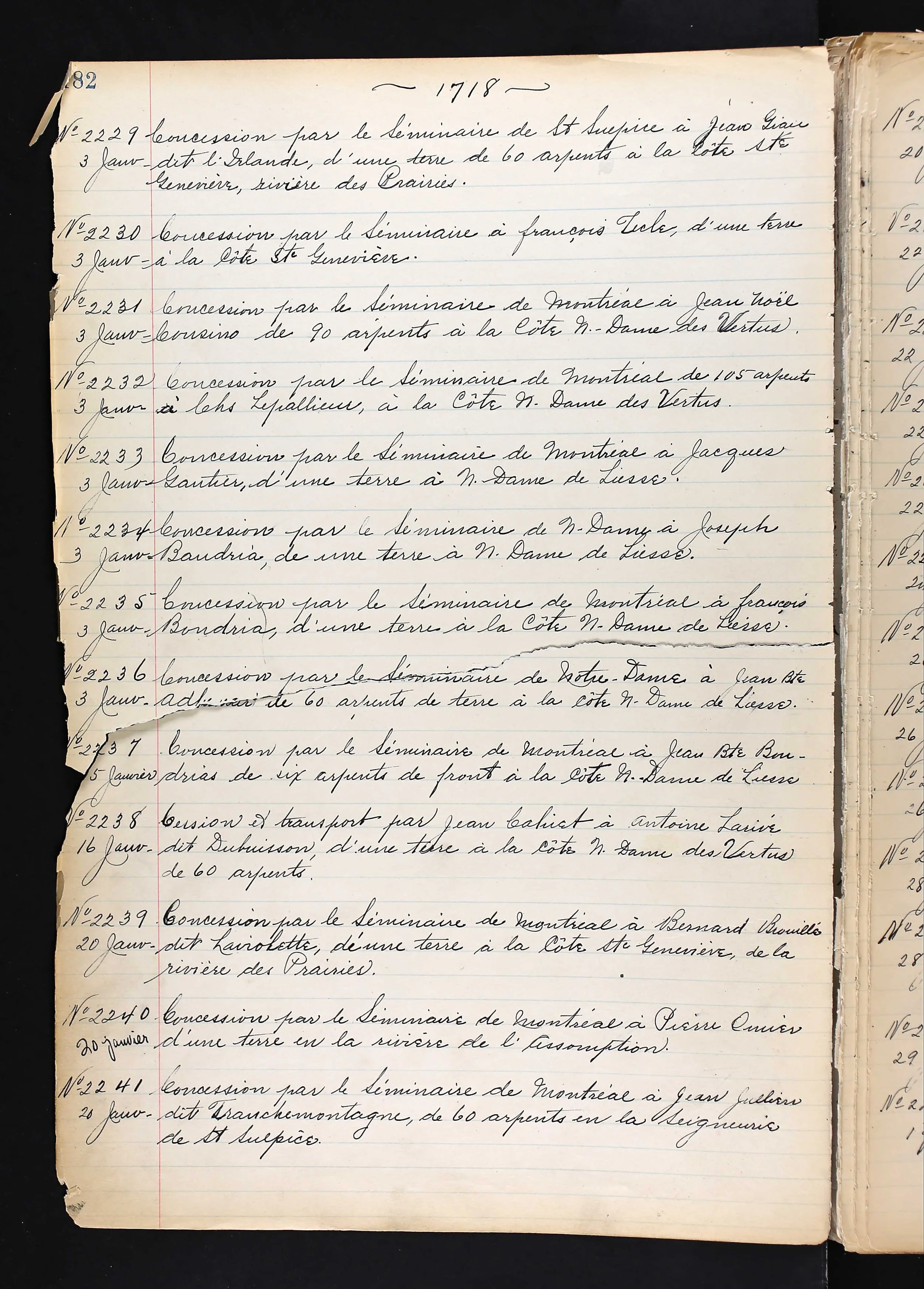
The répertoire for 1718. Act no. 2241, 20 January: « Concession par le Séminaire de Montréal à Jean Sullière dit Tranchemontagne, de 60 arpents en la Seigneurie de St Sulpice ». The entry immediately above it, no. 2240 of the same day, grants Pierre Ouier land on the same river—the seminary was settling that stretch in a single sitting.

Act no. 2241, first page. The margin carries the renvoi naming Paul Daveluy as the grantee's brother-in-law. BAnQ, CN601,S340.
The grantor is Messire François Vachon de Belmont, priest of the Seminary of Saint-Sulpice and superior of the ecclesiastics of the Séminaire de Villemarie, acting as procurator for François Leschassier, superior in Paris, for the seminary as seigneurs and proprietors of the île de Montréal and other places. He is assisted by Messire François Citoys de Chaumaux, priest, secretary and œconome of the seminary at Villemarie, who signs the act beneath him. The same two men appear in the concession of 1720.
An anomaly in the third page — read this before citing it
The three images held for this act are pages one, two and three as filmed. The first page is unmistakably Jean's. But the closing of the third page reads « led. Paul Daveluy a declaré ne sçavoir signer, de ce interpellé, lecture faite »—naming Daveluy, not Suliere, as the party who could not sign. Raimbault appears to have passed concessions to both brothers-in-law at Villemarie that same afternoon, before the same witnesses, in near-identical wording, and the third page may therefore end the Daveluy act rather than this one. Until the film's page sequence is checked, the datation and the non-signature clause are not cited here as Jean's. The alternative—that Raimbault copied the wrong name into his own closing—is possible and is not assumed.

Second page: the mill obligation, the thirty-six-foot road the grantee must leave and keep passable, and the seigneurs' reservation of timber and of a right of first refusal.

The third page as filmed, with the datation of 20 January 1718 and the signatures of Belmont, Citoys de Chaumaux, the witnesses Guillet and Monsou, Gamelin and the notary Raimbault. Its non-signature clause names Paul Daveluy—see the note above.
The Second Land: 30 April 1720
30 April 1720 Two years and three months later, Jean gave the first grant back and took a larger one. The concession of 30 April 1720 gives him five arpents of frontage on the Rivière L'Assomption, above the portage, with the depth left open. This is the grant that fixed the family in the region for the rest of their lives, and until this month it was known here only from a one-line index entry.
The operative clause — act no. 2591, 30 April 1720
« […] a Reconnu et Confessé avoir Baillé et Concedé a titre de Cens et Rentes Seigneurialles non Rachetables a Jean Sullieres ce present acceptant preneur aud. titre pour luy ses hoirs et ayans cause a l'avenir la quantité de Cinq arpens de terre de front sur la proffondeur qui se trouvera, sur le bord de la Riviere de Lassomption, au dessus du portage, du Costé du Sud ouest de lad. Riviere, a prendre un arpent du Costé du Sud est de certaine ligne tirée en proffondeur au Sud ouest par derriere le bout des habitations qui sont au dessous dud. portage, et quatre arpens au dessus de lad. ligne du Costé du Nord ouest, le tout sans anticiper sur les vingt arpens de proffondeur desd. habitations de lad. Coste de la Riviere de Lassomption […] au dessous dud. portage. »
BAnQ, CN601,S340, greffe de Pierre Raimbault, act no. 2591. Working reading from the digitised minute, September 2026.
Put on the ground, that places the farm above the portage, on the south-west bank. A line had been run inland to the south-west behind the rear ends of the habitations lying below the portage; Jean's five arpents straddle that line—one arpent on its south-east side, four on its north-west—and the act is careful that they must not eat into the twenty arpents of depth already belonging to those neighbouring farms. His own depth is left to the survey: sur la profondeur qui se trouvera.
The portage named in the clause is the one the parish took its name from. L'Assomption's church was Saint-Pierre-du-Portage; Jean's land lay just upstream of it. All eight of the children baptised from 1725 onward were carried to that church.
What he owed for it
The charges run to two full pages, and they are the ordinary weight of the seigneurial system written out. Jean and his heirs were bound to bring their grain to the seigneurs' mill and to help build it; to hold feu et lieu—a dwelling, lived in—on the land within one year at the latest; to clear; to suffer roads across the land and to make and keep passable a grand chemin along the frontage; and to fence in common with his neighbours on both sides.
The rent was ten sols and a half-minot of wheat—good, dry, clean, sound and merchantable—for every twenty arpents of superficie, carried to the seminary's receipt office at Villemarie, together with a further seven sols six deniers in a clause the notary partly struck through. It fell due each year at Saint-Martin, 11 November, the first payment the following year.
The seminary reserved a good deal besides: lods et ventes, saisines, defaults and fines under the Coutume de Paris; construction timber for its own use, taken without payment for as long as any stood; one arpent of standing wood it could have cut and carried off once, whenever and by whomever it pleased; any millstones found in the ground; and a right of first refusal over the farm ahead of any purchaser. Jean, for his part, had one year to have the concession measured by a sworn surveyor and to produce the certificate—on pain of the grant being void.
It was done at Villemarie, in the seminary's hall, on the afternoon of 30 April 1720, before Ignace Gamelin and Jean Baptiste Hervieux, merchants of the island, as witnesses. Belmont signed; the two merchants signed; the notary signed.
He still could not sign
« et led. preneur declaré ne sçavoir Signer, de ce Interpellé, Lecture faite. » Four years after the contract at Québec, questioned again as the ordinance required, Jean Suliere again declared he could not sign. This is the second act read directly on this page in which he says so—two notaries, two towns, four years apart, the same answer. The 1718 concession is not counted here, for the reason given in the previous section.
The grant this one replaced
At the foot of the act, in a marginal addition keyed into the text with a cross, is the clause that ties the two concessions together.
Marginal addition, act no. 2591
« Et au Moyen de la d. presente Concession, celle cy devant faite aud. preneur d'une portion de terre qui joint d'un Costé a Paul Daveluy et d'autre […] sur le bord de la d. Riviere de Lassomption, demeure dès a present Nulle, led. preneur la Retrocedant a Mess[ieu]rs Les Seigneurs pour y faire et disposer comme bon leur semblera […] »
Same act. The second boundary is not yet legible.
An earlier concession to the same grantee—a portion of ground bounded on one side by Paul Daveluy, on the bank of the same river—is declared null by this act and handed back to the seminary. That is the grant of 20 January 1718. Same grantee, same grantor, same river, same neighbour named on the same side. Jean surrendered three arpents of frontage on a fixed twenty-arpent depth and took five arpents on an open depth, half a river-bend upstream, above the portage.
How firm is that identification?
The 1720 clause does not date the grant it annuls, so the two acts are joined by convergence rather than by a stated cross-reference: the grantee, the grantor, the river and the adjoining owner all agree, and act 2241 precedes act 2591 in the same greffe. What would settle it is a negative search: a page-by-page reading of the Raimbault répertoire between acts 2241 and 2591 for any other concession to Jean Sullières. That search has not been made, and until it is, this page treats the identification as very probable rather than proved.
What these readings are, and are not
The passages from both concessions are working readings of the digitised minutes made in September 2026, not collated transcriptions. The rent figures, the second boundary in the retrocession clause, and the struck-through passages all need checking at higher magnification. A marginal note on the first page of act 2591, apparently recording the delivery of an engrossed copy and dated 10 March 1726, has not been read with confidence. Where a figure matters here, treat it as provisional.

The répertoire entry that led to the act. The five arpents and the grantor are here. The boundaries, the charges, the reservations and the retrocession of the 1718 grant are not. An index entry is a clerk's summary; it is not the deed.

Act no. 2591, first page. The margin carries the act number and date; the body names Belmont and describes the five arpents above the portage.

Second page: the grand chemin, the common fencing, the rent payable at Saint-Martin, and the reservations of timber and millstones.
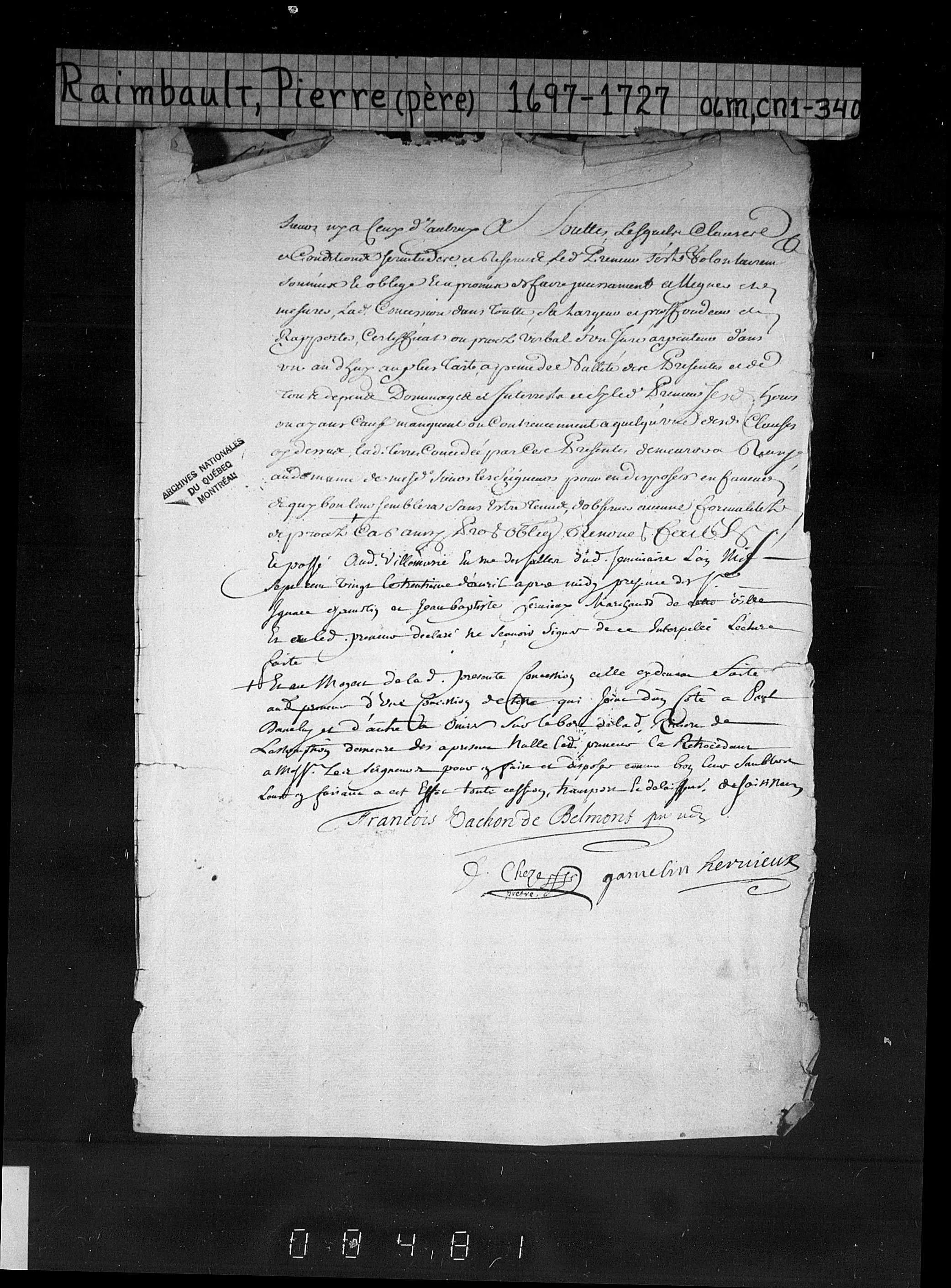
Third page. The surveyor's obligation, the datation at Villemarie before Gamelin and Hervieux, Jean's declaration that he could not sign—and, beneath the signatures, the marginal clause annulling the concession of 1718.
The Twelve Children
Twelve children were born between 1717 and 1737. Their baptismal places trace the family's westward movement: Québec, then Pointe-aux-Trembles and Rivière-des-Prairies near Montréal, then St-Sulpice, and from 1725 onward L'Assomption, where the rest were born.
The land came first, the family followed slowly
Jean held ground on the Rivière L'Assomption from January 1718, yet his children were still being baptised near Montréal in 1720, 1722 and 1724, and the first L'Assomption baptism is Marie-Josèphe's in September 1725. Both concessions required feu et lieu within a year. Seven years passed between the first grant and the first child carried to the parish church at Saint-Pierre-du-Portage. Whether the family was living on the land and travelling back to established parishes for baptisms, or had not yet moved at all, is not answered by any document read here.
Eight of the twelve lived to marry. Four died in infancy—Marie-Geneviève at three months, Marie-Thérèse at five, Marie-Louise at nine, and Agathe at six. Marie-Louise and Marie-Gabrielle were born on the same day, 1 October 1729, and only one of them reached adulthood.
| Child | Birth | Marriage | Death |
|---|---|---|---|
| 1. Jean Bernard | 20 May 1717Québec (Notre-Dame) | 4 Feb 1743, Marguerite Payment LarivièrePierrefonds (Ste-Geneviève) | 30 Dec 1798L'Assomption |
| 2. Louis | 28 Feb 1720Montréal, Pointe-aux-Trembles (St-Enfant-Jésus) | 29 Jan 1753, Marie Josèphe Botquin dit St-AndréL'Assomption | 8 Nov 1760L'Assomption |
| 3. Marie-Jeanne-Anne | 23 Jun 1722Montréal, Rivière-des-Prairies (St-Joseph) | 1 Dec 1742, Jean Baptiste Pineau dit DeschateletsL'Assomption | 19 Nov 1754L'Assomption |
| 4. Marie-Geneviève | 2 Mar 1724St-Sulpice | — died in infancy | 18 Jun 1724Repentigny |
| 5. Marie-Josèphe | 20 Sep 1725L'Assomption | 22 Nov 1745, Noël Lajoie dit QuesnelL'Assomption | 14 Aug 1795L'Assomption |
| 6. François | 28 Dec 1726L'Assomption | 14 Jan 1754, Marie Louise Botquin dit St-AndréL'Assomption | 24 Mar 1806St-Jacques-de-l'Achigan |
| 7. Marie-Thérèse | 16 Jul 1728L'Assomption | — died in infancy | 10 Dec 1728L'Assomption |
| 8. Marie-Louise | 1 Oct 1729L'Assomption — born the same day as Marie-Gabrielle | — died in infancy | 24 Jul 1730L'Assomption |
| 9. Marie-Gabrielle | 1 Oct 1729L'Assomption — born the same day as Marie-Louise | 7 Feb 1752, Joseph Marie Pineau dit DeschateletsL'Assomption | 25 Aug 1784Terrebonne (St-Louis-de-France) |
| 10. Marie-Barbe | 12 Jul 1731L'Assomption | 13 Jan 1749, Jacques HamelinL'Assomption | 21 Feb 1806Verchères (St-François-Xavier) |
| 11. Marie-Françoise | 17 Apr 1733L'Assomption | 10 Jan 1757, Jean Baptiste Leboeuf Boutet dit AlboeufL'Assomption | 22 Sep 1819St-Jacques-de-l'Achigan |
| 12. Agathe | 22 Jun 1737L'Assomption | — died in infancy | 7 Jan 1738L'Assomption |
On this table, and on second marriages
The dates above are taken from the PRDH couple record for Jean Suliere and Marie Louise Lesage, which lists first marriages only. Several of these children married again: Marie-Barbe and Marie-Françoise both did, and so did Jean Bernard. Those second marriages come from compiled sources rather than from records read here, and one of them is in doubt—Marie-Barbe's second husband appears as Pierre Christophe Lebègue dit L'Espérance in one compilation and as Leboeuf Boutet dit Alboeuf without the acts behind them. Until those acts are read, only the first marriages are given here.
Reading the record tables on this page
Database records are given as tables throughout this page. Pr. is the presence field:p present, d deceased, — named in the act but not recorded present. M.S. is marital status: c célibataire, m marié, v veuf or veuve. These fields are derived by the PRDH from the acts. They are not transcriptions, and an event record renders the act's wording while an individual or family record renders the database's identification of a person—which is why two records can appear to disagree without either being wrong.
Selected baptisms
Jean Bernardin, 1717. The eldest, born 20 May and baptised the following day at Notre-Dame-de-Québec. His godfather was Jean Bernardin Lesage—his maternal grandfather, the brigadier of the beaver guards—and the child was named for him. His godmother was Anne Audet.

Baptism of Jean Bernardin Suliere, 21 May 1717, Notre-Dame-de-Québec. The godfather was the child's maternal grandfather. Eight months later his father took land on the Rivière L'Assomption.
Louis, 1720. Baptised 1 March at St-Enfant-Jésus de la Pointe-aux-Trembles, near Montréal—seven weeks before the second concession.

Parish register, St-Enfant-Jésus de la Pointe-aux-Trembles, March 1720.
Marie-Jeanne-Anne, 1722. Born 23 June at Rivière-des-Prairies, still in the Montréal region two years after the second grant.

Baptism of Marie-Jeanne-Anne Suliere, June 1722, Rivière-des-Prairies (St-Joseph).
Marie-Geneviève, 1724. Baptised 2 March at St-Sulpice—the seigneurie of the first concession; she lived three and a half months and was buried at Repentigny on 18 June.
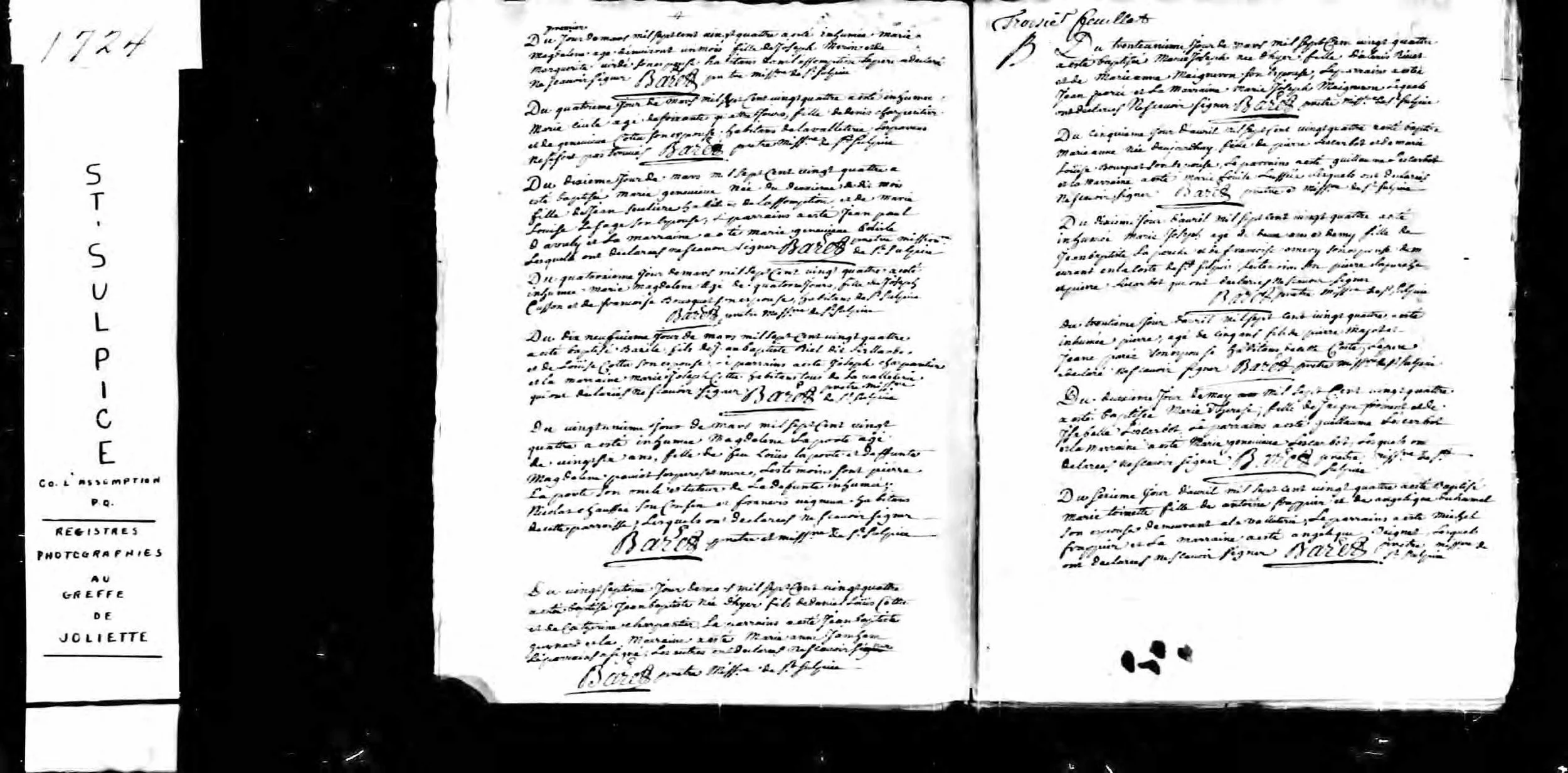
Parish register page, St-Sulpice, 1724.
Marie-Josèphe, 1725. Baptised 20 September at L'Assomption—the first of the children born in the parish where the family had settled. Godfather Louis Vaillant, godmother Marie Jeanne Suliere. She lived to sixty-nine.

Parish register page, L'Assomption, September 1725.
François, 1726. The one parish act on this page that has been transcribed in full.
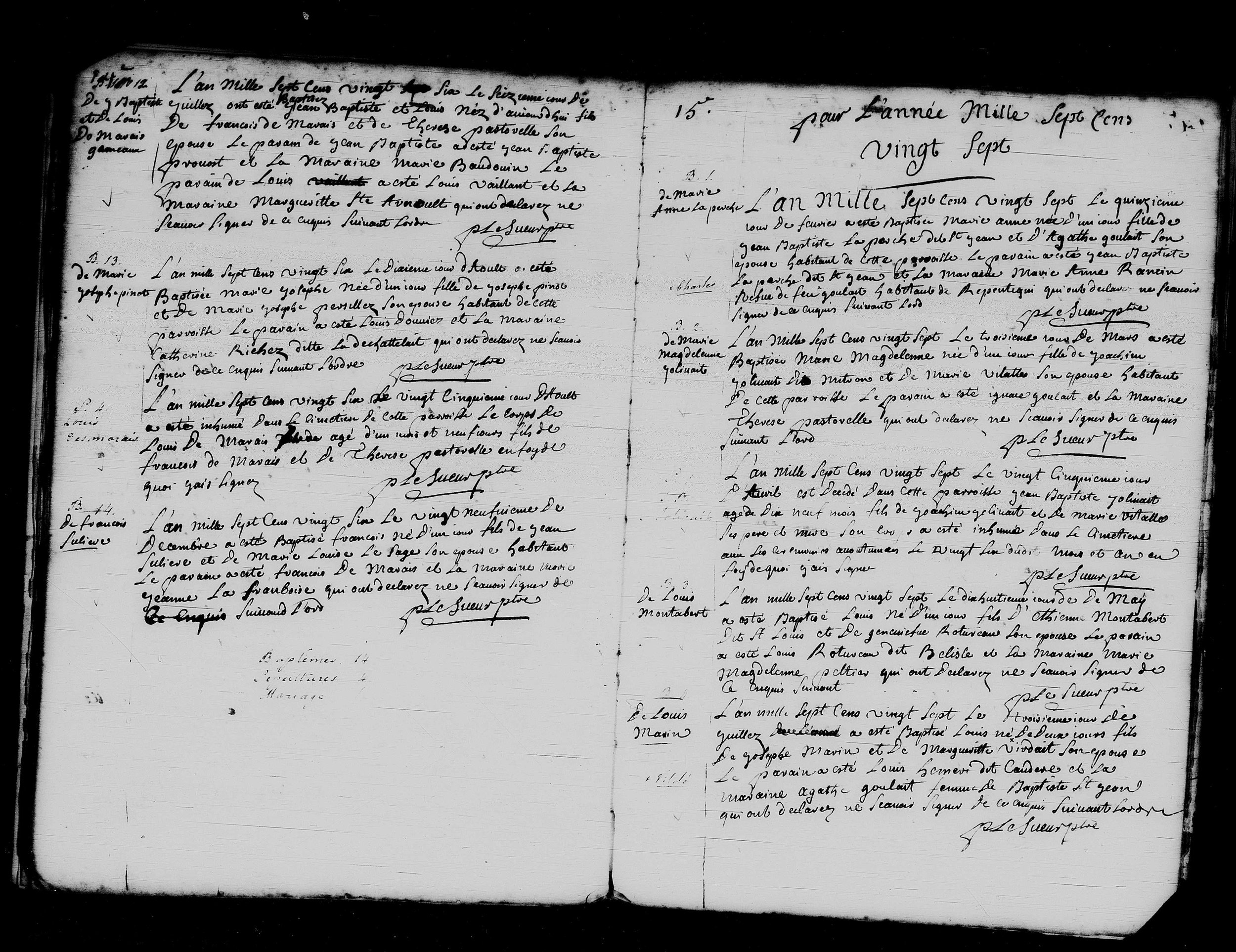
Parish register page, L'Assomption, 29 December 1726.
Baptism of François Suliere, 29 December 1726
« L'an Mille Sept Cent vingt Six le vingt neufième De Decembre a esté Baptisé Francois né d'un jour fils de Jean Suliere et de Marie Louise Le Sage son epouse habitant. Le parain a esté Francois De Marais et la maraine Marie Jeanne La Franboise qui ont declaréz ne Sçavoir Signer de ce enquis Suivant l'ord. »
Parish registers of L'Assomption, 1726. Signed Le Sueur ptre.
Marie-Barbe, 1731. Born 12 July. The PRDH record places the baptism at L'Assomption; St-Sulpice has also been given for it, and the act in the register image below has not been read closely enough to settle which parish is right. She married Jacques Hamelin in 1749 and lived to seventy-four.
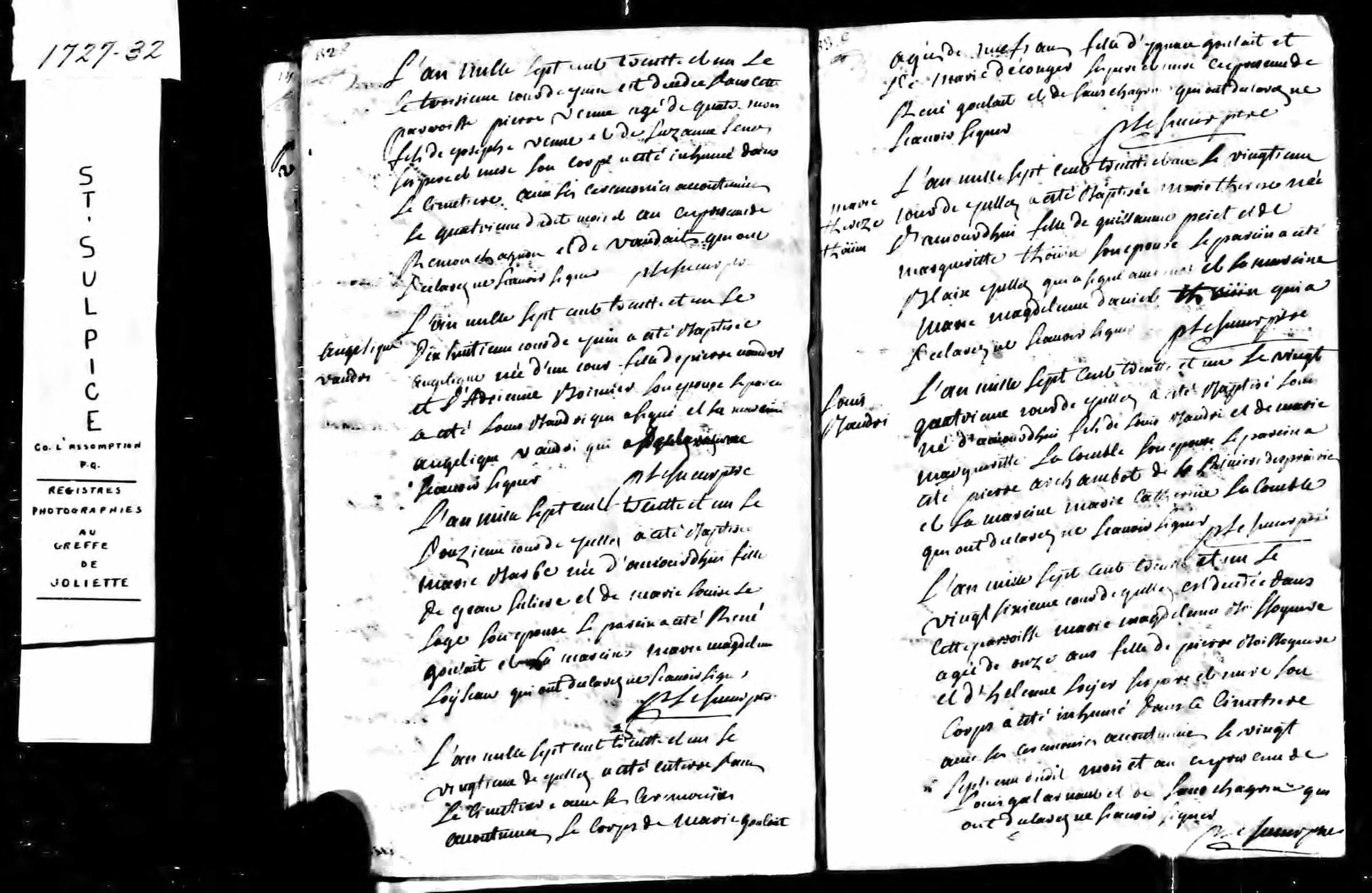
Parish register page containing the baptism of Marie-Barbe Suliere, July 1731. The parish needs confirming against this image.
Widower, 1757
Marie Louise Lesage died in January 1757, after more than forty years of marriage. She was buried at L'Assomption on the 31st. Jean was left a widower at about sixty-one, with most of his surviving children married and in their own households.
Second Marriage: 30 October 1758
30 October 1758 A little over a year and a half later, Jean married again. His second wife was Marie St-Jean dit Lagrange dit Lacage, born about 1718, daughter of Jean Baptiste St-Jean dit Lagrange dit Lacage and Marie Catherine Desautels dit Lapointe. She was a widow: she had married Pierre Gibeau at Sorel on 14 November 1735.
The act was made at L'Assomption, where Jean had been a habitant for nearly four decades. After the banns on three consecutive Sundays and no impediment found, the missionary priest received their consent and gave the nuptial blessing.
| Rank | Name and role as printed | M.S. | Pr. |
|---|---|---|---|
| 01 | Jean SULIERESpouse of 02 · Residence: L'Assomption | v | p |
| 02 | Marie STJEANSpouse of 01 · Residence: L'Assomption | v | p |
| 03 | Marie Louise LESAGESpouse of 01 — his first wife, named as deceased | m | d |
| 04 | Pierre GIBEAUSpouse of 02 — her first husband, named as deceased | m | d |
| 05 | Pierre BODQUIN | — | p |
| 06 | Noel QUENEL | — | p |
| 07 | Basile GREGOIRE | — | p |
| 08 | Francois COCHARD | — | p |
| 09 | Xxxxx DEGEAYOccupation: prêtre | c | p |

Parish register page, L'Assomption, 30 October 1758.
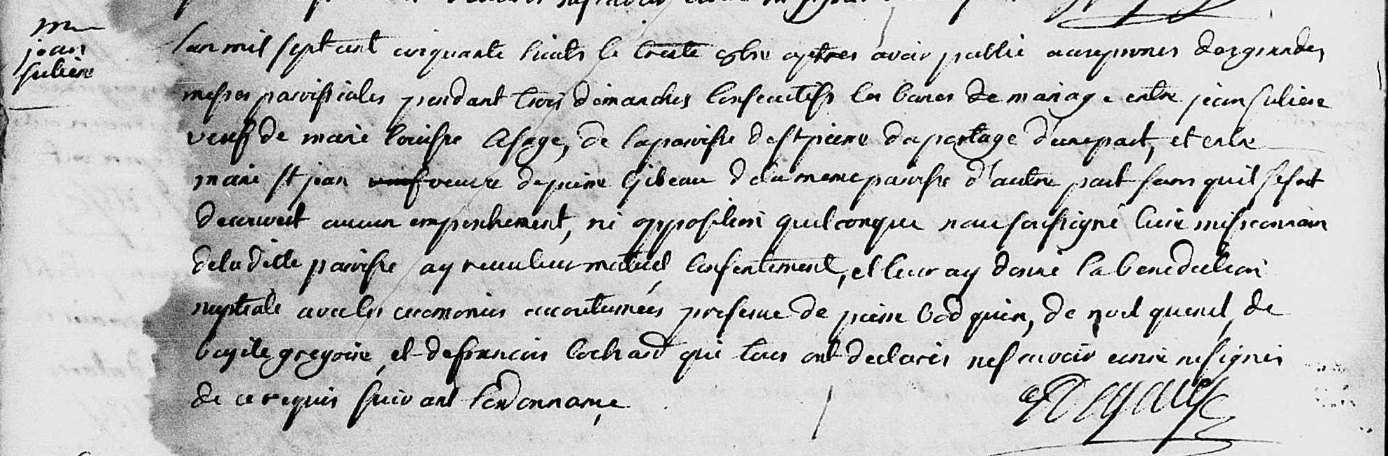
Detail from the same act.
No children are recorded from this marriage—unsurprising, with Jean at about sixty-two and his wife at about forty. It reads as a household arrangement between two widowed people, which was the ordinary shape of such marriages.
The Estate Inventory, 27 April 1757
27 April 1757 Marie Louise Lesage was buried at L'Assomption on 31 January 1757. Twelve weeks later, on the morning of 27 April, a notary came out to the farm on the Rivière L'Assomption at Jean's request and began the inventory of everything he and his wife had held in common since 1716.
The act is no. 816 in the greffe of Me Jean-Baptiste Daguilhe, notaire royal, resident in the parish of Saint-Pierre-du-Portage—the same portage the concession of 1720 measured from. It runs to twenty pages, and all twenty are online at BAnQ numérique. Its opening clause is the reason it matters here before any of its contents are read.
Opening of the inventory, 27 April 1757
« L'an Mil Sept Cent Cinquante Sept le Vingt Sept jour du mois d'avril avant midy, a la Requeste de Jean Sulliere pere habitant de la Coste de Lassomption, tant en son nom [comme] veuf de deffunte Marie Louise Lesage qu'a cause de la communauté de biens qui a esté entre ladite deffunte sa femme et luy, et voulant remettre a ses enfans les biens qui leur reviennent de ladite deffunte leur mere, estant tous en age de majorité, ont requis lesd. Notaire […] de proceder a ladite inventaire »
BAnQ, CN605,S14, greffe de Jean-Baptiste Daguilhe, act no. 816, images 06M_CN605S14P_04305–04324 (BAnQ numérique item 4612356). Working reading, September 2026.
The family, named in one place
What follows the request is a roll-call. Every surviving child of the marriage appears, in person or through a husband, and the notary lists them:
The heirs at 27 April 1757
Noël Quenel dit Lajoie, as having married Marie Josèphe · Jean Bernardin Sullière · Louis Sullier · François Sullier · Joseph Pineau fils, as having married Marie Gabrielle · Jacques Hamelin, as having married Marie Barbe · Jean Alleboeuf, as having married Marie Françoise · and Jean Pineau, widower of the late Marianne, in his own name and for Scolastique Pineau, his daughter, aged twelve, sole heir of her mother.
The forenames of two of the sons-in-law are provisional readings.
Three things fall out of that list. All eight surviving children are accounted for in a single act, which is an independent check on the family reconstructed from the PRDH couple record. Two Pineau brothers had married two Suliere sisters—Joseph to Marie-Gabrielle in 1752, Jean-Baptiste to Marie-Jeanne-Anne in 1742—and by 1757 one of them was a widower. And a granddaughter enters the record: Scolastique Pineau, twelve years old, standing in for the mother she had lost in 1754.
The act also records that the children were tous en âge de majorité. No guardian was needed and none was appointed; the youngest, Marie-Françoise, had married three months earlier. It was drawn avant midy, in the ordinary way, in the presence of the practitioner Loisel and of Sieur Charles Personne dit Lafond, both of L'Assomption; and at the foot, as at every other milestone of this man's life, the parties declared they could not sign.
What has been read, and what has not
The opening clause, the list of heirs and the closing have been read. The body of the inventory—twenty pages of it—has not. That is where the house is: the beds and linen, the kettles, the axes and ploughs, the animals in the yard, the grain in store, the debts owed and owing, and the titres et papiers, which should include the concession of 1720 and may mention the grant of 1718 it replaced. Nothing on this page yet describes how this family lived, because that reading has not been done.
Two years later the court at Montréal closed it. Me Daguilhe made a récolement—a verification—on 3 March 1759, and on 9 March 1759 Jean appeared before Jacques Joseph Guiton de Monrepos, lieutenant général, swore that he knew of no goods beyond those the inventory contained, and the community of 1716 was declared finished and dissolved.
Clôture d'inventaire, 9 March 1759
« L'an mil sept cent cinquante neuf le neuf mars neuf heures du matin par devant nous Jacques Joseph Guiton Monrepos &c est comparu Jean Sullierre pere veuf de feüe Marie Louise Lesage, lequel nous a dit que pour sureté et conservation des biens et effets dependants de la succession et communauté d'entre luy et lad. deffunte sa femme par Daguilhe no[tai]re le vingt sept avril mil sept cent cinquante sept, et recolement ensuite par led. Daguilhe le trois du present mois de mars, nous requerant de clore iceluy et declarer lad. communauté finie et resolue […] n'avoir point a sa connoissance d'autres biens et effets […] que ceux contenus au present inventaire »
BAnQ, CV601,S1,D1321, Clôtures d'inventaire, district judiciaire de Montréal. Working reading from the register image, September 2026.
The closing calls him Jean Sullierre père—the clerk distinguishing him from the eldest son, who had stood in the same court, before the same officer, eleven years earlier.

Inventory of 27 April 1757, opening page. Act no. 816, greffe de Jean-Baptiste Daguilhe. The heirs are named in the second half of the page.

The last page: the witnesses Loisel and Personne dit Lafond, the notary's signature, and the declaration that the parties could not sign.
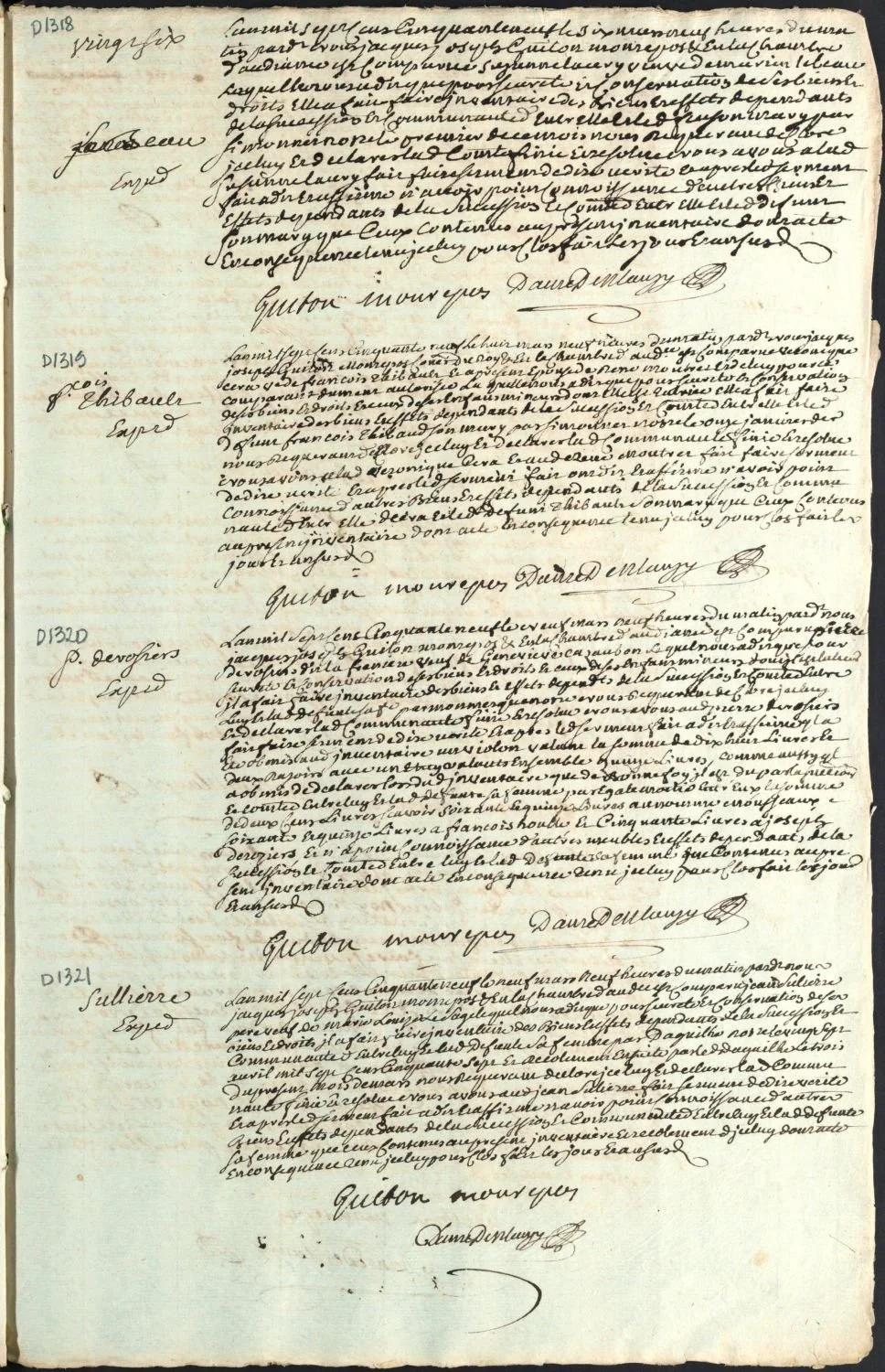
The register of clôtures d'inventaire for the district of Montréal, entry D1321: the closing of 9 March 1759. It is this entry that named Me Daguilhe and dated the inventory, and so led to the act itself.
And one for his eldest son
The same series holds a second closing belonging to this family. On 22 March 1748, at two in the afternoon, Jean Bernardin Sullière—the eldest son, born at Québec in 1717—appeared before Jacques Joseph Guiton de Monrepos as widower of the late Marie Marguerite Payment. Having been made guardian of their minor children, he had had an inventory made of the goods and effects of the succession and of the community between himself and his late wife, and asked the court to close it. BAnQ, CV601,S1,D631.
Its value on this page is a date. Marguerite Payment, whom Jean Bernardin had married at Pierrefonds in February 1743, was dead by March 1748, leaving children under age. The entry belongs properly to Episode 2 and is noted here because it came from the same register and the same search.

The register of clôtures d'inventaire for the district of Montréal, entry D631: the closing of 22 March 1748 for Jean Bernardin Sullière, widower of Marie Marguerite Payment. The entries run continuously down the page, each signed by the lieutenant général and the greffier.
Working reading
The 1748 entry has been read from the register image: the date, the officer, the two names, the guardianship and the request to close are legible, and the remainder is not yet transcribed. The notary before whom that inventory was taken is named in the entry and has not yet been made out. The 1759 entry has been read, and the inventory it closes is now in hand.
Death, 1766
7 October 1766 Jean Suliere dit Tranchemontagne died at L'Assomption at about seventy—forty-six years after the concession above the portage, and forty-eight after he first took ground on that river. He had seen eight of his twelve children marry, and grandchildren born in the parish.
This date needs a document
The PRDH individual record for Jean Suliere carries no burial entry, and no burial act is reproduced on this page. The date of 7 October 1766 has been carried forward from compiled sources and has not been verified against the L'Assomption register. It is given here because it is the received date, and flagged because it is the one date on which this section entirely rests.
Gravesite
Jean is understood to have been buried in the former Ancien cimetière de L'Assomption. When that ground was closed, remains were moved to a common grave at the present cemetery—a usual practice as colonial-era burial grounds were decommissioned and parishes grew.
This account has not been sourced to a parish or municipal record and is repeated here as tradition rather than as documentation.
Legacy
Jean Suliere's life spanned a formative stretch of French-Canadian history. Born about 1696 and married at Québec in 1716, he moved with the frontier into the Montréal hinterland and spent his last forty-eight years on the same river. His is the story of countless habitants who cleared land, raised families and built the agricultural parishes that shaped the province—and, like most of them, he did it beside kin. He took his first concession alongside his wife's brother-in-law, and the notary who wrote it thought that connection worth a note in the margin.
Eight of his children lived to marry—Jean-Bernard, Louis, Marie-Jeanne-Anne, Marie-Josèphe, François, Marie-Gabrielle, Marie-Barbe and Marie-Françoise—and their marriages tied the Suliere name into families called Larivière, Botquin, Pineau dit Deschatelets, Lajoie dit Quesnel, Hamelin and Leboeuf. Those kinship networks are how a single immigrant surname becomes a region.
His eldest son Jean Bernard, named for the Piedmontese grandfather who held him at the font in 1717, married Marguerite Payment dit Larivière at Pierrefonds in 1743 and died at L'Assomption in 1798 at eighty-one. He is the subject of Episode 2.
Document Gallery
The three notarial minutes, the judicial closing, and the parish register images behind this page. PRDH records are given as tables in the text above rather than here, so that what a database reports and what a record states are not shown side by side as though they were the same kind of evidence.
Page 1 — both sets of parents

Page 2 — douaire and préciput
Page 3 — the signature block
Daveluy & Marie Françoise Lesage — filiation
Signatures — the groom could not sign

Vol. 4, p. 136 — Suier–Lesage 1716 and Daveluy–Lesage 1712
Notre-Dame-de-Québec (full page)
Detail
Act no. 2241 — 60 arpents, seigneurie de St-Sulpice
Page 1 — « Paul Daveluy son beau frere »
Page 2 — charges and reservations
Closing names Daveluy — sequence to verify
Act no. 2591 — index entry
Page 1 — five arpents above the portage
Page 2 — rent, roads and reservations
Page 3 — the retrocession of the 1718 grant
Jean Bernardin
Louis
Marie-Jeanne-Anne
Marie-Geneviève
Marie-Josèphe
François — transcribed above
Marie-Barbe — parish to confirm
Jean & Marie St-Jean (full page)
Detail
Act no. 816 — the heirs named
Final page — witnesses and signature
Jean Suliere & Marie Louise Lesage — D1321
Jean Bernardin — entry D631

Marie-Françoise & François Morin
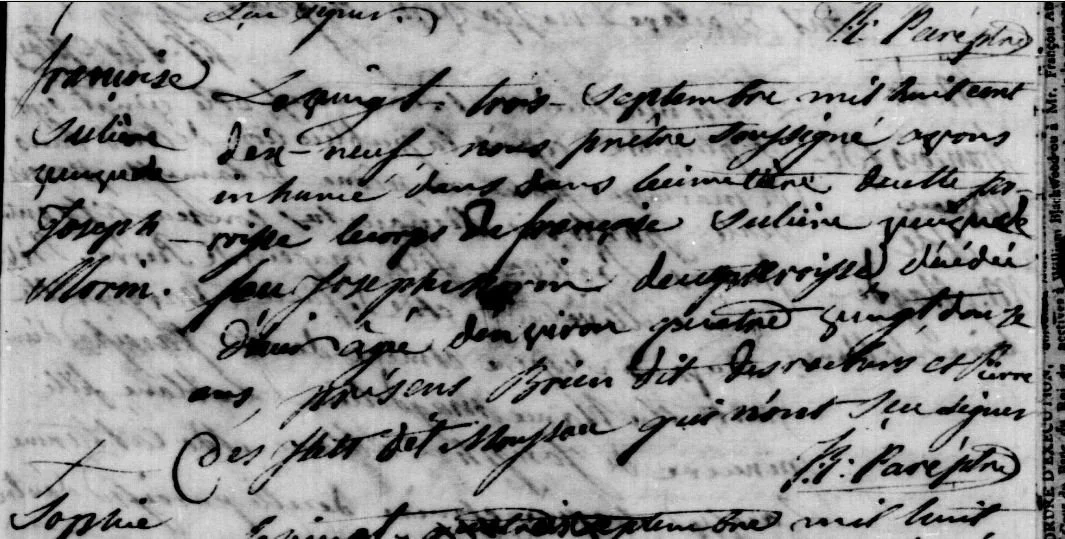
Marie-Françoise, aged 86
Sources
Notarial minutes, read directly
- Contrat de mariage, Jean Paul Daveluy and Marie Françoise Lesage, 21 January 1712, before Me Louis Chambalon, notaire royal en la prévôté de Québec. BAnQ, CN301,S58; images 03Q_CN301S58P_12967–12971. BAnQ numérique 4293245. Names the bride as daughter of Jean Bernardin Lesage, tisserand, and Marie Barbe Sylvestre, and the groom as son of the late Paul Daveluy of Rivière-des-Prairies and Elisabeth Aquin. This is the act that documents the beau-frère relationship recorded in the margin of the concession of 1718. Working reading, not collated.
- Contrat de mariage, Jean Suyer dit Tranchemontagne and Marie Louise Lesage, 8 September 1716, before Me Pierre Rivet dit Cavelier, notaire royal en la prévôté de Québec. Bibliothèque et Archives nationales du Québec, CN301,S240. Three pages.
- Concession par le Séminaire de Montréal à Jean Sullières dit Tranchemontagne, 20 January 1718, act no. 2241 — three arpents of frontage by twenty of depth in the seigneurie de Saint-Sulpice, fronting on the Rivière L'Assomption. Before Me Pierre Raimbault, notaire royal en l'île de Montréal. BAnQ, CN601,S340 (former cote CN1-340). Working reading, not collated. Contains the marginal renvoi « Paul Daveluy son beau frere ». The attribution of the filmed third page to this act is unverified — see the note in the text.
- Inventaire des biens de Jean Sullière, père, et de la défunte Marie Louise Lesage, 27 April 1757, act no. 816, before Me Jean-Baptiste Daguilhe, notaire royal, resident at Saint-Pierre-du-Portage. BAnQ, CN605,S14; images 06M_CN605S14P_04305–04324. Twenty pages. BAnQ numérique 4612356. Opening clause, list of heirs and closing read; the body of the inventory not yet read.
- Concession par le Séminaire de Montréal à Jean Sullières, 30 April 1720, act no. 2591 — five arpents of frontage on the Rivière L'Assomption above the portage, depth as surveyed. Before Me Pierre Raimbault. BAnQ, CN601,S340, Actes de notaire, boîtes 16–21 (nos 2452–3341), 1 March 1719 – 24 June 1725; consulted as FamilySearch digital film 008274277, images 471–473. Three pages. Working reading, not collated. Contains the marginal clause annulling and retroceding the earlier concession.
Judicial records
- Clôture d'inventaire — Jean Sullière, père, and the late Marie Louise Lesage, 9 March 1759. BAnQ, CV601,S1,D1321; Clôtures d'inventaire, district judiciaire de Montréal, Archives nationales à Montréal. ark:/52327/3386327. Register page reproduced and read on this page. Names Me Daguilhe as the notary and dates the inventory to 27 April 1757, with a récolement on 3 March 1759. This entry is what led to the inventory itself. Working reading, not collated.
- Clôture d'inventaire — Jean Bernardin Sullière and the late Marie Marguerite Paiement dit Larivière, 22 March 1748. BAnQ, CV601,S1,D631; same series. ark:/52327/3386978. Register image read; working reading only.
Finding aids
- Répertoire of the greffe of Pierre Raimbault, entries for 1718 and 1720, BAnQ Montréal. Act no. 2241 is summarised as sixty arpents in the seigneurie de Saint-Sulpice; act no. 2591 as five arpents of frontage on the Rivière L'Assomption. Both summaries are the clerk's, not the deeds'; both minutes are now read.
- Pierre-Georges Roy, Inventaire des contrats de mariage du Régime français conservés aux Archives judiciaires de Québec (Québec: Archives de la province de Québec, 1937–1938), 6 vols., vol. 4, p. 136. Two entries used: « Lesage, Marie-Louise, et Jean Suier (Rivet, 8 septembre 1716) » and « Lesage, Marie-Françoise, et Jean-Paul Daveluy (Chambalon, 21 janvier 1712) ». Roy indexes the greffes; the entries are finding aids, not witnesses to the acts. Both minutes behind these two entries have now been read.
Parish registers — parish copy, examined
- Marriage, 14 September 1716, Notre-Dame-de-Québec (full page and detail).
- Baptisms of Jean Bernardin (1717), Louis (1720), Marie-Jeanne-Anne (1722), Marie-Geneviève (1724), Marie-Josèphe (1725), François (1726) and Marie-Barbe (1731).
- Marriage, 30 October 1758, L'Assomption (full page and detail).
- Marriage of Marie-Françoise Suliere and François Morin, 1783; her burial, 22 September 1819.
Database
- PRDH-IGD, Université de Montréal — individual no. 50195 (Jean Suliere); couple no. 12165 (first marriage and the twelve children); couple no. 35068 and marriage no. 286540 (second marriage); individual no. 92520 (Marie St-Jean); couples nos. 23254 and 43199 (the eldest son's line). Database fields are not transcriptions of acts.
Compiled
- Denis Beauregard, Généalogie des Français d'Amérique du Nord, family sheet [15560]. Carries the parentage of Jean Suliere as presumed by convergence; the 1716 contract documents it directly.
Not located, or not yet done
- A negative search of the Raimbault répertoire between acts 2241 and 2591 for any other concession to Jean Sullières. Not made. Until it is, the identification of act 2241 as the grant retroceded in 1720 rests on convergence.
- Verification of the filmed page sequence for act 2241, whose third page closes in the name of Paul Daveluy.
- The body of the 1757 inventory — twenty pages of goods, livestock, debts and titres et papiers, of which only the opening and the closing have been read. This is now the highest-value outstanding reading on this line, not a document to find.
- The récolement of 3 March 1759, in the same greffe as the inventory.
- The procès-verbal of the sworn surveyor required within one year of each concession.
- The baptism of Jean Suliere, about 1696.
- The burial of Marie Louise Lesage, January 1757. The burial of Jean Suliere, October 1766.
- Any marriage contract for the second marriage of 1758. Any partage or tutelle following either death.
Storyline Genealogy
From Research to Story
Are You Connected to the Souliere Line?
If you descend from the Souliere, Suliere, or Soulier (dit Tranchemontagne) family of L’Assomption and St-André-d’Argenteuil, from the nineteen children of Janvier Souliere Sr., or from the allied Gravel, Poulin, Migneron, Lacasse, or Lesage lines — whether your branch stayed in Quebec or came to Chicago — I’d like to compare notes. Documented trees, DNA matches, family papers, and even half-remembered stories have all moved this research forward.
Get in Touch About This FamilyCousin connections are informal and reciprocal — no fee, no obligation, just shared work on shared ancestry.
Every Family Has a Story Worth Telling
Whether you're just beginning your research or ready to transform years of work into a narrative your family will treasure, I'd love to help.
LET'S TALK ABOUT YOUR FAMILY