
St. Anne’s Church : Heart and Soul of Griffintown
McCord Street & Basin Street, Griffintown, Montreal
St. Anne's Church
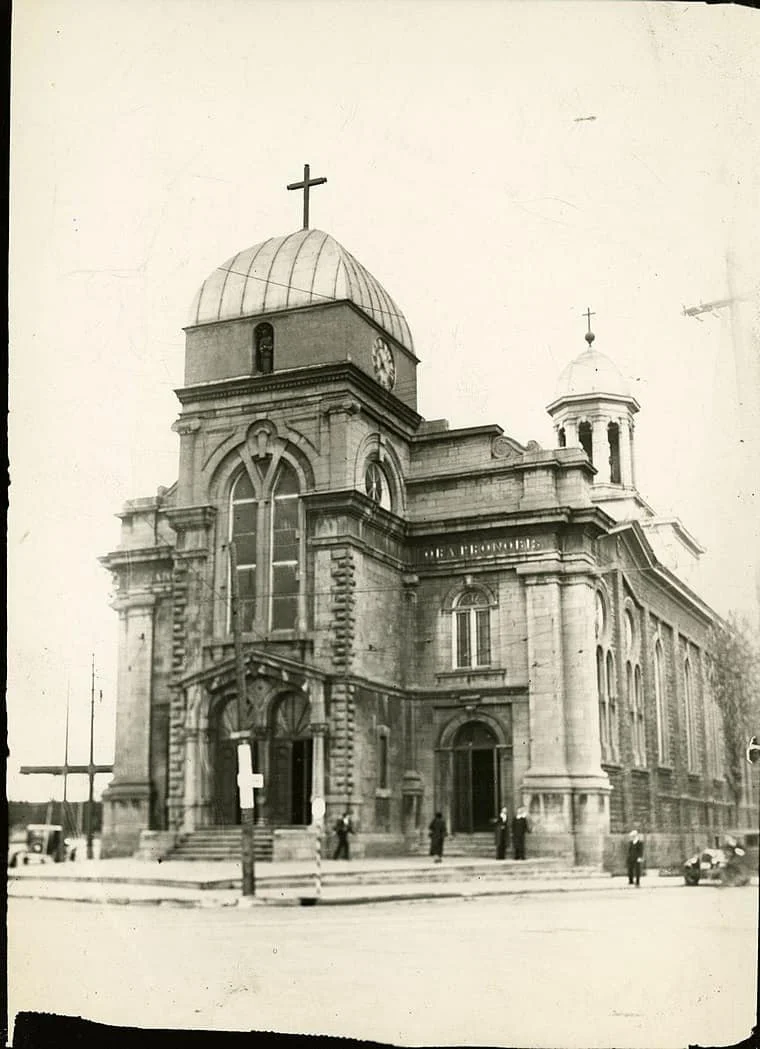
For 115 years, St. Anne's Church stood at the center of Montreal's Irish immigrant community. Here, in 1879, Mary Ann Hamall—Owen's younger sister—married William Byron, a brass finisher. The marriage record names her parents as "deceased Henry Hammell" and "Mary McMahon," providing crucial confirmation of the family connections documented at Notre-Dame.
This church no longer stands. Demolished in 1970 following the construction of the Bonaventure Expressway. The foundations remain visible in Parc Griffintown-St-Ann.
The Hamall Family at St. Anne's
Groom: William F. Byron, brass finisher, son of deceased Andrew Byron and Ellen Doyle
Witnesses: James Dennott, Mary Byron, Thomas Barrett
Officiant: J. Hogan, Priest
Note: Both bride and groom were children of deceased fathers. Mary Ann was Owen Hamall's younger sister, baptized at Notre-Dame in 1853.
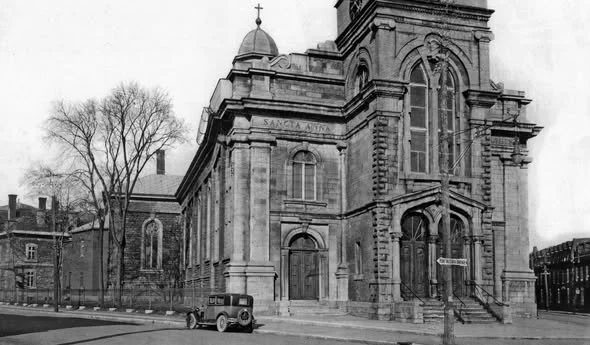
St. Anne's Church, Griffintown, circa 1930. The inscription "SANCTA ANNA" is visible above the entrance. The church served Montreal's Irish community for 115 years before demolition in 1970.
When Mary Ann Hamall walked down the aisle of St. Anne's Church on June 17, 1879, she was following a path worn by thousands of Irish immigrants before her. Griffintown's parish church—the "heart and soul" of the community—had witnessed the joys and sorrows of Montreal's "shanty Irish" since 1854. For Mary Ann, this was a homecoming of sorts: she had been baptized at Notre-Dame in 1853, but by the time she married, St. Anne's had become the spiritual center of working-class Irish Montreal.
Two months later, in August 1879, her brother Owen would marry Catherine Griffith at Holy Name Cathedral in Chicago. The siblings, separated by geography but united by family, both named their deceased parents in their marriage records—providing genealogists a century and a half later with parallel documentation of the Hamall-McMahon connection.
Griffintown: Montreal's Irish Quarter
Griffintown—named for Mary Griffin, who subdivided her land into affordable lots—became the recognized Irish quarter of Montreal in the mid-nineteenth century. Located on low-lying ground near the port and the Lachine Canal, it offered what desperate Famine refugees needed most: cheap housing close to work.
At the height of the Famine in the 1840s, as many as 30,000 Irish immigrants arrived in Montreal each year. They took work where they could find it—digging the Lachine Canal, building the Grand Trunk Railway, constructing the Victoria Bridge. Griffintown, adjacent to all these projects, offered the closest and most affordable housing. By 1871, the Irish comprised nearly half the population of St. Ann's Ward, of which Griffintown formed a part.
The Irish of Griffintown were what contemporaries called the "shanty Irish"—unskilled laborers employed in factories, construction, and on the docks. They were distinct from the "lace-curtain Irish" around St. Patrick's Church, who included merchants, skilled workers, and professionals. St. Anne's served both communities, but its heart belonged to Griffintown.
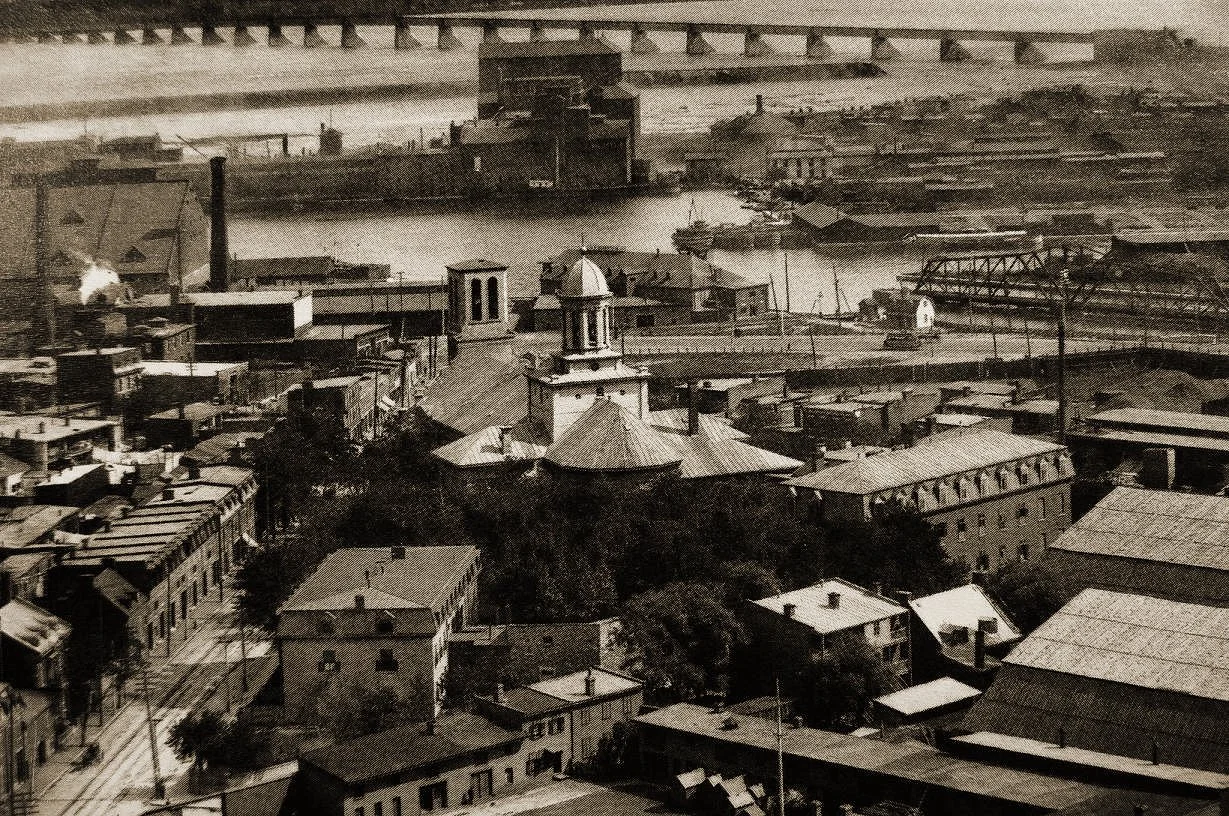
Aerial view of Griffintown, 1896, showing St. Anne's Church dome rising above the industrial neighborhood. The Lachine Canal and railway yards are visible in the background—the sources of employment that drew Irish immigrants to this community.
St. Anne's Church: 1848-1970
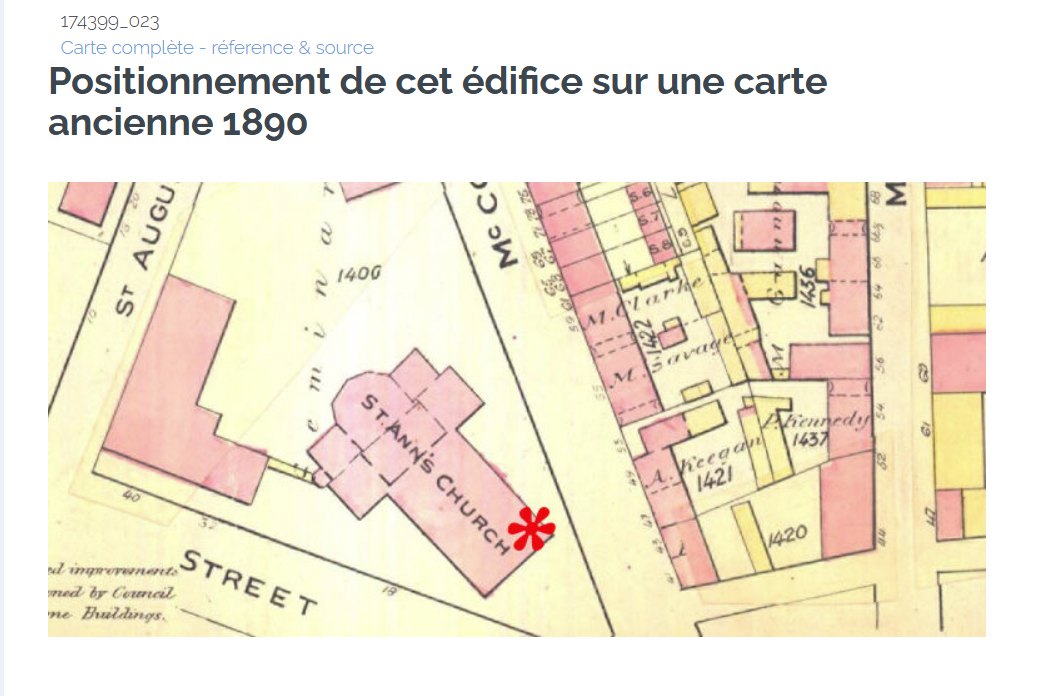
St. Anne's began as a mission in 1848, established to serve the Irish of Griffintown who could not easily reach St. Patrick's Church. A temporary chapel at the corner of Ottawa and Murray streets served the community until the Sulpicians came to their aid. The cornerstone for a permanent church at McCord and Basin streets was laid on December 8, 1854—the Feast of the Immaculate Conception.
The church, designed by architect John Ostell, remained part of St. Patrick's parish until it was erected canonically in 1880. In 1884, the Sulpicians handed the parish to the Redemptorist Fathers, a Belgian order that had already established a church at Ste-Anne-de-Beaupré. The Redemptorists transformed St. Anne's, spending over $100,000 in less than ten years.
Under the Redemptorists, St. Anne's hummed with activity. The church was enlarged and embellished with new ornaments, parquet floors, a carillon of bells, and new stations of the Way of the Cross. Schools were established or enlarged. A gymnasium, concert hall, and young people's hall were built, along with a three-story building containing a public library, reading rooms, and reception rooms. The Little Sisters of the Poor were brought in to care for the neighborhood's many poor, elderly, and needy residents.
"Tuesday devotionals were so popular, the city had to add extra buses to the area on those days."
At its peak, St. Anne's served over 1,300 families. The parish was more than a place of worship—it was the cultural and social center of Griffintown. The church imposed, as one historian noted, "a staunch Catholic propriety on the neighborhood, dictating the do's and do not's of every day society."
Mary Ann Hamall's Marriage
Mary Ann Hamall was born in Montreal in 1853, the youngest surviving child of Henry Hamall and Mary McMahon. Her father died when she was barely a year old; her mother remarried Patrick Thornton in 1855 and died in 1874. By the time Mary Ann married William Byron in 1879, she was an orphan—as was her groom, whose father Andrew Byron had also died.
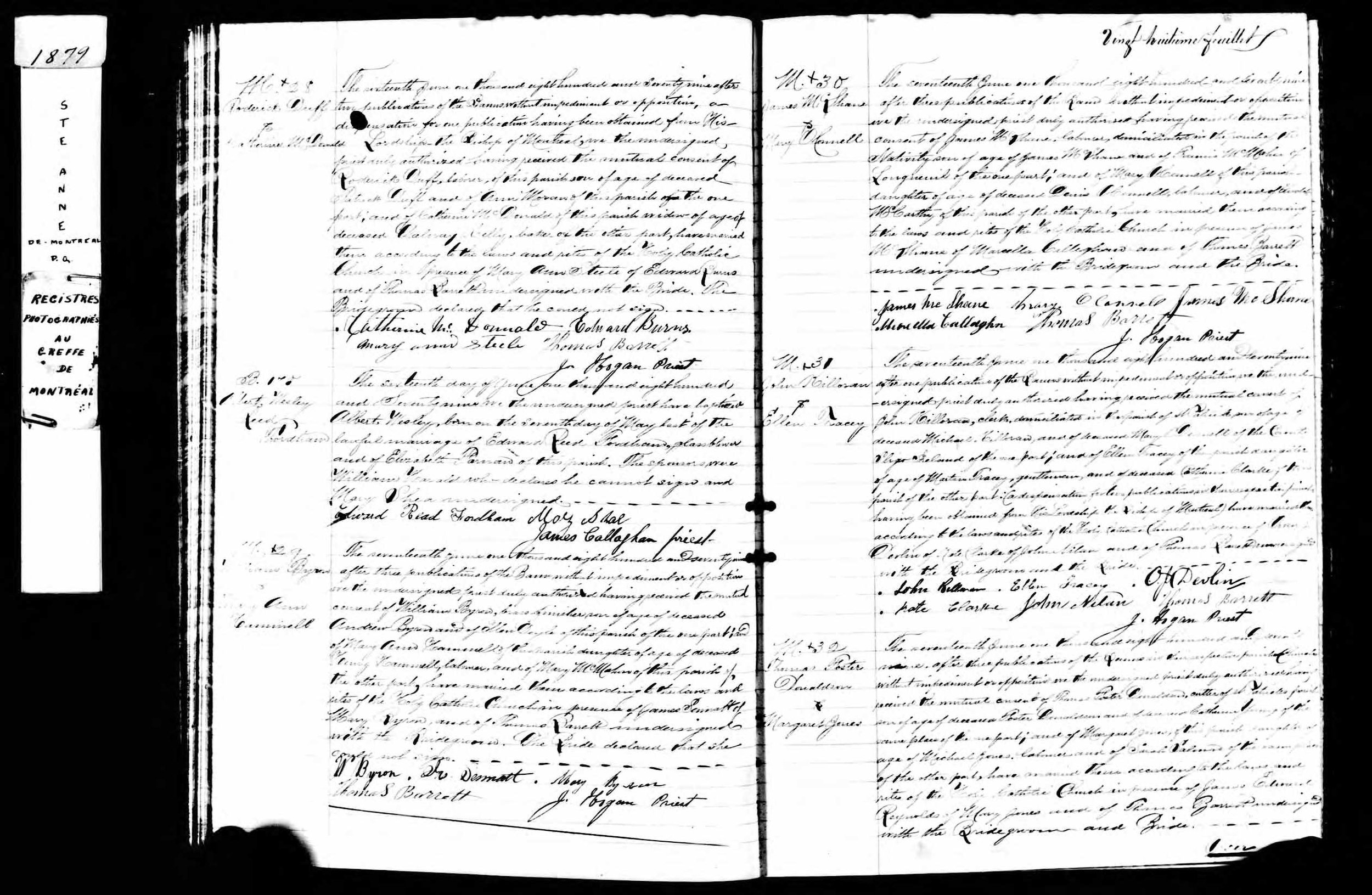
Marriage register page from St. Anne's Church, 1879, containing the entry for Mary Ann Hammell and William F. Byron.
Mary Ann Hammell & William F. Byron
Groom: William Byron, age 19, brass finisher, son of deceased Andrew Byron of this parish and Ellen Doyle of this parish.
Bride: Mary Ann Hammell, unmarried daughter of age, of deceased Henry Hammell, laborer, and of Mary McMahon of this parish.
Witnesses: James Dennott, Mary Byron, Thomas Barrett
Officiant: J. Hogan, Priest
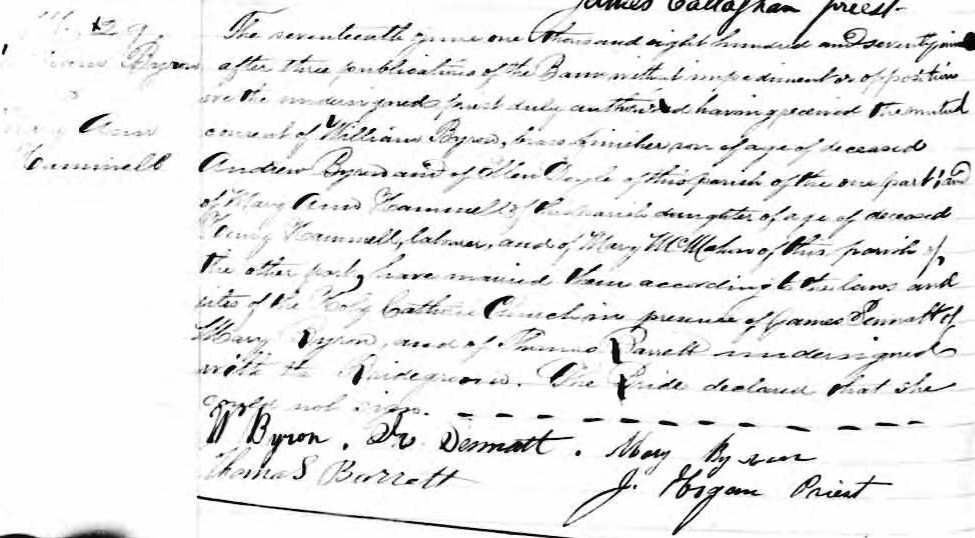
Detail from 1879 marriage record showing Mary Ann Hammell as "unmarried daughter of age, of deceased Henry Hammell, laborer, and of Mary McMahon of this parish."
The Byron Family at St. Anne's
Mary Ann's marriage to William Byron connected her to another Griffintown family. The Byrons appear repeatedly in St. Anne's parish records throughout the 1880s and 1890s, documenting the couple's life in the community.
William Byron worked as a brass finisher—a skilled trade that placed him slightly above the unskilled laborers who made up much of Griffintown's workforce. The couple had at least three children baptized at St. Anne's:
Henry Arthur Byron
Son of William Byron (tradesman) and Mary Ann Hamal of this parish.
Sponsors: Patrick Byron (laborer of this parish) and Ellen Byron
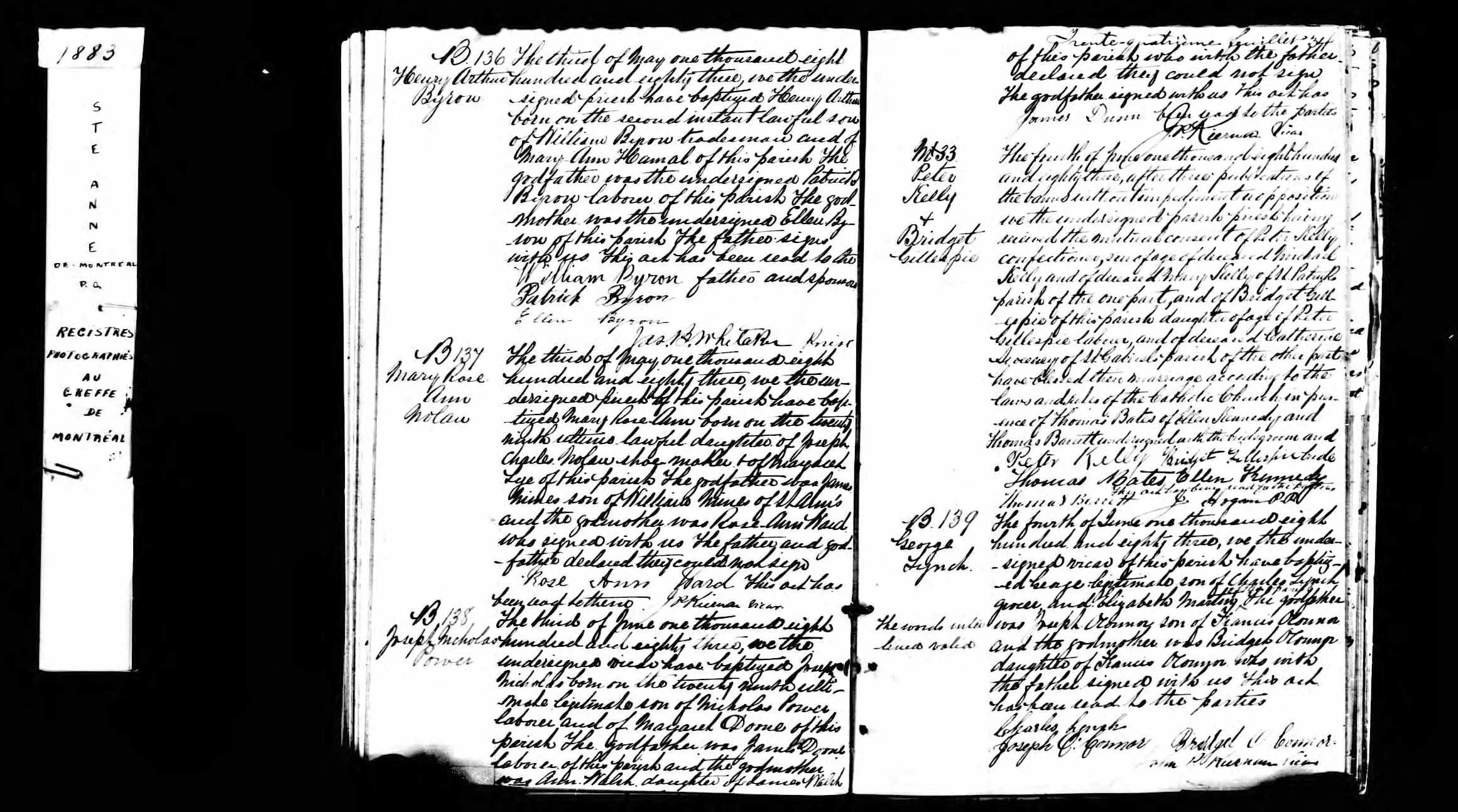
Baptism record for Henry Arthur Byron, May 3, 1883, showing parents William Byron (tradesman) and Mary Ann Hamal. The sponsors were Patrick Byron and Ellen Byron.
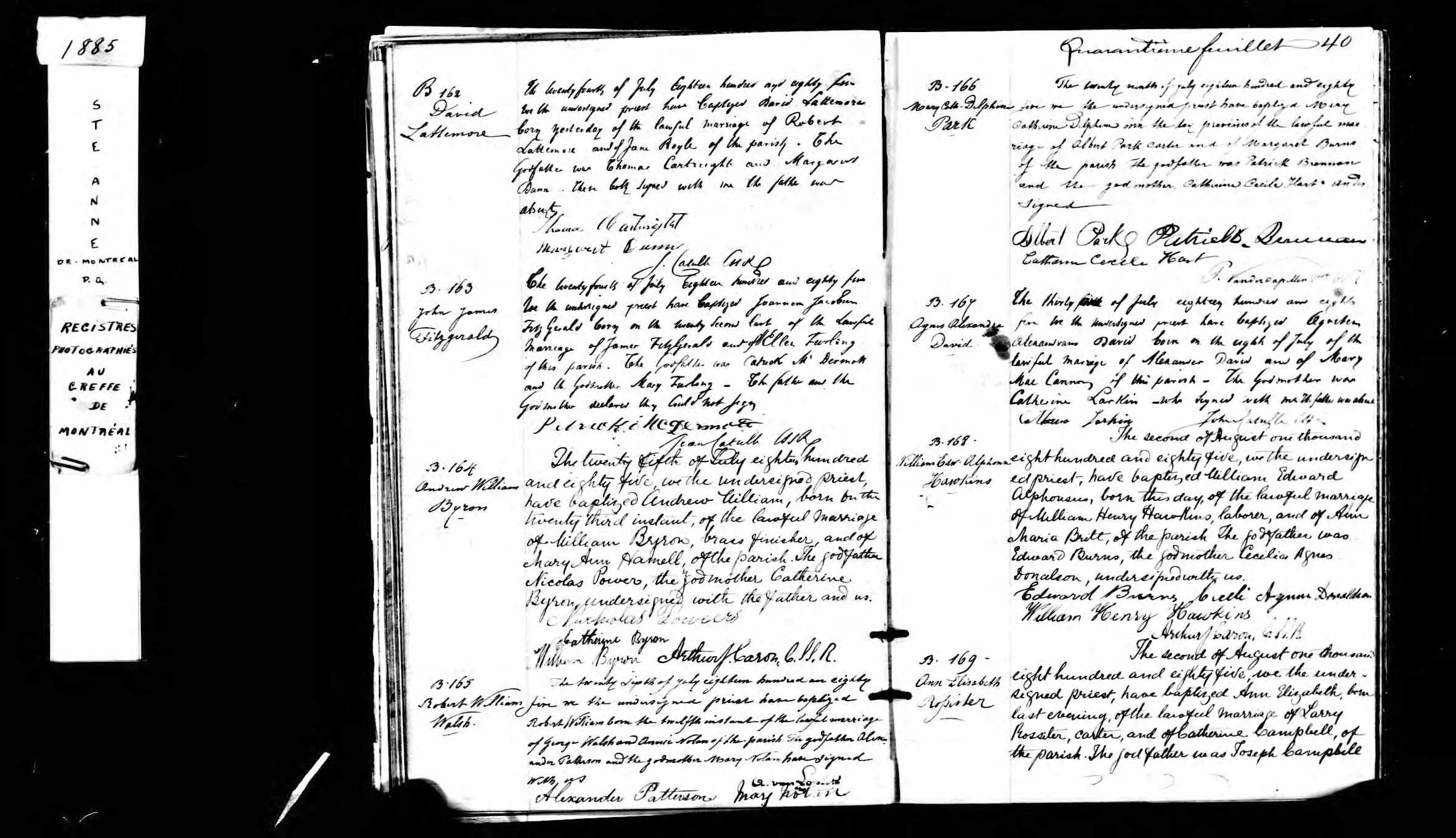
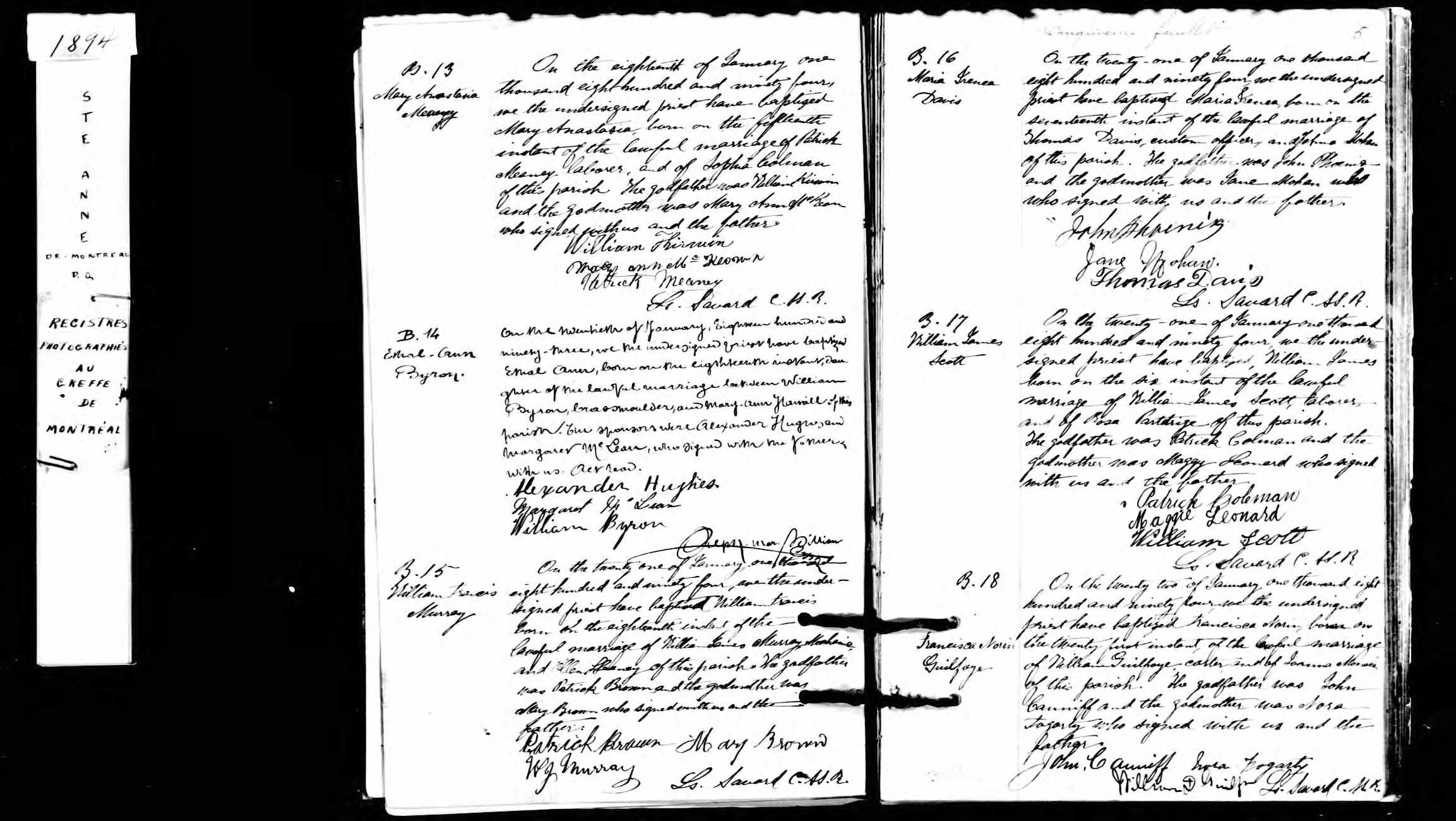
Two more children followed: Andrew William Byron (baptized July 25, 1885, sponsors Nicolas Power and Catherine Byron) and Ethel Ann Byron (baptized January 19, 1894, sponsors Alexander Hughes and Margaret McLean). These baptism records consistently name Mary Ann with variants of "Hamal" or "Hamill."
Mary Ann Hamall Byron's descendants would later provide crucial DNA evidence for the Hamall family research. Matches at 19 cM with individuals CR and DK—descendants of Mary Ann through the Byron line—helped validate the family relationships established through documentary evidence. The convergence of DNA and parish records demonstrates the power of combining modern genetic genealogy with traditional research methods.
The End of Griffintown
The decline of Griffintown began after World War II as residents moved to suburbs and industry replaced housing. In 1963, the city rezoned Griffintown as industrial, sealing the neighborhood's fate. Then in 1967, the Bonaventure Expressway cut through the heart of the community, forcing hundreds of families to relocate.
By 1970, St. Anne's—which had once served 1,300 families—was down to about 90. The last services were held on February 1, 1970. The church was demolished later that year. The parish was formally dissolved in 1982.
Then & Now
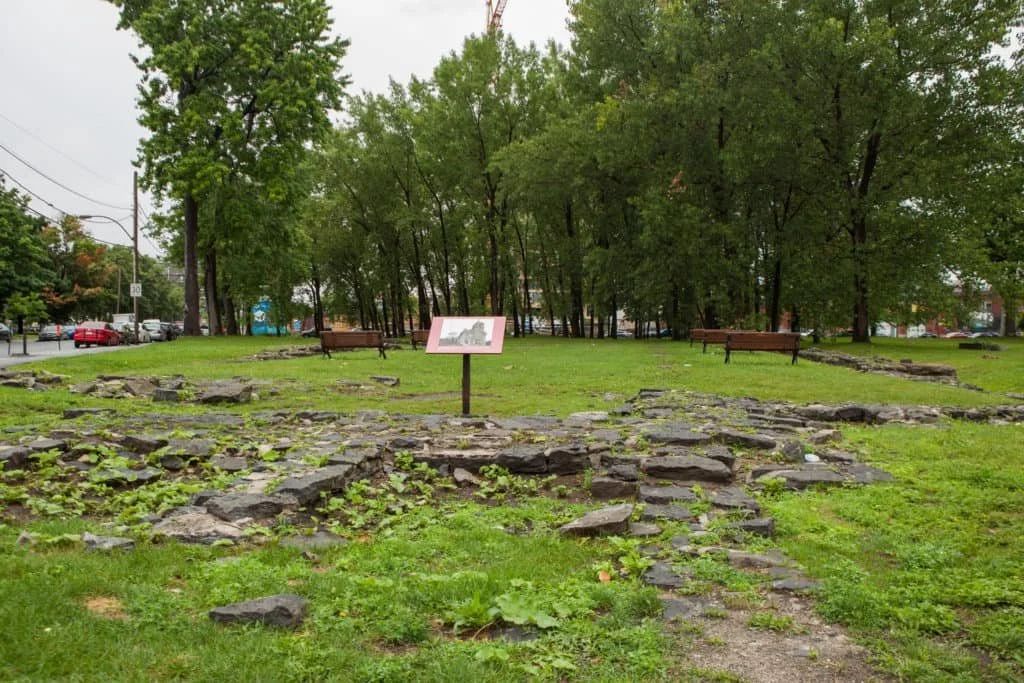
Today, the church's footprint is preserved within Parc Griffintown-St-Ann. Low stone walls still mark the layout of the former building. Park benches are strategically positioned where the pews once stood, facing the former site of the altar—a haunting yet beautiful testament to the neighborhood's vanished Irish heritage.
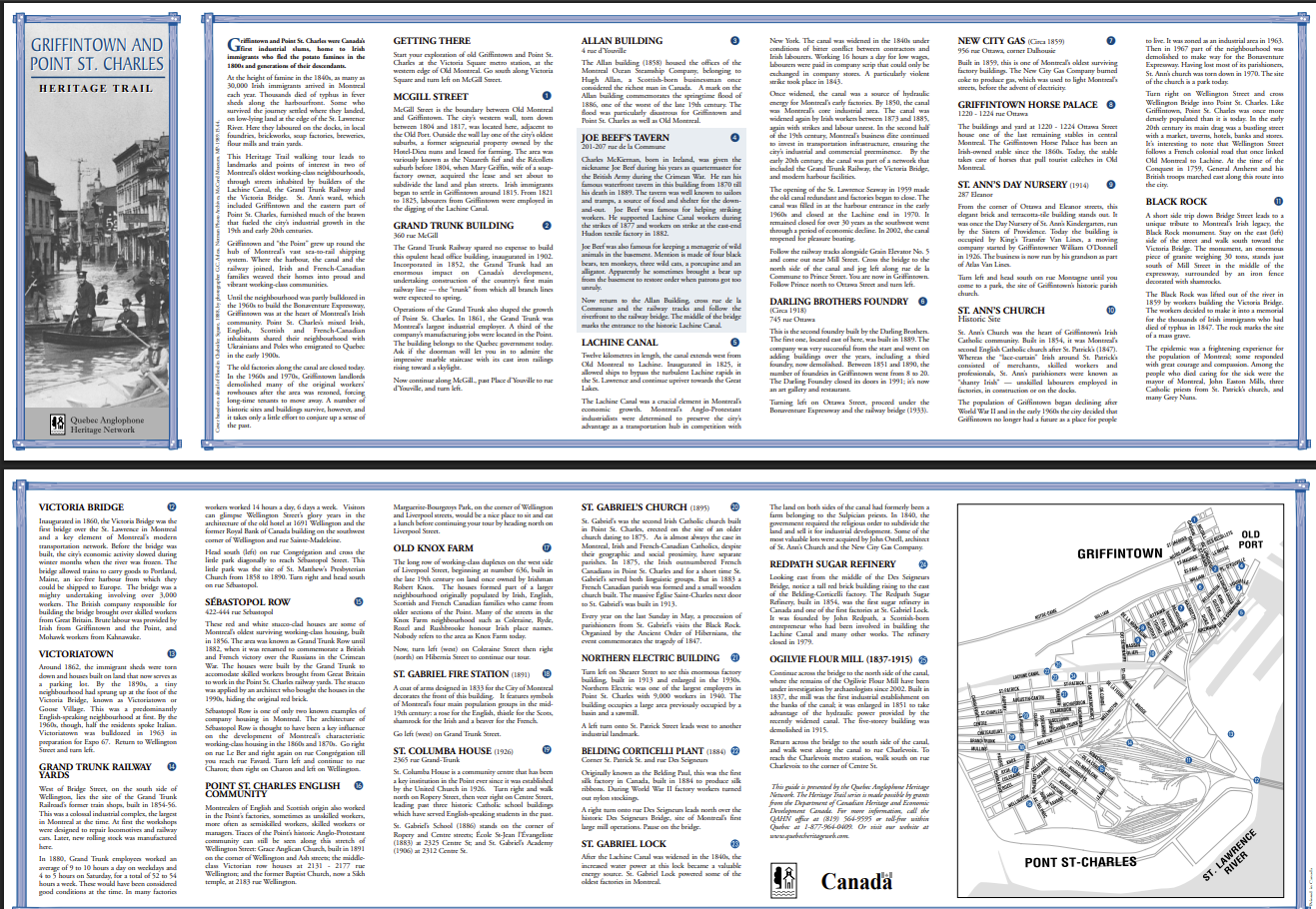
Griffintown & Point St. Charles Heritage Trail
St. Anne's Church is Stop #10 on the Quebec Anglophone Heritage Network's walking tour of Griffintown and Point St. Charles. The trail explores "Canada's first industrial slums, home to Irish immigrants who fled the potato famine" and the vibrant working-class communities they built.
Document Gallery
Want to Know When New Stories Are Published?
Subscribe to receive updates on new family history research—no spam, just meaningful stories when there's something worth sharing.
SUBSCRIBE TO OUR NEWSLETTEREvery Family Has a Story Worth Telling
Whether you're just beginning your research or ready to transform years of work into a narrative your family will treasure, I'd love to hear your story.
BEGIN YOUR RESEARCH INQUIRY