
Holy Name Cathedral
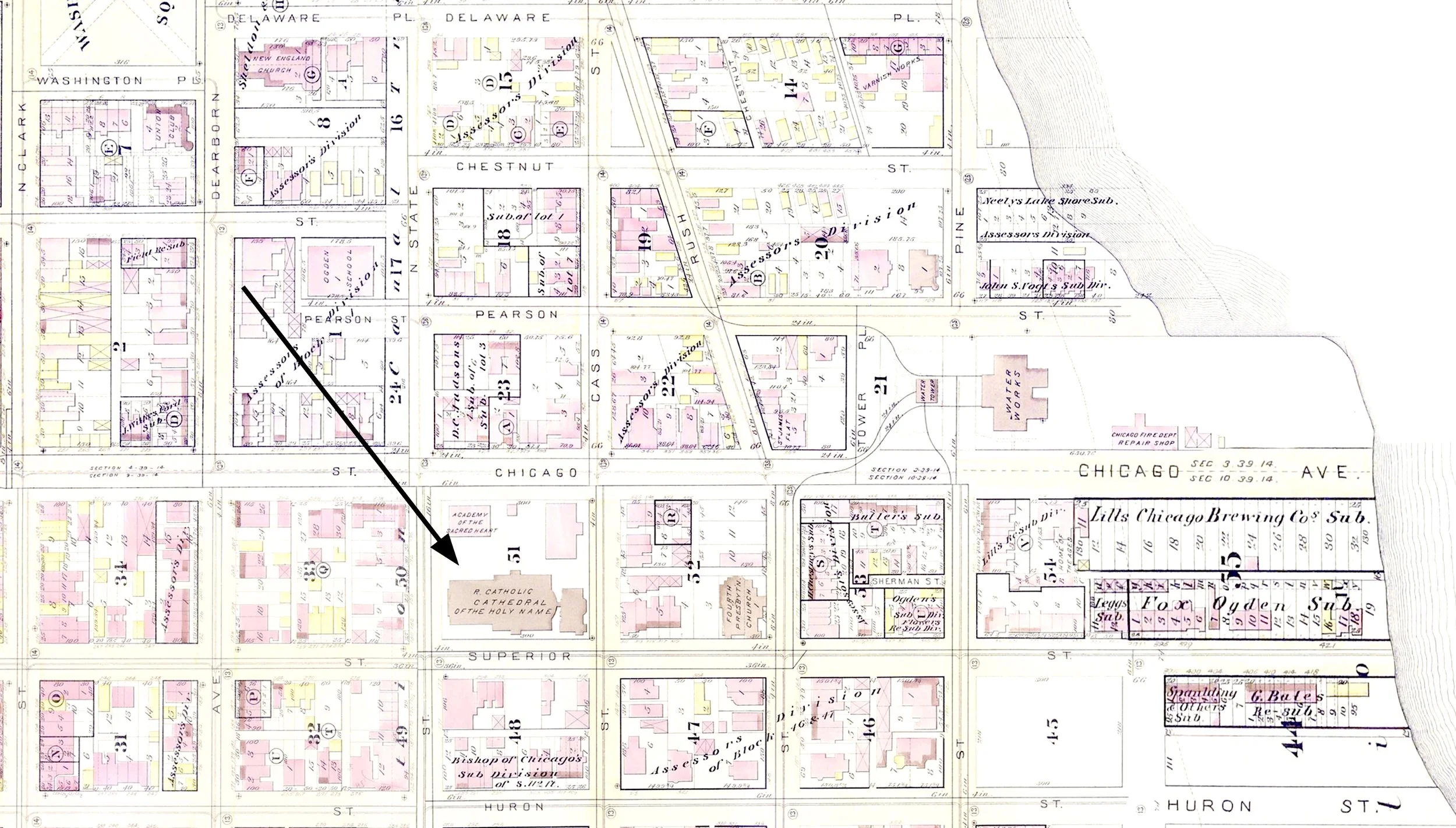
State Street & Superior Street, Chicago
Holy Name Cathedral
Where Owen Hamall and Catherine Griffith began their life together on August 13, 1879—and where their firstborn son Thomas Henry was baptized nine months later.
Churches of the Hamall Family
The Hamall family's movement through four Chicago parishes over thirteen years traces their residential mobility and community connections across the Near West Side and into Pilsen.
Thomas Henry (1880)
Mary (1885) • Katie (1890)
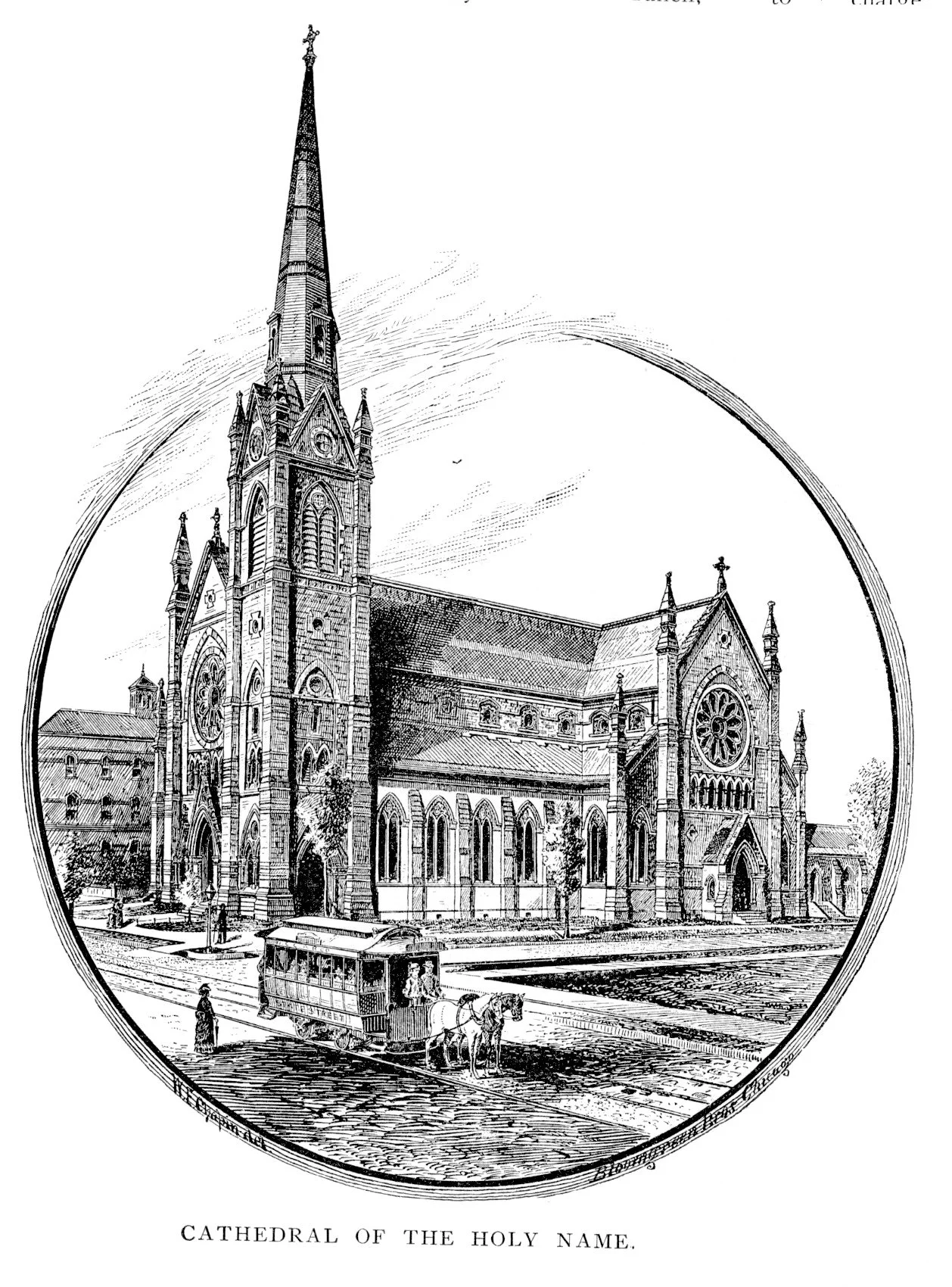
Holy Name Cathedral as it appeared in 1886—the church where Owen and Kate Hamall were married in 1879 and their firstborn son was baptized in 1880. Designed by Brooklyn architect Patrick Charles Keely, the Victorian Gothic structure featured a 210-foot spire, the highest in Chicago. Note the horse-drawn streetcar on State Street.
On August 13, 1879, Owen Hamall—a 32-year-old Irish immigrant working as an iron molder—stood at the altar of Holy Name Cathedral in Chicago to marry Catherine "Kate" Griffith, age 23. The ceremony was performed by Father D. M. J. Dowling at Chicago's mother church, the seat of the Roman Catholic Archdiocese. Nine months later, the couple returned to have their firstborn son Thomas Henry baptized at the same cathedral.
These two sacraments at Holy Name Cathedral mark the beginning of the Hamall family's documented story in Chicago—a story that would unfold across four parishes over the next thirteen years, through joy and devastating loss, as Owen and Kate welcomed six children and buried four of them.
Hamall Family at Holy Name Cathedral
& Catherine Griffith (age 23)
Officiant: D. M. J. Dowling
Certificate #41765
Parents: Owen Hamill & Cath. Griffith
Sponsors: John & Mary Griffith
Register Page 136
A Cathedral Risen from Ashes
When Owen and Kate exchanged vows in August 1879, Holy Name Cathedral had stood for only four years. The original cathedral—Chicago's first Catholic church—had been destroyed in the Great Chicago Fire of October 1871, leaving only its limestone walls and tower standing amid the devastation.
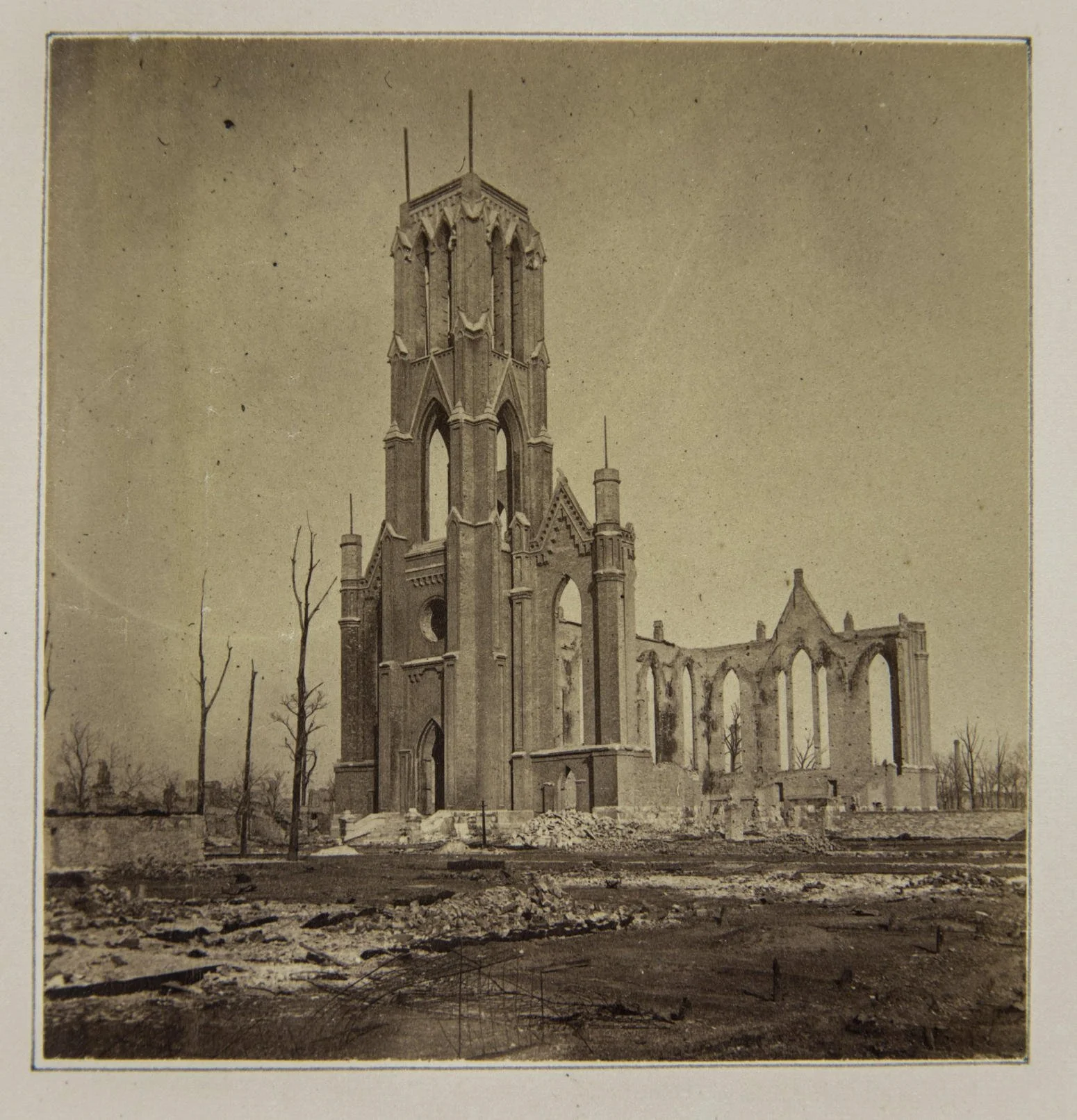
The ruins of Holy Name Cathedral after the Great Chicago Fire, October 1871. Only the limestone walls and tower remained standing. The cathedral that Owen and Kate knew was built on this foundation, dedicated November 21, 1875.
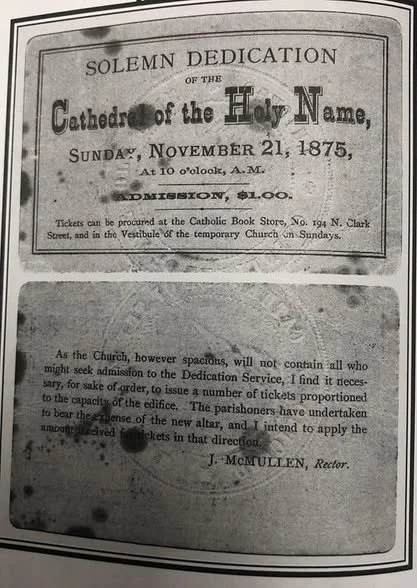
The new cathedral was solemnly dedicated on November 21, 1875—"Admission $1.00" read the tickets, which could be procured at the Catholic Book Store on Clark Street. Father J. McMullen, the rector, issued tickets proportioned to the capacity of the edifice, with proceeds going toward the new altar. This was the cathedral that would witness the beginning of the Hamall family.
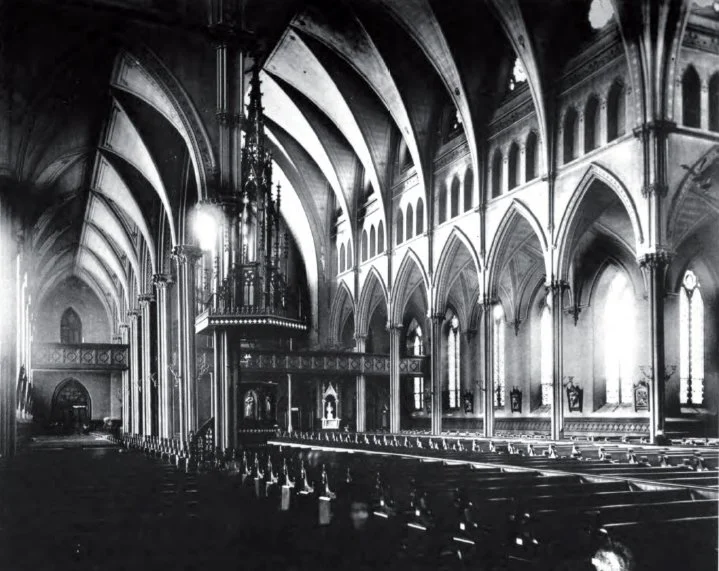
Holy Name Cathedral has served as the seat of the Roman Catholic Archdiocese of Chicago since 1843. The building Owen and Kate knew was designed by Brooklyn architect Patrick Charles Keely and constructed 1874-75 at a cost of $250,000. Its 210-foot spire was the highest in Chicago. The cruciform Gothic structure seated 2,300 in pews with room for 1,000 more—the largest capacity of any church in the city. The grand altar of Italian, Tennessee, Vermont, and Irish marble cost $5,000 alone.
The Marriage of Owen and Kate
Owen Hamall came to the altar with a history already marked by loss. Born in County Monaghan, Ireland around 1847, he had emigrated to North America as a child with his mother Mary McMahon and siblings. His mother had remarried after being widowed—to Patrick Thornton in Montreal around 1855—giving Owen a half-brother, William Thornton, who would later live with the Hamall family in Chicago.
By 1879, Owen had established himself as an iron molder in Chicago, boarding at 19 Bremer Street according to the 1878 city directory. Kate Griffith, his bride, was connected to another Irish immigrant family already established in Chicago—her mother Elizabeth Griffith had purchased a cemetery plot at Calvary Cemetery in 1870, the very plot where Owen and four of their children would eventually be buried.


Owen Hamall & Catharine Griffith
Married at Holy Name Cathedral, Chicago. Cook County Marriage Certificate #41765 records Owen Hamall, age 32, of Chicago, and Miss Catherine Griffith, age 23, of Chicago, united in marriage by D. M. J. Dowling, Priest.
Civil Record Citation: Marriage certificate, Owen Hamall and Catherine Griffith, 13 August 1879, Chicago, Cook County, Illinois; certificate no. 41765; Cook County Clerk's Office; digital images, FamilySearch "Illinois, Cook County Marriages, 1871-1920."
Dual Documentation
Having both the church marriage register and the civil marriage certificate provides redundant proof and cross-verification—a genealogical best practice. The civil record confirms ages (Owen 32, Kate 23), establishing approximate birth years of 1847 and 1856 respectively. Kate's maiden name Griffith connects her to the family network in Chicago, particularly her mother Elizabeth Griffith who purchased the cemetery plot where Owen would eventually be buried.
The Baptism of Thomas Henry
Nine months after their wedding, Owen and Kate returned to Holy Name Cathedral for the baptism of their firstborn son. On May 16, 1880, Thomas Henry Hamall was christened, with John and Mary Griffith—presumably Kate's relatives—serving as sponsors.
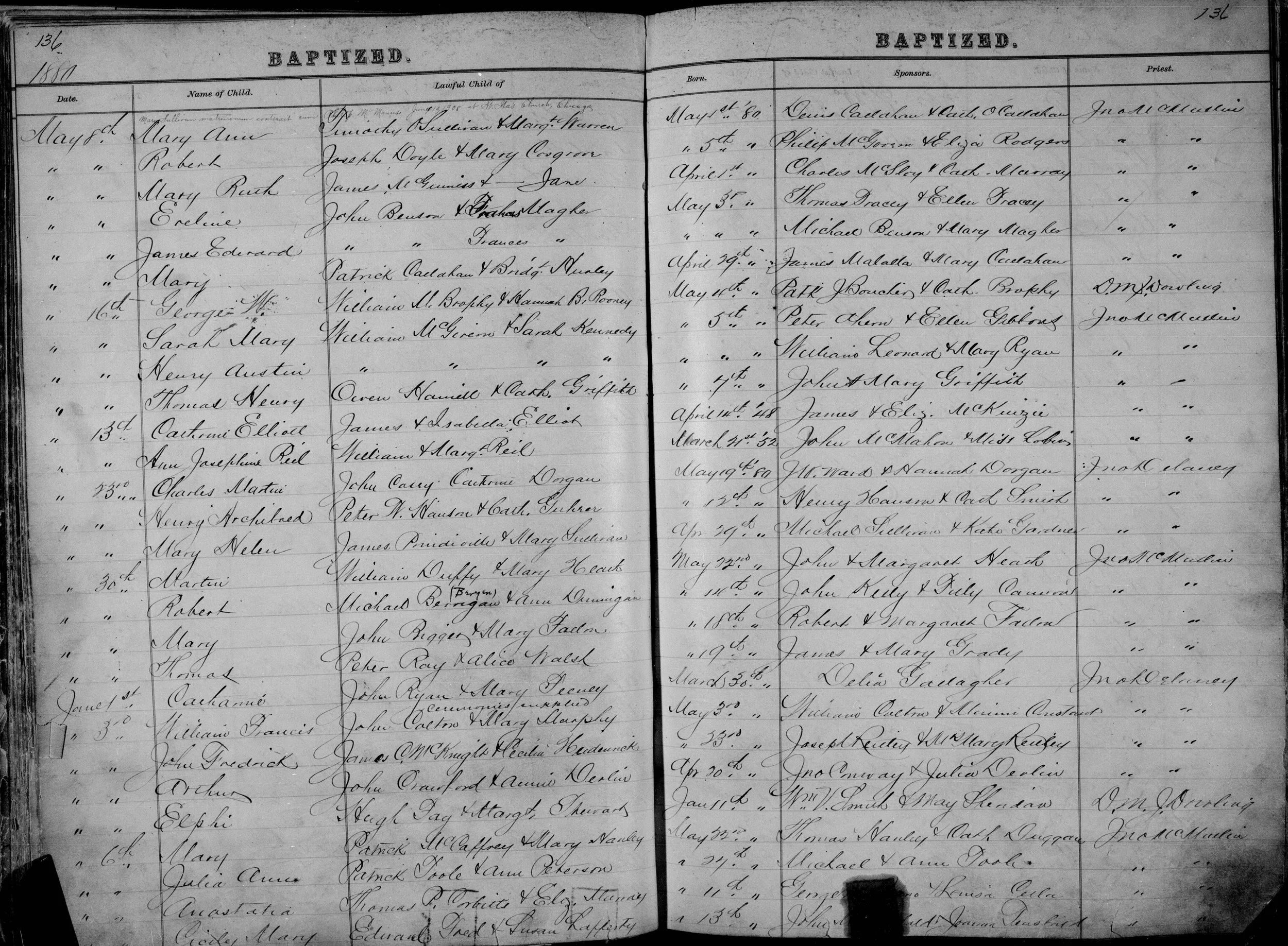
Holy Name Cathedral Baptism Register, page 136, May 1880. The entry for "Thomas Henry" shows parents Owen Hamill and Cath. Griffith, with sponsors John and Mary Griffith.
Thomas Henry Hamall
Son of Owen Hamill and Cath. Griffith. Born circa late April/early May 1880. Sponsors: John and Mary Griffith.
Just one month after Thomas Henry's baptism, the 1880 U.S. Census captured the young Hamall family at their home on Bremer Street. The household included Owen (age 33, iron molder), Kate (age 24), infant Thomas—and critically, a young man listed as "Hammil, Thornton" (age 24, born Canada), recorded with the relationship "brother."
The Mystery That Launched a Seven-Year Investigation
This 1880 census entry—showing "Hammil, Thornton" living with Owen's family—launched the genealogical investigation that would span seven years (September 2018–March 2024). Who was this person with a different surname living as Owen's "brother"? The answer, finally revealed through a baptismal record at Church of the Holy Family, confirmed that William Thornton was Owen's half-brother—born to Owen's mother Mary McMahon after her remarriage to Patrick Thornton in Montreal.
The Sole Surviving Son
Thomas Henry Hamall would become one of only two of Owen and Kate's children to survive to adulthood. Born into a family that would experience devastating tragedy, he witnessed as a child the deaths of four siblings in rapid succession during 1892-1893: Katie (July 1892), Lizzie (March 31, 1893), Eugene (March 31, 1893—the same day as Lizzie), and William (April 1893).
He also witnessed his father's decline: Owen's economic collapse by 1897 when he appeared on the "Destitute List" as blind and unable to work, and his death in February 1898 when Thomas was only 17 or 18 years old.
Despite the tragedies of his childhood, Thomas Henry survived to adulthood, married twice, and had children of his own—including Thomas Eugene Hamall (1904–1967). He lived to age 57 or 58, the only son of Owen and Kate to carry the Hamall name into the next generation. His sister Mary (1885–1959), baptized at Holy Family, was the only other sibling to reach adulthood.
The Cathedral Today
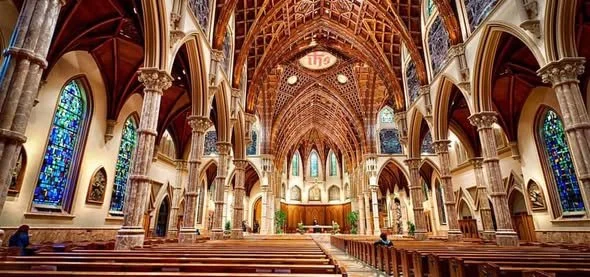
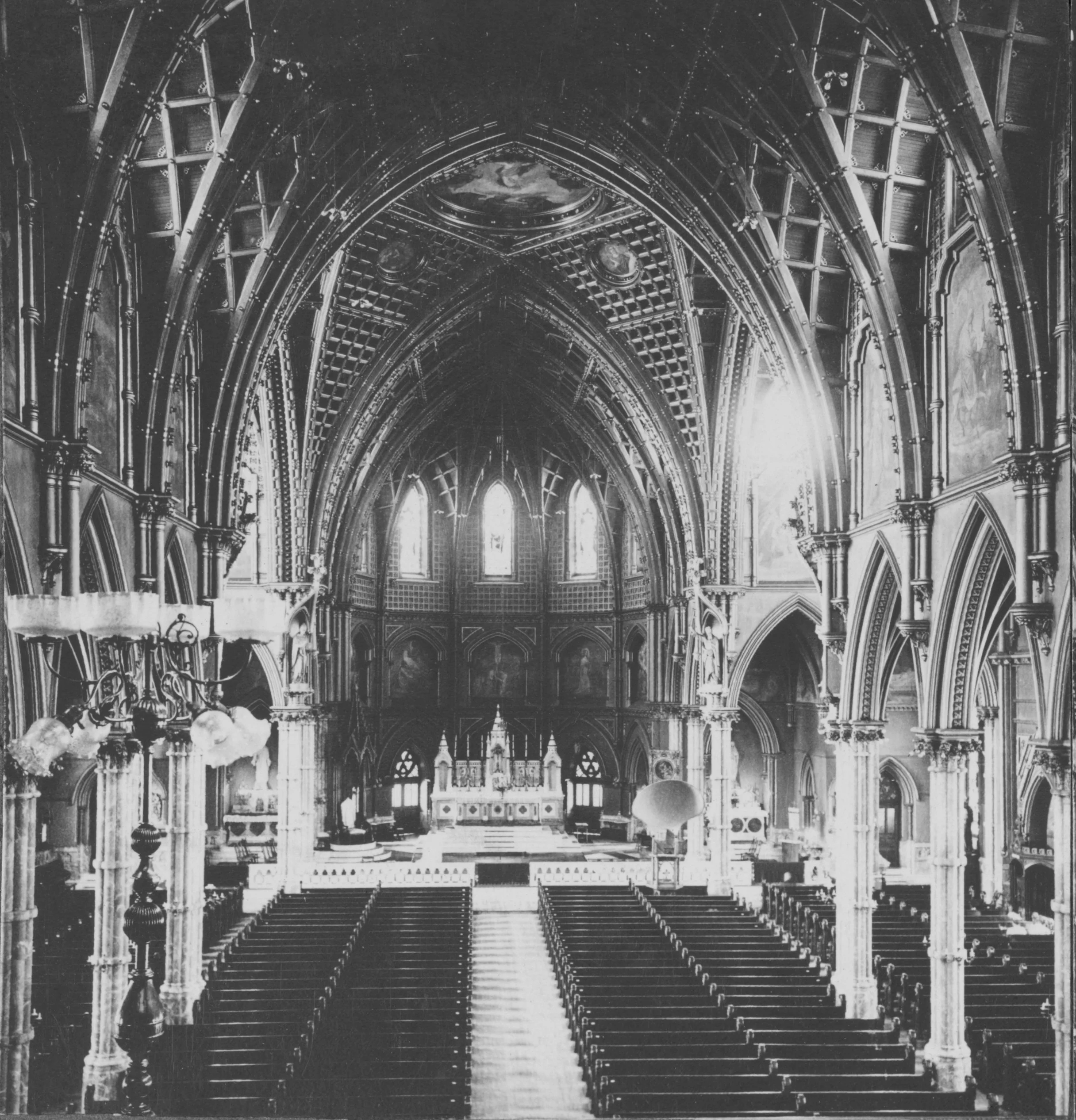
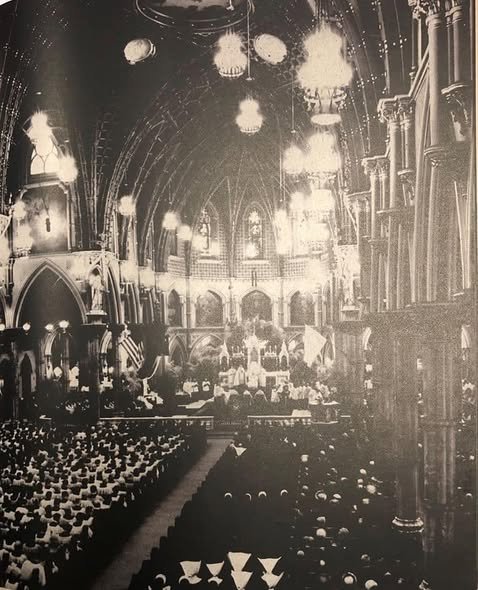
The interior of Holy Name Cathedral today, showing the dramatic Gothic arches and wooden ceiling. The cathedral has been extensively renovated since Owen and Kate's time, but remains the seat of the Archdiocese of Chicago.
Holy Name Cathedral continues to serve as the seat of the Roman Catholic Archdiocese of Chicago. The building Owen and Kate knew was extensively renovated in 1914, and the cathedral has undergone several restorations since. Today, it stands as one of Chicago's most significant religious landmarks, its records preserving the stories of countless immigrant families who began their American journeys within its walls.
For the Hamall family, Holy Name Cathedral represents the beginning—the place where Owen and Kate pledged their lives to each other, and where they celebrated the birth of their first child. From here, their journey would take them west through three more parishes as they sought housing, work, and community in 19th-century Chicago. But it all began here, at Chicago's mother church, in the summer of 1879.
Document Gallery
Want to Know When New Stories Are Published?
Subscribe to receive updates on new family history research—no spam, just meaningful stories when there's something worth sharing.
SUBSCRIBE TO OUR NEWSLETTEREvery Family Has a Story Worth Telling
Whether you're just beginning your research or ready to transform years of work into a narrative your family will treasure, I'd love to hear your story.
BEGIN YOUR RESEARCH INQUIRY