
The Sailors’ Church: Notre-Dame-de-Bon-Secours
Old Montreal, Quebec• 1657–Present
The Sailors' Church
Thomas Patrick Kenny was six or seven years old when his widowed mother, Margaret Connors Kenny, gathered her children for the long journey from Prince Edward Island to Chicago. Decades later, he still remembered one remarkable sight from that voyage: stopping at a church in Quebec where tiny ships hung from the ceiling, floating in the candlelit air like prayers made visible.
The church was Notre-Dame-de-Bon-Secours, known throughout the maritime world as the "Sailors' Church." Those ship models—votive offerings from sailors and immigrants who survived the dangerous Atlantic crossing—represented thousands of stories like his own: families leaving everything familiar, trusting their lives to wooden vessels and uncertain seas, carrying nothing but hope for a better life in America.
The Journey from Home
A Mother's Courage
Thomas Patrick Kenny was born at Charlottetown, Prince Edward Island, Canada's smallest province, where the salt air carried stories of fishing boats and family dreams. His father, James Kenny, died when Thomas was young, leaving his mother, Margaret Connors Kenny, to make one of the most difficult decisions any parent could face: stay in familiar surroundings with limited opportunities, or risk everything for her children's future.
Margaret chose courage. She brought Tom, his brothers Hugh and Lawrence, and his sister Kit (Catherine) down the St. Lawrence River on the long journey to Chicago, where relatives named Murphy had already established themselves in America's fastest-growing city.
The Kenny Family Route
Travelers from PEI to Chicago often utilized the St. Lawrence River and Great Lakes shipping routes or the expanding rail networks that passed through Montreal. The chapel at Notre-Dame-de-Bon-Secours, fronting the Old Port, served as a natural and spiritual landmark for those making this transformative journey.
Tom carried a small boy's memories of that transformative voyage. Years later, he would tell stories of stopping at the church in Quebec—seeing ship models hanging from the ceiling like prayers for safe passage. These weren't just decorations; they were offerings from sailors and immigrants who had survived the dangerous Atlantic crossing, giving thanks for deliverance and asking protection for those still to come.
Notre-Dame-de-Bon-Secours Chapel
Construction began on Notre-Dame-de-Bon-Secours, one of the oldest religious landmarks of Montreal, in 1655 under the guidance of French nun Marguerite Bourgeoys. She rallied the colonists of Ville-Marie to establish a sanctuary devoted to the Holy Virgin—a place where the faithful could seek Mary's protection in the dangerous wilderness of New France.
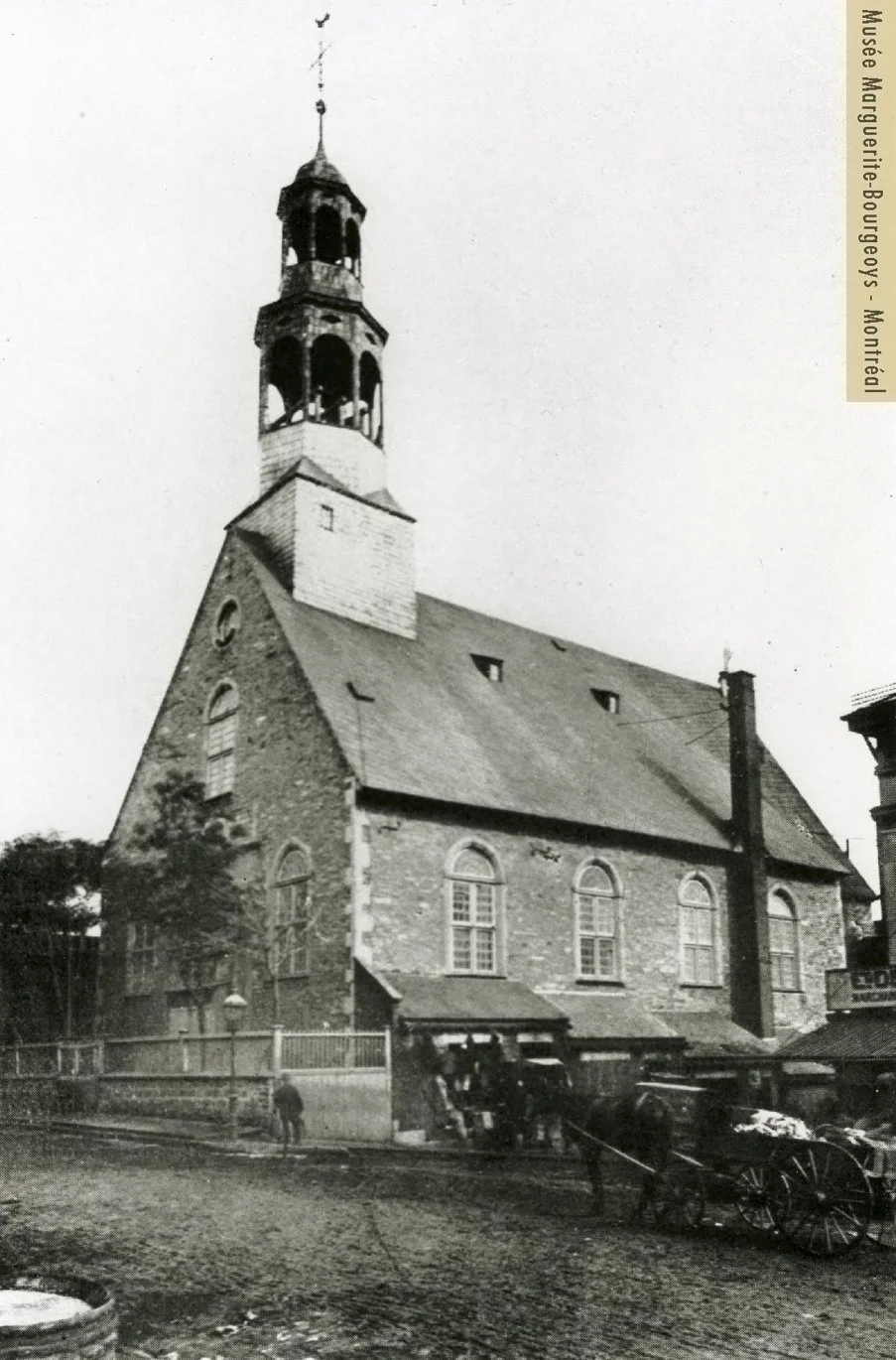
After one of her journeys to France, Marguerite returned with a wooden effigy of the Virgin Mary and placed it on the main altar. This small statue would become the spiritual heart of the chapel—and the focus of remarkable devotion when it survived a devastating fire in 1754, standing intact amid the ashes while the building around it burned.
Surviving the Flames
When fire destroyed the original chapel in 1754, the 16th-century wooden statue of the Virgin Mary was found standing intact in the lukewarm ashes. This "miraculous" survival intensified the devotion of Montreal's Catholic community and transformed the chapel into a pilgrimage site. The statue remains a central object of veneration today, a tangible connection to Marguerite Bourgeoys's original vision.
The chapel was quickly rebuilt on the same site, and through the decades was modified and embellished. Its location—directly fronting the harbor on the St. Lawrence River—made it the natural spiritual home for the city's maritime community and the first landmark greeting ships arriving at the Old Port.
The Sailors' Church
As an increasing number of settlers crossed the Atlantic to New France, Notre-Dame-de-Bon-Secours became intimately connected with the dangers of ocean travel. For many sailors and immigrants completing a treacherous trans-Atlantic voyage, the chapel was often the first significant building they encountered upon disembarking—their "first dry and steady step" on land.
Ships Floating in Air
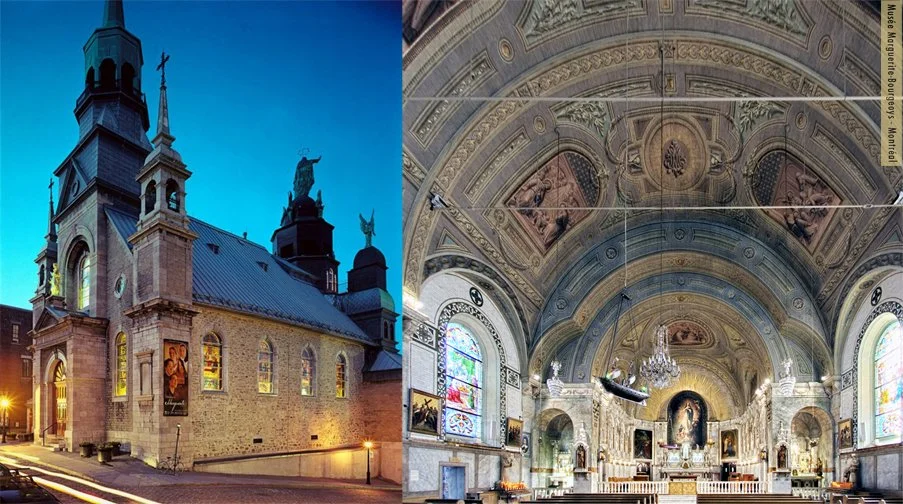
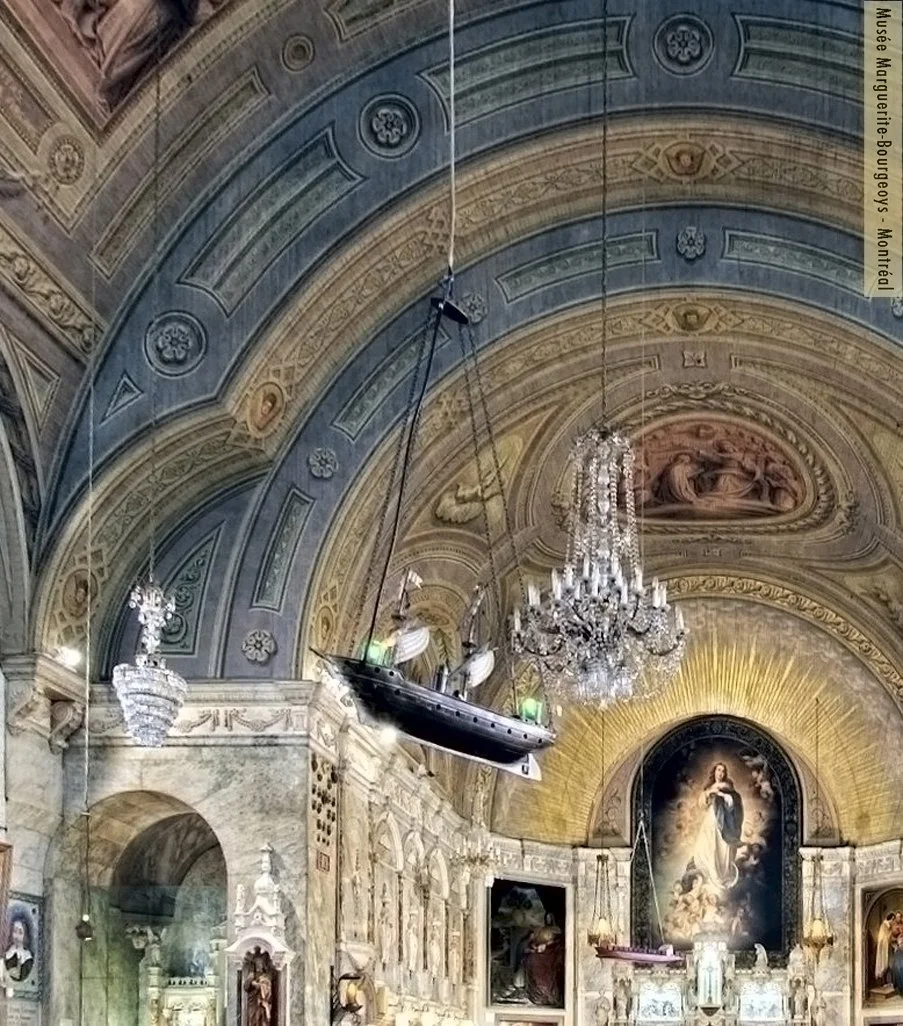
As a thankful gesture for safe passage, sailors commissioned boat models to be hung in the chapel as ex-votos—votive offerings of gratitude. These detailed miniature ships, suspended from the vaulted ceiling, appeared to float several meters above the floor. To a young child like Thomas Kenny, they would have seemed magical—prayers made visible, sailing through candlelit air.
The tradition continues today. The models represent a mix of expertly carved frigates and warships alongside more humble attempts, creating a dense, visually striking display found nowhere else in Montreal.
The unusual display attracted pilgrims and curious travelers alike. To emphasize the chapel's role as patron church of sailors, Monseigneur Ignace Bourget, Bishop of Montreal, commissioned a Stella Maris—a statue of the Virgin Mary as the "Star of the Sea"—and placed it atop the chapel in 1849. With arms outstretched toward the harbor, the Virgin Mary continues to welcome travelers and serve as a beacon of hope for incoming ships.
The 19th-century sailors' devotion to Notre-Dame-de-Bon-Secours originated from several factors:
- Strategic Location: The chapel, rebuilt in 1771 on the site of the original, was one of the first landmarks greeting ships arriving at the Old Port of Montreal.
- "Our Lady of Good Help": The chapel's very name promised divine assistance. Sailors who survived the perilous sea voyages visited to offer thanks to the Virgin Mary for her protection.
- Visible Symbol: The "Star of the Sea" statue atop the church served as a welcoming beacon—a visible sign of Mary's watch over mariners.
- Pilgrimage Tradition: The chapel became a popular pilgrimage site for sailors and their families praying for loved ones at sea, hosting 60,000 to 80,000 pilgrims annually during peak years.
The Chapel in the 1870s
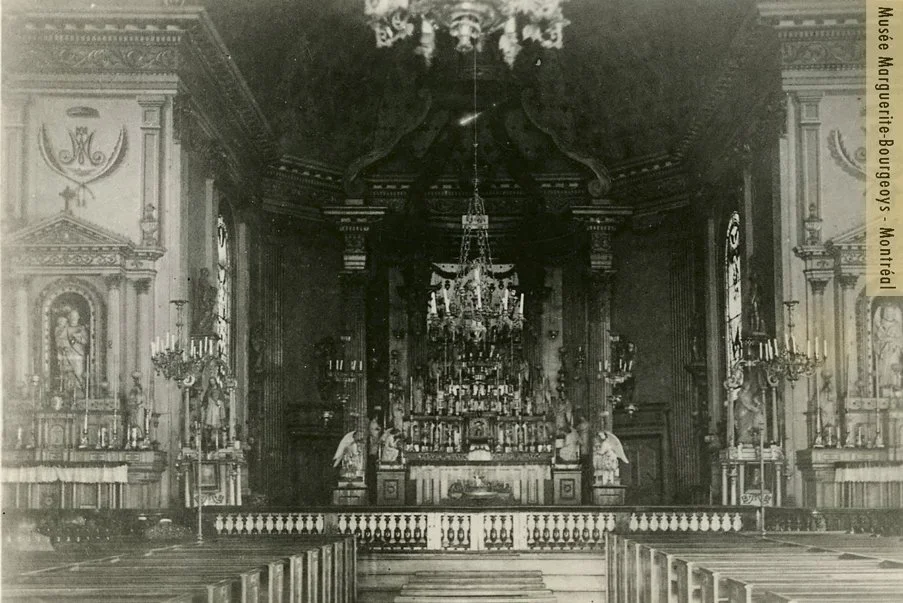
When the Kenny family passed through Montreal in the late 1870s, Notre-Dame-de-Bon-Secours was in the midst of significant renovations. A major project begun in 1877 updated the chapel's façade and bell tower—work that would continue through 1883 with the installation of a large bell and statue at the tower's peak.
Façade and Bell Tower Project
The chapel underwent significant structural renovations beginning in 1877. Despite the construction, the interior remained a powerful experience for visitors. The vaulted ceiling held its constellation of ship models, crystal chandeliers sparkled in the candlelight, and the miraculous statue of the Virgin Mary continued to draw pilgrims from across the region.
For young Thomas Kenny, the visual impact would have been unforgettable. The models—ranging from expertly carved frigates to more amateur attempts—created a dense, visually engaging display that differed from any other church he had ever seen. These detailed miniature ships, suspended from the vaulted ceiling, appeared to be "floating" several meters above the floor. To a six- or seven-year-old, they would have seemed like magic.
A Lasting Memory
Years later, Thomas would tell stories of this remarkable sight to his own children and grandchildren—the church where ships sailed through the air. His vivid memory of stopping to see these ship models during his family's St. Lawrence River journey became a treasured story he would tell throughout his life, connecting the Kenny family's American journey to centuries of immigrant gratitude.
The Founder
The story of Notre-Dame-de-Bon-Secours cannot be told without its founder. Marguerite Bourgeoys arrived in Montreal (then Ville-Marie) in 1653 and immediately set about building both the physical and spiritual infrastructure of the struggling colony. She is credited with first using the term filles du roi—King's Daughters—to describe the young women sent by Louis XIV to settle New France.
Saint Marguerite Bourgeoys: Mother of the Colony
Bourgeoys acted as guardian and mentor to the King's Daughters, meeting the young women at the docks as they arrived from France, providing them housing at Maison Saint-Gabriel, and teaching them the skills they would need as colonial wives and mothers. She rigorously interviewed prospective husbands to ensure they were of good character and had the economic means to support a family. Her signature often appears as a witness on the resulting marriage contracts.
The Bourgeoys story connects to the Kenny family history through the broader patterns of French-Canadian settlement. Many French Canadians can trace their lineage back to the filles du roi whom Bourgeoys mentored. The chapel she founded—the same chapel where young Thomas Kenny saw ships floating in the air—represents the intersection of French-Canadian Catholic tradition with the later waves of Irish immigration that brought the Kenny and Connors families to North America.
The Chapel Today
Notre-Dame-de-Bon-Secours Chapel still stands in Old Montreal, continuing its role as both an active place of worship and a museum honoring Marguerite Bourgeoys. The ex-voto ship models still hang from the ceiling, and the "Star of the Sea" statue still watches over the harbor.
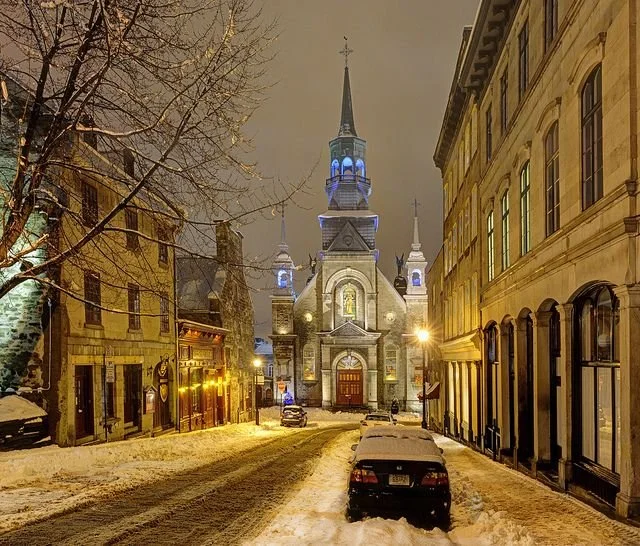
Visitors today can climb the chapel's tower for a panoramic view of the Old Port and the St. Lawrence River—the same view that would have greeted 19th-century travelers. In a small adjoining museum, 58 charming dioramas made by nuns in the 1940s tell the life story of St. Marguerite Bourgeoys through carefully crafted scenes featuring dolls, demonstrating through hundreds of hours of detailed work a loving devotion to the French nun who shaped Montreal's earliest years.
Timeline
"These weren't just decorations; they were offerings from sailors and immigrants who had survived the dangerous Atlantic crossing, giving thanks for deliverance and asking protection for those still to come."
The ship models Thomas Kenny remembered from his childhood journey represent one of the most tangible connections between his family's American story and the centuries of immigrants who came before. Notre-Dame-de-Bon-Secours served as a waypoint between worlds—a place where travelers paused to offer thanks for survival and prayers for what lay ahead.
For a young boy traveling with his widowed mother and siblings toward an uncertain future in Chicago, the sight of those ships sailing through candlelit air must have seemed both miraculous and comforting. Other families had made this journey. Other children had stood where he stood, looking up at these same offerings. And somehow, through faith or fortune or the protection of Our Lady of Good Help, they had survived.
Thomas Kenny carried that image with him for the rest of his life—a small boy's memory that became a family story, passed down through generations until it reached us today.
Sources
Primary Sources
- Kenny family oral tradition, as preserved through descendants
- Marguerite Bourgeoys Museum, Notre-Dame-de-Bon-Secours Chapel
Photographs
- Musée Marguerite-Bourgeoys, Montreal (historic and contemporary images)
- Photography: A. Brunner (choir loft, before 1885)
- Photography: Normand Rajotte et Bernard Dubois (contemporary chapel images, 2008)
- Photography: Bernard Dubois (The Idaho ex-voto)
Secondary Sources
- Diocese of Montreal, Notre-Dame-de-Bon-Secours Chapel history
- Atlas Obscura, "Notre Dame du Bon Secours" entry
- Musée Marguerite-Bourgeoys, "History of the Chapel" documentation
- GCatholic, "Notre-Dame-de-Bon-Secours Chapel" institutional profile
Every Family Has a Story Worth Telling
Whether you're just beginning your research or ready to transform years of work into a narrative your family will treasure, I'd love to help.
LET'S TALK ABOUT YOUR FAMILY