
The Storyline
Real families. Real discoveries. Real stories.

The Brothers Guilbault
On 10 October 1798, a priest at St-Paul-de-Lavaltrie baptized a six-year-old girl born in the pays d'en haut. In the same entry he named her father Gabriel Guilbault a voyageur, and her godfather Paul Guilbault — Gabriel's brother — as a man who could not sign his name. That one word sent this research into the Hudson's Bay Company Archives twice, once for each brother. Both times an account was found. Both times it had to be given up.
Part of the Storyline Genealogy series: The Guilbault Line

The Lieutenant and the Voyageurs
In the spring of 1820, Lieutenant John Franklin spent four months at Fort Chipewyan trying to hire French-Canadian voyageurs willing to paddle him toward an unmapped Arctic coast. Some agreed. Some refused — sensibly, since a North West Company crew had recently been killed in the same country. And in July, before the party went north, Franklin discharged three Canadians and paid them off. He named the sixteen who went. He did not name the three who didn't, and one line in a company ledger may be all that survives of one of them.
Part of the Storyline Genealogy series: From Research to Story

Finding a Gabriel Guilbault in the North West Company Records
A fur trade account book gives you a name and a number. No age, no parish, no father's name. This is how I found Gabriel Guilbault in the North West Company records — three volumes, a cross-post balance, an account marked settled — and how the parish registers later showed the man I had found was not the man I thought. The search method still works. It's the sixth step that decides it.
Part of the Storyline Genealogy series : A Research Journey From the Index to the Account Book

Sainte-Trinité-de-Contrecoeur: The Parish That Burned — and What Survived
On December 1, 1675, Philibert Couillaud dit Roquebrune — a former Carignan-Salières soldier who could not read or write — stood before a notary in Contrecoeur and witnessed the construction contract for the community's first chapel. Less than three years later, fire consumed the parish registers kept in a surgeon's house. In 1687, fire consumed them again. By 1701, fourteen and a half years of baptisms, marriages, and burials had simply ceased to exist. But the stone walls built according to the Conefroy plan — thick fieldstone, engineered to survive — held through the building fire of 1862, and were rebuilt around a new Victor Bourgeau vault in 1863. This is the story of Sainte-Trinité-de-Contrecoeur: what burned, what survived, and what it means for everyone researching families from the oldest settlement on the south shore of the St. Lawrence.
Part of the Storyline Genealogy series : Sacred Places

Philibert Couillaud dit Roquebrune: The Soldier from Nevers
He could not read or write. No birth record survives. No marriage record. No death record. What survives is an X on a debt ledger, a name in a bishop's register, six acts before four named notaries, and a cascade of lawsuits filed by the widow he left behind. From these fragments — a life emerges.
Part of the Storyline Genealogy series: Carignan-Salières — From Soldiers to Settlers

Élisabeth Roy (Le Roy)
She arrived at Québec in June 1665, an orphan from Senlis who could not write her own name, and was married by October. Over the next forty-four years Élisabeth Roy buried two husbands, lost two sons on a single day, and raised seven children across three marriages — one of only thirty-five Filles du Roi to marry three times. Her first marriage contract, read here in the original, was signed by the governor of New France, the lieutenant-general of the Americas, and the two women charged with placing the King's daughters.
Part of the Storyline Genealogy series: Filles du Roi & Filles à Marier — The Women Who Built New France

Antoine Leblanc dit Jolicoeur
In December 1687 a soldier called "Cheerful Heart" was buried at Saint-Jean, Île d'Orléans. Antoine Leblanc dit Jolicoeur had crossed the Atlantic with the Carignan-Salières Regiment, married a Fille du Roi from Senlis, raised five children, and buried two of them on a single day. Reconstructed from the notarial acts read in the original — the marriage contract, two concessions, a harvest engagement — alongside the parish registers, censuses and military rosters of seventeen years on an island in the St. Lawrence.
Part of the Storyline Genealogy series: Carignan-Salières — From Soldiers to Settlers

The Other Pierre Morin
There is a second Pierre Morin in the Carignan-Salières Regiment. He was born about 1643 in the diocese of Saintes, he was confirmed at Fort Chambly in May 1668, and by 1681 he was working a Sulpician domain at Lachine. He never married in the colony and left no descendants. Here is his record set out in his own right: one confirmation, one database reconstitution, and a great deal that has been attributed to him rather than documented.
Part of the Storyline Genealogy series: From Research to Story

How to Prove Carignan-Salières Service — and How to Know When You Haven't
You've traced your line to a man who married a Fille du Roi, and half a dozen trees call him a Carignan-Salières soldier. The sources aren't there. Here's the framework I use — and the citation-counting failure in my own published work that took a year and a new book to notice.
Part of the Storyline Genealogy series: From Research to Story

What Happens When A Fille du Roi Dies in Childbirth?
On May 30, 1694, the curé of Pointe-aux-Trembles wrote two entries on one page: a burial and a baptism, the same family, the same ink. The woman was Françoise Baiselat, a Fille du Roi of 1668. The child was her son François. What came after — three estates, children from three marriages, a widower who could not sign his name, and a priest still chasing the funeral bill three years on — is recorded in the notarial acts, and it is the part the register does not tell you.
Part of the Storyline Genealogy series: From Research to Story

André Corbeil dit Tranchemontagne
In September 1684 a young soldier from Saintonge stepped ashore at Québec in a company of the Compagnies franches de la Marine. Somewhere in the nine years that followed he acquired a second name: Tranchemontagne, the mountain-slasher. It was not his family's name and it was not a joke that faded. Three centuries later it is the name his descendants carry, and the name his own has nearly disappeared behind.
Part of the Storyline Genealogy series: Uncovering the stories behind the names that built New France.

Pierre Marsan dit Lapierre
Pierre Marsan dit Lapierre came out of Saint-Nicolas parish in Rouen and went home to nothing. When the Carignan-Salières was disbanded in 1668 he took the crown's offer and stayed, married a young widow with an infant daughter, and spent twenty-one years clearing land at Pointe-aux-Trembles. Ten children, one river-lot farm, and a death recorded nowhere — only bracketed between two acts.
Part of the Storyline Genealogy series: Carignan-Salières — From Soldiers to Settlers

Françoise Baiselat ~1651 - 1694
Françoise Baiselat was baptized in the shadow of Saint-Sauveur in Paris, the daughter of a pewterer who also carried the verge at the parish church. Orphaned of her father at eleven and bound out to a buttonmaker at thirteen, she sailed for New France in 1668 as a Fille du Roi with three hundred livres in furniture, clothing, rings and jewels. Twenty-six years, three husbands and twelve children later, she died bearing the last of them. This is her life told from the acts themselves.
Part of the Storyline Genealogy series: Filles du Roi & Filles à Marier — The Women Who Built New France
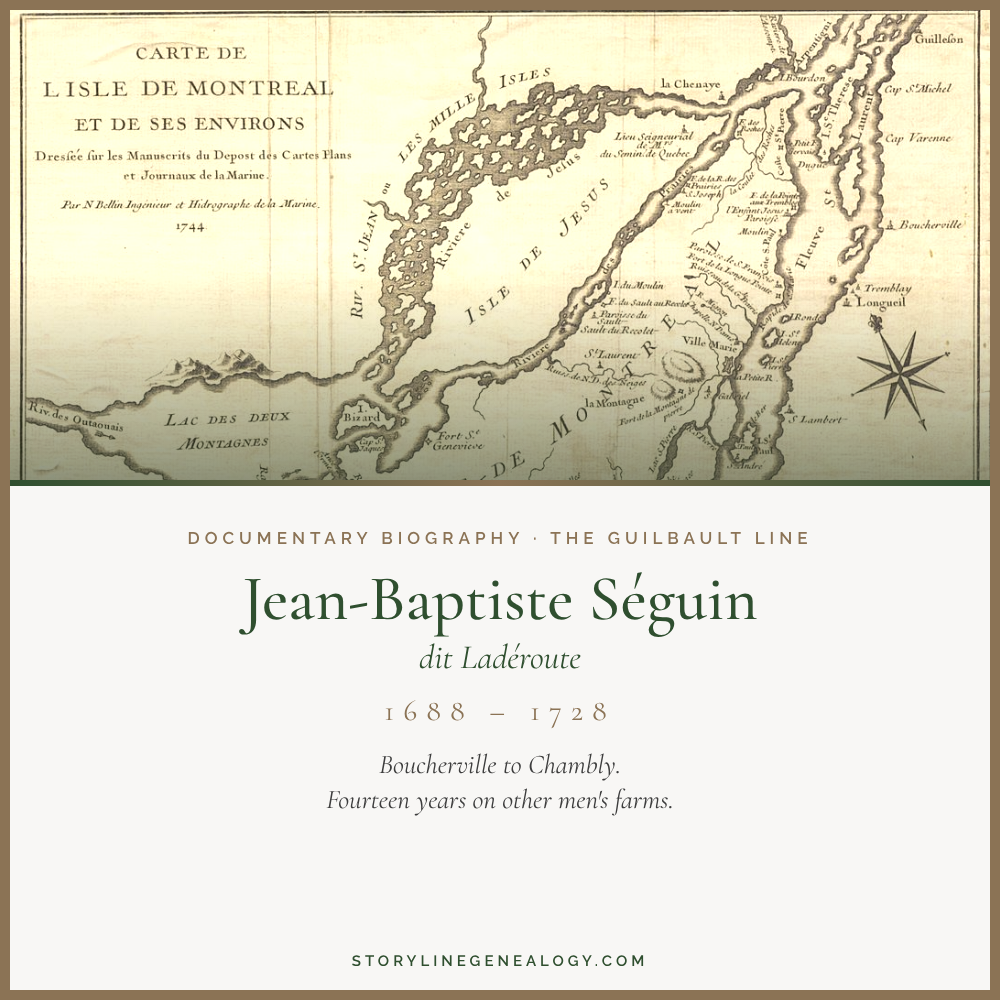
Jean-Baptiste Séguin dit Ladéroute
Born at Boucherville in 1688, Jean-Baptiste Séguin dit Ladéroute spent his working life on other men’s farms. Twelve notarial acts follow him through two half-profit tenancies, land bought with borrowed card money, a debt “for urgent necessities,” and a purchase he could never pay for, to his death at Montréal in 1728 and a widow “reduced to alms.” His ten children, among them our ancestor Marie Charlotte, carried the line to Vaudreuil and Oka.
Part of the Storyline Genealogy series: The Guilbault Line

Sainte-Famille de Boucherville
Sainte-Famille de Boucherville stands on land donated by Pierre Boucher himself — one of the most remarkable figures in early New France. On October 31, 1672, Carignan-Salières Regiment veteran François Séguin dit Ladéroute married Jeanne Petit in the original wooden chapel, just five years after the town was founded. Over the next two decades, the Séguin family filled the parish registers with baptisms and burials. Their son Jean-Baptiste, our direct ancestor, would carry the family name westward to the fur trade at Detroit.
Part of the Storyline Genealogy series : Sacred Places

Église Saint-François-de-Sales
The church of Saint-François-de-Sales in Neuville, Quebec, houses the oldest carved religious decor in North America and the parish registers that anchor the Soulière Line to the very beginnings of New France. In 1686, Marie Barbe Sylvestre — daughter of founding father and soldat Nicolas Sylvestre dit Champagne — married Jean Bernardin Lesage dit Lepiedmontois, an Italian soldier from Racconigi, Piedmont. Their story begins here, in the breadbasket of New France.
Part of the Storyline Genealogy series : Sacred Places

Anne Ledet: A Fille à Marier in New France
Before she married Gilles Pinel in 1657, Anne Ledet held a Jesuit land grant in her own name. Her first marriage had been dissolved — a wife left behind in France — and her daughters recorded as born out of wedlock. She raised eleven children and could not sign her name.
Part of the Storyline Genealogy series: Filles du Roi & Filles à Marier — The Women Who Built New France

Finding an Italian Ancestor in French-Canadian Research
When you're deep in French-Canadian genealogy, the last thing you expect to find is an Italian. But a dit name—Lepiedmontois, "the Piedmontese"—revealed a soldier from Racconigi, Italy, hiding in plain sight among 10,000 French settlers. Out of the founding immigrants of New France, over 95 percent were French. Italian permanent settlers were among the rarest of the rare. This is the story of how one dit name unraveled the assumption of a purely French founding population—and what it means for your research.
Part of the Storyline Genealogy series: French-Canadian Genealogy — From Research to Story

Jean Bernardin Lesage dit Lepiedmontois
In September 1716 a notary at Québec wrote down Jean Bernardin Lesage's occupation: brigadier of the beaver guards. The Piedmontese soldier who had married a fourteen-year-old at Neuville thirty years earlier had left the ranks for a post in the town — and he signed the contract, in a colony where his wife's own mother could not sign hers. Twelve children, four different birth years on the record, and a bishop's dispensation two generations on.
Part of the Storyline Genealogy series: From Soldier of the Troupes de la Marine to Settler.

Nicolas Sylvestre dit Champagne
He came to Canada a soldier and left six notarial acts behind him across twenty-eight years. Not one of them is signed. Orphaned at ten in Champagne, Nicolas Sylvestre farmed sixty years on the St Lawrence, buried two grown sons in a single year, and died in a house appraised at twenty-five livres.
Part of the Storyline Genealogy series: Founding Fathers