
The Storyline
Real families. Real discoveries. Real stories.
Following the Canoe Routes: How the Fur Trade Families Moved Between the Interior and Quebec
Genealogists researching French-Canadian voyageurs often encounter a puzzling pattern: a man appears in Quebec records, disappears for years, then resurfaces—sometimes with a wife and children who seem to have materialized from nowhere. The explanation lies in the geography of the fur trade. Understanding how these families traveled helps you know where to look for records.
Part of the Storyline Genealogy Series: A Storyline Genealogy Research Guide
The North West Company: A Genealogist’s Guide to the “Pedlars from Quebec”
For forty years the North West Company employed thousands of French-Canadian voyageurs and kept remarkably detailed accounts of what they earned and what they bought. This is a guide to those records — what survives, where it's held, and how to search it. Including the limitation nobody warns you about: an account book gives you a name and a number, and nothing else.
Part of the Storyline Genealogy Series: A Storyline Genealogy Research Guide
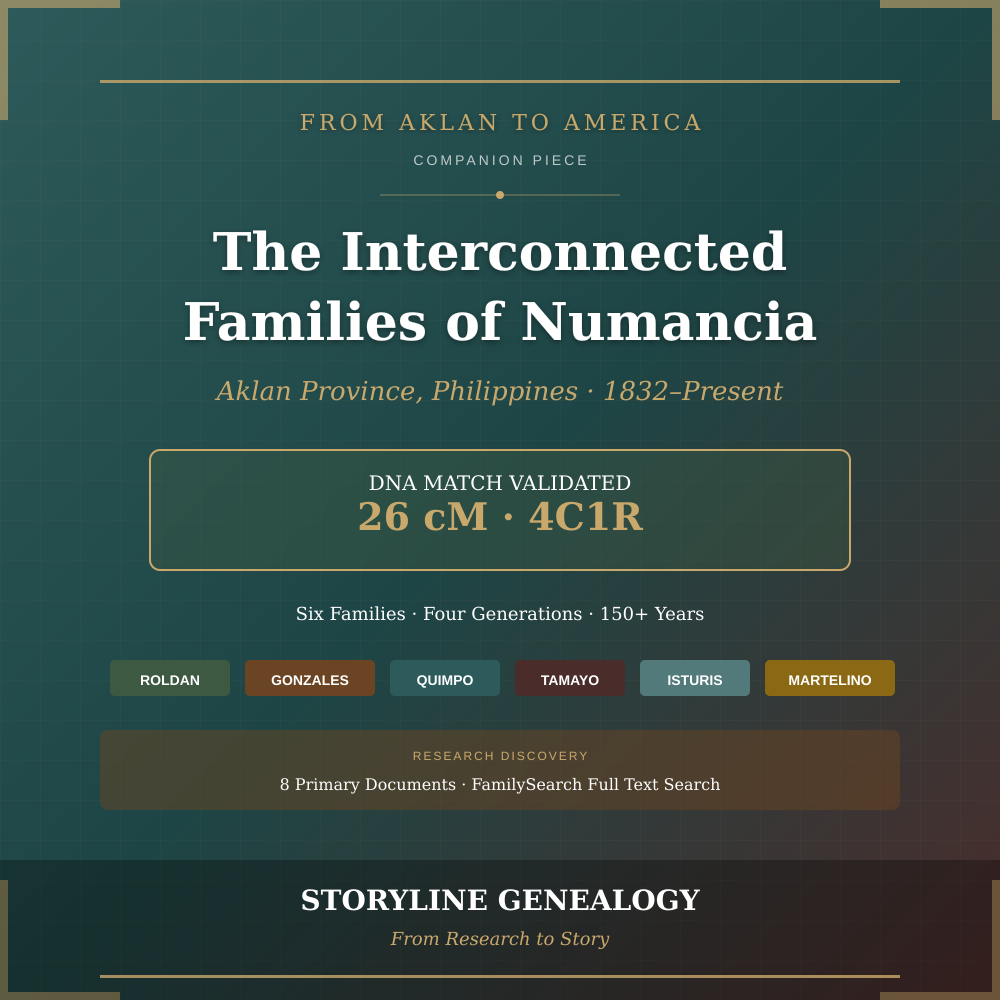
The Interconnected Families of Numancia
A distant cousin DNA match led to common ancestors through the Martelino line, launching an investigation that revealed six interconnected families in Numancia, Aklan Province. Using FamilySearch Full Text Search—a 2024 technology breakthrough that reads actual document text—eight primary documents spanning 35 years (1927–1962) documented the Roldan, Gonzales, Quimpo, Tamayo, Isturis, and Martelino families. The June 1927 Pacto de Retro sale provided the first proof that Fortunato Roldan was married to Margarita Isturis—a discovery that unlocked generations of family connections. This companion piece demonstrates professional Philippine genealogy research methodology.
Part of the Storyline Genealogy series: Documentary Biographies From Research to Story
Marriage à la façon du pays: The Unions That Built a Nation
During the 1700s and 1800s, marriages between French fur traders and Indigenous women were fundamental social and economic institutions in North America. These unions—called mariage à la façon du pays—created strategic alliances that facilitated the fur trade and led to the emergence of the distinct Métis culture. Learn where to find these families in the records, from Hudson's Bay Company Archives to Métis Scrip.
Part of the Storyline Genealogy series: Documenting the lives of our earliest ancestors through primary sources.
Irish Genealogy Challenges
Irish genealogy is widely considered among the most challenging in the world—and for good reason. Census records destroyed, parish registers that start too late, dozens of people with the same name in one parish, and DNA complicated by endogamy. After seven years researching my Hamall family from County Monaghan, I've encountered every obstacle the records can throw at a researcher. Here's what you're up against—and what you can do about it.
Part of the Storyline Genealogy series: From Research to Story
Parish Churches of County Monaghan
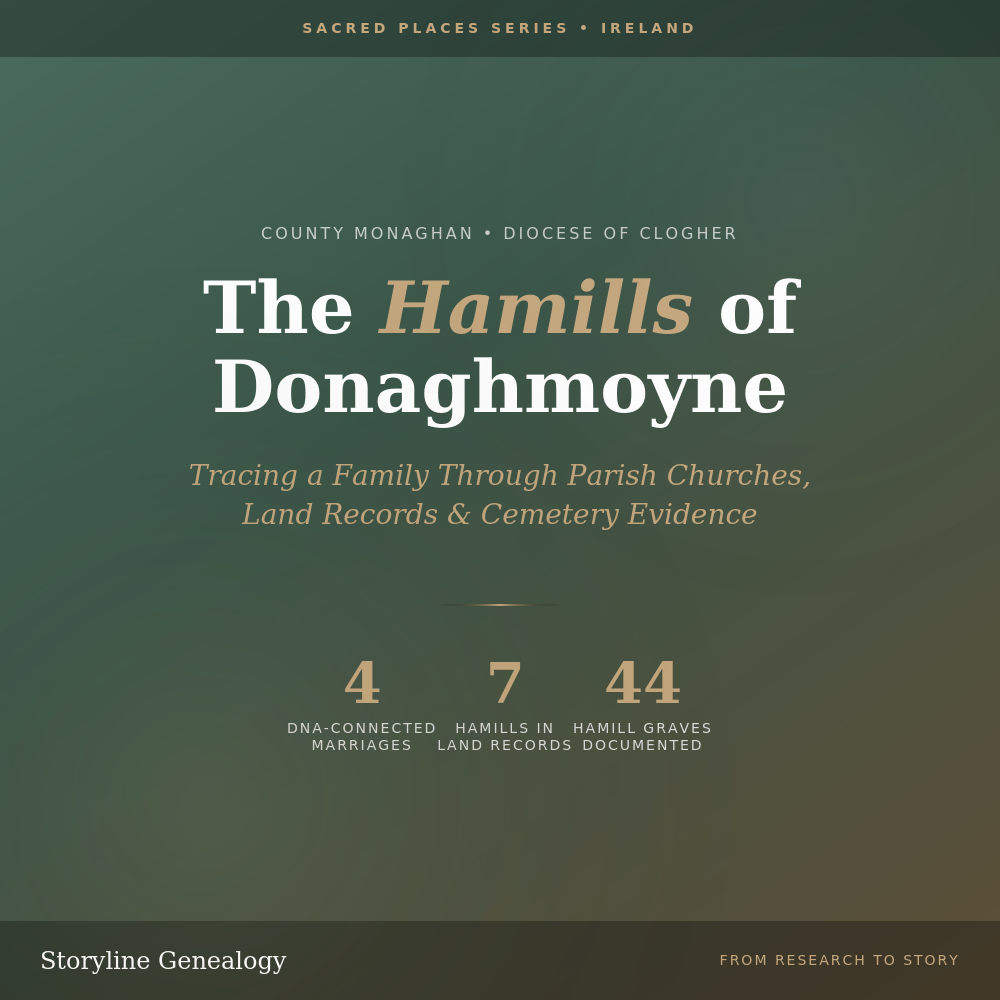
Four marriages. Four DNA connections. One parish name on every record: Donaghmoyne. This comprehensive guide explores the overlapping parishes, surviving records, and cemetery evidence that help trace the Hamill families of south Monaghan—from the townlands of Dian, Drumaconvern, and Edengilrevy to descendants scattered across two continents.
Part of the Storyline Genealogy series : Sacred Places
One Parish, Five Destinations
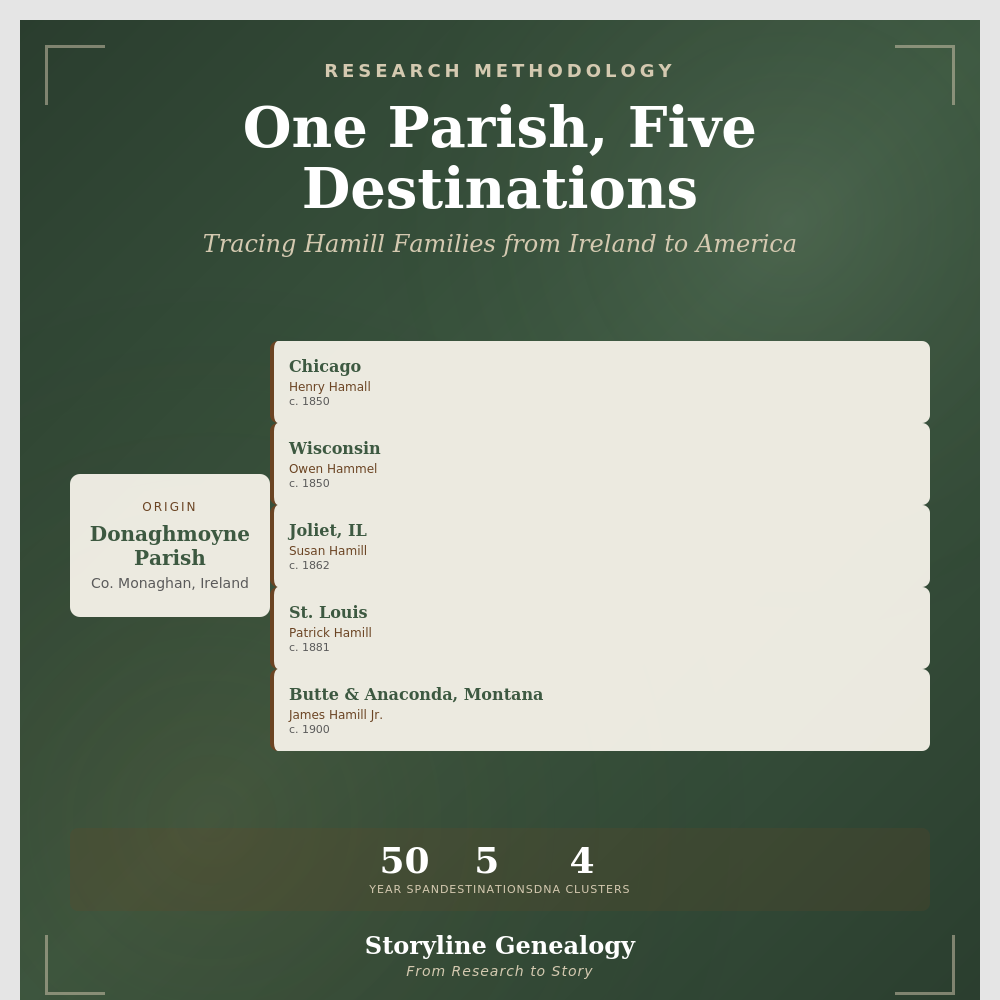
DNA doesn't lie, but it doesn't always explain itself either. As I've worked to untangle the Hamill families of Donaghmoyne parish in County Monaghan, I keep encountering the same puzzle: distinct clusters of DNA matches pointing to relatives scattered across five American destinations—Chicago, Wisconsin, Joliet, St. Louis, and Montana. These matches trace back to ancestors who were married in the same small Irish parish between 1841 and 1858. The geographic spread raises a fundamental research question: How do we prove that families who emigrated decades apart were actually connected back in Ireland?
Part of the Storyline Genealogy series: From Research to Story
The 1850 Hickey Map: The Montgomery Estate on Lot 34
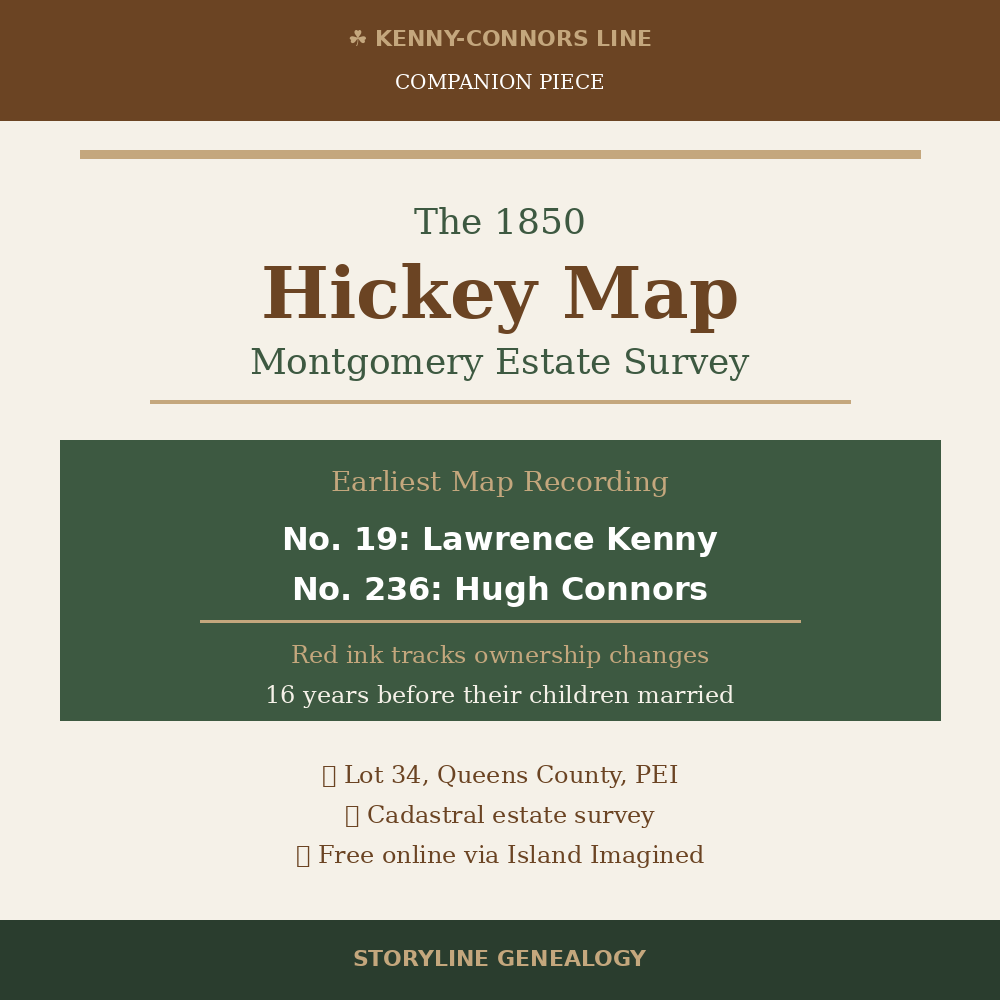
Before the 1863 Lake Map placed "L. Kenny" and "H. Connors" on the commercial record, another document had already captured their presence on Lot 34. Daniel Hickey's 1850 cadastral survey—"A Plan of Township No. 34, The Property of Sir Graham Montgomery & Brothers"—is a landlord's inventory of his tenants, recording each family by parcel number, name, and acreage. Lawrence Kenny appears at No. 19 with 50 acres; Hugh Connors at No. 236 with 84 acres. They were neighbors sixteen years before their children's weddings began.
Part of the Storyline Genealogy series: Documentary Biographies From Research to Story
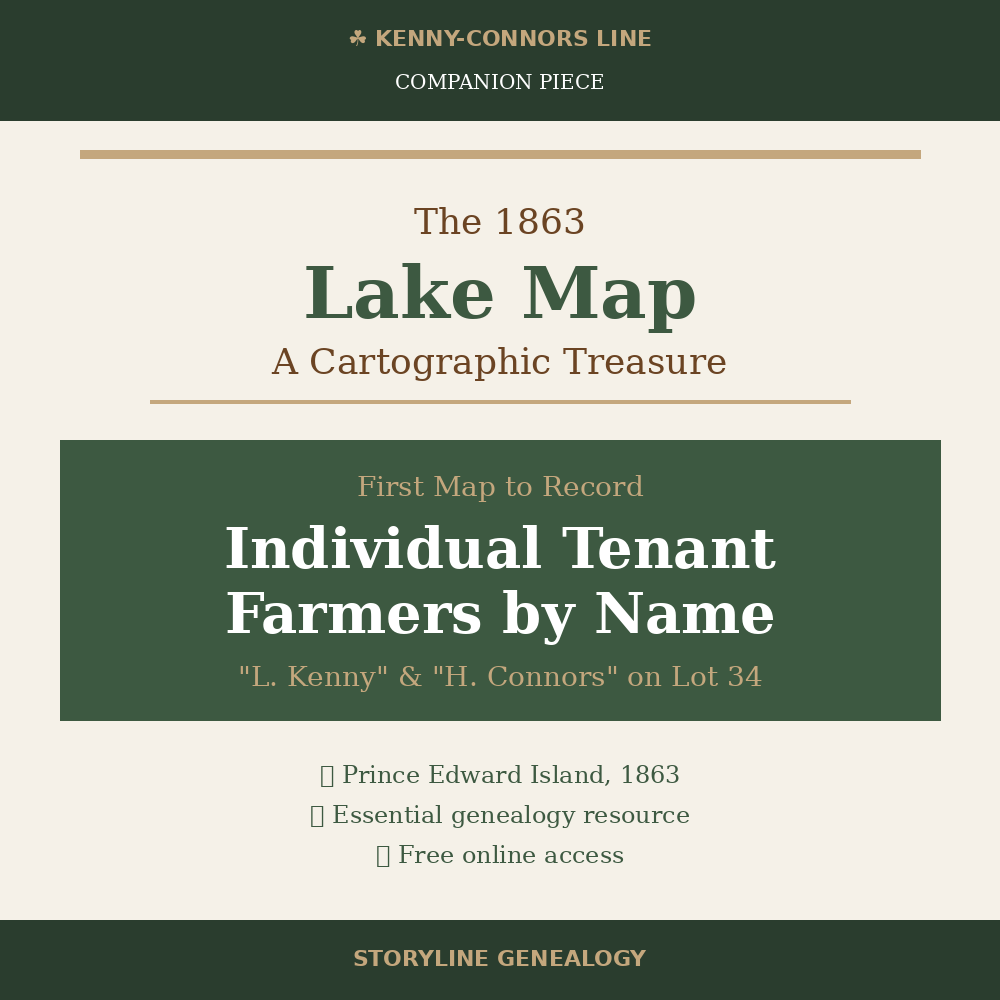
The 1863 Lake Map: A Cartographic Treasure
For genealogists researching Prince Edward Island, the 1863 Lake Map represents a holy grail: the first time individual tenant farmers were recorded by name on a commercial map. When I located "L. Kenny" and "H. Connors" on neighboring properties in Lot 34, I was looking at documentary proof of what the parish registers had suggested—these families lived close enough to walk to each other's farms. This companion piece explores the map's creation, significance, and how to use it for your own research.
Part of the Storyline Genealogy series: Documentary Biographies From Research to Story
Researching Prince Edward Island
Tracing Irish families who settled in Prince Edward Island requires navigating a unique set of records, repositories, and research strategies. This companion piece to the Kenny-Connors documentary biography series shares the methodologies developed over years of research—from the 1863 Lake Map to PEIGS cemetery transcripts—techniques applicable to any PEI genealogy project.
Part of the Storyline Genealogy series: Documentary Biographies From Research to Story
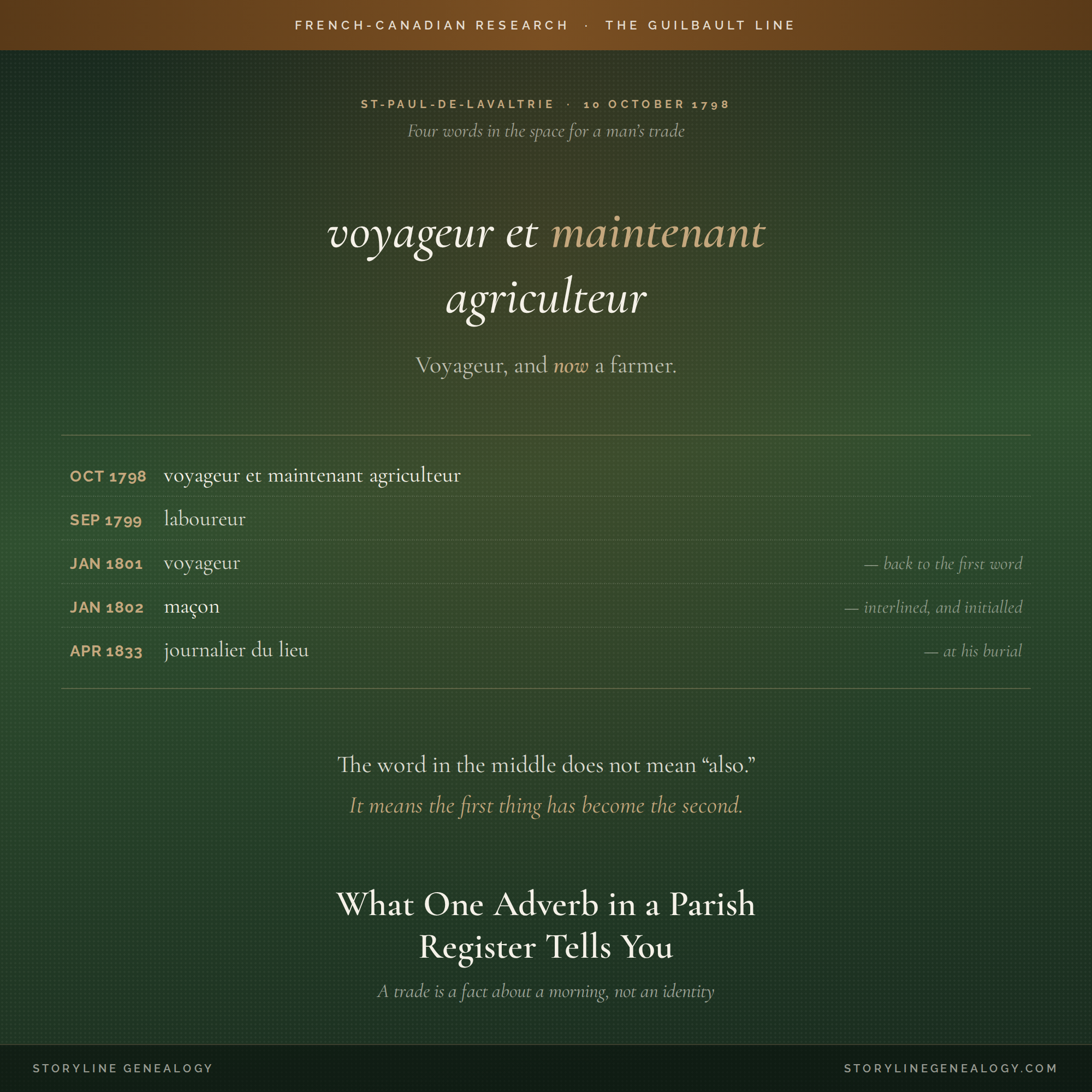
“Voyageur et Maintenant Agriculteur”
On 10 October 1798 a priest at St-Paul-de-Lavaltrie baptized three children of one family on the same day. The eldest was eight, born in the pays d'en haut, and had never been inside a parish church. In the space where a priest recorded a man's trade, this one wrote four words: voyageur et maintenant agriculteur. Voyageur, and now a farmer. The word in the middle does not mean "also" — it means the first thing has become the second. The priest wasn't describing a way of life. He was dating a change of one.
Part of the Storyline Genealogy French-Canadian Research series: Understanding the records, the context, and the lives they document.
When Newspapers Tell the Whole Story
No birth record. No marriage record. No official death record. For Terrence O'Brien, the newspapers told the whole story — his rise, his troubles, his secrets, and his death. A case study in what happens when traditional genealogy sources fail.
Part of the Storyline Genealogy series: Methodology From Research to Story
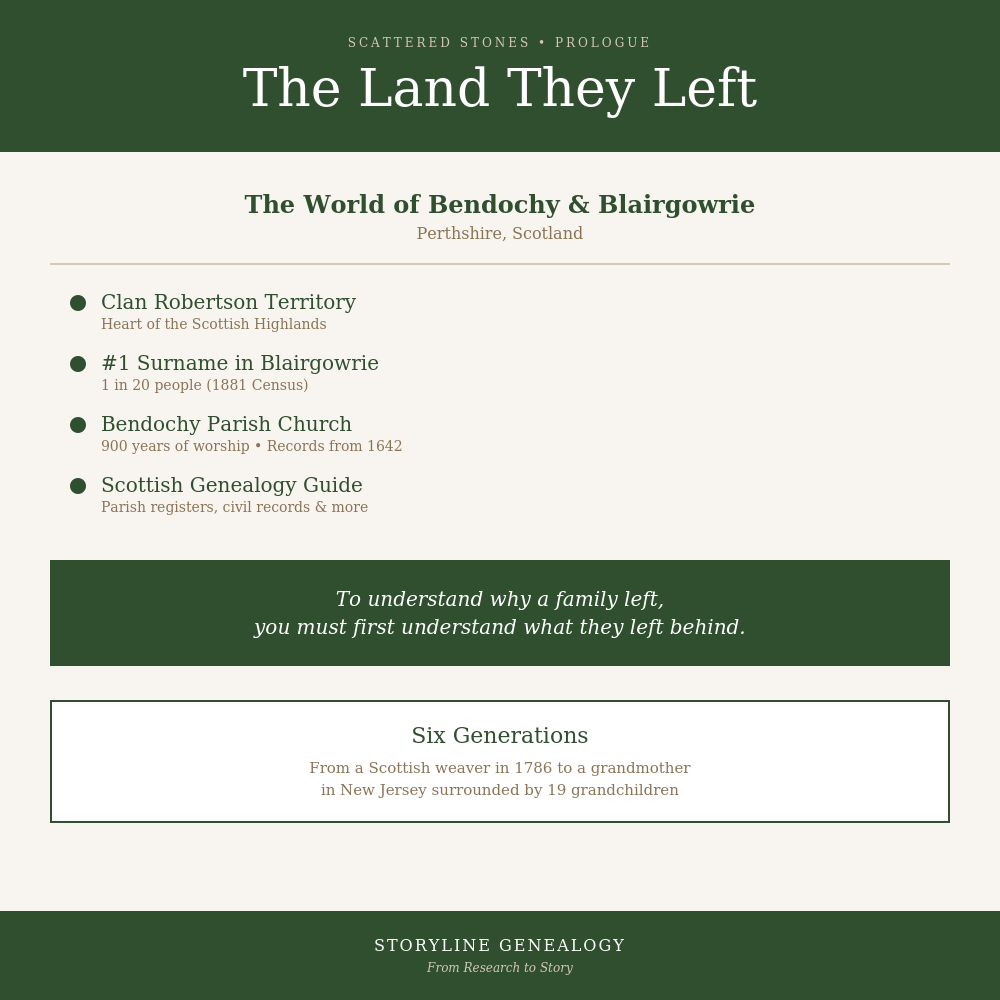
Scattered Stones Prologue: The Land They Left
Scattered Stones: Prologue
To understand why a family left, you must first understand what they left behind.
In the heart of Clan Robertson territory, where the Highlands meet the Lowlands, lies the parish of Bendochy—one of the oldest ecclesiastical sites in Scotland. Its parish registers begin in 1642. Two miles away, the market town of Blairgowrie sits at the edge of Strathmore valley, where rivers carve through ancient rock and the name Robertson appears in one of every twenty households.
Before we follow Duncan Robertson's descendants across the Atlantic—through Brooklyn and Georgia and New Jersey, across six generations—we must begin where they began.
Part of the Storyline Genealogy series: Documentary Biographies
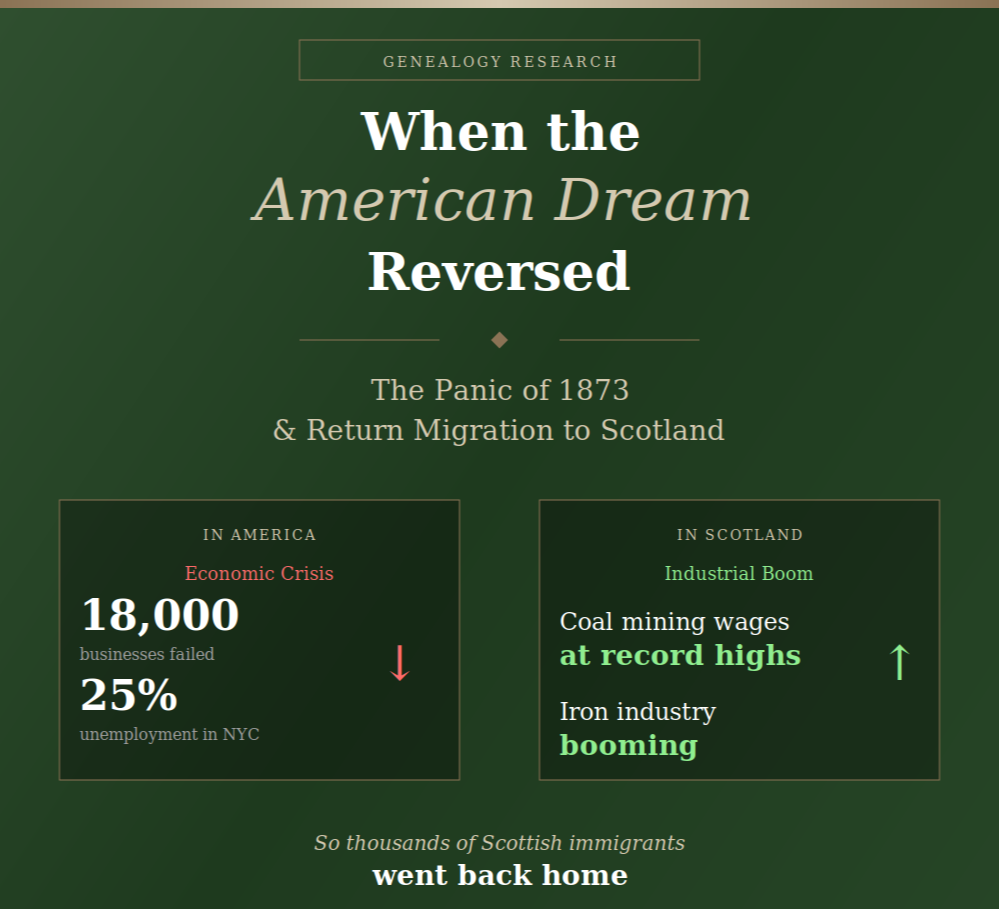
When the American Dream Reversed: The Panic of 1873
In the 1870s, thousands of Scottish immigrants made an unexpected choice: they went home. The Panic of 1873—America's first Great Depression—triggered mass unemployment while Scotland's coal and iron industries boomed. New research from the 1881 Scottish census reveals over 1,100 return migrants, including families like the Robertsons of our Scattered Stones series. This is the story of when the tide turned both ways.
Part of the Storyline Genealogy series: Scattered Stones: The Robertson Family of Blairgowrie
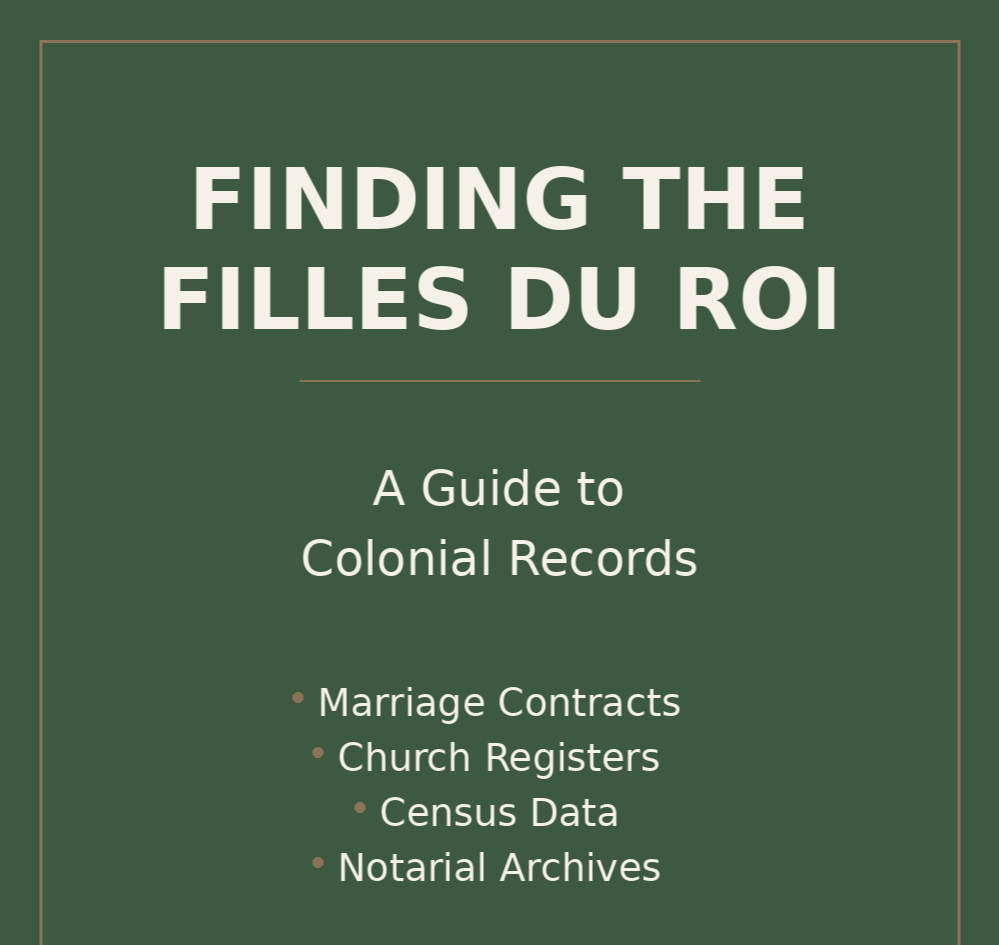
Finding the Filles du Roi in Colonial Records
The Filles du Roi left no personal diaries, but their lives are documented across colonial New France's archives. From marriage contracts to baptismal records, here's where to find the paper trail of the King's Daughters—and what those records can and cannot tell us.
Part of the Storyline Genealogy series: From marriage contracts to baptismal records—the documentary trail of the King's Daughters.
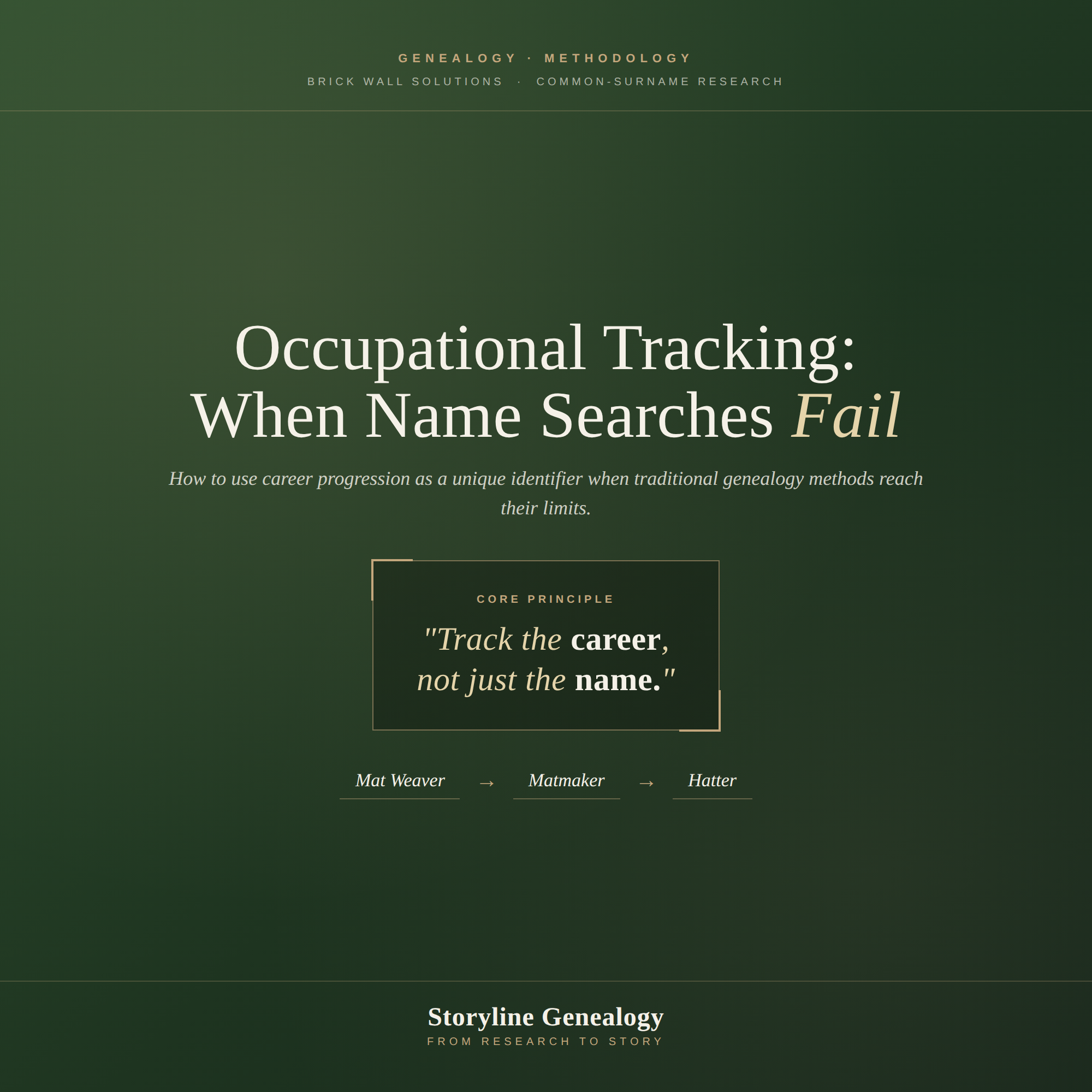
Occupational Tracking: When Name Searches Fail
You've searched every census. You've scoured city directories. You've analyzed DNA matches until your eyes crossed. But when your ancestor has one of the most common surnames in a city of 800,000 people—John Smith, Mary Jones, James Kelly—traditional name-based genealogy hits a wall.
For seven years, I searched for John Kenny among dozens of Brooklyn mat makers with virtually identical names. Traditional genealogy methods couldn't distinguish between them. But occupational tracking methodology could—and did. Learn how to use career progression as a unique identifier when name searches fail. This technique helped me solve a research problem that had stymied family historians for generations.
Part of the Storyline Genealogy Methodology Series: Because your ancestor's career tells a story when their name cannot.
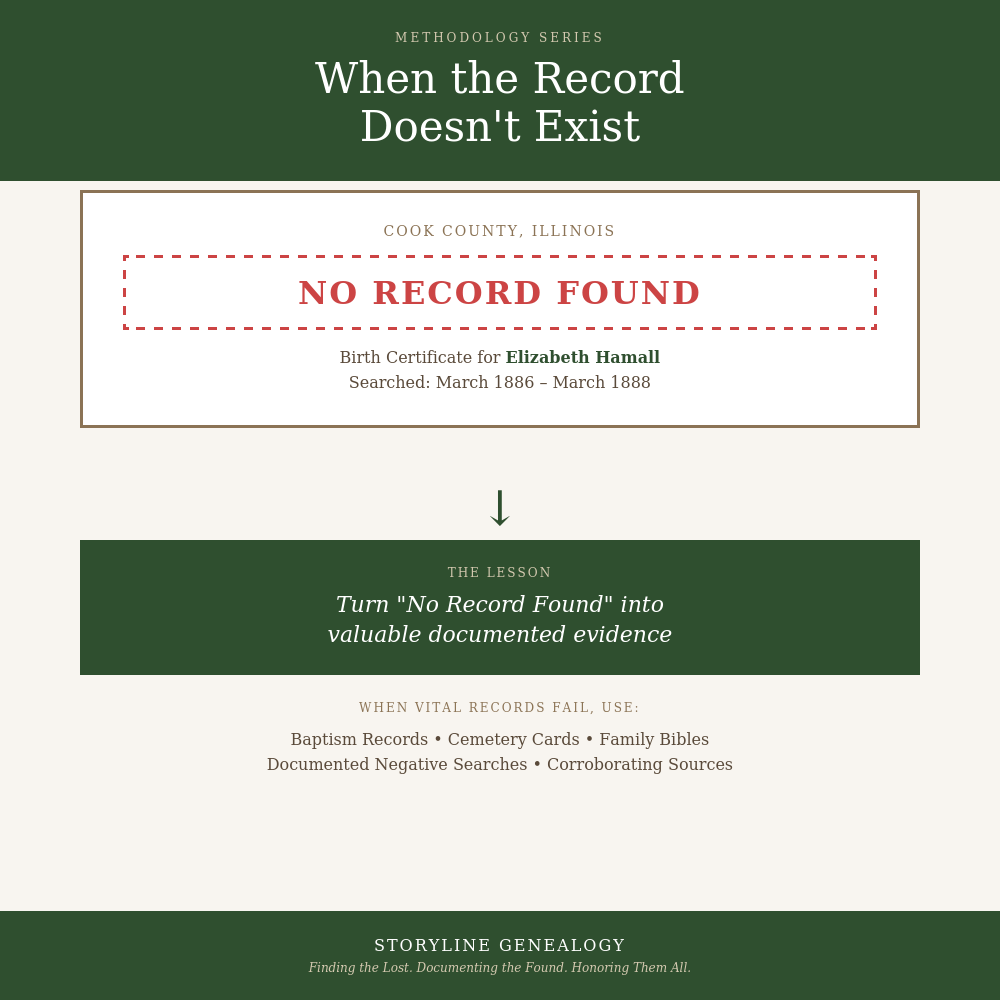
When the Record Doesn’t Exist: A Lesson in Documenting Negative Evidence
Learn how to turn "No Record Found" into valuable evidence. This case study follows Elizabeth Hamall's missing 1887 Chicago birth certificate, showing how baptism records, cemetery cards, and documented negative searches tell a complete story when vital records don't exist. A professional genealogy methodology lesson.
Part of the Storyline Genealogy Series: Finding the Lost. Documenting the Found. Honoring Them All.

Three Generations of Shrinking and Expanding
The Hamall family nearly died out. From Kate's six children in the 1880s, the Thomas Henry Hamall line eventually narrowed to just one great-grandchild—Thomas Kenny. And then he had six children. That's how close this family came to extinction. That's how much one generation can change everything.
Part of the Storyline Genealogy Series: proving that the stories worth telling are the ones that can be proven true.
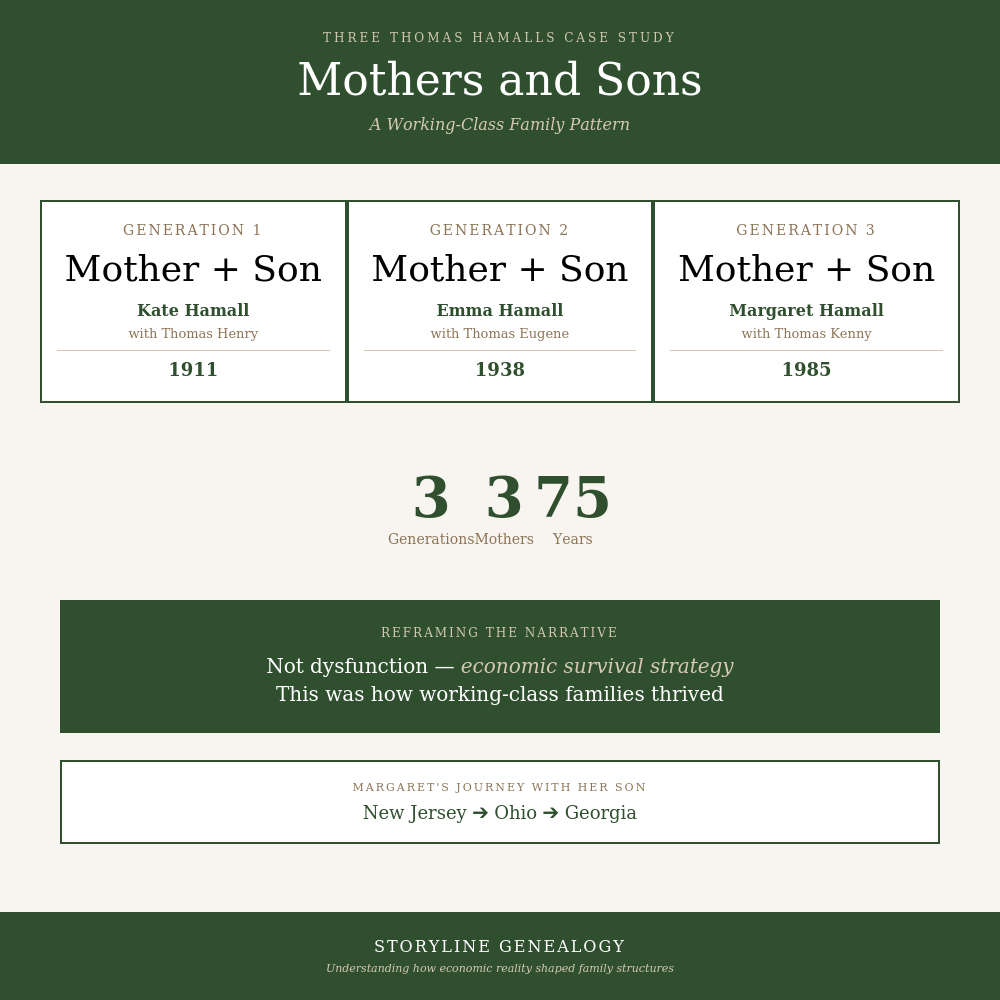
Mothers and Sons: A Working-Class Family Pattern
Three generations. Three mothers. Three sons. Three households built together. From Kate Hamall in 1911 to Margaret Kenny Hamall in 1985, a pattern repeated across 75 years—not because of dysfunction, but because this was how working-class families survived. Understanding multi-generational households as economic strategy, not pathology.
Part of the Storyline Genealogy Case Studies Series: Three Thomas Hamalls – Examining how economic reality shaped family structures across three generations of working-class Chicago families.
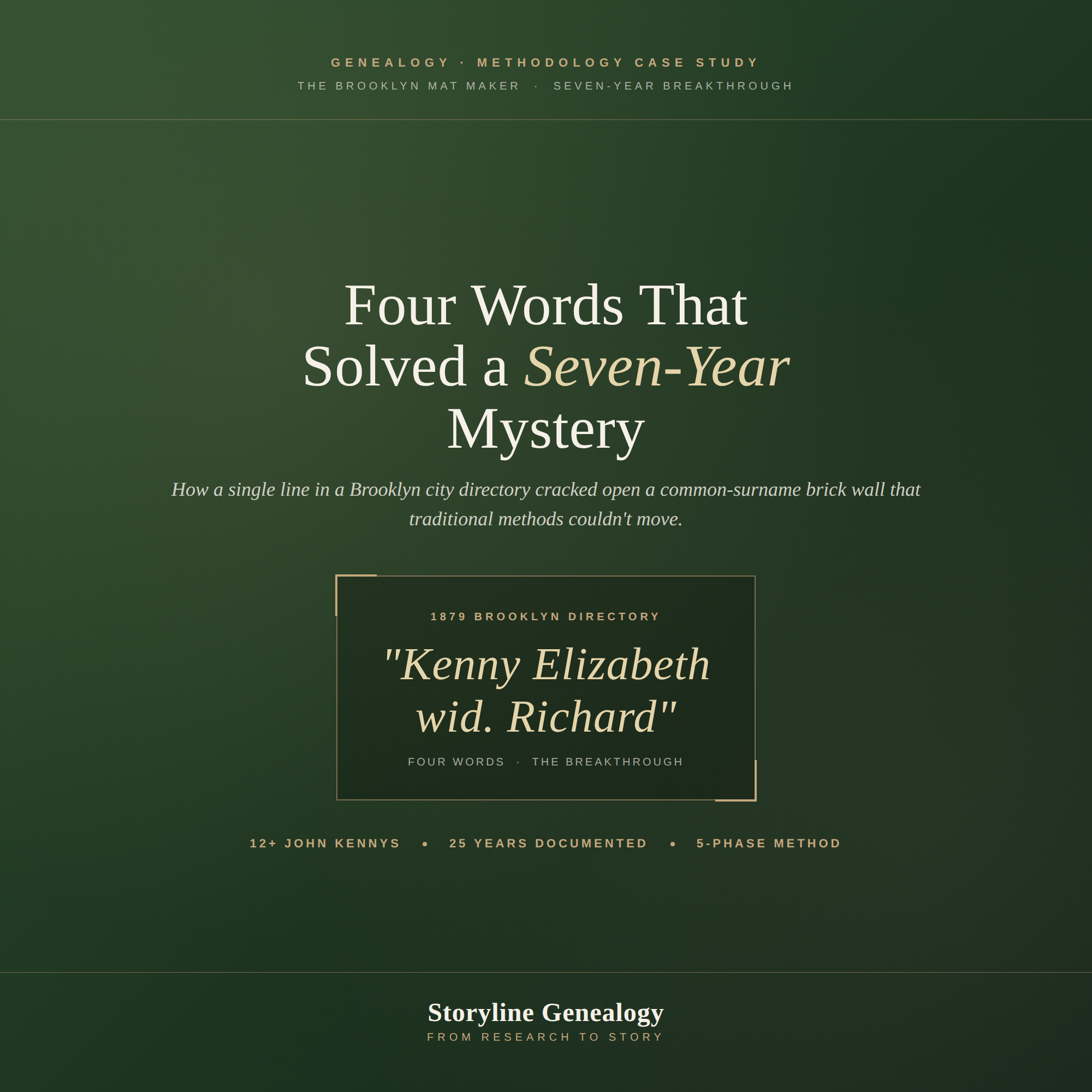
Four Words That Solved a Mystery
After seven years of failed research attempts with dozens of John Kennys in Brooklyn records, a single city directory entry changed everything. Discover how 'Kenny, Elizabeth, wid. Richard' unlocked an impossible genealogical puzzle and revealed an innovative research methodology.
Part of the Storyline Genealogy series: When traditional research methods fail, innovative approaches unlock the impossible cases that define professional genealogy.