
Three Generations of Shrinking and Expanding
Three Generations of Shrinking and Expanding
How the Hamall line came within one person of ending
Six children. Then two. Then three. Then one. Then six again.
 View the full image →
Thomas Kenny Hamall with his six children. Every person in this photograph exists because one man in one generation had a large family.
Kate Hamall bore six children in Chicago in the 1880s and early 1890s. Four of them died before 1894. Two generations later her great-grandson Thomas Kenny was the only person alive carrying Thomas Henry Hamall's line forward — one man, and if he had not married or had not had children, that would have been the end of it. He had six.
Kate’s Six
 View the full image →
1900 federal census, City of Chicago, Cook County. Kate Hamall, widowed head of household, forty-seven, with her two surviving children — Thomas Henry, twenty, and Mary, fifteen. William, Lizzie, Katie and Owen Eugene are not in this line because all four were already dead.
Kate was a working-class woman in Chicago, married to Owen Hamall, an Irish-born iron moulder who lost his sight and died at fifty-one. She bore six children and buried four of them.
The Six
1892 and 1893
The losses were not spread across a lifetime. Katie died in 1892. In 1893 the baby Owen Eugene died at ten months, then ten-year-old William, then six-year-old Lizzie.
Across those two years Kate went from six children to two.
Earlier versions of this page said she lost four children in a single year. The page's own list does not support it — one died in 1892 and three in 1893, which is a span of somewhere between twelve and twenty-four months depending on the exact dates. It is no less terrible for being stated correctly, and the death certificates would fix it exactly.
None of this was unusual. Diphtheria, scarlet fever, measles, typhoid and pneumonia moved through crowded working-class housing without anything to stop them, four decades before antibiotics. Two of Kate's six children reached adulthood.
Two Became Three
 View the full image →
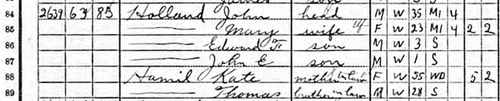
1910 federal census, Cook County. Kate’s household now holds her son-in-law John Holland, her daughter Mary, her grandsons Edward (three) and Emmett (one), and her son Thomas Henry — the whole of the next two generations in one enumeration. Edward and Emmett would both die childless, and Mary’s line with them.
Kate's two survivors both married, and between them had three children. All three lived.
The Second Generation
Medicine and sanitation had improved enough that none of the three was lost. But the shape of the family had already changed: six had become two, and two had between them only three. The line was narrowing while the children were healthier than ever.
Thomas Henry divorced Emma in October 1907, when Thomas Eugene was not yet three. He did not marry again until 1922, fifteen years later, and had no more children. Mary married John Holland and had her two boys, who grew up knowing their cousin Thomas Eugene and who would live with their dying uncle at 2639 South Ridgeway from 1936 to 1938.
Three Became One
 View the full image →
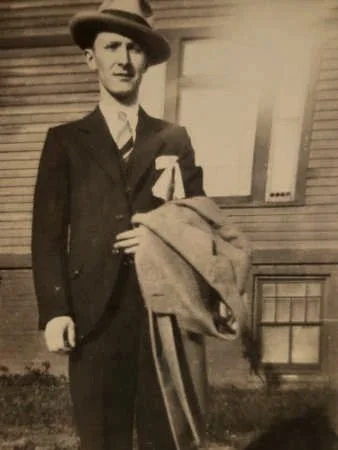
Thomas Eugene Hamall (1904–1967), only child of Thomas Henry. He would have one child himself.
The Third Generation
Edward and Emmett both lived long lives — Edward died in 1995 at eighty-nine, Emmett in 1998 at eighty-nine. Neither had children. When Emmett died, Mary Hamall Holland's line ended entirely: no grandchildren, no descendants, and nobody left to whom any of it had been told.
What an Extinct Line Costs the Research
Work on this family began in 2018. Edward had been dead twenty-three years and Emmett twenty. They were the last two people who had lived in a house with Thomas Henry Hamall, and there are no Holland descendants to interview, no cousins to test DNA against, and no household where the stories might have been repeated.
Everything in this series had to be rebuilt from censuses, directories, a court reporter, a newspaper's list of building permits, a tax roll and a handful of photographs — because the people who could have simply said it were gone.
Meanwhile Thomas Eugene married Margaret Kenny in 1930 and had one child, Thomas Kenny Hamall, born 21 July 1932. The marriage ended in divorce about 1941. Margaret took the boy to Miami to her parents in 1942; his father stayed in Illinois for years after that, and did not move to Florida himself until 1949 or 1950.
From 1938, when Thomas Henry died, one person carried that line: a boy of six.
Six, Two, Three, One, Six
Kate — born in the 1880s and early 1890s
six born · four dead by 1894 · two reached adulthood
Thomas Henry and Mary — born 1904–1909
three children · all three lived
Thomas Eugene, Edward and Emmett — the 1930s
one child between the three of them · the Holland line ends
Thomas Kenny — 1958 to 1972
six children · the same number Kate began with
One Became Six
Thomas Kenny Hamall married Barbara Ann O'Brien in November 1957. The marriage lasted fifty-three years, until his death in 2010. They had six children — five daughters between 1958 and 1964, and a son in 1972.
Six. The number Kate had started with, eighty years earlier.
How Narrow It Actually Was
In 1938 the whole of Thomas Henry Hamall's descent was one six-year-old boy in a household that had just come apart. Had he not married, or not had children, or not survived his childhood as four of Kate's did not, the line would simply have stopped — as his cousins' did, quietly, in the 1990s, with two old men and no one to tell.
Every descendant of Thomas Henry Hamall alive today comes through that one person and that one marriage.
Barbara
It is worth saying plainly whose doing this was, because the family records are full of Hamall men and this part is not about them.
Three Marriages
Two generations of short or broken marriages and single children, and then one that held for fifty-three years and produced six. Barbara also took Margaret — her husband's mother, not her own — into that household for the rest of Margaret's life, and moved her with it from New Jersey to Ohio to Georgia.
A note on that arrangement, because it is easy to get backwards. Margaret did not arrive as a dependent the moment her son married. She followed the family north, took an apartment of her own in New Jersey, and was still working as a book-keeper at sixty; she joined the household only when she could no longer keep one of her own going. Mothers and Sons follows that pattern across all three generations.
What the Shape of It Shows
Child mortality casts a long shadow. Kate lost four children in 1892 and 1893, and a family tree that should have branched wide came out of the 1890s with two twigs on it. Everything downstream is narrower because of one bad eighteen months.
A line can end quietly. Edward and Emmett Holland lived to eighty-nine apiece. Nothing dramatic happened to them. They simply had no children, and a whole branch of the family — and everything either of them knew — ended without anyone noticing at the time.
One generation can reverse it completely. Not by intention or strategy. One man married one woman in 1957 and they had six children, and a line that had come down to a single thread is now spread across several states.
Riverside, 1998
 View the full image →
The thirteen grandchildren of Thomas Kenny and Barbara Hamall. Kate Hamall buried four children in two years; this is the fifth generation down from the two who lived.
In 1998, fifty-six years after his mother took him out of Illinois, Thomas Kenny went back to Riverside with Barbara to show her the place.
He had the photographs — kept in an envelope marked Riverside House — and he had the memory: Saturday visits to his father, the library, a dog in a chair in the yard. He was eight or nine years old in those memories, and they were sixty years old by then.
What he may not have had was the address. The cottage his great-grandmother helped pay for in 1911, that his grandfather fought four years through the Illinois courts to keep, and that his father claimed as his legal residence in 1940, may simply not have been findable on the ground by 1998.
It Is Findable Now
He went back without an address. Twenty-eight years later the family has one.
The parcel is Lot 212, Block 1, in the Second Division of Riverside, Section 36, Township 39 North, Range 12 — identified from the property's own current legal description and confirmed against the 1949 Riverside assessment roll, which carries Emma Hamall's name against the west half of that lot.
Which is the small, unglamorous point this whole series keeps arriving at. He stood in the right village in 1998 with the right memories and no way to put them on a map. A tax list, a newspaper's building permits and a deed description did it afterwards — none of them written down for us, all of them still there.
The proof he actually wanted was never the address. It was that any of it had happened: that there had been Saturdays, and a father, and a dog in a chair, and somewhere the two of them were together. The photographs carried that on their own, and somebody had thought them worth putting in a marked envelope and keeping.
Then he went home to Barbara and six children, from a family that had come within one small boy of ending.
The Three Thomas Hamalls
Six posts documenting three generations of Thomas Hamalls, one cottage in Riverside, Illinois, and 130 years of family history proven through forensic analysis, legal documents and oral-history verification.
1. The Property War
Four years of litigation to the Supreme Court of Illinois over a one-room house, read from the decision itself.
2. They Were Never Photographed Together
What forensic photographic analysis can prove when the subjects were captured in separate frames — and what it cannot.
3. The Mystery Man
A second man at the Capitol in 1947, the best name the evidence supports, and the brother it cannot rule out.
4. Mothers and Sons
Three generations of mothers keeping house with their sons — not dependence, but an economic survival strategy in working-class America.
5. The Father Who Tried
Thomas Eugene Hamall's twenty-three years of rebuilding, and what the record shows about the son he was said to have left.
6. Three Generations of Shrinking and Expanding · you are here
From Kate's six children to a single surviving thread and back again — how child mortality and one marriage shaped a family line.
The full case study draws on twenty-two primary sources, forensic photographic analysis and legal documents across eighty-seven years, to BCG-compliant standards. And if you want to see where the whole thing began, the Hamalls start with Owen Hamall — a seven-year mystery across three countries that began with a single census entry.
View the Full Case Study →Does Your Family Tree Narrow Somewhere?
Most do. A generation that buried more children than it raised, a branch that ended with two people who had none, a line that came down to one name and then widened again. The shape of a family is usually the clearest thing a set of records will tell you, and it is the part nobody writes down.
Storyline Genealogy works on cases where:
- A generation lost several children and the tree narrows sharply afterwards
- A branch ended and took its stories with it, leaving nobody to interview
- Few living descendants make DNA testing difficult to plan
- A family wants the pattern across generations written down while it can still be checked
