
Mothers and Sons: A Working-Class Family Pattern
Mothers and Sons
A working-class family pattern, three times over
Part of the Three Thomas Hamalls case study — how economic reality shaped the households of three generations of working-class Chicago families.
 View the full image →
Margaret Kenny Hamall with her son Thomas Kenny at 4506 North McVickers Avenue, Chicago, about 1932. The third of the three households in this piece, at its beginning.
Three generations of this family, and three times a mother kept house with her grown son. Kate with Thomas Henry. Emma with Thomas Eugene. Margaret with Thomas Kenny. Read through a modern lens the repetition looks like a family trait. Read through the household accounts it looks like arithmetic.
A Pattern Born of Necessity
Multi-generational households were ordinary in working-class America in the first half of the twentieth century, and for widowed, divorced and unmarried women they were often the only arrangement available. Before 1935 there was no Social Security at all; after it, for most of these women, there was not enough of it.
What follows is three women, each in her own circumstances, arriving at the same solution.
Kate Hamall
The Woman Without a Photograph
There is no photograph of Kate Hamall anywhere in this collection. No image of the Chicago-born woman who buried four of her six children, lent her son four hundred dollars to build a cottage, worked as a dressmaker, and lived in that cottage from 1911 until she died in 1919.
Her absence from the visual record is itself a fact about working-class women and who got photographed.
Kate Hamall
1853 – 1919 · with Thomas Henry, 1911–1919
- Born 1853, Chicago, Illinois
- Married Owen Hamall, 1879; widowed February 1898
- Children six born, two surviving to adulthood — Thomas Henry (1880) and Mary (1885)
- Work dressmaker, contributing to the household income
- 1910 living with her daughter Mary Hamall Holland's family
- 1911–1919 living with her son Thomas Henry at 291 Lionel Road, Riverside, Illinois
- The loan four hundred dollars toward building the cottage — roughly twelve thousand in today's money
- Died 9 November 1919
A widow in her fifties and sixties in 1900s Chicago had few employers, no pension, no Social Security and little prospect of a household of her own. But the arrangement at Lionel Road was not charity in either direction. Kate put in money, domestic labour and her dressmaking income; Thomas Henry got a household that ran while he worked, and help with a small son after his own marriage ended.
Her loan helped build the cottage. Her presence made it a house someone lived in. For eight years they held it together between them.
After Kate died in 1919 Thomas Henry remarried; his second wife died in 1936. He may have spent his last two years with his sister Mary Hamall Holland at 2639 South Ridgeway in Chicago, where his nephews Edward and Emmett Holland also lived. He died in 1938.
Emma Guilbault Hamall
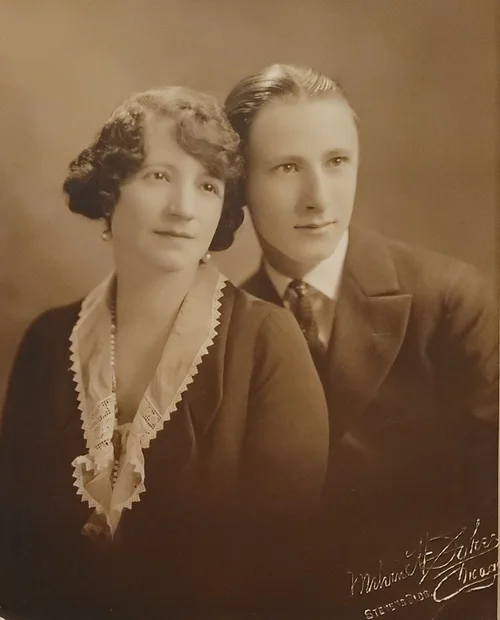
Emma Guilbault Hamall with her son Thomas Eugene, 1929, during their years keeping house together in Chicago.
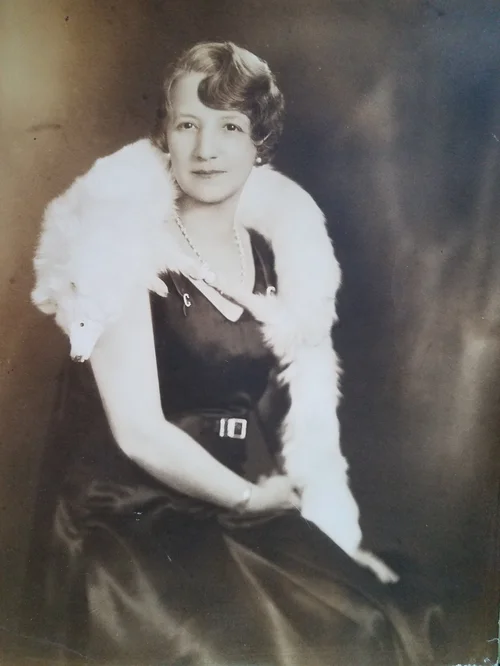
Emma Guilbault Hamall. A working woman across four decades — dry goods, drug store, then ladies’ dresses.
 View the full image →
The Thébault family in Chicago, early 1900s, with Emma Guilbault in the front row and young Thomas Eugene — Tommy — at the front. The French-Canadian side of the house.
Emma Guilbault Hamall
1883 – 1970 · with Thomas Eugene, on and off from the 1920s
Emma worked, which set her apart from both of the other two women here. She supported herself through a string of sales positions across four decades. It was still not enough on its own: women earned roughly half to three-fifths of men's wages for the same work, with no health insurance and no retirement, and the Depression arrived when she was forty-six.
Sharing a household with her son meant one rent instead of two, a home that stayed running while both of them worked, and company. When Thomas Eugene went to Florida she went too, in her middle sixties, and started again in a new city.
She outlived her son by three years, and the manner of it is worth a sentence. When Thomas Eugene died in 1967 his mother was eighty-four and in a nursing home in Miami. Her grandson brought her north to Villa Maria at North Plainfield — the next town to Plainfield, where he was then living — and she died there in 1970. Whatever the state of relations between Thomas Eugene and his son, it was that son who fetched his father's mother a thousand miles and put her where he could reach her in ten minutes.
Margaret Kenny Hamall

Margaret Kenny Hamall with her son in Miami, arm in arm.

Margaret Katherine Kenny Hamall, about 1970, in her early sixties.
 View the full image →
Hialeah Park, 12 April 1942: Mrs. Tomasius, a friend; Margaret; her son Tom, then nine; and her father Thomas P. Kenny. Her parents had retired to Florida, and she and the boy had just followed them.
 View the full image →
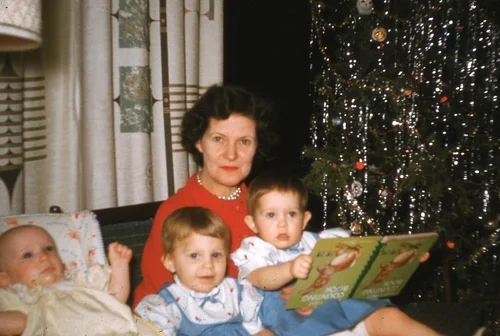
Margaret — "Grandma Hamall" — with her granddaughters Annette, Mary and Eileen at Omaha, Nebraska, 1960. Within six years she would be living in their household, and would move with it from New Jersey to Ohio to Georgia.
Margaret Katherine Kenny Hamall
1907 – 1985 · with her parents, then with her son
Margaret's version of the pattern ran in two stages, and the second is the one that lasted. After the divorce she was in her early thirties with a boy of nine, no work history outside the home, and parents who could take them both in. That is what allowed her son a settled childhood in a family that had just come apart.
Twenty-five years later the direction reversed — but not at once, and that is the part worth noticing. By 1953 the household in Miami was hers and her son's, and he was supporting it at twenty-one. When she followed the family north she did not move in with them. She took an apartment of her own — she was writing from a Union, New Jersey address in February 1968 — and kept books for a living into her sixties.
The end of that working life is not precisely dated. Her letter of February 1968 has her still employed and approaching retirement; family memory has it ending with a fall on ice, a broken arm and an injured back. What is certain is that she was keeping books at sixty and was not keeping them at sixty-five, and that when she stopped there was not enough behind her to keep an apartment going.
Only then did she join her son's household. The pattern in this piece is not a reflex, and Margaret is the clearest case of it: she kept her own front door for as long as she could pay for one.
What Those Nineteen Years Looked Like
- She had her own room in the house, and the children came to it after school for a snack and a talk
- She was a resident rather than a second parent — she was not raising the children, and by the later years was often unwell
- She came to it from an apartment of her own — the move followed the end of her working life, not the start of the family's
- She moved with the household every time it moved, which was three times in three states
Eight Years, Twenty, Nineteen
Kate kept house with Thomas Henry for eight years, 1911 to 1919.
Emma was with Thomas Eugene, on and off, for the best part of twenty, into the 1960s.
Margaret was with Thomas Kenny for four before his marriage, then kept an apartment of her own in New Jersey, and joined his household for the last stretch of her life.
Three women, three sets of circumstances, one arrangement — arrived at separately, in three different decades, by people who were not copying each other.
Why the Pattern Existed
It is easy to read three generations of this as a family temperament. The household economics are a better explanation, and they are documented.
What a Woman on Her Own Was Facing
Kate's generation. A widow had almost no options: few employers would take an older woman, there were no pensions and no Social Security, and living with an adult child was the safety net.
Emma's generation. Divorced and separated women carried a social stigma as well as a wage gap — roughly half to three-fifths of a man's pay for the same work. Social Security arrived in 1935; the early benefits were small.
Margaret's generation. Many women of her age never worked outside the home at all, so a divorce meant starting at forty with no employment record. By the time she reached retirement age the benefit still would not cover a household.
And it cut both ways. The sons carried two generations on one income. They also got a house that ran, someone at home, and in Thomas Henry's case help with a small child. Whether the mothers took much part in raising the grandchildren varied and in Margaret's case was slight. The arrangement was not sentimental. It was, three times, the thing that worked.
What the Pattern Cost
There is a real cost in these households and it is worth naming carefully, because it is easy to name it wrongly.
When a child grows up in one parent's household and that parent's family, he grows up among their stories. The other side's history is not necessarily suppressed; it is simply not in the room. Nobody has to decide to withhold anything for a whole branch of a family to go quiet within a single generation.
What We Do Not Know, and Will Not Guess
Thomas Kenny Hamall grew up in his mother's parents' house and later kept house with his mother for nineteen years. He said in later life that he felt estranged from his father. Separately, the record shows his father in Miami from at least 1950, a trip to Washington in 1947, a letter before the 1957 wedding, and a thousand-mile journey to be at it.
Whether anyone told him about any of that, we have no way of knowing. No letter, diary or account in this collection speaks to it. It would be easy to write that his mother's household shaped what he heard, and impossible to demonstrate — and the person it would accuse is not here to answer. This page records the gap and stops.
What can be said is that the Hamall history was not passed down, and that the 1998 trip to Riverside — Thomas Kenny going to look at his grandfather's cottage — reads like a man going after something he knew was missing.
Family stories are told by whoever has the child's ear. A history can go quiet in one generation without anyone intending it.
Three Households, Three Vantage Points
Margaret
Divorced at thirty-three with a boy to raise and no work history, she took her son into her parents' house and gave him a settled childhood out of an unsettled year. She kept house with him for another four years when he was the one earning, and lived nineteen more in the family he made. That is most of a lifetime given to one household or another.
Thomas Eugene
He lost his career fifteen weeks into the marriage and spent twenty-three years getting back on his feet. He was in Miami from at least 1950, the same city as his son for several years in the early fifties, and he turned up for the things that could be turned up for. Whether any of that reached his son is a separate question from whether he did it.
Thomas Kenny
He experienced distance from his father, and said so. That was his life and his word for it, and no address in a census overturns it. He also kept his father's watch and wore it to all five of his daughters' weddings, and it was he who moved his father's mother to New Jersey and saw her cared for until she died.
These do not have to be reconciled. They were all happening at once, in one family, to people who were doing their best with what the decade gave them.
A Note on Method
Two cautions came out of this piece. The first: a repeated living arrangement across generations is an economic fact before it is a psychological one, and the household accounts should be read before anyone's character is. Ask what independent living would have cost, and whether it was available at all.
The second is harder. When a family story has a gap in it, the temptation is to fill the gap with a motive — someone must have withheld something. That is the point to stop and write down what is actually known. A silence in the record is evidence of a silence, and nothing more.
The Three Thomas Hamalls
Six posts documenting three generations of Thomas Hamalls, one cottage in Riverside, Illinois, and 130 years of family history proven through forensic analysis, legal documents and oral-history verification.
1. The Property War
How Thomas Henry Hamall fought a four-year legal battle to the Illinois Supreme Court to protect the cottage his mother helped him buy.
2. They Were Never Photographed Together
How forensic photographic analysis proved three generations of connections when the subjects were captured in separate frames.
3. The Mystery Man
Using forensic ear analysis to identify Emmett John Holland in a 1947 photograph — twenty years after he died and his memories were lost.
4. Mothers and Sons · you are here
Three generations of mothers keeping house with their sons — not dependence, but an economic survival strategy in working-class America.
5. The Father Who Tried
Thomas Eugene Hamall's twenty-three years of rebuilding, and what the record shows about the son he was said to have left.
6. Three Generations of Shrinking and Expanding
From Kate's six children to near-extinction to explosive survival — how child mortality, small families and one generation's choice saved the line.
The full case study draws on twenty-two primary sources, forensic photographic analysis and legal documents across eighty-seven years, to BCG-compliant standards. And if you want to see where the whole thing began, the Hamalls start with Owen Hamall — a seven-year mystery across three countries that began with a single census entry.
View the Full Case Study →Your Family’s Story Deserves This Level of Research
Every family has interrupted stories — a branch that went quiet after a divorce, a move, or a death nobody talked about afterwards. The records that close those gaps are usually ordinary ones: an address, a directory entry, a household on a census page. What they change is not the feeling but the account.
Storyline Genealogy works on cases where:
- A family narrative and the documentary record do not agree
- Relationships were fractured by divorce, distance or economic hardship
- A story was lost between generations
- More than one person's account has to be honoured at once
