
The Catherine Lemesle Case Study
The Research Question
While building the Guilbault family tree, an unusual pattern emerged: the same woman — Catherine Lemesle, a Fille du Roi who arrived in Quebec in 1671 — appeared in two separate branches. Not two women with similar names. The same person, documented by the same baptism record, the same marriage contract, the same parish register entries.
This case study examines how Catherine Lemesle became an 8th great-grandmother twice over, what the phenomenon called pedigree collapse reveals about colonial Quebec society, and how documentary evidence proves the connection through both lines.
Key Finding
Catherine Lemesle's descendants through two different children — Marie Anne Morin, born 1673, and Joseph Morin, born 1682 — married each other in 1757, reuniting family lines that had been separate for eighty-five years. Their son Gabriel Guilbault inherited Catherine's ancestry through both parents.
The Double Ancestry: How It Works
In standard genealogy each generation back doubles the number of ancestors: two parents, four grandparents, eight great-grandparents. By the 8th great-grandparent level you have, in theory, 1,024 ancestors in that single generation.
But no region ever held that many people available to marry each other. The arithmetic only balances if some of those ancestor slots are filled by the same people appearing more than once. This is pedigree collapse, and it was routine in colonial Quebec, where small communities meant limited choice and repeated intermarriage between the same families.
Working the numbers
Step 1 — Which generation?
Count the "greats" and add two: one for the parent step, one for the grandparent step.
Step 2 — How many slots, and how many people?
The number of ancestor positions in any generation is a straight power of two. The number of people filling them is a different question.
Step 3 — What share of the ancestry?
An ancestor's expected genetic contribution halves with every generation. Multiply by the number of separate paths of descent.
| Quantity | Formula | Result |
|---|---|---|
| Generation number | n = greats + 2 | 10 |
| Slots in that generation | 2n | 1,024 |
| Slots Catherine occupies | A | 2 |
| Distinct people in the generation | 2n − (A − 1) | 1,023 |
| Her share of the tree | A / 2n | 2/1,024 = 1/512 |
| Expected DNA contribution | A × (½)n | ≈ 0.195% |
What that number actually means
An ancestor at 1/512 carries the same expected weight as a single 7th great-grandmother — one generation nearer than she really is. Doubling does not make her a closer relative; it makes her a heavier one. She occupies the ancestral position of someone born a generation later while remaining, in fact, ten generations back.
Two cautions belong with the figure. First, 0.195% is an expectation, not a measurement: autosomal DNA is shuffled at each generation, and at ten generations there is a substantial chance of inheriting nothing at all through any one path. Doubling the paths improves the odds without guaranteeing anything. Second, the 1,023 figure assumes every other position in that generation holds a distinct person. In a colonial Quebec pedigree that assumption is certainly false — Catherine is simply the duplication that has been traced. The real count of distinct individuals is lower, and unknown.
Catherine Lemesle & Pierre Morin
Married 13 June 1672 • Notre-Dame-de-QuébecPATH 1: Through Marie Anne Morin
- Marie Anne Morin (1673–1743)
married Guillaume Deguise, 1691 - Marie Catherine Deguise (1704–1731)
married Charles Guilbault - Charles Gabriel Guilbault (1731–1784)
married Marie Charlotte Morin, 1757
PATH 2: Through Joseph Morin
- Joseph Morin (1682–1735)
married Marie-Anne Brideau, 1704 - Joseph Morin II (1709–1781)
married M.C. Charles Croquelois - Marie Charlotte Morin (1738–1767)
married Charles Gabriel Guilbault, 1757
The convergence, 1757: when Charles Gabriel Guilbault married Marie Charlotte Morin, both were great-great-grandchildren of Catherine Lemesle — through different children. Their son Gabriel Guilbault le voyageur carried her ancestry through both parents.
Cousins marrying was not unusual in colonial Quebec. What makes this instance worth documenting is that it demonstrates how carefully each line must be traced separately, and how one seventeenth-century woman's eight children rippled forward into branches that looked, on paper, entirely unrelated.
Documentary Evidence: Catherine's Origins
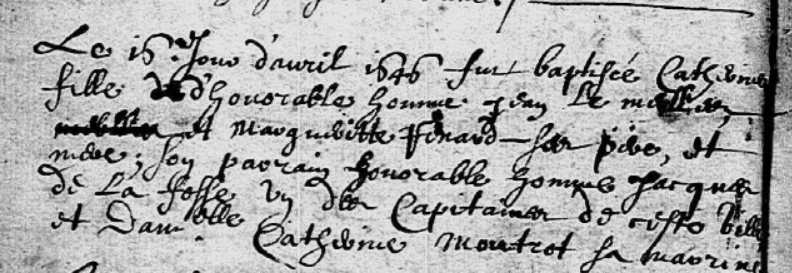
Catherine Lemesle was baptized on 16 April 1646 in the parish of Saint-Pierre-du-Châtel in Rouen, one of France's largest and most prosperous cities. The register entry establishes her parentage and her godparents:
"Le 16e jour d'avril 1646 fut baptisée Catherine, fille d'honorable homme Jean Le Mesle et Marguerite Renard ses père et mère. Son parrain honorable homme Jacques de La Fosse, un des capitaines de cette ville, et Damoiselle Catherine Moutrot sa marraine."
On the 16th day of April 1646 was baptized Catherine, daughter of the honourable man Jean Le Mesle and Marguerite Renard, her father and mother. Her godfather, the honourable man Jacques de La Fosse, one of the captains of this town, and Damoiselle Catherine Moutrot her godmother. — Parish register of Saint-Pierre-du-Châtel, Rouen, 16 April 1646The register calls her father honorable homme — a formula of respectable standing rather than a trade. His occupation, marchand bourgeois, comes from the compiled Fichier Origine file transcribed later on this page, not from this entry. The godfather was a captain of the town and the godmother carries the honorific Damoiselle. Whatever the household's exact means, it was not a poor one.
Where the record is found
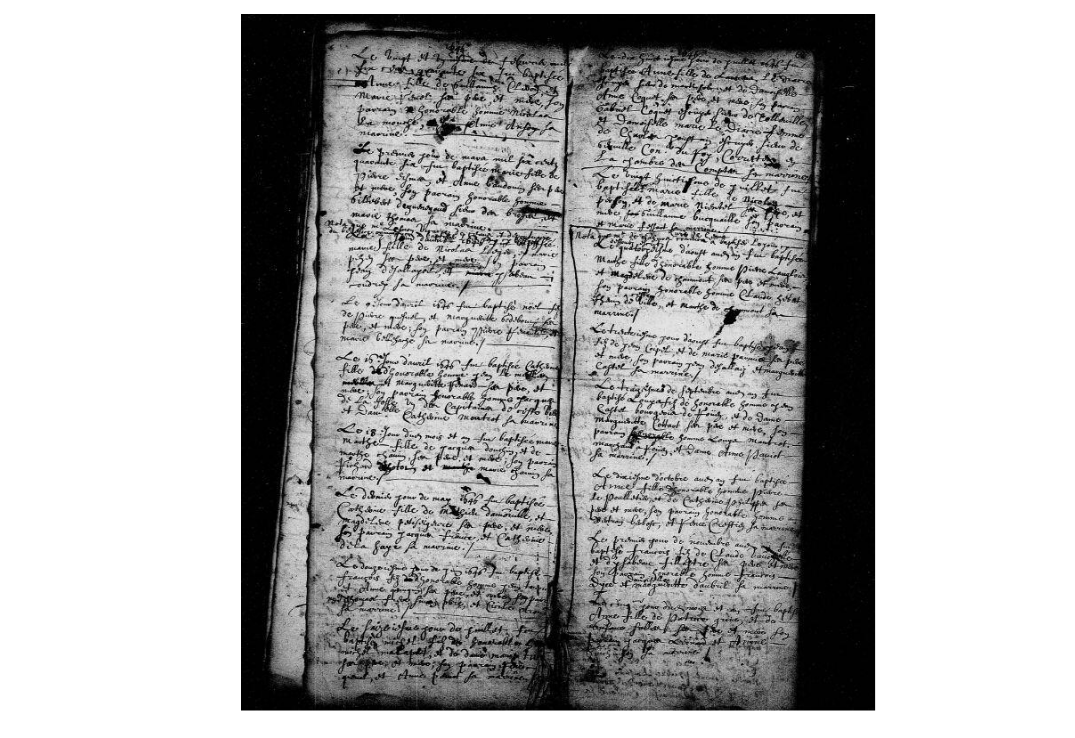
Rouen (paroisse Saint-Pierre-du-Châtel), Normandie (modern Seine-Maritime), France. Registre paroissial: baptêmes, mariages, sépultures, 01/01/1604–31/12/1648. Archives départementales de la Seine-Maritime, cote 3 E 1, Registre 557. Baptism of Catherine LeMesle, 16 April 1646, image 68 of 146, left page, fifth entry. Permalink to the image (accessed 24 January 2026).
The archive notes that this register also contains marriage banns, and that part of it was microfilmed upside down — worth knowing before scrolling past a page that appears blank or reversed.
Catherine's Siblings
The Fichier Origine records two siblings baptized at the same Rouen parish:
- Jacques Lemesle — baptized 5 October 1652
- Marie Lemesle — baptized 1 February 1654
The same file flags a related act worth pursuing: Pierre Lemesle, born in Rouen (Saint-Jean), whose banns were published there on 3 April 1633 with Marguerite Tabouelle, born in Rouen (Saint-Martin-du-Pont). The relationship to Catherine's family has not been established.
By 1671 both of Catherine's parents were dead. Every colonial record calls her fille de défunt Jean Lemesle. As an unmarried woman in her mid-twenties with no surviving parents, her prospects in France were narrow.
The Church Where She Was Baptized
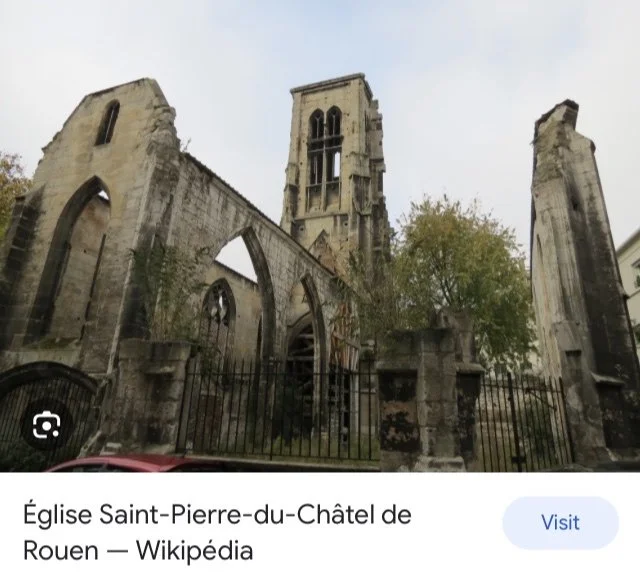
The Église Saint-Pierre-du-Châtel still stands in Rouen, in ruins. The Gothic church where Catherine was baptized in 1646 survived until it was heavily damaged in the Second World War. The remaining walls and tower are preserved as a historic monument.

The Voyage: Le Prince Maurice, 1671
In the summer of 1671 Catherine Lemesle sailed from Dieppe aboard Le Prince Maurice, bound for Quebec. The contingent of Filles du Roi travelling that season was chaperoned by Madame Anne Gasnier Bourdon, the widow appointed by Intendant Jean Talon to oversee the programme — a woman who will reappear in this story in a way that is not incidental.
The ship reached Quebec on 30 July 1671. Catherine brought a dowry of 200 livres, of which fifty came directly from Louis XIV: the standard royal supplement that made a Fille du Roi a materially attractive match in a colony short of both women and capital.
At twenty-five Catherine was older than most of her fellow passengers, who were commonly between sixteen and twenty-five. The Atlantic crossing took six to eight weeks. She landed on 30 July 1671 and married on 13 June 1672 — ten and a half months later.
Marriage to Pierre Morin: June 1672
Pierre Morin was born about 1648 at Saint-Étienne-de-Brillouet in the diocese of Luçon, Poitou — today in the Vendée — the son of Jacques Morin and Hilaire Guéry, both dead before his marriage. That origin is stated in four separate documents across thirty-four years: the marriage contract of 1672, the marriage banns, his admission to the Hôtel-Dieu de Québec in 1706, and his burial entry. On his origins there is no disagreement anywhere.
On his military service there now is. He has long been identified as a soldier of the Carignan-Salières Regiment, in the company of La Noraye, and this practice published that identification. It is currently unresolved. A "Pierre Morin" is named on the regiment's 1668 muster roll under the La Noraye heading; Michel Langlois assigns that line to Catherine's husband, while Peter J. Gagné assigns it to a different man born about 1643 in the diocese of Saintes and names Catherine's husband as the exclusion. The PRDH, which links its records to individuals when it has grounds, declined to link this one to anyone. No document has been produced that identifies the man on the roll. The full dispute is set out in the Pierre Morin case study, and the rival candidate has a page of his own: The Other Pierre Morin.
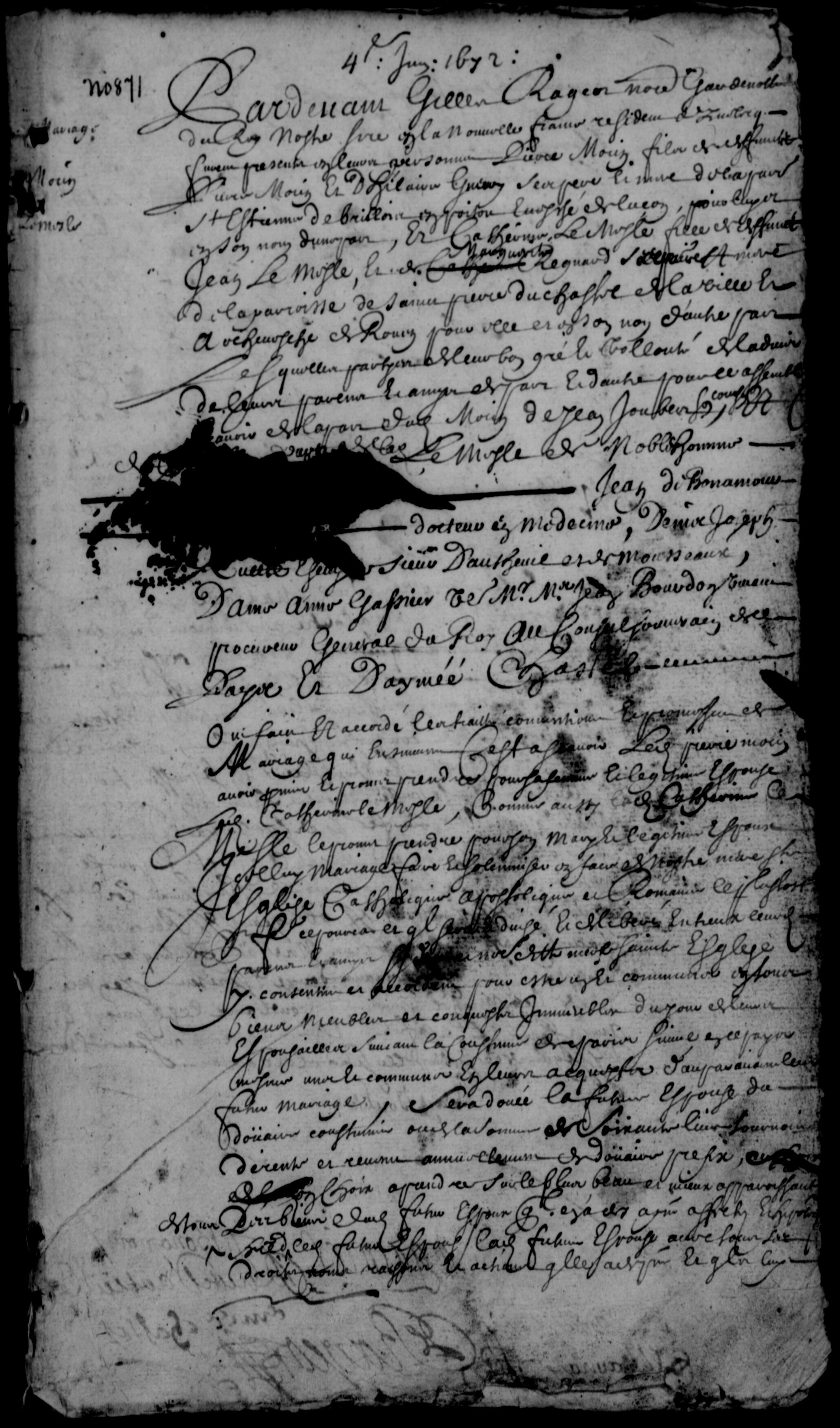
Two documents establish the marriage itself: a notarial contract of 4 June 1672 and the parish register entry of 13 June 1672.
The Day Before: A House at the Petite Rivière
The répertoire of the notary Gilles Rageot for June 1672 records, immediately before the marriage contract, an act that has not previously appeared in this account:
3 June, no. 870 — Vente: Jean Merieu dit LaSolaye et al. to Pierre Morin.
4 June, no. 871 — Mariage: Pierre Morin & Catherine Le Mesle.
The act has now been read. On 3 June 1672, Jean Mérien dit LaSolaye and Barbe Le Baron his wife, habitants demeurant à la petite Rivière, sold to Pierre Morin — then living in the house of the Hôpital at Quebec — a habitation on the petite Rivière with its outbuilding and cabins, together with half of that year's standing harvest.
The price was 400 livres tournois in principal and a further fifteen francs pour les épingles, the customary gratuity to the vendor's wife: 415 livres in all. Half of it, 207 livres 10 sols, was payable not to the vendors but to the religious of the Hôtel-Dieu, on the arrival of that year's ships — the sale settled a debt the Mériens owed the monastery. The three nuns are named in the act: Marie Renée de la Nativité, superior; Anne de Saint-Bernard, assistant; Jeanne Agnès de Saint-Paul. All three signed, and their signatures are the clearest hands on the page.
Five years later, an addition entered on the same folio records that Jean Mérien had received from Pierre Morin, acquéreur, the whole four hundred and fifteen livres, in principal and lawful costs, and gave him quittance.
Nine Months Earlier: Act 675
The same greffe holds an earlier act. On 29 September 1671 — two months after the season's ships landed, and nine months before the wedding — Pierre Morin, described again as demeurant à l'Hospital de cette ville, sold a concession to François Baribault of Charlesbourg for seventy-two livres tournois, payable by instalments and secured against the land itself.
The act recites where the land had come from: Pierre had it from the Religieuses Hospitalières of the Hôtel-Dieu, by a contract passed before the notary Paul Vachon. That earlier contract has not been examined. It is now the most promising unread document in this family's file, because a concession act typically identifies its grantee more fully than a sale does.
He could not sign this act either. The closing formula records that he declared he did not know how to write or sign, and the two witnesses — Jacques de la Touche and Guillaume Renaud — signed in his place with the notary.
The greffe holds eight acts under this name across nineteen years. Six of them are land, and read in order they describe a single continuous holding on one stretch of one river.
| Date | Act | Type | What it records |
|---|---|---|---|
| 29 Sept 1671 | 675 | Vente | Pierre Morin, demeurant à l'Hospital de cette ville, sells a concession to François Baribault of Charlesbourg for 72 livres. Held of the Hospitalières by a contract before the notary Paul Vachon. |
| 3 June 1672 | 870 | Vente | Jean Mérien dit LaSolaye and Barbe Le Baron sell him a habitation at the petite Rivière with hangard and cabins, 415 livres. Witnesses: Pierre Bodin and Jacques Gauthier. |
| 4 June 1672 | 871 | Mariage | Marriage contract with Catherine Le Mesle. |
| 14 June 1676 | 1457 | Vente | Morin, habitant demeurant à la petite Rivière St Charles, sells that habitation on — two arpents' frontage by twenty-four deep, with house, hangard and stable, reserving the standing crop. Neighbours: Pierre Bodin on one side, Jacques Gauthier on the other. The act recites his title: the contract of 3 June 1672 from Mérien dit LaSolaye and Barbe Le Baron. |
| 8 Aug 1676 | 1483 | Vente | Jacques Gauthier sells him land on the rivière Saint-Charles, twenty-four arpents deep, with the barn standing on it — adjoining Morin's own ground. Held of the Hospitalières by a contract before Vachon. |
| 1677 | 870 (addendum) | Quittance | Mérien acknowledges the whole 415 livres received from Pierre Morin, acquéreur, and gives him discharge. |
| 17 Dec 1679 | 2010 | Vente | Samuel Vigné of the rivière Saint-Charles sells to Morin for 180 livres, payable by instalments. |
| 18 April 1682 | 2367 | Convention d'alignement |
Morin and Nicolas Odet settle the boundary line between their adjoining habitations. Morin declares he cannot write or sign. |
| 12 March 1690 | 3986 | Marché | Pierre Morin, habitant de la petite Rivière, and Joseph Charpentier of Quebec — both described as carpenters — undertake for André Coubron, mason, to build a timber house twenty-four feet by eighteen, on ground near the church and the hospital, for 135 livres. Morin declares he cannot write or sign. |
Read together, the acts describe a man clearing one holding, acquiring a better one, marrying, trading up again within the same neighbourhood, fixing a line with a neighbour and, at the end, contracting work with a mason. Both early land acts place him in the orbit of the Hôtel-Dieu: he held his first concession from the nuns, he was lodging in their house, and half the purchase price of the second property was payable to them directly.
A Trade, at the End
The last of the eight acts is the only one that says what Pierre Morin did for a living. On 12 March 1690 he and Joseph Charpentier of Quebec — the notary calls them both charpentiers — contracted with André Coubron, a mason of the town, to build him a house.
The specification is set out at length: a timber-framed building twenty-four feet long by eighteen wide, closed with round pikes on all four sides, the frame carried on beams sized to the proportions of the building, standing three feet above the enclosure, with gables at either end. The work was to be done well and duly, on ground the client would point out to them near the church and the hospital. The price was 135 livres. Morin and Charpentier are named as the entrepreneurs, bound jointly and severally for the work; Coubron and Joseph Charpentier signed, and Morin declared once more that he did not know how to write or sign.
He was about forty-two. His wife would bear their eighth child that October. Whatever else he was, he was a carpenter with a partner, taking work in the town from a mason, on a site beside the Hôtel-Dieu — the institution whose land he had held in 1671 and in whose house he had lodged when he married.
Why this matters beyond the biography
The PRDH's individual record for Pierre Morin carries no occupation, because the parish registers that the reconstitution is built from record none. The trade was never lost; it was simply in a different archive. A database's empty field is a statement about that database's sources, not about the man — which is worth remembering the next time a card appears to say that nothing is known.
Individually, none of these acts identifies its Pierre Morin. None gives an origin, a parish, a parentage or an age. But they do not stand individually.
Act 1457 recites act 870 as its own title. When Morin sold the habitation in June 1676, the notary set out where he had got it: by contract of the third of June 1672, from Jean Mérien dit LaSolaye and Barbe Le Baron his wife, before the same notary. The document itself joins the two acts. Whoever bought that habitation the day before the marriage contract is the same man who sold it four years later, and the register says so rather than leaving it to inference.
The residence descriptions form a chain. Demeurant à l'Hospital de cette ville in 1671 and again in June 1672; habitant demeurant à la petite Rivière St Charles in 1676; habitant de la petite Rivière in 1690. Nineteen years, one notary, one stretch of the rivière Saint-Charles.
The neighbours are the same neighbours. Pierre Bodin and Jacques Gauthier witness the purchase of 1672; in 1676 they are named as the properties adjoining on either side; Gauthier sells him more ground that August. Bodin witnesses the marriage banns, stands godfather to the Morins' daughter in 1685, and in the 1681 census his household is enumerated immediately above theirs. He is not a name that recurs by chance.
He could not sign, in 1671, in 1672 and again in 1682. Catherine's husband was illiterate, on the evidence of his own marriage contract and of a notarial act of 1668.
He was buying alone in 1672. No wife is named in act 870, no community of property is contemplated, no dower is charged against the land. He acquires it pour luy, ses hoirs ou ayant cause — a single man's purchase, made the day before he signed a marriage contract.
What this does and does not settle
It settles the residence. The acts name the place outright: la petite Rivière Saint-Charles. This site formerly read the "petite Rivière" of the 1672 banns as Petite-Rivière-Saint-François on the Côte-de-Beaupré, and built a narrative of a family moving back and forth between Beaupré and Quebec. There was no movement. He is on the rivière Saint-Charles in 1672, on the rivière Saint-Charles in 1676, at Petite Auvergne on the same river in 1681, and still at the petite Rivière in 1690.
It does not make him a soldier. None of the eight acts mentions the Carignan-Salières Regiment, a company, or military service of any kind. That silence is worth weighing rather than passing over: this same notary, in August 1668, described François Trotain in a marriage contract as Soldat de la Compagnie du Sr de Norrouest. Rageot recorded a company when a man had one. Across nineteen years and eight acts he never recorded one here. It is not proof of anything — a man demobilised in 1668 is an habitant by 1671, not a soldier — but anyone citing these acts should know the word does not appear.
It does bear on a rival's evidence. Gagné's compilation cites a June 1672 house purchase at the Petite Rivière, from Jean Mérienne and Barbe Baron, as an event in the life of the other Pierre Morin — attributing it to the notary Becquet, in whose greffe it has not been found. The transaction is real, it is Rageot's act 870, and act 1457 ties it by recital to the man living on the rivière Saint-Charles beside Pierre Bodin. On the evidence now in hand, that purchase belongs to Catherine's husband.
One caution stays attached. What is offered here is a convergence of named individuals, recited titles and repeated descriptions — Bodin, Gauthier, the notary, the Hôtel-Dieu, the river, the illiteracy, the timing — not a document that states who this Pierre Morin was. The chain is internally sound and it is still circumstantial at its ends. The concession act in Paul Vachon's greffe may yet do better.

The Marriage Contract, 4 June 1672
The contract was drawn before Gilles Rageot, notaire garde-notes du Roy at Quebec, as act no. 871. It names both sets of parents, both parishes of origin, and the terms of the match — community of property, a dower settlement, a préciput, and the reciprocal gift between spouses. It names the company assembled to witness it, and this is the part worth pausing on:
The seven signatures on the contract
- A. Gasnier — Dame Anne Gasnier, widow of Jean Bourdon, procureur général du Roi au Conseil souverain
- J. Bonamour — Noble homme Jean de Bonamour, docteur ès médecine
- Ruette d'Auteuil — Denys Joseph Ruette d'Auteuil et de Monceaux
- Chastel
- J. Michel
- J. Maurray
- Rageot — the notary
Anne Gasnier signed. The woman who had chaperoned the crossing from Dieppe the previous summer put her name to Catherine's marriage contract eleven months later — a continuity of care that outlasted the voyage, and the kind of detail that only survives because someone wrote it down and someone else kept the paper.
Neither the bride nor the groom is among the signatures. Both were illiterate: the Fichier Origine records that Catherine could not sign, and Pierre appears elsewhere in the same year among men who declared they did not know how to write.
A caution about arguing from witnesses
An earlier version of this page treated the standing of these witnesses — d'Auteuil of the Conseil souverain, a doctor of medicine, the King's own appointee — as evidence bearing on Pierre Morin's identification. That argument is withdrawn. Witness lists tell us who was in the room; they are weak evidence of why. Rageot's répertoire shows d'Auteuil executing an act of his own with the same notary the same day, which is a sufficient explanation for his presence without any inference about the groom. The signatures remain interesting. They are not proof of anything about Pierre's past.

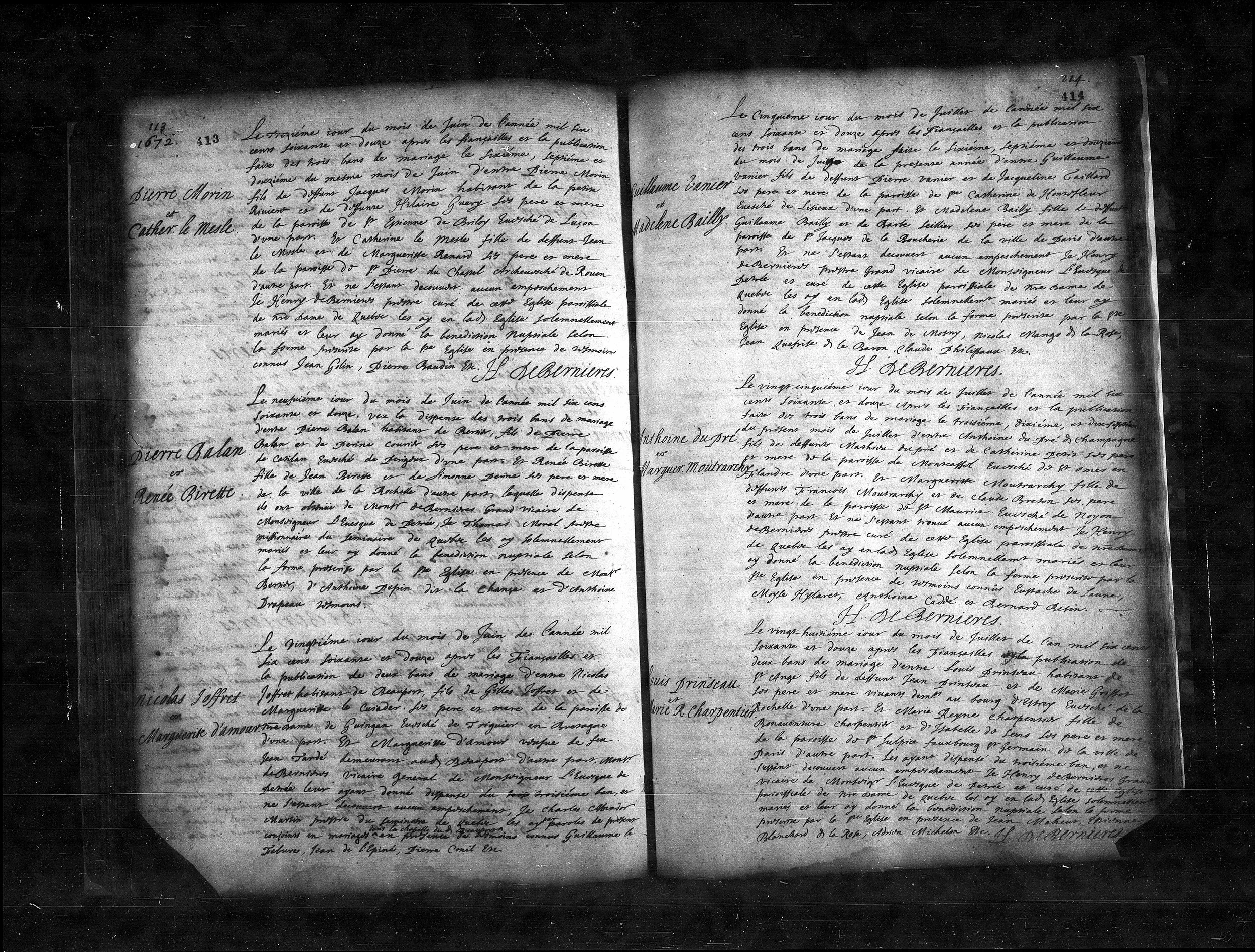
The Church Marriage, 13 June 1672
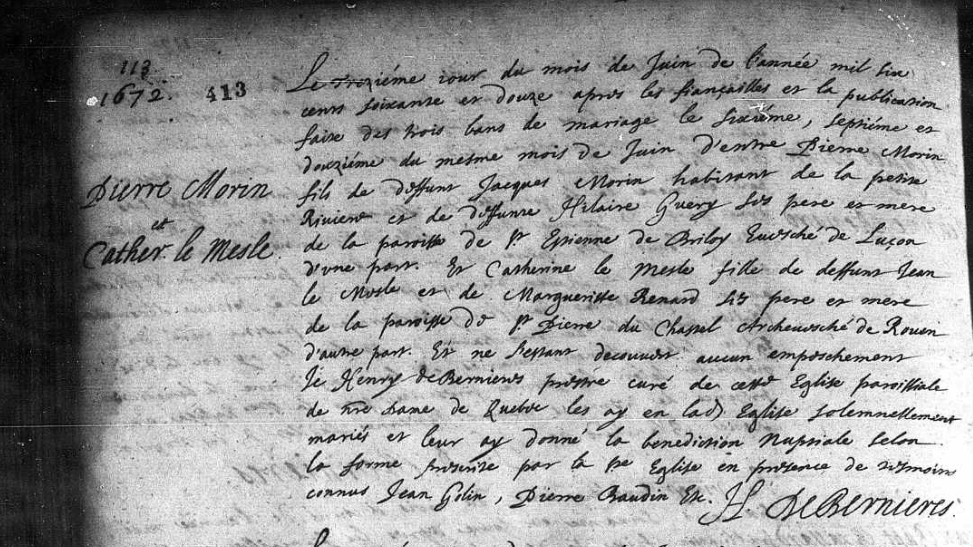
The register of Notre-Dame-de-Québec identifies both parties in full, names the three publications of the banns, and records the officiating priest and the witnesses:
"Le treizième jour du mois de Juin de l'année mil six cents soixante et douze, après les fiançailles et la publication faite des trois bans de mariage, le sixième, septième et douzième du mesme mois de Juin, d'entre Pierre Morin, fils de deffunct Jacques Morin, habitant de la petite Rivière, et de deffuncte Hilaire Guery ses père et mère, de la paroisse de St Estienne de Briloy, Evesché de Luçon, d'une part; et Catherine le Mesle, fille de deffunt Jean le Mesle et de Marguerite Renard ses père et mère, de la paroisse de St Pierre du Chastel, Archevesché de Rouen, d'autre part..."
— Notre-Dame-de-Québec parish register, 13 June 1672. Priest: Henry de Bernières. Witnesses: Jean Golin and Pierre Baudin.Two notes on this entry
The date. The register reads treizième — the thirteenth. Until August 2026 this page transcribed it as troisième, the third, which contradicted the caption printed directly beneath it. The three banns were published on the sixth, seventh and twelfth of June, so the marriage cannot have taken place on the third; the corrected reading is the one the rest of the record requires.
The word order. The phrase habitant de la petite Rivière falls immediately after the name of Pierre's deceased father, which has misled readers into attributing the residence to Jacques Morin. Jacques died in Poitou and never crossed the Atlantic. The residence belongs to the groom, and it is the Petite Rivière of the Quebec district — not Petite-Rivière-Saint-François on the Côte-de-Beaupré, as this site formerly read it.
The Morin Family: Eight Children, Two Ancestral Lines
Pierre and Catherine settled at Petite Auvergne, a côte in the seigneurie of Notre-Dame-des-Anges on the rivière Saint-Charles, just outside Quebec. They stayed there — the notarial acts name the place outright, la petite Rivière Saint-Charles, in 1676, and still describe him at the petite Rivière in 1690. Over seventeen years they had eight children; five reached adulthood. Two of those five are direct ancestors, along paths that would not converge for eighty-five years.
| Child | Born | Died | Marriage / Notes |
|---|---|---|---|
| Marie Anne ★ PATH 1 | 22 July 1673 | 24 Nov 1743 | Guillaume Deguise dit Flamand, 1691 |
| Jean | 28 Jan 1676 | 5 Aug 1687 | Died age 11; buried Notre-Dame-de-Québec |
| Pierre (first) | c. 1677 | — | Age 4 on the 1681 census at Petite Auvergne; no later record |
| Louise Anne | 25 Oct 1678 | 20 Feb 1710 | Jacques Payant dit Saintonge, 1699. Entered as Anne on the 1681 census and as Louise by the PRDH |
| Joseph ★ PATH 2 | 5 Jan 1682 | 11 Dec 1735 | 1. Marie-Anne Brideau, 1704 2. Dorothée Girardin, 1724 — not carried by the PRDH family record |
| Marie Jeanne | 22 April 1685 | 26 Nov 1755 | Jean Baptiste Legris dit Lépine, 1711 |
| Marie-Madeleine | 17 Jan 1687 | 3 Jan 1689 | Died age 1, two weeks short of her second birthday |
| Pierre Jean (second) | 17 Oct 1690 | 25 Jan 1747 | Marie-Louise Bezeau, 29 June 1721, L'Ancienne-Lorette |
The highlighted rows are the two children through whom Catherine becomes a double ancestor. Their descendants grew up apart, married into different families, lived in different parishes — and then, in 1757, two of them married each other.
A note on the third child. A Pierre appears at age four on the 1681 census and never again; a second son was christened Pierre Jean in 1690. Reusing a living child's name was not the practice. The 1690 baptism is, in all likelihood, the only surviving trace of the first Pierre's death.
Pierre Morin died on 12 December 1706 and was buried at the Hôtel-Dieu de Québec. Catherine Lemesle survived him by at least fifteen years. She was still being admitted to the Hôtel-Dieu as late as 1710, recorded there as femme de Pierre Morin rather than as his widow. The Fichier Origine places her death at Quebec after 8 June 1721; three weeks after that date, on 29 June 1721, her youngest son married at L'Ancienne-Lorette and the register named him son of the late Pierre Morin and of Catherine Le Mesle — the mother not marked deceased. No burial has been found. Their full documentary biography is at Pierre Morin & Catherine Lemesle →
Documentary Evidence: The Two Ancestral Lines
The baptisms of Marie Anne and Joseph Morin are the starting points of the two paths that would eventually rejoin.
Marie Anne Morin (1673) — Path 1
Marie Anne was the firstborn, baptized 22 July 1673. She married Guillaume Deguise dit Flamand on 12 August 1691. Their daughter Marie Catherine Antoinette Deguise married Charles Guilbault, and their son Charles Gabriel Guilbault — the subject of Episode 4 of The Guilbault Line — married his distant cousin Marie Charlotte Morin in 1757.

Joseph Morin (1682) — Path 2
Joseph was born 5 January 1682 and baptized the next day. He married Marie-Anne Brideau on 4 November 1704 and, by later accounts, Dorothée Girardin in 1724 — a second marriage the PRDH family record does not carry. His son Joseph Morin II married Marie Charlotte Charles Croquelois, and their daughter Marie Charlotte Morin married Charles Gabriel Guilbault.

The 1757 Convergence
On 26 September 1757, at Notre-Dame in Montreal, Charles Gabriel Guilbault married Marie Charlotte Morin. He was twenty-six; she was nineteen. A notarial marriage contract preceded the church ceremony.
Neither is likely to have known they shared a common ancestor. But in marrying they rejoined lines that had been separate since Catherine Lemesle's children were born in the 1670s and 1680s.
Their son Gabriel — the voyageur who would later marry an Ojibwe woman named Marie Josephte Abitakijikokwe — inherited Catherine Lemesle's ancestry from his father and from his mother alike.
Connection to The Guilbault Line
This case study connects directly to Episode 4: Charles Gabriel Guilbault — The Quebec Patriarch in The Guilbault Line documentary biography series. Charles Gabriel is Catherine Lemesle's great-great-grandson through Path 1, and he married her great-great-granddaughter through Path 2.
Continue the Story
Episode 4 tells the full story of Charles Gabriel Guilbault (1731–1784), including his two marriages and the four sons who survived to adulthood — one of whom became the voyageur Gabriel Guilbault.
Read Episode 4 →The Guilbault Line series traces seven generations from Pierre Guilbault, who arrived at Quebec about 1647, to Evangeliste Guilbault (1845–1883). Catherine Lemesle enters that story by marriage — twice — which is a useful demonstration of how the maternal lines feeding into a patrilineal surname create connections the surname itself never shows.
An unexplored convergence
On the 1681 census of Petite Auvergne, four households from Pierre Morin and Catherine Lemesle, live Pierre Guillebeault and Louise Sénécal. Two Storyline ancestral lines, on the same côte, seventy-six years before their descendants married. Whether the families were connected in 1681 or merely adjacent has not been established, and the question deserves its own examination.
Compiled Database Records
Two compiled databases carry this family. The Fichier Origine documents Catherine's French baptism and her parents; the PRDH — Programme de recherche en démographie historique, Université de Montréal — reconstitutes the Quebec family from the parish registers. Both are transcribed below rather than reproduced. Neither is an independent witness to the records it indexes, and neither carries any military attribution for Pierre Morin.
| Name | LEMESLE, Catherine |
| Sex | Female |
| Place of origin | Rouen (St-Pierre-du-Chastel), 76540, Seine-Maritime |
| Baptism | 16-04-1646 |
| Death | Quebec, after 8 June 1721 |
| Year of arrival | 1671 (estimated) |
| Occupation on arrival | Fille du Roi |
| Marital status | Married |
| First spouse | Pierre Morin |
| Marriage | 1672-06-13, Québec (Notre-Dame) |
| Father | Jean LEMESLE, merchant |
| Mother | Marguerite Renard |
| Siblings noted | Baptized at Rouen (St-Pierre-du-Châtel): Jacques, 05-10-1652; Marie, 01-02-1654 |
| Related act flagged | Pierre Lemesle, born Rouen (St-Jean), banns at Rouen (St-Jean) 03-04-1633 with Marguerite Tabouelle, born Rouen (St-Martin-du-Pont) |
| Identification | DGFQ, p. 835 |
| Reference | OFC, p. 43 |
| Researcher | Archange Godbout |
| Document source | AD-76 (digitised) |
What this record is. A compiled French-origins file keyed to the digitised Rouen register at the Archives départementales de la Seine-Maritime. Its value is that it points at the original — and the original is reproduced earlier on this page.
On the death date. "After 8 June 1721" is a terminus, not a death: it records the last date on which the compiler could show her living. It is not a burial, and no burial has been found.
Fichier Origine, Catherine Lemesle (Landry no. 339, Dumas no. 281); fichierorigine.com. Card data restated, not reproduced.| Name | Pierre MORIN |
| Status | Immigrant |
| Father | Jacques MORIN |
| Mother | Hilaire GUERY |
| Birth | Around 1648 · st-etienne de brillouet, ev. lucon, poitou (ar. fontenay-le-comte, vendee) |
| Death | 1706-12-12 |
| Burial | 1706-12-12, Hôtel-Dieu de Québec |
| First marriage | 1672-06-13, Québec, with Catherine LEMESLE |
| Wife's parents | Jean LEMESLE and Marguerite RENARD |
| Occupation | No field on the card |
| Military service | No field on the card |
The last two rows are the point. The PRDH reconstitutes this man from the parish registers and gives him parents, an origin, a marriage, a death and a burial. It gives him no trade and no company, because the registers give none — though the notarial record does give a trade: he is described as a carpenter in a building contract of 1690. Whatever supports the Carignan-Salières identification, it is not this record.
What the card is, and is not. A reconstitution — the database's reading of the underlying acts, not a further witness alongside them. The origin restates what the marriage contract, the banns and the burial entry each say independently.
PRDH-IGD, individual no. 53641, Pierre Morin; www.prdh-igd.com. Card data restated, not reproduced.| Sex | Birth | Marriage | Death | Child & spouse |
|---|---|---|---|---|
| f | 1673-07-22 Québec | 1691-08-12 Québec | 1743-11-24 Québec | MARIE ANNE Guillaume Deguise Flamand |
| m | 1676-01-28 Québec | — | 1687-08-05 | JEAN |
| m | before 1677 Lieu indéterminé (au Québec) | — | — | PIERRE |
| f | 1678-10-25 Québec | 1699-02-03 Québec | 1710-02-20 Hôtel-Dieu de Québec | LOUISE Jacques Payant Stonge |
| m | 1682-01-05 Québec | 1704-11-04 Québec | 1735-12-11 L'Ancienne-Lorette | JOSEPH Marie Anne Brideau |
| f | 1685-04-22 Québec | 1711-08-11 Québec | 1755-11-26 Québec | MARIE JEANNE Jean Baptiste Legris Lepine |
| f | 1687-01-17 Québec | — | 1689-01-03 Québec | MARIE MADELEINE |
| m | 1690-10-17 Québec | 1721-06-29 L'Ancienne-Lorette | 1747-01-25 Hôtel-Dieu de Québec | PIERRE Marie Louise Bezeau |
Three things this card settles. The fourth child is entered as Louise, not Anne — she was given both names, and different compilers pick different ones, which is why some trees credit this couple with a ninth child who never existed. The third child, Pierre, has a birth "before 1677" at an undetermined place and nothing after it. And the youngest son's marriage on 29 June 1721 is the entry that carries Catherine past the Fichier Origine's terminus.
What the card is, and is not. A reconstitution of the family from the parish registers, and the source of the dates in the children's table above. It records one marriage for Joseph; the second, to Dorothée Girardin in 1724, comes from elsewhere and is flagged as such.
PRDH-IGD, family record of Pierre Morin and Catherine Lemesle; www.prdh-igd.com. Card data restated, not reproduced.What this page previously claimed about Pierre Morin's military service
Until August 2026 this page stated that Pierre Morin served in the Compagnie de Naurois, "independently confirmed by the PRDH, the SFRSC, and Jack Verney." That claim is withdrawn, on three grounds.
The confirmations were not independent. The PRDH's list of migrants reproduces the 1668 muster roll's roster in the roll's own order. It is an accurate index to that document, not a second witness to it. Verney's appendix reconstructs the company from the same archival record and gives Pierre Morin no origin and no dit name, so it cannot distinguish one Pierre Morin from another. Counted as three authorities, they were one document counted three times.
The PRDH made no attribution. Its migrant record for the La Noraye roster resolves to no individual at all — the entry carries no link. The same database links freely elsewhere, including the confirmation held at Chambly in May 1668, which resolves cleanly to a different Pierre Morin from the diocese of Saintes. It identifies when it has grounds. Here it declined.
A specialist compilation now excludes him. Peter J. Gagné's From Soldiers to Settlers (2025) assigns the roll entry to the Saintes man and names Catherine's husband as the exclusion. Michel Langlois assigns it the other way. The question is open, and this practice's published position is that it is open.
Neither database transcribed above carries a military attribution of any kind. The PRDH individual record has no occupation field and no company field. That absence was always visible on this page; it simply went unremarked.
Research Significance
Catherine Lemesle's double appearance in one family tree illustrates several principles worth carrying into other research.
1. Pedigree collapse is normal, not exceptional
In colonial Quebec, with a small population and a limited marriage pool, collapse was arithmetically unavoidable. Researchers working in French-Canadian ancestry should expect the same ancestors to appear more than once, particularly among the founding generation of Filles du Roi and early settlers. Finding a duplication is not a sign that the research has gone wrong.
2. Maternal lines carry the connections
Surname research follows patrilineal descent by construction. The maternal lines feeding into each generation are where the unexpected links sit. Catherine Lemesle never bore the Guilbault name, and she appears in the Guilbault tree twice.
3. The DNA implications are real but modest
Descending from one ancestor through two lines roughly doubles the expected inheritance — from about 0.098% to about 0.195%, as worked above. In practice this means DNA matches who also descend from Catherine may share more centimorgans than the documented relationship predicts, and relationship estimators built on single-path assumptions will read those matches as closer than they are.
For DNA researchers
Two paths double the expectation; they do not double a measurement. Autosomal inheritance is random at every meiosis, and at ten generations there is a genuine chance of having inherited nothing at all through either path — in which case the paper trail is the only evidence there will ever be. Treat the doubling as a reason to expect noisier match data, not as a finding in itself.
Document Gallery



Continue the Story
Episode 4 of The Guilbault Line tells the full story of Charles Gabriel Guilbault (1731–1784). For Catherine and Pierre's life together, see the documentary biography; for the unresolved question of Pierre's military service, see the case study and the note on the rival candidate.
Read Episode 4 → Documentary Biography → Pierre Morin Case Study →