The Donaghmoyne Network
Four Couples, One Parish, Exploring DNA Connections
Investigating potential connections between four couples married in Donaghmoyne parish, County Monaghan, Ireland (1841–1858)—whose descendants scattered across North America over fifty years of emigration
The Research Question
Can DNA evidence combined with documentary research establish that four couples married in Donaghmoyne parish between 1841 and 1858 were part of an interconnected family network?
Between 1841 and 1858, four couples married in the small Catholic parish of Donaghmoyne in County Monaghan, Ireland. Over the following decades, their families would disperse across North America—to Montreal and Chicago, to Wisconsin and Nebraska, to Joliet, Illinois, and eventually to St. Louis, Missouri, and the copper mines of Anaconda, Montana.
DNA testing has revealed that descendants of these four couples share genetic connections—but the match levels vary significantly. Some connections are strong enough to suggest close family relationships; others are at levels that require careful interpretation. This case study brings together documentary evidence and DNA analysis to explore how these families may have been connected in Ireland.
A Note on DNA Evidence
DNA matches below 30 cM require careful interpretation. While such matches can represent distant cousin relationships, they can also occur by chance between unrelated individuals (known as "identical by chance" or IBC). The cross-network matches in this study range from 8–34 cM—levels that are suggestive but not conclusive on their own. The combination of DNA evidence with documentary evidence (same parish, same surname, overlapping timeframes) builds a circumstantial case, but segment triangulation and additional testing are needed to strengthen these conclusions.
The Four Founding Couples
Married in Donaghmoyne Parish, County Monaghan, 1841–1858
| Couple | Marriage | Destination | Status |
|---|---|---|---|
| Henry Hamall & Mary McMahon | 1841 | Montreal → Chicago | DNA Tested |
| Owen Hammel & Ann King | 1846 | Wisconsin → Nebraska | DNA Tested |
| Susan Hamill & Charles McCanna | 1857 | Joliet, Illinois | DNA Tested |
| James Hamill Sr. & Ann Gartlan | 1858 | Stayed in Dian → Children emigrated | DNA Tested |
The Working Hypothesis
Owen Hammel, Henry Hamall, and James Hamill (father of Susan) may have been brothers, children of an as-yet-unidentified Hamill couple in Donaghmoyne parish, likely married c. 1810–1815. DNA matches between their descendants are suggestive but at levels requiring careful interpretation.
James Hamill Sr. (1827–1914), father of the Montana and Missouri emigrants, may connect to this group through a collateral line—possibly as a cousin or nephew rather than a brother, given the age gap and DNA patterns showing indirect rather than direct connections.
Research continues to identify DNA clusters that tie all of these Hamill couples who originated from the same parish. The goal is to establish the exact nature of the relationships—whether siblings, cousins, or more distant kin.
Connection Status
Current evidence level for each proposed relationship
Brothers and sisters — children of James Hamill Sr. & Ann Gartlan of Dian. Documentary evidence confirms sibling relationship (including Peter's 1949 death certificate naming both parents). Strong internal DNA matches (23–228 cM) between descendants across 5 children's lines.
DNA matches of 21–34 cM on 23andMe, 10–17 cM on Ancestry between descendants. Pattern is consistent with a close relationship (brothers or first cousins), but matches at these levels can also occur by chance. Documentary evidence: both married in Donaghmoyne, 5 years apart. Naming patterns suggest possible sibling relationship.
DNA matches of 8–15 cM between descendants—at the threshold of significance. These matches could represent distant cousin relationships but are also within the range that can occur by chance. Documentary evidence places both families in Donaghmoyne; further research needed.
Some DNA matches identified between descendants, but at levels requiring careful interpretation. All three Hamill individuals (Henry, Owen, Susan) married in Donaghmoyne parish—suggesting possible common ancestry that the DNA evidence does not yet prove.
One promising match identified on another testing platform that appears to connect these lines. Shared matches through other clusters point to common Monaghan ancestry. May indicate a more distant relationship (cousins rather than siblings). Research ongoing.
Key Findings to Date
Why This Research Is Challenging
Connecting these Donaghmoyne families requires pushing beyond the limits of what Irish genealogy and autosomal DNA can typically provide. Several factors make this research particularly daunting:
The Irish Record Gap: To prove sibling relationships between Henry Hamall (married 1841), Owen Hammel (married 1846), and James Hamill (father of Susan), we need to identify their parents—a couple likely married around 1810–1815. But Catholic parish registers for Donaghmoyne begin only in 1835, and most civil registration starts in 1864. The Great Famine (1845–1852) and subsequent emigration scattered families before comprehensive records existed. We're searching for ancestors in a period where few records survive.
The Only-Child Problem: The Henry Hamall and Mary McMahon line presents an extreme genealogical bottleneck. While Owen Hamall (1847–1898) had at least one sibling who survived to adulthood—his sister Mary Ann Hamall Byron, through whom all four of our DNA matches descend—his half-brother William Thornton (through Mary McMahon's remarriage) lost three children in early childhood and left no descendants. Owen's own line narrowed dramatically: his son Thomas Henry (1880–1938) had only one child, Thomas Eugene. His daughter Mary Hamall Holland had two sons, but neither left descendants. Thomas Eugene had one son, Thomas Kenny, who married Barbara O'Brien and had six children—five of whom have tested. But here's the problem: those five testers have no 1st cousins, no 2nd cousins, and no 3rd cousins to compare with. The family came within one generation of extinction, and while it survived, the lack of cousin matches makes triangulation nearly impossible within the Chicago Hamall line itself.
Autosomal DNA Limitations: Autosomal DNA is powerful for relationships within 4–5 generations, but we're looking for common ancestors 7+ generations back (c. 1790 or earlier). At that distance, autosomal DNA becomes unreliable—many descendants won't share any detectable DNA even if they're truly related. The cross-network matches we've identified (8–34 cM) are at the edge of what autosomal testing can meaningfully detect.
The Path Forward: Y-DNA Testing
To break through these barriers, we need Y-DNA testing—specifically Big Y-700 tests from Hamill/Hamall/Hammel men in each line. Y-DNA traces the direct paternal line and can identify common ancestors hundreds of years back, well beyond autosomal DNA's reach. If Henry, Owen, and James were truly brothers, their male-line descendants would share matching Y-DNA signatures.
Currently needed: Male descendants (surname Hamill, Hamall, Hammel, or direct male-line descendants) from the Owen Hammel/Wisconsin line, the Susan Hamill/Joliet line, and additional testers from the James Hamill/Montana-Missouri line. If you're a male-line descendant of any Donaghmoyne Hamill family, your Y-DNA test could be the key to solving this puzzle.
Research Gaps & Next Steps
The primary gap in this research is the parental generation. If Owen Hammel, Henry Hamall, and James Hamill (father of Susan) were indeed brothers, their parents likely married in Donaghmoyne around 1810–1815. Identifying this couple would definitively establish the sibling relationship.
The relationship between this proposed sibling group and James Hamill Sr. (1827–1914) also requires clarification. The indirect DNA connection patterns, combined with the younger birth year of James Sr., suggest he may connect through a collateral line—perhaps as a nephew or cousin rather than a brother.
Critical next steps include: Segment triangulation to determine if cross-network matches share the same DNA segments (true IBD) or occur on different segments (potential IBC); additional DNA testing of descendants from underrepresented lines; deeper analysis of pre-Famine Irish records.
Key to solving the puzzle: Pre-Famine records—particularly the Tithe Applotment Books (1823–1838)—may hold the answer. A "Henry Hamil" appears in Edengilrevy townland in 1824, potentially representing the father or uncle of our subjects.
Case Study Components
Six interconnected components demonstrating professional genealogical methodology
Case Study Summary
You Are Here
Overview of the Donaghmoyne Network research—four couples, their migrations, and the DNA evidence suggesting possible connections.
- Research question and hypothesis
- Four founding couples identified
- Connection status for each relationship
- Key findings and research gaps
BCG Evidence Analysis
Documentary Foundation
Comprehensive analysis of documentary evidence—from Irish marriage records to American vital records across five destinations.
- Marriage records from Donaghmoyne parish
- Griffith's Valuation geographic analysis
- Migration evidence across three countries
- The Gartlan connection documented
Methodology Guide
Research Standards & Approach
Detailed explanation of research methods including DNA analysis techniques and how documentary and genetic evidence correlate.
- GPS-compliant methodology
- DNA cluster analysis approach
- Triangulation techniques
- Evaluating evidence confidence levels
DNA Evidence Analysis
Cluster-by-Cluster Review
Detailed DNA analysis showing match levels, what they suggest, and the limitations of the current evidence.
- Four DNA cluster profiles
- Cross-network match analysis
- IBD vs IBC considerations
- Confidence levels for each connection
Document Gallery
Primary Source Images
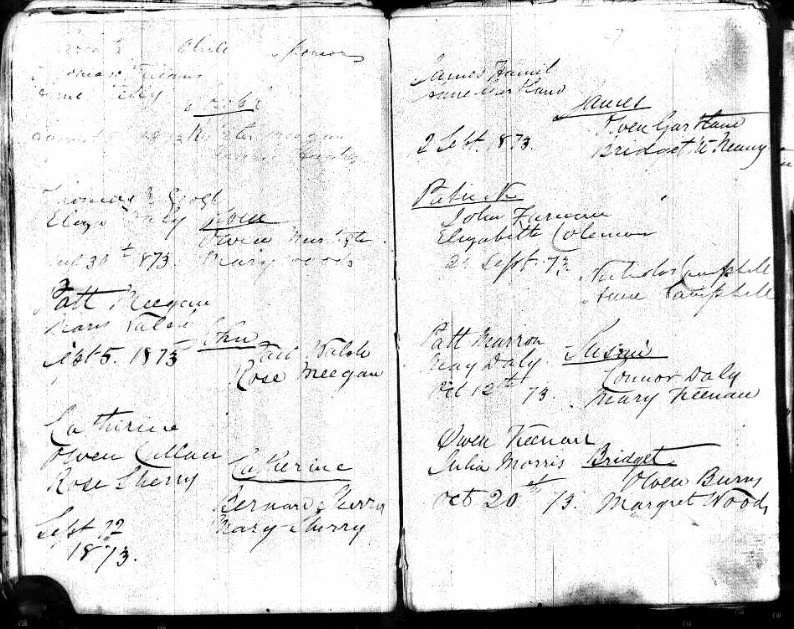
High-resolution images of key documents supporting the research—marriage records, census pages, death certificates, and more.
- Four Donaghmoyne marriage records
- Wisconsin guardianship papers
- American vital records
- Newspaper evidence
Evidence Trail
Source Citations & Analysis
Complete source citations and analysis notes for all evidence used in this case study.
- Full source citations
- Evidence evaluation notes
- Research log excerpts
- Unresolved questions
Documentary Biography Series
Complete family histories for each line in the network
The James Hamill & Ann Gartlan Line
7-Episode Series • Dian → Montana, Missouri & Ireland
Complete documentary biography tracing all children of James Hamill Sr. and Ann Gartlan—from Dian townland to Anaconda, St. Louis, and beyond.
Explore the Series →The Owen Hammel & Ann King Line
6-Episode Series • Donaghmoyne → Wisconsin & Nebraska
The family that lost their father in 1858, leaving widow Ann with four minor children. DNA analysis explores the brother hypothesis.
Explore the Series →The Susan Hamill & Charles McCanna Line
5-Episode Series • Donaghmoyne → Joliet, Illinois
Susan Hamill's journey to Joliet, her connection to James Hamill of St. Louis, and DNA evidence exploring network connections.
Explore the Series →The Hamall Line
Documentary Biography Series • Montreal → Chicago
Henry Hamall's descendants from County Monaghan to Riverside, Illinois—five generations of famine, emigration, tragedy, and resilience.
Explore the Series →Are You Connected to This Network?
If you descend from any Hamill, Hamall, Hammel, McCanna, Gartlan, or McMahon family with roots in County Monaghan—particularly Donaghmoyne parish—your DNA and family records could help establish these connections.
Whether your ancestors settled in Chicago, Wisconsin, Nebraska, Illinois, Missouri, Montana, or elsewhere, I'd welcome the opportunity to collaborate. Your DNA test results might provide the evidence needed to prove how these four families connect.
Contact: mary@storylinegenealogy.com