
The Death That Never Was
A Misattributed Burial and the Documentary Case for 1701
The corrected death range set out here was published by J. Jacques Séguin in La Séguinière, the journal of the Association des Séguin d'Amérique, in June 1994, and is carried by Denis Beauregard's Genealogy of the French in North America. This study did not originate it.
The reading it replaced is also in print, and remains so. Peter J. Gagné's From Soldiers to Settlers: The Carignan-Salières Regiment in Canada (2025) holds that the May 1704 burial is François's, entered under an erroneous given name.
Two notarial acts of October 1703 and March 1704 naming a François Séguin dit Ladéroute at Boucherville have not been read in the original, and the conclusion below is provisional until they are. The test that would settle them is identified in full.
The Problem
François Séguin dit Ladéroute holds a singular place in North American genealogy. Arriving in New France with the Carignan-Salières Regiment in 1665, he became the progenitor of virtually all Séguin families across the continent. Denis Beauregard's compilation estimates his descendants at between 1,890,000 and 2,310,000 Quebecers across twelve recorded generations.
Two of the most consulted reference databases record his death as 9 May 1704, with burial the following day at Notre-Dame-de-Montréal. PRDH-IGD carries it on individual record no. 68331. Fichier Origine carries it on record no. 243774, last modified in February 2023.
They are not two witnesses. Fichier Origine identifies the migrant from the Dictionnaire généalogique des familles du Québec, page 1041 — and DGFQ is the same compilation Beauregard flags as the origin of the erroneous date. Both databases descend from a single source.
The questions before us. What do the two Raimbault marriage contracts establish about the date of François's death? Whose burial is recorded at Notre-Dame in May 1704? And can the two be reconciled?
What the Databases Record
| Father | Laurent SEGUIN |
| Mother | Marie MOSSIEU |
| Baptism | 4 July 1644 — st-aubin-en-bray, ev. beauvais, picardie (ar. beauvais, oise) |
| Death | 9 May 1704 |
| Burial | 10 May 1704 — Montréal (Notre-Dame-de-Montréal) |
| First marriage | 31 October 1672 — Boucherville (Ste-Famille), with Jeanne PETIT, daughter of Jean PETIT and Jeanne GAUDREAU |
The highlighted rows are the entries this study disputes. The mother's surname is rendered MOSSIEU here; the 1644 baptismal act at Saint-Aubin-en-Bray names her Marie Massieu.
| Place of origin | St-Aubin-en-Bray (Notre-Dame-et-St-Aubin), Oise 60567 |
| Date of baptism | 4 July 1644 |
| Place and date of death | Montreal, 9 May 1704 |
| Arrival / occupation | 1665; soldier in the Carignan-Salières Regiment, Saint-Ours company |
| Marriage | 31 October 1672, Boucherville, to Jeanne Petit |
| Identification of the migrant | DGFQ, p. 1041 |
| References | MSGCF vol. 2 p. 219; OUTAOUAIS-G vol. 26 p. 106 |
| Researchers | Robert-Lionel Séguin; André Séguin; Lise Dandonneau |
Not an independent witness. Fichier Origine identifies the migrant from DGFQ p. 1041, the same compilation Beauregard flags as the source of the erroneous death date. Tracing the source string, rather than counting the databases, shows one authority behind both.
| Baptism | 4 July 1644, Saint-Aubin-en-Bray (Notre-Dame-et-Saint-Aubin), Oise 60567, citing MSGCF (1947:2) 219 |
| Death | Between 20 November 1700 and 10 October 1701, citing La Séguinière (1994:4:2) 9 |
| Error flag | Marks the alternative death date carried by DGFQ (1042) as an error, resolved on the marriage contracts of his daughters dated 20 November 1700 and 10 October 1701, both before notary Raimbault |
| Marriage | 31 October 1672, Boucherville; contract 21 September 1672, depositary Thomas Frérot |
| Descendants | Estimated 1,890,000 to 2,310,000 Quebecers |
Source. Denis Beauregard, Genealogy of the French in North America, entry [1732]. © Denis Beauregard, 2005–2026. Data transcribed and rearranged; the compilation's own text is not reproduced.
On priority. Beauregard's citation leads to J. Jacques Séguin, "Décès de François Séguin dit Ladéroute," La Séguinière 4:2 (June 1994) 9 — the article that first published the corrected range. His one-day difference on the second contract is inherited from it: the 1994 article dates the Robidou contract 10 October 1701, where the act examined here is dated 9 October, with the church marriage on the 10th.
The Raimbault acts are the hinge. Let us read them.
The Evidence Trail
Four documents bear directly on the question: two marriage contracts drawn by notary Pierre Raimbault of Montréal, the parish marriage that followed the second contract, and the 1704 burial at Notre-Dame-de-Montréal that was mistaken for his.
Source: Notary Pierre Raimbault (père), Act No. 402, Montréal

Marriage contract of Antoine Marie and Marie Madeleine Séguin, 20 November 1700. Notary Pierre Raimbault, Act No. 402. The marginal heading reads "Mariage de A. Marie avec Marie Seguin."
What the act establishes. On 20 November 1700 François Séguin is described as the husband of Jeanne Petit, not as deceased; as a resident of Boucherville; as absent from the signing on account of illness; and as expected to ratify the contract in person when able. A notary drawing a marriage contract records widowhood precisely, because dower and community property depend on it. Had he been dead, the act would say so.
A note on the groom's name
The Raimbault répertoire indexes this act as the marriage of Louis Marie and Marie Séguin. The act itself names Antoine Marie as the groom; Louis Marie and Mathurine Guard are his parents, stipulating on his behalf. PRDH individual no. 153 agrees, recording Marie Madeleine Séguin's first husband as Antoine Marie Marie Stemarie, son of Louis Marie Stemarie and Mathurine Goard. The finding aid names the father in place of the son, and any citation drawn from the répertoire alone inherits the error.
This matters beyond the name. The répertoire is the same class of document as the two 1703–1704 entries discussed below, and it has already been shown to misname a party.

The Raimbault répertoire, folio 41, entry No. 402, dated 20 9bre 1700: "Mariage de Louis Marie + Marie Séguin." The finding aid names the groom's father rather than the groom.
Source: Notary Pierre Raimbault (père), Act No. 527, Montréal

Marriage contract of Joseph Robidou and Marie Jeanne Séguin, 9 October 1701. Notary Pierre Raimbault, Act No. 527. Jeanne Petit appears here as veufue de deffunct françois Seguin.
What the act establishes. By 9 October 1701 Jeanne Petit is veufue — widow — of deffunct françois Seguin, described as vivant habitant de Boucherville, in his lifetime a resident of Boucherville. She acts alone for her daughter, as a widow must. This is the terminus ante quem, and it is the single most important document in the case.
Source: Parish Register of Saint-Antoine-de-Longueuil

Marriage of Joseph Robidou and Marie Jeanne Séguin, 10 October 1701, parish of Saint-Antoine-de-Longueuil. The ceremony took place the day after the contract was signed.
This record does not state that François was dead
The act applies deffunt and deffunte to the groom's parents and applies neither word to the bride's. A reader coming to this record alone would not learn that François Séguin had died. The parish index reflects exactly that: PRDH union no. 5267 marks André Robidoux and Jeanne Denot with the presence code d for deceased, and marks François Séguin and Jeanne Petit with dashes, meaning the act states nothing about either.
This is a filiation clause, not a presence record. Naming a parent in a marriage act establishes descent, not attendance and not survival. The record is silent on François's status — it neither supports nor contradicts the notarial evidence of the previous day.
| Rank | Name and role | Age | M.S. | Pr. |
|---|---|---|---|---|
| 01 | Joseph ROBIDOU — spouse of 02; residence Laprairie-de-la-Madeleine | 25 | c | p |
| 02 | Jeanne SEGUIN — spouse of 01 | 20 | c | p |
| 03 | Andre ROBIDOUX — father of 01, spouse of 04 | — | m | d |
| 04 | Jeanne DENOT — mother of 01, spouse of 09 | — | m | d |
| 05 | Francois SEGUIN — father of 02 | — | — | — |
| 06 | Jeanne PETIT — mother of 02 | — | — | — |
| 07 | DEBELMONT — Vicar General of the Bishop of Quebec | — | c | p |
| 08 | Guillaume ROBIDOU — brother of 01 | — | — | p |
| 09 | Jacques SUPERNANT — father-in-law or stepfather of 01, spouse of 04 | — | v | p |
| 10 | Pierre SEGUIN — brother of 02 | — | — | p |
| 11 | Charles PATENOTRE — brother-in-law or stepbrother of 02 | — | — | p |
| 12 | DEFRANCHEVILLE — priest | — | — | p |
Legend. M.S. = marital status (c = single, m = married, v = widowed). Pr. = presence at the act (p = present, d = deceased, a = absent, em dash = not stated).
Reading the highlighted rows. Both of the bride's parents carry dashes in both columns. The index is not asserting that François was alive; it is recording that the act says nothing either way. Contrast ranks 03 and 04, where the same index applies d because the act says deffunt.
The bride's brother Pierre Séguin and her brother-in-law Charles Patenotre — husband of her sister Marie Françoise — were present. Neither stood in place of the father; the act records no role for him beyond filiation.
Resolving the Parish Records
Two parish records dated after October 1701 appear, on an index reading, to describe François Séguin as living. A third, dated 1715, states plainly that he was dead. All three must be accounted for.
The Marriage of François fils, 22 February 1702
Four months after his mother was called a widow before a Montréal notary, François Séguin the younger married Marie Louise Feuillon at Sainte-Famille de Boucherville. The PRDH index for that marriage records both of his parents as married.
| Rank | Name and role | Age | M.S. | Pr. |
|---|---|---|---|---|
| 01 | Francois SEGUIN — spouse of 02; residence Boucherville; origin Ste-Anne près de Grondines | 23 | c | p |
| 02 | Marie Louise FEUILLON — spouse of 01; residence Ste-Anne | 19 | c | p |
| 03 | Francois SEGUIN LADEROUTTE — father of 01, spouse of 04; residence Boucherville | — | m | — |
| 04 | Jeanne PETIT — mother of 01, spouse of 03; residence Boucherville | — | m | — |
| 05 | Michel FEUILLON — father of 02, spouse of 06; residence Ste-Anne | — | m | — |
| 06 | Louise BERSIERE — mother of 02, spouse of 05; residence Ste-Anne | — | v | — |
| 07 | Michel FEUILLON — brother of 02 | — | — | p |
| 08 | Antoine FEUILLON — brother of 02 | — | — | p |
| 09 | Nicolas DUBRAY LAPLUME | — | — | p |
| 10 | Joseph QUINTAL — clerk to M. Quintal | — | — | p |
| 11 | PAPIN — merchant, Boucherville | — | — | p |
| 12 | R DELASAUDRAYS — priest, curé, Boucherville | — | c | p |
The distinction the index draws. Louise Bersière, mother of the bride, is coded v — widowed. François Séguin and Jeanne Petit are coded m — married. The index is capable of recording widowhood in this very record and does not record it for the Séguin parents.
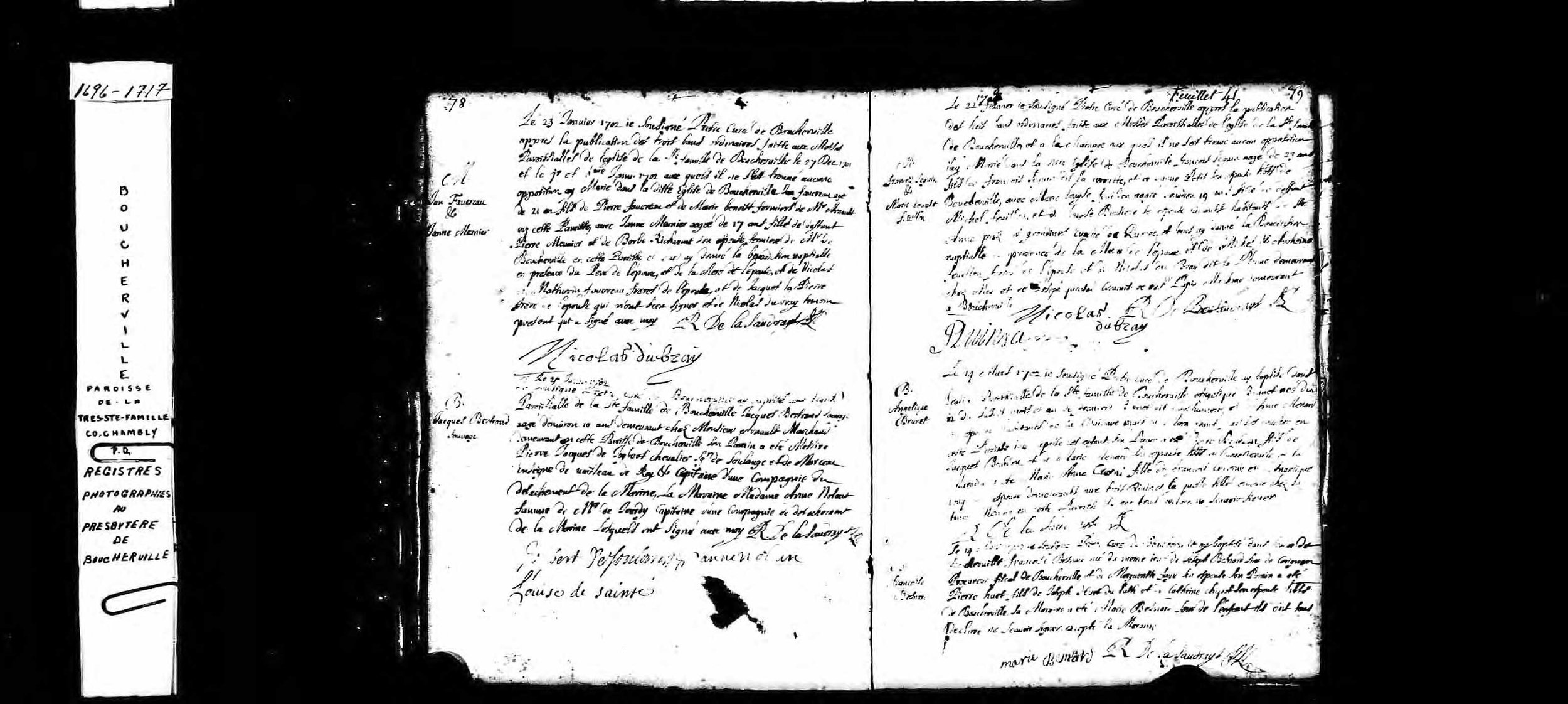
Page from the Boucherville (Sainte-Famille) parish register containing the marriage of François Séguin fils to Marie Louise Feuillon, 22 February 1702.
Resolution
The état matrimonial column records the marital condition in which a named party stands, not whether that party is living. For parents named in a filiation clause, m records that the couple were married to each other — the fact that legitimates the child. It is not a statement that both were alive on the day of the act. Widowhood is recorded when the act itself supplies it, as it does for Louise Bersière and as it does not for Jeanne Petit.
The same silence appears in the Longueuil act of the preceding October. Neither record contradicts the notarial evidence; both are mute on the question.
The Marriage of Simon, 11 November 1715
Thirteen years later, Simon Séguin, widowed, returned to Sainte-Famille de Boucherville to marry Madeleine Cole, a young woman of New England origin then in service to the merchant Papin. The act of that marriage does what the acts of 1701 and 1702 do not.
| Rank | Name and role | Age | M.S. | Pr. |
|---|---|---|---|---|
| 01 | Simon SEGUIN — spouse of 02; residence Boucherville | 33 | c | p |
| 02 | Madeleine COLLE — spouse of 01; servant of M. Papin; origin New England | 17 | c | p |
| 03 | Francois SEGUIN — father of 01; residence Boucherville | — | — | d |
| 04 | Jeanne PETIT — mother of 01; residence Boucherville | — | — | p |
| 05 | Joseph COLLE — father of 02, spouse of 06; residence New England | — | m | — |
| 06 | Catherine SERRE — mother of 02, spouse of 05; residence New England | — | m | — |
| 07 | Jean Baptiste SEGUIN — brother of 01 | — | — | p |
| 08 | PAPIN | — | — | p |
| 09 | Joseph BENARD — brother of 10 | — | — | p |
| 10 | Jean Baptiste BENARD — brother of 09 | — | — | p |
| 11 | Gabriel BOISDORE | — | — | p |
| 12 | DELASAUDRAYS — priest, curé, Boucherville | — | c | p |
The parish-side confirmation. Here the act supplies what the earlier ones withheld: François is coded d, deceased, and Jeanne Petit p, present in the church. This is the same register, the same parish, and the same curé who recorded the 1702 marriage without status. The difference lies in what each act was drafted to say, not in any change in François's condition.
The 1715 act is independent of the Raimbault contracts. It corroborates the widowhood from a parish source, fourteen years after the fact.
The parish records are consistent with the notarial evidence. No parish act states that François Séguin was living after 9 October 1701. Two are silent; one, in 1715, states that he was dead. The apparent conflict was an artefact of reading an index column as a survival statement rather than as a transcription of what each act happens to say.
The Burial of May 1704
If François died between November 1700 and October 1701, whose burial was recorded on 10 May 1704 at Notre-Dame-de-Montréal?
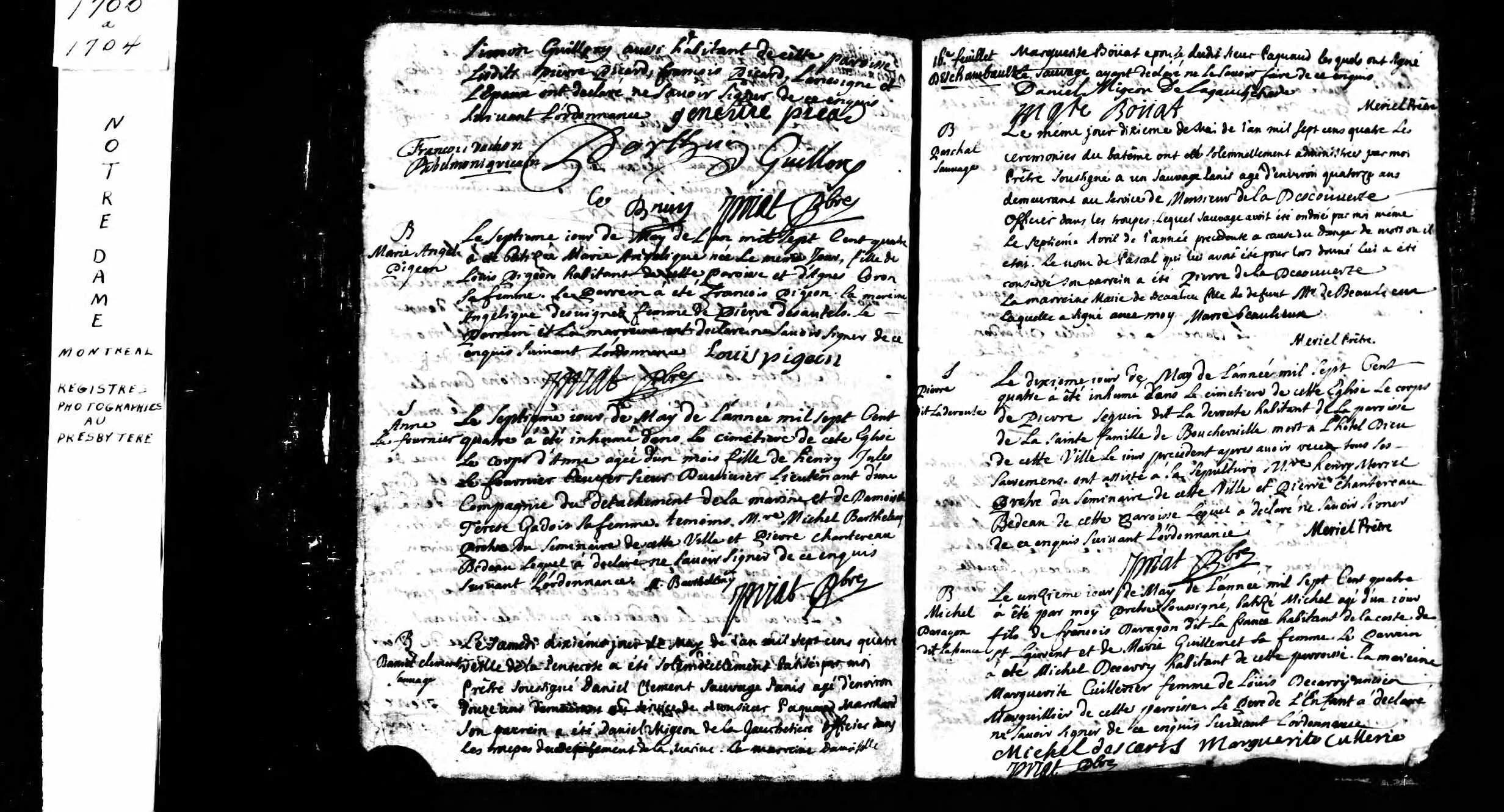
Page from the Notre-Dame-de-Montréal parish register, 1700–1704, containing the burial long attributed to François Séguin.
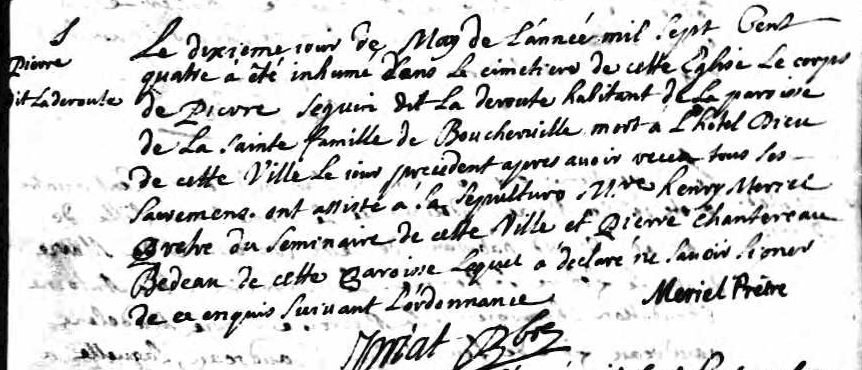
Detail of the 10 May 1704 entry. The given name reads Pierre Séguin dit La Deroute.
Every condition for misattribution is present in a single line: the surname Séguin, the dit name La Déroute, and residence in the parish of Sainte-Famille de Boucherville. Only the given name distinguishes the two men, and a compiler working from an abstract rather than the act would not see it.
He was not François's son Pierre, who was baptized 24 August 1682, married Marie Barbe Filion at Boucherville on 4 February 1704 — three months before this burial — and was buried at Mascouche on 9 November 1760.
The Case Against This Reading
The reading this study replaces is not new, and it is not anonymous. It was set out by the ethnologist Robert-Lionel Séguin in articles published in 1947, and it rests on a reasoning the 1994 article states plainly:
The 1947 argument. No burial act for François Séguin had been found. No Pierre Séguin dit Ladéroute was then known to have been living at Boucherville, or anywhere in New France, other than François's son — who did not die until 1760. It followed that the clerk had erred, and that the 1704 act should be read as François rather than Pierre.
That reasoning is sound on its premises. The burial names an habitant of Sainte-Famille de Boucherville who died at the Hôtel-Dieu in Montréal; if no second man of that name can be produced, an error in the given name is the economical explanation. Everything turns on whether the second premise still holds.
It is also the reading still in print. Peter J. Gagné's From Soldiers to Settlers (2025) gives François's dates as 1644–1704 and states that he died on 9 May 1704 at the Hôtel-Dieu de Montréal and was buried the next day under the first name Pierre. Gagné's source line reads Jetté, PRDH, Tanguay and Trudel — all downstream of the 1947 articles — and La Séguinière does not appear among them. He cites the contract of 20 November 1700 and the phrase indisposition; he does not mention the contract of 9 October 1701 in which Jeanne Petit acts as veufue de deffunct françois Seguin. The 2025 book is therefore not an independent judgment against the corrected range so much as a continuation of the reading that range was published to replace.
The Second Premise No Longer Holds
A Pierre Séguin dit Ladéroute does appear in the Montréal registers of the 1690s, and he cannot be François's son.
| Date | Act | Age of François's son Pierre |
|---|---|---|
| 22 February 1693 | Godfather at the baptism of Pierre Picard, Montréal | 10 |
| 13 June 1693 | Godfather at the baptism of Jacquette-Angélique Demuis, Montréal | 10 |
| 31 October 1695 | A Pierre Séguin present at the marriage of François Gloria and Marie Bénard, Montréal | 13 |
A boy of ten does not stand godfather, and a boy of thirteen is not called as a witness to a marriage. These appearances place a Pierre Séguin dit Ladéroute of adult standing in the Montréal district a decade before the disputed burial. That is not an identification, and this study does not offer one — but the 1947 argument required that no such man existed, and he did.
Two further points weigh against the 1704 reading. The parish register of Boucherville, in the act of 11 November 1715, records François as deceased with his widow present — difficult to reconcile with a death in 1704 unless the same register is supposed capable of two errors about the same man. And François is absent from his children's marriage contracts throughout the period he is supposed to have been living:
| Date | Contract | Who acts in the father's place |
|---|---|---|
| 20 Nov 1700 | Marie Madeleine and Antoine Marie (Raimbault) | Jeanne Petit, for her husband absent pour son indisposition |
| 9 Oct 1701 | Marie Jeanne and Joseph Robidou (Raimbault) | Jeanne Petit, as widow |
| 30 Dec 1703 | Marie Madeleine and François Achin, second marriage (Adhémar) | Charles Patenotre, the bride's brother-in-law |
| 2 Feb 1704 | Pierre and Barbe Filion (Adhémar) | François the brother of the groom, with his wife Marie Louise Filion |
The last of these is three months before the disputed burial. If the father were living at Boucherville that winter and transacting before a notary there, his absence from his own son's marriage contract — with the son François standing in his place — would require explanation. None has been offered.
The Two Notarial Entries of 1703 and 1704
There remains one live evidentiary problem. The répertoire of Marien Tailhandier, notary at Boucherville, contains two entries naming a François Séguin dit Ladéroute after the death this study proposes:
| Date | Entry as indexed | Bearing on the question |
|---|---|---|
| 13 October 1703 | Two leases by Jean Poirier to François Séguin dit Ladéroute, one describing him de l'île St-Jean | Two years after the widowhood is recorded |
| 2 March 1704 | Obligation by François Séguin dit Ladéroute to Jacques Aubuchon | Nine weeks before the disputed burial |
Why the répertoire cannot answer this
These are index lines in a finding aid, not acts. They carry no patronymic, no wife's name, no père or fils. A father and a son bearing the identical given name and dit name, both resident in the same parish, are indistinguishable in such a line — and this is the same répertoire that turned Antoine Marie into Louis Marie in the 1700 entry examined above.
The son was demonstrably at Boucherville in this window. He married there in February 1702, and his first child, Marie Françoise, was baptized at Sainte-Famille on 25 May 1704, sixteen days after the disputed burial. By April 1706 the family had crossed to the Île Jésus. Both men were therefore in the parish when these acts were drawn, and nothing in the index separates them.
A further detail cuts against reading them as the father's. The 13 October 1703 lease describes the lessee as de l'île St-Jean. The father's holding was a lisière de terre on Île Grosbois, granted 15 April 1700 for his lifetime — a different island in the Boucherville archipelago. This is suggestive, not decisive.
The Test That Would Settle It
Both acts can be resolved on sight, because the two men differ in a respect that notarial acts record.
François the elder could write. He and Jeanne Petit both signed their marriage contract of 21 September 1672 before notary Frérot, and he signed the baptismal register of Sainte-Famille on 12 November 1688 at the baptism of his son Jean-Baptiste, alongside the godfather and the witness Julien Beaussault.
The 1994 article adds a further observation from the same greffe. The last act it identifies as signed by François is a lease of two cows from the Sieur de Niverville, drawn before Tailhandier on 30 October 1700 — three weeks before the indisposition is recorded. Its author notes that the signature already appears less steady than usual, but that he was still well enough to come to the notary's office at Boucherville and sign. No signed act by François is identified after that date.
Notarial acts close with the same formula as parish registers: the parties either sign or declare that they cannot. If the 13 October 1703 lease or the 2 March 1704 obligation carries a signature, the party is the father, the death range set out here fails, and the 1704 reading is vindicated. If either reads ne sachant signer, the party is the son and the case for 1701 stands undisturbed.
Outstanding. Greffe de Marien Tailhandier, BAnQ, acts of 13 October 1703 and 2 March 1704. Requested; not yet examined. This study will be revised on the evidence of those two documents whichever way they fall.
Correlation
Arranged in order, the records give the following:
Concession on Île Grosbois — Marie-Anne Margane, widow of Ignace Boucher, cedes a strip of land to François and Jeanne for their lifetime only.
LIVING
Lease of two cows from the Sieur de Niverville — Tailhandier, Boucherville
The last act identified as bearing François's signature. The hand is reported less steady than usual.
LIVING, signing
Marriage contract: Antoine Marie and Marie Madeleine Séguin — Raimbault, Act 402
Jeanne Petit acts as the wife of François Séguin, who is absnt pour son indisposition and expected to ratify.
LIVING, ill
Marriage contract: Joseph Robidou and Marie Jeanne Séguin — Raimbault, Act 527
Jeanne Petit acts as veufue de deffunct françois Seguin.
DECEASED
Marriage: Joseph Robidou and Marie Jeanne Séguin — Longueuil
Both parents named in the filiation clause without status. The groom's parents are called deffunt; the bride's are not qualified either way.
NO STATEMENT
Marriage: François Séguin fils and Marie Louise Feuillon — Boucherville
Both parents indexed as married to each other. The bride's mother, in the same act, is marked widowed.
NO STATEMENT
Marriage contract: Marie Madeleine and François Achin, second marriage — Adhémar
Charles Patenotre, the bride's brother-in-law, serves as her witness. The father does not appear.
FATHER ABSENT
Marriage contract: Pierre Séguin and Barbe Filion — Adhémar
The groom's brother François and his wife Marie Louise Filion serve as witnesses. Three months before the disputed burial; the father does not appear.
FATHER ABSENT
Two leases from Jean Poirier — Tailhandier répertoire
A François Séguin dit Ladéroute, one entry describing him de l'île St-Jean. Father or son not established.
UNRESOLVED
Obligation to Jacques Aubuchon — Tailhandier répertoire
A François Séguin dit Ladéroute. Father or son not established.
UNRESOLVED
Burial of Pierre Séguin dit La Déroute — Notre-Dame-de-Montréal
An habitant of Boucherville who died at the Hôtel-Dieu. Read here as a different man; read by Gagné as François under an erroneous given name.
DISPUTED
Baptism of Marie Françoise Séguin — Boucherville
First child of François fils and Marie Louise Feuillon, sixteen days after the disputed burial. Godfather her uncle Simon Séguin. Neither grandparent named.
NO STATEMENT
Marriage: Simon Séguin and Madeleine Cole — Boucherville
François recorded as deceased; Jeanne Petit present in the church. Independent parish confirmation.
DECEASED
Conclusion
On the evidence presently examined, François Séguin dit Ladéroute, baptized 4 July 1644 at Saint-Aubin-en-Bray in Picardy, died between 20 November 1700 and 9 October 1701, at fifty-six or fifty-seven. No burial record has been located and no place of death is established; his last recorded residence was Boucherville, and he had held a lifetime grant on Île Grosbois since April 1700.
The date of 9 May 1704 carried by PRDH-IGD and Fichier Origine derives from a burial recorded in the register as that of Pierre Séguin dit La Déroute — read here as a second man of the same surname and dit name, and read since 1947 as François himself under an erroneous given name.
Two notarial acts remain unexamined that bear directly on the choice between those readings. Until they are read, this conclusion is provisional.
The corrected range is not new. J. Jacques Séguin published it in La Séguinière in June 1994, and Beauregard's compilation has carried it since. What this study adds is the documentary basis set out in full: the acts transcribed from the originals, the misindexed groom in the 1700 répertoire entry, the resolution of two parish records whose index entries have been read — including in earlier versions of this study — as evidence that François was alive after October 1701, and the parish act of 11 November 1715, which corroborates the widowhood from a source independent of the notary and which the 1994 article did not use.
It is worth noting how slowly a correction travels even within a single publication. The June 1994 issue of La Séguinière carries the corrected range on page 9. On page 18 of the same issue, a feature on Séguin street names gives François's dates as 1644–1704 and states that he died at the Hôtel-Dieu de Montréal. Thirty-two years later PRDH-IGD and Fichier Origine still carry 1704, and so does the most recent published study of the regiment.
That penultimate point is the methodological one worth carrying away. An index column is a transcription of what an act states, not a finding about the person. Where a register names parents to establish descent, it will often say nothing about whether they were living, and reading that silence as testimony — in either direction — is how a single misread given name became the accepted death date of an ancestor to nearly two million people.
Corrections Sought in the Databases
| Database | Current Entry | Entry Supported by the Acts |
|---|---|---|
| PRDH-IGD (#68331) | Death: 9 May 1704 Burial: 10 May 1704, Notre-Dame-de-Montréal |
Death: between 20 November 1700 and 9 October 1701 Burial: no record located |
| Fichier Origine (#243774) | Place and date of death: Montreal, 9 May 1704 | Death: between 20 November 1700 and 9 October 1701 Place: not established; last recorded residence Boucherville |
Beauregard's compilation already carries the corrected range. The two databases above do not, and both remain in active use.
Methodology
Evidence Analysis Framework
This study follows the Genealogical Proof Standard as defined by the Board for Certification of Genealogists:
- Reasonably exhaustive research. Marriage contracts and parish marriage acts were examined for every child marrying between 1694 and 1723. Two notarial acts of 1703 and 1704 identified in the Tailhandier répertoire remain outstanding and are named as such.
- Complete and accurate citation. Each act is cited to repository, notary or parish, act or image number, and access path.
- Analysis and correlation. Notarial and parish evidence are weighed separately. Notarial acts state survivorship because property rights turn on it; parish filiation clauses frequently do not state it at all. Databases are traced to their source strings rather than counted.
- Resolution of conflicting evidence. Two parish records dated after the widowhood were tested and found silent rather than contradictory. One later parish record, from 1715, independently confirms it. The published contrary reading is stated and answered. The two unexamined notarial acts are identified, together with the test that would resolve them.
- Soundly reasoned written conclusion. The range is bounded by a terminus post quem of 20 November 1700 and a terminus ante quem of 9 October 1701, and is stated as provisional pending the outstanding acts.
Prior Work
The 1704 death date originates in articles published by the ethnologist Robert-Lionel Séguin in 1947, from which it entered the standard compilations. The corrected range was published by J. Jacques Séguin in "Décès de François Séguin dit Ladéroute," La Séguinière 4:2 (June 1994) 9, the journal of the Association des Séguin d'Amérique, and is cited to that source in Denis Beauregard's Genealogy of the French in North America, entry [1732], which also flags the DGFQ date as erroneous.
The present study is a re-examination of the underlying acts and an extension of the analysis to records not treated in the 1994 article — in particular the parish acts of 1701, 1702 and 1715, and the misindexing of the 1700 contract in the Raimbault répertoire. It does not claim priority for the correction.
The 1947 reading remains in print in Peter J. Gagné, From Soldiers to Settlers: The Carignan-Salières Regiment in Canada, 1665–1668, vol. 2 (2025), and is stated and addressed above.
Negative Searches
- Boucherville (Sainte-Famille) parish register, 1700–1704: no burial for François Séguin dit Ladéroute.
- Boucherville (Sainte-Famille) parish register, 1700: no marriage act for Antoine Marie and Marie Madeleine Séguin. PRDH likewise assigns that union no parish location; the contract of 20 November 1700 is the only located record of it.
- Hôtel-Dieu de Québec, patient registers, May and June 1704: no relevant entry. Noted for completeness only — the burial act specifies the Hôtel-Dieu of Montréal, a separate house whose records are held by the Religieuses Hospitalières de Saint-Joseph and have not been consulted.
- A second Pierre Séguin dit La Déroute: not identified. Three appearances of a Pierre Séguin dit Ladéroute of adult standing are recorded in the Montréal registers in 1693 and 1695, at dates when François's son Pierre was ten and thirteen, but no act naming his parentage, residence or age has been located. Establishing who this man was remains the principal open question in the argument advanced here.
Source Citations
Marriage contract, Antoine Marie and Marie Madeleine Séguin (1700):
Quebec, Canada, Notarial Records, 1637-1935, database with images, FamilySearch, Pierre Raimbault (père), 1697-1727, Act 402, 20 November 1700; citing BAnQ, CN1-340. Indexed in the Raimbault répertoire, folio 41, as the marriage of Louis Marie and Marie Séguin; the act names Antoine Marie as groom.
Marriage contract, Joseph Robidou and Marie Jeanne Séguin (1701):
Quebec, Canada, Notarial Records, 1637-1935, database with images, FamilySearch, Pierre Raimbault (père), 1697-1727, Act 527, 9 October 1701; citing BAnQ, CN1-340.
Marriage, Joseph Robidou and Marie Jeanne Séguin (1701):
Canada, Québec, registres paroissiaux catholiques, 1621-1979, database with images, FamilySearch, Longueuil, Saint-Antoine-de-Longueuil, Baptêmes, mariages, sépultures 1669-1730, image 93, 10 October 1701; citing BAnQ, Montréal. Indexed as PRDH-IGD union no. 5267.
Marriage, François Séguin fils and Marie Louise Feuillon (1702):
Boucherville (Sainte-Famille) Parish Register, 22 February 1702; indexed as PRDH-IGD union no. 3892.
Marriage, Simon Séguin and Madeleine Cole (1715):
Boucherville (Sainte-Famille) Parish Register, 1696-1717, feuillet 148, 11 November 1715; indexed as PRDH-IGD union no. 3959 and individual no. 68334.
Baptism, Jean-Baptiste Séguin (1688), for the father's signature:
Boucherville (Sainte-Famille) Parish Register, 1669-1695, 12 November 1688.
Baptism, Marie Françoise Séguin (1704):
Boucherville (Sainte-Famille) Parish Register, 25 May 1704; indexed as PRDH-IGD act no. 2809.
Burial, Pierre Séguin dit La Déroute (1704):
Canada, Québec, registres paroissiaux catholiques, 1621-1979, database with images, FamilySearch, Montréal, Notre-Dame-de-Montréal, Baptêmes, mariages, sépultures 1700-1704, 10 May 1704; citing BAnQ, Montréal.
Marriage contracts of 1703 and 1704, cited from the 1994 article:
Greffe d'Adhémar, BAnQ: marriage contract of Marie Madeleine Séguin and François Achin, 30 December 1703; marriage contract of Pierre Séguin and Barbe Filion, 2 February 1704. Both cited in J. Jacques Séguin (1994); not examined in the original.
Lease of two cows, Sieur de Niverville to François Séguin, 30 October 1700:
Greffe de Marien Tailhandier, BAnQ. Identified in J. Jacques Séguin (1994) as the last act bearing François's signature; not examined in the original.
Published prior work:
Séguin, J. Jacques. "Décès de François Séguin dit Ladéroute." La Séguinière (Association des Séguin d'Amérique), vol. 4, no. 2 (June 1994), p. 9.
Outstanding:
Greffe de Marien Tailhandier, BAnQ: leases of 13 October 1703 (Jean Poirier to François Séguin dit Ladéroute) and obligation of 2 March 1704 (to Jacques Aubuchon), identified from the printed répertoire, pages 14 and 16.
Database records consulted:
PRDH-IGD, individual nos. 68331, 68334, 153, 65080; unions nos. 3764, 3892, 3959, 5267; acts nos. 2809, 99551; family no. 4015. Université de Montréal. Records read in the French interface. — Fichier Origine, record no. 243774, modified 4 February 2023. — Denis Beauregard, Genealogy of the French in North America, entry [1732], © 2005–2026.
What the Correction Changes
The correction does not affect descent. François Séguin dit Ladéroute remains the progenitor whatever the date of his death. It affects four things:
- The length of Jeanne Petit's widowhood, which runs thirty-two years to her death in March 1733 rather than twenty-nine.
- The circumstances of his last years. The illness recorded in November 1700 came seven months after he and Jeanne received their lifetime grant on Île Grosbois, and he did not recover from it.
- The reading of his children's marriages. Marie Madeleine married with her father too ill to attend; Marie Jeanne, eleven months later, married as the daughter of a dead man.
- The status of the 1704 burial, which on the reading advanced here belongs to an unidentified Pierre Séguin dit La Déroute of Boucherville and remains an open research question.