
The Survivor

The Challenge
Hilaire Guilbault was born June 23, 1818, in the parish of Verchères (St-François-Xavier), and baptized the same day. His father was Joseph Guilbault, farmer, of St-Paul-de-Lavaltrie; his mother was Rosalie Marie Lescault Lesot. They had married at Verchères on September 23, 1811. PRDH Individual #2462814 confirms the baptism entry; PRDH Family #116841 places Hilaire among his siblings in the Joseph-Rosalie family group. The Quebec record is well-preserved and specific.
The Gauthier document (entry #56) establishes his HBC service as 1838–1848 and notes he is linked to Paul Guilbault. But the HBCA has returned no servant contract for Hilaire. His entry into the fur trade — when, from where, under what terms — is not yet documented in any primary record. For a man whose Oregon life will prove thoroughly documented, his interior HBC years are almost entirely invisible in the archive.
Hilaire’s father Joseph (b. December 15, 1786, St-Paul-de-Lavaltrie; PRDH #611757) was the son of Paul Guilbault père (b. 1761) — the “Invisible Voyageur” of the companion case study. This makes Joseph the first cousin of Paul Guilbault (b. 1798, “The Canadian”) and makes Hilaire Paul’s first cousin once removed. The Gauthier document’s phrase “linked to Paul Guilbault” describes a relationship confirmed across three interlocking PRDH records.
No HBC servant contract has been located for Hilaire. The circumstances of his westward departure — which Montreal outfit he joined, what terms he signed, whether he traveled with a specific brigade in 1838 — are not documented in any surviving record identified to date. The Gauthier document states HBC 1838–1848 but provides no supporting citation. The Munnick annotation confirms his presence in the 1838 westward brigade through the Dalles des Morts narrative, but this is a secondary source derived from the register record and brigade history, not from an HBCA contract. The search for his contract in the HBCA Name File and servant record series remains open.
The Breakthrough
The Dalles des Morts had earned its name earlier — seven men died of starvation there in 1817 after losing their canoes. The 1838 disaster deepened the rapids’ grim reputation in HBC history. For Hilaire, it was the event that placed him on the Columbia and in the same brigade as Fathers Blanchet and Demers — the priests who would soon begin recording Catholic community life in the Pacific Northwest in the registers that document his marriage, his role as godfather, and his death.
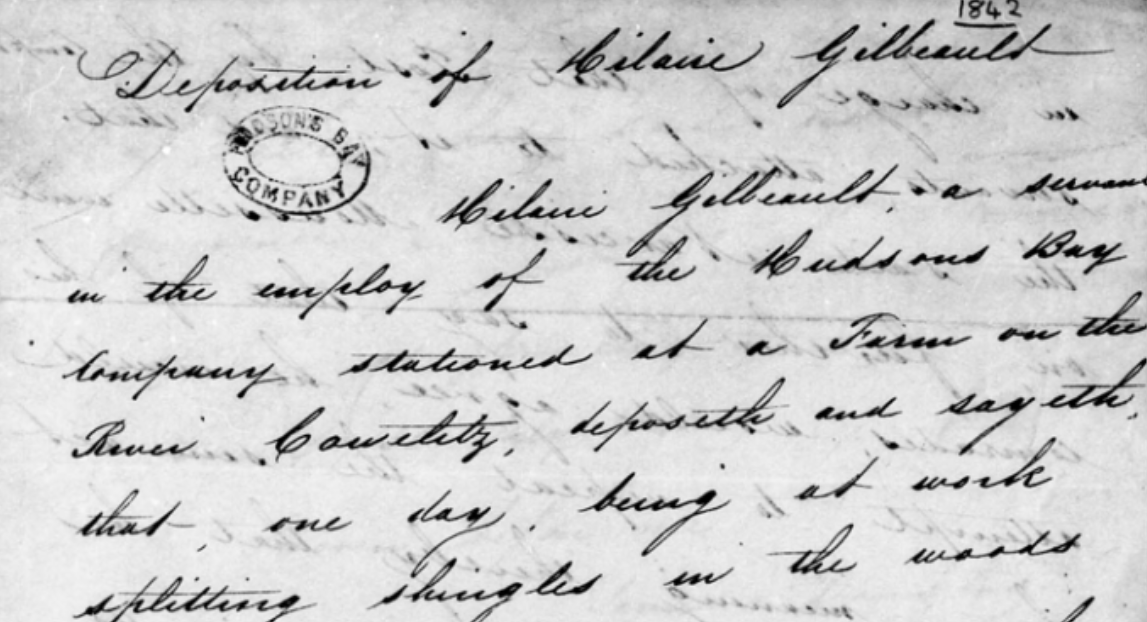
Three things make this document exceptional. First, it is Hilaire’s sworn voice — not a register entry, not a compiled annotation, but his own account of an event he witnessed. Second, it records his moral character under pressure: he rejected the proposal, reproved Moussette, and reported immediately. Third, James Douglas took the oath personally, which signals how seriously the HBC treated this incident. The murder of John McLoughlin Jr. at Fort Stikine in April 1842 — the event Moussette referenced as a model — had shaken the Columbia District. Douglas was not delegating this investigation.
The two men who stood with Hilaire in the woods that day are also named. Narcisse Forcier (also spelled Forceur) filed a corroborating deposition, sworn before Douglas on the same date, that Douglas notes “states to the same effect.” Forcier subsequently appears in French Prairie records as a settler in the same community as Hilaire. Narcisse Moussette, by contrast, does not appear in the Oregon settlement records — his departure from the Cowlitz community after this incident was permanent.
The deposition does not mention Paul Guilbault. But both men were in the Columbia District in July 1842: Hilaire at Cowlitz Farm; Paul, by then a Fort Vancouver boatman settled in the country since 1831, documented in the same Catholic registers where Hilaire would appear within months. They moved in overlapping worlds. The deposition is not the kinship record — B-876 is. But B.47/z/1 is the document that establishes Hilaire as an HBC servant of standing, character, and consequence at the precise moment he was transitioning from company employee to Catholic community member.

The Result
M-2 in the Catholic Church Records of the Pacific Northwest (Vancouver Vol. I) records: on April 21, 1842, at Fort Vancouver, Father Demers presided at the marriage of Hilaire Guilbeau and Louise, Walla Walla by nation, aged about 30 years. The ceremony included a dispensation and the formal adoption, by the groom, of four children belonging to the bride. The names of the four children are not given in the register — a noted gap in the Munnick annotation that has not been resolved in any subsequent record. Witnesses were Jean Baptiste Lajoie and Alexandre Pambrun, both members of the established French Prairie community.
The deposition is dated July 30, 1842 — three months after the marriage. Hilaire was already a married HBC servant, a new stepfather to four children, and a resident of Cowlitz Farm when he walked into the woods to split shingles that day.
B-876 is the record that makes the Gauthier phrase “linked to Paul Guilbault” legible as human history. On January 29, 1843, Father J.B.Z. Bolduc baptized François, legitimate child of Paul Guilbeau and Catherine, Walawala by nation. Godfather: Hilaire Guilbeau. Godmother: Louise Walawala by nation. Neither godparent could sign; both declared not knowing how to write.
This is the only record that places Hilaire and Paul in the same physical space at the same moment. Hilaire named the child. Louise — who had been Walla Walla herself before her marriage to Hilaire — stood godmother for a child born of another Walla Walla woman. The two cousins were bound by godparentage, the formal Catholic bond of spiritual kinship, at the same ceremony where Paul’s son received his name. Nine months earlier, Hilaire had married Louise. Nine months later, Louise stood godmother for Paul’s son. These families were not merely neighbors at French Prairie. They were family, and they had made themselves so deliberately.
The Munnick annotation records: “From 1847 to 1848 he was a laborer at the Cowlitz Farm belonging to the Company. Roberts, manager of the Farm, noted in his journal of September 6, 1847, ‘Carrier pulling down and carters removing Guilbeaus old house to below the hill where it is to be set up again to answer for a stable this winter.’” The Roberts journal entry is one of the few primary sources for this period of Hilaire’s life that names him by action rather than by legal event. He was moving a house. His house was being repurposed as a stable. He was still at Cowlitz, still in HBC employ, five years after the deposition that had named him a man of integrity before James Douglas.
Oregon State Archives records confirm: provisional land grant, Lewis County, Oregon, March 8, 1847, Vol. 4, Pg. 205, Hilaire Guilbeau. He was registered as a property holder in the Oregon provisional government’s land system during the same period he was still employed at Cowlitz Farm. The land grant establishes him as a settler with legal standing in Oregon Territory, not a transient laborer.
Louise Walla Walla’s four adopted children remain unnamed in every surviving record. The M-2 register entry notes their adoption with the phrase “four children of the bride only, names not given, were recorded and adopted by the groom” — Munnick’s summary of the register entry confirms this gap. No subsequent baptism, burial, or marriage record in the St. Paul Mission registers has yet identified any of the four children by name with a parental reference to Hilaire or Louise. This is a documented open question, not an oversight.
Hilaire Guilbault is the researcher’s second cousin four times removed, through the line: Gabriel Guilbault fils (b. 1791, cultivateur, Oka) → Gabriel Guilbault père (b. 1762, voyageur, NWC) → Gabriel Guilbault (b. 1731) → Joseph Guilbault → Pierre Guilbault. Hilaire descends from the same Gabriel (b. 1731) through his son Paul (b. 1761), then Joseph (b. 1786), then Hilaire (b. 1818). The Catholic Church Records of the Pacific Northwest, consulted in parallel research on the Laurent Quintal and Marie Anne Nipissing case study and on Paul “The Canadian,” named Hilaire in the same registers. His case study emerged from the same research session that completed his cousin’s. They died the same year. Their families are buried in the same cemetery. The research that found one found the other.
No HBC servant contract has been located for Hilaire in the HBCA Name File or B-series records. His entry into HBC service in 1838 and his post assignments between 1838 and 1842 are not confirmed in any primary HBCA source beyond the deposition itself. The names of Louise Walla Walla’s four children, adopted at the April 1842 ceremony, remain unknown in all surviving records. No burial record for Hilaire has been identified in the St. Paul Mission register beyond the Early Oregonians Database entry citing his death on June 24/26, 1849.
Explore the Full Methodology →This case study is part of the Storyline Genealogy series on the Guilbault Line and the From Oka to Oregon westward migration. The companion case study documents Hilaire’s first cousin once removed Paul Guilbault, “The Canadian,” whose Oregon life overlaps Hilaire’s at every significant moment. The Catholic Church Records of the Pacific Northwest, consulted in research on the Laurent Quintal and Marie Anne Nipissing case study, are the archive that named both men in the same registers.
The Survivor: How the Research Was Done → The Canadian: Paul Guilbault → The Invisible Voyageur: Paul Guilbault père → From Oka to Oregon →