
Philibert Couillaud dit Roquebrune
Reconstructing a Pioneer Life Across 14.5 Years of Missing Records
The Challenge
Philibert Couillaud was born around 1641 in the diocese of Nevers, Nivernais. He arrived with the Carignan-Salières Regiment in 1665, settled in the Seigneurie de Contrecoeur after his discharge, and died sometime before 8 March 1701. Together with Catherine Laporte dit Saint-Georges, whom he married around the fall of 1675, he fathered eleven children across roughly a quarter-century. Their descendants carry the surnames Larocque, Roquebrune, Larock, Rock and more than a dozen variants.
None of that was easy to establish. Philibert's name appears as Couillaud, Couillaut, Couillat, Coulleau, Caillou, Rocbrune, Rocquebrune, Roquebrune, and Larocque across the documentary record — a shape-shifting identity that made reliable identification a constant methodological challenge.
For generations, some researchers placed Philibert as a son of the alleged noble Bernard de Laroque, connecting him to southern French aristocracy. This lineage was fabricated by Robert de Roquebrune — a twentieth-century novelist and archivist who invented a pedigree for his own family. The fiction persists in online databases. It has no evidentiary foundation. Philibert's actual origins — diocese of Nevers, parents unknown — are recorded in his 1669 confirmation register, where he appears as "Philbert Couilliau de Nevers." That record, made in his own era, is the authoritative statement of origin.
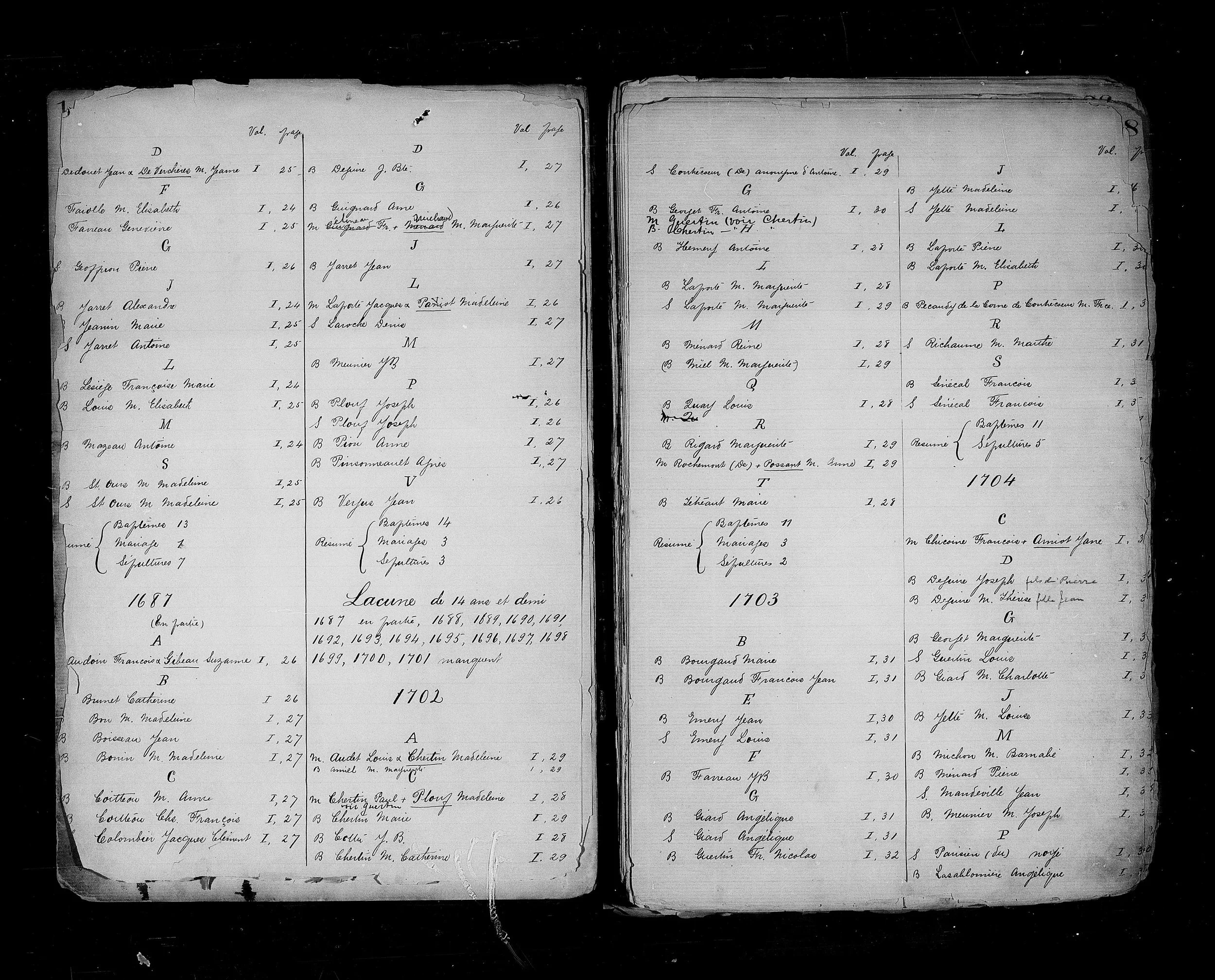
Contrecoeur is one of the few Quebec parishes to lose its registers not once but twice. The first fire — at the home of surgeon Jean Bouvet dit Lachambre, who housed the visiting missionary and kept the registers — destroyed roughly 2.5 years of records (June 1678 through January 1681). A compiler's note in the surviving volume documents this loss explicitly.
The second and far more devastating gap spans 14.5 years: 1687 en partie through 1701 manquent. The register index records each missing year by name. Four of Philibert's eleven children were born inside it — Michel, Marie Hilaire, Philibert fils and Marie Barbe — and their births can only be estimated from ages stated in adult records. Louis, born c. 1679 on the PRDH reading, falls inside the earlier loss instead. Philibert's own death also falls within the second gap.
What remained after the fires was a scattered archive: eight notarial acts across four notaries (one of them now lost), a civil lawsuit, a land auction, a census, five surviving baptism entries across three parishes, and the legal documents generated after Philibert's death by a widow managing at least 413 livres in documented obligations. The marriage contract has never been found. No death record survives. No burial entry marks his passing.
Proving the facts of his life — his origins, his marriage, his children, his death — required assembling this dispersed evidence into a coherent, BCG-compliant evidentiary argument.

The Breakthrough

The Result
Philibert Couillaud arrived in New France as a soldier and left it as a surname. The dit name Roquebrune — toponymic in form, from roc brun, a brown or dark rock — appears first in the 1667 land sale as Rocbrune. It recurs in the 1679 annulment witness, the 1688 obligation, the 1701 lawsuit, and every subsequent legal document as his standard identifier. The abbreviated form Laroque appears as early as 1680, in the hand of Notary Adhémar, on the very concession deed by which Philibert bought his land from the Seigneur de Contrecoeur. The shift toward Larocque was not purely a development of the next generation; it was already present in official notarial usage in his own lifetime. By the following generation it had become the dominant form, and English orthography carried it further: Larock, Roque, Rock, Rockburn, Rockbrune.
PRDH-IGD Family Record #4480 documents eleven children of Philibert and Catherine Laporte. Five have surviving baptism records: Jean-Baptiste (Sorel, 1677), Marie-Anne (Contrecoeur, 1681), Antoine (Boucherville, 1683), Catherine (Contrecoeur, 1685), François (Contrecoeur, 1686). Jean is documented only by the 1681 census. Louis, the researcher's ancestor, falls in the first register loss. Four more — Michel, Marie Hilaire, Philibert fils and Marie Barbe — were born during the 14.5-year gap with no surviving parish documentation.
A competing analysis by research analyst Michel Larocque — unpublished spreadsheets held in the Larocque family archive — proposes thirteen children, adding two unnamed births, one in each register loss, and moving Louis from c. 1679 to c. 1689. His strongest support is not the interval model but the census itself: on the displayed dating Louis should appear in 1681 at age two, and he does not. Against that, Desjardins reads the entry for Baptiste as Louis. PRDH's own note on Louis's record allows a baptism after François's in December 1686 and sets aside the burial age as uninformative, so the two datings are not rival authorities. Neither count can be settled from surviving records. The PRDH enumeration is followed here; both are set out in the methodology.
Reconstructed from the 1667 land sale before notary Bénigne Basset (BAnQ, Greffe Bénigne Basset); the 1669 Chambly confirmation register (PRDH #403509); the 1 December 1675 Contrecoeur chapel construction contract; the 8 September 1679 annulment witness and the 14 February 1680 transport witness (Pierre Mesnard notarial records, Contrecoeur); the 12 February 1680 land concession purchase from the Seigneur de Contrecoeur (Antoine Adhémar, No. 481, BAnQ); the 1681 Census of New France (Library and Archives Canada); the 18 May 1688 notarial obligation before Royal Notary Claude Maugue (ANQ, Montréal); the 1687 Sédillot obligation, lost, documented through the 1701 judgment; obligation No. 3063 to Pierre Lamorche; five surviving baptism registers (FamilySearch); the parish register gap documentation — compiler's note, volume cover, and lacune index (ANQ); BAnQ TL4,S1,D480 (Aubuchon lawsuit, 1701–1707, four pages); BAnQ TL4,S1,D1280 (land auction, 1711, sixteen pages); the 15 October 1728 registration of the dower donation (Archives du District de Montréal); PRDH-IGD Family Record #4480 with individual records for the children; FrancoGene record [16026]; and the analytical birth-date research of Michel Larocque. Examined and rejected: the fraudulent Bernard de Laroque noble pedigree, on the grounds that no primary document supports it and the 1669 confirmation register contradicts it.
Catherine Laporte dit Saint-Georges was baptized at Notre-Dame-de-Montréal on 12 October 1663 and married Philibert around the fall of 1675, the earliest date canon law allowed. She outlived him by some thirty-six years. She kept the Contrecoeur land in production after his death, leasing it to a tenant, and was still drawing a crop from it in October 1707 when the huissier seized the grain. She remarried at Varennes on 9 October 1706 — the register calls her "veuve de feu Jean Couillault," as her son's marriage entry in the same parish had called his father Jean two years earlier; at Varennes, Philibert was written down as Jean. She died at Varennes on 11 April 1737, aged seventy-three — recorded in the burial act as about eighty. Her story is inseparable from his.
The inventory of Jacques Laporte's estate, made at the fort of Contrecoeur on 16 July 1698 and registered on 12 August, lists those present and names "paul Laporte fils, et philibert Couliaux gendre" — Philibert Couillaud, son-in-law. Catherine's father was Jacques Laporte dit Saint-Georges, and the relationship is stated in words in a notarial act. The same inventory describes Jacques's own concession at Contrecoeur as bounded "du costé du sudouest a Celle de Philibert Coulliaux" — adjoining Philibert's land on the southwest.
An engagement of 24 March 1709 before Antoine Adhémar records Philibert's son Louis as living with Louis Laporte Saint-George, son oncle — Catherine's brother, and so Philibert's brother-in-law.
And "Sr george" in the 1688 obligation is Jacques himself. Catherine's own baptism entry of 1663 calls her father "Georges De la Porte dit St Georges"; her son's 1683 baptism calls him Georges; Maugue calls him Sieur George in 1688. Three clerks across twenty-five years wrote the same man's dit name where his given name should have stood. He had a son called Georges, baptized in 1662, but that son was twenty-six and unmarried in 1688 and it is the father's land the inventory places against Philibert's.
The researcher behind this case study is a direct descendant of Philibert Couillaud — his 7th great-granddaughter through the Louis line: Philibert → Louis (c. 1679, West Island / Oka) → Jean Baptiste (1720) → Joseph "Thomas" (1764) → Marie Madeleine Rocbrunes Laroque (1805) → Evangeliste Guilbault (1845) → Elisabeth Emma Guilbault Gilbert (1883) → Thomas Eugene Hamall (1904) → Thomas Kenny Hamall (1932) → the researcher.
This summary presents the case study findings. The full methodology documents each evidence line with complete primary source analysis, document-by-document transcription and evaluation, and archival citations — including the notarial obligations, the Aubuchon lawsuit, the 1711 land auction, the register gap documentation, and the analytical birth-date research.
Read the Full Methodology → Read the Documentary Biography → Access the Complete Research File →