
Born in the Pays d'en Haut
and the limits of what the records will carry
An earlier version of this page identified Joseph Claude Guilbault in three Hudson's Bay Company Archives records. Two of those attributions have been withdrawn on re-examination of the documents themselves, and a third is unresolved. The corrections are set out below rather than removed, because the reasoning that produced the error is more instructive than the error. Every withdrawn claim is recorded in the research log with the document that overturned it.

The Challenge
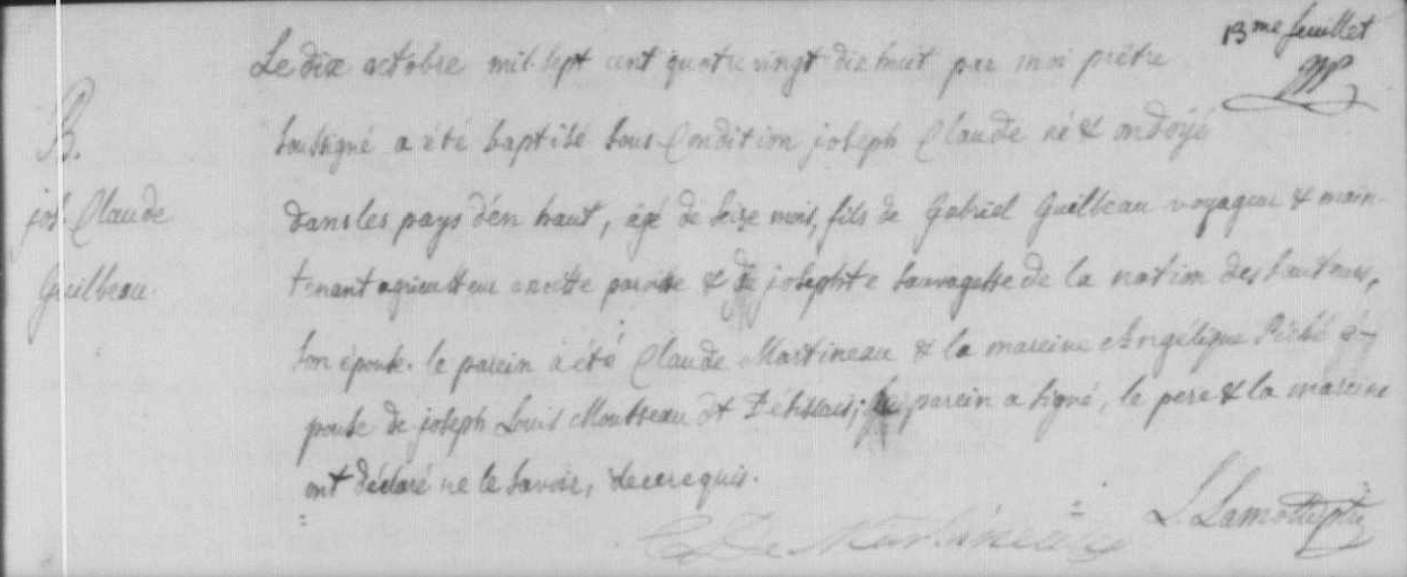
Joseph Claude Guilbault was born in June 1797 somewhere in the pays d'en haut — in the interior fur trade country, before his family came down to the St. Lawrence. His father Gabriel Guilbault was a voyageur. His mother was Marie Josephte Abitakijikokwe, an Anishinaabe woman whose January 1801 baptism at Oka records her as de la nation Sauteuse sur le lac supérieur. Joseph Claude was baptized at St-Paul-de-Lavaltrie on October 10, 1798, at sixteen months of age, and the priest noted the unusual fact: né et ondoyé dans les pays d'en haut. Born and privately baptized in the upper country.
He was one of three children born there — his brother Gabriel and his sister Angélique were carried down from the upper country and baptized beside him that same October day. What set him apart was not where he began but that he alone never settled. Gabriel fils came home to Quebec, farmed, married, and was still calling himself voyageur in the 1851 census at sixty. Angélique married at Rigaud in 1815 and was buried there four years later with her father standing at the grave. Joseph Claude never came back except to die.
The name Joseph Guilbault is not rare in this generation. The extended Guilbault network — centred at St-Paul-de-Lavaltrie and L'Assomption, spreading through the Lanaudière parishes — produced at least five men of the name in overlapping years. Unsourced online trees have attributed the Oka burial to three of them.
- Paul's son Joseph (b. 1786, m. Rosalie Lescault) — eliminated by his children's births. He married at Verchères in 1811, fathered children in Quebec through the 1840s, settled in the Joliette area, and never carries a voyageur designation. He cannot be the man buried at Oka in 1833.
- The nephew Joseph (b. 14 December 1798, son of Joseph Louis) — eliminated by a conception interval. His first child was born 2 December 1820, conceived about March 1820. A man in Lower Canada in March could not have been on the upper Peace River by mid-May, and that is where the 1820 contract once attributed to this family was passed.
The challenge here is not that the records lie. It is that for a man who spent his adult life in the pays d'en haut, the Quebec parish system was not built to document his existence. Parish registers capture baptisms, marriages and burials in Quebec parishes. A man baptized at sixteen months, never married in a Quebec church, and returned to Quebec only to die will leave almost nothing.
The obvious remedy is to go to the archives of the companies that employed voyageurs. That was done. What follows is what was found there, and what it turned out to be worth.
The Evidence
The renewal clause is solid and valuable: it establishes an 1819 engagement that exists and has not been retrieved.
The opening clause is the difficulty, and it decides the case. The contract states the engagé's parish of origin, and on the plate it reads de la paroisse Larivière. Not St-Paul, not Lavaltrie, not L'Assomption, not Joliette. And the deeper problem is that it states a parish at all — the case for Joseph Claude rested on his being the one Guilbault with no Quebec parish identity. A man declaring himself de la paroisse X has one.
The Hudson's Bay Company Archives plates carry a printed prohibition on reproduction. The contract is transcribed rather than displayed, and the reference is given in full so that any reader may order the image directly from the Archives of Manitoba.
The entry names no parents. The PRDH card carries a single rank — age 040, male — with no father, mother or spouse. Every element of it is consistent with Joseph Claude and none of it is probative of parentage. The identification is an argument from convergence of occupation, approximate age, place and timing, and it is offered here as one.

Guilbeau (1798 baptism) · Guilbeault (1833 Oka burial, Red River census) · Guilbault (PRDH family record). The clerks of the fur trade volumes render this family Gibeau, Gibeault, Gilbian and Guilbian on a single page, which is precisely why spelling has been treated here as noise and never used to identify anyone.
The Result
- Born June 1797 in the pays d'en haut, privately baptized there, to a voyageur father and an Anishinaabe mother — stated, 1798 baptism
- Baptized under condition at St-Paul-de-Lavaltrie, 10 October 1798, aged sixteen months, with his brother Gabriel and sister Angélique — stated
- Named as a son, aged four, at his parents' marriage at Oka in January 1801, which legitimized the four children then living — stated
- A Joseph Guilbeault, Voyageur, aged about forty and recently arrived, buried at Oka 31 January 1833 — consistent, parentage not stated
- No Quebec marriage and no children found for him in any parish
No fur trade record has yet been shown to be his. The ledger account is another man's. The 1820 contract names a parish that belongs to no branch of this family. The Red River entry may or may not be compatible with his death. Between October 1798 and January 1833 — thirty-four years, the whole of his working life — there is nothing that can be attributed to him with confidence.
The burial gives environ quarante ans against a documented birth in June 1797 — an overstatement of five years, and the priest hedged it. Set beside the rest of this family it is unremarkable: Gabriel père's 1833 burial gives ninety-three against a documented seventy, an error of twenty-three years; Joseph Morin's 1781 burial gives ninety against seventy-one; Gabriel fils's 1880 burial gives ninety-two against ninety. Four generations, four overstatements, and Joseph Claude's is the smallest of them. A stated age is only as good as the person stating it, and at a burial nobody is stating it.
Louis Pierre Constant Pinesi is Grand Chief Pierre Louis Constant Pinesi (1768–1834), the forenames transposed by a French-language priest. He had been recorded as premier chef of the Algonkins of the Lake of Two Mountains since a petition of July 1798, and in February 1830 the Crown, in the name of Sir James Kempt, formally designated him Grand Chief — a title conferred from outside, on a printed form with the name and date filled in, which added nothing to the standing he already held among his own people. He petitioned the Crown for recognition of Algonkin land rights across four decades and was never answered. He was chief of the bande de la Tourte, and he signed with the mark of a passenger pigeon. He died of cholera at Oka on 13 August 1834 with his wife Marguerite Nipawikwe, eighteen months after standing at this grave, and both were buried the following day.
Simon Kakiuttawelch has not been identified. An earlier version of this page named him as Simon Chawanasiketch, the Grand Chief's son. That identification does not hold: Chawanasiketch's attested renderings are Chawanasiketch, Chawenassiketch, Constant and Pinesi, and Kakiuttawelch is not among them. The 1823 Oka census does list a son as Simon Constant — but the burial gives an Algonkin surname where the census gives a French one, so the two records share only a forename. Simon is not distinguishing here: the Grand Chief's brother was Simon Chimaganich, a chief in his own right, and his son-in-law was the Nipissing chief Simon Kiwekwato. Either would also be a man of standing at such a burial.
What remains is the part that mattered. The phrase depuis peu domicilié en cette mission has always read as the priest barely knowing the man he was burying — and the corrected margin, where he wrote the surname, struck it through and wrote it again, says the same thing. That stands. But the most prominent Algonkin leader in the Ottawa River watershed attended the burial, with a second Algonkin man beside him. A voyageur who arrived at Oka in his last weeks was unknown to the French priest and not unknown to the Algonkin community. That does not require the son.
The extended Guilbault voyageur network — Gabriel, his brother Paul, their first cousin once removed Paul "the Canadian," and the Oregon line that followed — were all in the trade. But every other Guilbault man in it had a Quebec family to return to. Paul père came home to St-Paul-de-Lavaltrie in the autumn of 1821, lent his wages out as secured grain annuities, and was buried there in 1831 as cultivateur. Their Quebec identities were intact.
Gabriel was the only one who took an Anishinaabe wife and had children in the pays d'en haut. Joseph Claude is the consequence, a generation on. He had no Quebec household to return to because he had never really had one.
He is often said to have come home to his mother's community. That needs stating carefully. Marie Josephte was baptized and married at Oka in January 1801, is described as de cette mission in January 1802, and buried two of her children there. But by 1806 the family is recorded in the seigneurie d'Argenteuil, and she was buried at Ste-Madeleine-de-Rigaud on 25 June 1813, her husband present and styled mari de la défunte. When her son was buried at Oka in 1833 she had been dead twenty years and gone from that mission for nearly thirty. It was a community she had belonged to. It was not one she was waiting in.
When Gabriel Guilbault père was buried at Saint-Benoît on April 8, 1833, the register called him journalier du lieu — a day labourer of the place. He had been a maçon in the Rigaud and Argenteuil records from 1802 through 1815; by the end he was a labourer in the parish where he died. His brother Paul died in 1831 at Saint-Paul-de-Lavaltrie: cultivateur. Different endings, but both men had a Quebec place and a Quebec trade to be recorded by.
Joseph Claude died on January 29, 1833 — ten weeks before his father, and about ten miles from him. There is nothing in the record to say whether either knew of the other's death, and the closeness makes that silence harder to explain rather than easier. When Durocher recorded the burial he wrote one occupation word, Voyageur, because it was the only identity the man had brought to Oka with him. Whether the trade records will ever show us that work is a question this page cannot yet answer.
Joseph Claude Guilbault was my 3rd great-granduncle — the brother of Gabriel Guilbault fils (b. c. June 1790), my direct ancestor through the line: Gabriel & Marie Josephte → Gabriel fils → Evangéliste Guilbault (1845) → Elisabeth Emma Guilbault (1883) → Thomas Eugene Hamall (1904) → Thomas Kenny Hamall (1932) → Researcher. He and Gabriel fils were both born in the pays d'en haut to the same Anishinaabe mother. Gabriel fils came home. Joseph Claude did not. I have had to take a good deal off this page, and what is left is thinner and truer. The records of a man who lived outside the system that kept records are supposed to be thin. Filling that thinness with documents that turn out to belong to someone else is the error this correction exists to undo.
This summary sets out what the records establish and what they do not. The full methodology page documents each source with complete transcription and source evaluation, together with the reasoning that withdrew two identifications previously published here and the tests that eliminated the competing candidates.
Read the Full Methodology → Case Study: The Voyageur Years — Gabriel → Case Study: Who Was Paul Gibeau? — Paul → Read the Documentary Biography →