
The Woman at the Grave
Across Four Colonial Spellings

The Challenge
On April 4, 1801, Father Leclercq buried two-year-old François Guilbault in the cemetery of the Oka mission. The child was the son of Gabriel Guilbau and Marie Josephte Abitakijikok8e — a French-Canadian man and his Saulteaux wife from Lake Superior. Present at the burial were Gabriel Guilbau, brother of the deceased, and a woman the priest recorded as catherine messenepik8e. The typed transcription of the register reads her name as Catherine Nesepik8e. Both witnesses declared they could not sign their names.
That single appearance — six words in a burial register — was the only record linking Catherine to the Guilbault-Abitakijikokwe family. She was not identified as a relative. She was not given a surname. PRDH indexes only the child and his parents, so she appeared in no index, no genealogical database, no published research connecting her to any known individual. She was, in the language of archival research, a dead end.
The challenge facing any researcher working with Indigenous names in Quebec mission records is compounded by a fact that undermines the most basic tool of genealogical research: name-based searching. Colonial priests rendered Indigenous names phonetically, and no two priests heard the same sounds the same way. A name that one priest wrote as Messinebik8e might become Missinebik8e in the hand of the same priest two years later, and messenepik8e when a different priest encountered the same woman — and a modern typescript might then misread it again as Nesepik8e. The "8" in missionary orthography represents the sound ou or w, making these names phonetically closer than they appear on the page — but not close enough for any search algorithm to link them.
The additional complication is that the same woman might appear under a French surname in one parish and her Indigenous name in another. At Longue-Pointe, near Montreal, a priest might record the French surname used in town. At Oka, a mission priest accustomed to Indigenous parishioners might record the full Algonquian name. The same person thus occupies two entirely separate identity profiles in the archival record — and neither profile knows the other exists.
One element of Catherine's name was legible across every variant: the ending. The ending -bik8e, -pik8e, or -bikwe recurs in every rendering. In Algonquian languages — Ojibwe, Algonquin, Ottawa, Nipissing — the morpheme -kwe or -ikwe means "woman." It is the same ending carried by Marie Josephte Abitakijikokwe, the Saulteaux mother of the child being buried. Two women, both carrying Algonquian names ending in the feminine marker, standing at the same grave in the same mission. The suffix told the researcher that the witness was not Iroquois, not French — she was Algonquian, from one of the nations that shared that linguistic root.
The question was not whether Catherine was Indigenous. The question was whether she could be found again — in other records, under other spellings, in a form that revealed who she was, where she came from, and why she stood at the burial of a Guilbault child in 1801.
The Oka mission at Lac-des-Deux-Montagnes served three distinct Indigenous communities: Mohawk (Iroquois), Algonquin, and Nipissing, alongside a growing number of French-Canadian families connected through the fur trade. The mission registers from this period contain dozens of Indigenous names using the "8" orthography, each rendered differently by each priest. Father Malard, who served the mission through the late 1790s, and Father Leclercq, who wrote the 1801 entry, each had their own rendering habits. Searching for Catherine required examining every entry by both priests, comparing handwriting across years, and — crucially — abandoning name-based searching in favor of a methodology built on linguistic analysis, geographic proximity, and temporal overlap.
The Breakthrough
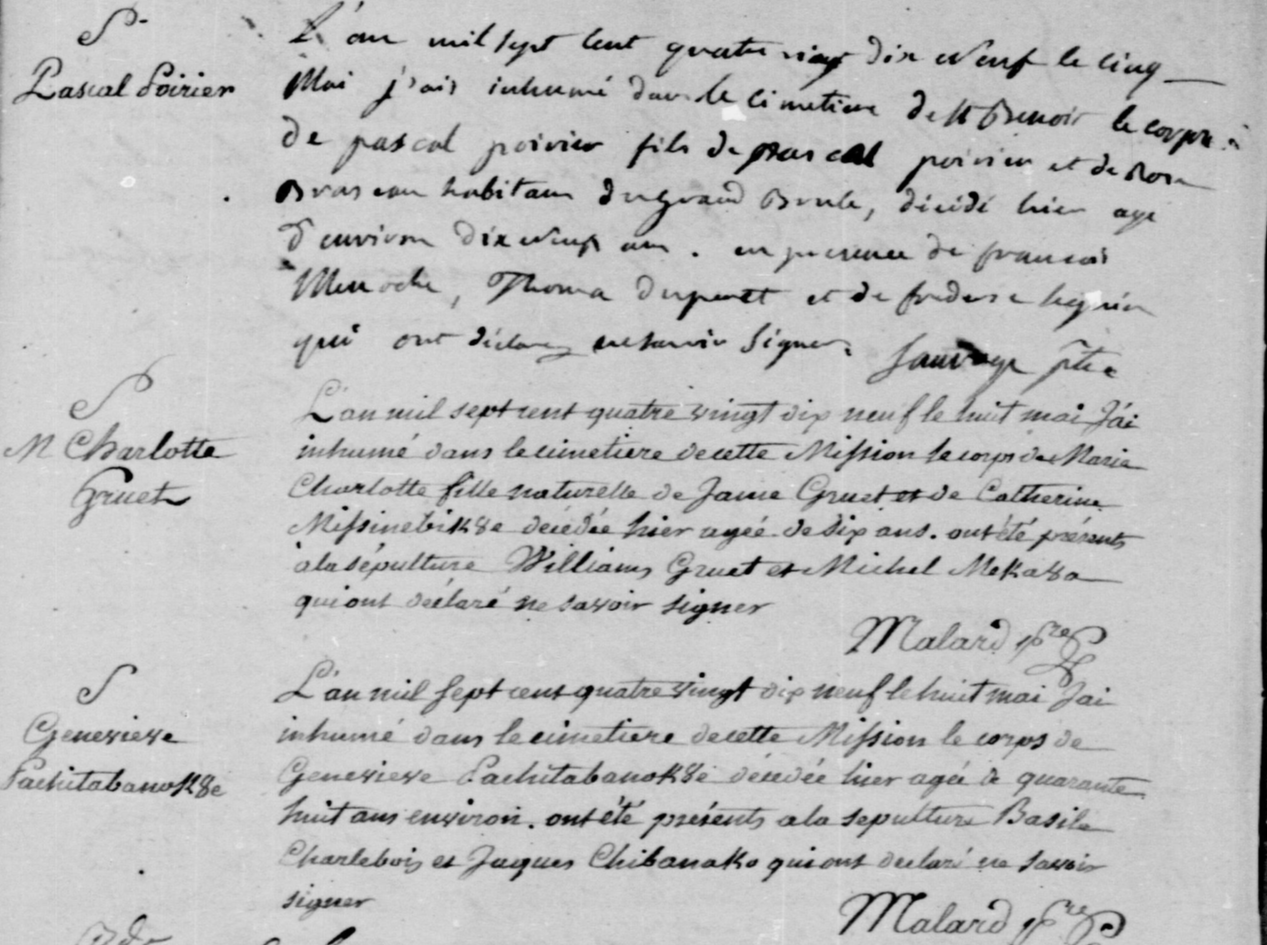
Catherine madore
Father Girouard — Longue-Pointe, 27 Oct 1793 — PRDH #650339, #650340
Catherine Messinebik8e
Father Malard — Oka, 16 Oct 1797
Catherine Missinebik8e
Father Malard — Oka, 8 May 1799 — PRDH #773817 (normalized: MISSINEBIKOUE)
catherine messenepik8e
Father Leclercq — Oka, 4 Apr 1801 — original register (typescript: Nesepik8e); not indexed in PRDH #2752515
The identification does not rest on any single spelling match. It rests on the convergence of four evidentiary streams. First, the Algonquian ending -bik8e / -bikwe is preserved across every variant, by every priest, in every record — it is the constant beneath the variations. Second, the geographic placement is consistent: all records originate at Oka or in the immediate Montreal orbit, within the same small mission community. Third, the temporal overlap is exact: Catherine Missinebik8e was burying her own daughter at Oka in May 1799; catherine messenepik8e was witnessing the burial of a neighbor's child at the same mission cemetery less than two years later. Fourth, the social context is coherent: both the Gruet-Messinabikwe family and the Guilbault-Abitakijikokwe family were French-Indigenous unions at Oka, both were raising and losing children in the same mission, and Catherine's presence at François Guilbault's burial suggests the kind of intimate community connection — godmother, neighbor, elder — that characterized mission life.
The standard genealogical tool — name-based searching — fails here entirely. No search algorithm would link madore, Messinebik8e, Missinebik8e, and messenepik8e as the same person. The methodology that succeeds is the one this case study documents: Algonquian linguistic analysis combined with geographic, temporal, and social context analysis. It is a replicable approach for any researcher working with Indigenous names in colonial mission records.
The Result
Catherine Messinabikwe (also rendered Messinebik8e, Missinebik8e, messenepik8e, MISSINEBIKOUE in PRDH, and under the French surname Madore) was an Ottawa (Odawa) woman, identified as Odaawak in genealogical records compiled from the parish evidence. Her origins are traced to Michilimackinac — the strategic hub of the Great Lakes fur trade at the straits between Lake Michigan and Lake Huron — where French-Canadian voyageurs and Indigenous nations intersected in the networks of commerce, kinship, and cultural exchange that defined the pays d'en haut.
She formed a customary union (mariage à la façon du pays) with Jacques Gruet, also known as James or Djan Grouet, a French-Canadian man born around 1770. Their children were born across the fur trade geography: Guillaume was born in Wisconsin in January 1789; Anne Marie Catherine was born in the same region around 1787. Both were baptized conditionally at Longue-Pointe in October 1793. By 1797 the family was at the Oka mission, where their younger children were baptized and, in one case, buried.
At Oka, Catherine and Jacques were part of a small but significant community of French-Indigenous families living alongside the Mohawk, Algonquin, and Nipissing residents of the mission. The registers of these years were kept by several priests — Malard, Leclercq, and a Father Sauvage among them — and every page carries the mix of languages, nations, and naming conventions that characterized mission life. On the same register page as François Guilbault's burial, entries record the burial of Agathe Françoise (an Iroquoise), the baptism of Elizabeth (daughter of Ignace Karetton and Catherine Kangankob8en, Iroquois), and the burial of Catherine (an elderly Iroquoise of about 80 years) — a snapshot of the multi-nation community in which Catherine Messinabikwe lived.
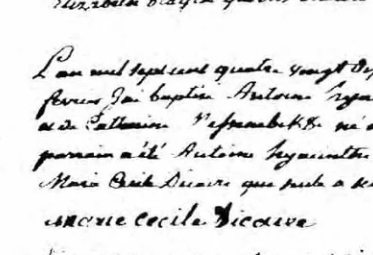
Catherine buried her own ten-year-old daughter, Marie Charlotte, at the Oka mission cemetery in May 1799. Less than two years later, she stood at the burial of two-year-old François Guilbault — the child of another Indigenous woman in another French-Indigenous union at the same small mission. The parallel is exact: two women from different Great Lakes nations, one Saulteaux from Lake Superior, one Ottawa from Michilimackinac, both navigating life at the colonial mission, both burying children in the same cemetery, both carrying Algonquian names that ended in the same feminine suffix and were written differently by every priest who wrote them down.
Documented from: PRDH-IGD, Burial #773817, Oka (L'Annonciation), 8 May 1799 (Marie Charlotte Gruet, mother: Catherine MISSINEBIKOUE); PRDH-IGD, Burial #2752515, Oka, 4 April 1801 (François Guilbault; parents only indexed — the witness appears in the register as catherine messenepik8e); PRDH-IGD, Baptism #650339, Longue-Pointe, 27 October 1793 (Guillaume Grouet, mother: Catherine MADORE); PRDH-IGD, Baptism #650340, Longue-Pointe, 27 October 1793 (Anne Marie Catherine Grouet, mother: Catherine MADORE); Parish Registers, L'Annonciation-de-la-Bienheureuse-Vierge-Marie, Oka, Deux-Montagnes, 16 October 1797 (Baptism of Charlotte and Marie Therese, mother: Catherine Messinebik8e); Library and Archives Canada, MG 8, G 21, Volume 2, Registres de la paroisse de l'Annonciation, Oka, 1786–1806, original manuscript pages, and Cadieux typescript.
Catherine Messinabikwe and Jacques Gruet's children became founding members of Western Canadian Métis communities. Their son Antoine Hyacinthe Grouette, baptized at Oka on February 14, 1798, lived until 1885 and is recognized as a patriarch of the Grouette Métis line. Their daughter Anne Marie Catherine married François Xavier Oronhiatkhat, a Mohawk man at Oka, bridging the Ottawa and Iroquois communities at the mission. The family's trajectory — from Michilimackinac to Wisconsin to Montreal to Oka to the Red River and beyond — traces the full arc of the fur trade diaspora that reshaped the demographics of the Great Lakes and Western Canada.
The identification of Catherine Messinabikwe in the 1801 burial record connects two family lines — the researcher's Guilbault-Abitakijikokwe ancestry and the Grouette Métis founding family — across the same small mission cemetery where both families buried their children. It is a connection that was invisible in every genealogical database, unlinked in PRDH, and unsearchable by any conventional method. It required the methodology this case study documents: linguistic analysis of Algonquian name morphology, systematic comparison of priestly handwriting across records, and the recognition that name-based searching is the wrong tool for identifying Indigenous individuals across colonial records.
The researcher behind this case study is a direct descendant of Gabriel Guilbault and Marie Josephte Abitakijikokwe — their 4th-great-granddaughter through the line: Gabriel & Marie Josephte → Gabriel Guilbault fils (1791) → Evangeliste Guilbault (1845) → Elisabeth Emma Guilbault Gilbert (1883) → Thomas Eugene Hamall (1904) → Thomas Kenny Hamall (1932) → Researcher. Catherine Messinabikwe stood at the grave of a child in this direct line. Identifying her — naming her — is an act of recovery: restoring to the historical record an Indigenous woman whom the colonial archive rendered invisible through its own inconsistency.
This summary presents the case study findings. The full methodology documents each record with complete primary source transcriptions, paleographic analysis of priestly handwriting, Algonquian linguistic notes, and the four-stream convergence logic — linguistic, geographic, temporal, and social — that confirmed Catherine's identity across four colonial spellings in five records.
Read the Full Methodology → Documentary Biography: Gabriel Guilbault père → Marriage à la façon du pays →