Case Study · The Guilbault Line

The Voyageur Years

Documenting Gabriel Guilbault in the
North West Company Records, 1816–1821
How five account books in the Hudson's Bay Company Archives — found across two search platforms — transformed a parish record label into a documented five-year journey from the pays d'en haut to the Athabasca, wages earned, dissolution payments settled, and a brother working alongside him all along
1 8 1 6   –   1 8 2 1
5 Years of NWC Employment Documented
5 HBCA Volumes — Two Platforms Required
188 Livres — The Linking Balance

Primary Sources: Hudson's Bay Company Archives · Archives of Manitoba  |  130–200 Vaughan Street, Winnipeg, Manitoba  |  HBCA Series F.4 — North West Company Records  |  Ancestry · Canada HBC Corporate and Employment Records, 1766–1926

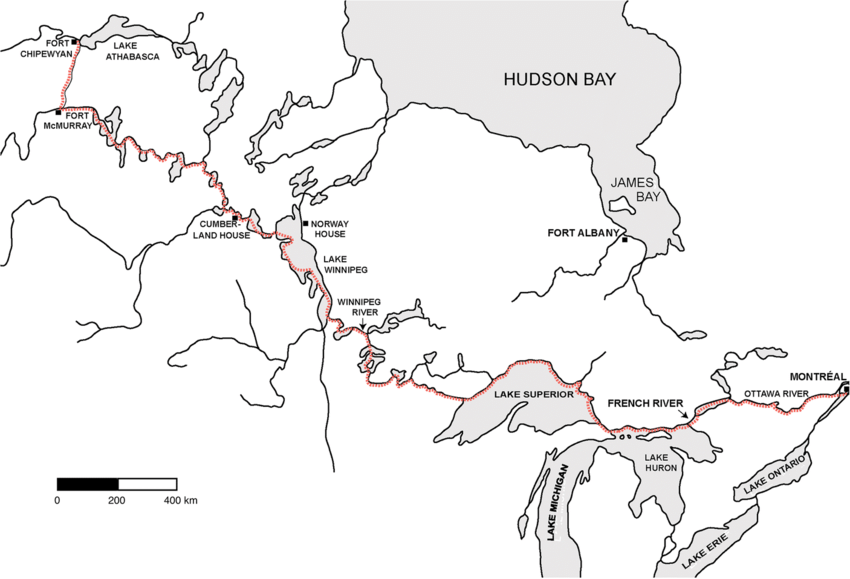
Map of the Voyageurs Highway — the 3,000-mile fur trade route from Montreal to Fort Chipewyan, traveled by Gabriel Guilbault as a North West Company voyageur between 1816 and 1821

The Challenge

The parish records called him a voyageur. They did not say where he went, whom he worked for, what he earned, or how long he stayed. The label described an entire way of life — and documented almost none of it.

Gabriel Guilbault père was born at L'Assomption in 1762. By October 1798, when his children received emergency baptisms at Saint-Paul-de-Joliette, his occupation was recorded as "voyageur et maintenant agriculteur" — voyageur, and now farmer. The voyageur years were behind him. Or so the priest assumed.

They were not. By 1816, Gabriel was back in the pays d'en haut — at fifty-four years of age. His wife Marie Josephte Abitakijikokwe had died at Rigaud in June 1813. He remarried in February 1815. And then, at an age when most men of his era were aging into their final decade, Gabriel Guilbault returned to the North West Company.

The Documentation Gap

Parish records label Gabriel as a voyageur across multiple decades, but they do not document where he worked. They record baptisms, marriages, and burials — not canoe routes, trade contracts, or account balances. The gap between Marie Josephte's death in June 1813 and any specific documented context spans more than seven years. During this time, he remarried, fathered children, and returned to the interior trade.

The Platform Problem

Finding Gabriel in the NWC account books required not one archive search but two independent platforms — and they did not return the same results. The HBCA Name Index, the searchable database at the Archives of Manitoba, identified Gabriel in three volumes under phonetic name variants. But two additional volumes documenting his 1821 dissolution payments — F.4/43 and F.4/45 — appeared only through Ancestry's separate indexing of the same collection, where his name was rendered as Guilbeau and, in one entry so phonetically degraded it defies surname searching, Gulbiau.

Neither platform alone gives a complete picture. A thorough search of this collection now requires both platforms and a willingness to search under first name alone across hundreds of results.

The Two Pauls Problem

The NWC Name Index also identified a second man — Paul Guilbeau — working at the same posts in the same years. Establishing who Paul was, and distinguishing him from a second man also named Paul Guilbault in the same records, required tracing five volumes and the Quebec parish system. The resolution came from the NWC's own dissolution ledger, which placed the two Pauls eight entries apart on the same page — with different surname spellings and different wage figures — making the disambiguation visible to anyone who looked.

The Post-1821 Question

The 1821 merger restructured the entire interior fur trade. What happened to Gabriel after the merger? The 336-livre credit balance in his Athabasca account was his to claim. The dissolution payment records in F.4/43 and F.4/45 show 610 livres — the gross wage figure at the dissolution stage, before the Lachine deductions that produced the net 336. His final accounting is documented across three volumes at two accounting stages.

HBCA F.4/43 — NWC Pays 1821, August 31 — Gabriel Guilbeau 610 livres in the NWC dissolution payment list, found only through Ancestry's indexing of the same HBCA collection

The Breakthrough

Five volumes, two platforms, three accounting stages. The 188-livre linking balance carries forward from Lac La Pluie to Athabasca. The 610-livre figure appears independently in two dissolution payment volumes. The disambiguation of two Pauls is settled by the NWC's own final ledger.
1. F.4/29 — Lac La Pluie Blotter, 1820
Geographic placement and the linking balance established Strong Gabriel Guilbault at Lac La Pluie (Rainy Lake). Purchases: capotes, tobacco, gun flints, soap. Balance: 188 livres. Transfer notation: "To Atha—" — abbreviated for Athabasca. This 188-livre figure must appear identically in F.4/37 to confirm the same individual across two geographically separate posts.
2. F.4/37 — Athabasca General Blotter, 1820–1821
Identity confirmed by balance match; settlement documented Strong Gabriel appears as Gilbian Gabriel at reference 100. His account carries the debit: "To Sundries at Lac la Pluie — 188." Identity confirmed across two volumes. Wages: 450 livres. Final balance after all debits — including 90 livres for 3 pints of rum: 336 livres. SETTLED.
3. F.4/32 — NWC General Ledger, Folio 414
Continuous employment 1816–1821; family in the same volume Strong The main NWC General Ledger documents Gabriel's continuous five-year NWC employment from 1816 through the merger. His son Joseph Claude appears at p.403 of the same volume; his brother Paul at p.396 — father, son, and uncle in the same bound ledger within eighteen pages of each other.
4. F.4/43 — NWC Pays 1821 · August 31 (Ancestry only)
Dissolution payment confirmed; return route established Strong Found only through Ancestry — not surfaced by the HBCA Name Index. Heading: NorthWest Company Pays 1821 Cont., dated August 31, 1821 — a dissolution payment list for the full returning workforce as brigades came down through Lachine from the interior. Gabriel Guilbeau — 610 livres. His August 31 presence places him on the return canoe route at exactly the right time for a man who wintered in Athabasca. The 610 figure is the gross wage at the dissolution payment stage, before the Lachine deductions that produced the F.4/37 net balance of 336.
5. F.4/45 — NWC Balances 1821 (Ancestry only)
610-livre figure independently confirmed Strong Also found only through Ancestry. Gabriel Guiltheau — 610 livres. Same figure as F.4/43, confirmed independently in a second dissolution volume. Two volumes recording the same amount rules out transcription error. Gabriel is now documented in five F.4 volumes across the full span of his NWC employment.
The Two Pauls: Resolved by the NWC's Own Ledger
F.4/46 and F.4/47 — both Pauls on the same pages Resolved Two men named Paul Guilbault appear in the same NWC records: Gabriel's brother Paul Guilbault père (b. 1761) and Paul Guilbault "The Canadian" (b. 1798, Lavaltrie) — second cousin once removed of Gabriel's line through their common ancestor Charles Guilbault × Catherine-Antoinette Deguise Flamand (1727, PRDH Family #15831).

F.4/47 — North West Balances 1821 — places both men eight entries apart on the same dissolution page, under different surname spellings:

  • Gibeau Paul: 500 wages / 617.14 balance — Paul père, Gabriel's brother. Matches his F.5.3 NWC contract (500 livres) and his F.4/37 settlement (617.14) exactly.
  • Guilbeau Paul: 350 wages / 96 balance — Paul "The Canadian." Matches his F.4/32, p.396 account exactly.

The NWC's own dissolution ledger distinguished them with different surname spellings. The disambiguation that required five volumes to establish was built into the company's accounting all along. Paul Guilbault père's identity as Gabriel's brother is confirmed through seven Quebec parish documents. Paul "The Canadian" is Gauthier Entry #57 — HBC 1821–1840, linked to Hilaire Guilbault and the Oregon settlement.

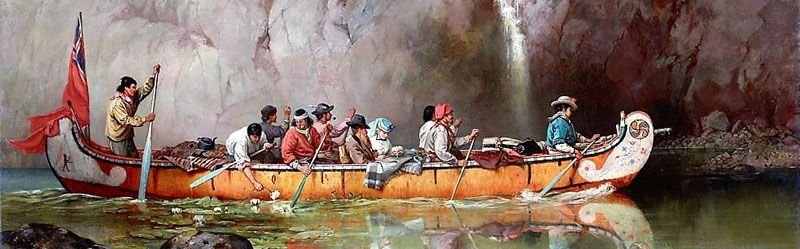
Frances Anne Hopkins, 'Voyageurs in a Canoe,' 1869 — depicting the interior fur trade canoe travel that Gabriel Guilbault undertook as a North West Company voyageur between 1816 and 1821

The Result

Five account books. Two search platforms. One man's complete NWC career — from the first blotter entry in 1816 to the dissolution payment in August 1821 — confirmed by a 188-livre balance, corroborated at three accounting stages, and accompanied throughout by his brother.
What the Records Establish

Gabriel Guilbault was continuously employed by the North West Company from 1816 through the 1821 merger — five years documented across five HBCA volumes in two search platforms. His route: Lac La Pluie to Athabasca. Athabasca wages: 450 livres. Net balance after post deductions: 336 livres. Gross wage figure in the dissolution payment records: 610 livres. His account was formally settled — and he was back at Lachine by August 31, 1821, in the same dissolution payment list as the Indigenous voyageurs who had paddled with him.

He was fifty-four to fifty-nine years old during this service. His brother Paul, born 1761, was working alongside him. Together they appear in three of the same five volumes. The fur trade pattern of family-based recruitment, operating invisibly in the Quebec parish records, is directly visible in the NWC account books.

The Platform Finding

The methodological discovery is as significant as the archival one. The HBCA Name Index and Ancestry's indexing of the same collection are complementary, not equivalent. The HBCA index found Gabriel in three volumes. Ancestry found him in two additional dissolution volumes under spellings the Name Index does not surface. Three searches are now standard for any thorough HBCA research: the HBCA NWC Account Books Name Index; the HBCA Servants' Contracts Index; and Ancestry's HBC Corporate and Employment Records using first-name and surname variant searches.

The Occupation Arc in Full

In October 1798, a priest recorded "voyageur et maintenant agriculteur." By 1802, the Oka records called him maçon. From 1816 through 1821, five NWC volumes document him in the pays d'en haut. When Gabriel died at St-Benoît on 8 April 1833, the register recorded: maçon. The mason's trade, not the voyageur's paddle, was how the parish remembered him. His son Joseph Claude, born in the pays d'en haut to his Ojibwe wife, was buried five months earlier at Oka — recorded by that priest as what he had always been: Voyageur.

Open Research Questions

Gabriel's movements between the August 1821 dissolution payment and his 1827 Ottawa River land acquisition remain undocumented. The origins of Marie Josephte Abitakijikokwe — "de la Nation Sauteuse sur le lac Supérieur" — remain the research frontier for the family's Ojibwe line. And whether José Gilbeau (A.32/30, fo.192, 1821, Fort Chipewyan, George Simpson) is Gabriel's son Joseph Claude — a promotion from devant to gouvernail at the merger — is an open hypothesis pending the 1819 original HBC contract.

Researcher's Note

The researcher behind this case study is a direct descendant of Gabriel Guilbault and Marie Josephte Abitakijikokwe — their 4th-great-granddaughter through the line: Gabriel & Marie Josephte → Gabriel Guilbault fils (1791) → Evangeliste Guilbault (1845) → Elisabeth Emma Guilbault Gilbert (1883) → Thomas Eugene Hamall (1904) → Thomas Kenny Hamall (1932) → Researcher. The NWC records document the working life of a great-grandmother's great-great-grandfather — a man who was paddling the Athabasca route while his Quebec family waited, four generations before her birth.

Companion Case Studies

Gabriel's brother Paul Guilbault père is documented in the same five volumes — his identity, his service, and his probable encounter with Lieutenant John Franklin. Gabriel's son Joseph Claude, born in the pays d'en haut, paddled the same interior routes and died as Voyageur at Oka in 1833.

The Invisible Voyageur: Paul Guilbault père → Born in the Pays d'en Haut: Joseph Claude →