
Four Men Named Morin

The Challenge
In 1668 the colonial administration listed the soldiers of the Carignan-Salières Regiment who had chosen to become inhabitants of Canada. Nine handwritten pages, roughly four hundred men, arranged by company. It survives at Library and Archives Canada and is freely available.
On page eight, under the heading Naurois, the first name written is Pierre Morin.
That entry is unusual. Of the ten soldiers in the company, he is the only man the clerk named in full. The others appear by nom de guerre — Sᵗ Surin, Rencontre, La Prairie, Chastelleraud, Le Picart — or by surname alone, or, in one case, by a given name and nothing more. The clerk had no consistent method. He wrote what he had.
So the roll gives a full name where it usually gives a fragment. What it does not give is an age, an origin, a parentage, or any other means of telling one Pierre Morin from another.
Peter J. Gagné's From Soldiers to Settlers (2025) devotes four consecutive entries to men of this surname in the regiment.
| Name | Company |
|---|---|
| Morin, [Unknown] Officer, killed in a Mohawk ambush near Fort Sainte-Anne, 19 July 1666 | Unknown |
| Morin, Charles c. 1641–1704. A miller, from the diocese of Poitiers. Married a Fille du Roi in 1667 | Chambly |
| Morin dit Larose, Nicolas Named as a soldier of the company by notary Vachon, October 1667 | Chambly |
| Morin, Pierre c. 1643–after 1681. Diocese of Saintes, parents unknown. Habitant of Lachine by 1681 | Naurois |
There is no fifth entry. The most recent specialist study of the regiment considered the man who married Catherine Lemesle and excluded him from it, with the line: "Not the Pierre Morin who married Catherine Lemesle in 1672."
Morin was among the most common surnames in seventeenth-century France, and Pierre among the most common given names. A further Pierre Morin dit Boucher (1634–1690) lived in Acadia in the same decades and has been conflated with ours for generations. Four in one regiment is not an anomaly. It is what the name rate predicts.
The Investigation
Michel Langlois assigns the roll's Pierre Morin to our Pierre — son of Jacques Morin and Hilaire Guéry of Saint-Étienne-de-Brillouet, husband of Catherine Lemesle. He states his reasoning openly: the man's connections with the soldiers Lariou and Trotain, and his place of residence.
Gagné assigns the same line to a man born about 1643 in the diocese of Saintes, and names our Pierre as the exclusion. His reasoning is not spelled out, but the chain appears to run from the roll, to the Chambly confirmation of May 1668 where a Pierre Morin gave his origin as Xainctes, to Saintes.
Jack Verney's reconstruction of the company (1991) names a Pierre Morin and gives no origin, no dit name, and no disambiguating note. He cannot corroborate an identification he does not make. The SFRSC lists "Morin, Pierre — soldier — La Noraye" without publishing its basis; a query is outstanding.
No individual is linked to the roster entry in the PRDH's transcription of the roll. Witnesses in other acts of the same period are likewise unlinked, so this may reflect a cataloguing convention rather than a judgment — a distinction worth preserving, since reading intent into a silence is the error this case study exists to describe.
Both readings lean on one event: the marriage of François Trotain at Notre-Dame-de-Québec, 16 August 1668, where a Pierre Morin appears as a witness. Trotain was a La Noraye soldier — his marriage contract, drawn three days earlier by the notary Rageot, names him explicitly as Soldat de la Compagnie du Sr de Norrouest.
- The contract names Trotain's company and gives Pierre Morin no occupation, no residence, no company, and no stated relationship. He appears among the groom's amys.
- A co-witness at the church ceremony was Jean Mouflet, a soldier of the La Varenne company. The witness group is mixed, not a company cluster.
- Gagné records his Pierre as witnessing the marriages of both Trotain and Alexandre Téchenay. These are two separate entries on the same register page. Morin witnessed the first; the witnesses to the second were Trotain, Antrade, de Fay and Larion. Téchenay was from Gascony, not Saintes.
- Gagné places his Pierre at the Petite Rivière by a June 1672 house purchase from Jean Mérienne and Barbe Baron, citing the notary Becquet. The act is not in Becquet's greffe. It is in Rageot's, as act 870 of 3 June 1672 — the day before act 871, the marriage contract of Pierre Morin and Catherine Lemesle, and witnessed by Pierre Bodin. See The Notarial Record below.
The contract does establish one thing about the man, whoever he was. At the close, the bride and the groom's friends declared that they did not know how to sign. Pierre Morin was among them.
Langlois's second ground was place of residence — and here the record has moved a long way since this page was written. The 1681 census places the family at Petite Auvergne, a côte on the rivière Saint-Charles, not in the Basse-Ville of Québec as previously published. Their immediate neighbour was Pierre Bodin, witness to their 1672 marriage banns and godfather to their daughter in 1685. The household of Jacques Hédouin and Jeanne Brassard, on the same côte, supplied two further godparents.
That much was inference from a godparent network. The notarial record now states it outright. In June 1676 Rageot describes the man selling the Morin habitation as habitant demeurant à la petite Rivière St Charles, and in 1690 still as habitant de la petite Rivière. The Petite Rivière of the 1672 banns is the Québec one, named in an act rather than deduced from neighbours.
The whole social world this site had placed on the Côte-de-Beaupré was in fact beside Québec. That corrects the family's residence securely — and it dissolves the census corroboration the old case study relied on, while replacing it with something better.

The Unresolved Question
Pierre Morin was born about 1648 in the parish of Saint-Étienne-de-Brillouet, in the diocese of Luçon, Poitou, son of Jacques Morin and Hilaire Guéry, both dead before he married. He could not sign his name. He married Catherine Lemesle, a Fille du Roi from Rouen who could not sign hers, at Notre-Dame-de-Québec on 13 June 1672. They had eight children and raised five to adulthood on the côte of Petite Auvergne, among neighbours who stood godparent at their font. He died at the Hôtel-Dieu de Québec on 12 December 1706. Catherine was discharged from the same hospital eight days later, and outlived him by at least fifteen years.
He took his first land from the Religieuses Hospitalières on 29 July 1670 — two parcels of two arpents' frontage on the rivière Saint-Charles, in the seigneurie of Saint-Ignace — and held ground there for the rest of his life, paying his seigneurial dues in eight consecutive years between 1683 and 1690. In 1675 he took a second holding across the river in the seigneurie of Lauzon, in partnership with the neighbour who had stood beside him since the beginning. He bought and sold four more times, settled a boundary line in 1682, and in March 1690 contracted with a partner to build a house — described in that act, for the only time in any record, as a carpenter. The PRDH's individual card leaves the occupation field empty because the parish registers carry no trade. The notarial archive does.
His parish of origin is stated in four separate documents across thirty-four years: the 1672 marriage contract, both copies of the 1672 banns, the 1706 hospital register, and the 1706 burial register.
Those four documents are four independent records. They are not four independent informants. Each traces to Pierre or his household telling a scribe where he came from. No French register has ever been located to verify it — the Fichier Origine, which admits an immigrant only once a French document has been found, carries no record for him. Nor does it for his rival. Neither man's origin rests on a document from France. Consistent self-report across thirty-four years remains far stronger than a single uncited database field, but it should be described accurately.
That he was a soldier. No record of his life uses the word soldat — not the marriage contract, not the banns, not the parish register, not the census, not the eight notarial acts, not the hospital admission, not the burial.
The identification rests entirely on connecting him to a name on a roll, and that connection is now claimed in two incompatible directions by researchers with better access to the regiment's records than this practice has.
- The seigneurial plan of Saint-Ignace. The surveyor François de Lajoüe mapped the seigneurie in January 1707, naming the holders and the neighbouring proprietors along the rivière Saint-Charles. It survives in the Augustines' own archive. Thirteen months after Pierre's death it will not name him, but it should name his successors — and fixing his two parcels on the ground would settle what became of them.
- The surveyors' minutes. A run of procès-verbaux de ligne et bornes for lands on the rivière Saint-Charles in the seigneurie of Saint-Ignace survives in the Greffes d'arpenteurs at the Cour supérieure of Québec. Morin's own boundary settlement of 1682 was a notarial act; a surveyor's minute may lie behind it, and those minutes name neighbours on both sides.
- The Batiscan land cession. Langlois records that his Pierre gave up land at Batiscan for a musket, a birchbark canoe, an axe, a half-blanket, a straw mattress and a pair of snowshoes. He cites no source. That is a demobilised soldier liquidating a concession and taking payment in kit — and a grant at Batiscan implies a military award. Batiscan lies near neither the rivière Saint-Charles nor Lachine, so the act may separate the two men decisively.
- The Anseau deposition of 1667. Langlois places a Morin, with a Monsieur de Beaudéduit, in Benjamin Anseau's testimony to the inquiry into the brandy trade. Also uncited.
- The basis of PRDH individual 81890. If the Saintes origin derives from the Chambly confirmation alone, the exclusion of our Pierre rests on a record already excluded here on geographic grounds — and the reasoning is circular.
- Jetté, 1983, p. 827. Where the Saintes attribution may have begun. Long out of print; a booklet of corrections was issued in 2001, the dictionary's most frequently noted error being misidentified places of origin.
One line has closed. The June 1672 house purchase Gagné assigns to the Saintes man has been located — in Rageot's greffe rather than Becquet's — and it is bound by a later act to the man living on the rivière Saint-Charles. That item is off the list.
If the remaining searches come back empty, the case grows neither stronger nor weaker. It becomes settled as unresolved — which is itself a finding, and one this practice is content to publish.
The roll tells us that a Pierre Morin served in the La Noraye company. It does not tell us which one — and neither, on the evidence now in hand, does anyone else.
The Notarial Record: Nine Acts, Twenty Years
The name index to the greffe of Gilles Rageot carries eight act numbers under Morin Pierre. A ninth act, drawn by a different notary, was found by a different route entirely — and it turned out to be the earliest of them all. Together they do not answer the regiment question, and no honest reading of them pretends otherwise. What they do is give this man a documented life between the marriage and the burial, in a stretch where until now there was a census entry and a series of baptisms.
| Date | Act | Type | What it records |
|---|---|---|---|
| 29 July 1670 | — | Concession | The Religieuses Hospitalières grant two parcels on the rivière Saint-Charles in their fief of Saint-Ignace — two arpents' frontage by twenty-four and a half deep, and two by twenty-four. Rent: forty-eight sols and two live capons at Christmas, with two sols of cens. Drawn by the notary Paul Vachon. Morin holds the first représentant Jacques Gauthier and the second représentant Simon Chardieu. |
| 29 Sept 1671 | 675 | Vente | Pierre Morin, demeurant à l'Hospital de cette ville, sells a concession to François Baribault of Charlesbourg for 72 livres. Held of the Hospitalières by a contract before the notary Paul Vachon. |
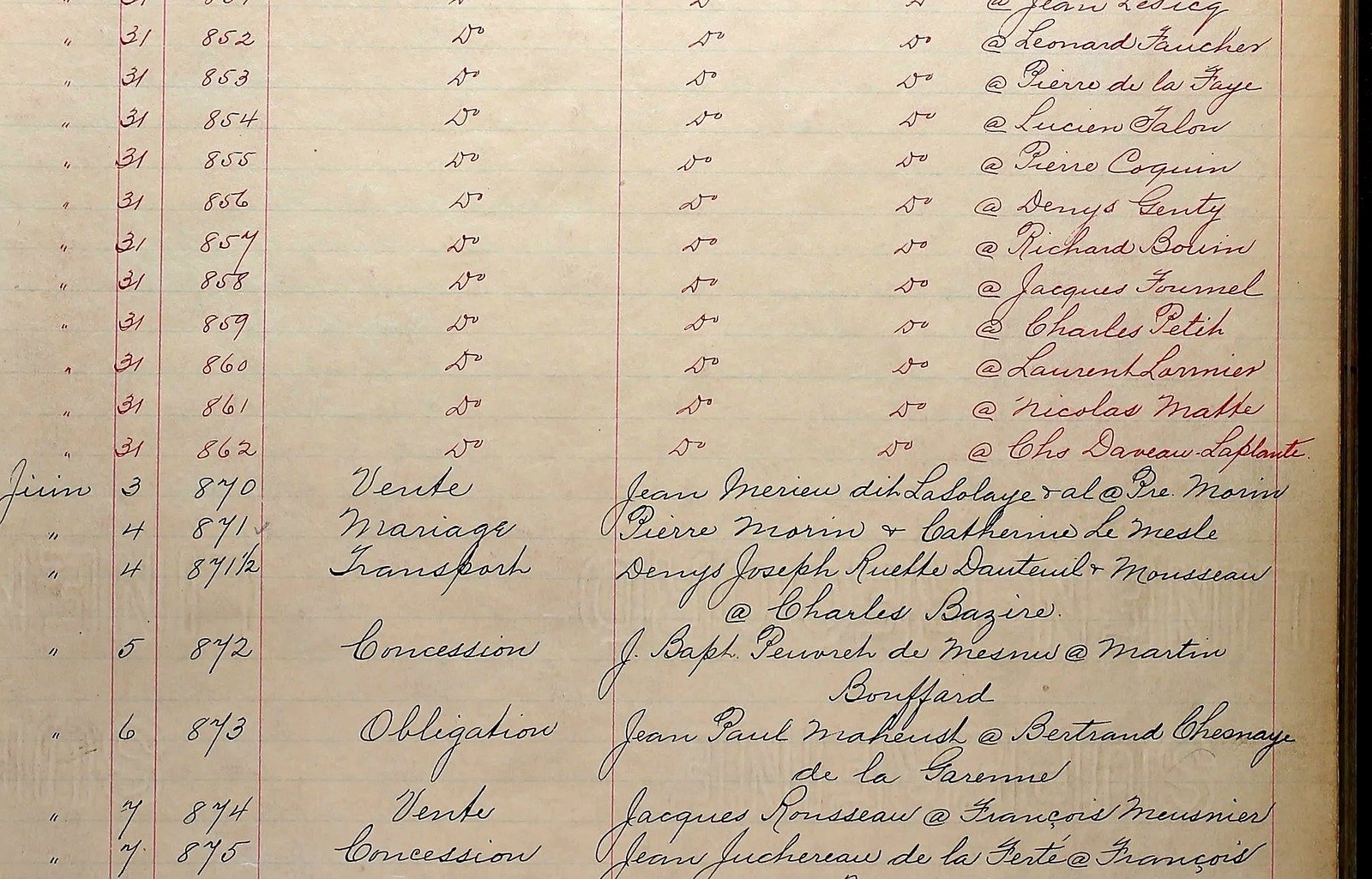
| 3 June 1672 | 870 | Vente | Jean Mérien dit LaSolaye and Barbe Le Baron sell him a habitation at the petite Rivière with hangard and cabins, 415 livres — half of it payable to the religious of the Hôtel-Dieu. Witnesses: Pierre Bodin and Jacques Gauthier. |
| 4 June 1672 | 871 | Mariage | Marriage contract of Pierre Morin and Catherine Le Mesle. |
| 4 Feb 1675 | — | Concession | Claude de Bermen, sieur de la Martinière, acting for the heirs of the late Jean de Lauzon, grants to Morin and Jacques Gauthier jointly a forfeited holding in the seigneurie of Lauzon, on the south shore — divided between them by half at their own request, four livres, the eel fishery reserved. Notary Paul Vachon. Morin is described as habitant dans la petite Rivière en la seigneurie des Révérendes Mères Hospitalières. Both declare they cannot write or sign. |
| 14 June 1676 | 1457 | Vente | Morin, habitant demeurant à la petite Rivière St Charles, sells that habitation on — two arpents' frontage by twenty-four deep, with house, hangard and stable. Neighbours: Pierre Bodin on one side, Jacques Gauthier on the other. The act recites his title: the contract of 3 June 1672 from Mérien dit LaSolaye and Barbe Le Baron. |
| 8 Aug 1676 | 1483 | Vente | Jacques Gauthier sells him land on the rivière Saint-Charles, twenty-four arpents deep, with the barn standing on it, adjoining his own ground. Held of the Hospitalières by a contract before Vachon. |
| 1677 | 870 addendum | Quittance | Mérien acknowledges the whole 415 livres received from Pierre Morin, acquéreur, and gives him discharge. |
| 17 Dec 1679 | 2010 | Vente | Samuel Vigné of the rivière Saint-Charles sells to Morin for 180 livres, payable by instalments. |
| 18 April 1682 | 2367 | Convention d'alignement |
Morin and Nicolas Odet settle the boundary line between their adjoining habitations. Morin declares he cannot write or sign. |
| 12 March 1690 | 3986 | Marché | Morin, habitant de la petite Rivière, and Joseph Charpentier of Québec — both described as carpenters — undertake for André Coubron, mason, to build a timber house twenty-four feet by eighteen, near the church and the hospital, for 135 livres. Morin declares he cannot write or sign. |
What the acts establish
They join themselves together. When Morin sold the habitation in June 1676, Rageot set out where he had got it: by contract of the third of June 1672, from Jean Mérien dit LaSolaye and Barbe Le Baron his wife, before the same notary. That is act 870, named and dated inside act 1457. The buyer of the day before the marriage contract and the seller four years later are the same man, and the register says so rather than leaving it to be inferred.
They fix the residence, and now name the seigneurie. Habitant dans la petite Rivière en la seigneurie des Révérendes Mères Hospitalières, February 1675; habitant demeurant à la petite Rivière St Charles, June 1676; habitant de la petite Rivière, March 1690. The Beaupré narrative this site published for a year is finished, and the correction rests on documents rather than on a reading of godparents.
They keep the same company, and for longer than anyone knew. Jacques Gauthier is now there from the very beginning: Morin's first parcel in 1670 is held représentant Jacques Gauthier; Gauthier witnesses the purchase of 1672; the two take a concession together at Lauzon in 1675 and split it between them; in 1676 Gauthier's land adjoins Morin's on one side, and that August he sells him more. Twenty years, five documents, one partner. Pierre Bodin runs alongside almost as long — witness in 1672, adjoining neighbour in 1676, godfather in 1685, and next door in the 1681 census.
They give him a trade. Carpenter, in the building contract of 1690 — the only occupation recorded for him in any source.
And a seigneurial roll pays him in. The Augustines' papier terrier et censier for Saint-Ignace records against his name: Il a payé 1683, 1684, 1685, 1686, 1687, 1688, 1689, 1690. Eight consecutive years of dues, in a source that owes nothing to parish registers or to the census.
What they do to Gagné's chain
Gagné supports his Saintes Pierre in part with a June 1672 purchase of a house at the Petite Rivière from Jean Mérienne and Barbe Baron, attributed to the notary Becquet. The transaction is real and the parties are right. The notary is not: it is Rageot, act 870, executed the day before act 871. And act 1457 ties that purchase by recital to the man living on the rivière Saint-Charles between Pierre Bodin and Jacques Gauthier — the same Bodin who stood at the Morin font in 1685.
On the evidence now in hand, that purchase belongs to Catherine's husband. One of the two checkable items in Gagné's chain was the Téchenay witness appearance, which is two acts compressed into one. This is the second.
A silence worth recording, and not over-reading
Across eight acts spanning nineteen years, Rageot never once describes this man as a soldier or a former soldier. That is the same notary who, in August 1668, wrote Soldat de la Compagnie du Sr de Norrouest into François Trotain's marriage contract. He recorded a company when a man had one.
This is not evidence that Pierre Morin never served. A man demobilised in 1668 is an habitant by 1671, and notaries describe people by what they are on the day, not by what they were. But the word does not appear, and anyone citing these acts should know it. The soldier claim gains nothing here and loses nothing.
One thing the acts do not yet reconcile
In September 1671 Morin sells a concession he held of the Hospitalières by a contract before Vachon. But the seigneurial roll shows him holding both 1670 parcels and paying dues on them down to 1690. Either there was a third Vachon concession, or the roll records original titles regardless of later transfers, or the parcel sold in 1671 is not one of the two. Until that is settled, this page will not assert an unbroken chain of tenure, and no reader should infer one from the table above.
What is still circumstantial
Not one of the nine acts states an origin, a parish, a parentage or an age. The chain is internally sound — 1457 recites 870, the 1675 concession names the seigneurie outright, and the residence descriptions and neighbours run continuously through all of them — but it is anchored at neither end by a document that says who this Pierre Morin was. The land is now documented to a standard the identification is not, and the gap between the two is the honest shape of this case.
Counting Citations as Witnesses
The most useful thing to come out of this problem is not the answer. It is a fault that appears on both sides of it — and in this practice's own work first.
What this site did
The published case study claimed four independent confirmations of Pierre Morin's service: the muster roll, the PRDH, the SFRSC, and Verney. Examined one at a time, they are not four.
- The PRDH List of Migrants reproduces the roll's La Noraye roster in the same order, with the same two anomalies in the same two positions. It is an accurate index to the roll, not a second witness to it.
- Verney names a Pierre Morin and gives no origin, no dit name, and no disambiguating note.
- The SFRSC entry's basis is not published. It may rest on the same reasoning this site used.
- The header statistics counted the roll twice — once inside the four, and again as a separate primary record.
What looked like convergence was one document, counted four ways.
What Gagné's apparatus does
His source line for the Saintes Pierre reads as eight authorities: ANOM COL D²C 47 fo. 45 | Gareau (wrong Pierre Morin) | Jetté | PRDH | LAC MG1-D2C | Roy & Malchelosse | Trudel | Verney.
Read closely, the eight thin out. ANOM COL D²C 47 and LAC MG1-D2C are the same roll — the French original and Canada's microfilm copy of it. Jetté and the PRDH share an authorship: the 1983 Dictionnaire généalogique des familles du Québec was produced with the collaboration of the Programme de recherche en démographie historique, so the database record and the dictionary entry are unlikely to be independent of one another. Gareau he flags himself as the wrong Pierre Morin. And Verney gives no origin at all.
None of what survives independently attests a Saintes origin for the roll's Pierre Morin. This is not an accusation of carelessness. Gagné is the more careful party here — he flags a conflation in Gareau that others reproduced without noticing. It is an observation about how compiled apparatus behaves: a list of citations reads as corroboration long after the sources beneath it have converged on a single root.
A caution against the mirror-image error
It is tempting to read the PRDH's unlinked roster entry as a verdict — to say the database declined to identify the man. It supports no such reading. What can be said is that no individual is linked to the entry, and that witnesses in other acts of the same period are likewise unlinked, so the absence may reflect a cataloguing convention rather than a judgment. Treating a silence as a finding is the same fault as treating a citation list as a count of witnesses. Both mistake the shape of a source for its content.
A finding aid can hide a document completely
The best example this case has produced came after the section above was written, and it cost an evening to learn.
Rageot's act of September 1671 recites that Morin held his land of the Hospitalières by a contract before the notary Paul Vachon. Vachon's répertoire was then read page by page from 1644 to 1675 — every month, both sides of every opening. Pierre Morin does not appear. On the face of it that is a documented negative of the strictest kind: right greffe, right years, exhaustive search, nothing there.
It was not a negative at all. The act exists, it is in Vachon, and it is dated 29 July 1670. The répertoire could not produce it because the répertoire indexes by grantee, and Morin was never the grantee. He held both parcels représentant another man — Jacques Gauthier on one, Simon Chardieu on the other. The document that finally produced the act was not a notarial index at all but the Augustines' own seigneurial roll, which is organised by censitaire: by who paid, not by who was granted.
The lesson is narrower and more useful than "indexes are incomplete." An exhaustive search of a finding aid establishes only that the sought name does not appear under the principle by which that aid is organised. A negative search is worth what its index is worth, and its extent is not the only thing that needs recording — its organising principle does too.
The controls this case produced
Proximity in an ordered document is not evidence of relationship. A name on a roll is not an identification. An index to a source is not a second witness to it. A citation list is not a count of independent authorities until each entry has been traced to its root. The absence of a linkage in a database is not a judgment unless the database says so. And a negative search proves only that a name is absent under the principle by which the finding aid is arranged.
These now sit alongside the standing rule this practice has used for years: never infer presence from naming alone.
Researcher's Notes
These notes record where this site's earlier reasoning has been revised, and why. Each names a claim that was published, the evidence that unsettled it, and the date it was withdrawn. They are kept visible rather than deleted, per this practice's convention: a methodology on which nothing has ever failed is not a methodology. The principal notes follow; the remainder are documented on the research file.
"Pierre Morin dit Champagne"
Carried in every page title on this site. Verney's Appendix B gives a nom de guerre in parentheses to six of the ten La Noraye soldiers and gives Pierre Morin none; "(Champagne)" on the same roster is a separate soldier whose surname could never be recovered. The muster roll and the PRDH roster both place Champagne as a separate entry. The SFRSC listing leaves the Dit/De column blank for him, on a list that fills it for two other soldiers who genuinely carried the name — Jean Mouflet of La Varenne and Jean de Paris of Petit. Eight notarial acts drawn for him between 1671 and 1690 carry no dit name either.
Langlois's roster does appear to attach Champagne to this man, so the name is not without a source and the question is not closed. But the two authorities who set out their conventions explicitly — Verney by his parentheses, the SFRSC by its columns — both decline to give it to him, and the primary roll lists Champagne on a line of his own. This site will not use the dit name until a record is produced that attaches it.
"Verney identifies Pierre Morin dit Champagne and explicitly distinguishes him from Pierre Morin dit Boucher"
Verney's entry says only that he settled in Canada in 1668. No dit name, no origin, no mention of Boucher. The claim was built from a third-party index citing Verney, not from Verney. The distinction from the Acadian Pierre Morin dit Boucher remains sound on other grounds; it is not Verney's.
"Captain Pierre de Naurois received a seigneurial grant in 1672 which became the Seigneury of Lanoraie"
Wrong on three counts. The captain was Louis de Niort de La Noraye. La Noraye was his own name, not a place name later applied to the company — the SFRSC records Naurois as a variant spelling of it. And his seigneurial concession came in 1688, twenty years after demobilisation; 1672 is the year of his marriage at Québec.
"The muster roll places a separate Morin in the Chambly company; the Chambly confirmation identifies that man"
The Chambly company's Morin was Charles. And the confirmand who gave his origin as Xainctes is assigned by Gagné to Naurois — the company at issue. The exclusion of that record from our Pierre's evidence stands on geographic grounds alone, which is the stronger ground: the same confirmation list renders Luçon twice, as "Lucon" and "Lusson," and neither is Xainctes.
"Four independent confirmations"
See the methodological finding above. One document, counted four ways.
"Pierre Morin signs his own name, confirming literacy. Catherine Lemesle also signs."
The signatures on the 1672 contract resolve to witnesses only — Anne Gasnier, Bonamour, Ruette d'Auteuil, Chastel, Michel, Maurray and Rageot the notary. The 1668 Trotain contract records Pierre Morin among the friends who declared they could not sign, and the notarial acts of 1671, 1682 and 1690 record the same declaration three more times. The Fichier Origine records that Catherine could not sign. Both were illiterate, which is a finding rather than a gap.
"The family settled in the Basse-Ville of Québec, having moved from Petite-Rivière on the Côte-de-Beaupré"
The 1681 census places them at Petite Auvergne, a côte in the seigneurie of Notre-Dame-des-Anges on the rivière Saint-Charles. Their neighbours were the godparents of their children. The Petite Rivière of the 1672 banns is the Québec one. The family did not move between Beaupré and the capital; they stayed on the Saint-Charles for thirty years, and the residence narrative published here was wrong throughout.
"The 1667 census and the 1672 banns independently corroborate a residence at Petite-Rivière on the Côte-de-Beaupré"
With the banns re-read, that corroboration collapses. The 1667 identification of "Pierre Martin, 22, domestique" in Simon Guyon's household is now doubtful on its own terms — and an age of 22 in 1667 implies a birth about 1645, closer to Gagné's man than to ours.
"Four independent primary documents confirm his Poitou origin"
Four independent records; not four independent informants. Rephrased rather than withdrawn — the consistency across thirty-four years is real and remains the strongest thing in his file.
"The concession recited in act 675 is not in Vachon's répertoire — a documented negative"
Wrong, and wrong in the way this page exists to describe. Vachon's répertoire was swept page by page from 1644 to 1675 and the absence of Pierre Morin was recorded as a finding. The act was in that greffe the whole time, dated 29 July 1670. It could not appear in the index because the index is arranged by grantee and Morin held as représentant of another man.
The claim was published nowhere, but it was held as a conclusion for a day, and it is recorded here because a methodology page that only catalogues other people's errors is not a methodology page. The section above sets out the control this produced.
The residence, and what replaced the argument for it
W-8 corrected the family's residence from the Basse-Ville and the Côte-de-Beaupré to Petite Auvergne, on the strength of the 1681 census and the godparent network. That correction was right, but the reasoning behind it was inference from association — the same class of argument this page criticises elsewhere.
The notarial record now states the place directly, three times, and the last of them names the seigneurie: habitant demeurant à la petite Rivière St Charles (June 1676), habitant de la petite Rivière (March 1690), and habitant dans la petite Rivière en la seigneurie des Révérendes Mères Hospitalières (February 1675). A seigneurial roll kept by that same community then records eight years of his dues. The conclusion is unchanged; the evidence under it has been replaced with something that does not depend on reading a social network. Recorded here because a claim that improves deserves the same visibility as one that fails.
The research note "The Other Pierre Morin"
That note argued that the Chambly confirmation identified the Chambly company's Morin rather than ours. It was wrong on both halves — the Chambly company's Morin was Charles, and the Xainctes confirmand is assigned to Naurois. It assumed two Morins in the regiment. There were four. It is withdrawn, and this page replaces it.
An Unresolved Case, Published as One
Pierre Morin and Catherine Lemesle are ancestors of somewhere between half a million and a million living Québécois. Almost every published account of him, including the ones formerly on this site, states that he was a Carignan-Salières soldier. That statement may be true. It is not, at present, demonstrable.
What is demonstrable is a life: a man from a marshland parish in Poitou whose baptism has never been found, who could not write his name, who married a Fille du Roi who could not write hers, who took two arpents of river frontage from a community of nursing sisters in the summer of 1670 and paid them forty-eight sols and two live capons every Christmas for twenty years, who went into land with the same neighbour twice on two sides of the river, who framed a house for a mason at forty-two, who raised five children to adulthood on a côte outside Québec among neighbours who stood at their font, and who died in a hospital ward in December 1706 — in the house of the same sisters whose land he had farmed — still described, thirty-four years after he had left it, as belonging to the parish of Saint-Étienne in the diocese of Luçon.
That is a smaller claim than this site made for a year. It has the advantage of being supportable — and, as it turns out, a good deal fuller than the claim it replaced.
For researchers working the same ground
If you descend from this family, or work on the Naurois / La Noraye company, and you hold the Batiscan cession, the Anseau deposition, or any notarial act naming Pierre Morin between 1665 and 1672 — please make contact. The identification is open, and it should be settled by documents rather than by repetition.
This case study replaces the former analysis at this address. The documentary biography and full methodology have been revised in line with the findings above; the research file records every withdrawn claim with its dated rationale.
Documentary Biography → Full Methodology → Complete Research File →Sources. Rolle des Soldats du Regiment de Carignan Salière qui se sont faits habitans de Canada en 1668, Library and Archives Canada, Colonies D²ᶜ 47 (ANOM COL D2C 47). Peter J. Gagné, From Soldiers to Settlers: The Carignan-Salières Regiment in Canada, 1665–1668, vol. 2 (2025), pp. 502–504. Jack Verney, The Good Regiment: The Carignan-Salières Regiment in Canada, 1665–1668 (Montreal & Kingston: McGill-Queen's University Press, 1991), Appendix B, Table 4, p. 168. Michel Langlois, Compagnie Naurois. La Société des Filles du roi et soldats du Carignan, Alphabetical Listing of the Carignan-Salières Regiment Officers and Soldiers Who Settled in Canada, January 2025. PRDH-IGD, Université de Montréal: individuals 53641 and 81890, List of Migrants 402529, confirmation 403507, burial 73205. Greffe of Paul Vachon, BAnQ, CN301, S266: concession of 29 July 1670 (recited in the terrier); concession of 4 February 1675 to Pierre Morin and Jacques Gauthier; concession of 29 July 1670 to Jacques Larue; concessions of 4 August 1670 (route Saint-Bernard); répertoire, 1644–1675. Papier terrier et censier du domaine de la seigneurie de Saint-Ignace, 1679–1726, Monastère des Augustines de l'Hôtel-Dieu de Québec, HDQ-F1-M1,2/4:1, folios 3, 4 and 11, and the Table des noms et surnoms des tenanciers. Plan de la seigneurie de Saint-Ignace, François de Lajoüe, January 1707, HDQ-F1-Q-PR3-00002-001. Greffe of Gilles Rageot, BAnQ, CN301, S238: répertoire 1672, folio 37; name index, "Morin Pierre"; acts 675 (29 September 1671), 870 (3 June 1672, with quittance of 1677), 871 (4 June 1672, marriage contract, ID 78360), 1457 (14 June 1676), 1483 (8 August 1676), 2010 (17 December 1679), 2367 (18 April 1682), 3986 (12 March 1690), and 3907 (9 November 1689, marriage contract of Joseph Charpentier). Marriage contract of François Trotain and Jeanne Ardies, notary Gilles Rageot, 13 August 1668, no. 307. Marriage register, Notre-Dame-de-Québec, 16 August 1668. Marriage banns, Notre-Dame-de-Québec, 1672, two register copies (nᵒ 729; 117/1672/413). Census of New France, 1681, Petite Auvergne (LAC, M-2330). Registre journalier des malades de l'Hôtel-Dieu de Québec, 1689–1760, ed. Marcel Fournier and Gisèle Monarque. Burial register, Hôtel-Dieu de Québec, 12 December 1706. Fichier Origine, record 242471.
Research and narrative by Mary Hamall Morales, Storyline Genealogy. Published 14 August 2026; revised 15 August 2026 with the Saint-Ignace land record. This case study supersedes "Pierre Morin of the La Noraye Company" and the research note "The Other Pierre Morin." Corrections and additional documents are welcomed.