
The Free Man of the Prairies

The Challenge
Laurent Quintal and Marie Anne Nipissing were married at Fort Vancouver on July 9, 1839, in one of the most thoroughly documented fur trade marriages in the Pacific Northwest Catholic registers. Their children’s baptisms, the names of their witnesses, Marie Anne’s adult baptism the day before the ceremony — all of it is there, in the original sacramental registers, published in translation by Mikell De Lores Wormell Warner with annotations by Harriet Duncan Munnick. And yet, in widely circulated family trees that carry no primary source citations, this couple appears attached to two families that are not theirs.
Laurent Quintal is commonly assigned the parents Étienne Quintal and Gauthier Dit St Germain, with a birth year of approximately 1802.
This is a different man. The error propagates backward through an entirely different Quebec family — different grandparents, different great-grandparents, a completely different ancestral line substituted for the correct one in every generation above Laurent.
The wrong Laurent is not a minor variant. He belongs to a separate Quintal family with no documented connection to the Columbia District or to any of the records that name our Laurent. The confusion likely arose because “Quintal” was a common French-Canadian surname with many bearers across the Montreal-area parishes, and because researchers working without primary source verification merged two men of similar name and approximate era.
For any descendant of Laurent and Marie Anne, the consequence is severe: every ancestor listed above Laurent — his parents, grandparents, and all collateral lines — belongs to someone else’s family tree.
Marie Anne Nipissing’s father is commonly identified in unsourced trees as a man with the surname Courteoreille, occasionally with a first initial.
No Courteoreille connection appears in any primary source for Marie Anne. The Catholic register entries that record her baptism and marriage name her father directly. He was not a Courteoreille.
This error matters beyond genealogy. Marie Anne’s actual heritage — Nipissing through her father, Chinook through her mother — is precisely documented in two independent Catholic sacramental records. Substituting a false paternal line does not merely misidentify one person. It erases her documented Indigenous identity and replaces it with an invented one, affecting the heritage record of every descendant who relies on these trees.
Neither error appears in any document that predates the age of online collaborative genealogy databases. Neither has ever been supported by a citation to an original register, an archival record, or a published scholarly source. They exist, and persist, because they were copied — from tree to tree, platform to platform — without the verification step that primary source research requires.
The primary sources that correct both errors have been accessible for decades. They were waiting to be read.

The Breakthrough
Laurent Quintal was born August 10, 1797, at St-Constant (La Prairie), Quebec, the fifteenth of seventeen children born to François Quintal and Marie Hébert. His twin sister Marie Suzanne died fifteen days later. He survived.
Sources: PRDH-IGD Family #55528; St-Constant parish baptismal register, 1797; HBCA biographical sheet, F.4/32 (parish confirmed as St. Constant); NWC engagement contract, SHSB #22959 / ANQM Greffe Beek, 21 February 1817 (fourth independent confirmation of St-Constant parish and February 1817 entry date).
His direct paternal line has been traced four generations above his parents through a retrieved NWC engagement contract and a compiled genealogy (Gauthier, Ancestry of French Canadians to Oregon Prior to 1842), to an immigrant ancestor — François Quintal from Aunis, France — who married in Québec City on October 17, 1678. Verification of each intermediate generation against PRDH is in progress.
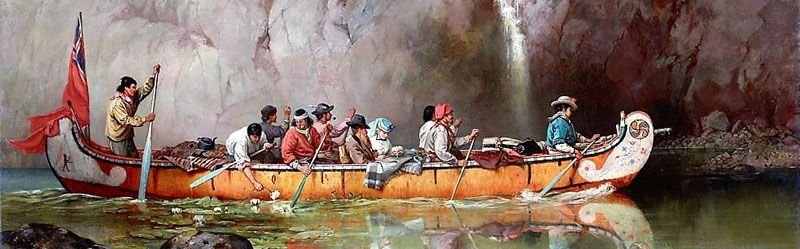
Laurent entered the North West Company on February 21, 1817, as a hivernant (winterer) under McTavish and McGillivray in the English River District. When the NWC and Hudson’s Bay Company merged in 1821, his contract carried forward. He spent the next fifteen years in HBC service — first in the English River District, then thirteen years as a Middleman in the Snake Country and Columbia District.
On February 10, 1824, he was listed sixth in Alexander Ross’s Snake Country expedition party — eleven men, twelve guns, thirty-three traps, fifty horses — leaving the Flat Head House to join the free men encamped at Rivière de Chevaux (HBCA B.202/a/1, p. 3). A note in the HBCA biographical sheet resolves a long-circulating confusion: the “sly dog Laurent” who deserted with Lazard in the Ross narrative was an Iroquois named Laurent Karatohon, not Laurent Quintal. Both men named Laurent were on the same expedition. The party roster distinguishes them.
In 1836–37, Laurent’s final HBC servants’ account entry (B.239/g/16) carries a notation in the remarks column: Free. The word is there, in the original ledger. Not inferred from a later record — recorded in the moment. By 1839, when he stood before a priest at Fort Vancouver, the registers describe him as a free man of the prairies and as engaged in the party of the hunt of the prairie. Consistent across three sacramental entries.
Marie Anne Nipissing’s father was Louis Nipissing — Nipissing by nation, present in the Hudson’s Bay Company’s Columbia District community, dead before July 1839. Her mother was an unnamed Chinook woman. Marie Anne was half Nipissing, half Chinook.
Sources: B-186 (baptism July 8, 1839) and M-61 (marriage July 9, 1839), both in Catholic Church Records of the Pacific Northwest, Vancouver Vol. I — two independent sacramental entries, same register system, consecutive days.
B-186 records her adult baptism on July 8, 1839 — the day before her marriage — as the natural daughter of Louis, “Nipissing by nation,” and of a woman of the country recorded as unbaptized. The margin notation identifies her as Tchinouk (Chinook) through her mother’s heritage. The following day, the marriage record M-61 names him again, now as already dead — establishing that he died before July 1839. Two record entries, one day apart: the same father named, independently, twice.
Munnick’s published annotation (A-59) further identifies the western surname form: Napassant is the Columbia District corruption of the word Nipissing, used as a family surname across the community. It is not a different family. It is the same name, rendered phonetically by English-language recorders who had never heard the Algonquian original.
Louis (age 4) and Rosalie (age 18 months) were baptized together on June 21, 1839 — eighteen days before their parents’ church marriage — in records B-167 and B-168 of the same Vancouver volume. Their parents are named as Laurent Quintal, a free man of the prairies, and Marie Anne Nipissing. Godfather for both: Pierre Belèque. The Catholic register documents a regularization of a pre-existing union, not a new one.
On how these records are presented. HBCA manuscript plates carry a printed reproduction prohibition and are transcribed rather than reproduced throughout this site. Catholic Church Records of the Pacific Northwest (Warner and Munnick, 1972 onward) remains in copyright as a compiled and annotated work; its pages are not reproduced and its annotations are reported as fact rather than quoted. Full transcriptions of every record named here appear in the methodology.
The Result
Laurent Quintal was born into a large French-Canadian family in the La Prairie district of Quebec in 1797 and died on a farm on the Calapooia Creek in Douglas County, Oregon in 1861 — sixty-four years documented across four archive collections on two sides of a continent. Marie Anne Nipissing was born in the Pacific Northwest around 1816–1819, daughter of a Nipissing man and a Chinook woman, and died in the same Douglas County in 1886 — twenty-five years after Laurent, outliving him by more than two decades.
Together their corrected ancestral lines run: Laurent’s parents were François Quintal and Marie Hébert — confirmed in PRDH-IGD Family #55528 and the 1797 baptismal register. Marie Anne’s father was Louis Nipissing — confirmed in B-186 and M-61 of the Catholic Church Records of the Pacific Northwest. Every generation above each of them, correctly identified, belongs to one of these two families — not to the Gauthier Dit St Germain line and not to the Courteoreille.
Zoé Quintal was born August 1840 at St Paul, Marion County, Oregon Territory — the child who connects Laurent and Marie Anne to their living descendants. She appears in the 1850 Oregon Federal Census as a ten-year-old in her parents’ household: a federal enumerator’s record, produced with no reference to the mission registers. Harriet Duncan Munnick’s biographical annotation A-19 identifies her as Laurent Quintal’s daughter, from Munnick’s own reading of the Catholic registers. The Oregon State Archives Early Oregonian Database also names both parents on her profile.
Those three are not three independent witnesses. The Early Oregonian is a compiled database, and the source field on Zoé’s profile cites the St Paul register volume — the same body of records Munnick worked from. Two of the three trace to one record system. What the census gives is genuinely independent; what the registers give is a single, strong line.
The same source field points to something better. It cites St Paul I, 19-B294 — a register entry, apparently Zoé’s own baptism. If that entry names Laurent and Marie Anne, it is a sacramental record of her parentage distinct from any annotation, and it restores a true second independent witness. It has been added to the retrieval request to the Archdiocese of Portland.
Zoé married Augustin Délard — known in pioneer records by his nickname “Quine,” which explains the variant “Augustin Quine Delore” in some sources — in Marion County, Oregon on August 25, 1857. They reared a family of eight children, first in Wasco County and then in Crook County. Zoé died December 6, 1905, at Suplee, Crook County, and is buried at the Delore/Suplee Cemetery. Augustin’s own heritage — his father born in Canada, his mother born in British Columbia — reflects the same Métis Columbia District world that produced Laurent and Marie Anne’s marriage.
After Laurent’s death in 1861, Marie Anne continued in Oregon. Munnick’s annotation A-59 places her later years in Douglas County — the same county where Laurent had died — consistent with her Early Oregonian profile, which records her death in 1886 in Douglas County and her ethnicity as Chinook Indian. She was approximately sixty-seven to seventy years old. She had outlived her husband by twenty-five years, survived in the same Pacific Northwest landscape her father’s people had reached through the fur trade, and left her documented identity in two Catholic registers that no one had connected to her for generations.
The errors documented here are not unusual. They are the predictable consequence of building genealogical records without consulting primary sources — and of copying those records, unchecked, across platforms that have no mechanism for source verification. Every person who descends from Laurent Quintal and Marie Anne Nipissing has an interest in the corrected record. The uncorrected version does not merely misidentify two people. It assigns them parents, grandparents, and ancestral lines belonging to other families, and it erases a documented Indigenous heritage — Nipissing and Chinook — that belongs to Marie Anne and to every generation that follows her.
The primary sources were always there. What was missing was the verification.
Laurent Quintal appears in Oregon records as Cantrel, Coutrell, Kantal, Chantal, and Cantell — all phonetic renderings of the French-Canadian surname by English-language recorders. Marie Anne appears as Nipissing, Napassant (the western form of the Nipissing nation name used as a surname), and Lapset. Neither set of variants represents a different person. The HBCA biographical sheet documents the Quintal variants explicitly; Munnick’s A-59 annotation documents the Napassant variant and its linguistic origin. All roads lead to the same couple — once the primary sources are read.
The document-by-document analysis behind this case study — including the HBCA ledger transcriptions, the Ross expedition party roster, the Catholic register entries, PRDH citations, and the complete evidence base for both corrections — is available in the full methodology.
Full Methodology The Guilbault Line A Genealogist’s Guide to NWC Records