
The Canadian

The Challenge
Paul Guilbault was born January 21, 1798, in the parish of St-Paul-de-Lavaltrie (Joliette) and baptized the following day. His father was François Guilbault, of St-Paul; his mother was Marie Archange Larivière. They had married at L’Assomption on February 7, 1786. The baptismal record is clear, well-preserved, and indexed in the PRDH as individual no. 499642. It is also, in the Quebec parish record system, the last thing Paul Guilbault ever appears in.
There is no Quebec marriage record. No Quebec burial record. No occupation designation in a child’s baptismal entry — because no children appear in Quebec with him as father. No census appearance in the province. After January 22, 1798, the man who would spend his working life in the fur trade and settle permanently in Oregon leaves the Quebec parish registers entirely.
The searches behind that statement covered the parish record system: PRDH-IGD, and the Lavaltrie, L’Assomption and Lanaudière registers. They did not cover the notarial record, which is a separate archive with separate finding aids. That distinction matters here, because the Société historique de Saint-Boniface voyageur contracts database — which indexes fur-trade engagements passed before Montreal notaries — holds a three-year engagement of 30 December 1819, before the notary Beek, for a Paul Guibeau of L’Assomption parish, as milieu, at 700 livres, for McTavish McGillivrays & Co. and Pierre de Rocheblave.
If that act is this Paul’s — and he was twenty-one, of the right parish, and in the Athabasca the following season — it is the earliest record of his working life and it is a Quebec document. The index entry is not the act. Until the Beek greffe is read directly, this page states what is established: no Quebec parish record after January 1798, and one indexed notarial engagement awaiting verification.
The silence is not for want of records in the family. The generations above Paul are thoroughly documented in the PRDH:
Paul did not invent this career. The SHSB contracts database records an engagement of 1 May 1792, before the notary Chaboillez, for Guilbeau, François, of L’Assomption parish, as second gouvernail to Sault-Ste-Marie, at 180 livres with 100 advanced, for the agent A. Henry. François Guilbault had married Marie Archange Larivière at L’Assomption in 1786; their son Joseph was born in October 1792, conceived about four months before this contract was signed.
Paul’s father was in the trade six years before Paul was born. Recruitment in this family runs down the household, not across the parish — which changes what Paul’s own departure means. He was not a boy who left; he was a boy raised in a house that a man left from.
Paul’s father François (b. 1760) and the voyageur brothers Gabriel Guilbault père (b. 1762) and Paul Guilbault père (b. 1761) were first cousins — François descending from Charles Thomas (b. 1727), the brothers from Gabriel (b. 1731), both sons of the 1727 marriage. Paul (b. 1798) is therefore first cousin once removed to each of them.
Gabriel père was a hivernant: three of his children were born in the pays d’en haut and carried down to St-Paul-de-Lavaltrie for baptism in October 1798, where the priest styled him voyageur et maintenant agriculteur. He married Marie Josephte Abitakijikokwe at Oka in 1801. His brother Paul père signed his first engagement at Lac la Pluie in July 1798 and was in the Athabasca department in 1820–21, settling at a wage of 500 livres with a balance of 617.14 in his favour — then came home to St-Paul-de-Lavaltrie, converted his wages into grain annuities, and died a cultivateur in 1831. Their children and grandchildren remained in Quebec.
Paul (b. 1798) was in the same department in the same season as Paul père — and did not come back.
The Breakthrough
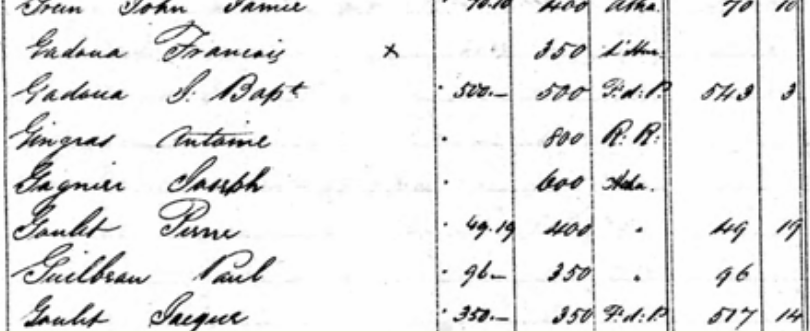
| Heading | Dr Paul Guilbeau Cr — below Thomas Gray and Louis Foulais |
| 1820 Dr | To amount of Merchandise Book 180.2 · to cash 15 · to sundries of R. Books 250.18 — 446 |
| 1821 Cr | By Wages 350 · By Balance 96 — 446 |
| 1821 | To Balance 96, brought down on the debit side |
Read the direction of that closing entry. He drew 446 livres of goods against 350 livres of wages and entered 1821 owing the company 96 livres. That was ordinary practice for keeping a man engaged — but it is the opposite of money in hand, and it should not be described as earnings.
| 1820 | To account from Fort William 179.10 · share of a canoe lot 2.8 |
| Purchases | Six yards molton 13.10, a pound of tobacco 16, a camwood knife 9 — 40.18 · leggings, blanket, boots and two pairs of trousers 62 |
| Under S.L. | (Slave Lake) a further 62; then tobacco and sundries, Fort Providence — 140; 148; total 250.18 |
| F. Chip. | Purchases at Fort Chipewyan |
| 1821 | By Wages 350, By Balance 80.8 — footing 430.8. Then To Balance 80.8. |
The two balances differ — 96 in the general ledger, 80.8 in the Athabasca blotter — and that is not a discrepancy to be reconciled. They are different books kept for different purposes at a post and at head office. The figure that identifies the man is the wage, and in both volumes it is 350.
The route those entries describe is itself the record of a season: an account opened at Fort William on the Great Lakes, carried west into Slave Lake, charged at Fort Providence, and closed at Fort Chipewyan. The 1821 settlement register lists him in the Athabasca department and shows his engagement transferred to the Hudson’s Bay Company at the merger rather than cancelled by it. He was twenty-two.
Which Guilbault? At least three men of the name could be meant, and nothing in the three entries distinguishes them. Paul “the Canadian” is a candidate on Gauthier’s service dates, which cover 1828. Hilaire Guilbault is documented in western service in the following two decades, though his recorded service begins in 1838. And Joseph Guilbault, born 21 October 1792 — this Paul’s own elder brother — has no marriage and no death recorded in the PRDH, the only son in the sibling set with neither, and is under active investigation as a Quebec-vanished voyageur of exactly the right generation.
What the entries establish stands regardless of which man is meant, and it is worth having: he had independent charge of four Indigenous carriers rather than travelling in an officer’s party; he was provisioned separately from the fort, with pemmican cached for the return; and he completed the round trip with every load delivered. That is the work of an experienced interior transport man operating on his own authority.
Simpson’s party that season included James Douglas, later Governor of British Columbia; the chief factor William Connolly; the surgeon Richard Hamlyn; and Colin Fraser, Simpson’s piper. The gentlemen kept the journals, and the carriers appear in them by surname or not at all. That core asymmetry is the whole problem this case study is built around — which makes any inference about the forename completely specultive.
The connection between the two men is not an inference from a printed page. In January 1843 Hilaire stood as godfather to Paul’s son François, with his own wife Louise as godmother — a formal, recorded bond of spiritual kinship between the two households in a single register entry.
Paul and Hilaire were “documented side by side” in the same annotation page, but that should not be treated as evidence of close association. The annotations are arranged alphabetically; two Guilbaults will fall together whether or not they ever met. The alternative argument is stronger and was already evident: Gauthier’s explicit linkage of the two men, the godparentage of January 1843, their shared Walla Walla kin network, and their deaths within months of each other in 1849.

The Result
The Early Oregonians Database (Oregon State Archives) records Guilbeau, Paul: born ca. 1800, died ca. 1849, arrived Oregon 1833 — five years after the McDonald journal placed a Guilbault on the McLeod Lake portage. Munnick’s biographical annotation has him sent from Fort Walla Walla in 1831 to join John Work’s Snake Country brigade. A provisional land grant at Champoeg (Vol. 3, Pg. 079) was filed September 7, 1846. He did not live to patent the claim.
Record M-18 in the Catholic Church Records of the Pacific Northwest (Vancouver Vol. I) documents Paul Guilbault’s marriage to Caty Sakaïan, Walla Walla by nation, on December 29, 1838, at Fort Vancouver. Paul was in the service of the Honourable Company of Hudson’s Bay, domiciled at Fort Vancouver. Witnesses: James Douglas, Esquire, and William Fraser Tolmie, Esquire. Three pre-nuptial children were recognized as legitimate at the ceremony: François (aged 6), Louis (aged 2), and Paul (aged 7 months). Neither spouse could sign; both made the mark of a cross. Caty was baptized the same day as B-213, the entry immediately preceding the marriage in the same register.
Munnick’s annotation states that Caty bore Paul six children. The registers identify four by name, across five years:
- François — recognized at the 1838 marriage, then baptized as B-876 on January 29, 1843, with Hilaire Guilbeau as godfather and Louise Walla Walla as godmother
- Louis — recognized at the marriage; baptized B-46, November 29, 1840, aged 5½ years
- Paul — recognized at the marriage; baptized B-47, November 29, 1840, aged 2½ years
- Marie — B-41, baptized June 20, 1841, born May 29; godfather Michel Cotnoir, godmother Mathilde Fagnant
Four children are individually documented in the registers. Munnick’s figure of six is a compiled statement and is reported here as hers, not as a register count.
Caty Walla Walla died in 1848.
B-876 makes documentary what the Gauthier compilation only implied. When Paul’s son François was baptized in January 1843, Hilaire Guilbeau stood as his godfather, with Hilaire’s own wife Louise Walla Walla as godmother. Hilaire had married Louise at Vancouver County in April 1842, nine months earlier, adopting four children of the bride at the same ceremony (M-2). The two second cousins once removed were not merely in the same Oregon community — they were godparents to each other’s households.
The Munnick index for Vancouver Vol. I places Paul Guilbault on more than fifteen separate pages — as father, as godfather, as witness at burials (S-3, S-4, S-8, S-9, S-11, S-17 across 1840–1841), and as present at baptisms through 1843. He stood godfather in July 1839 to Michel, child of the engagé Louis, Iroquois dit le frisé, and to Pierre, son of Thomas Tawakon, Iroquois, and Françoise — the woman he would himself marry nine years later. He was a witness at the burial of Cowlitz, Willamette and Flathead people through 1840 and 1841. The index is a map of a man embedded in his community.
After Caty’s death, Paul married Françoise on November 5–6, 1848, in Marion County, Oregon. Munnick identifies her as Cayuse; the Early Oregonians Database records her as Walla Walla, born ca. 1810, under the aliases Française and Louise. The conflict is noted and not resolved here. Her record documents three marriages: Thomas Tewatcon in 1839, Paul Guilbeau in November 1848, and Laurent Sauvé on April 9, 1850. She appears in the 1850 Marion County census and survived to the 1880 census in Wasco County. Her remarriage in April 1850 sets the outer bound on Paul’s death.
| Paul père (b. 1761) | Paul “the Canadian” (b. 1798) | |
|---|---|---|
| Kinship | Brother of Gabriel père | First cousin once removed to both |
| Service | NWC 1798 (Lac la Pluie); NWC Athabasca 1820–21 | NWC Athabasca 1820–21; HBC to 1840 per Gauthier |
| Wages / balance | 500 / 617.14 in his favour | 350 / 96 owed, and 80.8 at the post |
| Attested in | F.5/1 fo. 115; F.5/3 p. 32; F.4/37; F.4/46–47 | F.4/32 p. 396; F.4/37; F.4/46–47; McDonald 1828 (surname only); Vancouver registers 1838–43 |
| Returned? | Yes — Quebec, 1821 | No. Oregon by 1831–33. |
| Wives | Marie Geneviève Olivier Milot (Quebec) | Caty Walla Walla (1838); Françoise (1848) |
| Post-service | Notarial annuities; died cultivateur, 1831 | Land grant, Champoeg, 1846; died ca. 1849 |
Paul Guilbault (b. 1798) is first cousin once removed to both Paul Guilbault père (b. 1761) and Gabriel Guilbault père (b. 1762) — my 4th-great-grandfather — through their shared descent from Charles Guilbault and Catherine-Antoinette Deguise Flamand, married in 1727. Paul père and Gabriel père were brothers, so the relationship to each is necessarily the same; an earlier version of this page gave two different answers, and that is what sent me back to the 1727 baptism to recompute the whole set. Four men of one family met the same historical moment from four directions: Gabriel, who wintered in the pays d’en haut and married Abitakijikokwe at Oka; the older Paul, who came home and bought annuities; this Paul, who built a Walla Walla family in Oregon; and Hilaire, who followed him west and died at St. Paul Mission the same year. The Catholic Church Records of the Pacific Northwest, consulted in the same period for a parallel project on the Nipissing and fur-trade community of French Prairie, turned up Paul’s Oregon life entirely unexpectedly.
Which Guilbault does McDonald name in 1828? Three candidates stand and the journal does not choose between them. The test that would narrow the field is a documented-negative search for Joseph Guilbault, b. 21 October 1792, across the Lavaltrie, L’Assomption and Lanaudière registers after May 1820 — a marriage or burial closes him; a clean negative makes him a serious candidate.
Is the 1819 Beek engagement his? The SHSB index entry must be checked against the notarial act itself before it can be cited as his earliest record.
Who is Munnick’s “Paul Guilbault (I)”? The numbering implies a second Paul in the western records. He must be identified and ruled out before anything further is published on the Oregon material.
The HBCA post journals for McLeod Lake (B.188 series) and Fort St. James have not been searched. Munnick’s sixth child has not been identified in any register entry. The mother of François, born about 1832 during the Snake Country years, is unidentified. Whether Paul died in the gold fields or elsewhere in Oregon is unconfirmed.
Explore the Full MethodologyThis case study is part of the Storyline Genealogy series on the Guilbault Line. The companion case study documents Paul Guilbault père’s North West Company service — the two men worked the same department in the same season, and telling them apart is what the wage figures are for. The Oregon records that found this Paul were the same Catholic Church Records of the Pacific Northwest consulted in parallel research on the French Prairie community.
The Canadian: How the Research Was Done The Invisible Voyageur: Paul Guilbault père → The Voyageur Years: Gabriel Guilbault → When the Research Comes Full Circle →