
The War Chief’s Wife
at the Mission du Lac-des-Deux-Montagnes, 1786–1824
The War Chief’s Wife
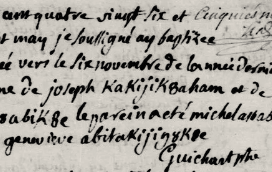
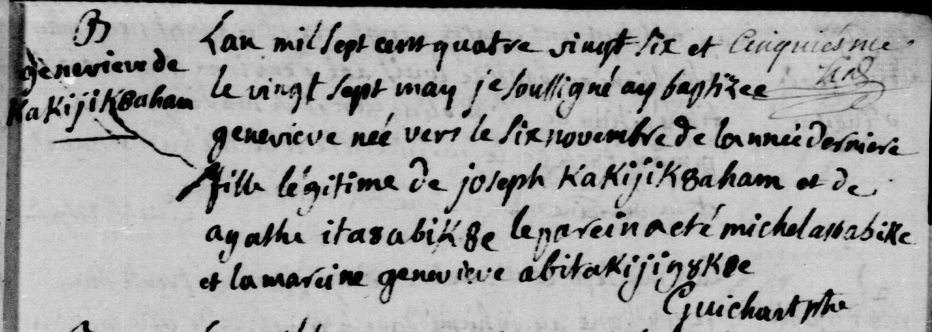
Geneviève first appears in the Oka mission registers on May 27, 1786, standing as godmother at the baptism of a baby girl. Over the following thirty-eight years she surfaces in ten more records — as godmother, as mother, as a witness at her own daughter’s wedding in 1805, as godmother again in 1818, and finally in her own burial record in February 1824. Across those records, priests rendered her name in eight distinct spellings belonging to two name systems that no search algorithm or published index connects to each other.
Kitchiwabisi — recorded variously as 8abizi le grand, Kitchi Wabizi, and the Great 8abissi — was an Algonquin war chief at Oka. The prefix Kitchi means “Great.” He died in the hunting lands twenty-two days before his burial at Oka on April 21, 1794, at roughly forty-three years of age. Geneviève outlived him by thirty years.
By 1796, two years after her husband’s death, Geneviève had a son named Joseph with a man called Simon Na8ak8eskam. The priest recorded Joseph as fils naturel — born outside a church marriage. Significantly, the woman chosen as Joseph’s godmother was Agathe Ita8abik8e — the same woman whose child Geneviève had stood for as godmother in 1786. That reciprocal sponsorship documents a sustained relationship between the two families over at least a decade. Nine years after Joseph’s birth, in August 1805, Geneviève was still at Oka, standing at Marie Angélique’s wedding and declaring she could not sign. She would remain at Oka for nineteen more years.
Jean-Guy Paquin’s genealogical fiche for Bernard Wabisi at weskarini.ca lists the mother as “Geneviève ABITAKIJIKOKWE, KIZIKWE” with no death date. That blank is now filled. Geneviève died February 23, 1824, at Oka, aged 72, and was buried February 25, 1824 — recorded by Malard as Genevieve Ninzikwe Algonquine. She outlived her husband Kitchiwabisi by thirty years. She died the same year as Bernard Wabisi, the younger war chief of Kitchiwabisi’s family, seven months before his September burial. Both died at Oka; both were recorded by the same priest who had documented their family for decades. The span of her documented life at the Oka mission: thirty-eight years, 1786 to 1824, across eleven records that name her.

Two Names, One Woman
Geneviève is named under two distinct name systems across eleven records at the Oka mission. The first and most frequent is the Abitakijik- family name shared with other documented individuals. The second is a personal name first recorded in 1805 and last in 1824. Connecting these names to a single individual requires tracing spousal identifications, parental roles, and the timing of events that only one woman could have experienced.
The name under which she was most frequently recorded — as godmother, as mother, as wife of Kitchiwabisi. Eight records and six different spellings in the original registers, written by three priests (Guichart, Leclercq, and Malard), spanning 1786 to 1803.
Geneviève Abitakijig8k8e
Original register + Cadieux transcription, Vol. 2, p. 6. Priest: Guichart. First documented appearance.
Geneviève abitakijig8k8e
Original register, C-2895 Image 480, written abita kijig8k8e; Cadieux transcription agrees. Pouliot-Thisdale’s index lists only the second element, Kijig8k8e. Father: Kichi8abizi. Priest: Guichart.
Geneviève abitakijig8k8e
Original register + Cadieux transcription. Baptized by Guichard; written by Leclercq.
Geneviève Ontakijikok8e / Kontakijikok8e
Original register. Pouliot-Thisdale pp. 282, 293. Father: “the Great 8abissi.”
Geneviève oatakijikok8e
Original register. Pouliot-Thisdale p. 295 reads Ostakijikok8e. Priest: Leclercq, ten days after the entry above. O- initial variant.
Geneviève Abitakijikok8e
Original register + Cadieux transcription, C-2895 Image 625, p. 160. Priest: Malard. Father: Simon Na8ak8eskam. Godfather: Joseph Kakigik8ang. Godmother: Agathe Ita8abik8e (reciprocal sponsor — see 1786).
Geneviève Abitakigikok8e
Original register: Abitakigikok8e — unique -kigi- variant. Cadieux transcription, p. 322, C-2895 Image 789: Abitakigikokse. Priest: Malard. Joseph Mathieu, 8ga8 Outaois, age ~14. Godfather: Joseph Minjotté, whose daughter Marie Susanne Kiakigikokwe had been buried three days earlier on the same register leaf. Twenty-nine days before Thérèse’s burial below.
Geneviève Abitakijikoke (original) / Abitakigikokse (Cadieux p. 322)
Original register + Cadieux transcription, p. 322, C-2895 Image 789. Priest: Leclercq (LECLERO in Cadieux) — different priest from the Joseph Mathieu baptism (Malard) on the same register leaf. Terminal -8e dropped in original; Cadieux renders same -kigi-/-se form as the September entry above. No PRDH for this burial.
A different name entirely — shorter root, no Abita- prefix. Documented in three records, all written by Malard: her daughter’s wedding in 1805, a baptism in 1818 at which she was godmother, and her own burial in 1824.
Geneviève Nizik8e
Original register + Cadieux transcription, p. 345. Priest: Malard. Bride: Marie Angélique Abitakigikok8e. N-/K- consonant shift (cf. Catherine Messinabikwe M-/N-).
Geneviève Ninzikwe
Original register, June 22, 1818 (Drouin Collection, Oka 1818). Priest: Malard. Godchild: Bernard, son of Pierre Jacques Oyabamitch and Elizabeth Ikwessens; godfather Bernard Ajawegone. Cadieux Vol. 3, p. 499 reads Minzikwe; the original reads Ninzikwe. First appearance of the Nin- form.
Geneviève Ninzikwe
Original register + Cadieux transcription, p. 561, C-2896 Image 48 — both agree. Priest: Malard. Died February 23, 1824, aged 72 (birth c. 1752). Witnesses: Augustin Kiwanaki and Jacques Michel Kiwechkam. Identified as Algonquine. Same form as 1818; Ninzikwe = Nizik8e with a minor -n- insertion. Same System 2 root, same priest.
No linguistic analysis links these names on paper. What links them is the woman behind them: the same Christian name (Geneviève), the same husband (Kitchiwabisi / 8abizi le grand / the Great 8abissi), the same children (Marie Jeanne, Thérèse, Marie Angélique), and a continuous presence at the same small mission from 1786 to 1824. The identification is built on life events, not spelling. Pouliot-Thisdale, who worked directly from the original registers, explicitly characterizes many of these variant spellings as “misspellings” — confirming that the orthographic divergence reflects scribal inconsistency, not separate identities.
The Abitakijik Connection
Marie Josette Abitakijikokwe — identified in her 1801 marriage record as Saulteux (Ojibwe) — married the French-Canadian fur trader Gabriel Guilbault at Oka. Her story is documented in Abitakijikokwe — The Woman Behind the Name.
Deliris López Tiwari, who has shared cultural context about Marie Josephte, explains that Abitakijikokwe was her primary Anishinaabe (Ojibwe/Saulteaux) name, not a surname. The priests who baptized her followed a common colonial practice: they recorded her name as a surname after the baptismal name Marie Josephte. In Anishinaabemowin, Abitakijik means “Half-sky” or “Mid-sky,” the position of the sun at midday, and -okwe means “woman.” Her name is Mid-Sky Woman. Because it was a personal name, the name Geneviève and Marie Josephte shared is a lead in the kinship question rather than proof of it.
Both women carried the Abitakijik- name. Both were at Oka during the same period. And the family network runs deeper still: in 1786, Geneviève served as godmother at the baptism of a baby girl whose father was Joseph Kakijik8aham (Kakijikouaham). The Kakijik- root of the father’s name is the same root embedded in Abitakijikokwe — suggesting that Geneviève and the baby’s father were part of the same extended kin group, and that this child was being welcomed into the community by her own kinswoman. The baby’s mother was Agathé Ita8abik8e. Ten years later, in 1796, Agathé Ita8abik8e served as the godmother of Geneviève’s own son Joseph — a reciprocal godparent relationship documented across a decade, and a further thread in a web of kinship that extended through the Oka mission community.
The exact relationship between Geneviève and Marie Josette — sisters? mother and daughter? aunt and niece? — has not been determined. Resolving this kinship question is the next phase of research, and it is central to understanding how the researcher's direct ancestral line connects to the family of an Algonquin war chief.
The document-by-document analysis behind this case study — including original manuscript images, Cadieux transcriptions, Pouliot-Thisdale index references, and linguistic notes on every spelling variant across both name systems — is available in the full methodology.
Full Methodology Companion Narrative Essay