
Two Families, One Story : Covehead
Covehead
In Episode 3, we followed Lawrence Kenny from Newfoundland to Prince Edward Island, where he raised his family on Lot 34. But Lawrence was not alone on that land. Just down the road lived another Irish family—the Connors—who had arrived by a different route but would become inseparable from the Kenny story. This is the story of Hugh Connors, whose children would marry into the Kenny family three times in a single generation.
Lot 34: Geography and Place Names
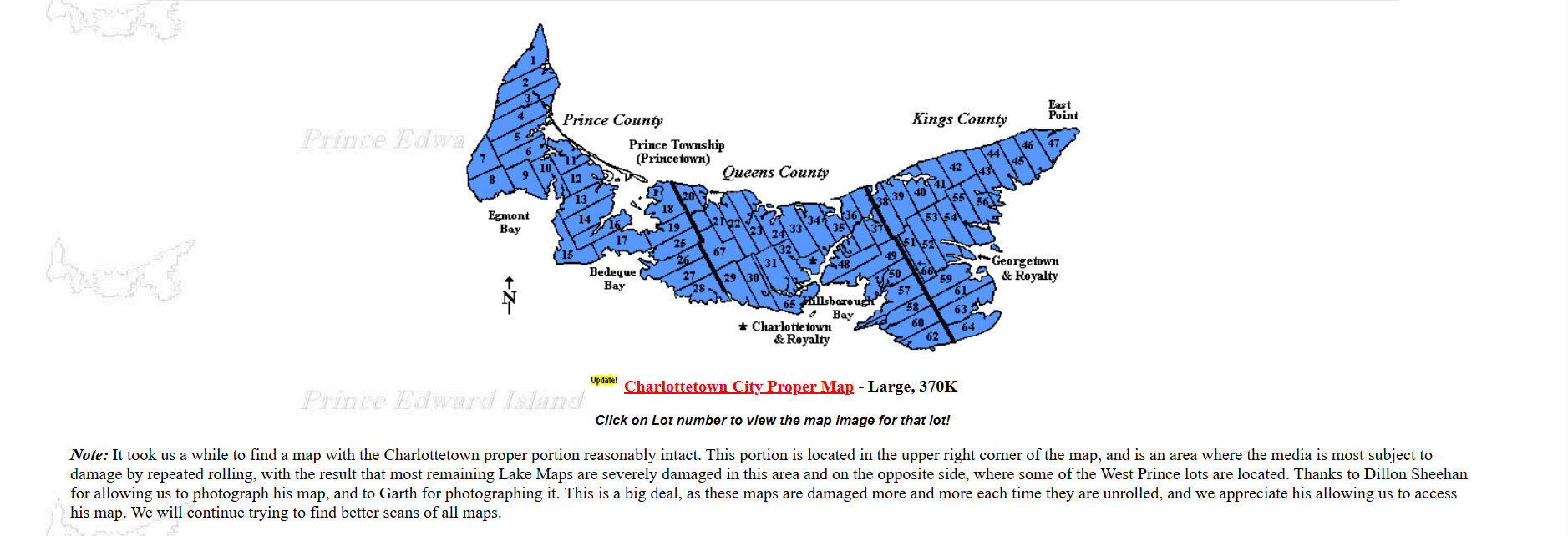
Lot 34 lies in Queens County, approximately eight miles north of Charlottetown, and was part of Charlotte Parish. Originally awarded to John Dickson in the 1767 lottery that divided Prince Edward Island among British proprietors, it later passed to Sir James Montgomery, 1st Baronet, whose estate would dominate the township for generations. The name "Covehead" refers to the inlet and surrounding area along the North Shore, where a Post Office operated from 1856 to 1913. The township also encompassed communities like York, Pleasant Grove, and Friston Road—names that appear throughout the Kenny and Connors records. Samuel Holland's 1762 survey established the lot system, dividing the Island into 67 townships. Though formally abolished at Confederation in 1873, Islanders continued to identify their land by lot numbers well into the 20th century.
A Marriage in New Brunswick
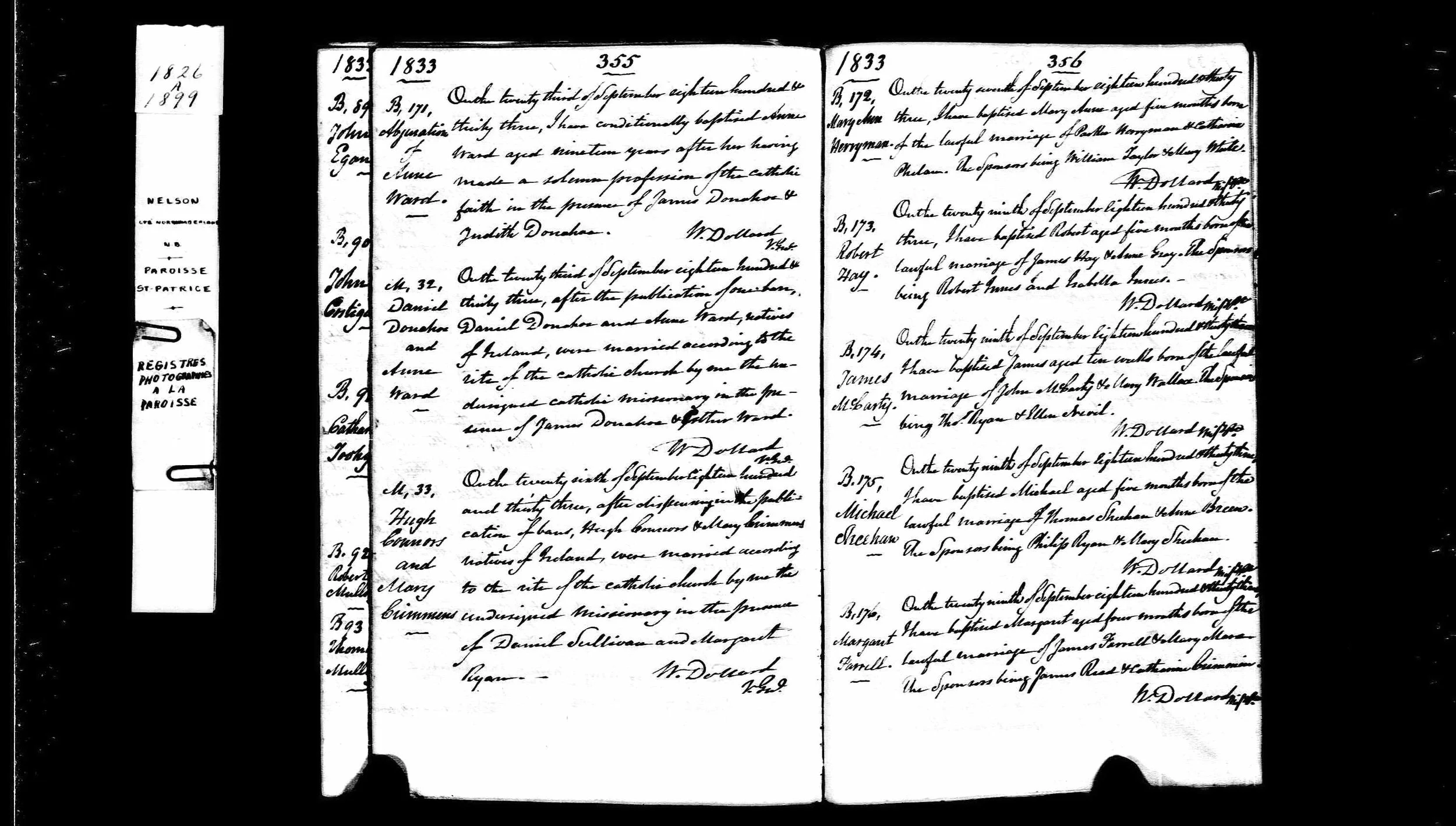
The story of Hugh Connors on Prince Edward Island begins not on the Island itself, but in the Miramichi region of New Brunswick. On September 26, 1833, Hugh Connors and Mary Cummins—both described as "natives of Ireland," and both of the parish of Chatham, County of Northumberland—were married according to the rites of the Catholic Church at St. Patrice (Nelson Parish). The witnesses were Daniel Sullivan and Margaret Ryan.
and thirty three, after dispensing the publi-
cation of bans, Hugh Connors & Mary Crimmens
natives of Ireland, were married according
to the rite of the catholic church by me the
undersigned Missionary in the presence
of Daniel Sullivan and Margaret
Ryan. — W. Dollard V.G.I.
The officiating priest was Father William Dollard, Vicar General — and the office matters more than it looks. Dollard was vicar general of the Diocese of Charlottetown, which in 1833 covered New Brunswick and Prince Edward Island together under Bishop Angus Bernard MacEachern. The priest who married Hugh and Mary in the Miramichi held authority over Lot 34 as well. Dollard was summoned to the episcopal residence at St Andrews, P.E.I., that same year, and in 1843 he was consecrated the first Catholic bishop of New Brunswick. The marriage entry describes both Hugh and Mary as "natives of Ireland"—a detail that would be confirmed decades later in Hugh's obituary, which specified County Wexford as his birthplace.
Earlier drafts of this page expanded "V.G." as "Vicar General of Ireland." There was no such office. Dollard's jurisdiction was the Diocese of Charlottetown — the county register quoted in Episode 1 has him sign simply as "Missionary of Miramichi" — and reading it correctly turns a piece of clerical trivia into evidence: New Brunswick and Prince Edward Island were one diocese, which is part of why a family could marry on the Miramichi and turn up a few years later in a Queens County parish register.
The Miramichi Connection
The Miramichi region of New Brunswick was a major destination for Irish Catholic immigrants in the early 19th century, particularly those from the southeast of Ireland. Many Irish families used New Brunswick as a stepping stone before moving on to Prince Edward Island, where land was more readily available under the leasehold system. The marriage in Nelson Parish suggests Hugh and Mary may have spent time in the Miramichi timber trade before settling on PEI.
Hugh Connors was in Atlantic Canada a year before that marriage, and Episode 1 shows where. On 27 September 1832, in a St. John's parish register, a baptism was recorded for "Bridget of Hugh Connor and Mary Henesy," with Paul Henesy and Margret Connors as sponsors — Mary's brother and Hugh's sister, in the standard Irish practice of one godparent from each side. The entry sits at pages 420–421 of the register. Two pages further on, in October, a priest baptized James of Lawrence Kenny and Cath Corcoran. The two families were in the same parish, weeks apart, thirty-four years before their children began to marry.
Sps Paul Henesy and Margret Connors paid [May?]
Five Spellings, One Woman
Hugh's wife is recorded under five surnames across thirty years: Henesy in Newfoundland in 1832, Cummins — rendered elsewhere as Crimmens — in New Brunswick in 1833, Henepy at David's baptism in 1838, Henery at Ann's in 1846, and Henephy or Hennessey on the 1991 family group sheet. Episode 1 sets these out as phonetic renderings of one name and settles on Mary Henesy. The identification does not rest on the spellings at all: it rests on the same husband, the same daughter Bridget, and Paul Henesy standing sponsor at that daughter's font.
Two details in the 1833 entry are worth pausing over. The couple were married "by dispensation of Bann" — the three Sundays' public notice was waived — and the bride is described in the register as "a maid, Spinster," which rules out a first marriage and any earlier married name. A dispensation was granted when a marriage could not wait; here a child of Hugh Connor and Mary Henesy had already been baptized a full year before. Read together, the two records look less like a courtship than a regularization — a union already in existence, brought inside the Church as soon as a priest with authority to dispense the banns was within reach.
The 1833 marriage survives in two different renderings. The narrative entry transcribed above names the couple "natives of Ireland" and signs "W. Dollard V.G.I."; the numbered entry quoted in Episode 1 — no. 1680 — gives their residence as the parish of Chatham, County of Northumberland, describes the bride as "a maid, Spinster," records the dispensation, and is signed by the parties themselves before "Wm Dollard, Missionary of Miramichi." They are almost certainly the parish register and the county register of the same marriage, and each preserves something the other leaves out.
| Record type | Couple (family file) |
|---|---|
| File number | 1047322 |
| Husband | Hugh CONNOR |
| Wife | Mary CRIMMENS |
| Marriage | 26 September 1833 |
| Place | Nelson (St-Patrice) |
Programme de recherche en démographie historique (PRDH-IGD), Université de Montréal, family file 1047322, Hugh Connor and Mary Crimmens, married 26 September 1833, Nelson (St-Patrice). Consulted at prdh-igd.com.
This index entry is worth setting down carefully, because it is the origin of one of the four spellings. PRDH is a database, not a register: its compilers read the same New Brunswick entry and rendered the bride's surname Crimmens, where Episode 1's transcription of the register reads Cummins. Both are readings of one word in one hand. The register is the record; the index is a finding aid, and should be cited as such rather than in place of it. What PRDH does independently confirm is the parish: Nelson (St-Patrice), which is where this page places the marriage.
A caution on the obituary's date. It says Hugh "emigrated from County Wexford, Ireland to Prince Edward I. ... in the year 1832," but the documents place him in Newfoundland in September 1832 and in New Brunswick in September 1833; Episode 1 reads the obituary as putting the move to the Island nearer 1839. The year 1832 is when he reached British North America, not when he reached Lot 34.
Settling on Lot 34
By 1841, Hugh Connors had established his family on Lot 34 in Queens County, Prince Edward Island. The 1841 census captures the household in its early years: Hugh as head of household, a farmer on land belonging to the Montgomery Estate.
The Montgomery Estate dominated Lot 34. Originally granted to Sir James Montgomery, 1st Baronet, after the 1767 lottery that divided PEI among British proprietors, the estate operated under a leasehold system that would define life for generations of Island tenants. Families like the Connors held land under 999-year leases—effectively permanent tenancy, but never ownership. The roads that crossed the township—Covehead Road, Friston Road, and others—connected these scattered farms to each other and to St. Eugene's Church, the center of community life.
Hugh Connors on Lot 34
on PEI
(84 in 1841 & 1850)
on Lot 34
The census return is unusually full, and it is worth setting out whole.
| The Household | |
|---|---|
| Township | 34 |
| Head of family | [not entered] |
| Trade or occupation | Farmer |
| Males under 16 | 3 |
| Males 16 to 45 | 1 |
| Males 45 to 60 | 1 |
| Males upwards of 60 | 0 |
| Females under 16 | 3 |
| Females 16 to 45 | 1 |
| Females 45 to 60 | 0 |
| Females upwards of 60 | 0 |
| Deaf and dumb · insane · blind | 0 · 0 · 0 |
| Total in family (including servants and apprentices) | 9 |
| Religion | |
| Roman Catholic | 9 |
| All other denominations | 0 |
| Land | |
| Acres held in fee simple | 0 |
| Acres held by leasehold | 84 |
| Acres by written demise · verbal agreement · as occupants | 0 · 0 · 0 |
| Term of lease | 999 years |
| Years of term expired | 0 |
| Present rent per acre | 0/1/0 (one shilling) |
| Rent in currency | 4/4/0 |
| Quality — 1st · 2nd · 3rd | 0 · 0 · 84 |
| Acres of arable land | 16 |
| Produce and Stock | |
| Bushels of wheat | [figure not legible on this copy — to confirm] |
| Bushels of oats | 45 |
| Bushels of barley | 12 |
| Bushels of potatoes | 250 |
| Horses · neat cattle · sheep · hogs | 1 · 4 · 6 · 2 |
| Passage and Origin | |
| Passage paid by proprietors · repaid to proprietors | [not entered] · [not entered] |
| Persons who paid their own passage | 3 |
| Natives of England | 1 |
| Natives of Scotland | 0 |
| Natives of Ireland | 2 |
| Natives of this Island | 5 |
| Natives of the British Colonies | 1 |
| Natives of other Colonies | 0 |
1841 Census of Prince Edward Island, Township 34, Hugh Connors. Public Archives and Records Office of Prince Edward Island, PARO Collections Database, record 1067. Transcribed from the PARO record.
One Native of the British Colonies
Among the nine people in the house, the enumerator counted two born in Ireland, five born on the Island, one born in England — and one born in "the British Colonies." That is Bridget, baptized in Newfoundland in September 1832. Two farms away on the same Lot in the same census, Lawrence Kenny's household carries the identical designation for his son James, baptized in the same St. John's parish weeks later. The 1841 census holds both Newfoundland children, in two neighbouring houses, under the same six words.
The land columns overturn a long-standing assumption. The family group sheet reasoned from an 1861 entry that Hugh was about twelve years into his lease, and therefore settled around 1849. But in 1841 he already holds 84 acres by leasehold on a 999-year term with none of it expired — a lease newly entered, not one eight years old. And 84 acres is exactly the figure Daniel Hickey's surveyors would record against No. 236, Hugh Connors, nine years later in the 1850 cadastral survey of the Montgomery Estate, "A Plan of Township No. 34, The Property of Sir Graham Montgomery & Brothers." The same parcel, the same acreage, from two independent sources. By 1880 Meacham's Atlas shows "Hugh Connors, 105 acres" on Friston Road — an expansion of twenty-one acres over the following three decades.
The rent arithmetic confirms the reading: one shilling an acre across 84 acres is eighty-four shillings, and the return gives the rent in currency as £4/4/0. Of those 84 acres, only sixteen were arable. The rest was forest, and the whole holding was entered as third quality. This is a family at the beginning of the work, not the end of it — one horse, four cattle, six sheep, two hogs, and 250 bushels of potatoes off sixteen cleared acres.
The Children of Hugh and Mary
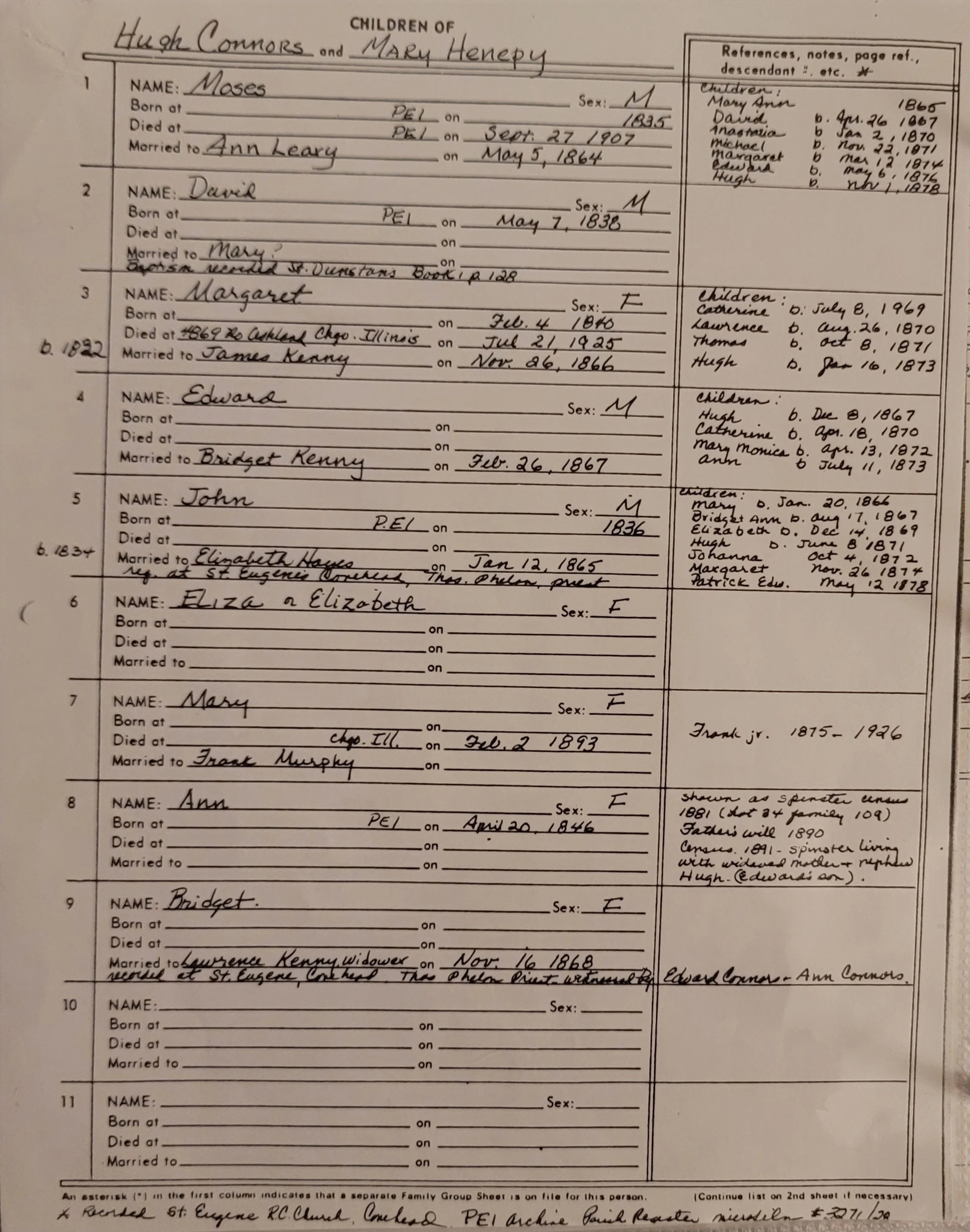
Hugh and Mary Connors raised a large family on Lot 34. Mary Ellen Molony Brady compiled the children onto a family group sheet in November 1991, working from the St. Eugene's parish register on Prince Edward Island Archives microfilm #3271/28, and she recorded nine — four sons and five daughters. That count is not just her arithmetic: Hugh's 1890 obituary says he died "leaving a widow, 4 sons and 5 daughters," which is the structural check on the list. Only two of the nine have a surviving baptism on the Island — David in 1838 and Ann in 1846, both at St. Dunstan's in Charlottetown, and both transcribed in full below; the eldest, Bridget, was baptized in Newfoundland before the family ever reached the Maritimes mainland. The rest are placed on the sheet from the marriage register, the censuses and the will. The cards below keep the group sheet's order, which is not birth order.
Moses Connors
Eldest son. Married Ann Leary, 5 May 1864, by banns, Fr. Thomas Phelan officiating; seven children. Named executor of Hugh's will. The 1891 census gives his age as 56 in the next dwelling to the home farm.
John Connors
Married Elizabeth Hayes, Jan. 12, 1865, at St. Eugene's Church, Covehead. Father Phelan officiating.
David Connors
Baptized May 19, 1838, St. Dunstan's — Book 1, p. 198, by James F. Morris. Father: Hugh Connors, Mother: Mary Henepy. Witness at his brother Moses's wedding in May 1864; gone from Lot 34 by 1881. Not to be confused with his nephew David, son of Moses, who was fourteen that year.
Eliza Connors
Listed sixth on the group sheet with no detail beside her name. She surfaces once in the registers: witness at her brother Edward's marriage to Bridget Kenny, February 26, 1867.
Margaret Connors
Married James Kenny, Nov. 26, 1866. Four children: Catherine, Lawrence, Thomas, Hugh. Her three Chicago census returns all imply a birth about 1836.
Edward Connors
Absent from the three boys counted in the 1841 census, so born after that spring. Married Bridget Kenny, Feb. 26, 1867. Children: Hugh, Catherine, Mary Monica, Ann. Died young: the 1881 census enters Bridget as a widow, keeping her own family under his father's roof with Hugh 13, Catherine 11 and Mary 9.
Ann Connors
Baptized May 31, 1846, St. Dunstan's, by M. Reynolds — "5 weeks old," which is the only indication of her birth. Never married; cared for by family per Hugh's will.
Mary Connors
Married Francis Murphy at Old St. Stephen's, Chicago, April 10, 1871. Son Frank Jr. (1875–1926). Buried in the south half of her sister Margaret's plot at Calvary, with Frank Sr. (d. 1896) and Frank Jr. (d. 1926). A "May Connors" witnessed Moses's wedding in 1864 — see below.
Bridget Connors
The eldest. Her baptism in St. John's is the record that opened the series (Episode 1). Married Lawrence Kenny (widower), Nov. 16, 1868, St. Eugene's; Father Phelan officiating, witnessed by her brother Edward and her sister Ann. Census ages 47 in 1881 and 58 in 1891.
The Two Island Baptisms
Two of the nine children have a surviving baptismal record on Prince Edward Island, both at St. Dunstan's in Charlottetown. Together they are the only documents that name Hugh and Mary as parents in their own right.
| Child | David Connors |
|---|---|
| Birth date | 7 May 1838 |
| Place of birth | Charlottetown |
| Baptism date | 19 May 1838 |
| Officiating clergy | James F. Morris |
| Father | Hugh Connors |
| Mother | Mary Henepy |
| Church | St. Dunstan's, Charlottetown |
| Record book · page | Book 1 · p. 198 |
Baptismal record, David Connors, 19 May 1838, St. Dunstan's, Charlottetown, Book 1, p. 198. Public Archives and Records Office of Prince Edward Island, PARO Collections Database, record 127976.
| Child | Ann Connors |
|---|---|
| Birth date | [no date entered] |
| Place of birth | Charlottetown |
| Baptism date | 31 May 1846 |
| Officiating clergy | M. Reynolds |
| Father | Hugh Connors |
| Mother | Mary Henery |
| Church | St. Dunstan's, Charlottetown |
| Record book · page | Book 2 · p. 122 |
| Notes | Date of birth: "5 weeks old" |
Baptismal record, Ann Connors, 31 May 1846, St. Dunstan's, Charlottetown, Book 2, p. 122. Public Archives and Records Office of Prince Edward Island, PARO Collections Database, record 127866.
Two corrections fall out of these entries. David's baptism is at Book 1, page 198; the family group sheet gives page 128, and 198 is what the record says. And Ann has no recorded birth date at all — only the priest's note that she was "5 weeks old" at the font on 31 May 1846. Any April birth date for her is a calculation, not a record, and five weeks back from 31 May falls around 26 April. Earlier versions of this page gave 20 April as though it had been written down.
The mother's surname is entered differently in each: Henepy in 1838, Henery in 1846 — two more renderings of the name that appears as Henesy in Newfoundland, Cummins or Crimmens in New Brunswick, and Hennessey elsewhere. Four priests, four spellings, one woman.
A Wedding in 1864, and Two Witnesses
Moses, the eldest, married first. The entry sits on a page of the St. Eugene's marriage register alongside five other Covehead weddings of the same year, and the witnesses are the reason it matters here.
| Parties | Moses Connors, B. · An[n] Leary, S. |
|---|---|
| Date of celebration | 5 May 1864 |
| By licence or banns | Banns |
| Witnesses | David Connors · May Connors |
| Certified by | Thomas Phelan, C.C. |
| Recorded | 13 December 1864 |
Marriage register, Moses Connors and Ann Leary, 5 May 1864, pp. 198–199. Prince Edward Island Archives, St. Eugene's parish register, microfilm #3271/28.
The First Island Trace of Mary
Mary Connors is the thinnest figure on the group sheet — no birth date, no birthplace, nothing before she turns up in Chicago in 1871 marrying Francis Murphy. Here, seven years earlier, a "May Connors" signs as witness at her brother's wedding, beside David Connors. "May" was an ordinary contraction of Mary in this hand. The register does not say these two are the groom's brother and sister — registers rarely do — but two Connorses standing up at a Connors wedding in Covehead in 1864 is the first thing resembling a record of Mary on the Island, and it puts David there too, twenty-six and still at home, seventeen years before he vanishes from the census.
Worth saying what this is not. It is a name on a line, not a stated relationship, and this series has been caught once already reading too much into a witness list. What it earns is a place in the file and a reason to look: a Mary Connors of the right family in the right parish at the right date, where before there was nothing at all.
An Unplaced Baptism
One record in the file does not fit the nine — and set beside the two above, the reason becomes obvious.
| Child | Hugh Connor |
|---|---|
| Birth date | 18 October 1839 |
| Place of birth | [no field] |
| Baptism date | 18 October 1839 |
| Officiating clergy | L. Deligney |
| Father | [no father named] |
| Mother | Mary H. |
| Church | St. Mary's R.C., Indian River |
| Notes | "Film" |
Baptismal record, Hugh Connor, 18 October 1839, St. Mary's R.C., Indian River. Public Archives and Records Office of Prince Edward Island, PARO Collections Database, record 128068.
The Record Names No Father
David's entry names Hugh Connors. Ann's entry names Hugh Connors. This one names nobody. There is no father's field, no place of birth, and the mother is given only as "Mary H." Everything that ties this baptism to the Lot 34 family is inference: a surname, an initial, and a year. It is not enough to make a son of Hugh and Mary, and it is not enough to fix a birth date on anyone.
No Hugh appears among the nine children on the 1991 group sheet. The obituary's count would not settle it either way — it records survivors, so a son who died before 1890 would not be listed.
Two things keep this from being settled. The first is geography, though it cuts less deeply than it looks: Indian River lies in Lot 13, Prince County, some thirty-five miles west of Covehead, while the family's other baptisms are at St. Dunstan's in Charlottetown. But 1839 is also, on Episode 1's reading of the obituary, about the year the Connors reached the Island — a family still moving is a family that could be baptizing a child anywhere. The second problem is the sharper one. The same date — 18 October 1839 — is also carried in the family's records as the birth date of Edward Connors. One document is being read two ways.
An Open Question
Either there was a Hugh Connors Jr. who died before his father and is missing from the group sheet, or the 1839 Indian River entry was at some point assigned to Edward and has been doing double duty ever since. The two readings cannot both stand. Until the register is re-examined, this page records the nine children the group sheet and the obituary agree on, and sets the 1839 baptism beside them rather than inside them.
The 1841 census, transcribed above, adds a count that neither reading can ignore. Eighteen months after this baptism, the household holds three males under sixteen. Moses, John and David fill those three places exactly. A Hugh born in October 1839 and still living would be a fourth, and Edward — if he was born by 1841 — a fifth. The house has room for neither.
That does not close the question; it narrows it. Either the Indian River child was never of this family, or he died before the 1841 enumeration. Edward's birth date has now been withdrawn across the series — from this page, from Episode 7 and from the series overview — because the only record it ever rested on names no father. He is recorded here as born after the spring of 1841, which is what the household count supports and all that can honestly be said. The test remains the register itself: St. Mary's, Indian River, for October 1839, read against the St. Dunstan's books for the same period. If Edward's own baptism turns up with a date of its own, the question answers itself.
Three Kenny-Connors Marriages
Between 1866 and 1868, three of Hugh Connors' children married into Lawrence Kenny's family: Margaret married James Kenny (Lawrence's son), Edward married Bridget Kenny (Lawrence's daughter), and Bridget married Lawrence Kenny himself after he was widowed. These three marriages in three years transformed two neighboring families into one extended kinship network.
A fourth Kenny marriage belongs in the picture, though it was not a Connors match: Lawrence's daughter Alice married John O'Brien in 1869. In 1881 the O'Briens are the very next family on the page after Hugh Connors — Alice, 43, recorded as married, with Mary 11, Lawrence 9, James 7, Patrick 6 and Michael 4, and no husband in the house. Ten years later a John O'Brien, 40, a stone mason born in Ireland, heads the household beside Alice at 55. Episode 5 follows the three Connors weddings; the O'Briens are the reminder that Lot 34's Irish households intermarried in every direction — and that this one has a question in it. A man of forty in 1891 was eighteen in 1869, and Alice was thirty-four.
A Henesey on Prince Edward Island
Five entries down the same register spread, on 28 January 1864, Patrick Brogan married Catherine Henesey — and the witness was Paul Henesey.
That name has appeared once before in this series. At Bridget's baptism in Newfoundland in September 1832, the sponsor was Paul Henesy, whom Episode 1 reads as Mary's brother. Thirty-two years later a Paul Henesey is standing witness in the Connors' own parish on Lot 34.
One man or two, this has not been tested, and thirty-two years is long enough for a son to carry his father's name. But it is the first sign anywhere in this file that Mary Henepy's own family came to the Island as well — that she did not arrive among strangers — and it hands the Henesey line a parish, a year and two given names to start from. It also supplies something the spellings argument has lacked: an independent Prince Edward Island attestation of the surname, written HENESEY, by a priest who had no connection to the Newfoundland register.
Bridget Was the Eldest
Episode 1 identifies the Bridget baptized in Newfoundland in September 1832 as the same Bridget Connors who married the widowed Lawrence Kenny in 1868 — the child whose baptism opened the whole investigation. Her census ages corroborate it: 47 in 1881 and 58 in 1891 both point to the early 1830s. That makes her the eldest of the nine, and it means she was born a year before her parents' marriage — which is precisely what the dispensation of banns in that 1833 entry would lead one to expect. The group sheet, which lists her ninth and leaves her birth blank, is the one place this does not show.
| Connors, Moses | M · 45 · Farmer · Married |
|---|---|
| Ann | F · 43 · Married |
| Mary A. | F · 16 |
| David | M · 14 |
| Anastasia | F · 11 |
| Michael | M · 9 |
| Edward | M · 5 |
| Hughie | M · 2 |
1881 Census of Canada, Prince Edward Island, District 2 Queens, Sub-district L, Township 34, p. 26, dwelling 109 [sic, family 114]. Transcribed from the original nominal return.
Six children, and one who should be there is not. The group sheet gives Moses seven, among them a Margaret born 12 March 1874 — the infant whose godparents were Lawrence Kenny and Margaret Connors Kenny, home from Chicago that spring. A girl born in March 1874 would be seven in 1881, and she is not in the house. She may have been away, or she may have died in childhood; the parish burial register would say which. It is a small gap, but it sits directly beneath one of the warmest moments in the whole series.
Neighbors on the Land
Two historical maps document that the Kenny and Connors families were neighbors on the Montgomery Estate. The earliest evidence comes from Daniel Hickey's 1850 cadastral survey, which records Lawrence Kenny at No. 19 and Hugh Connors at No. 236—both tenants on Sir Graham Montgomery's property. The red ink annotations on the Hickey Map show later ownership transfers, with "now John Connors" appearing below William Riley's entry (No. 21), indicating the Connors family expanded their holdings over time.
 View the full document →
Thirteen years later, the 1863 Lake Map—the first commercial map to record property owners across all of Prince Edward Island—confirms what the Hickey survey showed: "L. Kenny" and "H. Connors" appear on Lot 34, their properties connected by the roads that linked this Irish Catholic community.
 View the full document →
Two Maps, One Story
The 1850 Hickey Map was a cadastral survey created for the Montgomery Estate, recording each tenant by parcel number with their acreage. It documents the landlord's perspective—who held what land and how much rent they owed. The 1863 Lake Map was a commercial venture, the first to record property owners across all of Prince Edward Island for public sale. Together, these maps provide complementary evidence: the Hickey Map shows Lawrence Kenny at No. 19 and Hugh Connors at No. 236 as tenants on the Montgomery Estate; the Lake Map shows them geographically as neighbors on Lot 34. Both families appear on both maps—proof they were neighbors for at least thirteen years before their children's marriages began in 1866.
This was a tightly-knit Catholic community. The same families appear again and again in the census records and parish registers: Reardon, Fitzpatrick, Whelan, Carroll, Kelly, Tracy, Kenny, Connors. They attended the same church, paid rent to the same landlord, and worked the same red Island soil. In such a world, the children of neighboring farms grew up together, and marriages between families were as much about strengthening community bonds as romantic attachment.
The Covehead Road
A sign on the Covehead Road claims it to be "The oldest road on Prince Edward Island." While this distinction may actually belong to the earlier French cart track linking the Hillsborough River to Havre-Saint-Pierre, the Covehead Road is certainly the oldest road still in continuous use on the Island. For families like the Kennys and Connors, this road was the spine of their community—connecting farms to church, neighbors to neighbors, and ultimately, family to family.
St. Eugene's Church
The Catholic community of Lot 34 centered on St. Eugene's Church in Covehead, where Father Thomas Phelan served as parish priest for much of the mid-19th century. The church was more than a place of worship—it was the social hub where families gathered, children were baptized, couples married, and the dead were remembered.
Both families left their marks in the parish registers. Lawrence Kenny's chapel subscriptions are recorded: 10 shillings toward painting the chapel in January 1861, another 10 shillings for fencing the churchyard in January 1862, and pew rent for pew #17 in the North Aisle in March 1865. Hugh Connors' children were baptized, married, and buried through the same parish.
The Kenny Connection
Jan. 7, 1861: Lawrence Kenny pays 10 shillings toward chapel painting
Jan. 1862: 10 shillings for fencing churchyard
Mar. 19, 1865: Pew rent #17, North Aisle
Mar. 21, 1874: Lawrence Kenny and his daughter-in-law Margaret Connors Kenny stand as godparents to Margaret, infant daughter of Moses Connors and Ann Leary
The Connors Connection
Jan. 12, 1865: John Connors marries Elizabeth Hayes (Fr. Phelan)
Nov. 26, 1866: Margaret Connors marries James Kenny
Feb. 26, 1867: Edward Connors marries Bridget Kenny
Nov. 16, 1868: Bridget Connors marries Lawrence Kenny (Fr. Phelan)
The Long Life of Hugh Connors
Hugh Connors lived to see the transformation of his family from Irish immigrants to established Island farmers. The 1881 census shows him at age 78, still on Lot 34 with his wife Mary (age 70), along with several unmarried children still in the household. By this time, his married children had established their own families, and the Kenny-Connors marriages had produced grandchildren who would carry both family names forward.
| Family 109 | |
|---|---|
| Connors, Hugh | M · 78 · b. Ireland · Catholic · Irish · Farmer · Married |
| Mary | F · 70 · Married |
| Ann | F · 30 · b. P.E.I. |
| Family 110 — the same dwelling | |
| Connors, Bridget | F · 38 · W (widow) |
| Hugh | M · 13 |
| Catherine | F · 11 |
| Mary | F · 9 |
1881 Census of Canada, Prince Edward Island, District 2 Queens, Sub-district L, Township 34, p. 25, dwelling 109, families 109 and 110. Transcribed from the original nominal return.
Edward's Death, in the Record at Last
The second family under Hugh's roof is his son Edward's. Bridget is enumerated as a widow in 1881, with Hugh 13, Catherine 11 and Mary 9 — so Edward died after about 1872, when his youngest was born, and before the spring of 1881. Until now this page could only say "before 1881" as an inference from his absence. The census says it outright.
One caution about every age in that dwelling: they run low, and they run low together. Ann was baptized in 1846 and should be about thirty-four, not thirty. Bridget Kenny was baptized in March 1839 and should be about forty-two, not thirty-eight. Mary Henepy, born about 1803, should be about seventy-eight, not seventy. Three women, each four to eight years short. That is not three separate mistakes but one enumerator working from a single informant's guesses, and it is the reason this page does not treat the 1881 ages as evidence against the 1891 return, which gives Ann 44 and Mary 88 — both of which fit the baptism and the group sheet.
Two absences in that household are worth noticing as much as the presences. There is no adult son named Hugh — the Hugh here is thirteen, Edward's boy and the future heir. And David, born in 1838, is not on Lot 34 at all; at forty-three he had gone somewhere the Island censuses have not yet been searched for him.
Hugh Connors died on November 22, 1890, at his home on Friston Road, Covehead. The Summerside Journal published his obituary on December 14, 1890:
"At Friston Road on the 22nd ult. Hugh Connors, aged 90 years, leaving a widow, 4 sons and 5 daughters, besides a large circle of grandchildren to mourn their loss. Deceased emigrated from County Wexford, Ireland to Prince Edward I., where he was favorably known and universally respected, in the year 1832."
His will, filed on December 24, 1890 before commissioner Peter Campbell by John S. McDonald, named Moses Connors and James Furlong as executors. The property was left to his grandson Hugh — Edward's son — with one significant stipulation: he must care for his Aunt Ann, who had never married and remained dependent on the family.
The Will, Five Months Later
The 1891 census shows the arrangement working exactly as written. Dwelling 113 on Lot 34 holds Hugh Connors, 23 — the grandson and heir — with his widowed mother Bridget, 50, his sisters Catherine and Mary, "Annie, 44, Aunt" provided for as the will required, and "Mary, 88, Widow, Grandmother, born Ireland."
— 1891 Census of Canada, district 135 Queens, sub-district 1, township 34, division 2, p. 25
That last line matters beyond this episode. The Prince Edward Island Genealogical Society's abstract of the death notice calls Hugh a widower; the notice itself, as Mary Ellen transcribed it, says he left a widow. The 1891 census settles it. Mary Henepy was alive five months after her husband's will was filed, living on the farm with her grandson. Episode 7 sets out the two versions of the notice in full.
From County Wexford to Lot 34
Hugh Connors' obituary confirms what the documentary evidence suggests: he came from County Wexford, Ireland—the same southeastern region that may have been home to the Kenny family as well. The question raised in Episode 2 gains new significance here: Did the Kenny and Connors families know each other in Ireland? Were the three marriages in the 1860s a continuation of older bonds, or a new connection forged in the shared experience of Island life?
The evidence cannot answer definitively. But it can show us two families who arrived in Atlantic Canada through different routes—the Kennys through Newfoundland directly to PEI, the Connors through Newfoundland and New Brunswick before settling on the Island—and who found themselves neighbors on the Montgomery Estate. Their children grew up together, attended the same church, and in a span of three years transformed two families into one.
The Pattern Continues
In Episode 2, we explored a 1776 marriage between John Kenny and Catherine Connors in County Wexford, Ireland. Now, on Prince Edward Island in the 1860s, we see another generation of Kenny-Connors marriages. Whether this represents a continuation of old-country ties or a coincidence of common Irish surnames, the documentary evidence shows that these two families were deeply intertwined—first as neighbors, then as kin.
In this small world of neighboring farms and shared faith, what happened next was perhaps inevitable. The children of Lawrence Kenny and the children of Hugh Connors did not merely live side by side—they became family. The three marriages of 1866-1868 would produce children who carried both names forward, and some of those children would eventually leave Prince Edward Island for new lives in the American Midwest.








Are You Connected to the Kenny-Connors Line?
If you descend from the Kenny or Connors families of County Wexford, the O’Connor family of Castleisland, County Kerry, or the Casey or Corcoran families — or their branches in Newfoundland, Prince Edward Island, or Chicago — I’d like to compare notes. Documented trees, DNA matches, family papers, and even half-remembered stories have all moved this research forward.
Get in Touch About This FamilyCousin connections are informal and reciprocal — no fee, no obligation, just shared work on shared ancestry.
Every Family Has a Story Worth Telling
Whether you're just beginning your research or ready to transform years of work into a narrative your family will treasure, I'd love to hear your story.
BEGIN YOUR RESEARCH INQUIRY