
Two Families, One Story: From Tailor to Farmer
From Tailor to Farmer
In October 1832, Lawrence Kenny brought his infant son James to St. Patrick's Church in St. John's, Newfoundland, to be baptized. The sponsors were Pierce Grace and Mary Keane—names that speak to the tight-knit Irish fishing community of the island. Within three years, Lawrence and his wife Catherine Corcoran would leave Newfoundland behind. They were heading for Prince Edward Island, where a different kind of life awaited: not fish, but soil. Not the sea, but the land.
The 1841 census captures Lawrence Kenny at a pivot point in his life. He is listed as a "Tailor"—the trade he brought from Ireland, perhaps practiced in Newfoundland, and still claimed on his arrival in the colony. But by the time of the next census, that occupation would be gone. Lawrence Kenny, tailor, would become Lawrence Kenny, farmer. The transformation was complete.
The 1841 Census
Prince Edward Island
The census enumerator found Lawrence Kenny's household that year: five persons living on fifty acres, paying rent to the Montgomery Estate. The details reveal a family in transition—Irish-born parents with children born across three different jurisdictions.
(£3/15/0 in all)
| The Household | |
|---|---|
| Township | 34 |
| Head of family | [not entered] |
| Trade or occupation | Tailor |
| Males under 16 · 16–45 · 45–60 · over 60 | 1 · 1 · 0 · 0 |
| Females under 16 · 16–45 · 45–60 · over 60 | 2 · 1 · 0 · 0 |
| Total in family | 5 |
| Roman Catholic | 5 |
| Land | |
| Acres in fee simple · by leasehold | 0 · 0 |
| Acres held by written demise | 50 |
| Term of lease | 999 years |
| Years of term expired | 3 |
| Present rent per acre | 0/1/6 (one shilling and sixpence) |
| Rent in sterling | 3/15/0 |
| Quality — 1st · 2nd · 3rd | 0 · 50 · 0 |
| Acres of arable land | 10 |
| Produce and Stock | |
| Bushels — wheat · oats · barley · potatoes | 7 · 50 · 6 · 400 |
| Horses · neat cattle · sheep · hogs | 2 · 2 · 0 · 6 |
| Passage and Origin | |
| Persons who paid their own passage | 2 |
| Natives of England · Scotland | 0 · 0 |
| Natives of Ireland | 2 |
| Natives of this Island | 2 |
| Natives of the British Colonies | 1 |
| Natives of other Colonies | 0 |
1841 Census of Prince Edward Island, Township 34, Lawrence Kenny. Public Archives and Records Office of Prince Edward Island, PARO Collections Database, record 256. Transcribed from the PARO record.
The household composition tells a story of movement, and the census counts it out precisely. Five people: two natives of Ireland — Lawrence and Catherine — two natives of this Island, and one native of "the British Colonies." That one is James, baptized at St. Patrick's in St. John's in October 1832. By 1835 Alice was born in Charlottetown and baptized at St. Dunstan's on July 2nd; Bridget followed in 1839, also at Charlottetown. The family had arrived on PEI sometime between late 1832 and July 1835.
The Same Six Words, Two Farms Apart
Hugh Connors' household, enumerated on the same Lot in the same census, also returns exactly one native of "the British Colonies" — his daughter Bridget, baptized in the same St. John's parish weeks before James. Neither family had a second child from Newfoundland; each had one, and the 1841 enumerator recorded both under the same six words without any idea what he was writing down. Episode 4 sets out the Connors return.
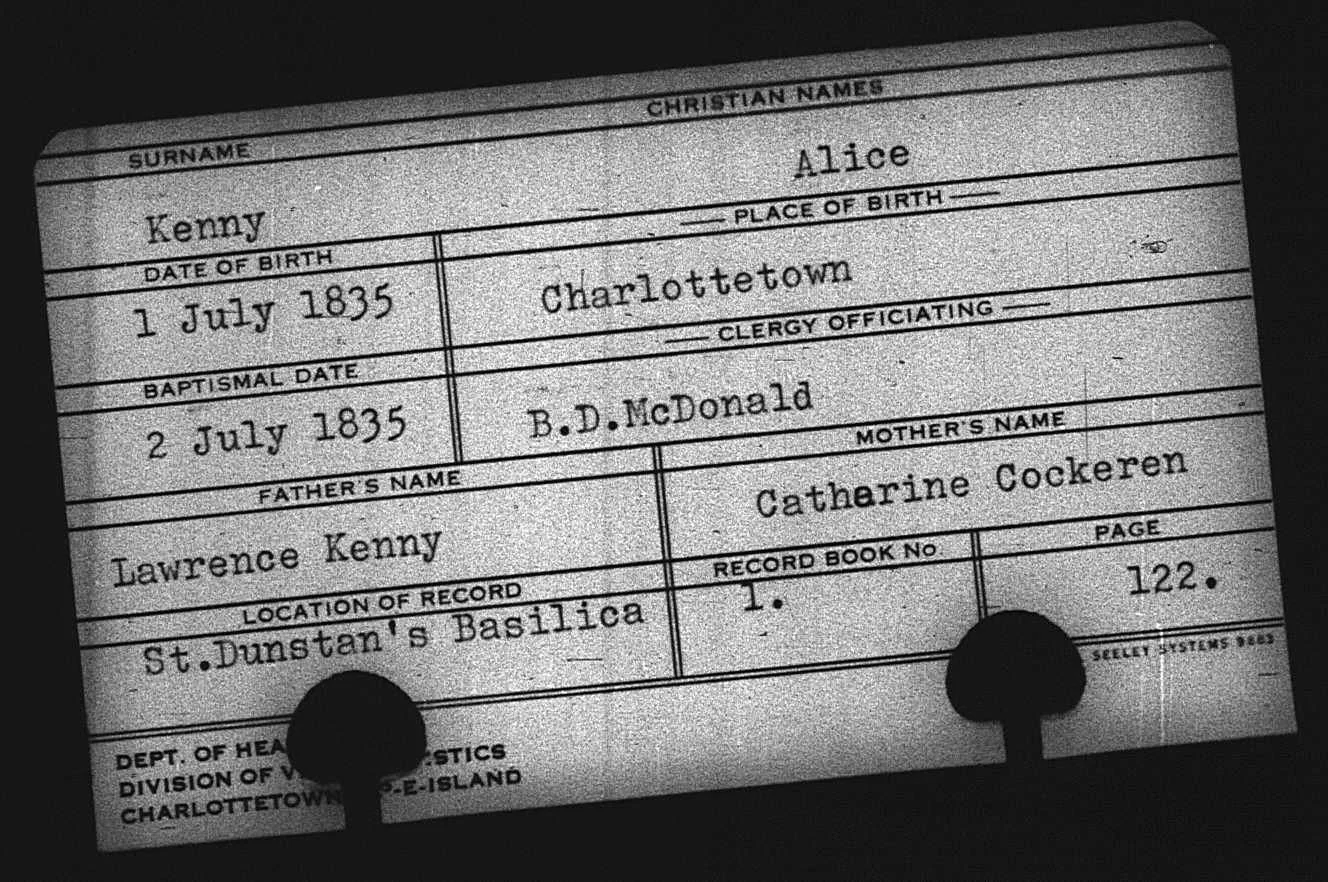
The baptismal records from St. Dunstan's Basilica confirm the details, and they are worth setting out in full — they are the only documents that name Lawrence and Catherine as parents in their own right.
| Child | Alice Kenny |
|---|---|
| Birth date | 1 July 1835 |
| Place of birth | Charlottetown |
| Baptism date | 2 July 1835 |
| Officiating clergy | B. D. McDonald |
| Father | Lawrence Kenny |
| Mother | Catharine Cockeren |
| Church | St. Dunstan's Basilica, Charlottetown |
| Record book · page | Book 1 · p. 122 |
Baptismal record, Alice Kenny, 2 July 1835, St. Dunstan's Basilica, Charlottetown, Book 1, p. 122. Public Archives and Records Office of Prince Edward Island, PARO Collections Database, record 149901.
| Child | Bridget Kenny |
|---|---|
| Birth date | [no date entered] |
| Place of birth | Charlottetown |
| Baptism date | 5 March 1839 |
| Officiating clergy | Charles McDonnell |
| Father | Lawrence Kenny |
| Mother | Catharine Corcoran |
| Church | St. Dunstan's Basilica, Charlottetown |
| Record book · page | Book 1 · p. 212 |
| Notes | Date of birth: "3 weeks" |
Baptismal record, Bridget Kenny, 5 March 1839, St. Dunstan's Basilica, Charlottetown, Book 1, p. 212. Public Archives and Records Office of Prince Edward Island, PARO Collections Database, record 149908.
Two things these entries settle. Bridget has no recorded birth date — only the priest's note that she was "3 weeks" old at the font, which puts her birth around 12 February 1839. Any February date for her is a calculation, not a record. And the mother's surname is written Cockeren in 1835 and Corcoran in 1839, by two different priests four years apart in the same register: the clearest demonstration on this page of how an Irish name moved with whoever held the pen.
From Tailor to Farmer
The shift from tailor to farmer was not unusual for Irish immigrants on Prince Edward Island. The skills that sustained a man in the crowded streets of an Irish town—or in the fishing settlements of Newfoundland—meant little on the cleared farmland of the Island's interior. What mattered here was the ability to work the soil, to clear forest, to raise crops and livestock.
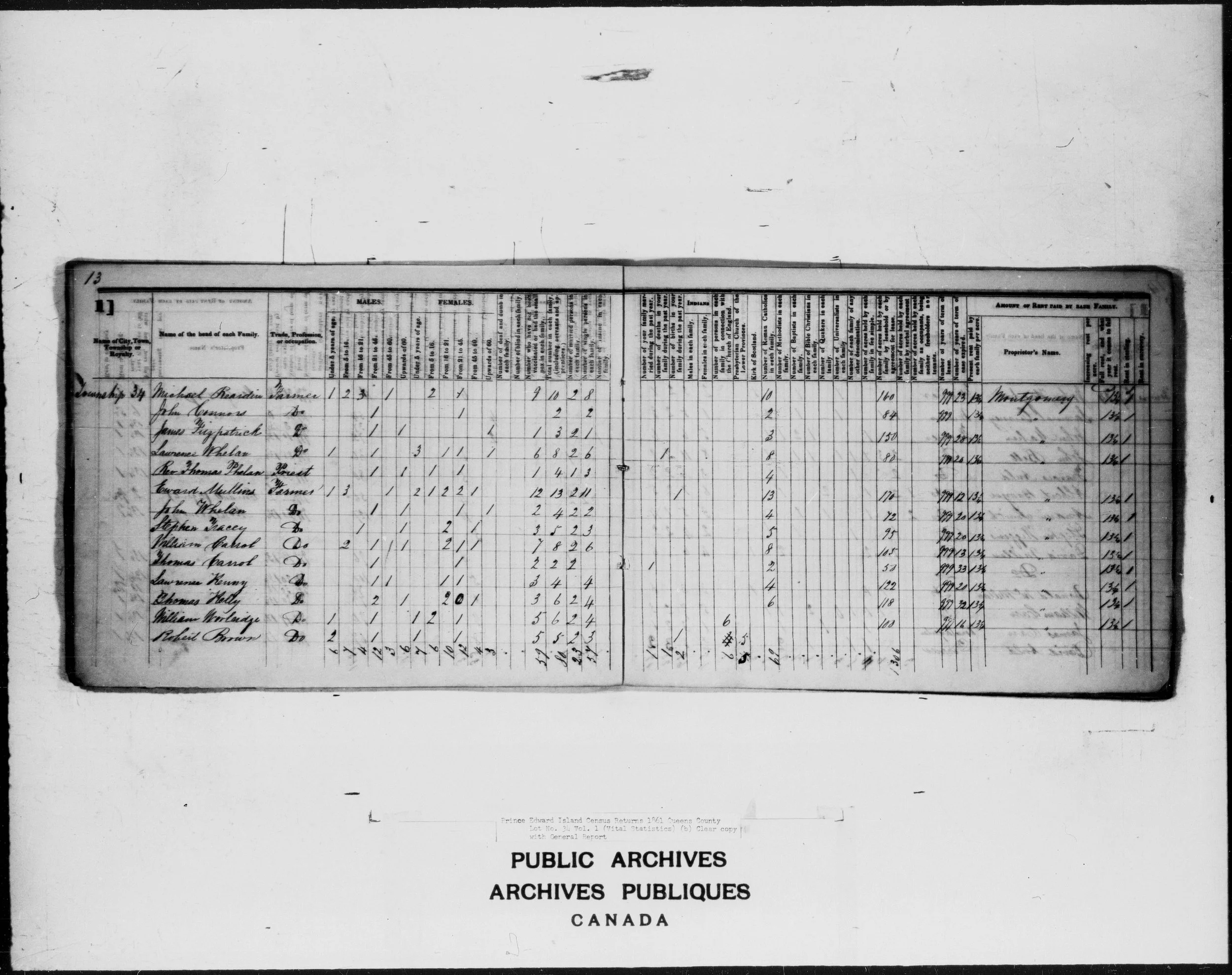
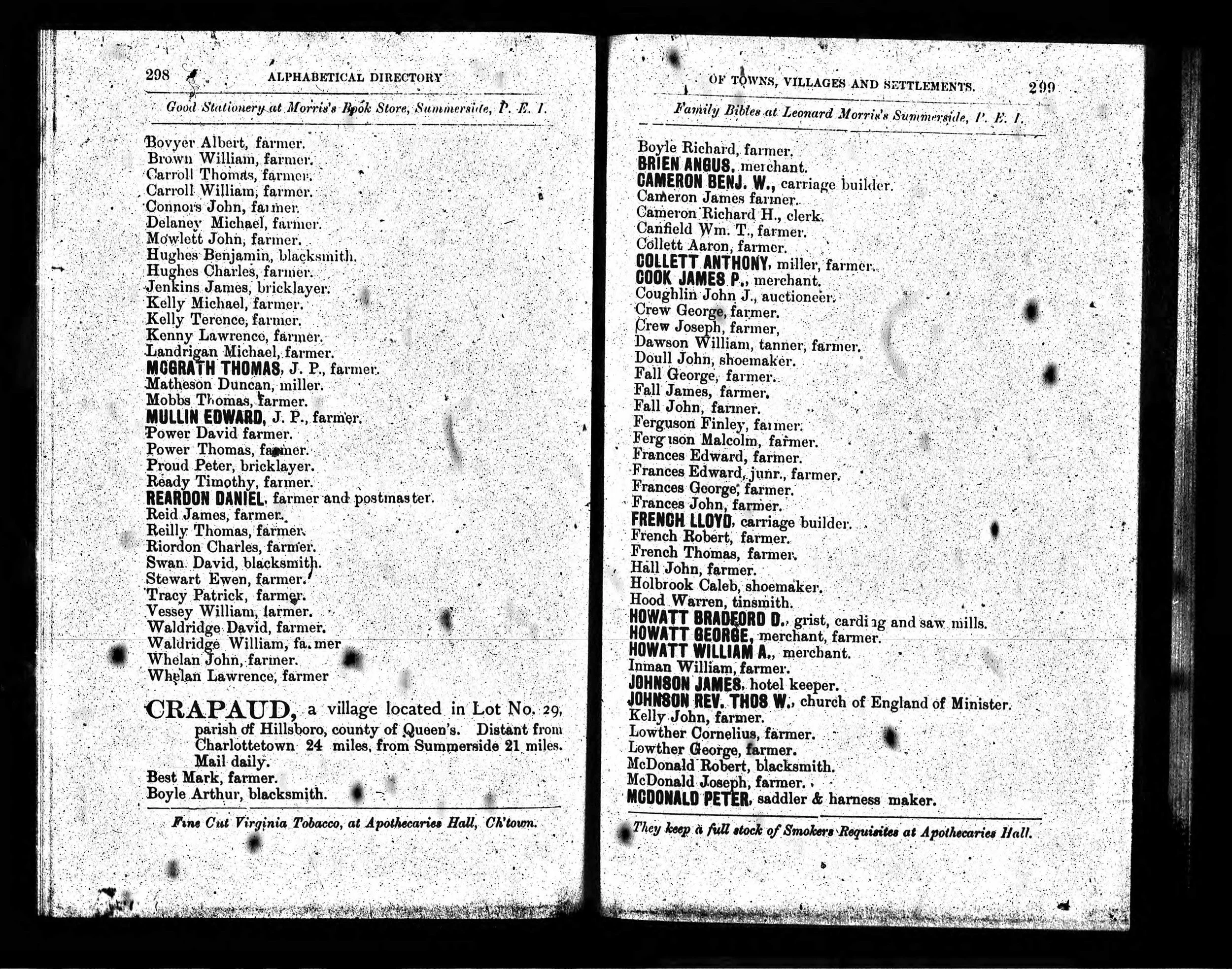
By 1861, when the next detailed census was taken, Lawrence Kenny had fully transitioned. The census lists him simply as a farmer, his tailor's needles long since set aside. The 1881 PEI Directory confirms this transformation: "Kenny Lawrence, farmer." His neighbors along the Covehead Road were farmers too—the Carrolls, the Connors, the Tracys, the Whelans. This was agricultural country.
"Lawrence Kenny, farmer" — the 1881 directory entry marked the end of a journey that began with needle and thread in Ireland and ended with plow and harrow on Prince Edward Island.
Catherine Corcoran
The spelling of her name shifted with each record: Corcoran, Cockeren, Corkeren. The phonetic challenges of recording Irish names in colonial registers ensured that Catherine's surname would appear differently depending on who held the pen. But across all records—the baptisms of her children, her husband's second marriage record, her gravestone—the pronunciation pointed to the same person.
We know remarkably little about Catherine beyond her role as wife and mother. She was born about 1801 — the stone's "Aet. 53" read back from January 1855 — likely in Ireland. She married Lawrence Kenny at a date and place unknown—possibly in Ireland before emigration, possibly in Newfoundland during their years there. She bore at least three children who survived to adulthood: James, Alice, and Bridget.
The Corcoran surname appears in both Wexford and Tipperary records from this period. Pierce Grace and Mary Keane, the sponsors at James Kenny's 1832 baptism in Newfoundland, bear names associated with southeast Ireland—the same region where the Connors and Kenny families may have originated. Was Catherine Corcoran part of the same emigrant network? The baptismal sponsors suggest existing community ties in St. John's.
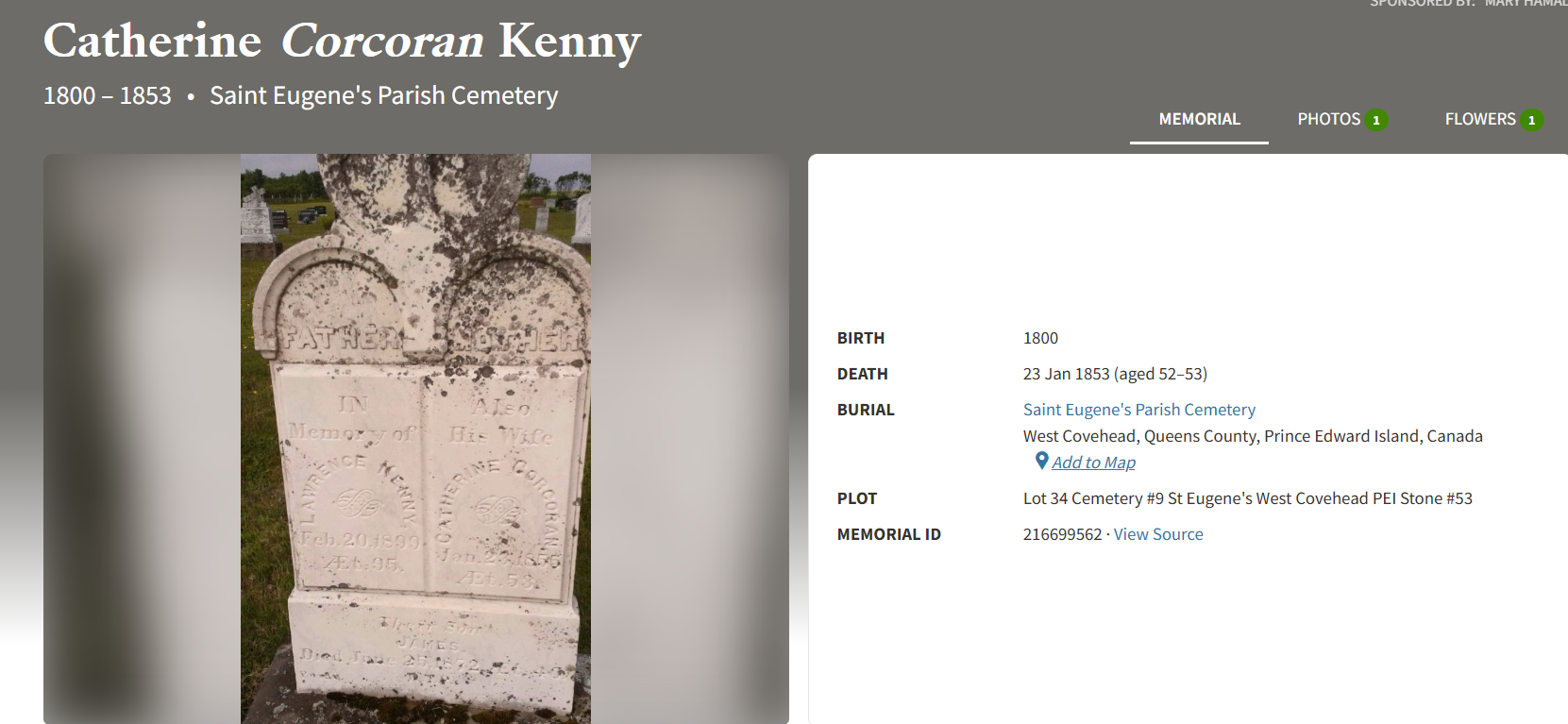
Catherine Corcoran Kenny died on January 23, 1855, at approximately 53 years of age. She was buried at St. Eugene's Parish Cemetery in West Covehead, Lot 34—the same land where she had helped establish a farm, raised her children, and watched them grow toward adulthood. Her death left Lawrence a widower with children still at home. James was about twenty-two, Alice nineteen, and Bridget three weeks short of sixteen.
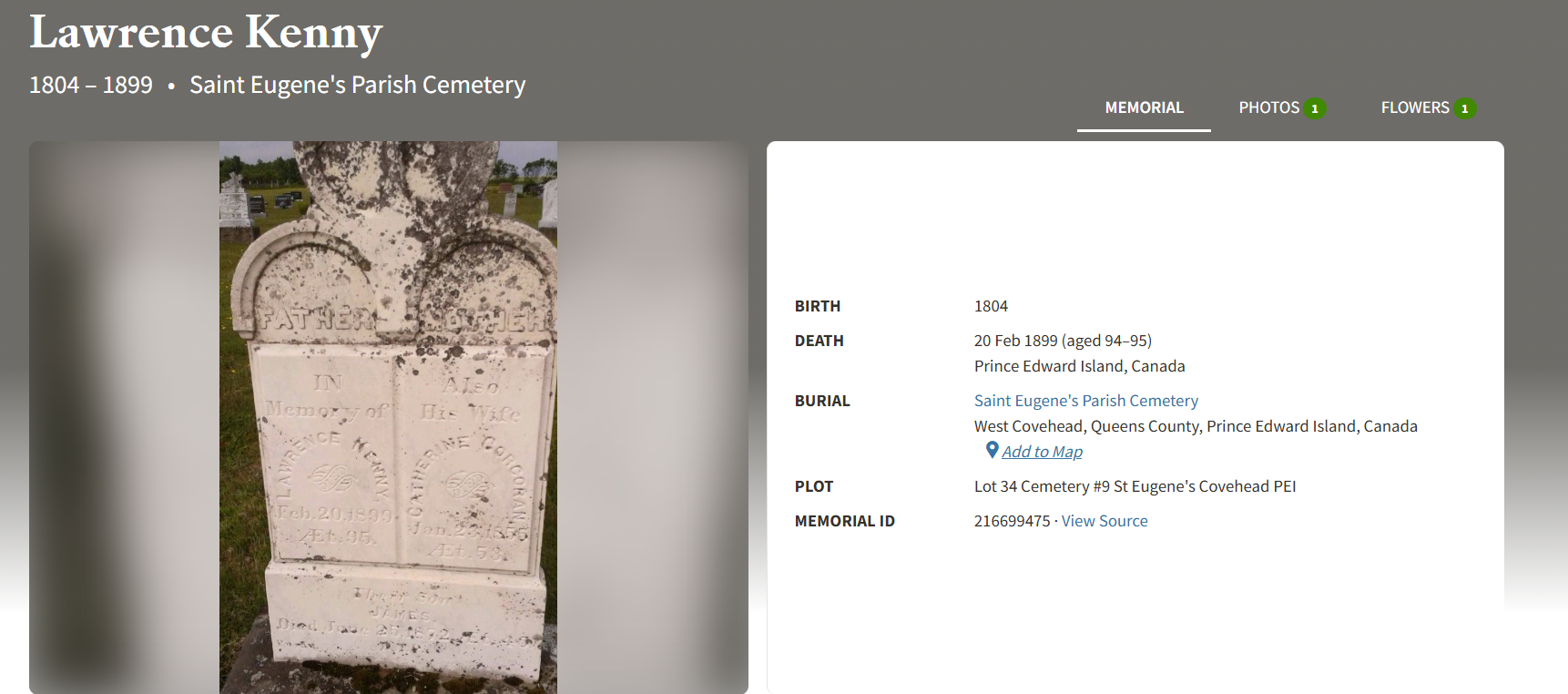
The headstone that marks her grave—shared with Lawrence and their son James—records the stark facts: "Catherine Corcoran / Jan. 23, 1855 / Aet. 53."
The family papers and the Find A Grave memorial both give 1853, and this series formerly followed them. It now follows the stone. The reasoning is simply which artefact is closest to the event: the monument was cut for this grave and carries her age at death as well as the date, while 1853 travels through a compiled sheet and a modern index, neither of which states where it came from. The day and month are identical in every source, which is what one would expect of a single remembered date drifting by two years in transmission. The entry in the St. Eugene's burial register would settle it outright and has not yet been read.
Land and Tenancy
Lawrence Kenny never owned the land he farmed. Like most settlers on Lot 34, he was a tenant of the Montgomery Estate—part of the vast landholding system that had defined Prince Edward Island since the 1767 lottery divided the entire island among British proprietors. The 1841 census sets down exactly what that cost him: one shilling and sixpence an acre, and £3/15/0 in sterling for the whole fifty. The two figures check against each other — fifty acres at eighteen pence is seventy-five shillings, which is £3/15/0 to the penny.
Earlier versions of this page gave the rent as "fifteen shillings per acre." That was the total, £3/15/0, read as a rate and stripped of its pounds. The correction matters for more than arithmetic: fifteen shillings an acre would have been ruinous on a fifty-acre tenant farm, and the real figure is an ordinary Montgomery rent.
Daniel Hickey's 1850 cadastral map of Lot 34—officially titled "A Plan of Township No. 34, The Property of Sir Graham Montgomery & Brothers"—records Lawrence Kenny at No. 19 with 50 acres. The red ink annotations show later ownership transfers: "now Thos Carroll" indicates Thomas Carroll eventually took over the Kenny property. Significantly, Hugh Connors appears at No. 236 with 84 acres, and the notation "now John Connors" below William Riley (No. 21) shows the Connors family expanding their holdings. The families were already neighbors on the Montgomery Estate—a proximity that would matter greatly in the next generation.
The census is precise about the shape of that tenancy in a way the map is not. Lawrence held his fifty acres by written demise on a 999-year term with three years already expired — which puts the beginning of his tenure at about 1838, three years after the family reached the Island. Hugh Connors, on the same estate, held his eighty-four acres by leasehold with none of the term expired in 1841. Two different tenures, taken up about three years apart, with the Kennys first.
The land itself was graded, and the grading explains the rent. All fifty of Lawrence's acres were entered as second quality at one shilling and sixpence; all eighty-four of Hugh Connors' were third quality at a shilling. The Kenny farm was the better ground, and the Montgomery agents priced it accordingly. Ten of the fifty acres were arable in 1841 — seven bushels of wheat, fifty of oats, six of barley, four hundred of potatoes, two horses, two cattle, six hogs and no sheep at all.
The tenant system shaped everything about life on Prince Edward Island. Families like the Kennys could clear land, build homes, raise children—but they could not own what they worked. The land question dominated Island politics throughout Lawrence Kenny's lifetime. It would not be fully resolved until the Land Purchase Act of 1875, by which time Lawrence was already an elderly man.
Widowerhood and Remarriage
For thirteen years after Catherine's death, Lawrence Kenny remained a widower. He appears alone in records, an aging farmer managing his land with whatever help his children could provide. James had married Margaret Connors on 26 November 1866—one of the three Kenny-Connors marriages that would bind the families together. Bridget married Edward Connors three months later, in February 1867. Alice married John O'Brien (Bryan) in 1869.
Alice's marriage has a loose end that this series has not resolved. The 1881 census finds her at forty-three on Lot 34, entered as married, with Mary 11, Lawrence 9, James 7, Patrick 6 and Michael 4 — and her husband nowhere in the return. Stone masons travelled for work, so an absence in April 1881 proves nothing on its own. But the 1891 household is headed by a John O'Brien of forty, born in Ireland, a stone mason, beside Alice at fifty-five. A man of forty in 1891 was eighteen in 1869, when Alice was thirty-four. Either the 1891 age is badly wrong, or the John O'Brien of 1891 is not the man she married in 1869. A marriage record and a death record for the first husband would settle it.
The timeline on this page formerly gave James's marriage as 25 June 1866 at St. Dunstan's. Both halves were wrong. The date was 26 November 1866, and 25 June 1872 — four entries further down — is James's death, which is almost certainly where the day and month came from. The St. Dunstan's attribution was withdrawn across the series: the register entry is certified by Fr. Thomas Phelan of St. Eugene's, Covehead, and was recorded in the same batch as his other Covehead marriages. Episode 5 sets out the evidence.
Then, on November 16, 1868, Lawrence Kenny married again.
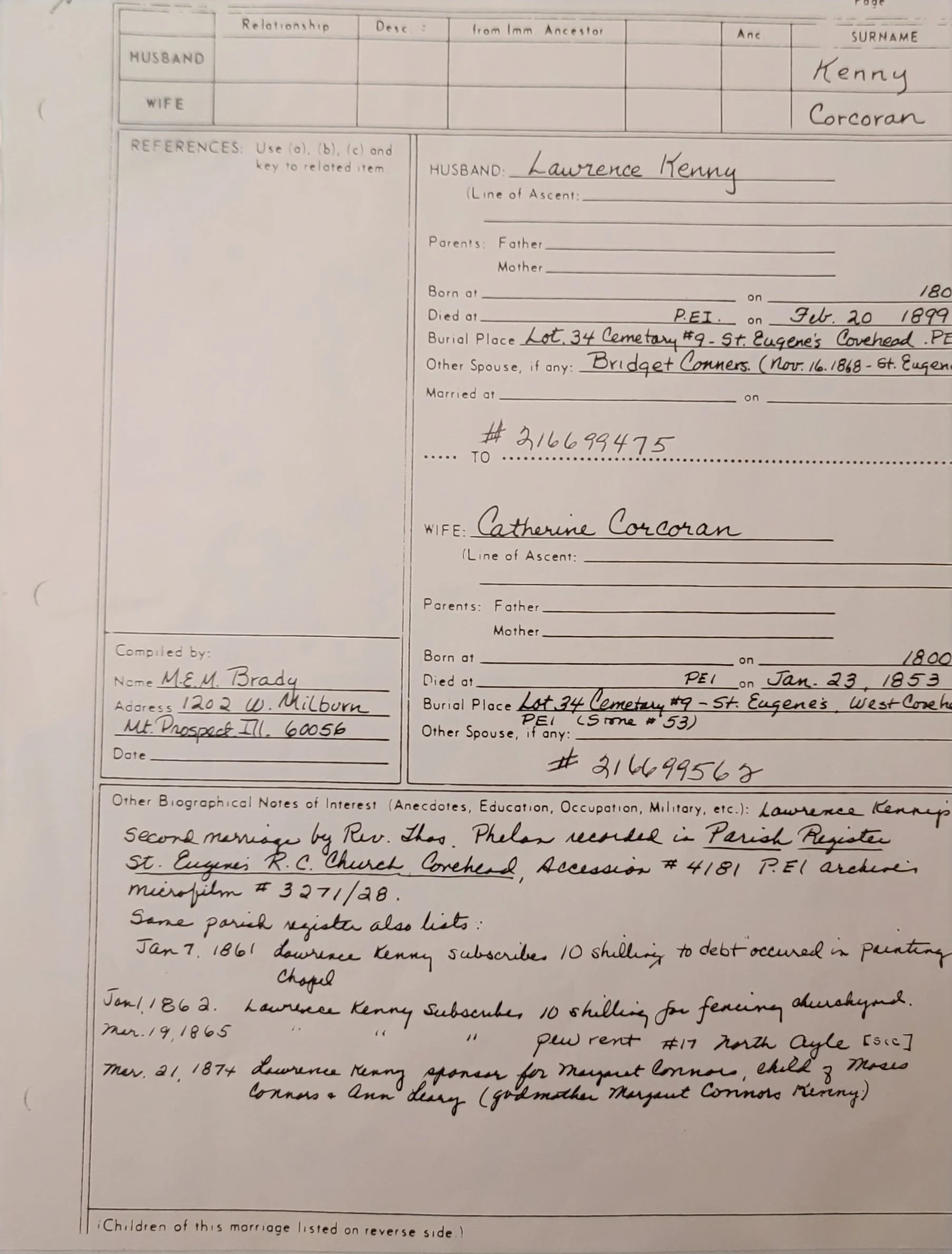
His second wife was Bridget Connors. The marriage was recorded in the Parish Register of St. Eugene's RC Church, Covehead, by Rev. Thomas Phelan, and witnessed by her brother Edward and her sister Ann. Lawrence was approximately sixty-four; Bridget was thirty-six. This was not a marriage for founding a family—it was a practical union between two people who understood the demands of Island life.
This page formerly gave Bridget's age as "about 45," which its own census figures contradict: 47 in 1881 and 58 in 1891 both point to a birth in the early 1830s, not the early 1820s. Episode 1 goes further and identifies her as the Bridget baptized at St. John's, Newfoundland, on 27 September 1832 — the child whose baptism opened the series. That makes her thirty-six at her wedding and the eldest of Hugh Connors' nine children.
The later censuses show the couple together, and all three of the surviving index entries are set out below. The original 1881 return, reproduced in the gallery, gives Bridget's age as 47 alongside her husband's 75.
| Name | LAWRENCE KENNY |
|---|---|
| Age | 75 |
| Religion | Roman Catholic |
| Lot | 34 |
1881 Census of Canada, Prince Edward Island, Lot 34, Lawrence Kenny. Public Archives and Records Office of Prince Edward Island, PARO Collections Database, record 41678.
| Name | LAWRENCE KENNEY |
|---|---|
| Age | 84 |
| Religion | Roman Catholic |
| Lot | 34 |
1891 Census of Canada, Prince Edward Island, Lot 34, Lawrence Kenney. Public Archives and Records Office of Prince Edward Island, PARO Collections Database, record 153257.
| Name | BRIGET KENNEY |
|---|---|
| Age | 58 |
| Religion | Roman Catholic |
| Lot | 34 |
1891 Census of Canada, Prince Edward Island, Lot 34, Briget Kenney. Public Archives and Records Office of Prince Edward Island, PARO Collections Database, record 153258.
Bridget's 58 in 1891 gives a birth about 1833; the Newfoundland baptism is September 1832. Within a year, which is as close as census ages ever come. Lawrence's 84 implies about 1807, against the roughly 1804 that his gravestone's "Aet. 95" requires — a three-year drift of the kind every long life accumulates across four enumerations.
The Long Life
Lawrence Kenny lived to see 95 years—an extraordinary lifespan for his era. Born around 1804 in Ireland, he survived the crossing to Newfoundland, the move to Prince Edward Island, the death of his first wife, the death of his son James, and the transformation of his adopted home from colony to Canadian province.
| Census Year | Age Recorded | Location | Notes |
|---|---|---|---|
| 1841 | ~37 | Lot 34, Township 34 | Listed as Tailor; 50 acres |
| 1861 | ~57 | Lot 34 | Listed as Farmer |
| 1881 | 75 | Lot 34 | With wife Bridget; Roman Catholic |
| 1891 | 84 | Lot 34 | Still on same land |
He died on February 20, 1899, and was buried at St. Eugene's Parish Cemetery—the same ground that held Catherine, his first wife, and James, his son who had predeceased him by 27 years. The headstone erected for the family remains there still, weathered but legible:
FATHER
In Memory of
LAWRENCE KENNY
Feb. 20, 1899
Aet. 95
MOTHER
Also His Wife
CATHERINE CORCORAN
Jan. 23, 1855
Aet. 53
Their Son
JAMES
Died June 25, 1872
The parish records note Lawrence's contributions to his church: January 7, 1861, Lawrence Kenny subscribed 10 shillings toward debt incurred in painting the chapel. January 1862, another 10 shillings for fencing the churchyard. March 19, 1865, paying pew rent for #17 North Ayle. March 21, 1874, serving as sponsor for Margaret Connors, child of Moses Connors and Ann Leary—the godmother being Margaret Connors Kenny, Lawrence's daughter-in-law.
These small entries in parish registers sketch the outline of a life lived within community: the obligations met, the ceremonies witnessed, the family connections maintained across generations.
Neighbors and Family
When Lawrence Kenny first cleared his acres on Lot 34, the Connors family had not yet arrived. The 1841 census puts three years of his term behind him and none of Hugh Connors' — the Kennys took their ground about 1838, the Connors about 1841. By 1850 both were settled, and Hickey's map shows them as tenants on the same estate: Lawrence Kenny at No. 19 and Hugh Connors at No. 236. By the 1860s, their children would begin the intermarriages that would bind the families together: James Kenny to Margaret Connors (1866), Bridget Kenny to Edward Connors (1867), Alice Kenny to John O'Brien whose family had connections to both lines (1869).
Lawrence Kenny, widower, even married a Connors—Bridget—in 1868. The pattern of intermarriage that may have begun in County Wexford decades earlier had found its fullest expression on Prince Edward Island. Two families from Ireland's southeast coast, having crossed the Atlantic by different routes—one through Newfoundland, one through New Brunswick—converged on fifty acres in Queen's County and became, through marriage, one extended family.
Document Gallery









Are You Connected to the Kenny-Connors Line?
If you descend from the Kenny or Connors families of County Wexford, the O’Connor family of Castleisland, County Kerry, or the Casey or Corcoran families — or their branches in Newfoundland, Prince Edward Island, or Chicago — I’d like to compare notes. Documented trees, DNA matches, family papers, and even half-remembered stories have all moved this research forward.
Get in Touch About This FamilyCousin connections are informal and reciprocal — no fee, no obligation, just shared work on shared ancestry.
Every Family Has a Story Worth Telling
Whether you're just beginning your research or ready to transform years of work into a narrative your family will treasure, I'd love to hear your story.
BEGIN YOUR RESEARCH INQUIRY