
Two Families, One Story : To Chicago
To Chicago
In the year James Kenny died—1872—Prince Edward Island was still five years from joining Canadian Confederation. Margaret Connors Kenny was widowed in her thirties, with four children under the age of ten. For five years, she stayed. Then she left everything she knew and traveled a thousand miles to a city still rebuilding from fire.
This is the story of how a widow from Covehead became a Chicago pioneer.
The Decision
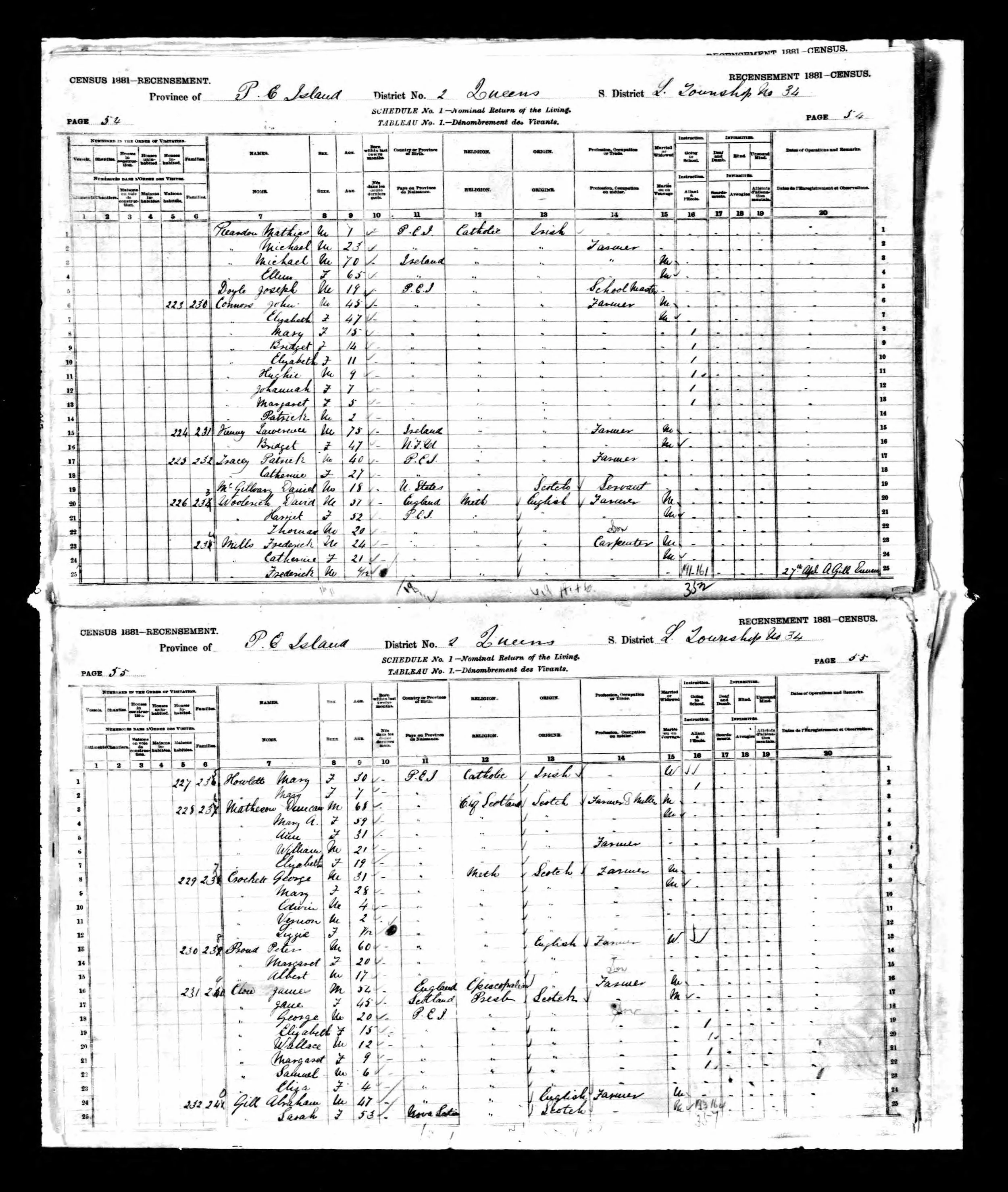
The 1881 census would later record Margaret's father-in-law Lawrence Kenny, then seventy-five years old, still farming at Covehead with his second wife Bridget Connors. Margaret's name does not appear beside them. By then, she was already gone.
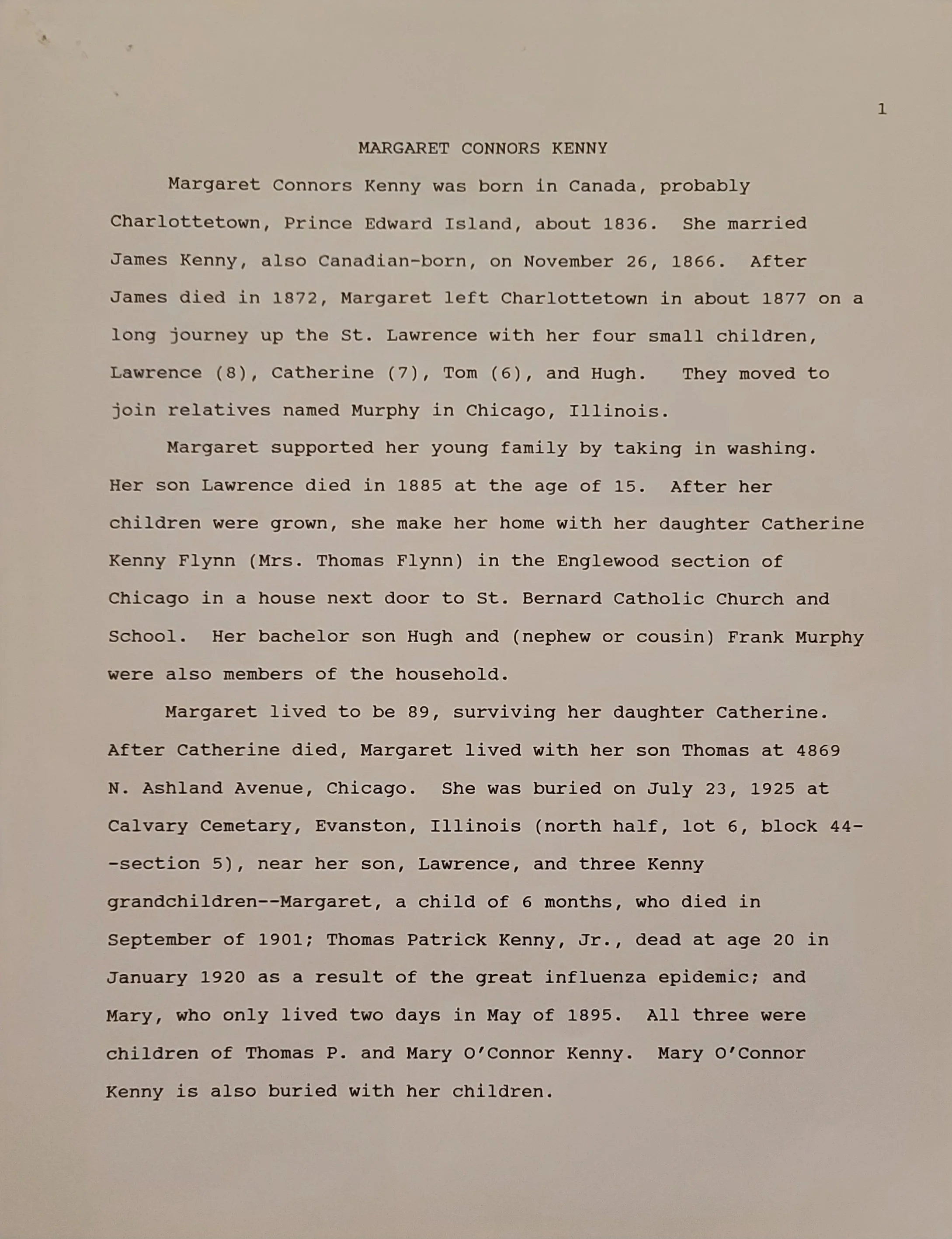
The family narrative, preserved by her great-granddaughter Mary Ellen Molony Brady, places Margaret's departure around 1877 — a date the censuses do not support and do not replace, as the note below sets out:
"Margaret left Charlottetown in about 1877 on a long journey up the St. Lawrence with her four small children, Lawrence (8), Catherine (7), Tom (6), and Hugh. They moved to join relatives named Murphy in Chicago, Illinois."
The ages in that passage are the ones she first typed. Later, working from the Covehead registers, Mary Ellen wrote the birth dates above each name in red ink: Catherine, July 8, 1869; Lawrence, August 26, 1870; Thomas, October 8, 1871; Hugh, January 16, 1873. Catherine, not Lawrence, was the eldest.
She did not leave at once, and the five years between her husband's death and her departure are not empty. On a spring morning in 1874 she stood at a font in Covehead:
Parish Register
March 24, 1874 — Margaret Connors Kenny, godmother
to Margaret Connors, infant daughter of Moses Connors and Ann Leary. Moses was Margaret's brother.
— St. Eugene's Church, Covehead; Prince Edward Island Archives, microfilm #3271/28
A widow of two years, standing up for her brother's newborn daughter. Whatever she was weighing, she was still on the Island in the spring of 1874, still inside the family that had farmed Friston Road since 1832. Three years later she was gone.
What pushed her from the island she had known all her life? Prince Edward Island in the 1870s offered limited opportunity for a widow with young children. The leasehold system still constrained Island farmers—even those who owned their land struggled against thin soil and short growing seasons. The island's population had been bleeding westward for decades, young people seeking opportunity in Boston, in New York, in the booming cities of the American Midwest.
Chicago had been devastated by the Great Fire of 1871 but was rebuilding itself with furious energy. The Irish community was well established, concentrated in neighborhoods where Gaelic could still be heard in the streets, where the Catholic Church anchored social life, where a widow might find work and her children might find opportunity. Chain migration had created pathways—the Murphy relatives had gone before and could help Margaret find her footing.
The Relatives Named Murphy
For as long as this story has been told in the family, it has contained a phrase that explains everything and identifies no one: Margaret moved to join relatives named Murphy in Chicago. Which Murphys? The narrative never said.
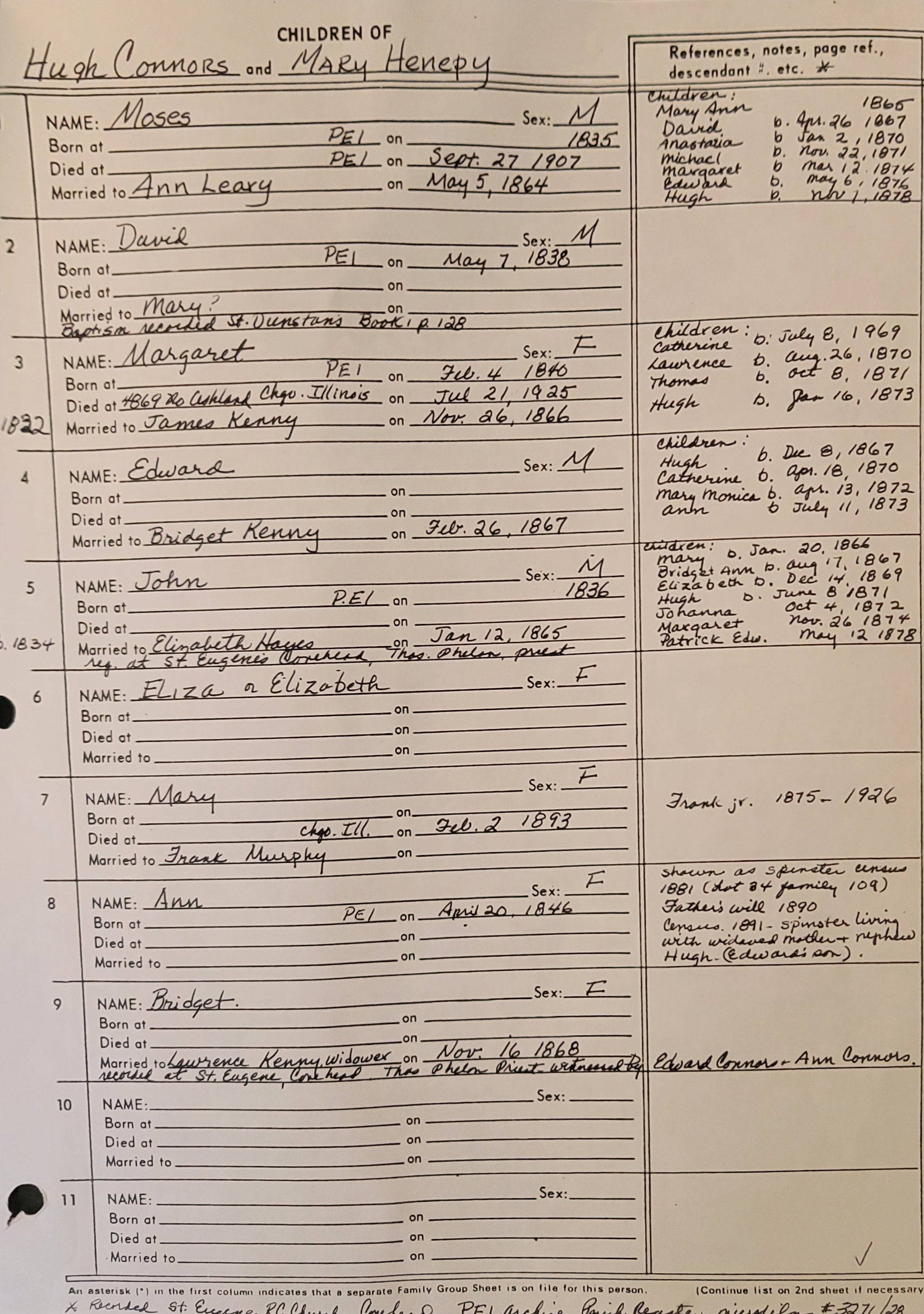
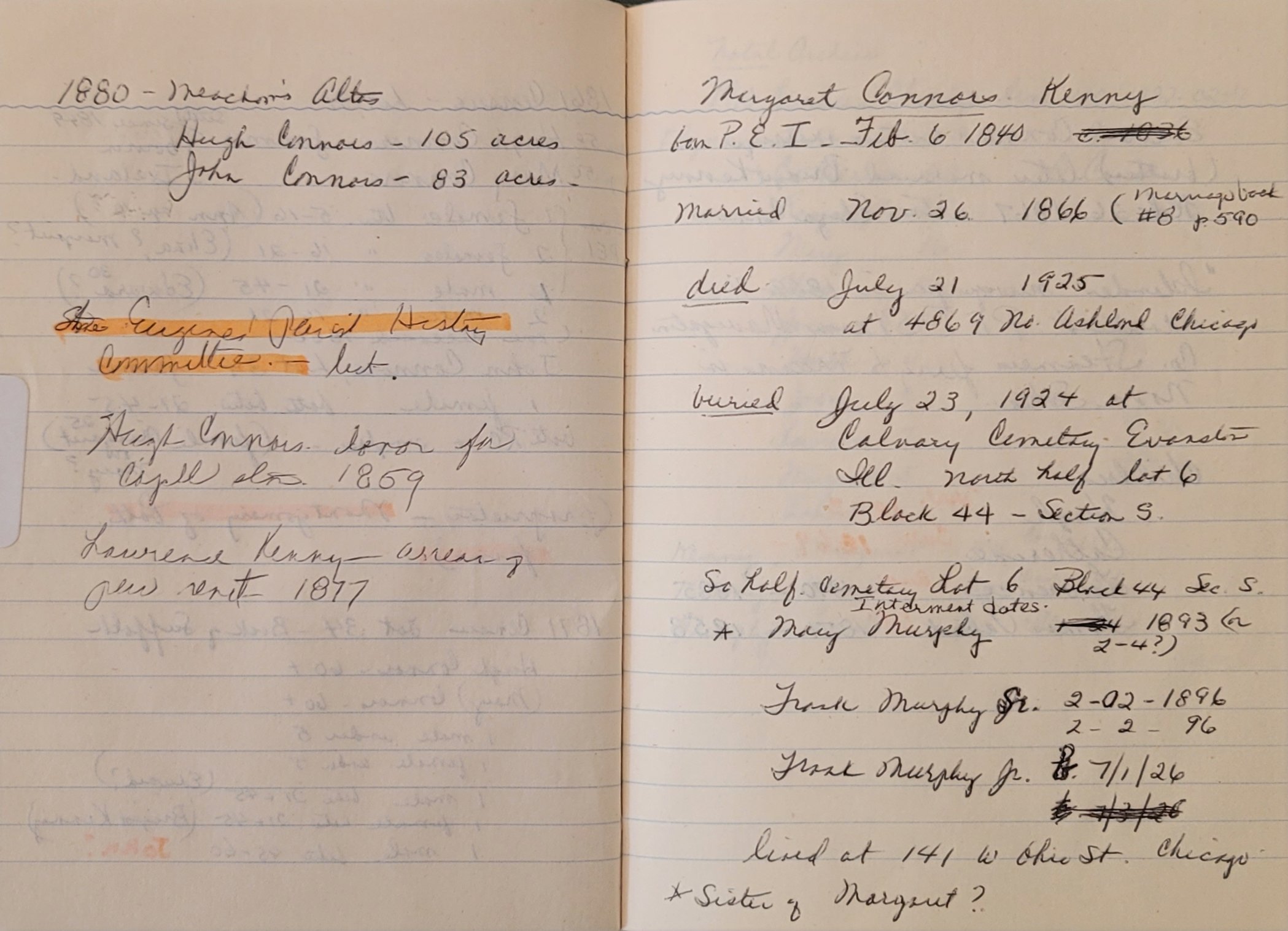
Mary Ellen Molony Brady found out, and wrote the answer in red ink in the margin of her own typescript. The Murphys were her sister's family.
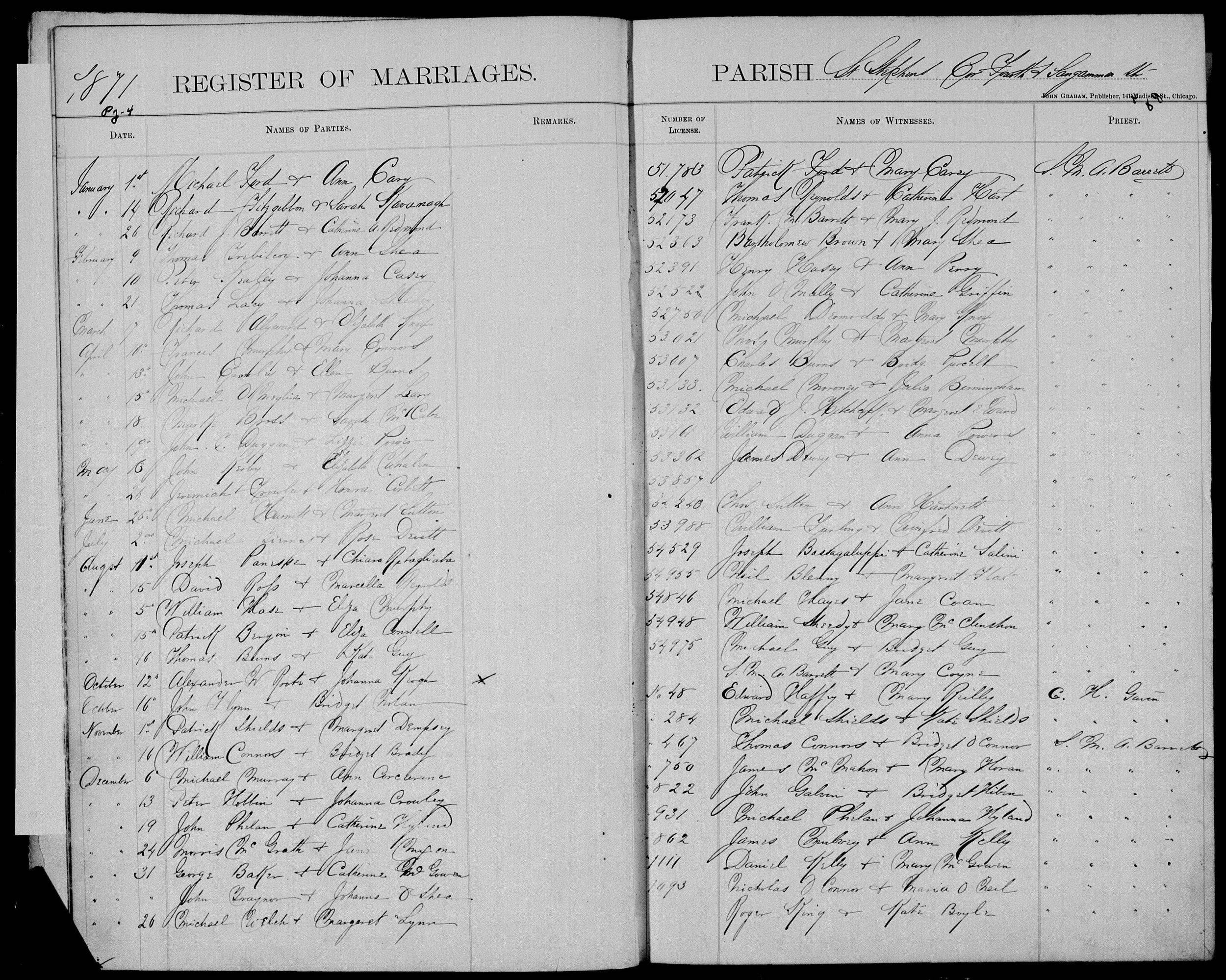
Parish Register
Francis Murphy and Mary Connors, married April 10, 1871
By licence no. 53021. Witnesses: Thomas Murphy and Margaret Murphy. Officiating: Fr. A. Barrett.
— Register of Marriages, St. Stephen's Parish, corner of Ohio and Sangamon Streets, Chicago, 1871, p. 4
Mary Connors was the seventh child of Hugh Connors and Mary Henepy of Friston Road, Covehead—the same parents as Margaret. She had crossed the ocean first and married in Chicago in the spring of 1871, the year before James Kenny died. The Murphy household was recorded at 141 West Ohio Street, on the same street as the church where the marriage took place.
So whenever Margaret finally left the Island, she was not sailing toward a city she had read about. She was going to her sister.
The family says about 1877. The records will not agree on a year, and they are worth setting out plainly. In the 1900 census Margaret, her daughter Catherine and her son Hugh each gave their year of immigration as 1881. The 1910 and 1920 returns both say 1880. Her son Thomas gave 1887 in 1930. Her 1925 death notice called her "fifty years a Chicago resident," which would mean about 1875. Five sources, a twelve-year spread, and no two of them the same.
What the file does fix is the outside edges. Margaret stood as godmother at St. Eugene's in Covehead in March 1874, so she was still on the Island then. Her son Lawrence was buried at Calvary Cemetery on 24 September 1885, so the family was in Chicago by that autumn. Between those two dates the record is silent, and this page keeps the family's "about 1877" as what the family said rather than as a year anyone has proved.
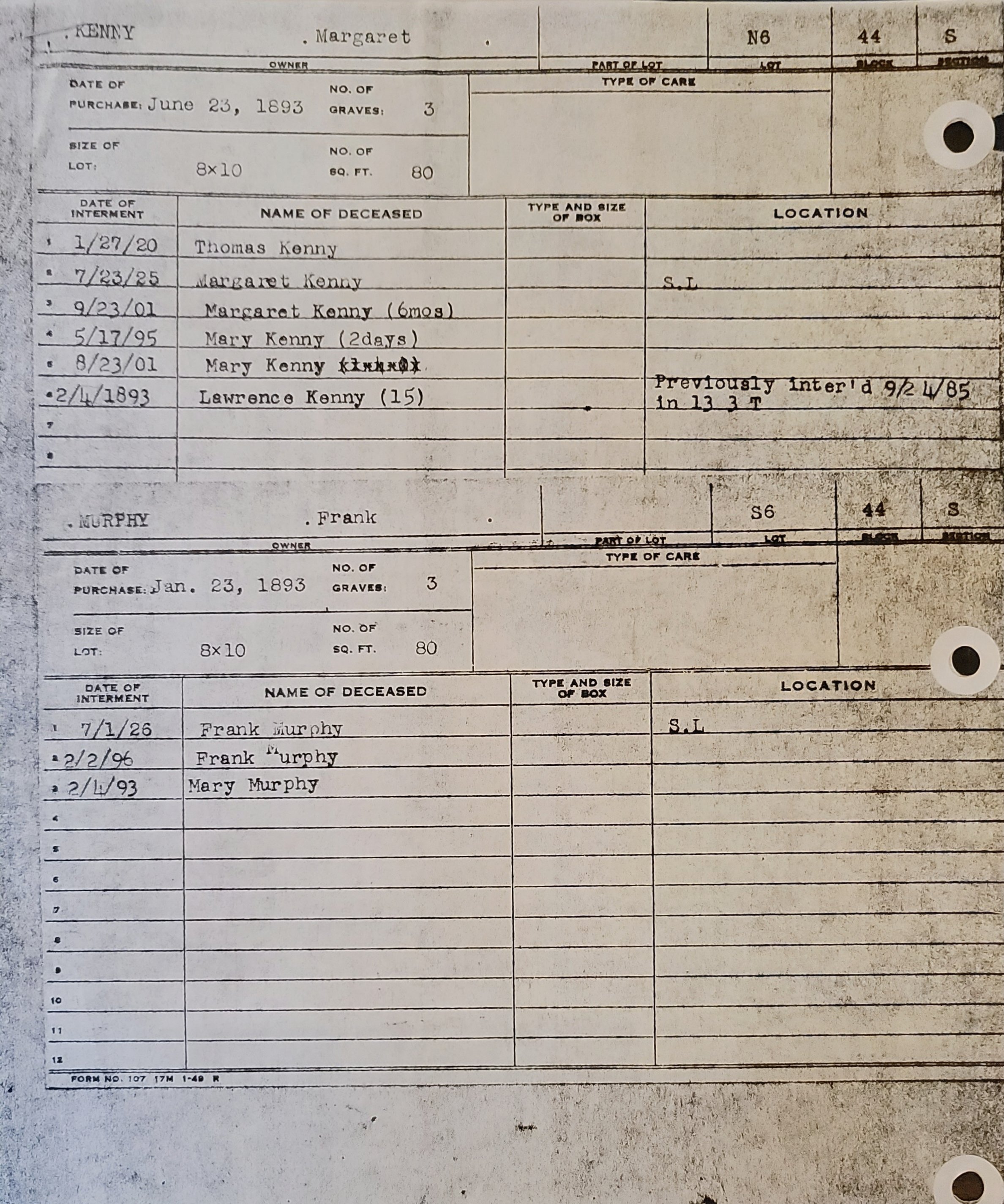
The kinship held for fifty years and is written into the ground at Calvary Cemetery. Frank Murphy bought the south half of Lot 6, Block 44, Section S on January 23, 1893; Mary Connors Murphy was buried in it on February 4. That same day, Margaret's son Lawrence—dead since 1885—was moved into the adjoining half. Margaret bought the north half outright that June. Two sisters from Covehead, lying either side of a single line. And when Mary's son Frank Murphy Jr. died in 1926, it was Margaret's son, by then a battalion chief, who arranged the funeral.
A New Address
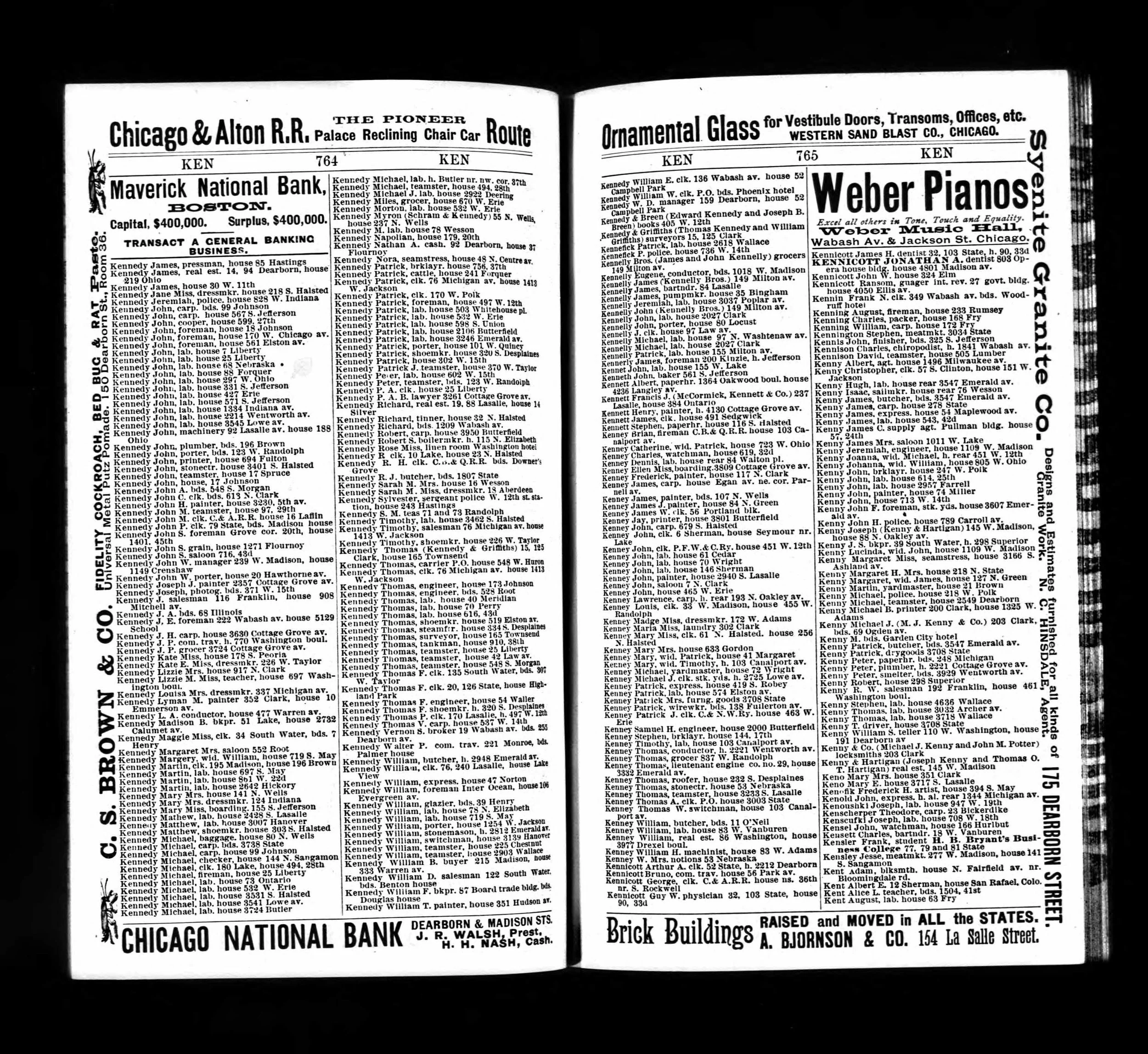
The first documentary evidence of Margaret in Chicago appears in the 1885 city directory:
Directory Record
"Kenny Margaret, widow James, house 127 N. Green"
— Lakeside Annual Directory of the City of Chicago, 1885
The address places her on the Near West Side, in a neighborhood dense with Irish and German immigrants, walking distance from factories and foundries—and a few blocks from St. Stephen's Church, where her sister had been married and where her own son would be buried from.
The geography is worth pausing over. Margaret is at 127 North Green Street. The Murphys are at 141 West Ohio. St. Stephen's stands at Ohio and Sangamon, between them. Her four children had been baptized three thousand miles away, at St. Eugene's in Covehead; her grandchildren would be baptized on the North Side, at St. Sylvester's. But in these years the whole of her Chicago—her sister, her parish, her rented rooms—fits inside a few city blocks.
The family narrative records how Margaret supported her young family:
"Margaret supported her young family by taking in washing."
It was the most common occupation for immigrant widows—work that required no capital beyond a washboard and strong arms, work that could be done at home while watching children, work that left no records except in the aching shoulders of the women who performed it.
The First Loss
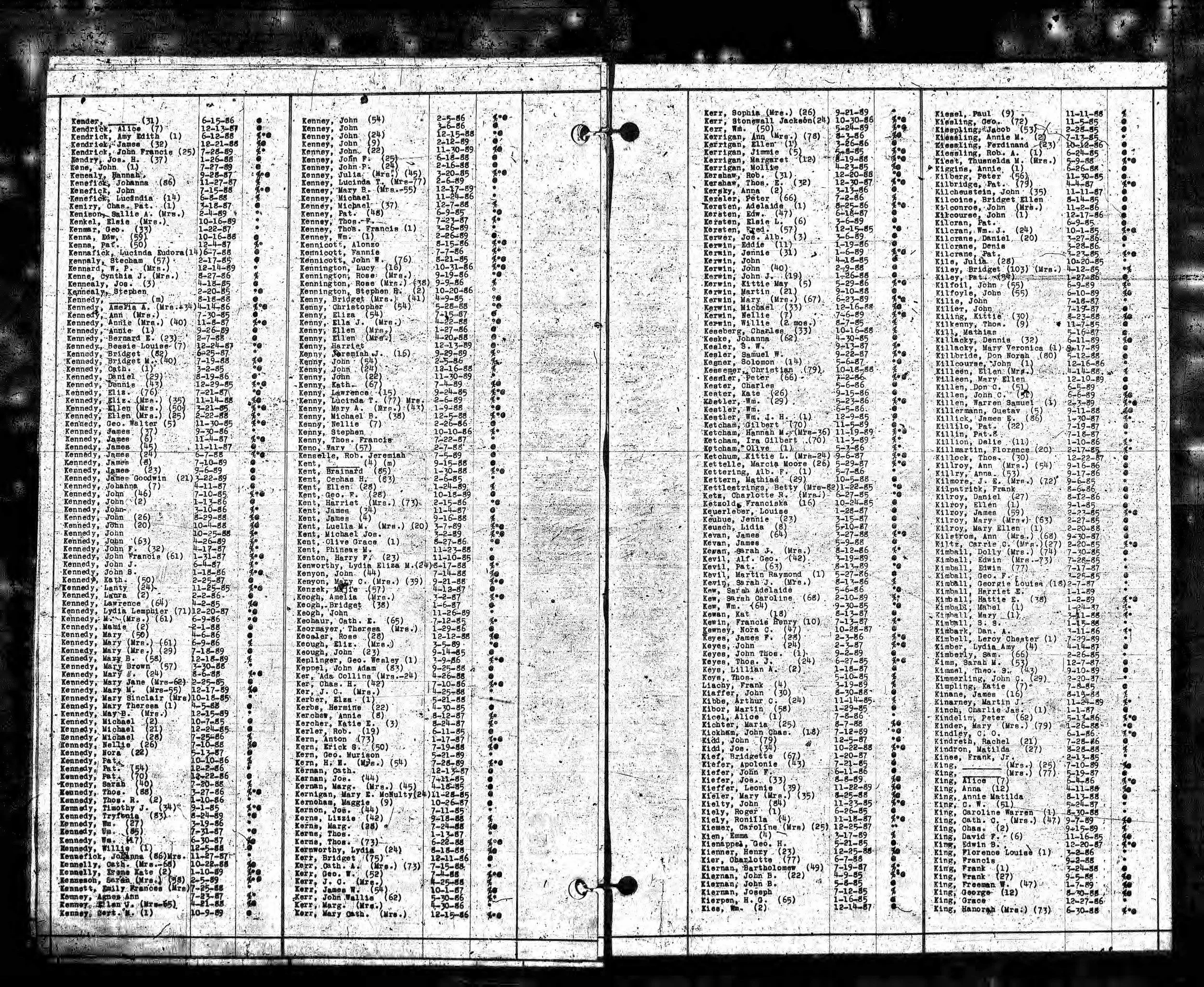
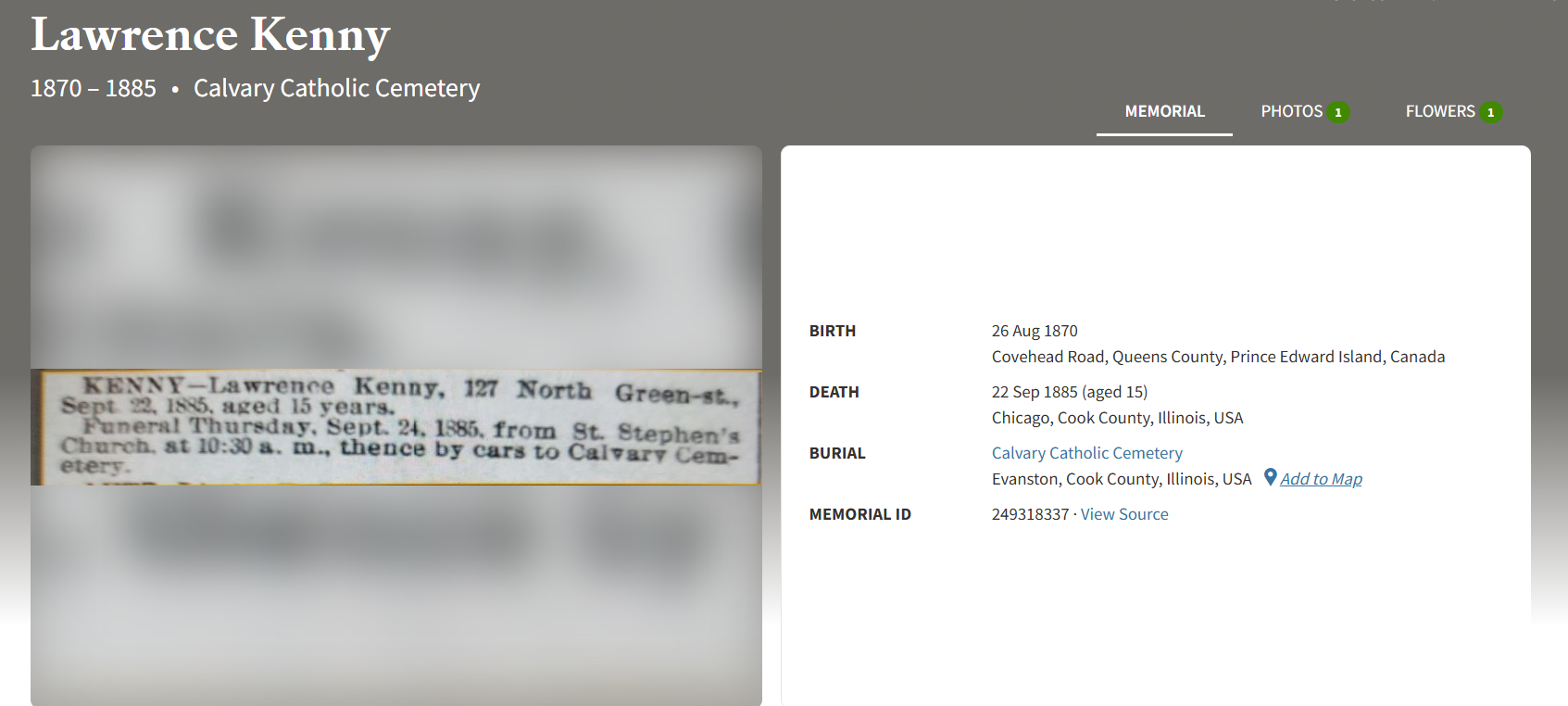
On September 22, 1885, Lawrence Kenny died at 127 North Green Street. He was fifteen years old.
Death Notice
"KENNY—Lawrence Kenny, 127 North Green-st., Sept. 22, 1885, aged 15 years. Funeral Thursday, Sept. 24, 1885, from St. Stephen's Church, at 10:30 a.m., thence by cars to Calvary Cemetery."
— Chicago Tribune, September 1885
He was buried at Calvary Catholic Cemetery in Evanston, the sprawling burial ground that served Chicago's Irish Catholic community. The cause of death is not recorded in the surviving notice. Whatever took him—disease, accident, the hazards of youth in an industrial city—it happened less than a decade after Margaret had brought her children to Chicago in search of a better life.
Lawrence had been born at Covehead Road, Prince Edward Island, on August 26, 1870. He had crossed an ocean's worth of distance with his mother and siblings. He had spent half his short life in one country and half in another. And now he lay in Illinois soil, the first of Margaret's children to be buried in their adopted homeland.
The Survivors
Three children remained: Catherine, Thomas, and Hugh. They would grow to adulthood in Chicago, marry, raise families, become Americans in ways their Island-born mother never entirely would.
Mother of nine children
Married Mary O'Connor and then Ellen O'Connor
Lived with family throughout life
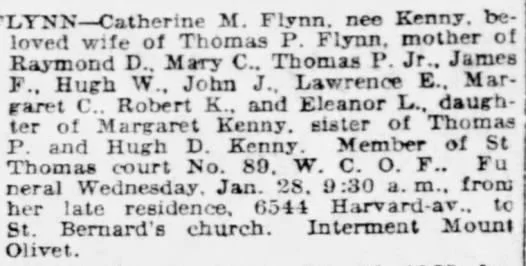
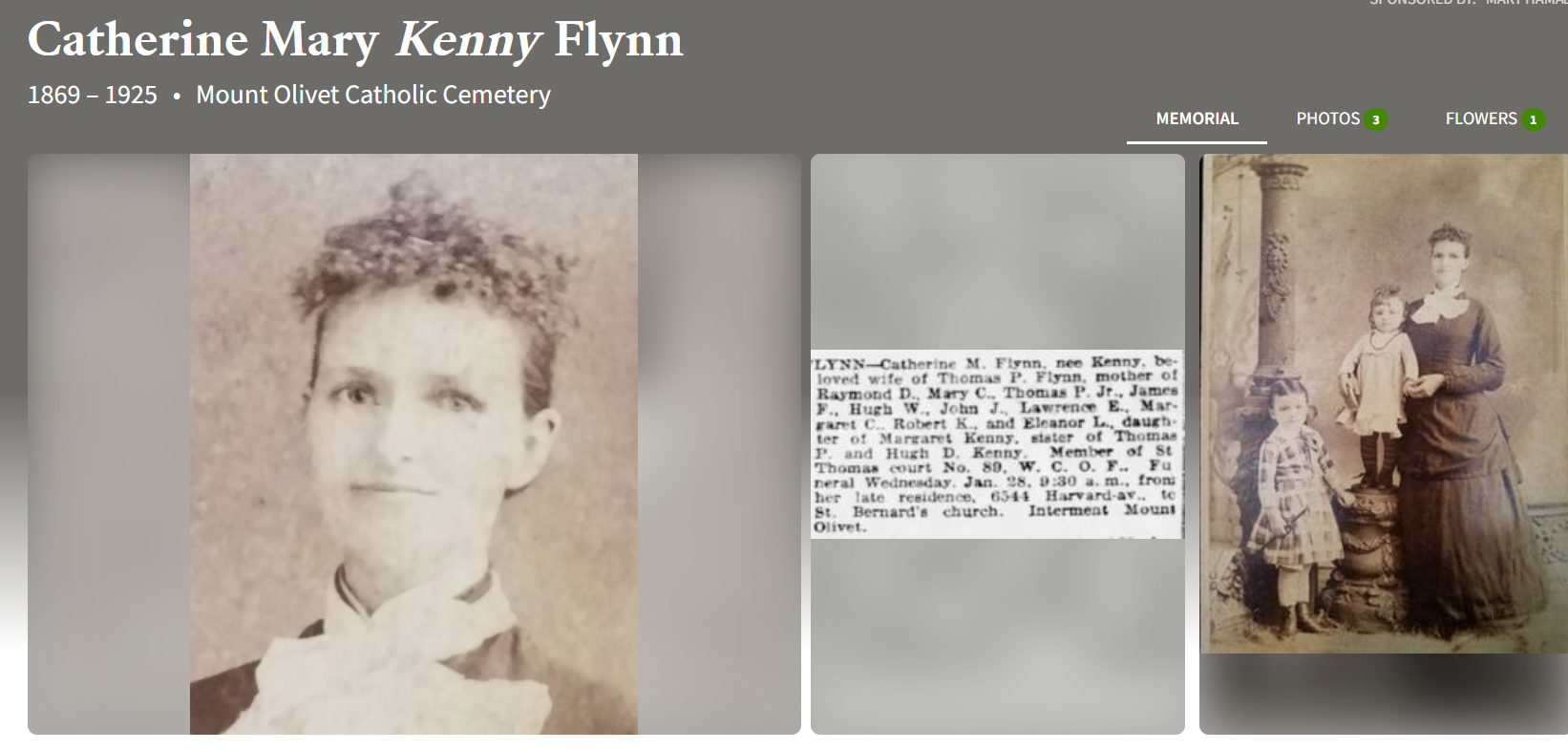
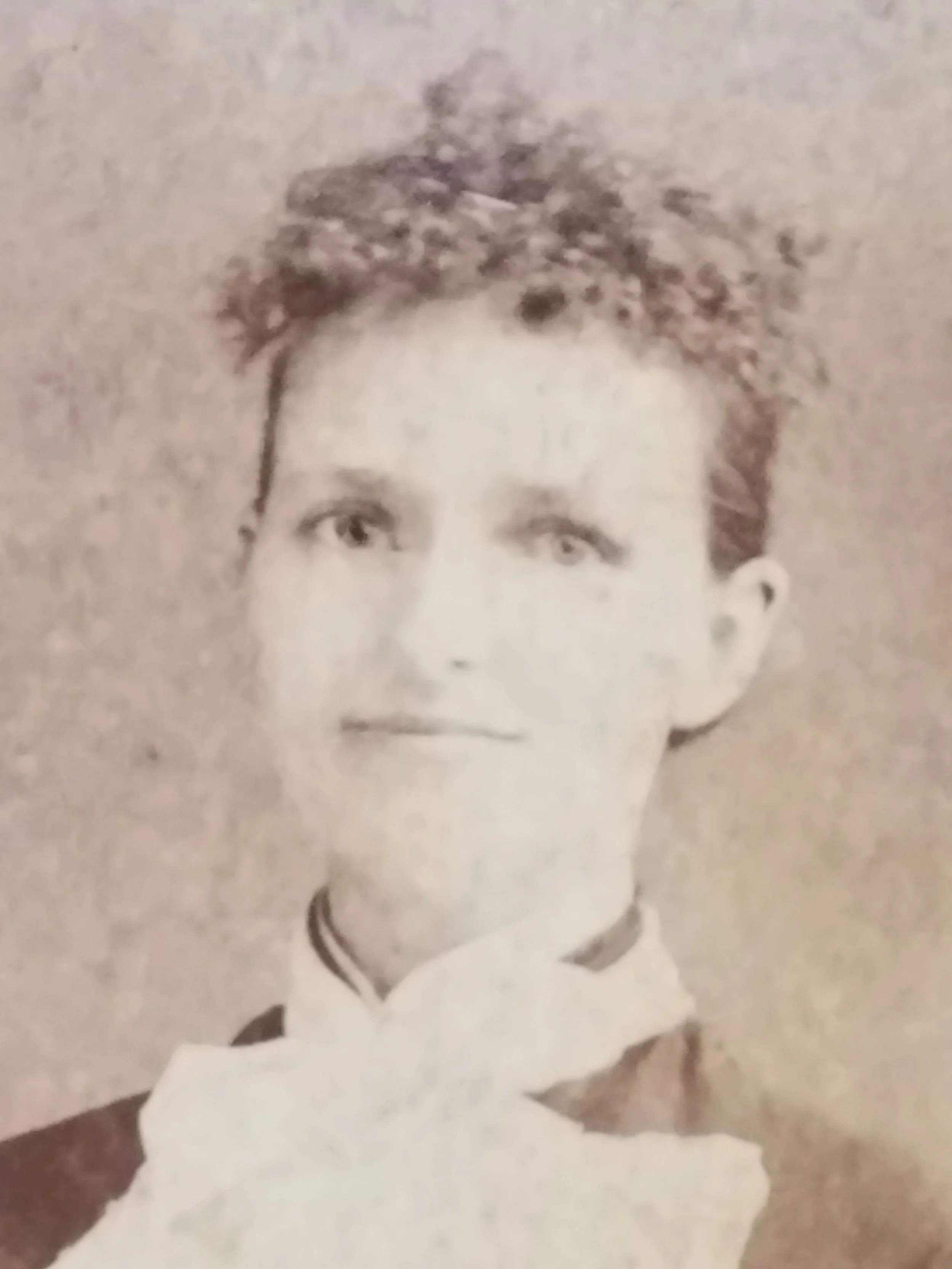
Catherine—called Kate or Katie—married Thomas P. Flynn. Her obituary, published in January 1925, would list nine children: Raymond D., Mary C., Thomas P. Jr., James F., Hugh W., John J., Lawrence E., Margaret C., Robert K., and Eleanor L. She had named a son Lawrence, keeping her lost brother's memory alive into the next generation.
Thomas P. Kenny would become a Battalion Fire Chief in Chicago, rising to a position of respect in a profession that Irish immigrants had made their own. The newspaper headline announcing Margaret's death in 1925 would identify her first as "Battalion Chief Kenny's Mother."
Hugh D. Kenny remained a bachelor, living with his mother and then with his married siblings throughout his life. The census records show him consistently present in the household—in 1900, 1910, and 1920—always listed with his sister Catherine's family.
The Long Years
The census records trace Margaret's trajectory across four decades in Chicago:
Cook County, Illinois
Margaret, age 64, is living with her daughter Catherine Flynn and son-in-law Thomas P. Flynn. She is listed as "mother-in-law," having emigrated from Canada, her occupation blank. Her son Hugh, 33 and unmarried, lives with them too.
Cook County, Illinois
The household has moved to Englewood, into a house next door to St. Bernard Catholic Church and School. Margaret is now 74. The census shows an expanded household: Catherine and Thomas Flynn with their growing children, Hugh still present, and a "cousin" named Frank Murphy. The household called him a cousin; the family narrative hedged, calling him "nephew or cousin." He was in fact Frank Murphy Jr., born 1875, the son of Margaret's sister Mary—her nephew, living under her daughter's roof, thirty-three years after the two sisters had last shared a house on Prince Edward Island.
Cook County, Illinois
Margaret is now 84, still living with Catherine's family. Her birthplace is recorded as Canada, her native tongue as English. She has lived in Chicago for more than four decades, has watched her grandchildren grow up American, has buried one child and would bury another—her daughter Catherine dying in January 1925, just months before Margaret herself.
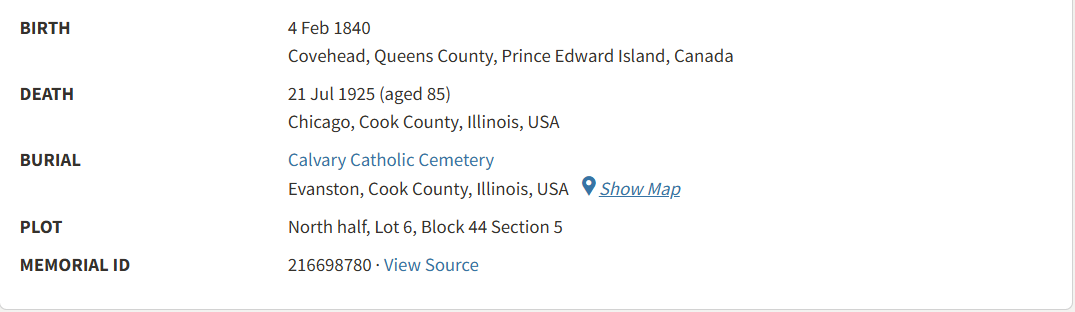
Read the three census cards above in order and they agree with one another: sixty-four in 1900, seventy-four in 1910, eighty-four in 1920. Every one of them points to a birth around 1836, and 1836 is the year Mary Ellen Molony Brady first typed. Later she struck it out and wrote February 1840—the year implied by the age of eighty-five in the 1925 death notice—but she left no record of what changed her mind, and her own papers disagree on the day: her family group sheet says the fourth of February, her Prince Edward Island notebook the sixth. No Island baptism has been found for Margaret. The 1866 marriage register at Covehead should give her age, and until someone reads that entry, this page names the year she is most often assigned and leaves the question standing.
The Island She Left Behind
Did Margaret ever return to Prince Edward Island? The records do not say. Her father-in-law Lawrence Kenny died on February 20, 1899, at Covehead—she would have been somewhere near sixty, established in Chicago for more than two decades. If she traveled back for his funeral, no document survives to record the journey.
The distance from Chicago to Covehead in the 1890s would have been formidable: train to Boston or Montreal, steamer across the Gulf of St. Lawrence, then overland to the north shore of the Island. A journey of several days and considerable expense for a widow who had supported her family by taking in washing.
Perhaps she never saw Covehead again. Perhaps the red cliffs and the red soil and the farmhouse where she had married James Kenny existed only in memory, growing softer and less certain with each passing year, until even the memories belonged more to her children than to her—stories about a place they barely remembered, a life lived before America.
A Pioneer's Passing
Margaret Connors Kenny died on July 21, 1925, at the home of her son Thomas P. Kenny, 4869 North Ashland Boulevard. She was eighty-five years old, the age the newspaper gave her—and the age Mary Ellen Molony Brady would later cross out her own typed “eighty-nine” to record. She had lived in Chicago for nearly fifty years.
Newspaper Notice
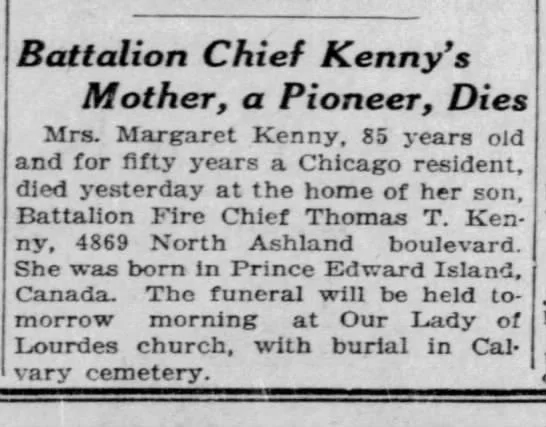
"Battalion Chief Kenny's Mother, a Pioneer, Dies"
Mrs. Margaret Kenny, 85 years old and for fifty years a Chicago resident, died yesterday at the home of her son, Battalion Fire Chief Thomas T. Kenny, 4869 North Ashland boulevard. She was born in Prince Edward Island, Canada. The funeral will be held tomorrow morning at Our Lady of Lourdes church, with burial in Calvary cemetery.
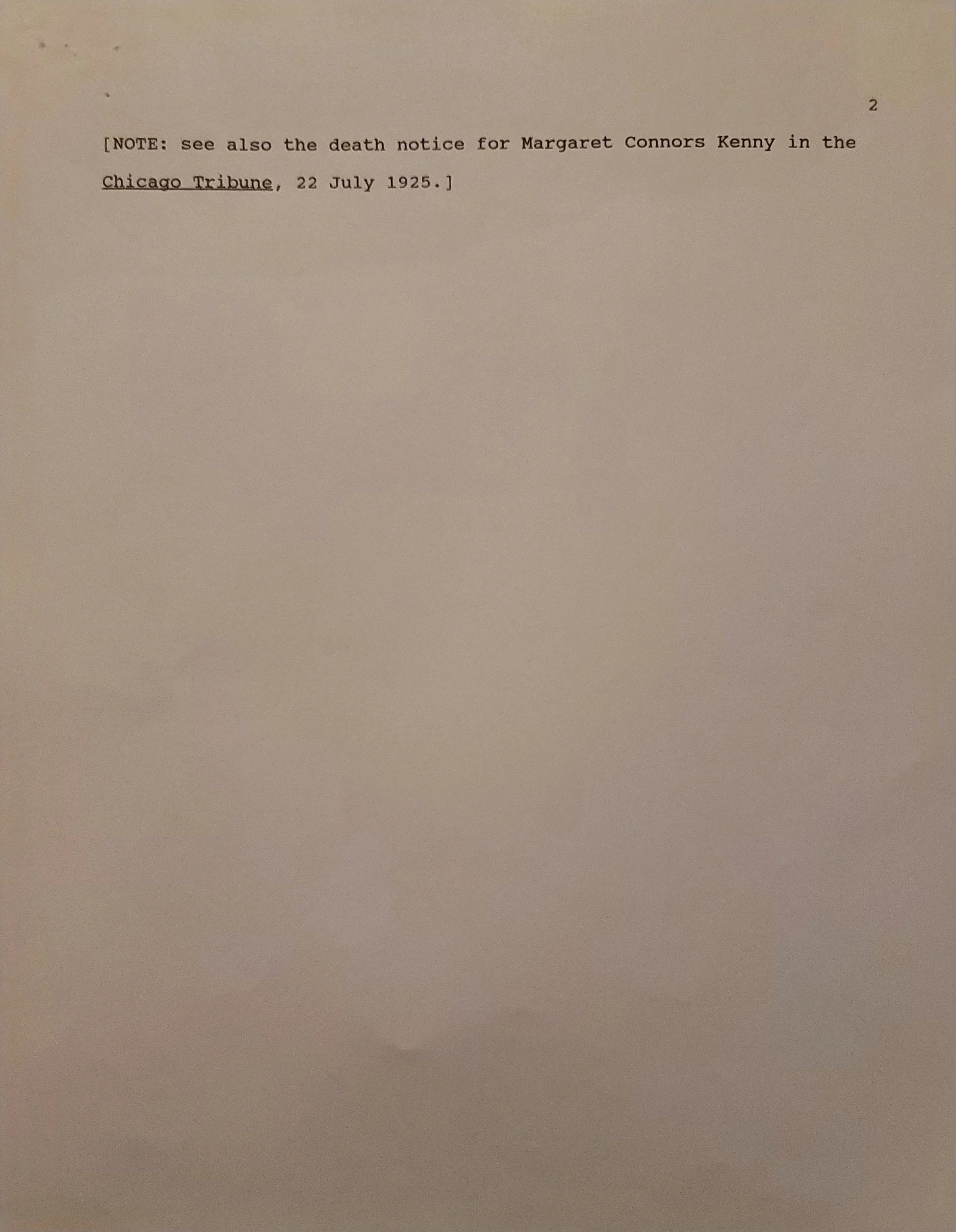
— Chicago Daily Tribune, July 22, 1925
She was laid to rest in the north half of Lot 6, Block 44, Section S—near her son Lawrence, who had died forty years earlier at fifteen, and near three of her grandchildren:
Section S, not Section 5. Calvary lettered its sections, and the interment card is clear; the figure 5 entered the family record through a misreading and has been repeated ever since.
Mary O'Connor Kenny, the wife of Margaret's son Thomas P. Kenny, is also buried with her children in that plot. The cemetery records show a family drawn together in death as they had been in life, Irish Catholic immigrants and their American-born descendants sharing the same Illinois earth.
Margaret Connors Kenny had crossed an ocean's worth of distance.
She spent forty-eight years in Chicago, never returning to Covehead,
watching her children become Americans.
Primary Sources





Are You Connected to the Kenny-Connors Line?
If you descend from the Kenny or Connors families of County Wexford, the O’Connor family of Castleisland, County Kerry, or the Casey or Corcoran families — or their branches in Newfoundland, Prince Edward Island, or Chicago — I’d like to compare notes. Documented trees, DNA matches, family papers, and even half-remembered stories have all moved this research forward.
Get in Touch About This FamilyCousin connections are informal and reciprocal — no fee, no obligation, just shared work on shared ancestry.
Every Family Has a Story Worth Telling
Whether you're just beginning your research or ready to transform years of work into a narrative your family will treasure, I'd love to help.
LET'S TALK ABOUT YOUR FAMILY