
Two Families, One Story: Two Baptisms in Newfoundland
Two Baptisms in Newfoundland
In the autumn of 1832, two Irish families—part of the same fishing community in St. John's, Newfoundland—each brought a child to be baptized at St. Patrick's Church. Their entries appear on consecutive pages of the same parish register: Bridget Connor on September 27th, James Kenny sometime in October. Neither family knew the significance of the other's presence. Thirty-four years later, their descendants would meet on Prince Edward Island and marry three times over.
This is the story of how we found them.
The Discovery
Every genealogical breakthrough begins with a question. For the Kenny-Connors line, that question was simple: When did these families arrive in Canada, and where did they come from?
Hugh Connors' 1890 obituary in the Summerside Journal stated he had "emigrated from County Wexford, Ireland to Prince Edward I... in the year 1832." His marriage record, dated September 26, 1833, placed him in Chatham Parish, New Brunswick, marrying "Mary Cummins." But when we searched earlier, we found something unexpected in Newfoundland—a baptism record from September 1832, a full year before that marriage.
Sps Paul Henesy and Margret Connors paid [May?]
Key Discovery
Hugh Connor and Mary Henesy were parents before their September 1833 marriage in New Brunswick—their daughter Bridget was baptized in Newfoundland a full year earlier. The variant spellings suddenly made sense: "Cummins," "Crimmens," "Hennessey," and "Henephy" were all phonetic renderings of the same name. Her name was Mary Henesy.
The sponsors were equally revealing. Paul Henesy—likely Mary's brother—and Margret Connors—likely Hugh's sister—represented the standard Irish Catholic practice of reciprocal sponsorship, each family providing a godparent.
But the discovery that changed everything came when we turned the page.
The Same Parish
The Kenny family—Lawrence Kenny and Catherine Corcoran—had long been assumed to have emigrated directly to Prince Edward Island. The 1841 PEI census listed Lawrence as a tailor with 50 acres on Lot 34, with family members born in Ireland, PEI, and "the British colonies." That ambiguous designation—"British colonies"—suggested at least one child was born somewhere other than Ireland or PEI.
The answer appeared just pages after the Connors entry, in the same Newfoundland parish register:
Sps Pierce Grace & Mary Keane
Breakthrough Discovery
James Kenny—the man who would marry Margaret Connors in 1866—was baptized in the same Newfoundland parish as Bridget Connor, just weeks later. Their entries appear on consecutive pages of the same church register. Both families were part of the Irish fishing community in St. John's in the autumn of 1832.
Two Families, One Community
Bridget Connor
Register Pages 420-421
Date: September 27, 1832
Parents: Hugh Connor & Mary Henesy
Sponsors: Paul Henesy & Margret Connors
Source: Newfoundland Church Records, 1793-1899
James Kenny
Register Pages 422-423
Date: October 1832
Parents: Lawrence Kenny & Cath Corcoran
Sponsors: Pierce Grace & Mary Keane
Source: Newfoundland Church Records, 1793-1899
This discovery transforms our understanding of these families. They were not strangers who happened to become neighbors on Prince Edward Island. They were part of the same Irish fishing community in Newfoundland—their children baptized weeks apart in the same church, their names recorded on consecutive pages of the same register.
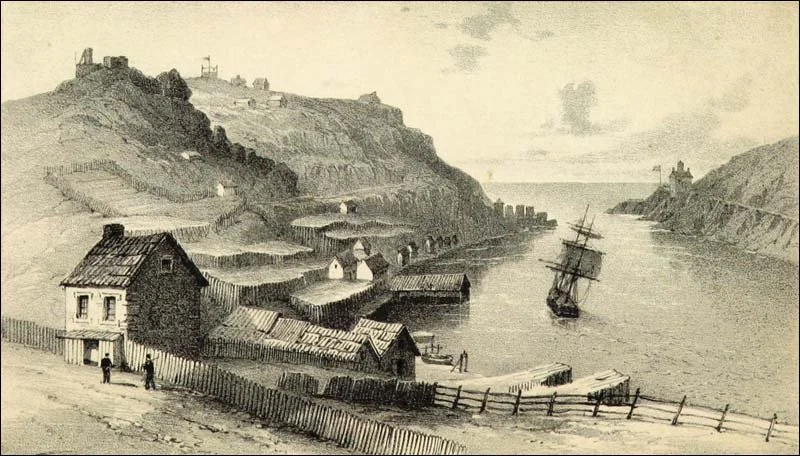
"Narrows, or entrance of the harbour of St. John's, Newfoundland with fish stages." Drawing by A. Thompson. In Richard Henry Bonnycastle, Newfoundland in 1842 (London: Henry Colburn, 1842). The fish stages lining the harbor were where Irish workers processed the catch that drew them across the Atlantic.
The Waterford Connection
Why would two Irish families named Kenny and Connor turn up in the same Newfoundland parish in 1832? The answer lies in a migration pattern that had been established for generations.
The vast majority of Newfoundland's Irish immigrants came from a remarkably compact region: south Wexford, south Kilkenny, south-east Tipperary, and all of County Waterford. As geographer John Mannion of Memorial University has noted:
"No other province in Canada or state in the USA drew such an overwhelming proportion of immigrants from so geographically compact an area in Ireland for so prolonged a period of time."
Waterford city had become a bustling port by the late seventeenth century, supplying English ships with provisions—salt pork, beef, and other food items. By the mid-eighteenth century, other ships began calling at Waterford, not for provisions but for Irish workers keen to labor in the Newfoundland fisheries.
Seasonal Migration
Most were farmers' sons from the inland areas through which the Suir, Nore, and Barrow rivers flowed. Ironically, many had no experience of the sea—a source of constant complaint from British officials in Newfoundland. But this did not deter the droves who crossed the Atlantic, initially as seasonal workers who returned to Waterford in winter with wages or tradeable fish.

The Atlantic route from Ireland's southeast coast to Newfoundland. Waterford port became the embarkation point for thousands of Irish workers bound for the Newfoundland fisheries.
The sponsors of James Kenny's baptism—Pierce Grace and Mary Keane—are quintessential Waterford and Wexford surnames. Their presence in St. John's in 1832, standing as godparents for the child of Lawrence Kenny and Catherine Corcoran, suggests the Kenny family was part of this established migration network from southeast Ireland.
Hugh Connors' obituary confirms he "emigrated from County Wexford." DNA evidence clusters Connors matches around Ballycullane and Tintern in County Wexford. The Kenny origin remains unproven, but the circumstantial evidence—the Waterford/Wexford sponsors, the Newfoundland connection, and a tantalizing 1776 marriage record from New Ross linking a John Kenny to a Catherine Connors—suggests both families may have originated from neighboring parishes in southeast Ireland.
A Shared Origin?
Both the Kenny and Connors families were part of the same Waterford-Newfoundland Irish fishing community. They may have known each other in Ireland before emigrating. They certainly knew each other in Newfoundland in 1832. And thirty-four years later, their children would intermarry three times on Prince Edward Island.
The New Brunswick Detour
A year after Bridget's baptism in Newfoundland, the Connors family appears in an unexpected location: the Miramichi region of New Brunswick, over 800 miles to the southwest.
Northumberland and Mary Cummins of the same a
maid, Spinster were married by dispensation of Bann
this 26th Sept of Eighteen hundred and thirty three by me
the undersigned Missionary of Miramichi (sig) Wm Dollard
This marriage was solemnized between us (sig)
Hugh Connors and (sig) Mary Cummins in the presence
of (sig) Danl Sullivan and (sig) Margaret Ryan
Why did Hugh and Mary leave Newfoundland for New Brunswick? The answer likely lies in the timber trade. While Newfoundland's economy centered on fishing, New Brunswick's Miramichi region was booming with the timber industry. Irish immigrants who arrived on returning timber ships quickly found work in the forests, supplementing meager farming incomes with winter logging.
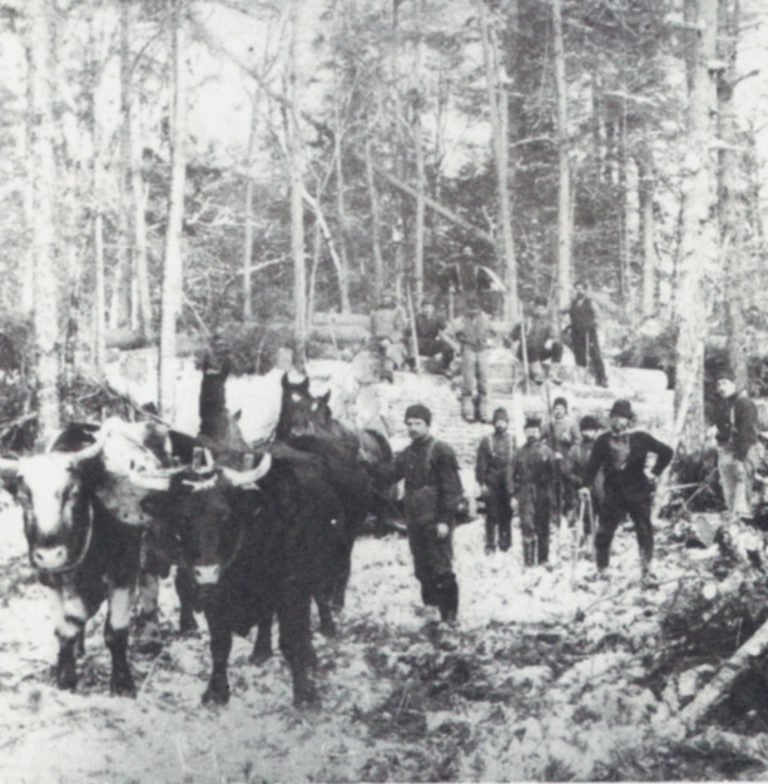
A logging crew in the Miramichi region. Irish immigrants who arrived on returning timber ships quickly found work in the forests, supplementing meager farming incomes with winter logging and dangerous spring river drives. Photo courtesy of King, "The Irish Lumberman-Farmer."
The Irish Transformation of Northumberland County
The Connors' New Brunswick stop was brief. By 1839—according to Hugh's obituary—they had moved again, this time to Prince Edward Island. But the Kenny family took a more direct route: by July 1835, Lawrence Kenny's daughter Alice was baptized in Charlottetown, proving they had arrived on PEI within three years of James's birth in Newfoundland.
Convergence
The two families' paths converged on Lot 34, Queens County, Prince Edward Island. They became neighbors on the Montgomery Estate, Catholic tenant farmers under the same landlord. Their children grew up together, attended the same church—St. Eugene's in Covehead—and worked the same red soil.
The Kenny-Connors Marriages
In November 1866, James Kenny married Margaret Connors. Three months later, Bridget Kenny married Edward Connors. Two years after that, the widowed Lawrence Kenny married Bridget Connors—the same Bridget whose 1832 Newfoundland baptism started this investigation.
Two families from the same Newfoundland parish, following different routes across the Maritimes—united on a small island in the Gulf of St. Lawrence.
That is the story the documents tell. In the episodes that follow, we will trace each family from their Irish origins to their American destinations, through famine and loss, marriage and migration, from the tenant farms of Prince Edward Island to the neighborhoods of Chicago.
But it begins here, in 1832, with two baptisms in Newfoundland—pages apart in the same register.
Document Gallery

1832 — Newfoundland Register
Full page showing Bridget Connor baptism
Baptism
1832 — Bridget Connor Baptism
Sept 27: "Bridget of Hugh Connor and Mary Henesy"
Baptism
1832 — Newfoundland Register
Full page showing James Kenny baptism
Baptism
1832 — James Kenny Baptism
Oct: "James of Lawrence Kenny & Cath Corcoran"
Baptism
1833 — New Brunswick Register
Full page showing Connor-Cummins marriage
Marriage
1833 — Connor-Cummins Marriage
Sept 26: Hugh Connors & Mary Cummins (Henesy)
Marriage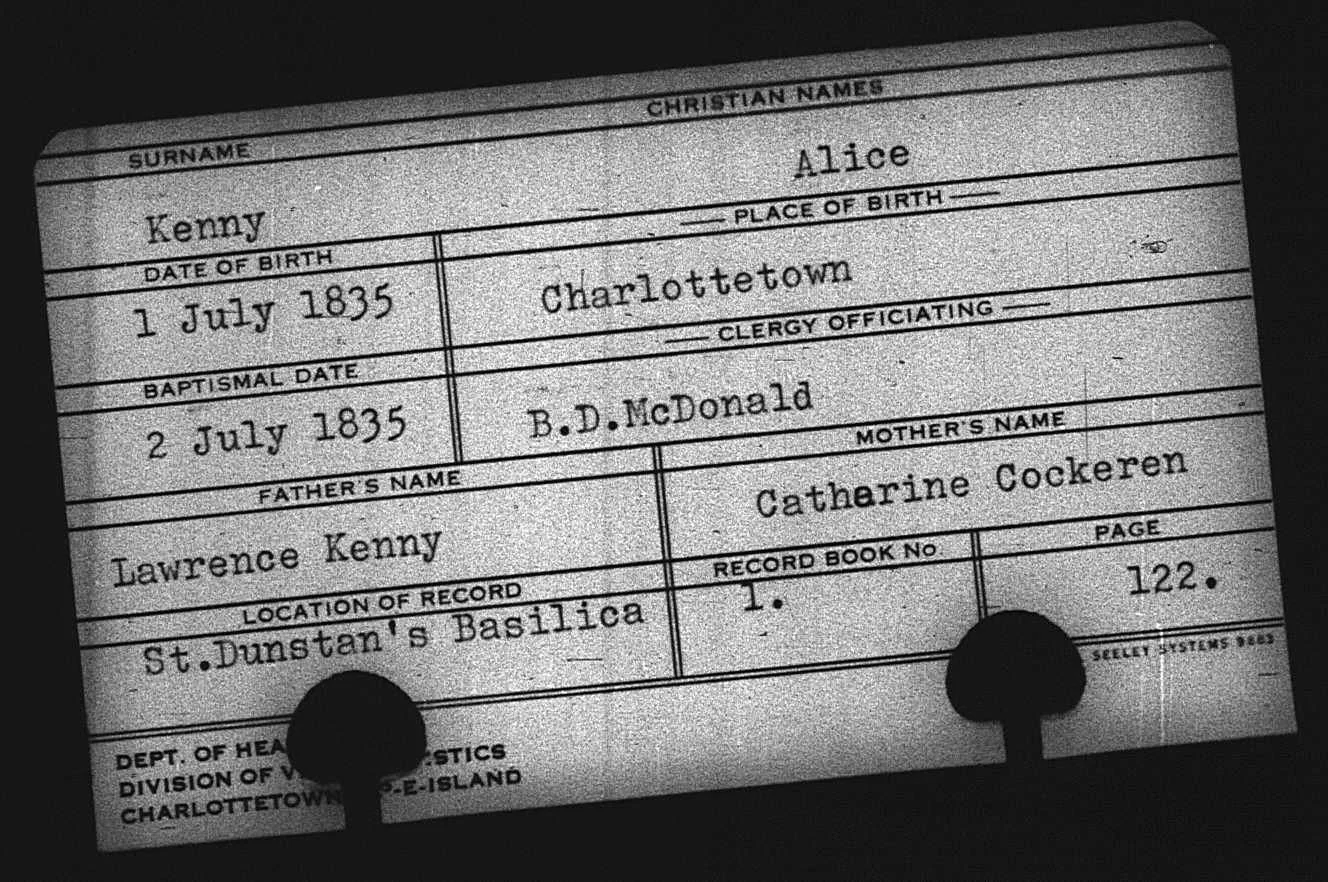
1835 — Alice Kenny Baptism
July 2, Charlottetown: Proves Kenny family on PEI
Baptism
1842 — St. John's Harbor
Fish stages where Irish workers processed the catch
Illustration
Ireland to Newfoundland
The Atlantic crossing from Waterford
Map
Miramichi Logging Crew
Irish lumberman-farmers in the timber industry
Photograph
Hugh Connors Family Sheet
Compiled by M.E.M. Brady, Nov 4, 1991
Family SheetAre You Connected to the Kenny-Connors Line?
If you descend from the Kenny or Connors families of County Wexford, the O’Connor family of Castleisland, County Kerry, or the Casey or Corcoran families — or their branches in Newfoundland, Prince Edward Island, or Chicago — I’d like to compare notes. Documented trees, DNA matches, family papers, and even half-remembered stories have all moved this research forward.
Get in Touch About This FamilyCousin connections are informal and reciprocal — no fee, no obligation, just shared work on shared ancestry.
Every Family Has a Story Worth Telling
Whether you're just beginning your research or ready to transform years of work into a narrative your family will treasure, I'd love to hear your story.
BEGIN YOUR RESEARCH INQUIRY