
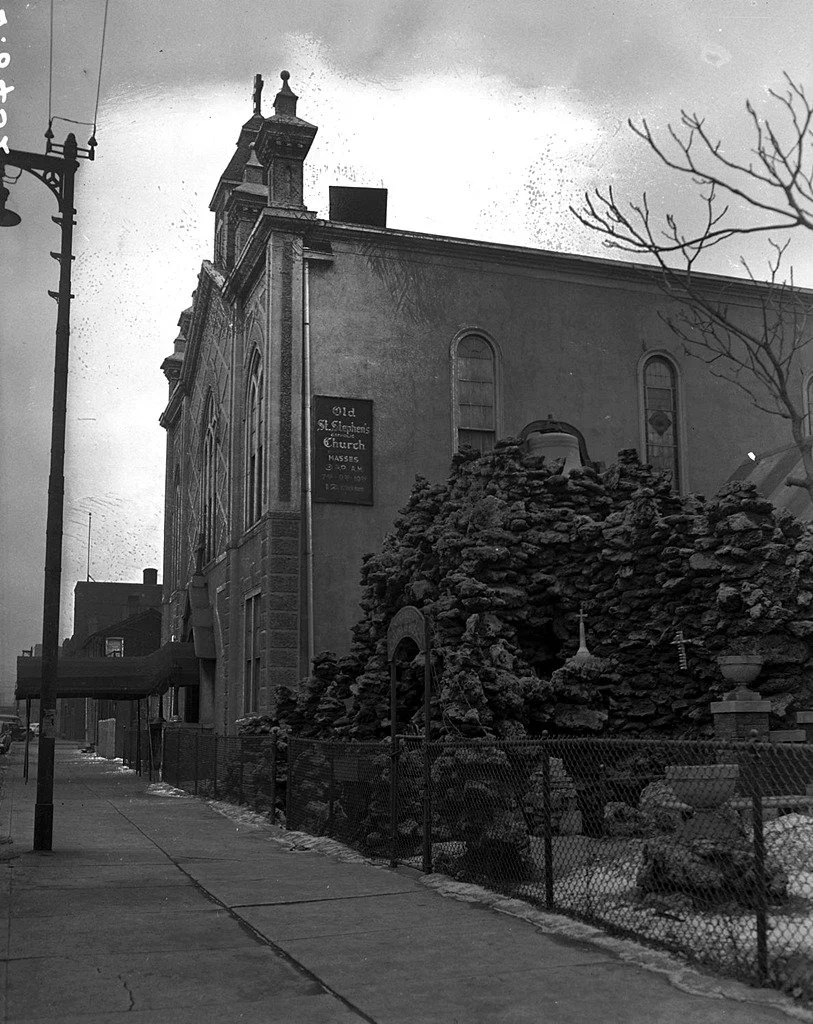
Old St. Stephen’s Church
923 West Ohio Street, Chicago (1869-1952)
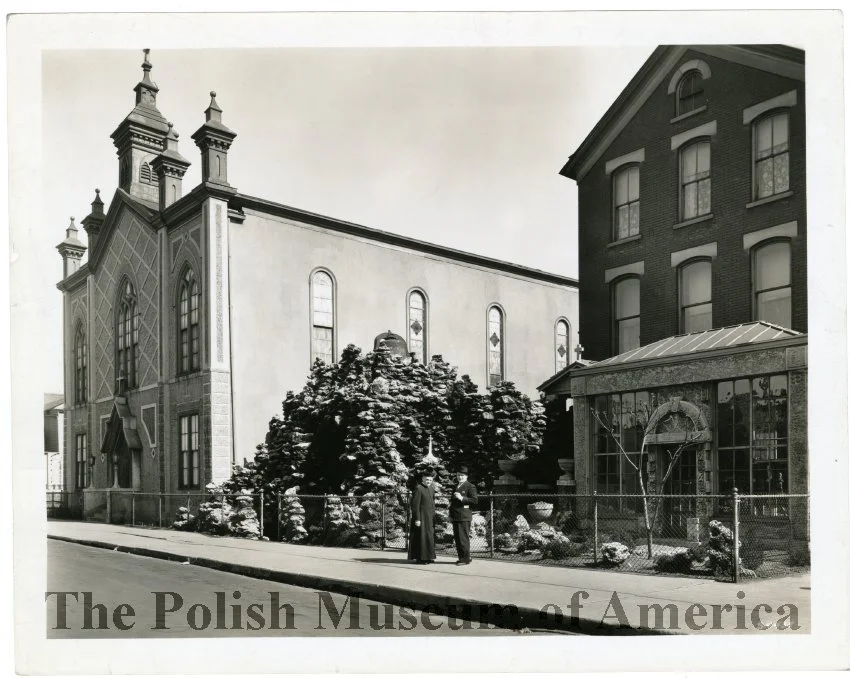
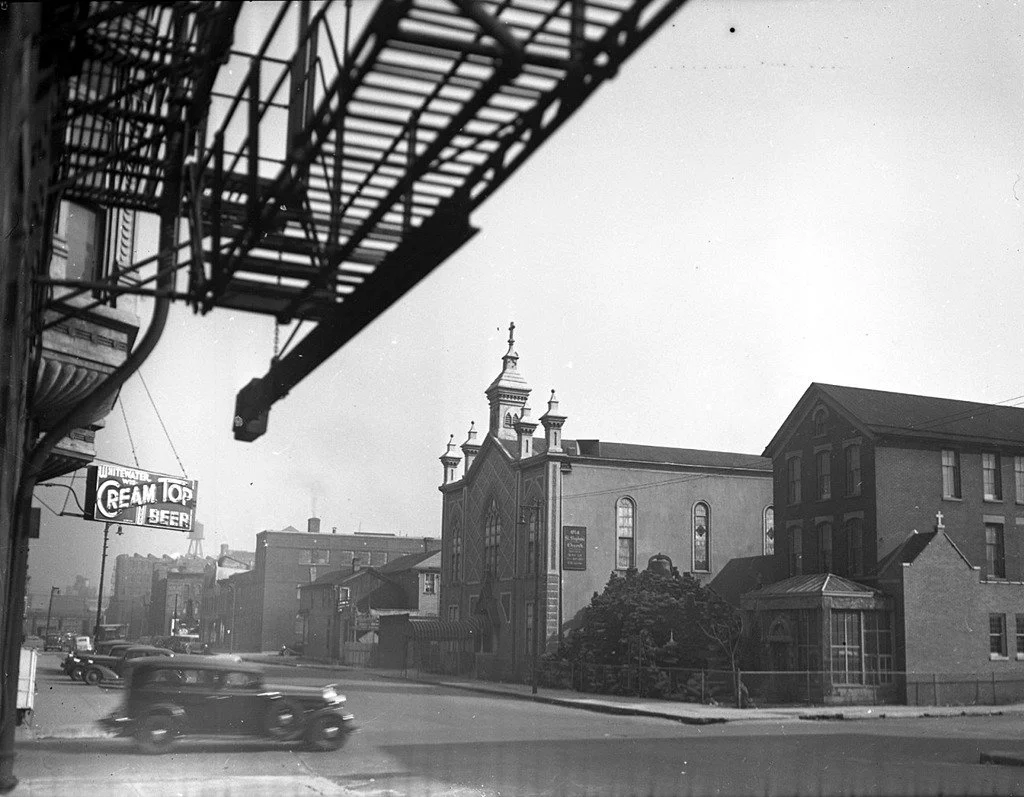
Old St. Stephen's Church
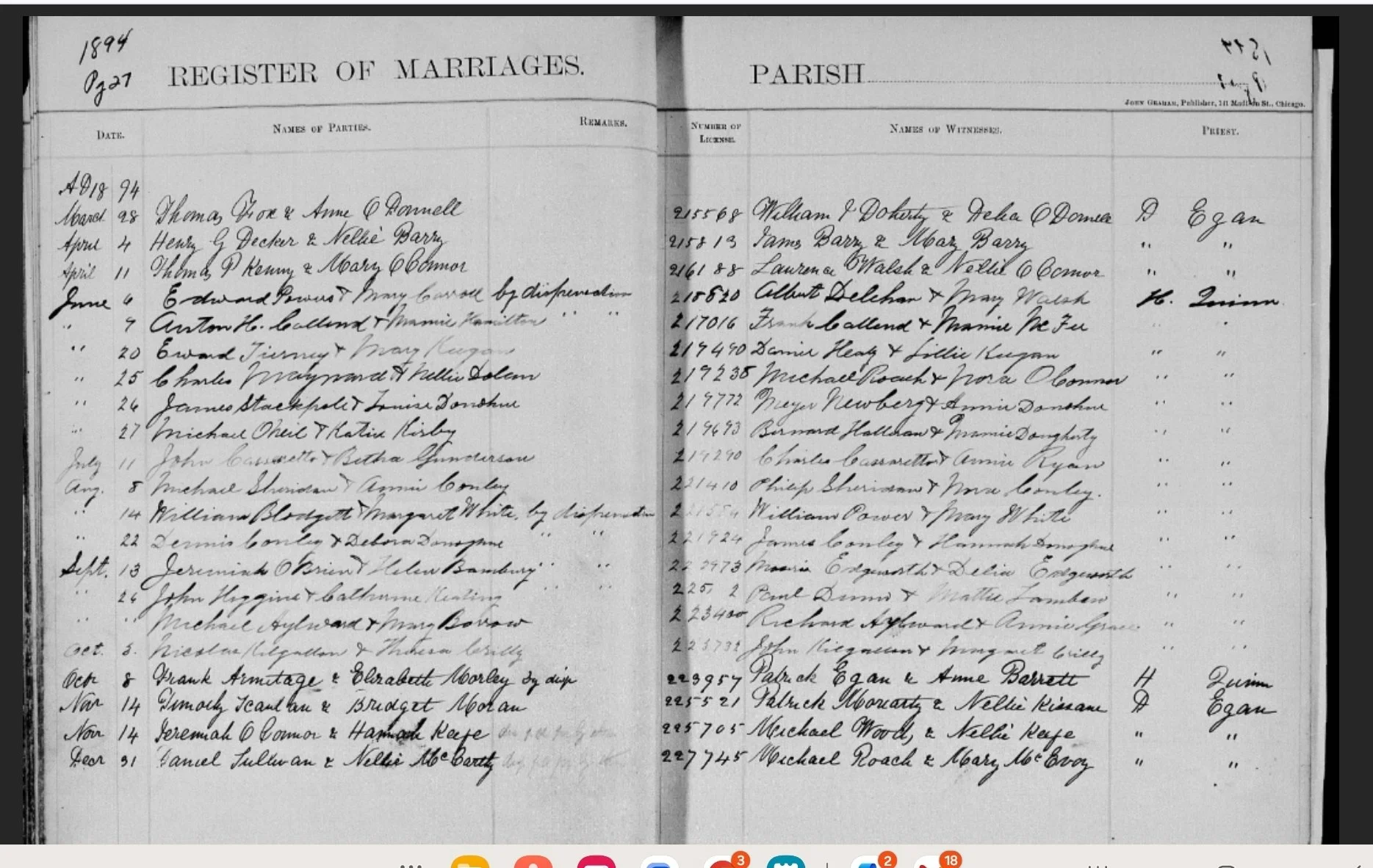
On April 11, 1894, Thomas Patrick Kenny stood at the altar of Old St. Stephen's Church to marry Mary "Maime" O'Connor. But this wasn't just any parish—it was Maime's home church, the place where she and her sister Ellen had been baptized as infants in the 1870s. The Gothic structure at 923 West Ohio Street had served the O'Connor family since at least 1870, making it the natural choice for the wedding that would join the Kenny and O'Connor families.
The Kenny family's connection to Old St. Stephen's would span less than a decade—from Thomas's 1894 marriage through the baptisms of his children—but the church's own story would end dramatically in 1952, demolished to make way for the Northwest Expressway that would reshape Chicago's urban landscape.
The O'Connor Family Parish
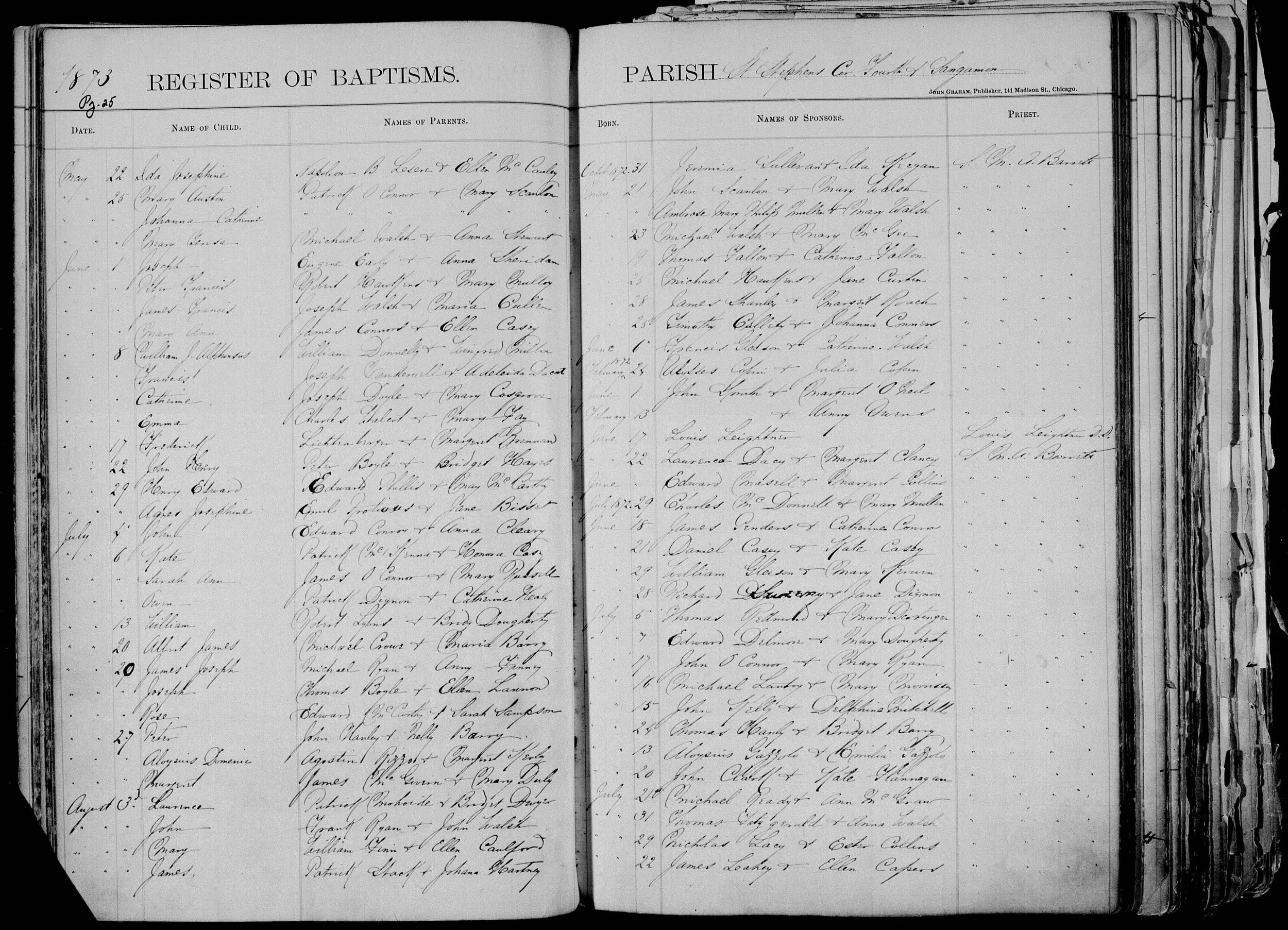
Recent research has revealed something extraordinary: Old St. Stephen's wasn't just where Thomas Kenny married—it was the O'Connor family's parish for decades before the wedding. James O'Connor (also recorded as "Connors") and Ellen Casey had their daughters baptized at this very church:
O'Connor Sisters Baptized at Old St. Stephen's
Why This Matters
The discovery that both O'Connor sisters were baptized at Old St. Stephen's explains why Thomas and Maime married there in 1894—it was Maime's home parish, where her family had worshipped for over two decades. It also reveals the deep roots the O'Connor family had in this Irish immigrant community on Chicago's Near West Side. When Ellen O'Connor served as godmother to Thomas and Maime's daughter Eleanor in 1896, she was standing in the same church where she herself had been baptized 26 years earlier.
A Parish for Immigrants
St. Stephen's Parish was organized in 1846 to serve the growing Irish Catholic population on Chicago's Near West Side. The original wooden church was replaced in 1869 with the Gothic brick structure that would stand for over eighty years at the corner of Ohio and Sangamon Streets.
Old St. Stephen's held the distinction of being Chicago's second-oldest Catholic parish. By the 1890s, the neighborhood around Ohio and Sangamon Streets was a dense working-class community of Irish immigrants and their American-born children—families like the Kennys and O'Connors who found in the parish not just spiritual sustenance but community, identity, and belonging.
The 1871 Great Chicago Fire tested the parish's role in the community. As flames swept through the city, St. Stephen's became a temporary refuge for lost children, displaced residents, and the homeless. The church survived the conflagration and continued to serve as an anchor for the neighborhood's recovery.
When Thomas Kenny married Mary O'Connor in 1894, the area around 923 West Ohio Street was a densely populated, working-class West Town neighborhood. The neighborhood featured a mix of two- and three-flats, small apartment buildings, and workers' cottages—many rebuilt after the Great Fire of 1871. Residents had easy access to major industrial corridors along Grand Avenue and Lake Street, and the new Metropolitan West Side Elevated Railroad was beginning to connect the area to the rest of the city. That same year, the Chicago Commons settlement house was founded nearby to serve the growing immigrant population.
The Kenny Family at St. Stephen's
Thomas Patrick Kenny—son of Prince Edward Island immigrants, Chicago firefighter, future Cherry Mine hero—came to St. Stephen's in 1894 as a young man of twenty-two to marry Mary "Maime" O'Connor. The O'Connor family, led by James O'Connor and Eleanor Casey, were established members of the parish community.
Kenny Family Sacraments at Old St. Stephen's
The parish records of Old St. Stephen's documented the rhythms of Catholic immigrant life: marriages that joined families, baptisms that welcomed new generations, and funerals that marked the passing of pioneers. For Thomas Kenny, these sacraments connected him not just to his faith but to the broader community of Irish Chicago.
Thomas P. Kenny and Mary O'Connor
The marriage register of Old St. Stephen's Church recorded the union of Thomas P. Kenny and Mary O'Connor on April 11, 1894 (License No. 216188). Thomas was twenty-two years old, a fireman with the Chicago Fire Department. Mary, called "Maime" by family, was the daughter of James O'Connor and Eleanor Casey. The officiating priest was Father Egan.
Research Note
The 1894 marriage record from Old St. Stephen's provides one of the earliest documented connections between the Kenny and O'Connor families. When Maime died in 1901, Thomas would marry her sister Ellen in a sororate marriage—keeping the children within the same extended family. The O'Connor connection, first established at St. Stephen's altar, would shape Kenny family history for generations.
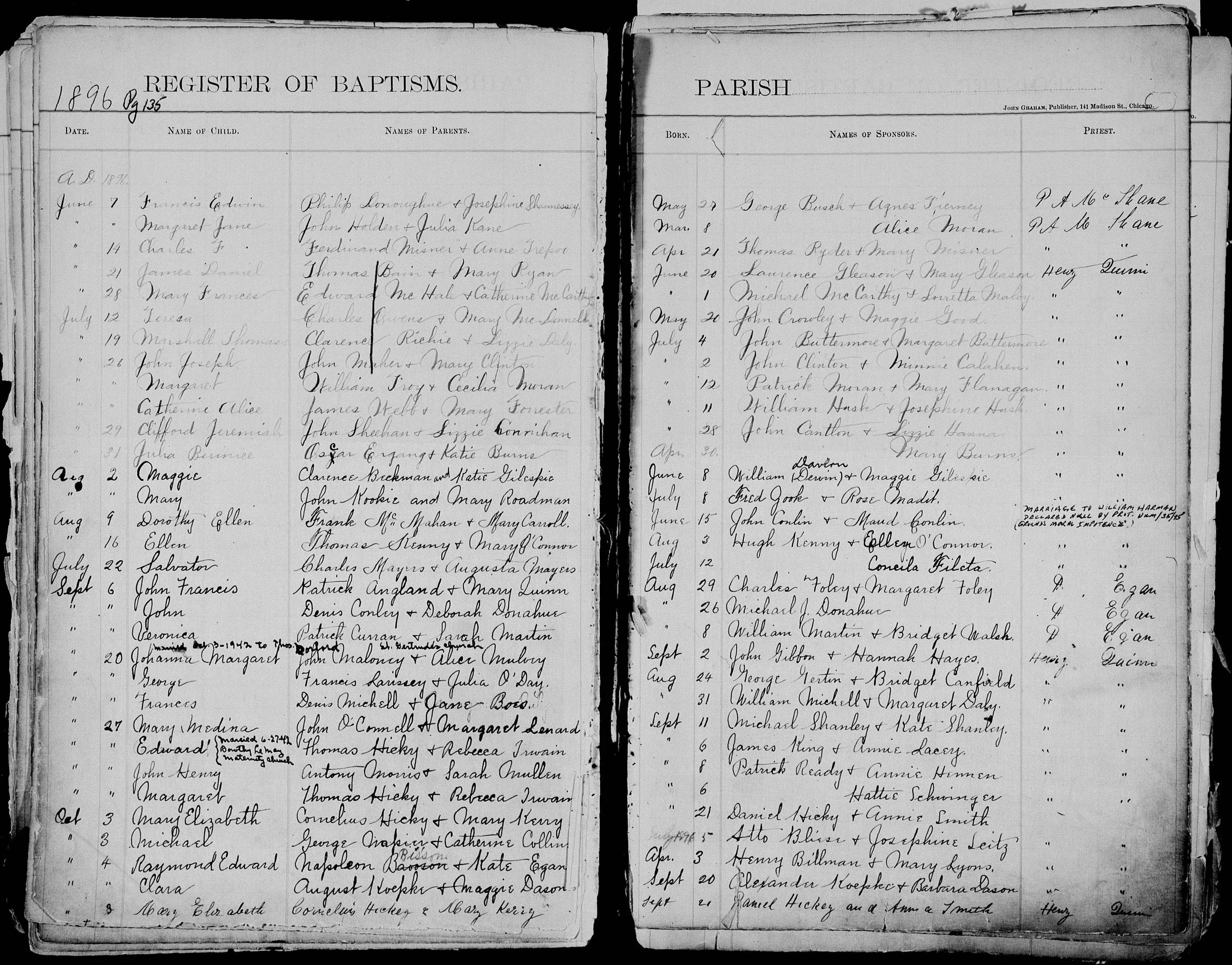
Ellen (Eleanor) Kenny
The baptism register records the baptism of Ellen Kenny on August 16, 1896, having been born on August 3rd. She was the daughter of Thomas Kenny and Mary O'Connor. Ellen (later known as Eleanor) would survive to adulthood and marry Joseph Conley.
A Remarkable Discovery
The baptism record reveals a poignant detail: Ellen O'Connor—the woman who would become Thomas's second wife after Mary's death—served as godmother to baby Eleanor in 1896. This wasn't coincidental; Catholic godparents often came from close family networks. When Mary died in 1901, Ellen already had an established relationship with her sister's children. The sororate marriage that followed in 1902 kept Eleanor and her siblings within the loving care of an aunt they already knew as "Aunt Nell" and godmother.
The Church Through the Years
Old St. Stephen's served its community through decades of change. Originally an Irish parish, demographics shifted as the neighborhood evolved. By 1916, the church was officially designated a Polish parish, reflecting the new immigrant populations that had settled in the area.
The Chapel of Roses
In 1935, Rev. Stephen A. Bubacz created one of the most distinctive features of Old St. Stephen's: the Chapel of Roses. This artistic reproduction of the famous shrine of St. Thérèse at Lisieux, France, brought "A Bit of Lisieux" to Chicago's West Side.
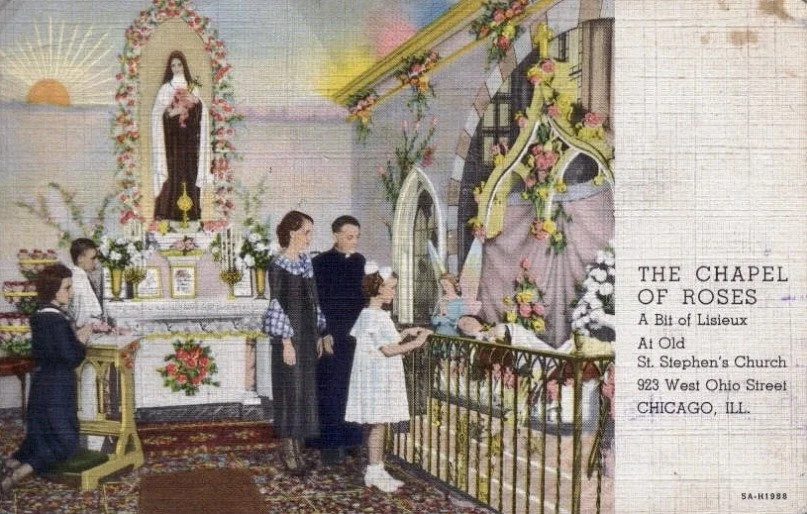
The chapel contained a life-sized painting of St. Thérèse by A. Luciani of Rome, several relics, five famous paintings representing incidents in the saint's life, and a replica of the catafalque as she lay in death. The grotto visible in photographs of the church exterior was part of this devotional complex that made Old St. Stephen's a pilgrimage destination for devotees of the "Little Flower."
The End of an Era
In 1952, Old St. Stephen's met its end—not by fire or neglect, but by urban planning. The church stood in the right-of-way for the projected Northwest Expressway (later named the Kennedy Expressway), and like countless other buildings in its path, it was condemned and demolished.
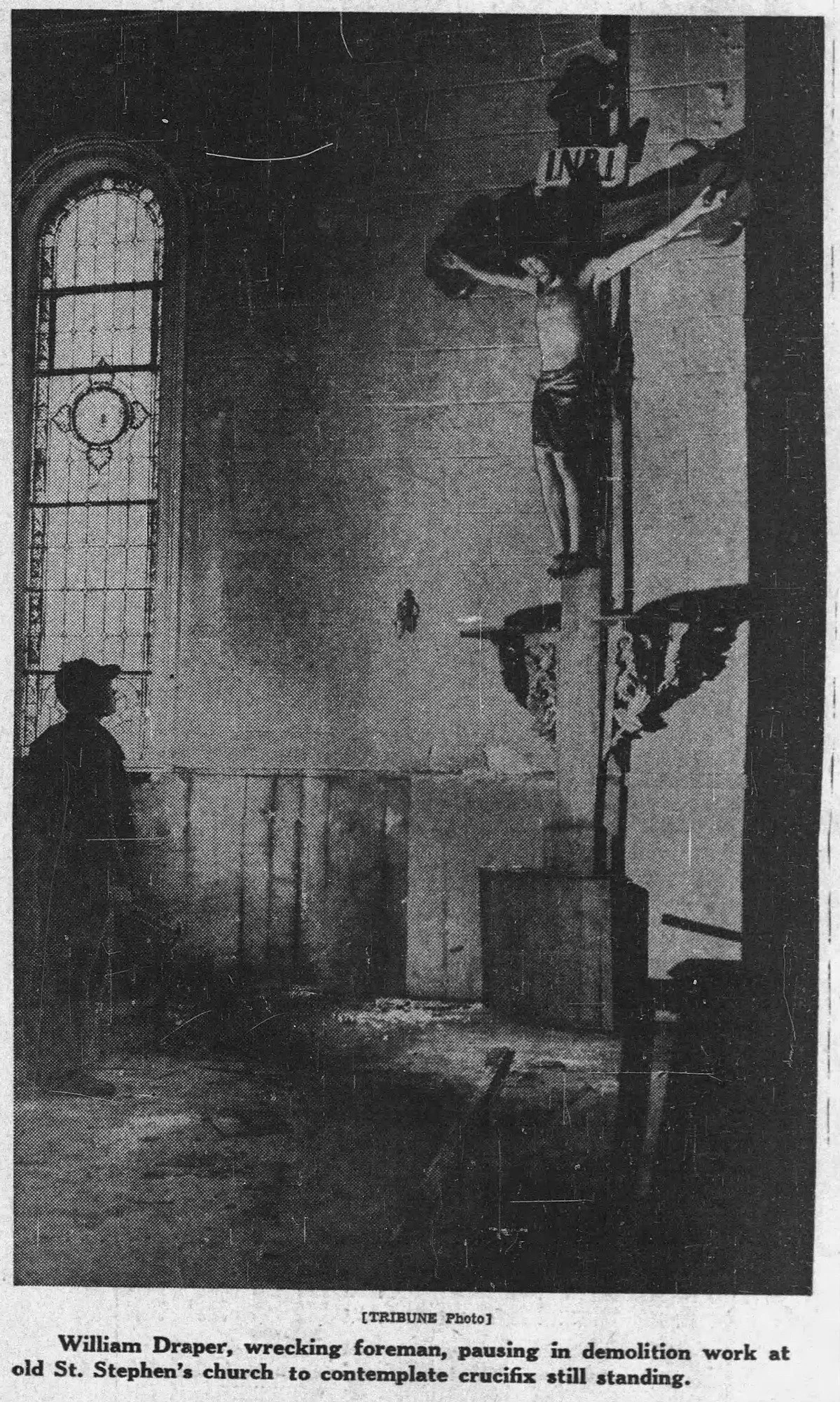
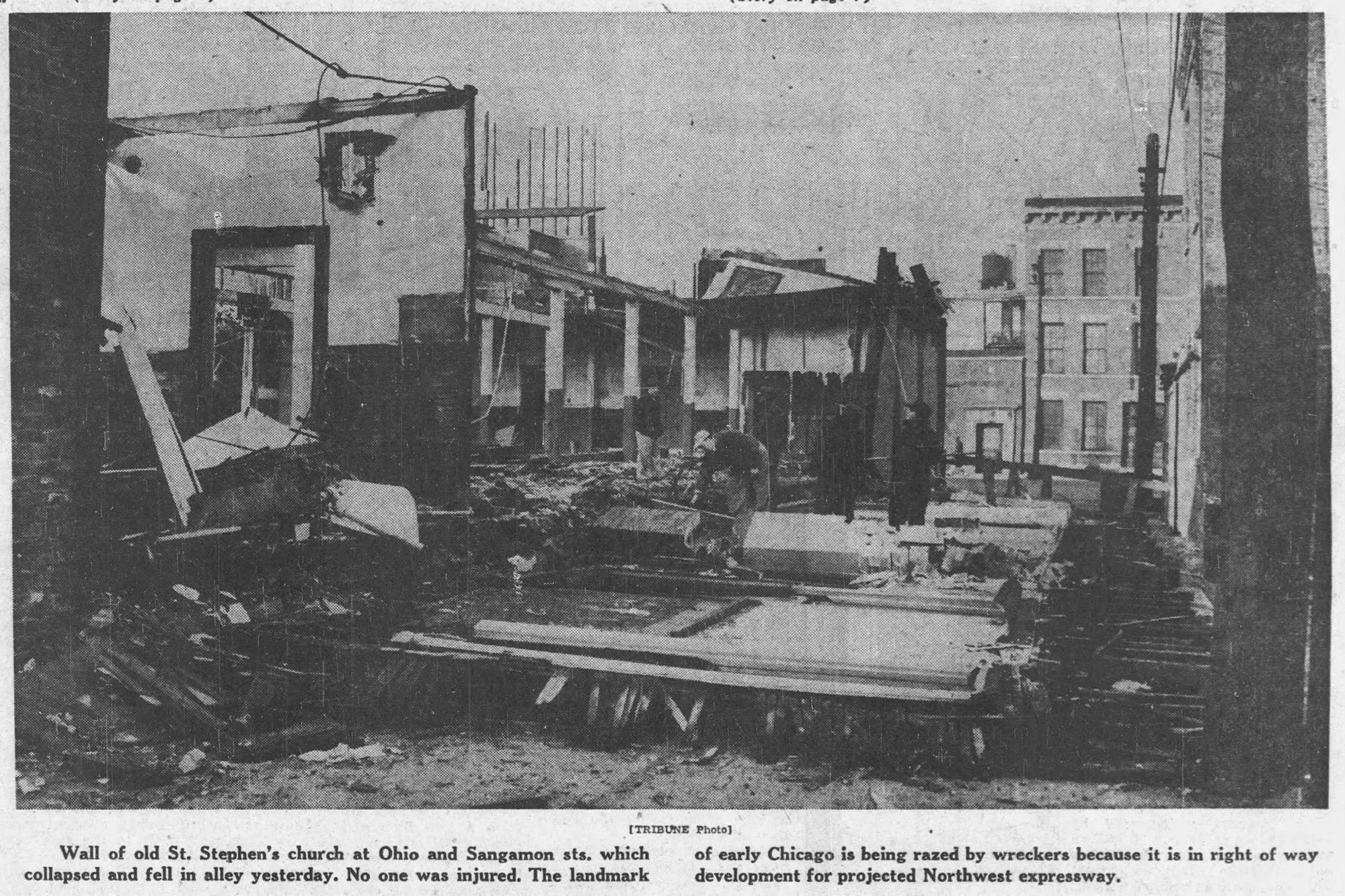
"The landmark of early Chicago is being razed by wreckers because it is in right of way development for projected Northwest expressway."
The congregation merged with Santa Maria Addolorata Church, while some parishioners transferred to St. John Cantius Church. The expressway that replaced the church and its surrounding neighborhood would reshape Chicago's transportation infrastructure for generations—but at the cost of communities like the one that had gathered at St. Stephen's since the 1840s.
What Remains
Today, the Kennedy Expressway flows over the ground where Old St. Stephen's once stood. No physical trace of the church remains at 923 West Ohio Street. But in parish registers, newspaper archives, and family records, the documentation of Irish Catholic life in 19th-century Chicago survives.
For the Kenny family, the marriage record of April 11, 1894, stands as testimony to a moment when Thomas Patrick Kenny—future fire captain, Cherry Mine hero, beloved "Pa"—stood in that Gothic church and pledged his life to Mary O'Connor. The baptismal records of their children Eleanor, James, and the infant Mary who lived only two days anchor the family's first American-born generation to a parish that no longer exists.
Genealogical Significance
Old St. Stephen's parish records, now preserved in the archives of the Archdiocese of Chicago, remain essential sources for documenting Irish Catholic families of the Near West Side. Researchers tracing Kenny, O'Connor, and related families should consult these records for marriage, baptism, and burial documentation from 1846-1952.
The church where Thomas Kenny married, where his children were baptized, where generations of Irish immigrants marked the sacraments of their faith—it exists now only in photographs, records, and the inherited memories of families who once called it home.
Primary Sources & Historical Images

Every Family Has a Story Worth Telling
Whether you're just beginning your research or ready to transform years of work into a narrative your family will treasure, I'd love to help.
LET'S TALK ABOUT YOUR FAMILY