
The Storyline
Real families. Real discoveries. Real stories.

Petrona Quimpo: The Woman Remembered as Tonang
A family kept the mother of Mamerto Morales only as a nickname — "Tonang Quimpo" — that no register could hold. This is the story of recovering her: a girl in the Quimpo house, a widow who held her land, a grandmother named across three generations of Kalibo baptisms, and how a family's memory and a century-old register were finally made to agree.
Part of the Storyline Genealogy series: From Aklan to America | From Research to Story

St. Joseph the Worker Parish
Some churches you find on a map; this one we found in a sentence, buried in a wartime certificate. When Numancia's records burned in 1944, the sworn substitutes the family gathered all named one parish—St. Joseph the Worker—where Jose Tamayo married Corazon Roldan in 1931 and where Romulo, Hally, and Virgilio were born. This Sacred Places article tells the story of the Numancia Church and the documents that led us home to it.
Part of the Storyline Genealogy series: Sacred Places

When the War Burned the Records
In much of the Philippines, the record you most want to see was burned in World War II. Drawing on the Morales-Tamayo case, this field guide shows how to reconstruct a lost Filipino family from what survived — church salvage books, notarial registers, delayed registrations, the immigration papers of relatives who emigrated, and DNA — and how to request the two U.S. records, the SS-5 and the A-File, that so often hold the answers.
Part of the Storyline Genealogy series: From Aklan to America | From Research to Story

From Aklan to America: Under the Stars and Stripes
When American forces landed on Panay in 1899, the Spanish world of Numancia was already passing. This second episode of From Aklan to America follows the Morales and Tamayo families through the Commonwealth years and the Japanese occupation — a notary's surviving register, a 1931 wedding at St. Joseph's, and a wartime death the records can only bracket, never quite name.
Part of the Storyline Genealogy series: From Aklan to America | From Research to Story

Cathedral of St. John the Baptist
In the coastal town of Numancia, Aklan, two families—the Morales and the Tamayo—raised their children within the spiritual orbit of the oldest church in the province. Founded as an Augustinian mission in 1581 and elevated to a parish in 1680, the Cathedral of St. John the Baptist in Kalibo survived Moro pirate raids, the great fire of 1885, World War II, and a 7.1 earthquake to stand today as the spiritual heart of the Ati-Atihan Festival. This Sacred Places article traces four centuries of faith and resilience—and the ancestral parish where the Morales and Tamayo families worshipped before their journey to Manila and, eventually, to America.
Part of the Storyline Genealogy series : Sacred Places

From Aklan to America: Four Families, One Province
In the 1830s, on the island of Panay in the Western Visayas, four children were born who would become the founding ancestors of interconnected family lines—Gonzales, Morales, Martelino-Roldan, and Isturis. They never knew one another, yet they farmed the same fertile plains, worshipped in the same colonial churches, and lived through the same upheaval as the Philippines moved from Spanish colony to revolutionary republic. A century later, their descendants would converge in a single family. This first episode traces those four lines through parish registers and property records, set against the encomienda system, the 19 Martyrs of Aklan, and the fall of Spanish Kalibo in 1898.
Part of the Storyline Genealogy series: From Aklan to America | From Research to Story

Église Saint-Aubin de Tourouvre
The eight-century Perche church that baptized Jean Creste in 1626 — and thirty-five other founding pioneers of New France whose names are recorded on a plaque inside: Juchereau, Pinguet, Guyon, Roussin, Gagnon, Giguère, Mercier, Rivard, Pelletier, Provost, and more. The Romanesque south wall dates to the twelfth century; the bell tower with its lantern campanile is Renaissance; the great baroque high altar is dated 1646; the famous Mercier emigration stained glass was installed in 1893. The building survived the burning of Tourouvre by retreating German troops on 13 August 1944, almost untouched.
Part of the Storyline Genealogy series : Sacred Places

Marie Crête: The Daughter Who Carried the Line
Notre-Dame de Québec, October 1657: a four-day-old infant carried to the font and baptized by the Sulpician Vicar Apostolic of New France. Sixty-five years later she would be buried in the same parish, a widow of three husbands. Between those two acts Marie Crête bore twelve children, sued her own brother-in-law in the Provost's Court of Quebec for twelve hundred livres, partitioned an urban Quebec property near the Hôtel-Dieu with the seigneur Saint-Simon, and paid seigneurial dues to the Crown's farmer-general. A documentary biography of the 8th great-grandmother of the Guilbault line — three marriages reconstructed from parish, notarial, judicial, and seigneurial records.
Part of the Storyline Genealogy series: From Research to Story

Cathedral-Basilica of Notre-Dame de Québec
In a modest 1647 stone church on the rock of Quebec, the marriage of a Norman bride and a Percheron husband was recorded on 13 September 1654. Over the next seventeen years she would return to the same parish church ten times to baptize her children at its font. Once, in the spring of 1663, to bury a six-week-old daughter. The cathedral-basilica that stands on the site today is the third major building since hers — destroyed in 1759 by British shelling, again in 1922 by fire, rebuilt stone-by-stone each time from photographs and the original Baillairgé plans.
Part of the Storyline Genealogy series : Sacred Places

The Mathematics of French-Canadian Cousinhood
When my son told me his coworker had French-Canadian background, I predicted we were probably 9th-to-10th cousins before either of us checked anything. I have made that prediction many times across my career, and the math always works. An essay on pedigree collapse and the founder effect.
Part of the Storyline Genealogy series: From Research to Story

Église Saint-Martin de Vieux-Bellême
In a Norman priory church older than France itself, four children of Vincent Gaulin and Marie Bonnemer were baptized between 1620 and 1630. Two would later cross to New France.
Part of the Storyline Genealogy series : Sacred Places

Marguerite Gaulin: A Fille à Marier of the Perche
Marguerite Gaulin was baptized on 14 May 1627 in the parish of Saint-Martin-du-Vieux-Bellême, in the rolling country of the Perche west of Paris. Twenty-seven years later she crossed an ocean as a fille à marier, married Jean Crête in the manor house of Sieur Robert Giffard at Beauport, and spent the next forty-nine years raising ten children at the heart of the Giffard-Juchereau seigneurial circle. This documentary biography traces her life through twelve primary sources, three royal censuses, and the baptism register acts of every child she bore.
Part of the Storyline Genealogy series: Filles du Roi & Filles à Marier — The Women Who Built New France
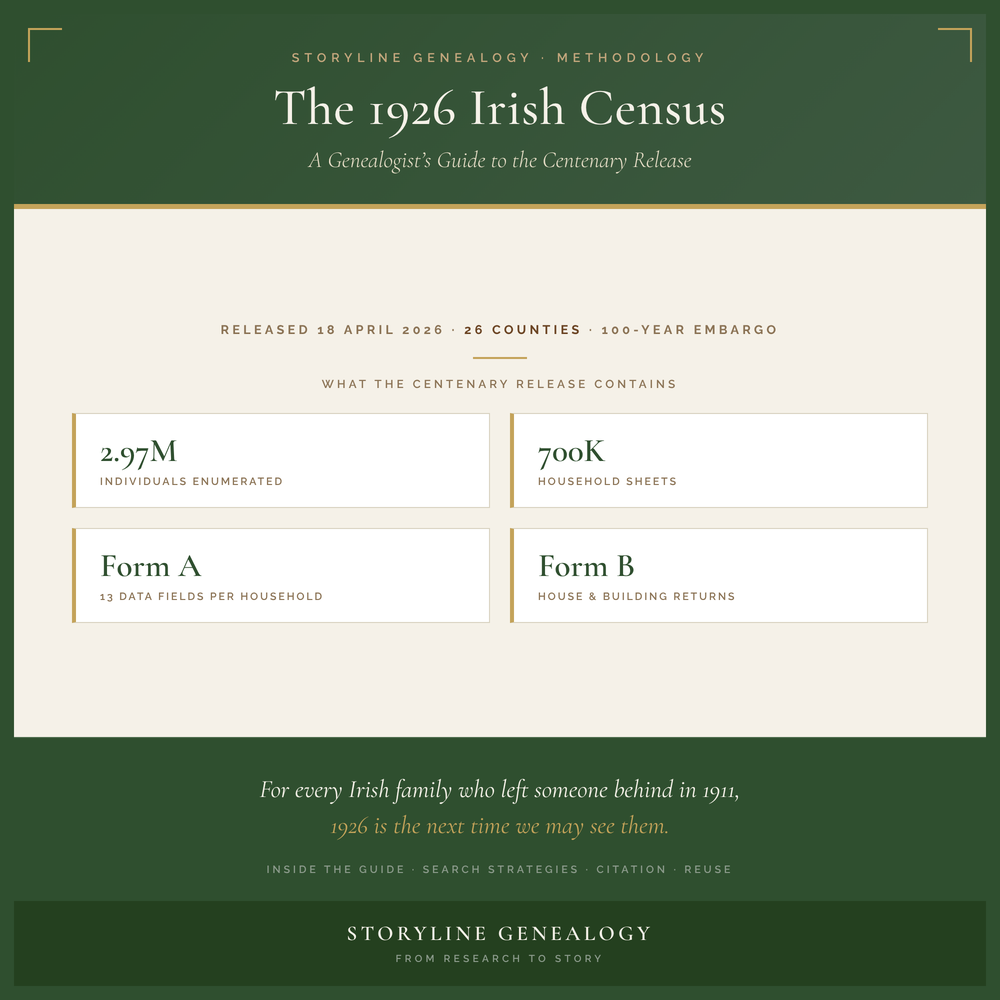
The 1926 Irish Census: A Genealogist's Guide
For one hundred years, the first census of the Irish Free State sat sealed in archival boxes. On 18 April 2026, the National Archives of Ireland released the entire collection to the public — nearly three million individuals, restored to the documentary record on the same calendar date their forms were filled in. This is a practical guide for genealogists working the new resource: what the twenty-six-county census contains, how to search it effectively, why no Northern Ireland returns survive to release, the known data limitations and forthcoming fixes, and the citation conventions to use when sharing what you find.
Part of the Storyline Genealogy Series: Research Methodology
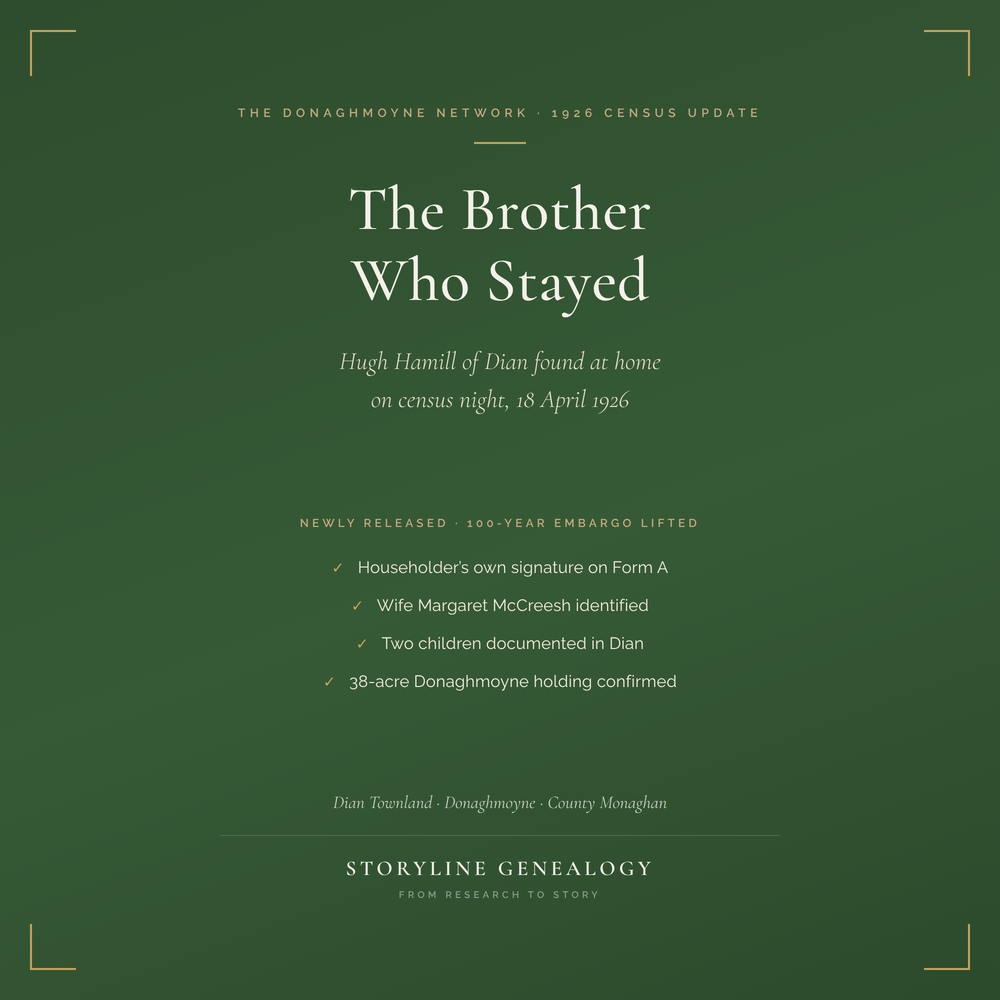
Hugh Hamill of Dian — The Brother Who Stayed
For more than a century, Hugh Hamill existed in the family memory only as the brother who stayed — the one who did not emigrate, the one who held the Donaghmoyne land. On 18 April 2026, exactly one hundred years after the enumeration of his Dian household, the first Census of the Irish Free State was released, and Hugh stepped back into the documentary record: his wife Margaret McCreesh of Culloville, two Irish-speaking children, thirty-eight statute acres, and his own signature on Form A. What the census could not show is what followed. Within six years the family had left Dian, the record of Hugh's death places him across the border in his wife's townland, and a fifth name on the family headstone turns out to be the boy of nine at his table.
Part of the Storyline Genealogy series: The Donaghmoyne Network

What the Finding Aids Don’t Show You
Two indexes cover the same Hudson's Bay Company Archives collection and return different answers. A microfilm reel catalogued as holding a run of account books quietly redirects one of them to two other reels. And an index entry, however precise, cannot tell you which of several men who shared a name you actually found. None is a flaw in the archive. Each will cost you a conclusion.
Part of the Storyline Genealogy series : A Research Methodology Guide

Newsletter : Spring 2026
Since November, the research has expanded—and the website with it. Six new specialized collections, three research libraries, and more. A tour of what's new at Storyline Genealogy.
Storyline Genealogy: From Research to Story

Helen Gladys Robertson Verhoek
She was born in 1907 with the face of a grandmother she never met. She died in 1942 of the disease that had killed that grandmother fifty-eight years earlier. Between those two dates, she was orphaned at sixteen, buried an infant daughter at twenty-three, and raised two children into a childhood she would not live to see finish. Her mother, grandmother, and great-grandfather had all died of the same thing. Helen Gladys Robertson Verhoek was the fifth generation to carry tuberculosis and the last to die of it. Streptomycin was isolated at Rutgers one year too late.
Part of the Storyline Genealogy Series: Documentary Biographies From Research to Story

Mary Agnes Kenny Robertson
Her husband died on a Monday in January 1924. She died the following Saturday — twelve days later — in the same house, of the pulmonary tuberculosis that had killed her mother in 1884 and her grandfather in 1870, and would kill her daughter Helen in 1942. Mary Agnes Kenny Robertson was orphaned at five and raised by an aunt who never married. She gave her three children the stability she herself never had, and it collapsed inside twelve days. The hinge biography of Scattered Stones — where the Kenny line meets the Robertson line and the whole family turns.
Part of the Storyline Genealogy Series: Documentary Biographies From Research to Story

Eliza Kenny: The Other Grandmother
Widowed in 1854 with two small sons, Eliza Kenny never remarried. She ran a Brooklyn grocery on Walworth Street alone for thirteen years and raised her sons alone for thirty-three. Her maiden name is lost to the record. Her birthplace in Ireland is unknown. And yet four words in an 1879 Brooklyn directory — "Kenny Elizabeth, wid. Richard" — rebuilt her entire family tree. A biography of presence and absence, of what survives in the record and what does not.
Part of the Storyline Genealogy Series: Documentary Biographies From Research to Story

Ann Lynch McKenna
On New Year's Day 1871, a poor Irish widow walked into Holy Cross Cemetery in Brooklyn and bought a family plot — not a single grave — for the husband she had just lost to tuberculosis. Ann Lynch McKenna had no way of knowing her single act of foresight would hold seven family members across seventy-nine years, or that her great-great-granddaughter would pay the final perpetual care check one hundred and twenty years later. The root of a Brooklyn Irish family.
Part of the Storyline Genealogy Series: Documentary Biographies From Research to Story