
St. Joseph the Worker Parish
Numancia, Aklan, Philippines
St. Joseph the Worker Parish
The hometown parish of the Morales and Tamayo families—a church we would never have found without the war-loss certifications that named it. Under the patronage of St. Joseph the Worker, it was here that Jose Tamayo married Corazon Roldan, and here that Romulo, Hally, and Virgilio were born into a town of farmers and laborers.

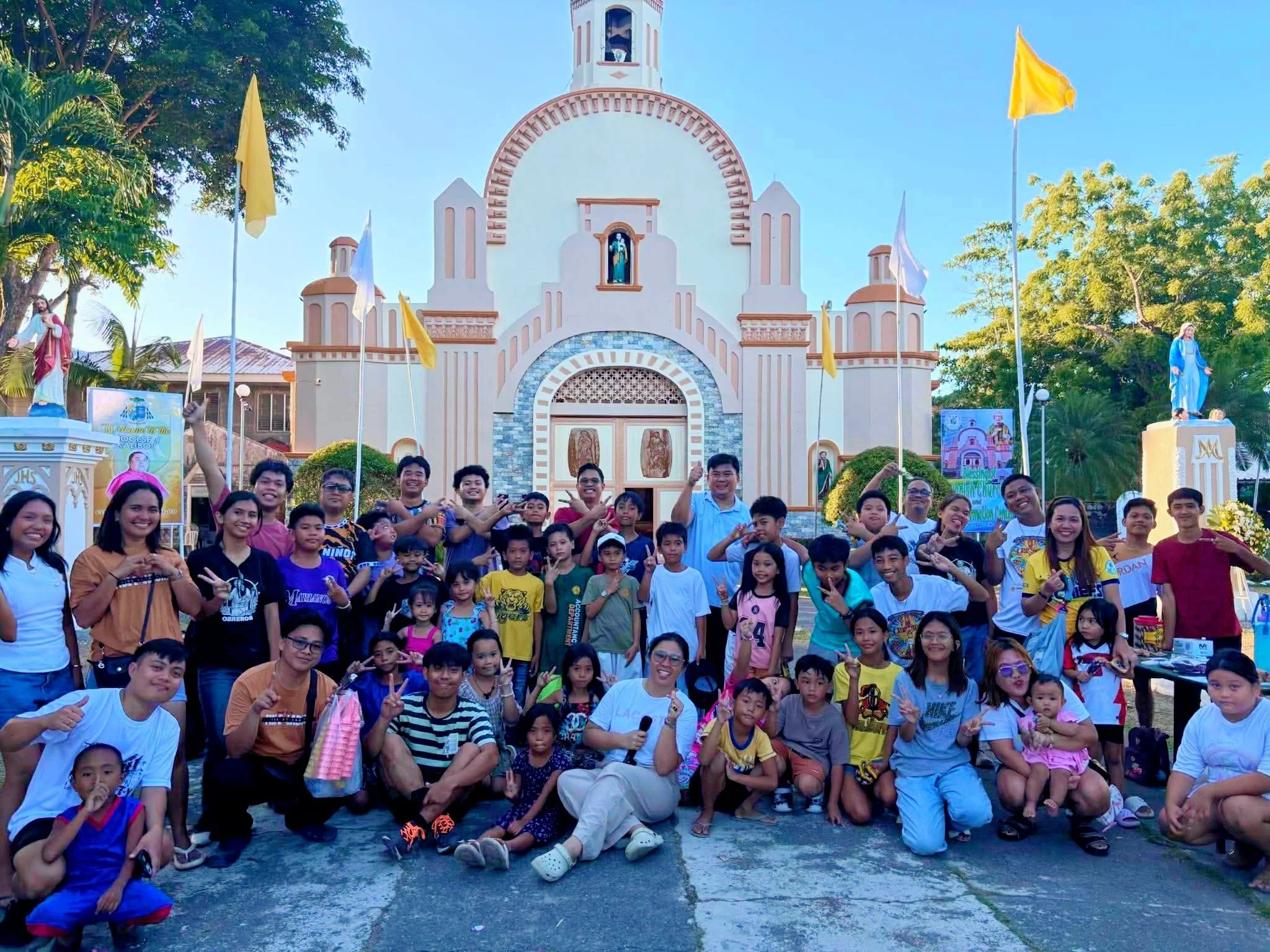
St. Joseph the Worker Parish in Poblacion, Numancia—its symmetrical façade crowned by a central bell tower and the image of St. Joseph carrying the Holy Child. Just steps from the town plaza, municipal hall, and school, the church remains the heart of the community whose patron honors the dignity of work.
Some churches you find on a map. This one we found in a sentence—buried in a wartime certificate explaining why a record no longer existed. When the civil and church registers of Numancia were destroyed in the Japanese occupation, the families who needed proof of who they were turned to sworn substitutes, and those documents named, again and again, a single parish: St. Joseph the Worker. It was in tracing those certifications that we learned where the Morales and Tamayo families had been baptized and married all along.
St. Joseph the Worker Parish—known simply as the Numancia Church—sits in Barangay Poblacion, a few steps from the Numancia Plaza, the municipal hall, and the town's school. Founded in 1874 under the patronage of the carpenter-saint, it served a town of farmers and laborers for whom the dignity of work was not an abstraction but a daily fact. Next door to the provincial capital of Kalibo and its great cathedral, Numancia's own parish was the closer, humbler church of home—and the one this family actually belonged to.
The Morales & Tamayo Families at St. Joseph the Worker
The Church We Found in the Records
Numancia lost its past twice over. As a parish priest later certified, almost all the books of the rectory “were destroyed or lost during the last World War,” and the municipal treasurer confirmed that all registry records of births, deaths, and marriages prior to 1945 “were totally destroyed in or around September 1944” during the Japanese occupation. For a family historian, this is the kind of loss that closes a door: no baptismal book to open, no marriage register to consult.
And yet the door reopened from the other side. When members of the family needed to prove their births and marriages—for travel, for employment, for life in the United States—they requested certifications from the very parish whose books had burned. Each certification recited the loss, then attested to what the family knew: a name, a date, a set of parents, and the church where it had happened. Those documents are how we learned that St. Joseph the Worker in Numancia, not the cathedral in Kalibo, was the family's home parish.

The document that pointed the way: a Certificate of Loss issued when the original could not be furnished, attesting that Jose Tamayo and Corazon Roldan were married on June 27, 1931 at St. Joseph Catholic Church in Numancia, solemnized by Rev. Proculo Ilijay. A record of absence that nonetheless named the parish.
Why This Church Matters to the Research
Without the certificates of loss, this parish would have been invisible to us. It was the documents—Jose and Corazon's 1931 marriage, and the parish birth certifications for Romulo, Hally, and Virgilio—that placed the family squarely in Numancia and named St. Joseph the Worker as the church of record. The absence of the originals, paradoxically, is what led us here.
A Parish for a Town of Workers
The story of Numancia's church is inseparable from the story of the town's separation from Kalibo. The original settlement in this part of Aklan lay at Laguinbanwa—“old town”—where Augustinian missionaries had built the region's first church in the sixteenth century. As the more prosperous ground across the Aklan River drew the population, the town center shifted toward Kalibo, and for generations the people of the surrounding barrios had to make difficult treks, fording swollen rivers, to attend Mass at the cathedral.
In 1874, that changed. A parish of their own was established at Numancia under the patronage of St. Joseph the Worker—a devotion chosen, fittingly, for a community of farmers and laborers. The stone church that took shape in the late nineteenth century (around 1889–1890) gave the town a sacred center of its own, only steps from the plaza and the municipal seat. It has been restored several times since, but it has remained, without interruption, the spiritual heart of Numancia.

The Numancia Church and its grounds. The historic stone church took shape in the late nineteenth century and has been restored several times, but it has remained the sacred center of a town of farmers and laborers—only steps from the plaza and the municipal seat.
Numancia adjoins Kalibo, the provincial capital, so closely that the Numancia Church is traditionally among the first stops on the Visita Iglesia. The two parishes share a deep history: the first church of the area stood at Laguinbanwa, in what is now Numancia, before the colonial town center moved across the river. For the Morales and Tamayo families, the cathedral in Kalibo was the grand church of the diocese—but St. Joseph the Worker was the parish of home.
The Patron of Numancia
The carpenter of Nazareth, foster father of Christ and patron of laborers, whose feast falls on May 1. The dedication was apt for a town built on farming and manual labor—a parish that honored the holiness of ordinary work. The church bears his image carrying the Holy Child above its central bell tower.
Every Feast of St. Joseph the Worker, the parish priests bless the streets and highways of Numancia, asking God's protection and safety for those who travel and labor along them. The parish is also known for its overflowing traditional Christmas Eve Masses—customs that bind the town across generations.
The Marriage That Began the Tamayo Line
On June 27, 1931, Jose Tamayo and Maria Corazon Roldan were married at St. Joseph Catholic Church in Numancia, the ceremony solemnized by Rev. Proculo Ilijay. We know this not from the original marriage register—which the war destroyed—but from a 1981 Certificate of Loss issued by the municipal treasurer, which recites the date, the church, and the officiating priest while explaining that no certified copy could be furnished. From that union descends the Tamayo half of the family, carried forward by their daughter Hally.
Less than a year later, on May 10, 1932, Hally Roldan Tamayo was born in Numancia to Jose and Corazon. Into the same parish, the Morales family brought their sons: Romulo G. Morales, born October 31, 1931, and Virgilio Morales, born June 26—a year the records give two ways (see the note below). Both were sons of Mamerto Morales and Patrocinio Gonzales of Poblacion. Years later, when the parish issued certifications for these births, it noted that Mamerto had by then died—“the late Mamerto Morales”—a small documentary echo of his loss on Agtawagon Hill during the war.
Virgilio's birth day is consistent across every record — June 26. The year is given two ways. The Parish of St. Joseph certification, issued in 1971 from the salvage books, records June 26, 1935 — while noting that his name could not in fact be found among the surviving records and that no certified copy could be furnished. His own 1976 United States naturalization certificate, which he signed, records June 26, 1936.
No contemporaneous birth record survives to settle between them, the originals having burned in 1944. We carry June 26, 1936 — the date on the document Virgilio himself signed — as the working year, with the parish's 1935 preserved here as the conflicting source. The parish certification reproduced in the gallery below shows the 1935 date exactly as the parish wrote it.
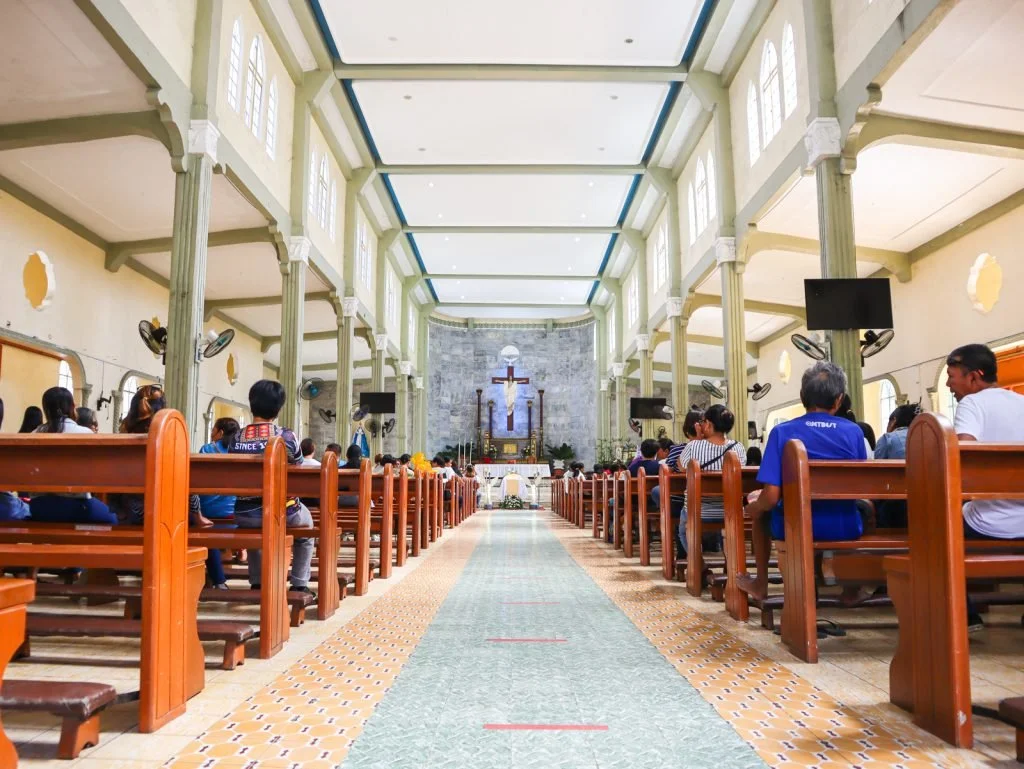
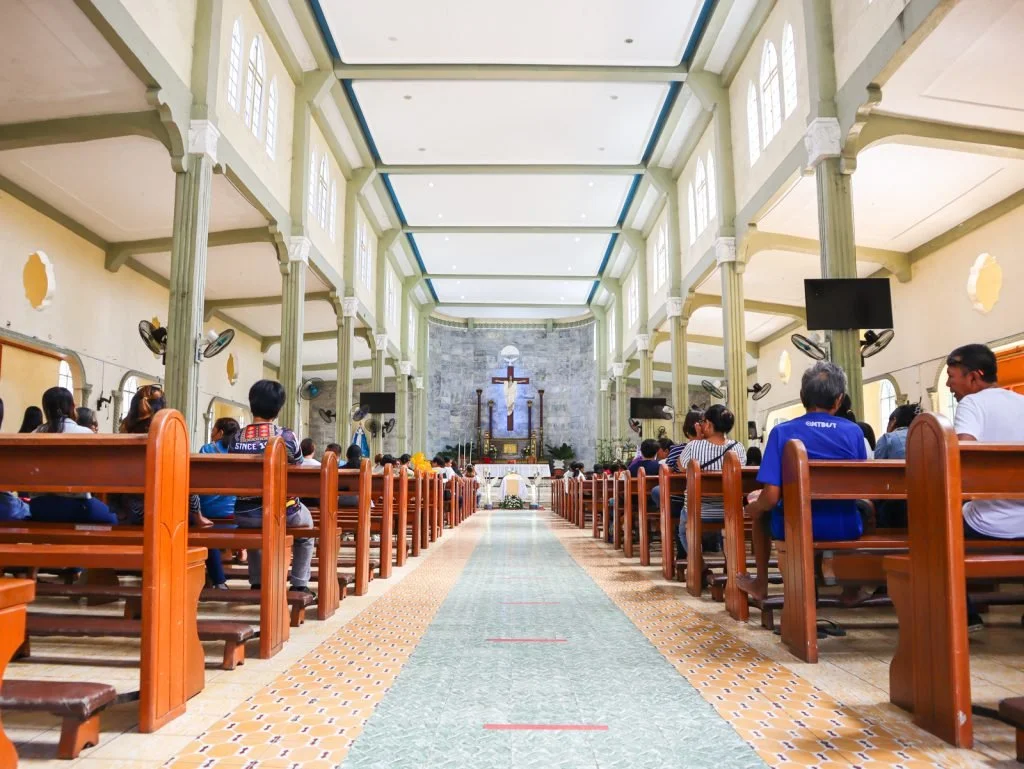
The nave and altar of the Numancia Church—the kind of space in which Jose and Corazon were married in 1931 and the children of the family were brought for baptism. The present interior reflects later restorations of the historic church.
Parish & Family Timeline
The Church Today
The Numancia Church today presents a clean, symmetrical façade with its bell tower set squarely at the center and a small, well-kept garden at its front. By night, lit against the dark, it remains the landmark of the town center—steps from the municipal hall, the integrated school, and the plaza where the life of Numancia still gathers. It continues its old customs: the blessing of the roads on the feast of its patron, the great Christmas Eve Masses that fill it past its doors.

The Numancia Church by night, lit against the dark—still the landmark of the town center, steps from the municipal hall, the school, and the plaza where the life of Numancia gathers.
For the Morales and Tamayo families, this is the church where the documented family begins—the parish of a marriage in 1931 and of the children born into the years just before the war. It is, in the most literal sense, the place the records lead home to.
The Church
The Documents That Led Us Here
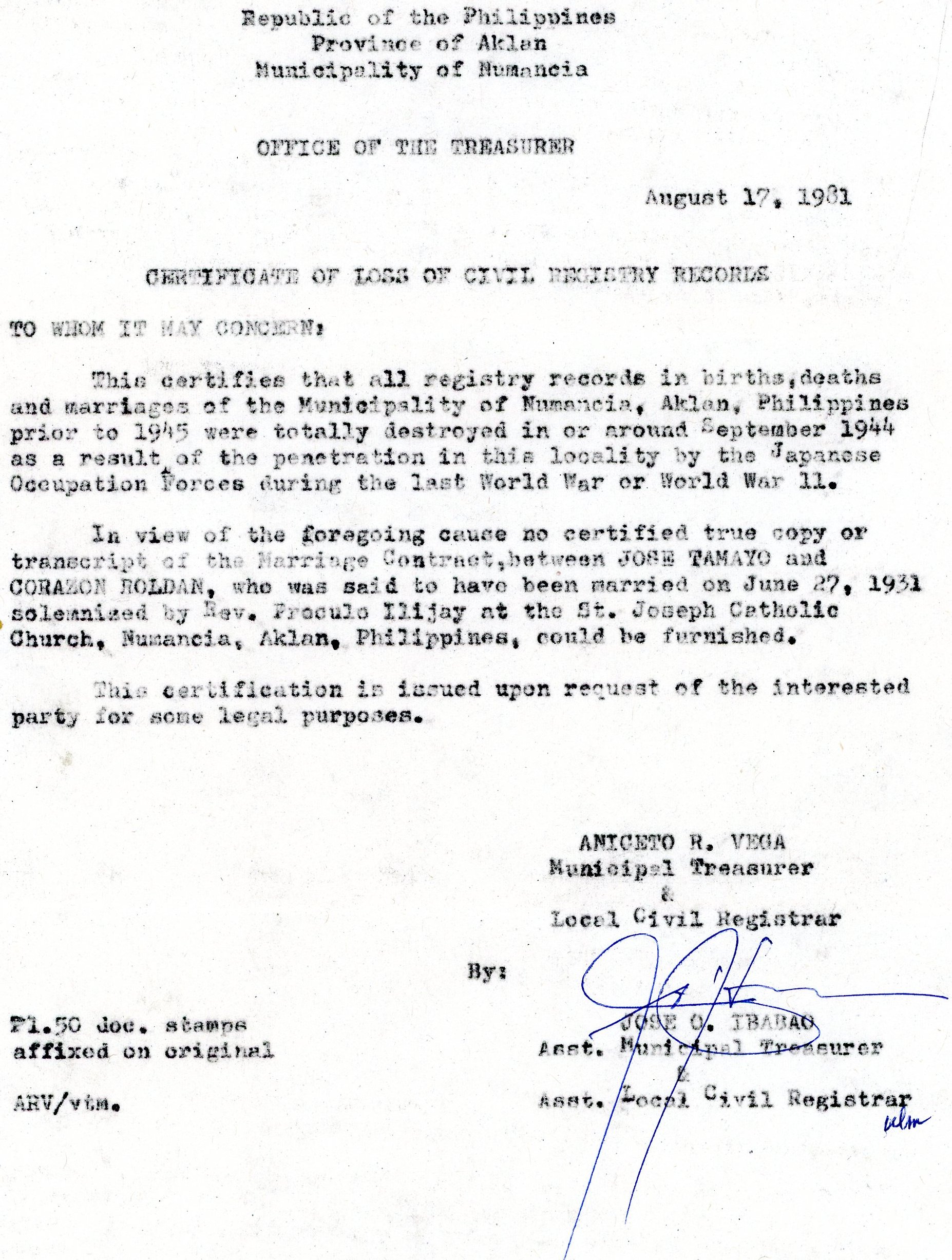
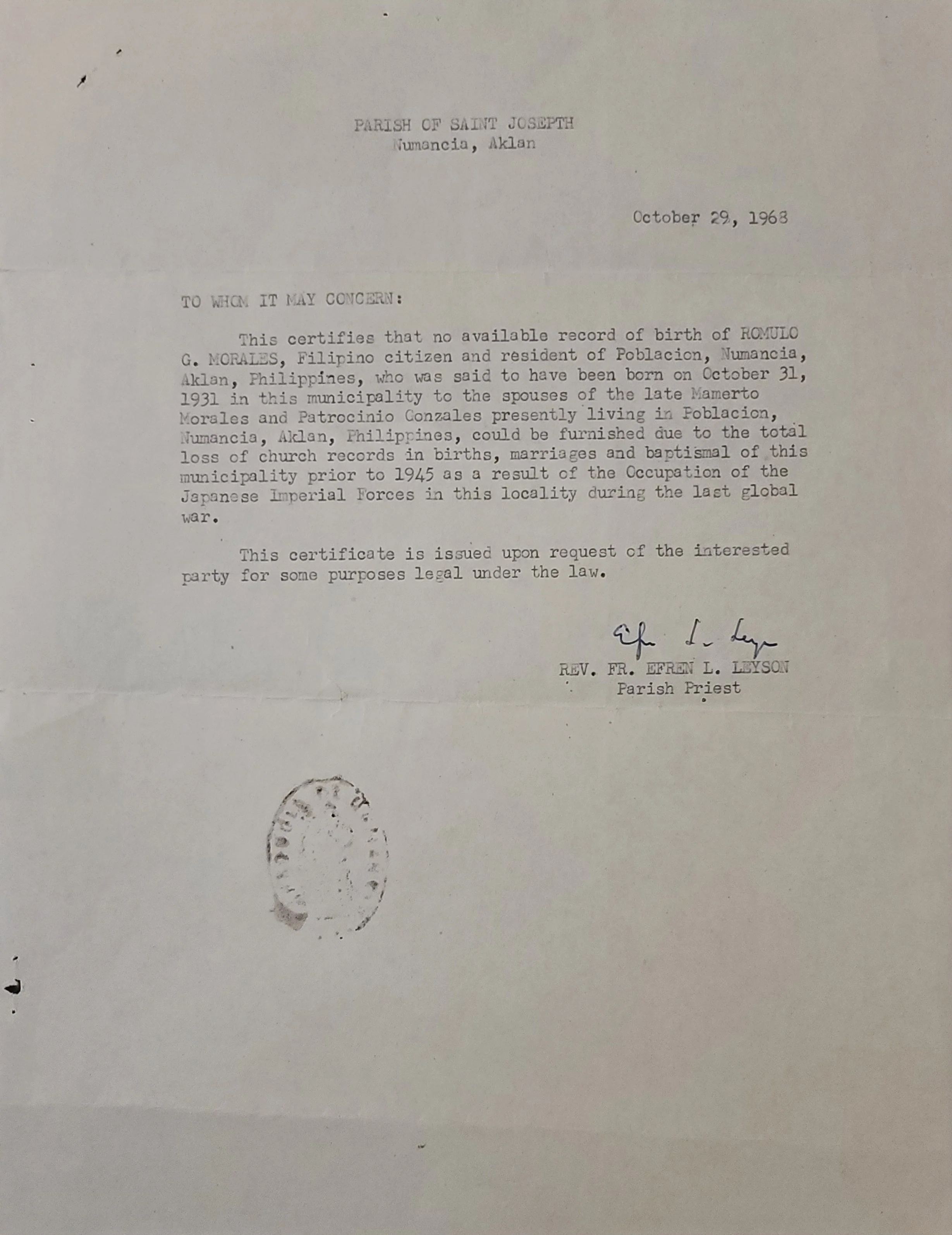


Each of these records is, on its face, a record of absence—a sworn statement that the original could not be furnished because the books of Numancia were destroyed in or around September 1944. But each also preserves the facts the family carried in memory: a marriage on June 27, 1931 at St. Joseph Catholic Church; births in 1931, 1932, and the mid-1930s to known parents of Poblacion, Numancia. Handled with care, negative evidence of this kind both documents the gap and points to the institution—this parish—where the events occurred.
For the fuller method behind reconstructing a family from a town whose records burned, see the companion article When the War Burned the Records.
Questions about your own research? Begin a research inquiry.
