
Cathedral-Basilica of Notre-Dame de Québec
16, rue de Buade, Old Québec, Québec, Canada
Cathedral-Basilica of Notre-Dame de Québec
On the thirteenth of September 1654, in the manor house of Sieur Robert Giffard at Beauport, Father Paul Ragueneau of the Society of Jesus celebrated the marriage of a young Percheronne named Marguerite Gaulin — twenty-seven years old, recently arrived from Saint-Martin-du-Vieux-Bellême as a fille à marier — to Jean Creste, also of the Perche. The entry was recorded that same day in the parish register of Notre-Dame de Québec, which then still served the entire colony. Over the next seventeen years she would return to this same parish church to baptize ten children at its font, and once, in the spring of 1663, to bury an infant. The building she knew has burned twice since. The site has not moved.
The Creste–Gaulin Family at Notre-Dame de Québec
Bride: Marie Marguerite Gaulin, daughter of Vincent Gaulin and Marie Bonnemer of Saint-Martin-du-Vieux-Bellême
Status: Bride arrived in New France as a fille à marier
Children baptized at Notre-Dame de Québec, 1656–1671: Louis (1656), Marie (1657), Marguerite (1659), Marie Françoise (1660), Marguerite (1663, died in infancy), Jean (1664), Joseph (1666), Marie (1668), Louise (1670), Pierre (1671) — ten baptisms across seventeen years.
Two Percherons, married in a stone church on the rock of Quebec less than thirty years after Champlain's first chapel stood on the same spot. Their descendants populate the Creste, Crête, Gaulin, and many other French-Canadian lines across North America.
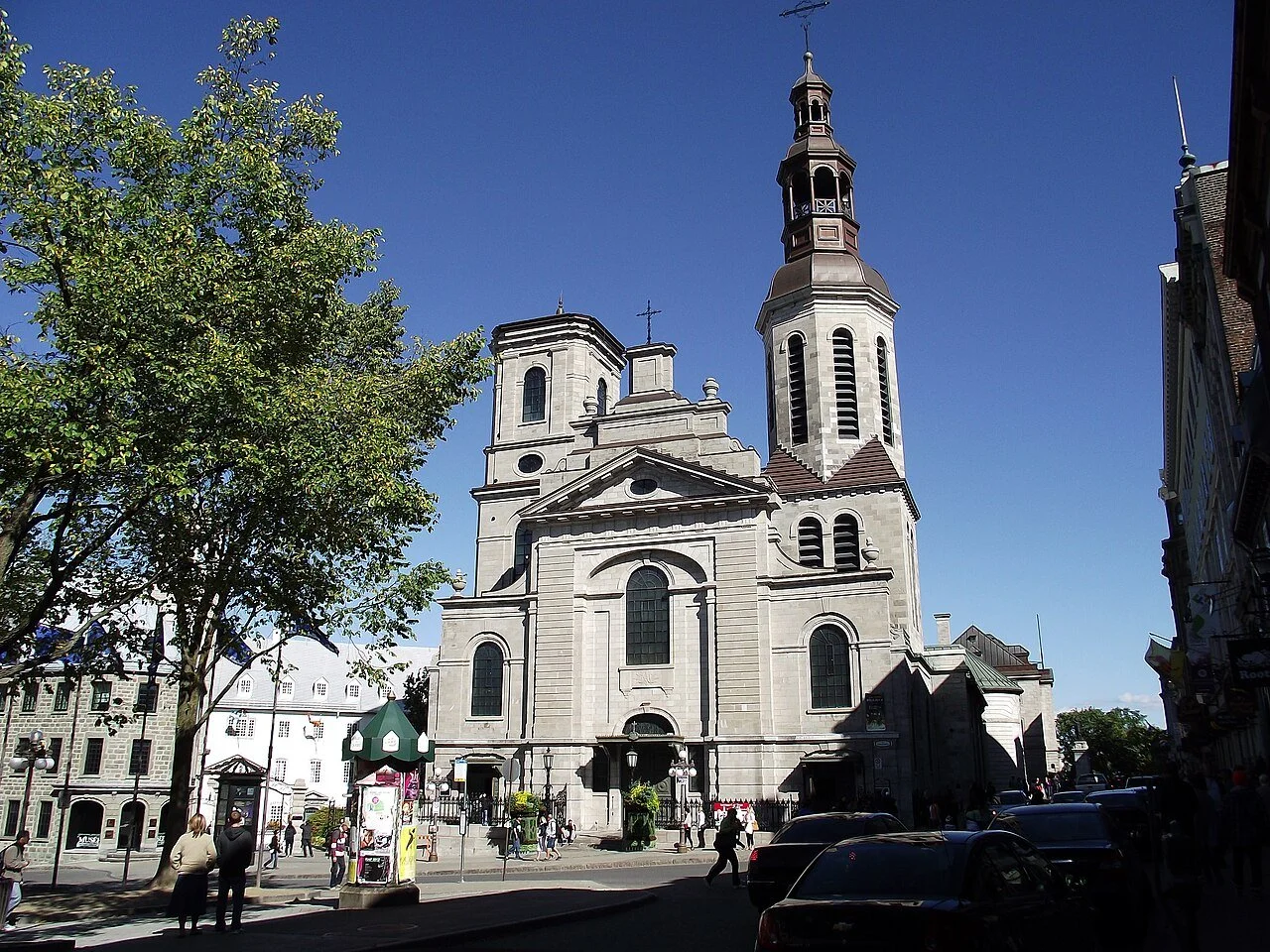
The Cathedral-Basilica of Notre-Dame de Québec today. The asymmetric façade — one shorter bell tower beside one taller — is the unmistakable signature of this building, rebuilt stone-by-stone after the catastrophic 1922 fire from old photographs and the original Baillairgé plans.
The cathedral-basilica at 16 rue de Buade in Upper Town Québec occupies ground that has held a stone parish church continuously since 1647. Samuel de Champlain had raised an earlier wooden chapel in Upper Town in 1633 — Notre-Dame de la Recouvrance, built to mark New France's recovery from British occupation — though its precise location is debated by scholars. When that chapel burned, the Jesuits built a new stone parish church in 1647 and named it Notre-Dame de la Paix. That building — modest, single-naved, with a small belfry — was the parish church of the entire colony when Marguerite Gaulin was married on 13 September 1654.
By the time her last child was baptized in 1671, the church was twenty-four years old and had just become the cathedral of an enormous new diocese stretching from the Atlantic coast to the headwaters of the Mississippi. By 1759, the building she had known would lie in ruins, gutted by British bombardment during the Siege of Québec. Rebuilt in 1766, refaced in 1843, destroyed by fire again in 1922, and resurrected over seven painstaking years between 1923 and 1930 — the church Marguerite knew exists today only in the foundations beneath the present floor and in the persistent gravitational pull of the site itself. The sacred place has not moved. The building has been born four times.
The Parish Church of 1647
Samuel de Champlain had built the earliest chapel in Upper Town in 1633, calling it Notre-Dame de la Recouvrance to mark the recovery of New France from the British occupation of 1629–1632. That wooden chapel burned within a decade, and its precise location — whether on the site now occupied by the cathedral or elsewhere in Upper Town — remains a matter of scholarly discussion. The Jesuits, who had assumed pastoral responsibility for the small colony, built a new stone parish church in 1647 on the corner of what is today rue de Buade and named it Notre-Dame de la Paix — Our Lady of Peace. This is the building whose foundations the current cathedral still partly rests upon, and this is the building Marguerite Gaulin would have known.
In September 1654 the church Marguerite entered as a bride was seven years old and modest by any standard. The colony of New France itself counted fewer than two thousand European inhabitants. There was no Bishop of Quebec yet — François de Laval would not arrive until 1659, and would not elevate the parish church to cathedral status until 1674. The priest who officiated at her marriage was almost certainly a Jesuit attached to the Quebec mission, or one of the small handful of secular priests then serving the colony.
The building had a single nave, a small choir, a modest belfry, and stone walls thick enough to do double duty as a fortification when needed. No gilded baroque interior; no carved canopy; no neoclassical façade. The grandeur that today's visitor associates with Notre-Dame de Québec is the work of the Baillairgé family, beginning more than a century after Marguerite's wedding.
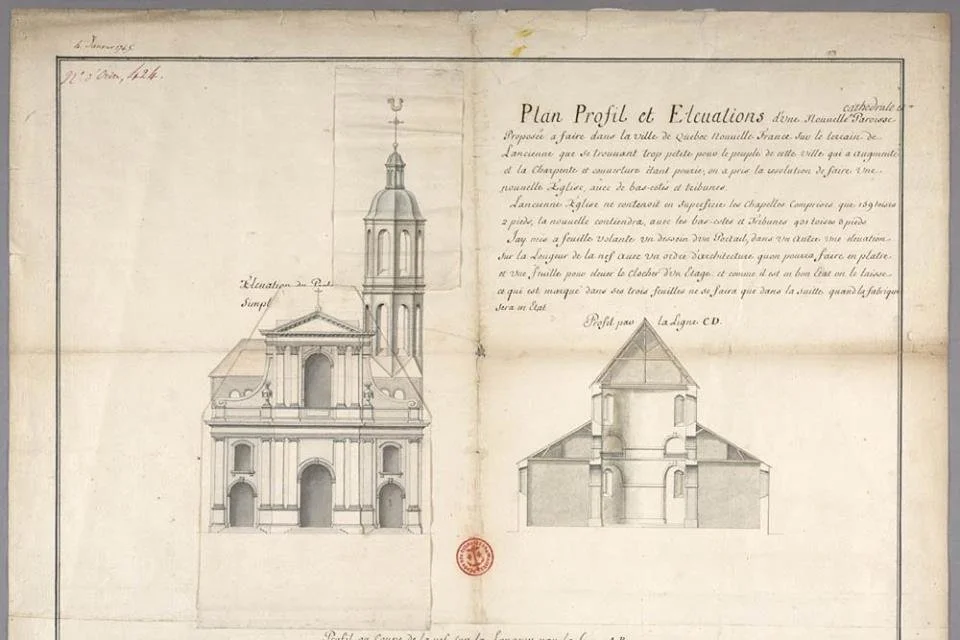
Architectural drawings from 1744, used during the reconstruction following the 1759 destruction of the church. The elevation at left shows the proposed bell tower and Neoclassical façade; the cross-section at right shows the nave profile. These plans — preserved through every subsequent rebuilding — are part of why the cathedral today still resembles, in its essential proportions, the structure Marguerite knew. (Archives de la Basilique-cathédrale Notre-Dame de Québec)
The Marriage of 13 September 1654
The PRDH file for Marie Marguerite Gaulin (record #36251) anchors the entire Creste–Gaulin lineage to a single date and a single church: 13 September 1654, Québec (Notre-Dame-de-Québec). Her parents are correctly named — Vincent Gaulin and Marie Bonnemer of the Perche — and her status is given as Immigrante. She arrived as one of the filles à marier, the cohort of young women recruited (in advance of the later, royally-sponsored filles du Roi program of 1663–1673) to balance the heavily male population of the early colony.
Marie Marguerite Gaulin
| Baptism | 14 May 1627 · Saint-Martin-du-Vieux-Bellême, Perche (diocese of Sées) |
| Father | Vincent Gaulin |
| Mother | Marie Bonnemer (deceased by 1654) |
| Colonial status | Immigrante (fille à marier) |
| First marriage | 13 September 1654 · Québec (Notre-Dame-de-Québec) · to Jean Creste |
| Death and burial | 15 January 1703 · Beauport (Nativité-de-Notre-Dame) |

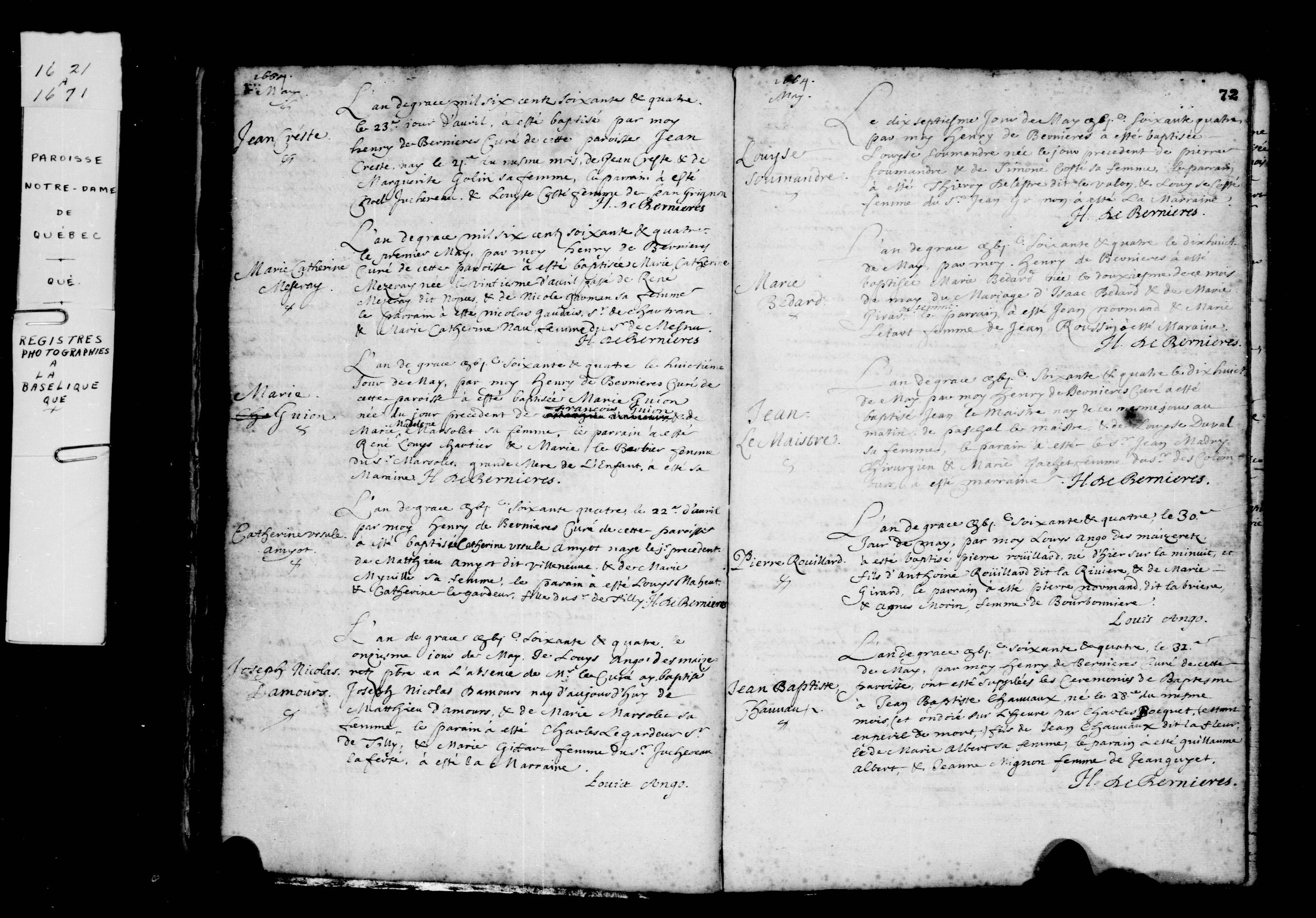
Register of Notre-Dame de Québec, 1621–1671 (page 121, September 1654). The Creste–Gaulin marriage entry, dated 13 September 1654, sits in the upper-right column. The register itself is the parish's official record of every sacrament celebrated within its jurisdiction — including those celebrated at outposts like Beauport, which had no register of its own until 1684. Registres photographiés à la Basilique de Québec.

Detail of the marriage entry, 13 September 1654. The critical passage reads "a solemnellement mariés en la maison du S. Giffard, en presence de tesmoins cogneus, le dit Sieur Giffard e le Sieur de la Ferté son gendre" — "solemnly married in the house of Sieur Giffard, in the presence of known witnesses, the said Sieur Giffard and Sieur de la Ferté his son-in-law." The officiating priest, named in the entry as le v.p. Paul Ragueneau, was Father Paul Ragueneau of the Society of Jesus — then superior of the Jesuit mission at Quebec.
Jean Creste & Marie Marguerite Gaulin
Location: Solemnized in the manor house of Sieur Robert Giffard at Beauport; entry recorded in the parish register of Notre-Dame de Québec (then the stone parish church of 1647, called Notre-Dame de la Paix — Beauport had no independent parish until 1684)
Officiant: The Rev. Paul Ragueneau, S.J., superior of the Jesuit mission at Quebec — famed for his account of the Huron missions and the 1649 martyrdoms of Brébeuf and Lalemant
Groom: Jean Creste, son of Antoine Creste (b. 1592 Saint-Aubin de Tourouvre) and the deceased Jeanne Legrand
Bride: Marie Marguerite Gaulin, age 27, of Saint-Martin-du-Vieux-Bellême, daughter of Vincent Gaulin and the deceased Marie Bonnemer
Status: Immigrante / fille à marier
Witnesses named in the register: Sieur Robert Giffard, seigneur of Beauport; Sieur de la Ferté (Charles Cadieu de Courville), his son-in-law; and others
The Surname in the Period Registers
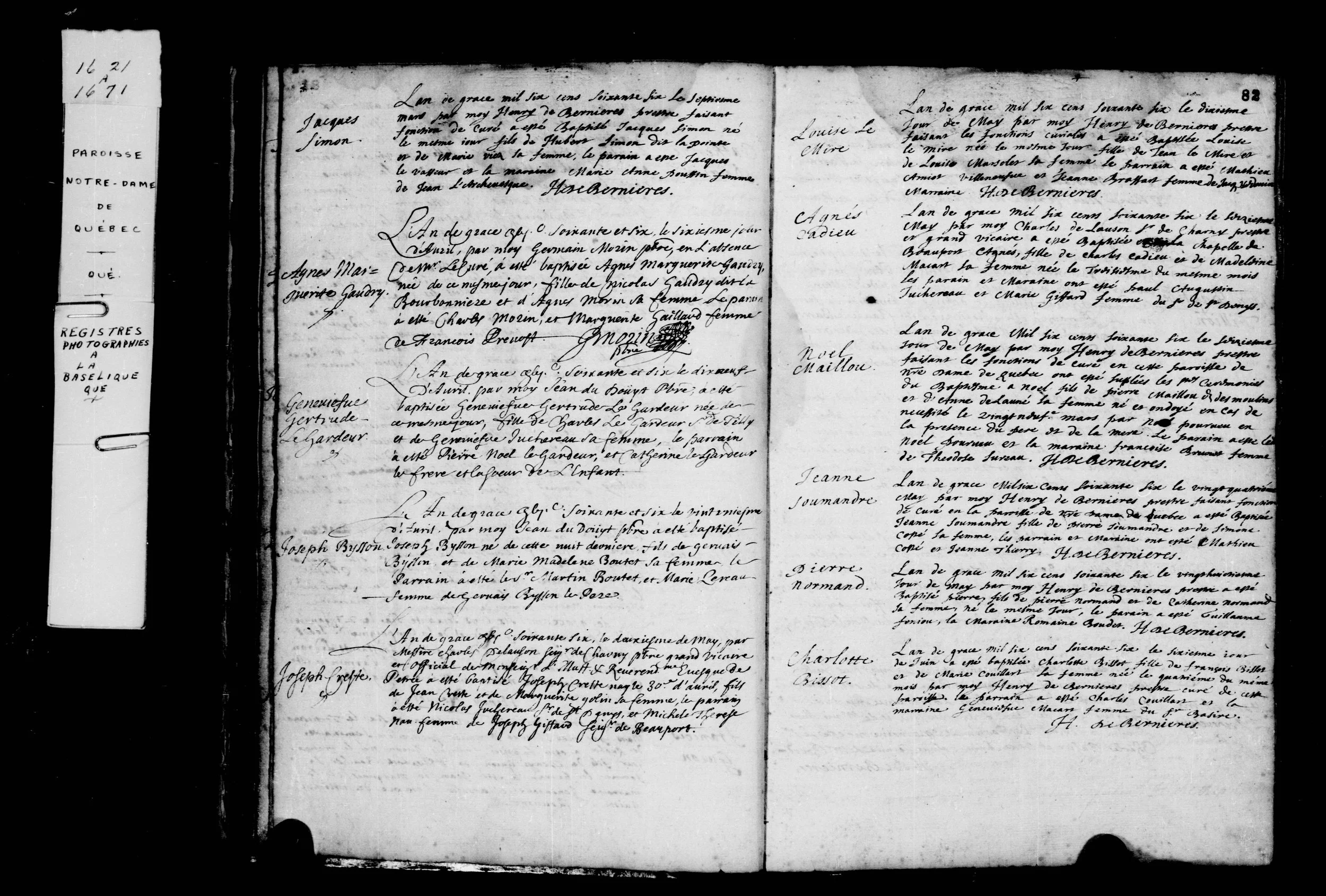
Across every Notre-Dame de Québec register entry — the 1663 baptism and burial of the infant Marguerite, the 1664 baptism of Jean, the 1666 baptism of Joseph, the 1668 baptism of Marie, the 1670 baptism of Louise at the Beauport chapel, the 1671 baptism of Pierre — the priest Henry de Bernières and his colleagues consistently wrote the family name as:
The modern French rendering Crête (with circumflex) reflects the standard early-modern French spelling evolution in which an internal 's' was replaced by an accent on the preceding vowel. The PRDH database renders it as Crete for ASCII searchability. All three forms refer to the same family. For period accuracy, this Sacred Places piece uses Creste throughout.
Ten Baptisms Across Seventeen Years
The same parish church witnessed every birth in the family. Between Louis's baptism on 6 May 1656 and Pierre's on 19 August 1671, Marguerite carried ten infants to the font of Notre-Dame de Québec. The officiating priests across the family's seventeen years at the font included Paul Ragueneau, S.J. (who had married the couple at Beauport in 1654), Henry de Bernières (later the first parish priest of Notre-Dame de Québec, arriving in the colony in 1657), and Charles de Lauzon de Charny, grand-vicar of Bishop Laval — a rotation of some of the most prominent clergy of early New France.
Jean Creste & Marie Marguerite Gaulin
| Marriage | 13 September 1654 · Québec (Notre-Dame-de-Québec) |
| Children | Ten baptisms across seventeen years, 1656–1671 (nine surviving infancy) |
| Parish pattern | Every baptism at Notre-Dame de Québec or its Beauport chapel-of-ease; most later marriages and burials at Beauport (Nativité-de-Notre-Dame, after 1684) |
| Residence | Beauport, seigneury of Robert Giffard |
By the late 1660s the Notre-Dame de Québec parish maintained a chapel-of-ease at Beauport, where many of Robert Giffard's seigneurial tenants lived. Several of the later Creste baptisms — Louise (1670), Pierre (1671) — took place at the Beauport chapel rather than at the mother church in Upper Town, with the entries copied into the Notre-Dame de Québec register. Beauport itself would not become a separate parish until 1684. For the family historian, this matters: the children of Jean Creste and Marguerite Gaulin appear in the Notre-Dame de Québec registers even when the actual baptism took place at the chapel of Beauport. A separate parish appears in the records only after Beauport's parish status was formalized.
A Mother's First Sorrow: April–May 1663
On the first of April 1663, Henry de Bernières — or more precisely his colleague, Charles de Lauzon de Charny, grand-vicar — baptized an infant girl born two days earlier to "Jean Creste et Marguerite Golin sa femme." The child received her mother's name: Marguerite. Her godparents were Pierre Soumandre and Marguerite Aubert, wife of Sieur Sillion. The entry sits about midway down the left-hand page of the 1663 register, written in the careful hand of the parish clerk.
Forty-six days later, on 16 May 1663, the same family returned to the same church to bury her. The PRDH burial record (#68946) preserves the facts: Marguerite Creste of Beauport, age one month, daughter of Jean Creste, habitant, of Beauport. The burial entry ends with a small but telling note from the register: "Le redacteur a omis de signer" — the priest who recorded this burial omitted to sign his own entry. Whether from haste, distraction, or the small everyday human failures that punctuate even sacred record-keeping, no signature seals the page beneath the child's name.
Marguerite Creste, infant
| Burial date | 16 May 1663 · Québec (Notre-Dame-de-Québec) |
| Age at death | One month |
| Father | Jean Creste, habitant, residence Beauport |
| Mother | Marie Marguerite Gaulin (named in the baptism entry of 1 April 1663) |
| Register note | "Le redacteur a omis de signer" — the officiating priest omitted his signature from the entry |
Marguerite Creste, infant
Age: One month
Father: Jean Creste, habitant, residence Beauport
Mother: Marie Marguerite Gaulin (named in the baptism entry of 1 April)
Place: Québec (Notre-Dame-de-Québec), arrondissement La Cité-Limoilou
From the Cathedral to Beauport: The Giffard Seigneury
The geography of the Creste–Gaulin family is precise. Marriage and baptisms anchor to Notre-Dame de Québec in Upper Town; the daily life of the family was lived a few kilometers east, on the seigneury of Beauport. The 1663 burial record fixes Jean Creste as an habitant (a censitaire, a tenant-farmer) of Beauport. Most of the children's later marriages and deaths take place at Beauport (Nativité-de-Notre-Dame) once Beauport became its own parish. Marguerite herself would die and be buried at Beauport on 15 January 1703, age seventy-five.
Robert Giffard de Moncel (c.1589–1668), born at Autheuil in the Perche, was an apothecary-surgeon who first crossed to New France in 1627. In 1634 he returned with a recruited contingent of settlers — most of them from the Perche region — to populate the seigneury he had received on the Côte de Beaupré, just east of Quebec City. This was Beauport. Over the following decades, Giffard's recruitment networks drew steadily on Percheron parishes — Tourouvre, Mortagne, Saint-Cosme-en-Vairais, Saint-Martin-du-Vieux-Bellême — pulling families across the Atlantic along lines of kinship and trust.
Marguerite arrived around 1654, two decades after Giffard's first contingent and well within the established Perche-to-Beauport migration corridor. There is no documentary evidence that she was personally recruited by Giffard, but the geography speaks: she and Jean settled on his seigneury and lived there for the remainder of their lives. The marriage at the cathedral parish in Upper Town and the daily life on the Côte de Beaupré reflect the standard pattern of seventeenth-century Quebec habitant life: sacramental life centered on the parish church; agricultural life centered on the seigneurial land.
Three Buildings, One Sacred Place
The church Marguerite knew burned in 1759 during the British shelling that preceded the fall of Quebec. The rebuilt church burned again in 1922. The current cathedral-basilica, completed in 1930, is the third major building on the site — but the foundations beneath it are partly those of the 1647 Jesuit church, and the layout, scale, and identity of the building have been preserved with extraordinary care across each rebuilding.

"View of the Market Place and Catholic Church, Uppertown, Quebec, 1832" — published by Adolphus Bourne, Montreal, after a drawing by R. A. Sproule. This is the cathedral in the form Marguerite's great-great-great-grandchildren would have known it: the 1766–1771 reconstruction by Jean Baillairgé, before Thomas Baillairgé designed the current neoclassical façade in 1843.
The interior that today's visitor encounters — gilded baroque, with the gold-leaf baldaquin floating above the choir like a small cathedral within the cathedral — is the work of three generations of the Baillairgé family across nearly a century (1786–1843), faithfully reconstructed after the 1922 fire using old photographs and original architectural plans. The sanctuary lamp hanging above the altar was a personal gift from King Louis XIV. The Holy Door installed in 2014 is one of only eight in the world and the only one outside Europe.

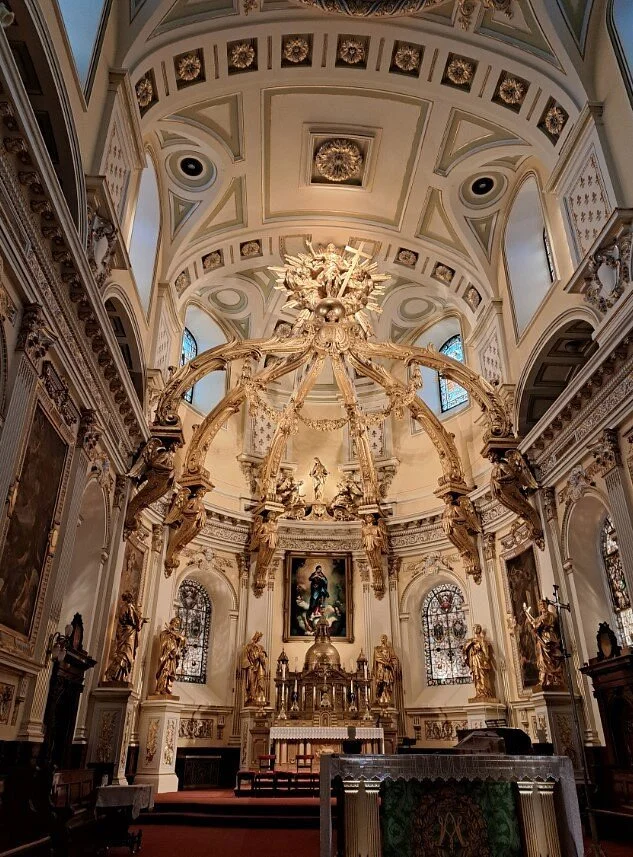
"Phoenix-like, it has risen from its ashes and continues to soar."
Timeline: The Cathedral Through the Centuries
Then & Now

Marguerite's Full Life — From Norman Priory to Beauport Grave
The marriage of 13 September 1654 is the central join in Marguerite Gaulin's life — the Atlantic crossing in one direction, four decades of life as Madame Creste on Robert Giffard's seigneury in the other. Her full biography traces every chapter; the case study lays out the BCG-style proof argument that links the Norman parish register to the Quebec marriage entry.
Visiting the Site
Address: 16, rue de Buade, Vieux-Québec (Upper Town), Québec, G1R 4A1, Canada
Open: Daily for visitors; remains an active parish church and the seat of the Archdiocese of Québec. Free admission; guided tours available in summer.
What to see: The gilded baroque interior reconstructed after the 1922 fire; the gold-leaf baldaquin; Louis XIV's sanctuary lamp; the Holy Door (one of eight in the world); and the crypt — final resting place of more than nine hundred individuals including François de Laval, four governors of New France, and pioneer families of the early colony.
Nearby: The Séminaire de Québec next door; Place d'Armes; the Château Frontenac; the Hôtel-Dieu (where Marie Françoise Creste died in 1702). Beauport itself is fifteen minutes east, where the family's daily life unfolded and where Marguerite is buried.
Document Gallery



Questions about your own research? Begin a research inquiry.
